
A Family Affair: Brothers Finish 1-2 at AMCC Championships and Win Top Honors

By Heather Cass, Publications Manager, Penn State Behrend
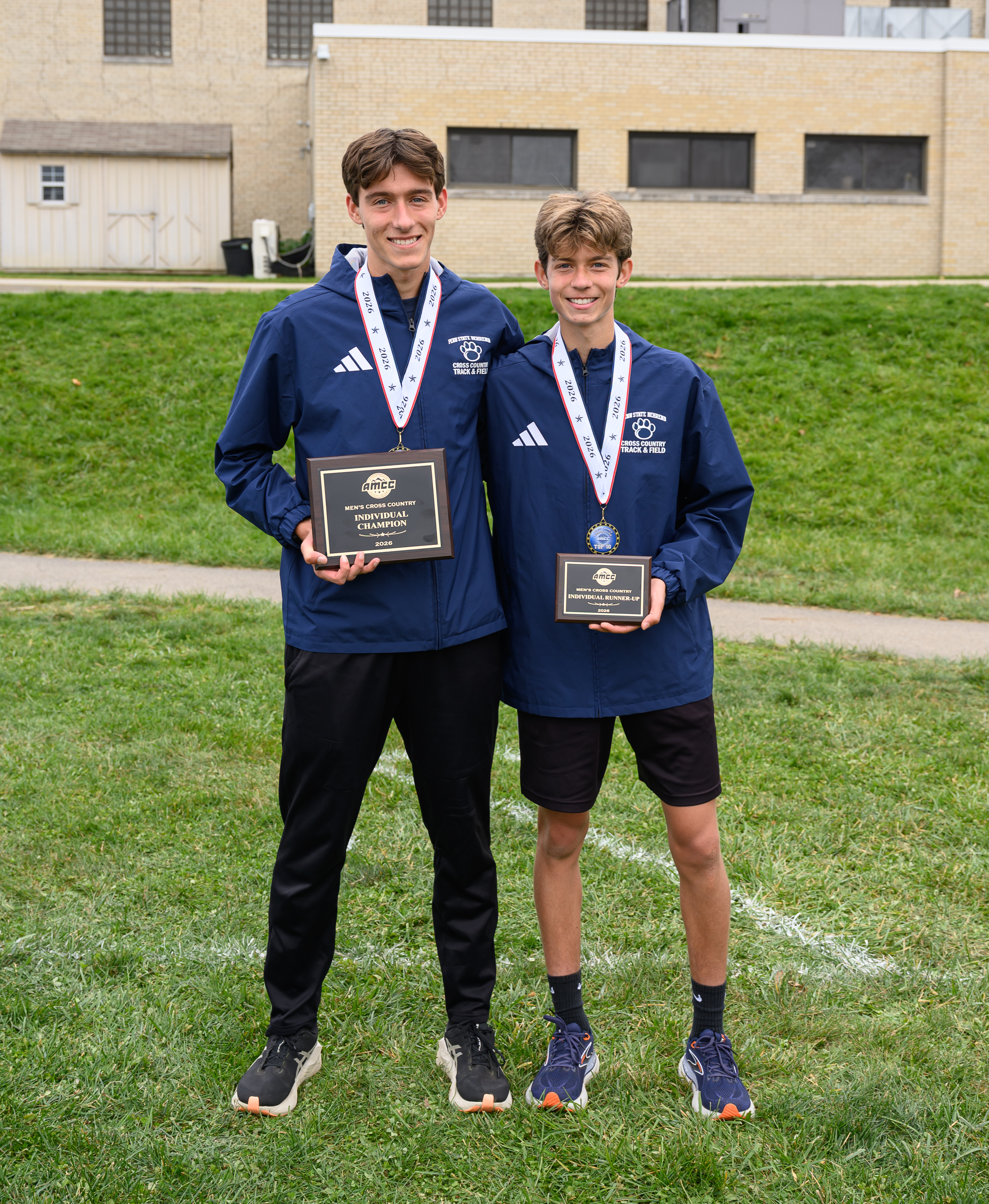
Peyton Brewer, left, and his brother, Quinn.

The top two finishers at the 2026 Allegheny Mountain Collegiate Conference men’s cross-country championships shared more than a blistering pace. They also share a last name.

Peyton Brewer, a senior mathematics major, and his younger brother, Quinn Brewer, a first-year industrial engineering major, finished first and second, leading Penn State Behrend to a seventh consecutive and eighteenth overall conference title.

Peyton claimed the individual title with a winning time of 26:33 over the 8K course. Quinn finished second, 23 seconds later, in 26:56.

The result was further proof that speed runs in the Brewer family. Their mother, Kathy Brewer, was an All-American collegiate runner and now coaches cross country at Harbor Creek High School. Their younger brother, Asher, is one of the region’s top high school distance runners, while their sister, Veronica, competes at the collegiate level.

The conference title added to an already impressive résumé for Peyton. Last year, he broke Behrend’s school record in the steeplechase, won the SUNYAC championship in the event, and earned a regional medal with a sixth-place finish against a field representing more than 100 NCAA programs.

“Peyton is really fast and strong,” said Greg Cooper, head cross-country coach. “He is also an incredible teammate and a great person to have on the team. We were happy to welcome his brother this year.”

Quinn has emerged as one of the Lions’ top performers in his debut season, culminating in his runner-up finish at the AMCC Championships. He said that having Peyton on the team has helped ease the transition to college competition.

“I enjoy having an older brother on the team because he has been able to help me figure out all the nuances and other things I need to know,” Quinn said. “He has made it a lot easier for me to transition to the new team.”

Despite growing up in a family of competitive runners, the brothers said they don’t spend much time discussing race strategy or training. Instead, they say that having a sibling on the roster provides a familiar presence and an additional layer of accountability throughout the season.

“We are competitive at races, but in training, I just try to encourage Quinn to stay consistent,” Peyton said. “Running has taught me that consistency pays off, and that I can push myself past anything I thought I was capable of.”

Their performances at the conference championships earned both brothers major postseason honors. Peyton was named the AMCC Runner of the Year, while Quinn was selected as the conference’s Newcomer of the Year.

It was a fitting end to Peyton’s cross-country career and a promising start to Quinn’s.

Whether the final Brewer brother joins the Lions one day remains to be seen, but it would seem to be destiny for Asher Behrend Brewer, who arrived in such a hurry that he was born in a car outside the college for which he was later named.
From Collapse to Comeback

Student athlete defies the odds, the surgeons, and expectations to run again

By Heather Cass, Publications Manager, Penn State Behrend

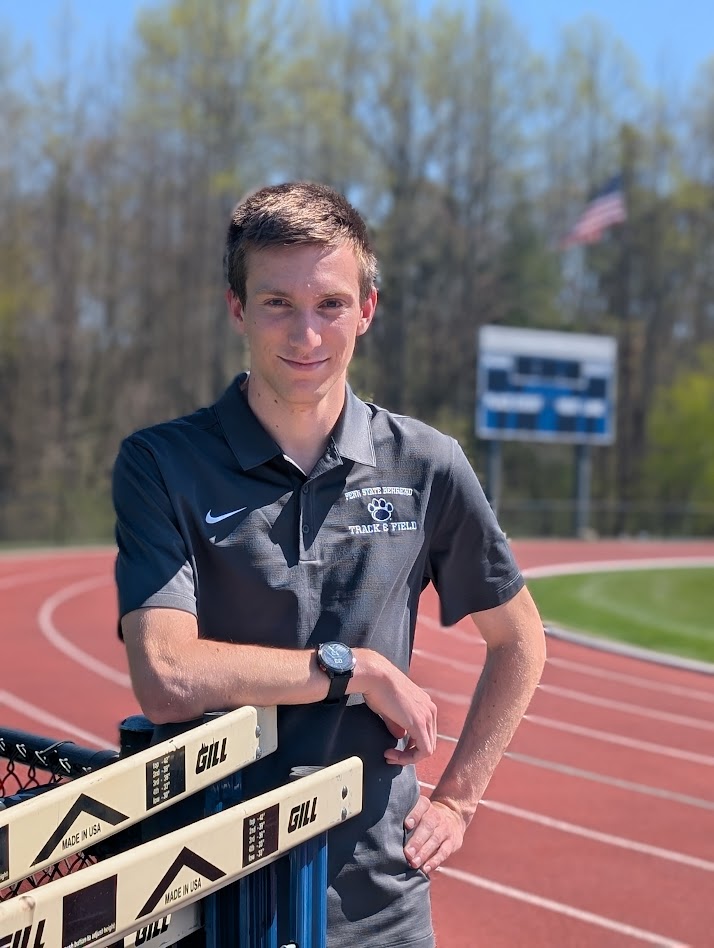
Aiden Seeman ’26

Aiden Seeman, a new graduate of the Mechanical Engineering program at Penn State Behrend and a member of the college’s track and cross-country teams, has been running since fifth grade. He is used to the ups and downs of the sport. You have good runs and bad runs.

But an unusually poor performance at a cross-country meet in Rochester, N.Y., in the fall of his junior year began to raise flags. His coach and athletic trainer thought maybe he was ill.

Seeman had been struggling with breathing, but otherwise felt fine, so he continued running.

“I was setting personal records in all of my events, so I wasn’t too worried,” he said.

But the breathing issue continued to plague him.  

“At the end of a race, my legs felt fine, but I just couldn’t catch my breath,” he said.

He was diagnosed with pneumonia. He treated it and kept running. When he was diagnosed with it again in the spring, he thought that things weren’t adding up. A follow-up X-ray suggested a collapsed lung.  

What followed was a series of tests, including CT scans and bronchoscopies — first in Erie, then in Pittsburgh. When the pulmonologist called Seeman personally to discuss the results, he knew it was probably not good news.

“She told me that they found something ‘concerning,’” he said.  

It was not a collapsed lung. He was diagnosed with an inflammatory myofibroblastic tumor, or IMT, an extremely rare mass in the lungs, most often found in children and young adults. Most of the doctors involved in his care had never seen one.

The news was shocking, but also strangely optimistic.

“I remember thinking: I’m young and fit. This is not something that should’ve happened to me,” he said. “But the good news is that this type of cancer is unlikely to metastasize. This is one of the best draws if you’re going to get cancer.” 

He was able to fit in one cross-country race with his team before he had surgery to remove the mass. Late last October, Pittsburgh surgeons worked to remove the mass. They expected to take 10 to 15 percent of his right lung. They took 40 to 45 percent.

“When they put me under for the surgery, I went under thinking I was going to be fine,” Seeman said. “When I woke up and I heard how much they had to take, I wasn’t so sure.”

Doctors were cautious about his recovery. Hopefully, he could work his way up to daily walks, they said. Running was unlikely.

He sat with that for two dark days. Then he decided that was enough.  

“No,” he said to himself. “I’m going to fight, and I’m going to run again. My goal was to put my track uniform on and compete with the team before I graduated.”

Eight days after surgery, he showed up and stood in the cold to support his teammates at the AMCC Cross Country Championships — not racing, just there.

A couple weeks later, he went on his first post-surgery run with his older sister. They ran a mile, walked for a bit, then ran a mile back. A 10-minute-mile pace, far off his usual 7:30.

“I’m not going to lie,” he said, “it sucked a lot, at first.”  

Through all of this, he maintained his academics, carrying 18 credits, making up all the work from two weeks of missed classes, a feat in itself.

By April, he was back on the track, competing in the 800 meters—the event he has always called his own. He is less than ten seconds off the personal record he set before he got sick. Sub-two minutes is the goal. He knows exactly how to get there.

“I benefit from knowing where I want to be and how to get there,” Seeman said. “And this whole experience has shown me what a goal and hard work can do.”

Greg Cooper, the head track and cross-country coach at Behrend, has watched all of it — the collapse, the diagnosis, the slow miles with his sister, and his comeback this spring.

“I am absolutely blown away,” Cooper said. “It’s hard for me to call it anything but miraculous. He would be quick to remind me he’s running seven seconds off his personal best. I would be quick to remind him he’s defied the odds and overcome more than any doctor told him he could.”

Seeman, graduated May 8, has a six-month follow up CT scan this month. He is looking forward to telling his surgeon that he’s racing again.

“Being able to run is so much more of a blessing than it ever was before,” he said. “I definitely appreciate running with the team more than I ever have. I don’t complain much anymore. Now, running is like an act of defiance.”