Software engineering faculty member says the future still belongs to people who know what they are building.
By Heather Cass, Publications Manager, Penn State Behrend
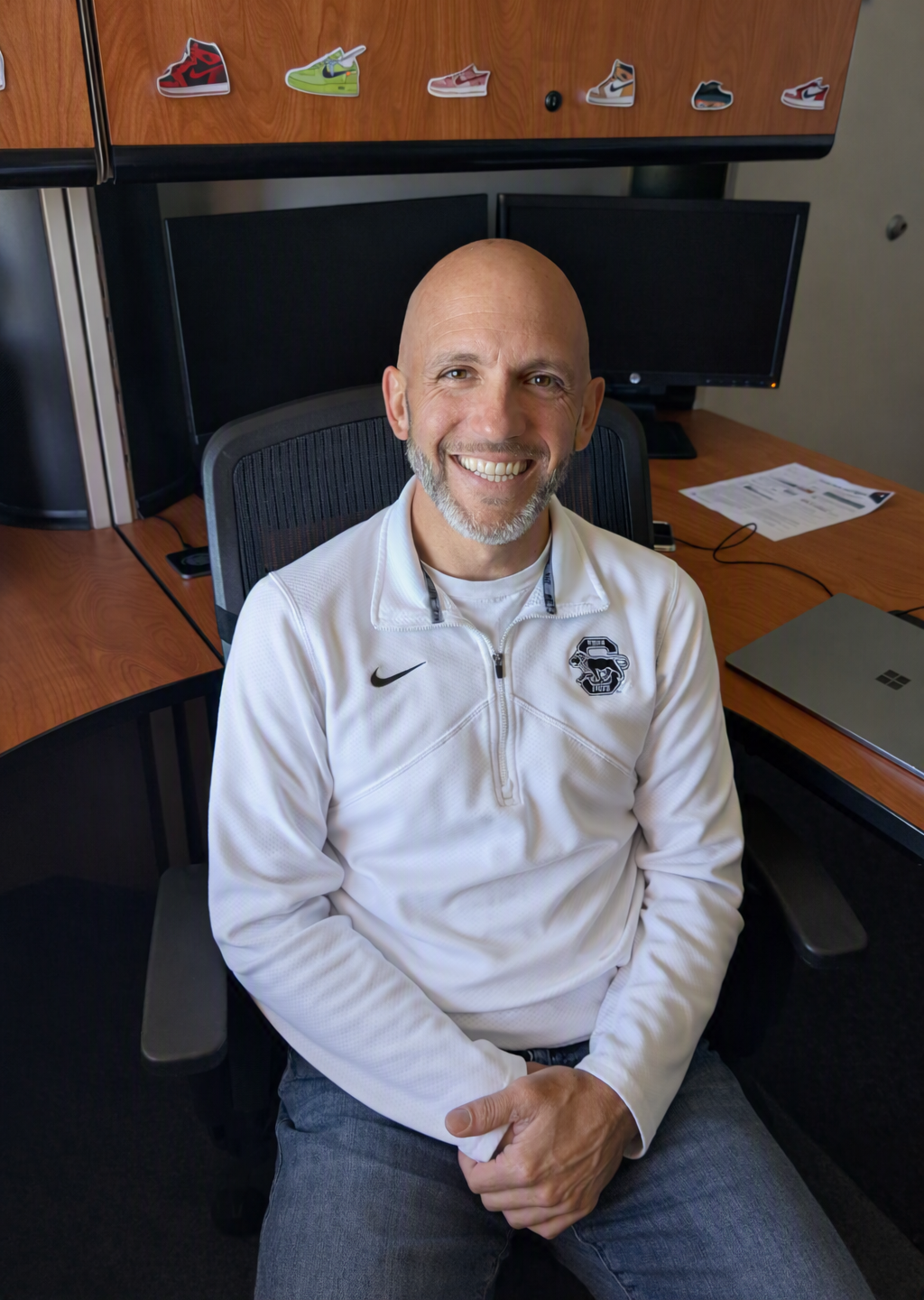
Russell Martin worked in the tech industry for twenty years before joining Penn State Behrend as an assistant teaching professor of computer science and software engineering. He’s watched multiple waves of technology reshape the field, from early automation tools to cloud adoption to mobile disruption. Artificial intelligence is the latest wave—and he isn’t losing sleep over it.
Behrend Blog sat down with Martin, who earned a bachelor’s degree in Management Information Systems in 2005 and an MBA in 2006, to talk about AI’s impact on the computer and software engineering field and how students can learn to use the technology without relying on it.
Q: A lot of students are worried AI will replace software engineers. Should they be?
Martin: No. I’ve been around long enough to see big shifts in technology. We adapt. What other choice is there?
There is software that’s fifty years old that we’re still using today because it’s good. AI isn’t going to come along and replace everything just because it’s the shiny new thing.
Companies will probably overreact—fire people, say they’re “moving to AI,” make shareholders happy—then they will realize it wasn’t as efficient or as good as they thought. They’ll hire people back. It will be a bit of a shell game. We’ve seen it before.
Q: So you don’t see AI as a threat to engineering jobs?
Martin: I see it as a tool. A powerful one, but still a tool. Students need to be smart users of it.
AI can make you more efficient. It can find problems faster. It can expose vulnerabilities that might have taken weeks, months or even years to find. Use that. But AI shouldn’t replace your own thinking.
Q: You’ve said there’s “no way to make anything AI‑proof.” What do you mean by that?
Martin: If a student wants to use AI, they’re going to use it. There’s no assignment I can write that magically prevents it. So instead of fighting it, I want to know how they’re using it. I want to see their prompts. I want to help them write better ones. I want them to be smart users of the technology, not pretend it doesn’t exist.
Q: How do you teach students to use AI responsibly?
Martin: Fundamentals first. You need to understand what you’re building before you let AI help you build it. Otherwise, it becomes a crutch.
I tell students: AI is a resource. It’s there. Why wouldn’t you use it? But use it ethically. Use it efficiently. Use it in a way that makes you better at doing your job.
Q: You spent more than twenty years in industry before teaching. How does that shape your view of AI?
Martin: In industry, your job as a software engineer has always been to automate your job out of existence. That’s not new. What’s new with AI is the speed at which it’s moving. AI might accelerate some changes—things that once took much longer could happen in three to five months. But the pattern is the same: technology changes, and people adapt.
I’ve worked in small businesses, medium companies, and large corporations. I’ve seen tools come and go. Information technology people are notorious for marketing the next big thing without fully validating it. We always say, “This is it.” Then it changes again. Will AI cause a massive shift? It already has. But where it finally settles—only time will tell.
Q: How does AI show up in your classroom?
Martin: In project‑based courses, students build something real — a business plan, a product, the code, the review. I throw curveballs at them like a business owner would. AI fits naturally into that. It’s another tool they can use to solve problems, find problems faster and learn.
Students can embrace AI without cheating. They can use it to learn. They can use it to experiment. They just need to understand what they’re doing.

