Behrend Machinists Build More Than Parts

By Heather Cass, Publications Manager, Penn State Behrend

Chris, left, and Andy Bartlett

The School of Engineering’s annual Fasenmeyer Design Conference is a big day for senior engineering student, the culmination of a two-semester capstone project. Faculty, industry sponsors, family, and friends fill the presentation rooms. Students wear suits and aim to impress.

So, when one team’s project literally fell apart outside the classroom minutes before their presentation, you can imagine the panic it induced. The project, months of work, lay in pieces.

Then Chris and Andy Bartlett arrived.

With tools in hand, Penn State Behrend’s resident machinists and problem-solvers dropped to their knees beside the students.

“It was like a NASCAR pit crew in the hallway,” Chris recalls with a laugh.

They got it working. The students presented. The project succeeded.

It’s exactly the kind of moment Chris and Andy relish and show up for—even when they don’t have to.

“They don’t have to come in over the weekends to machine parts for the Society of Automotive Engineers (SAE) club’s competition car the week before our competition,” said Hunter Kamensky, a senior Mechanical Engineering Technology major and a member of the club’s executive board. “They didn’t have to become Environmental Health and Safety coordinators of the SAE/Robotics Lab to ensure our safety, and they didn’t have to come to the SAE club’s car-testing day at Lake Erie Speedway to show their support, but they did. They care about students.”

Chris has been at Behrend for five years; Andy, his uncle, for three. Combined, they bring sixty years of tool-and-die industry experience to the School of Engineering.

They also bring a willingness to show up, say yes, and help students turn drawings into reality.

We sat down with Chris and Andy to talk about their work, why manufacturing matters, and what they hope students learn from them.

For someone unfamiliar with machining, how would you describe what you do here day-to-day?

Chris: We make things the engineering students and faculty design.

Andy:  We try to help them succeed by giving them the best approaches and let them know when something is not feasible. 3D printing is cool, but it’s fictitious. You can design and build parts with a 3D printer that won’t hold up in the real world.

What kinds of projects do you most often help with? Do any stand out as especially challenging?

Chris: We help with research projects, molds for the Plastics Engineering Technology program, welding, fabrication, capstone projects, and student clubs. We’re big supporters of the clubs because students learn a lot tinkering and working on side projects.

Andy: One of the most challenging projects we work on every year is the Cast in Steel capstone project, where students design and build functional replicas of traditionally forged items using modern steel casting. It’s reverse engineering. You basically have to work backward to create the piece. It’s technical, hands-on, and really fun.

When a student brings you a design that isn’t quite manufacturable, how do you handle it?

Chris: We can usually tell just by looking at plans what will work and what won’t. We mark it up, make suggestions, and show them the empirical data on what they are trying to do and why they need to revise.

Andy: Students do challenge us sometimes. We allow them to think it through or even try it, unless it’s going to be catastrophic. Failure teaches more than success.

The difference for us, having worked years in industry, is that we know manufacturing is inherently challenging. But in the shop, where they’re making a profit, everything has to be perfect. Failure is not something they embrace. The education environment is quite the opposite—we let them think through a bad idea. Then they really understand it.

What do engineering students learn in the shop that they can’t learn in a classroom?

Andy: In manufacturing, you learn that there are things that can be perfect in theory but impractical in real life. Tolerancing is a concept that clicks in the machine shop. The weight of materials and size of parts matter. Plastic is light, steel is very heavy. The physical reality matters.

Chris: Before they get to the machine shop, they’re working on fundamentals and hypotheticals. It’s all theoretical in the classroom, but when they see it, they really get it.

Andy: We have a dozen MET students, mostly seniors, who work with us on a weekly basis now. We wish we could get them in the shop in their first year. It would aid everything they’re learning in the classroom.

Can you share a memorable moment working with students?

Chris: That hallway moment with the senior design team—the NASCAR pit crew moment—that’s one.

Andy: Attending the SAE vehicle club’s training sessions at Lake Erie Speedway. We were testing on the track, doing modifications right there. We try to teach students to stay calm, even when things fall apart—because they will. You can’t be in a panic and do good engineering work.

How does your industry experience influence how you teach and support students?

Andy: At 22, young people tend to think they know everything, but I tell them when they get their first job, try to find a guy who is 50 or 55 and learn as much as you can from him. Those guys have real-world experience. You can learn a lot from them.

We also tell them to work on their interpersonal and teamwork skills, and we just try to instill the reality that manufacturing is hard work, and they will have mundane days. That’s just life.

Chris: We also encourage internships. That real-world experience is invaluable. They’re getting an excellent education at Penn State Behrend, but that physical contact with manufacturing matters.

Safety regulations limit the students’ access to the shop. How have you tried to help maintain hands-on opportunities?

Andy:  We started to think about ways that we could legally allow students to work in the shop and have been making some headway. There’s a danger factor. We have limitations we have to work with. There’s a lot of training involved.

We’re very involved in America’s Cutting Edge (ACE), which offers hands-on CNC training at Behrend for students over sixteen. It’s ideal for those who are interested in exploring engineering, manufacturing, or hands-on technical careers.

Chris: ACE gave us the ability to get mechanical engineers on the floor for a forty-hour boot camp. They construct an air engine. In total, we’ve had about sixty students take part in the boot camps.

Andy: We also offer support for the METAL program—a four-day hands-on training experience in casting and forging. The goal of these programs is to get young people involved in manufacturing. The next round of skilled manufacturing workers are being developed here.

There are camps scheduled for spring break and right after the semester ends, in May.

What’s the most rewarding part of your job?

Chris: Working with students. Teaching them what I love to do.

Andy: I love it when a student has that lightbulb moment. When they think…“Now that thing I learned in class a year ago makes sense.”

We also love that Behrend emphasizes hands-on experiences. We hear back from friends in the field that Behrend students stand out on the manufacturing floors. One told us: “If I go into a shop and I see a student or young employee who is really sharp, I ask where they go to school—it’s almost always Behrend.”

What do you hope students carry with them from their time working with you?

Andy: We talk about life a lot. We tell them: The most stressful jobs make the most money. What is your life worth to you? How important is that money? Consider if you want to walk that walk.

Chris: We want them to understand that this is real. This is how things are made. This is how you solve problems. And we want them to know they can do it.

Andy: Manufacturing is such a noble thing. Man is meant to make things.

Infinite Lizards, Infinite Beauty

Math and art converge in Behrend’s growing “geometry gallery”

By Heather Cass, Publications Manager, Penn State Behrend

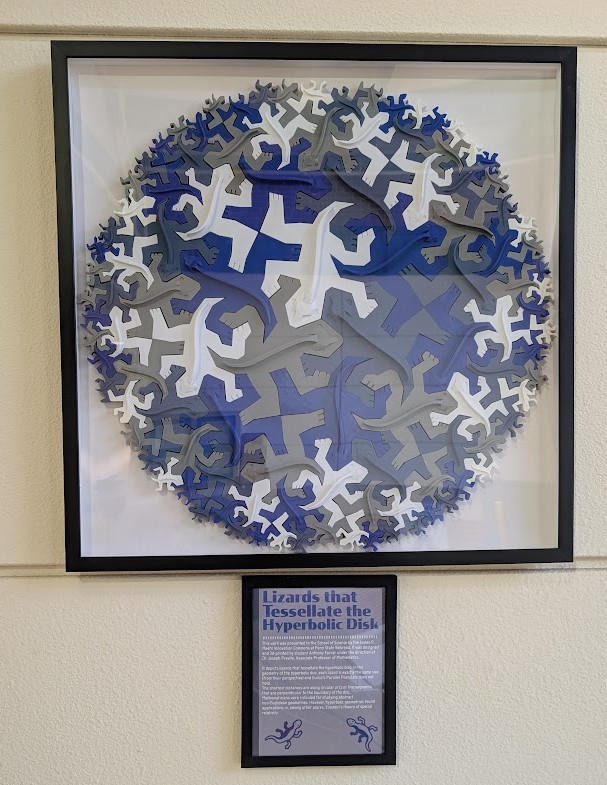
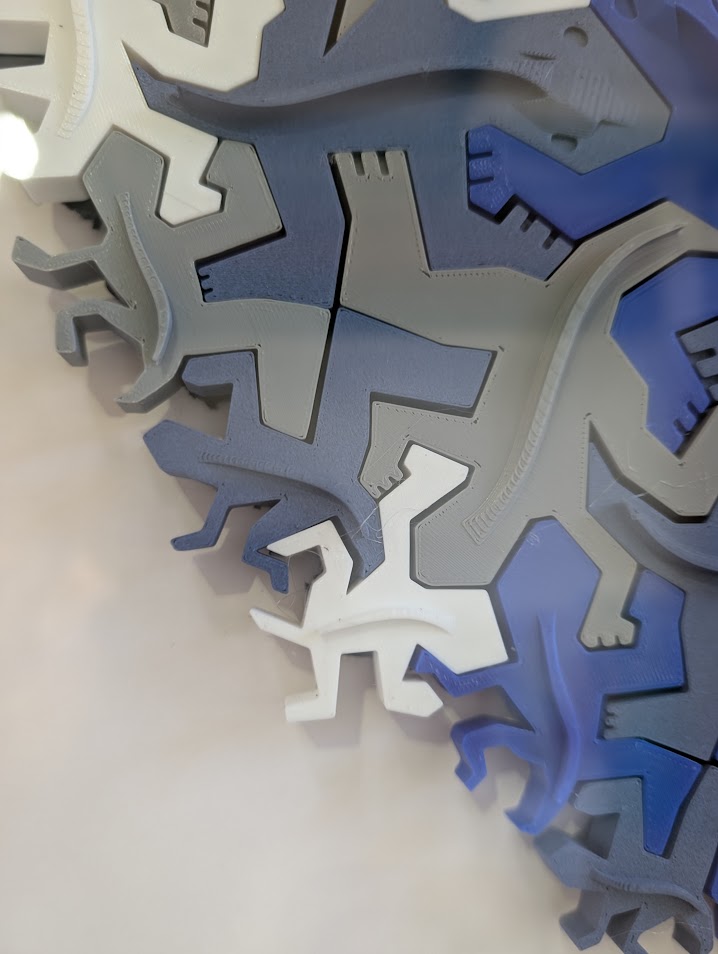
Math isn’t always numbers on a chalkboard. Sometimes it’s a work of art—a swirl of repeating lizards, 3-D printed in Penn State blue and white, then installed in a building where math, art, and science intersect. The lizards blend together in a hypnotic pattern, each appearing to shrink as it spirals toward infinity.  

The piece, Lizards that Tessellate the Hyperbolic Disk, was imagined by Dr. Joseph Previte, professor of mathematics, who wanted to capture the beauty of mathematics in a form anyone could see.

He took the design to the James R. Meehl Innovation Commons, the college’s open ideation lab, where engineering students Anthony Farrar and Quinlan Barnes transformed Previte’s concept into reality with 3-D-printed tiles and a sharp eye for symmetry.

The result is art born from math—or perhaps math revealed as art.

Dutch artist M.C. Escher showed the world that geometry could be beautiful with his mesmerizing tessellations and optical illusions, where patterns unfolded in ways both precise and poetic.

“For centuries, mathematicians questioned the value of studying this type of geometry, dismissed it as impractical and useless, with no relation to reality,” Previte said. “But it later proved essential to modern science, including helping Einstein describe how time and space work in his theory of relativity.”

While some mathematicians ridiculed the study of abstract math, others reveled in it. English mathematician G.H. Hardy argued that mathematics was a pure art form, divorced from practicality—something he took great pride in. Hardy’s theories later laid the groundwork for encryption, proving that beauty and utility often travel together.

That same tension—between abstraction and application, imagination and reality—now hangs on the wall at Behrend.  

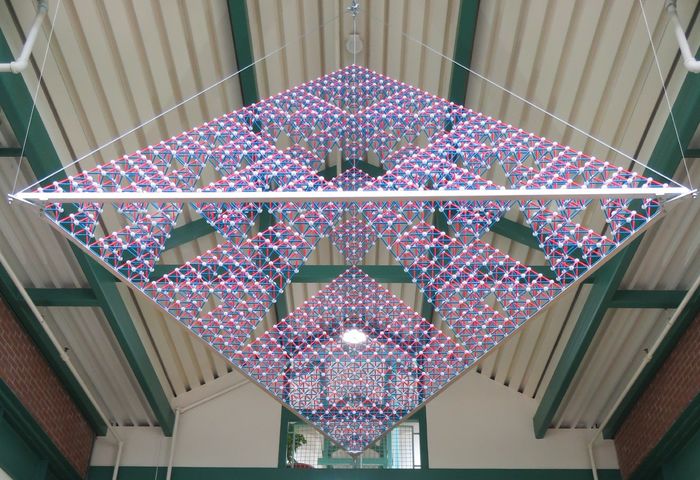
Lizards that Tessellate the Hyperbolic Disk joins an existing sculpture, Math in Flight, a stage-5 Sierpinski tetrahedron, a fractal shape featuring a pattern of infinite triangles, that hangs high above the entrance to Roche Hall in the Science Complex.  

Math Club students built the sculpture using Zometool construction parts. It consists of 2,050 white balls and 6,144 red-and-blue struts.

Previte has plans to continue adding to the mathematics art gallery.

“I’d like to do the Platonic solids next,” he said. “I am currently looking for a student in Innovation Commons to make that project a reality.”

You’re Invited to a Tree Hunt

By Heather Cass, Publications Manager, Penn State Behrend

When’s the last time you really looked at a tree? Not through a windshield or a window and not while scrolling past a picture on social media but standing right in front of it. The 2025 Erie County Tree Scavenger Hunt invites you to do just that.

The hunt—a free, self-guided activity created by the Penn State Master Gardeners of Erie County—is your invitation to step outside, slow down, and discover eighteen remarkable trees growing in the region.

“We want to encourage people to get out of their houses and cars and explore Erie County,” said Lisa Rand, coordinator of the project. “When you’re standing in front of a tree, you notice things you can’t get from a website or a drive-by. You can study its shape, feel the texture of its bark, and catch the scent of its leaves or needles.”

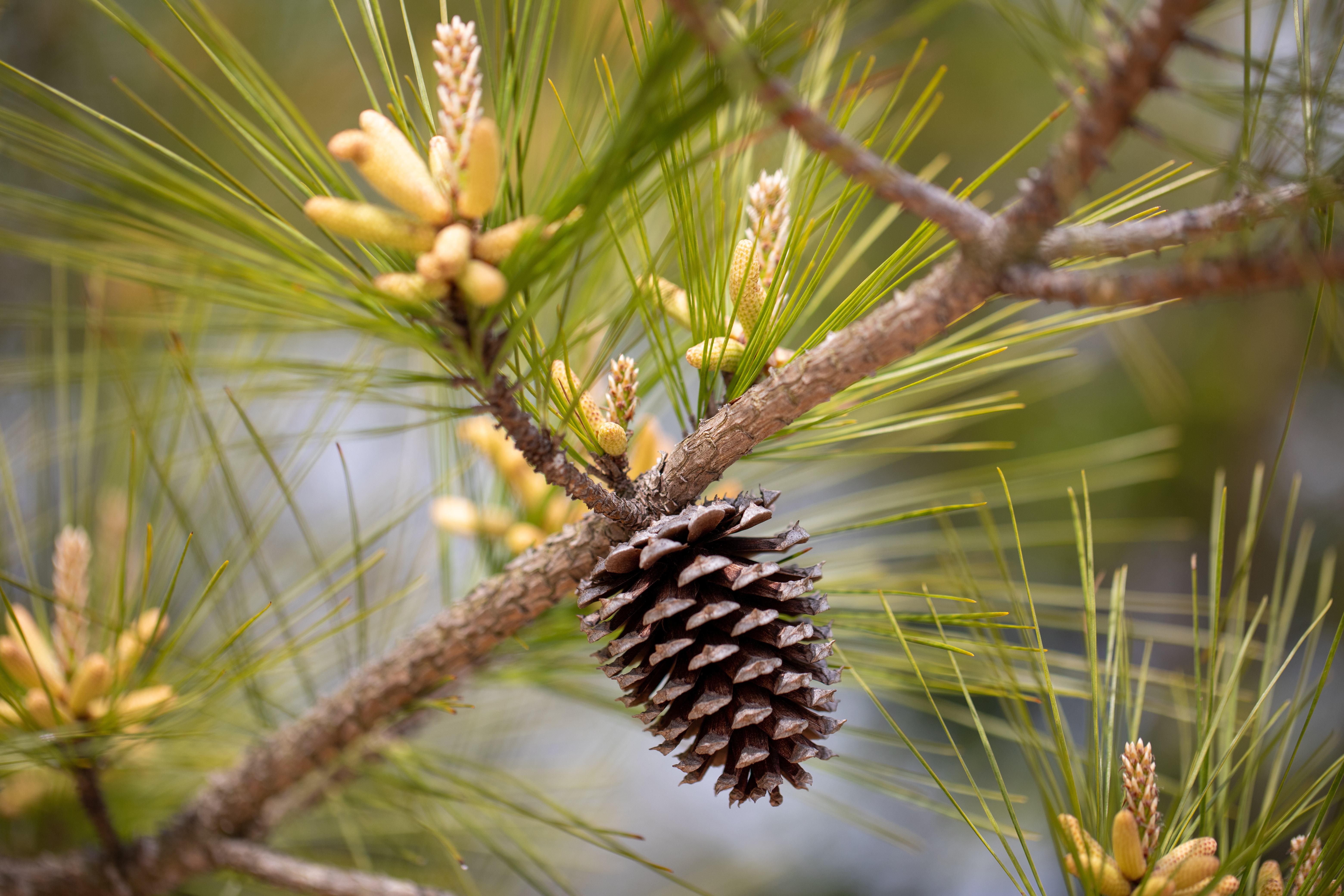
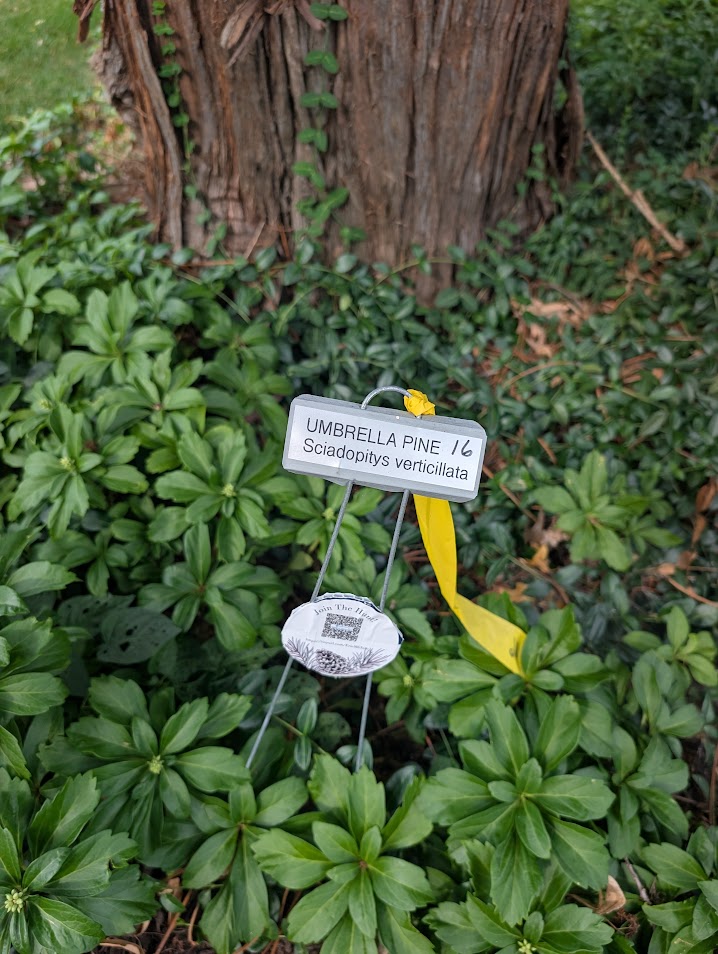
This year’s hunt focuses on conifers (cone-bearing trees) with eighteen “remarkable” specimens to find. All are located on public land or in places that welcome visitors, like Penn State Behrend, which is an official arboretum and home to more than 200 unique tree species.

What makes a tree remarkable?

“They’re all special for some reason—be it form, location, or historical significance,” Rand said. “The guide explains why each tree is significant.”

The scavenger hunt runs through October 1 and is open to anyone curious enough to lace up their shoes and start exploring. It’s part outdoor challenge, part botany lesson, and part treasure hunt—all rolled into one.

How to Play
Use the digital Tree Hunt Guide, filled with clues to locate specially tagged trees across the county. At each stop, you’ll find a metal ID tag with a number. Find at least ten trees, log their numbers using the yellow links in the guide, and you’ll be entered in a prize drawing to win—what else?—a live tree.  

It’s an easy, low-pressure way to spend time outdoors, learn about native trees, and maybe even discover a new favorite park or trail.

One past participant told Rand she and her mother found every tree in a previous hunt and couldn’t wait to do it again.

“It’s something they could enjoy doing together,” Rand said.

Note to college students: This also makes a fun—and free—date idea, and a nice break from hitting the books. Hint: One of the trees is right here at Behrend.

P.S. Want to go old school? A printable guide is available here.


Behrend’s Own “Ready Player One”

By Heather Cass, Publications Manager, Penn State Behrend

This spring, several staff and faculty members recommended Remington Orange, above, a Digital Media, Arts, and Technology (DIGIT) major, for an annual feature on the Behrend Blog that highlights graduating students.

There was just one problem: Orange was a junior.

Their mistake is understandable. In just three years, Orange, an immersive administrator in the college’s Virtual/Augmented Reality (VAR) Lab, has left his mark on campus—literally. From 3D scanning equipment and building video game consoles in the VAR Lab to creating 360-degree virtual tours for industry partners, Orange’s work can be seen all over Behrend.

“He oversees several of the undergraduate employees in the lab, working with them across a half dozen or more projects, helping them to achieve their own goals,” said Dr. Chris Shelton, associate professor of psychology and director of the VAR Lab. “He goes out of his way to learn and help others who are trying new techniques in the lab, while also improving the atmosphere with his positive attitude and calm demeanor.”

Orange is also collaborating with Jane Ingold, reference and instruction librarian and Behrend’s archivist, to digitally preserve college artifacts as part of his Schreyer Honors College thesis project.

“He is so engaged and is a real champion of Behrend history through the preservation work that he’s doing,” Ingold said. “This spring, he did 3D scans of Ernst Behrend’s old steamer trunk, the bust of Moritz Behrend’s head, and Bruno’s headstone.”

Behrend Blog caught up with Orange before he returned home to New Bethlehem for the summer.

How did you get involved in the VAR Lab?
I met another student, Marcus Jacobs (a ’22 Business Economics and International Business grad), who worked there, and he roped me in. I was interested in what they were doing in the lab. Now I do a lot of the project managing. I joke that I’m Marcus 2.0.

What are some projects you’ve worked on?
Most recently, I helped create a 360-degree virtual tour for Snap-tite, an Erie company, and I’m working on the Echoes of HistERIE project—scanning historical sites and artifacts like the Presque Isle Lighthouse. If something ever happens to these places, at least we’d still have them digitally.

We heard you built a turntable to help scan people in 3D?
Yes! It’s hard to do 360-degree scans of people while lugging around the camera and cables, so it’s easier if the person rotates on a platform while the camera stays put. You can buy turntables like this, but my true gumption is being frugal—so I wanted to build one. My dad and I used the motor from a pig roaster, since it offers a slow, strong spin. It turned out great.

You also created an augmented reality sandbox. Tell us about that.
It’s an interactive display that lets users shape and manipulate 3D topographic maps in real time. A 3D camera senses the shape of the sand, and a projector overlays a topographic map onto it. You can build mountains and valleys right in front of you. Again, you can buy these, but we made ours out of plywood and an old projector.

And the VARcade?
That’s an arcade machine I built from an old kitchen cabinet. It runs classic games and also gives students a platform to test new games they create in computer science or game design classes.

You sound like an engineer. Why did you choose DIGIT?
DIGIT is the best of both worlds. I get to work with emerging technology but in a more creative or artsy way. I like 3D modeling, photography, making movies, and videogames. I’m also minoring in game development.

What are some practical uses for VR and 3D images?
A lot of people think VR is just for video games, but it has serious real-world uses—training simulations, for instance, where it’s safer to make mistakes. It’s also great for exposure therapy for phobias and PTSD. And 3D tours can give people a sense of what a place looks and feels like without needing to physically go there.

What motivates you?
My faith—especially Jeremiah 29:11: “I know the plans I have for you, declares the Lord, plans to prosper you and not to harm you, plans to give you hope and a future.”

What are you looking forward to when you return in August?
My Schreyer thesis project, which is a continuation of the work I do in the lab. I’ll be using different scanners on various artifacts to find the most efficient methods for digital preservation. And I’m excited to see what else comes my way in the VAR Lab. I’m up for anything. 

Masterpieces, Meet the iPhone: Art History Gets a Makeover

By Heather Cass, Publications Manager, Penn State Behrend

This spring, students in Dr. Matthew Levy’s AMST 307N: American Art and Society course at Penn State Behrend engaged in a unique interdisciplinary project that blended historical analysis with creative expression. As part of the course, students worked in groups to create tableaux vivants—or “living pictures”—that reenact and recontextualize iconic works of American art that were discussed in class.

Not only did students have to study the formal and thematic elements of a chosen painting, but they also had to consider its relevance to contemporary social and cultural issues.

“Working in groups, they researched their chosen work, gaining a deeper understanding of the social issues it represented,” said Levy, associate professor of art history, music, theatre, and visual arts.

Each group then reimagined their selected artwork for a 21st-century context, using modern props, settings, and interpretations to bridge the past and the present.

“They had to think carefully about props, poses, setting, framing, and more to bring the work of art into modern times,” Levy explained.

Here are several standout projects from the class, along with insights from Levy on what made each piece compelling.

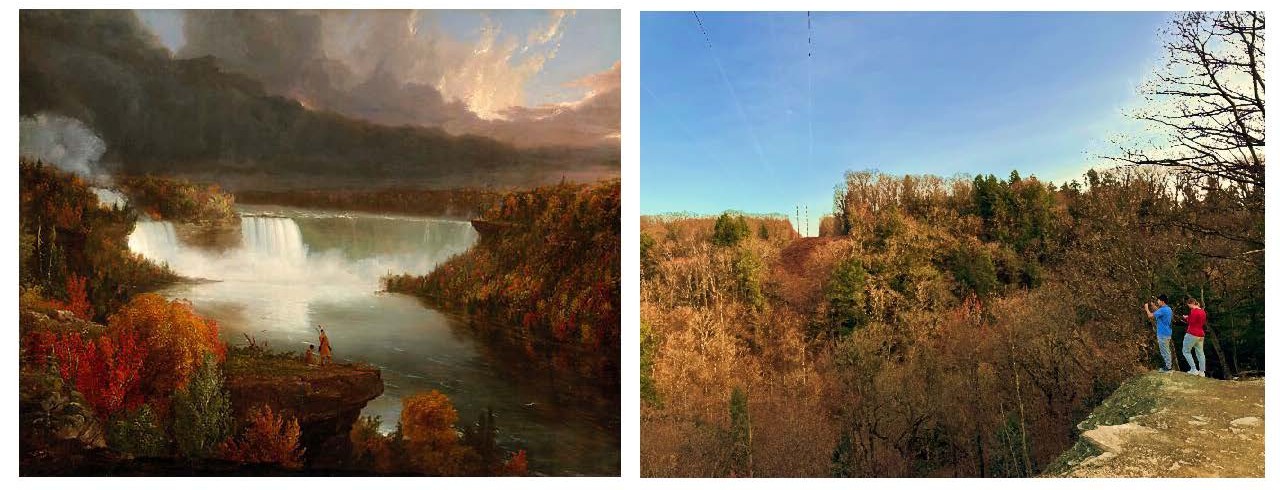
Distant View of Niagara Falls by Thomas Cole: “Where Cole’s view of Niagara Falls depicts the untouched majesty of the falls (represented both by the landscape and the presence of the Native Americans living at one with nature), the students depicted a domesticated and technologized landscape. Using the Wintergreen Gorge as their setting, they drew attention to the power lines, nature trail, and the use of phones to mediate our experience with nature.”

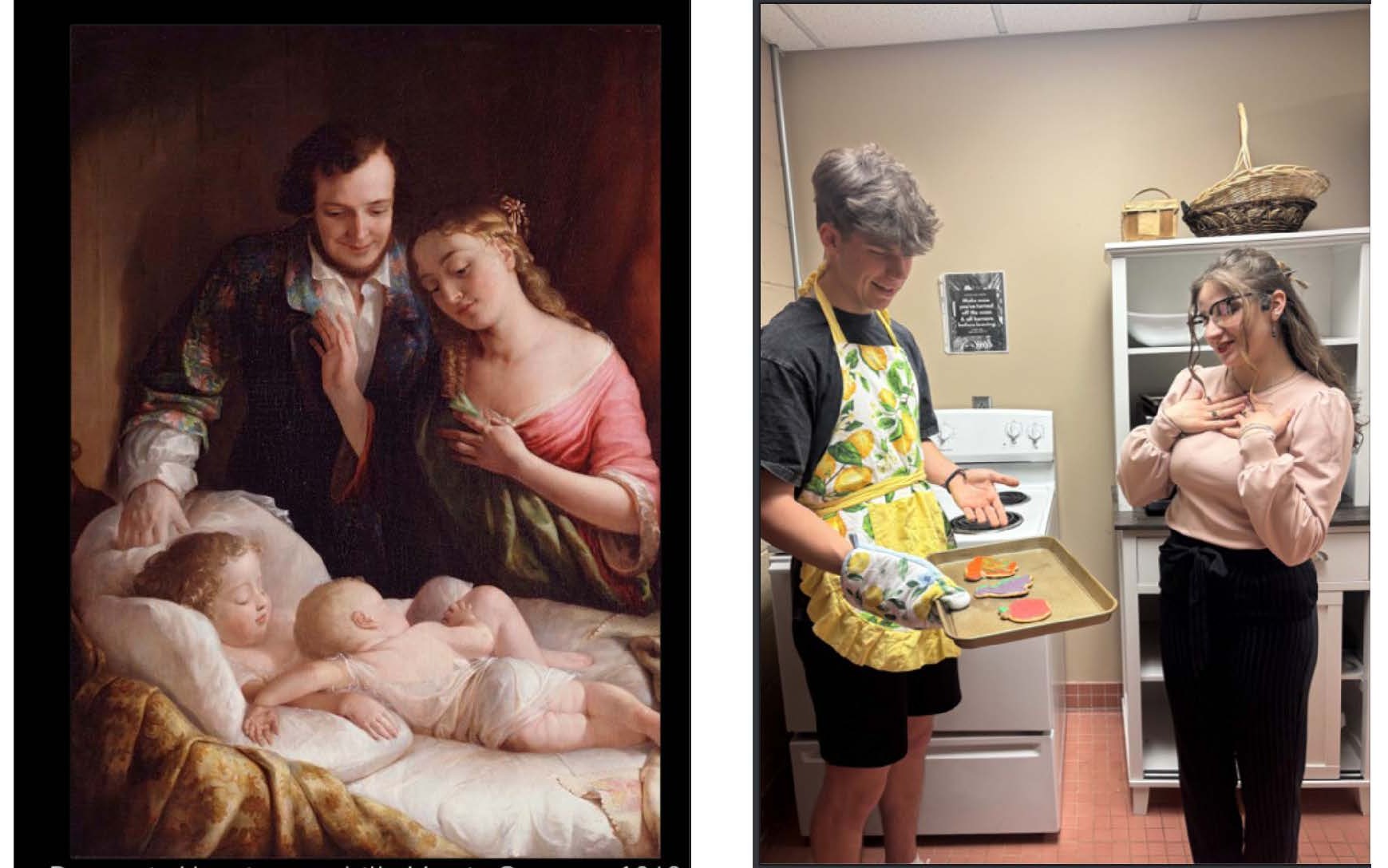
Domestic Happiness by Lilly Martin Spencer: “In the original painting, Spencer offers what was a progressive view of family life for the time, with both mother and father doting on their children. Our students instead depicted a “girl boss” showering praise on the domestic accomplishments of her stay-at-home husband. Notably, no children are present.”

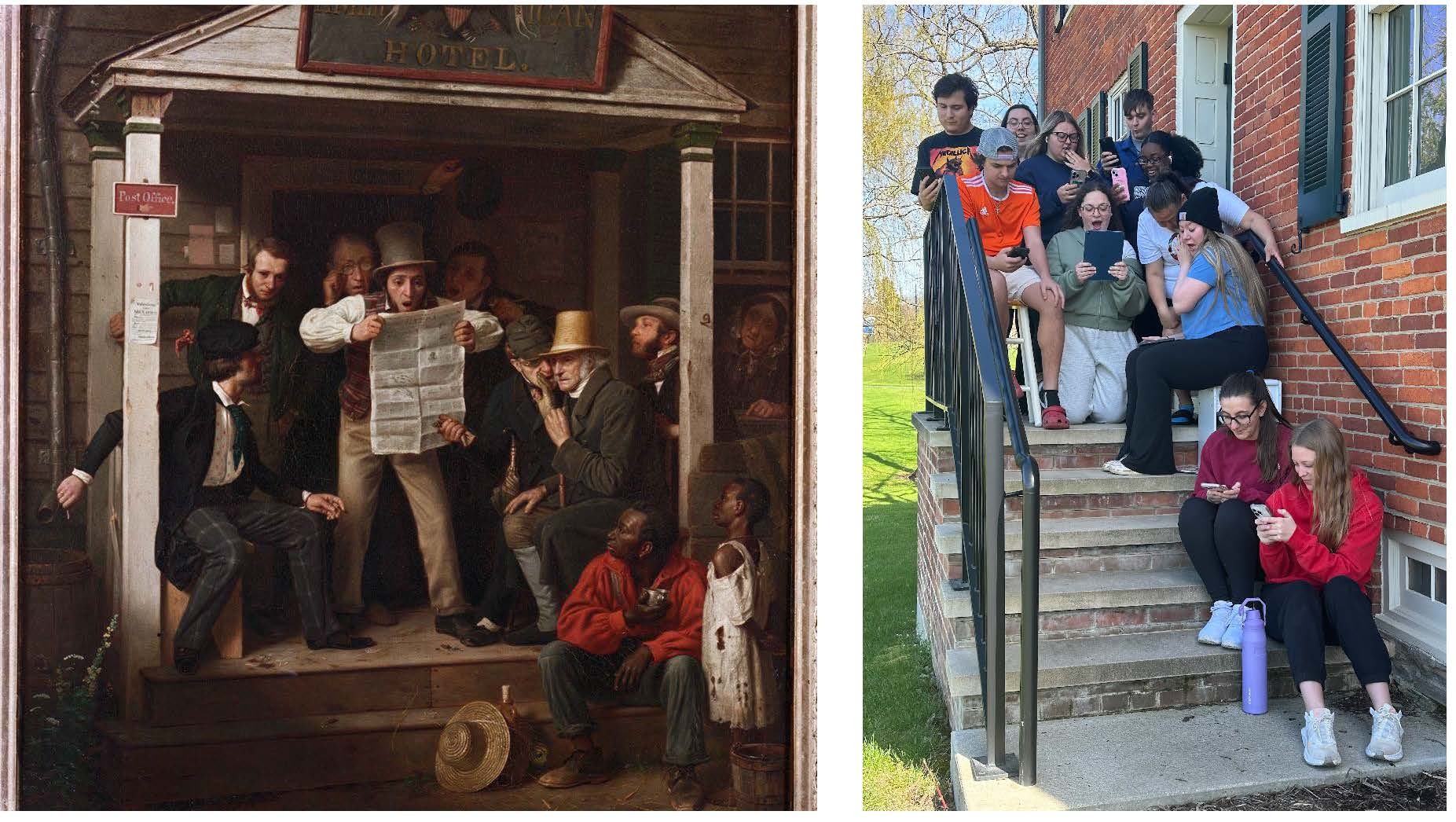
War News from Mexico by Richard Caton Woodville. “Woodville’s painting depicts the latest in information technology—the penny press—which made journalism far more accessible than ever before. Our students depicted a scene in which everyone is responding to the news, not in the shared experience represented by Woodville, but each on their own through their phones and tablets.”

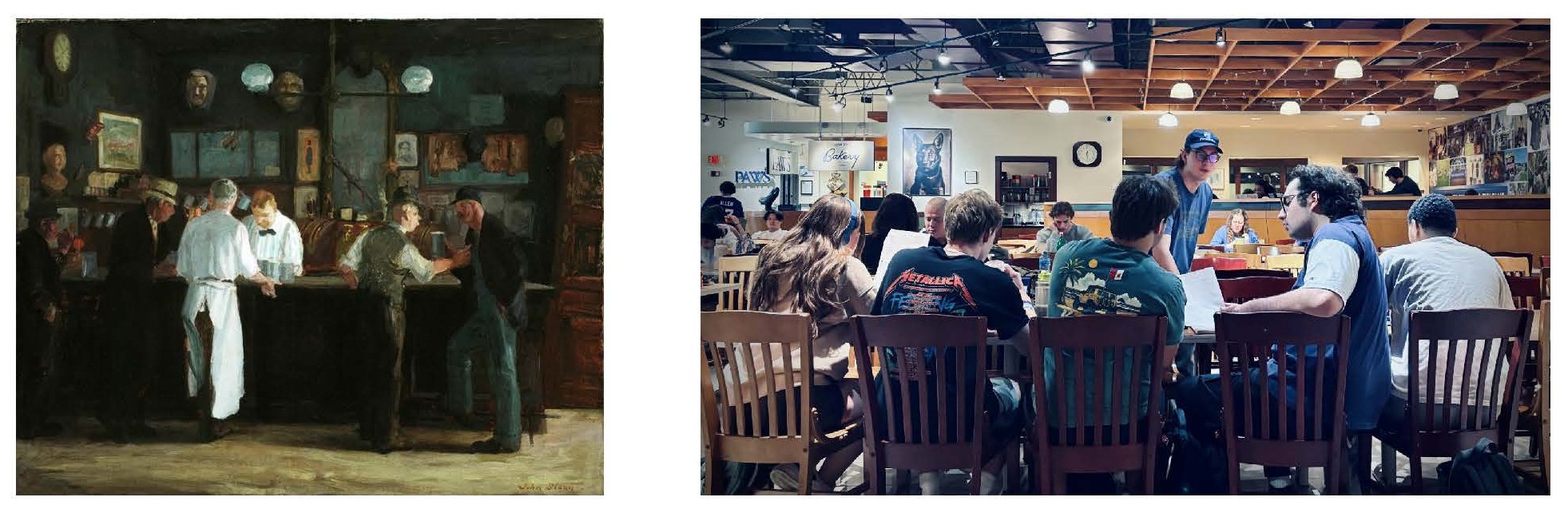
McSorley’s Bar by John Sloan: “Sloan’s painting depicts a scene of working-class sociability in a male-only bar. Our students represented a scene of co-ed sociability in Bruno’s Café on the campus of Penn State Behrend. Again, the presence of devices mediates human-to-human connection. Note how the student group considered the framing of the shot, mirroring the lights and memorabilia on the walls of the original.

Fun fact: McSorely’s Old Ale House is New York City’s oldest continuously operated saloon. The bar did not admit women until it was forced to do so in 1970.”

ABOUT THE COURSE

AMST 307N: American Art and Society covers the history of art in the English colonies and the United States from the seventeenth century to the present, examined through paintings, sculpture, buildings, prints and photographs, as well as exhibitions and national/world fairs.

The course is designed to meet two principal goals. The first is to increase students’ powers of visual analysis and help them build a critical vocabulary for discussing an art object’s medium, composition, style, and iconography. The second is to foster an understanding of the deep implication of the visual arts in their social and cultural contexts.

Ode to Resilience on National Love-a-Tree Day

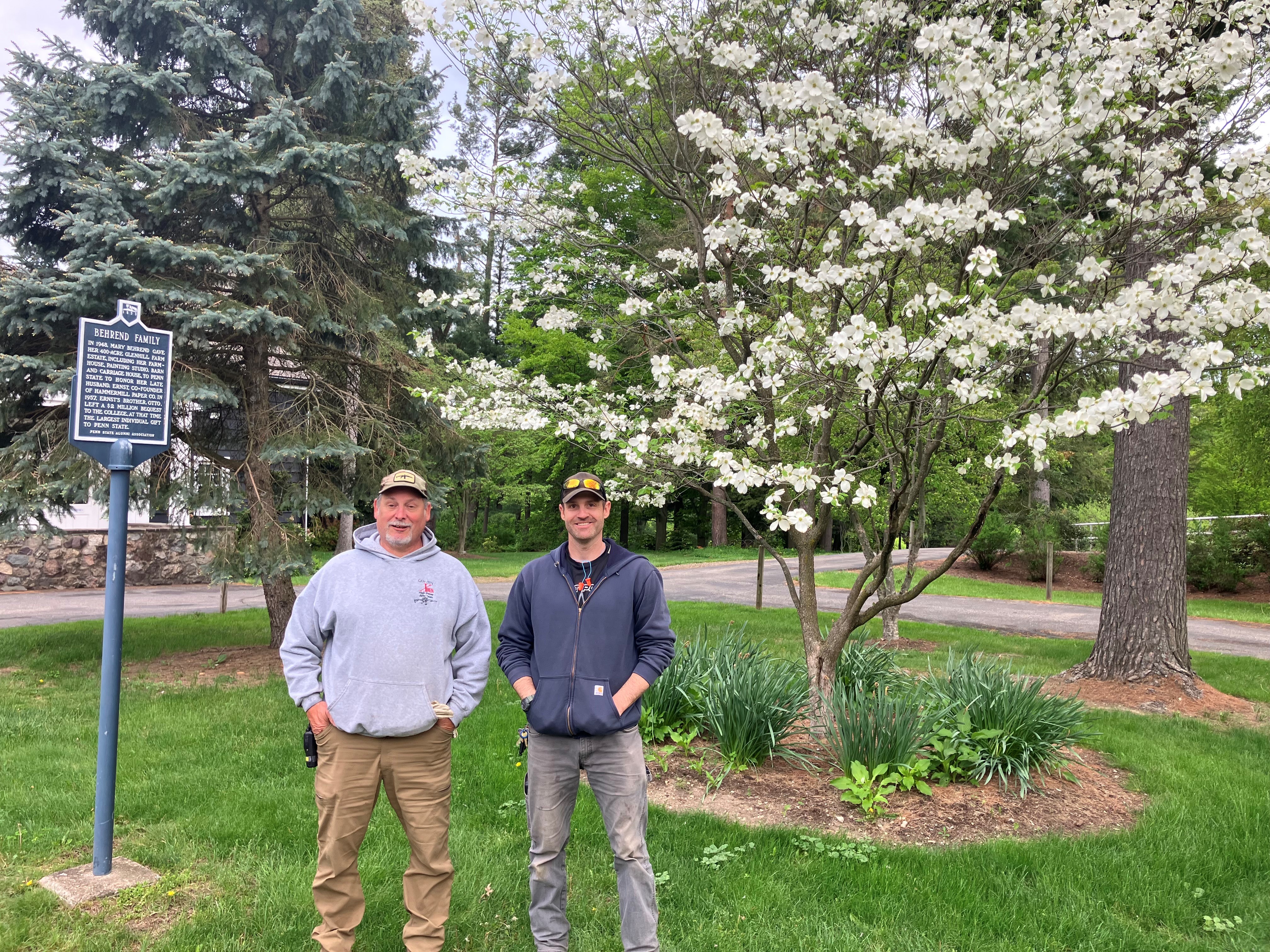
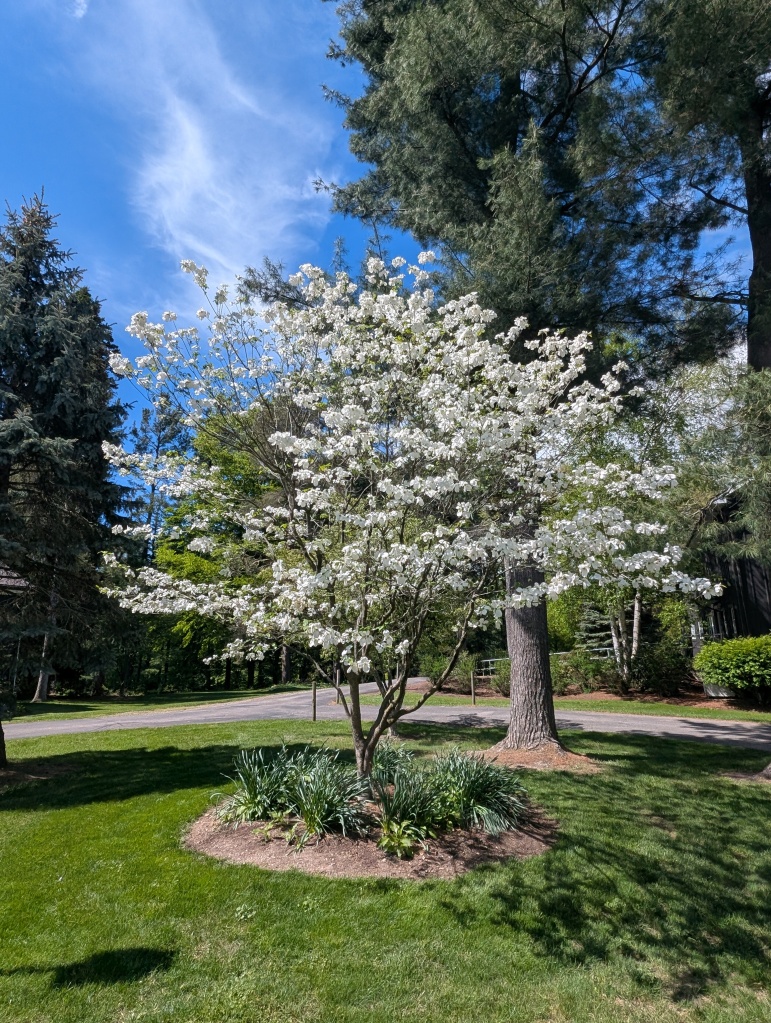
John Troncone, left, and Brooks Travis in front of a flowering dogwood that Troncone has transplanted four times in twenty years.

By Heather Cass, Publications Manager, Penn State Behrend

“Bloom where you are planted” is a metaphorical phrase encouraging individuals to make the best of their current circumstances. A real-life example of this sentiment can be found at Penn State Behrend, where a flowering dogwood tree is thriving even after having been transplanted four times.

The tree, Cornus florida, was first planted two decades ago near Lilley Library by groundskeepers John Troncone and Patricia Blackhurst, who is now retired.

“Patty and I planted it along the east side of the library, but it was too wet, and the tree was struggling there,” Troncone said.

They chose to move it next to the old Erie Hall, where the dogwood grew until a fire at Dobbins Dining Hall in March of 2010 forced another move.

“Housing and Food Services had to set up a temporary kitchen in Erie Hall that required us to remove the tree,” Troncone said.

He and Blackhurst dug a third hole for the growing tree, south of the Glenhill swimming pool.  Again, the tree grew and flowered until, a dozen years later, Troncone was once again facing the dogwood that had to go to make room for the Glenhill Gardens project.

He and his new groundskeeping partner, Brooks Travis, had to decide whether to destroy the tree or attempt yet another transplant.

“The timing was good,” Troncone said. “The tree was in the dormant stage at that point, and the weather was dry enough to give it a try.”

Troncone, Travis, and Jack Crowley, a student worker, spent three days carefully digging the tree out, wrapping its roots in burlap and tying them into a root ball for transplant. However, moving the 20-foot tree would be no easy feat.

“Then we got lucky,” Troncone said. “The contractor for the pool project had a track loader and offered to help us move it.”

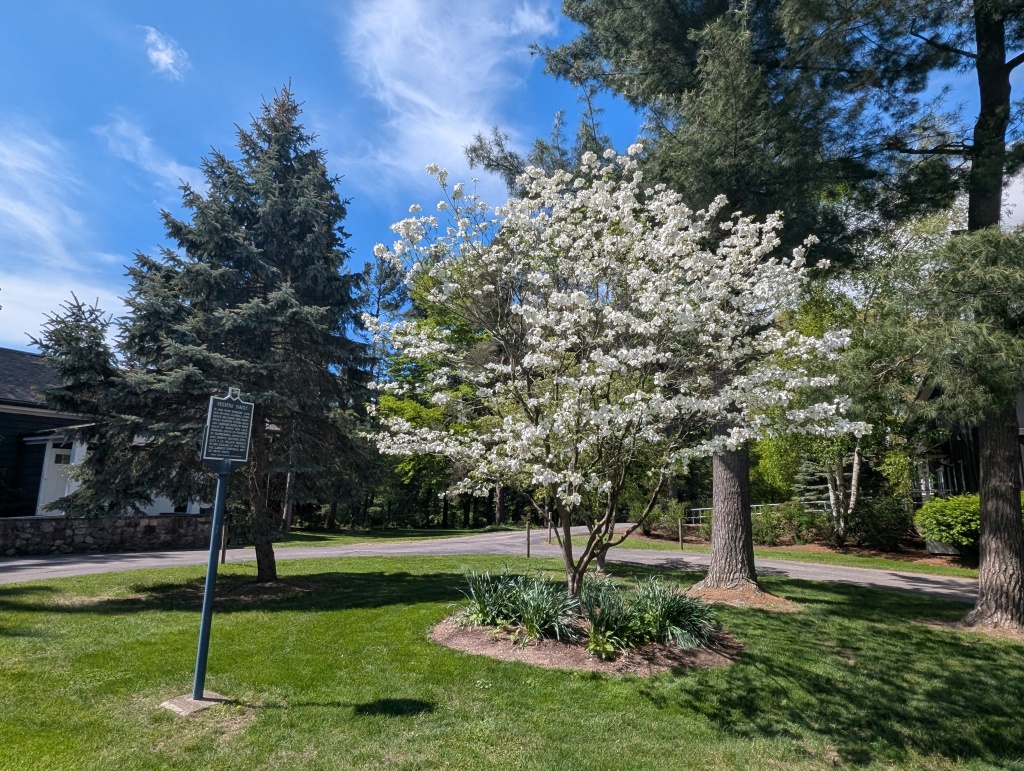
Troncone and Travis found the perfect spot for the tree in a grassy circle surrounded by the college’s original, historical buildings—Glenhill Farmhouse, Mary Behrend’s Studio, and the Turnbull Building.

It’s space fitting of a tree that has born witness to so many important moments and changes on campus.

It’s currently in full bloom, a gratifying sight for the caretakers who watch over it.

“Brooks and I are pleased with the tree’s condition to date,” Troncone said.  “I’m glad we were able to save it. Hopefully, that will be the last time we have to move it.”

A few interesting facts about flowering dogwood

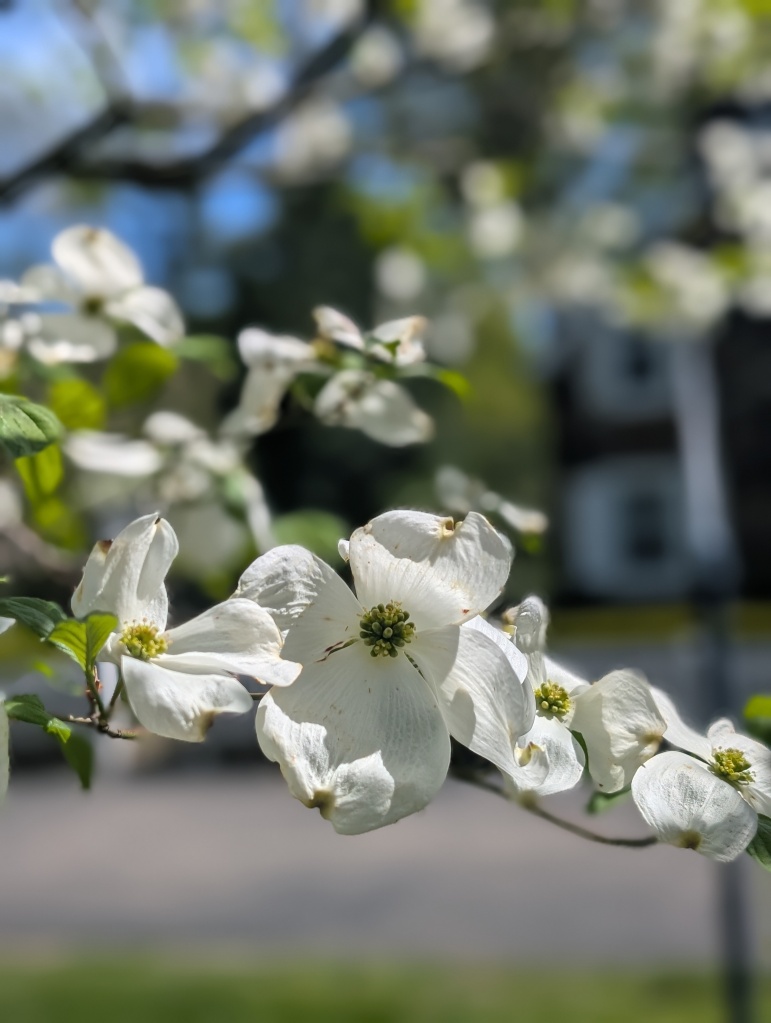
  • The large, showy “petals” are actually modified leaves called bracts, not true petals.
  • Native Americans used dogwood bark to make scarlet dyes and medicinal teas. 
  • In some cultures, the dogwood is a symbol of rebirth and resurrection. (Fitting for the subject of this blog post!)
  • The “fruit” of the dogwood is a drupe, similar to a plum, with a hard seed inside.
  • Dogwood wood is hard and strong, making it suitable for tool handles, charcoal, and other items.
  • The name dogwood is thought to be a variation of the Old English word “dagwood,” meaning a skewer or dagger. The hard wood of the tree was used to make these tools.
  • Another theory regarding the origin of the name dogwood suggests it could have been named for its berries, called “dogberries,” which might have been considered less desirable or “fit for a dog.”
  • Dogwoods have been used medicinally for generations; the bark is rich in tannins, so ground bark or leaves are used to treat pain, fevers, backaches, dizziness, weakness, excessive sweating, uterine bleeding, and incontinence.

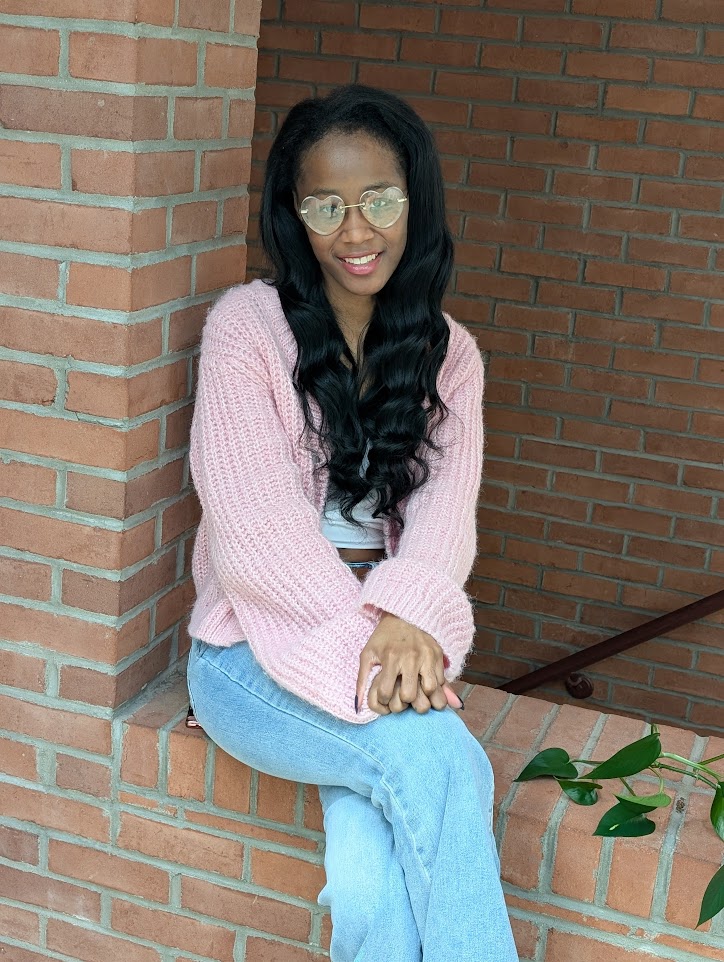
Standout Seniors 2025: Meet Kaijia McNair (Media and Communication)

Penn State Behrend’s Class of 2025 is ready to make its mark on the world. We’re proud of our students and all that they have learned and accomplished here at Behrend. Over the next several weeks, we will introduce you to a few of our remarkable seniors who have conducted valuable research, pioneered innovation, overcome challenges, and engaged in college life in a big way.

Today, we’d like you to meet Kaijia McNair.

Major: Media and Communication

Hometown: Baltimore, Maryland

Why she chose Behrend: It was the best choice for my major and for me. Choosing Behrend, which is six hours from my hometown, has helped me develop independence and influenced me to think about moving somewhere other than home after graduation.

Why she chose her major: Originally, I wanted to be a sports analyst or broadcaster. But after taking some communication classes, I learned that I hated being in front of the camera. However, I rediscovered my passion for writing and found myself comfortable presenting and speaking in public.

Campus involvement: Humanities and Social Sciences Ambassador.

What makes her unique: I think my work ethic makes me unique. I don’t believe in doing half the job and doing the bare minimum. A lot of my professors have praised me for turning in work that is above and beyond what is required.

What you’d be surprised to know about her: I absolutely love to crochet and play Team Fortress 2!

What she’s passionate about: Being a good person and leaving a good impression on people.

After her graduation in May, Kaijia plans to move to the northern Virginia/Washington, D.C., area and work in the field of public relations.   

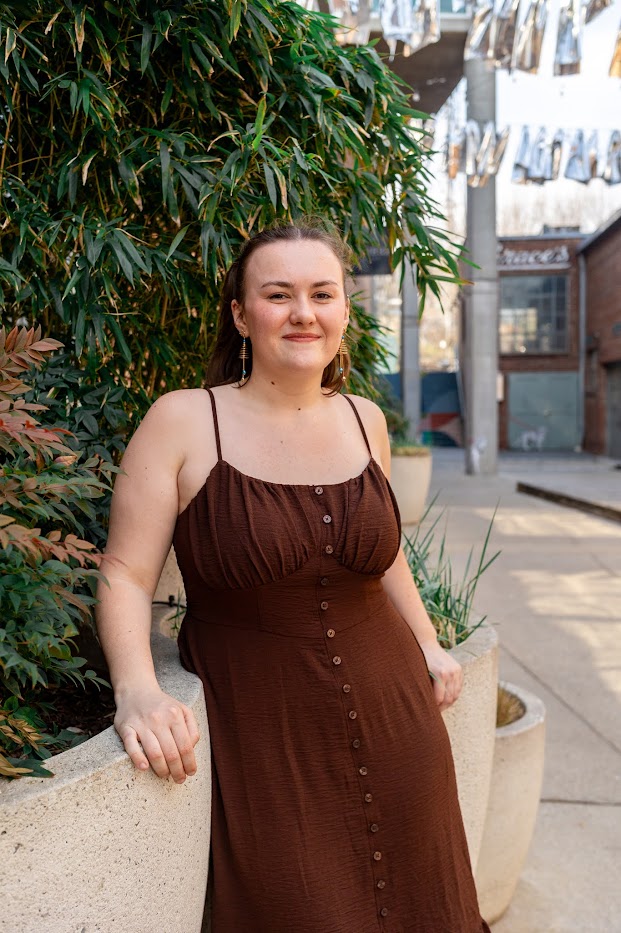
Standout Seniors 2025: Hanna Long (Psychology)

Penn State Behrend’s Class of 2025 is ready to make its mark on the world. We’re proud of our students and all that they have learned and accomplished here at Behrend. Over the next several weeks, we will introduce you to a few of our remarkable seniors who have conducted valuable research, pioneered innovation, overcome challenges, and engaged in college life in a big way.

Today, we’d like you to meet Hanna Long.

Major: Psychology

Certificates: Child Development

Hometown: Chesterfield, Virginia

Scholarships: Discover Award

Why she chose Behrend: I chose Behrend because of the small class sizes and the potential to do undergraduate research. I planned to do the 2+2 program but ended up staying at Behrend because of the research and internship opportunities I had here.

Why she chose her major: I felt a calling to work with children who have experienced mental illness. Also, while growing up, I had friends and family who struggled with mental health challenges. This is one of the reasons I chose Psychology. I want to be there to support others and be the person who listens when no one else does.

Proudest accomplishment at Behrend: Presenting my research project “Changes in Anxiety Levels of College Students Due to Interactions with Virtual and Animatronic Animals” to the Psychonomics International Research Conference in New York City.

Challenges overcome: I am an out-of-state, first-generation college student and I have delt with anxiety. Becoming a Psychology major and having an Emotional Support Animal helped me to cope.

Campus involvement: Alpha Sigma Alpha sorority (Fundraising Chair, VP of Finance, Membership Experience Director), Psychology Coalition (President), research assistant for The Susan Hirt Hagen Center for Community Outreach, Research, and Evaluation (CORE), mentor for the Mentor Project, and a resident assistant.

What makes her unique: I am completing my bachelor’s degree in three years! Also, I was known on campus as the Resident Assistant with the French Bulldog named Zoe. RA Zoe used to love going on rounds with me and loved all our residents!

What you’d be surprised to know about her: I love to sing. I also love hiking and exploring, which is why, after graduation, I will be attempting to visit every National Park in the United States. I am going to two National Parks this summer: Cuyahoga Valley National Park and Indiana Dunes National Park.

Advice for first-year students: Be yourself and don’t be afraid to branch out and meet new people. Don’t be intimidated by your professors. They want to help you succeed, so reach out to them and attend office hours.

After her graduation, Hanna plans to take a gap year before going to graduate school.

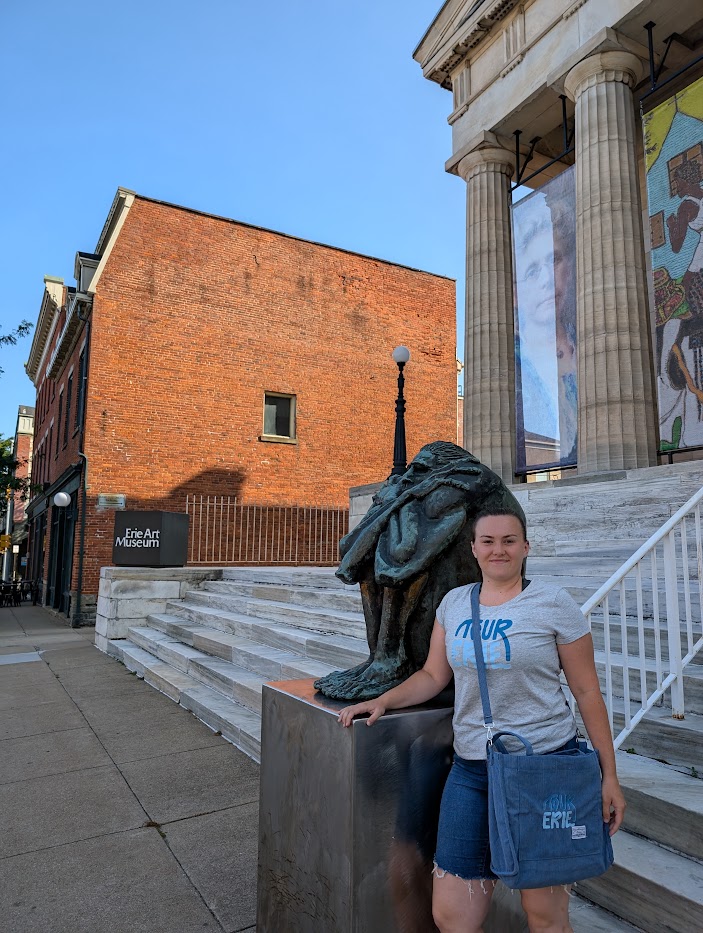
Standout Seniors 2025: Meet Lauren Cass (Media and Communication)

Penn State Behrend’s Class of 2025 is ready to make its mark on the world. We’re proud of our students and all that they have learned and accomplished here at Behrend. Over the next several weeks, we will introduce you to a few of our remarkable seniors who have conducted valuable research, pioneered innovation, overcome challenges, and engaged in college life in a big way.

Today, we’d like you to meet Lauren Cass.

Major: Media and Communication

Minor: History

Hometown: Erie

Scholarship: Erie Insurance Open Doors Scholarship

Awards: Pride of the Lion Award

Why she chose Behrend: I attended a lot of youth programs at Behrend, from College for Kids to Women in Business Day to Math Options. It feels like home. I knew there were a lot of caring and involved faculty and staff members at Behrend.

Why she chose her major: I’m a talker, so it suits my personality. It also suits my personal goal to work in an active and fun environment. It’s a versatile degree that can apply to nearly any industry.

Proudest accomplishment at Behrend: Finishing my degree. I had a rough start adjusting to college, and I started skipping classes and fell way behind. I ended up withdrawing on the last day of my first semester to save my GPA. When I re-enrolled for the next semester, I had an entire support network from Behrend helping me get and stay on track, including an academic counselor who I checked in with weekly. She helped me find a major that suited me, and I learned how to “do” college. I have been on the Dean’s List for the last three semesters.

Campus involvement: Lion Ambassador tour guide, four years.

Virtual life: I’ve been an employee and student researcher at the Virtual/Augmented Reality Lab for four years. I’m currently working on creating 360-degree point-of-view videos for people with disabilities.

Setting records: On April 5, the VAR Lab director, Dr. Chris Shelton, and I attempted to break the Guinness World Record for the most time in VR while watching VR content. We needed to beat 50 hours. Unfortunately, we had technical problems with Dr. Shelton’s equipment, and he wasn’t able to continue, but I made it to 55 hours, finishing on April 7 at 7:00 a.m. 

What makes her unique: I am co-owner of an Erie tourism business. In my junior year, my mother and I started a walking tour company in Erie, called Tour Erie. We offer historical tours in downtown Erie, which is why I added a minor in history. We have plans to add more tours when I graduate.

What you’d be surprised to know about her: I have an extensive plant collection, somewhere around fifty plants, and I can name them all. I also have two geckos, hissing cockroaches, and a tarantula.

What she’s passionate about: The National Parks. I’ve been to nearly a dozen of them with my family and can’t wait to visit more of them. This spring break, I visited Mammoth Cave in Kentucky.

She loves Erie: While I love to travel, I really love living in Erie, which is why I love sharing how awesome it is with visitors and residents on our tours.

Advice for first-year students: Don’t skip class! Set yourself up for success in your first year by going to class, paying attention, and doing the assigned readings before class. Also, join some clubs. I did not, and I regret it as it’s where most people seem to make friends.

Parting words: I’m so thankful to so many people at Behrend who helped me get to the finish line, including Emily Artello in Academic Advising, Jim Dowds in the Counseling Center, Mary Kay Williams in Admissions, Dr. Chris Shelton in the VAR Lab, and my advisor, Dr. Carrie Payne.

After her graduation in December, Lauren plans to focus on growing and diversifying her seasonal tour company and finding part-time work in brand management or another other aspect of business communication.

Standout Seniors 2025: Meet Nyla Zorbas (Biology)

Penn State Behrend’s Class of 2025 is ready to make its mark on the world. We’re proud of our students and all that they have learned and accomplished here at Behrend. Over the next several weeks, we will introduce you to a few of our remarkable seniors who have conducted valuable research, pioneered innovation, overcome challenges, and engaged in college life in a big way.

Today, we’d like you to meet Nyla Zorbas.

Major: Biology; Genetic and Developmental Biology option

Minors: Biochemistry and Molecular Biology

Hometown: Aliquippa, Pennsylvania

Scholarships: Wolves Club of Erie

On choosing Behrend: I chose Behrend because it has a smaller campus with wonderful faculty and many research opportunities.

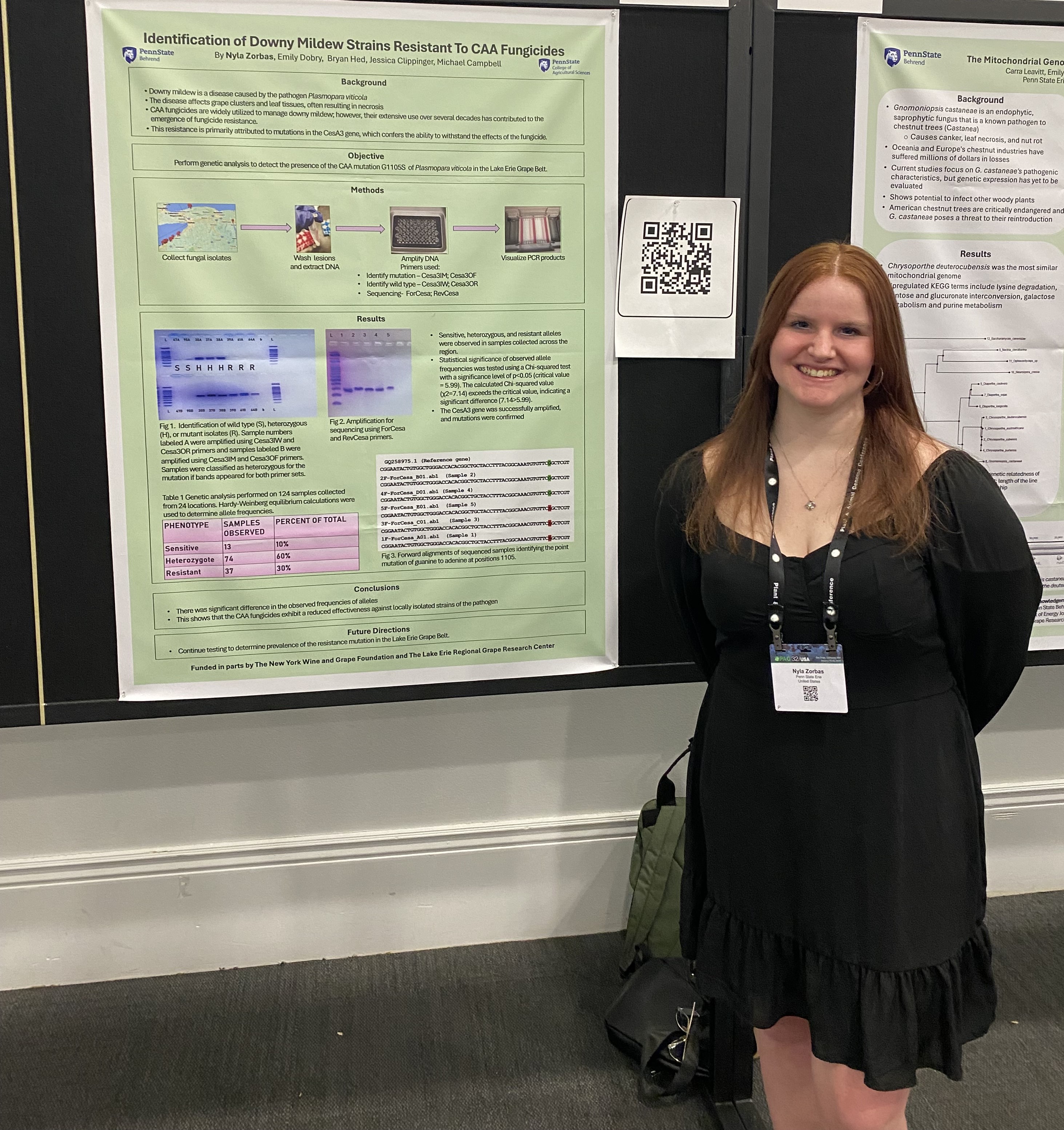
Proudest accomplishment at Behrend: Presenting my research work on downy mildew, a fungus that effects grapes, at an international conference, the Plant and Animal Genome Conference, in San Diego, California.

Campus involvement: I was in Science Ambassadors, Biology club, and TriBeta.

Her top priority in the coming years: To continue to learn and grow in my research with plant pathology.

Advice for first-year students: You aren’t alone. Everyone around you is new to this as well. Go out and make friends, join clubs, talk with your professors. Who knows what opportunities may arise?

Parting thoughts: I’m thankful for all the support I’ve received over the last four years. I would not have been able to do this without my family and the faculty here at Behrend.

Nyla has accepted a position in a plant pathology laboratory after her graduation in May.