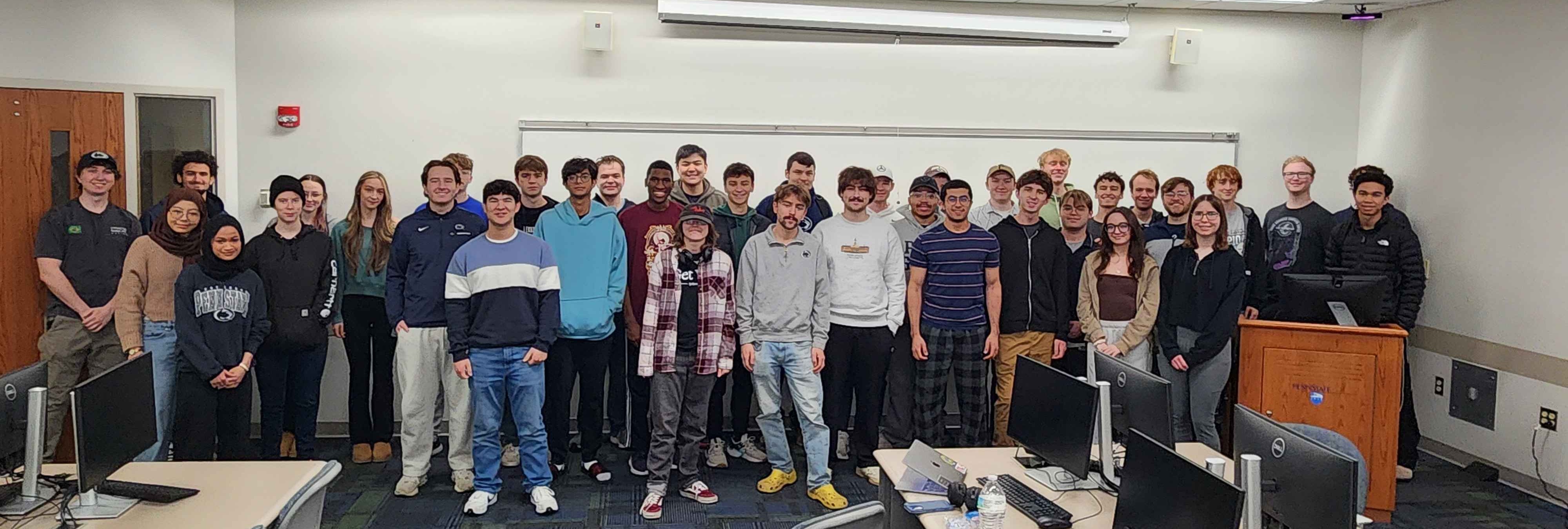
Annual student-driven hackathon is engineering education in practice
By Heather Cass, Publications Manager, Penn State Behrend
The tension is palpable in the final hours of the School of Engineering’s annual hackathon. Teams of students lean over laptops, working on last‑minute changes, troubleshooting bugs, and deciding which features to cut before the clock runs out.
It’s a twelve‑hour sprint that feels less like a class assignment and more like a real engineering deadline—fast, collaborative, and intensely creative.
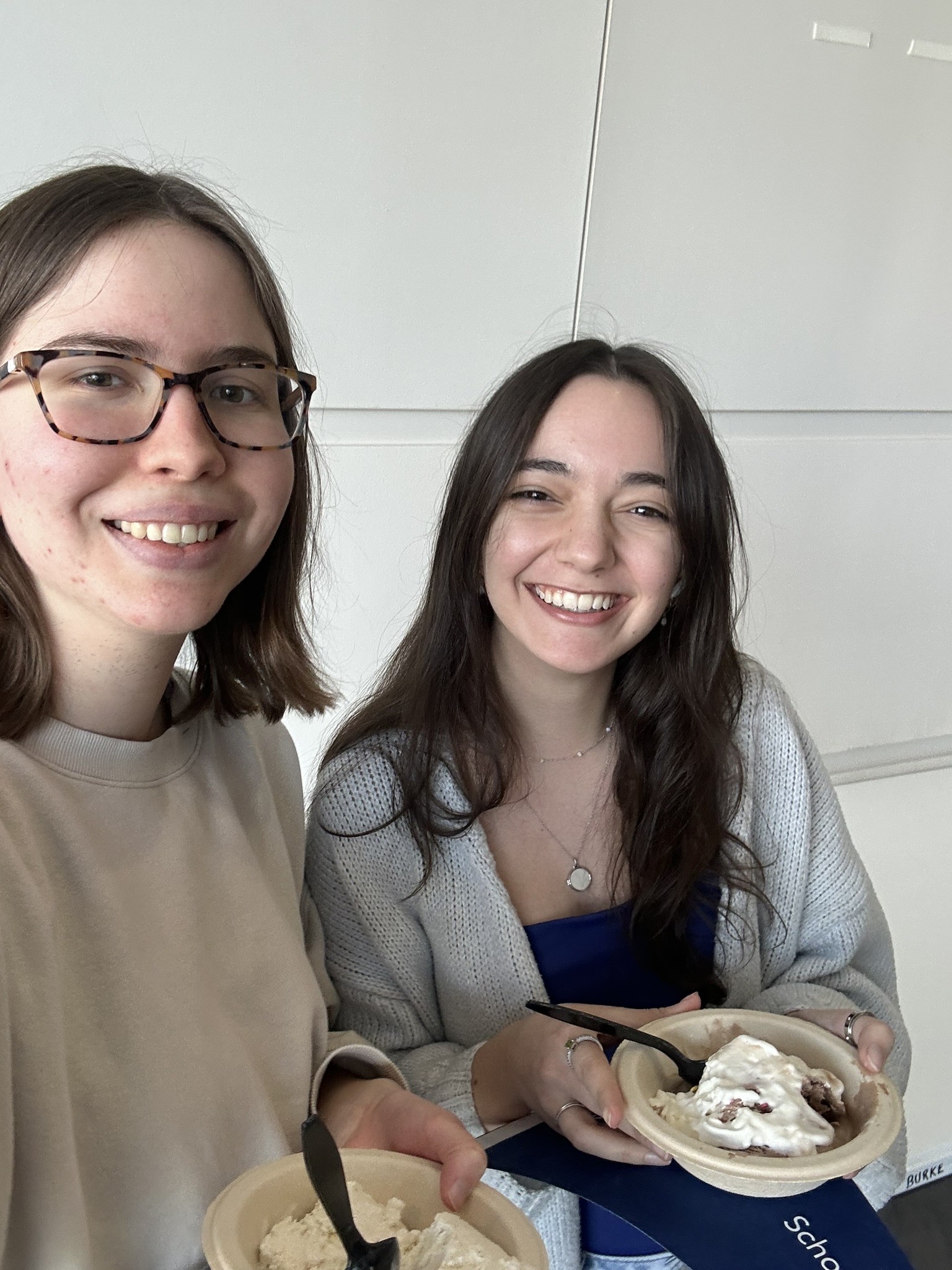
Last year’s winning team, Morgan Koch and Jamie Frantz, then juniors majoring in Computer Science, said the pace was the hardest part. They built a fully functioning period-tracking web application in one day, learning to prioritize functionality, manage scope, and present a minimally viable product under pressure.
“We had to handle choosing between including ‘half-baked’ features or excluding them entirely from our submission,” Koch and Frantz said. “We leaned toward exclusion to meet the time constraint with a completed app.”
Russell Martin, assistant teaching professor of computer science and software engineering and the faculty advisor for the annual hackathon, said the event mirrors what software and computer engineering students will face in the workplace.
“Real engineering is fast and collaborative,” he said. “You’re solving problems with limited time, limited information, and a team that’s learning alongside you. This gives them a safe place to practice that.”
Martin, a 2005 Management Information Systems and 2006 Master of Business Administration grad, would know: He worked in the tech industry for more than fifteen years before pivoting into academia, first as an adjunct instructor, and then, in 2002, as a full-time faculty member.
The hackathon is student‑driven through Behrend’s Association for Computing Machinery (ACM) club. Students propose the categories, faculty build the framework, and teams of two to four students have one day to create a minimally viable product and pitch it to judges.
But it’s more than a one-day affair. The ACM club hosts learning sessions in the weeks leading up to the event, giving participants a chance to experiment with new tools and technologies before the sprint begins.
The hackahon also gives students space to explore emerging tools — including AI. Martin encourages students to use AI the way engineers actually use it: as a resource, not a shortcut.
“There’s no way to make anything AI‑proof,” he said. “Students need to learn how to use AI responsibly. It’s a tool, but it shouldn’t be a crutch.”
For students, that balance is part of the learning experience. AI‑enabled features helped them enhance their project, but the real challenge is still the engineering work: designing, building, testing, and delivering something real in a short window.
The event continues to grow—from forty participants in its first year to more than sixty last year. It will expand again this spring to include students from the Black School of Business. The goal is to create cross‑functional teams that reflect how modern engineering projects operate.
“They won’t only work with engineers,” Martin said. “They will work on teams with people from marketing, finance, and sales.”
See what students built here.