Makers Engineer Ornaments, Fun

20151209_215318

By Heather Cass
Publications & Design Coordinator, Penn State Behrend

The upcoming holiday season offers the perfect distraction for stressed-out students. In this last week of classes, we found plenty of holiday cramming going on with every area from Housing and Food Services to Student Activities to the School of Engineering fitting in some festive merrymaking before things get serious with Finals Week next week.

Wednesday evening, a dozen students gathered in an electrical lab in Burke 145 to munch holiday treats and craft acrylic LED ornaments with Dr. Chris Coulston, associate professor of electrical and computer engineering.

Students first drew snowflakes on computers using CorelDraw and added any text they wanted before sending their creations to the laser printer to be cut out of acrylic. Then, they used soldering irons, wire, LED lights, and batteries to make their snowflakes glow.

Though the Makers group meets fairly regularly, Coulston refrains from calling it a club.

“It’s more like a gathering of like-minded makers,” he says. “I just invite students to show up and make something. It gives them an opportunity to try some of the tools we have, like the laser cutter and soldering equipment.”

Ultimately, though, it’s about encouraging critical thinking and creativity, which are key concepts for engineering students to grasp.

“We try to come up with things that challenge them or make them look at things in a slightly different way,” Coulston said. “For instance, before Thanksgiving, we made LED hot dogs. Who’d have thought you could light up a hot dog?”
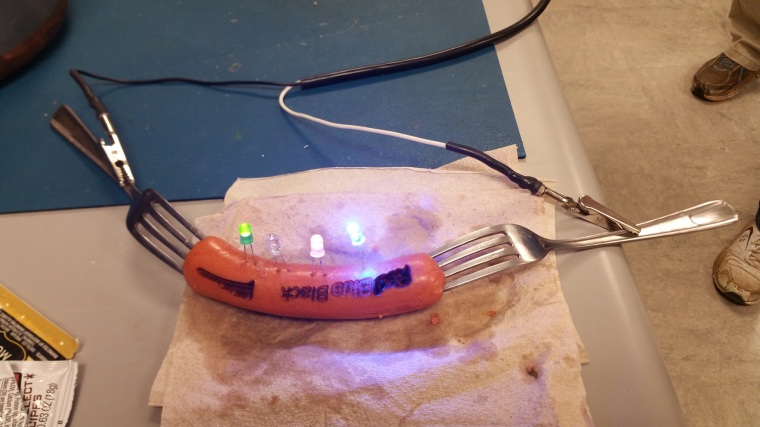
dog

While there may be no practical application for glowing frankfurters, there is certainly a demand for people with the creativity, technological skills, and theoretical knowledge to use ordinary objects in a truly unique way.

While the majority of those who attend Coulston’s Maker gatherings are engineering students, he welcomes all students and faculty members.

“I’d love to have some artists and scientists join us, too,” he said. “The more, the merrier. They’d probably have some really cool ideas.”

Coulston brought a special guest to Wednesday’s gathering, his pug, Shiloh, dressed in her holiday best.

“Anyone can get a picture with Santa, but where else can you get a photo with Santa Pug?” he says with a smile.

Just like an engineer, always looking to improve the original product.
This slideshow requires JavaScript.

9-hole disc golf course open at Behrend

By Heather Cass

Publications & Design Coordinator, Penn State Behrend

IMG_9956

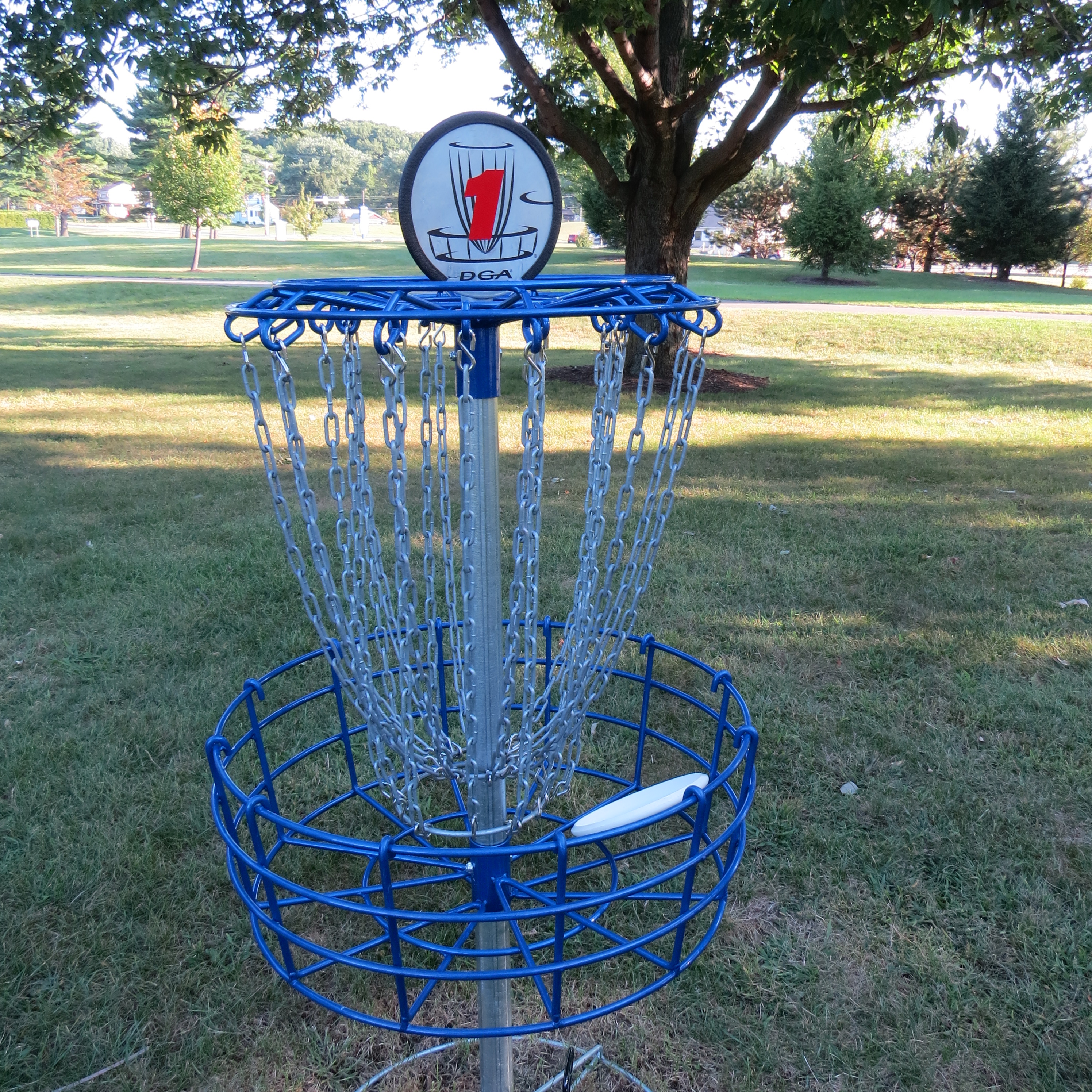
Have you noticed the medieval-looking baskets with chains on metal poles around campus and wondered what they are for?

They’re for your entertainment.

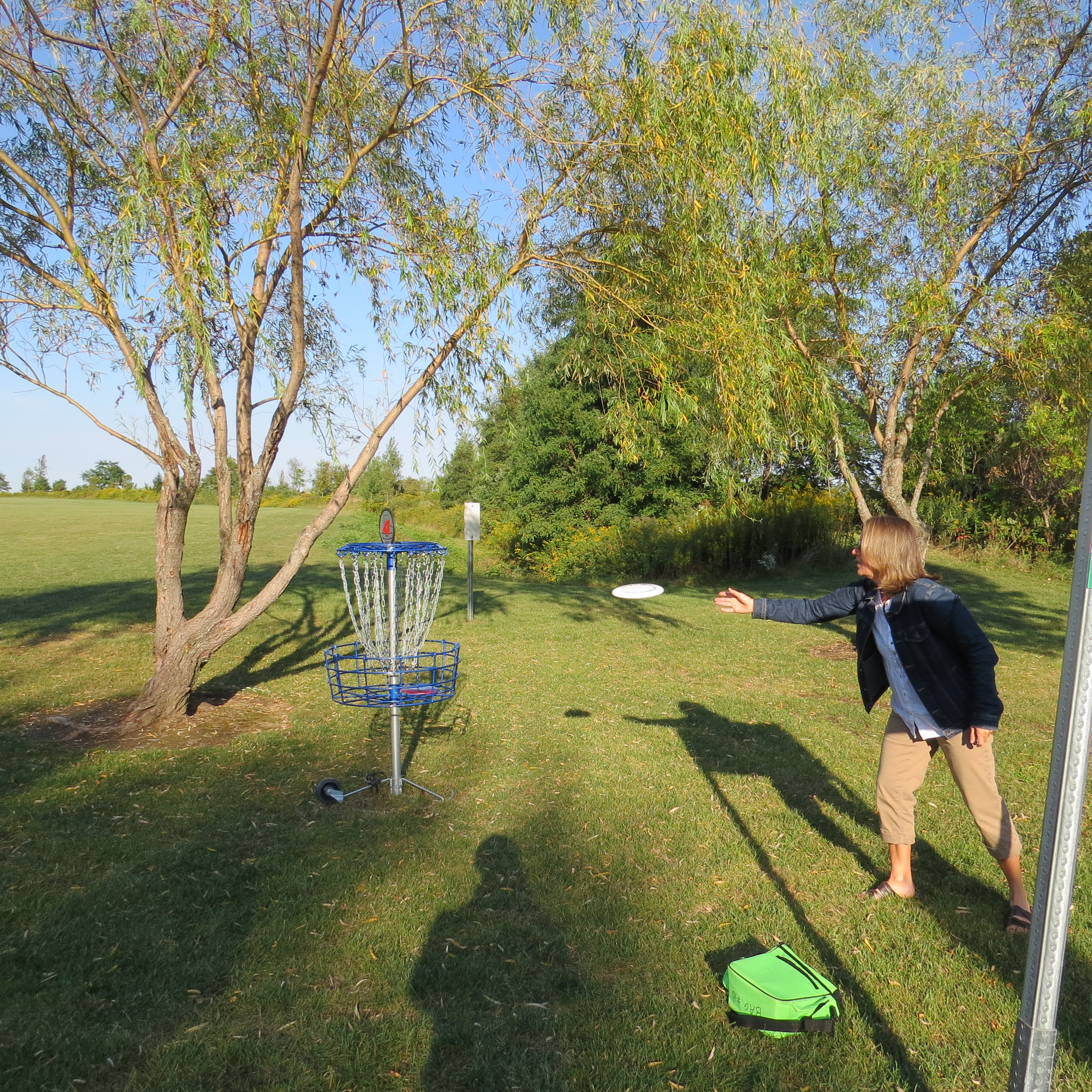
The baskets are targets for a new nine-hole disc golf course that snakes around the perimeter of campus. Disc golf is played much like traditional golf but with flying discs instead of balls and clubs. Players stand near the tee and try to get their disc into the basket in the fewest number of throws.

Student-driven fun

The project was initiated by Kyle Stephan ’14, a former SGA president, who got the ball rolling discs flying, by approaching the Student Activities and Athletics departments to obtain approval, advice, and, eventually, funding to establish a course on campus.

Stephan was joined by Mechanical Engineering majors Trey Neveux and Mark Malecky, and Psychology major Tyler Ferraino, who worked together to design the course, locate equipment, and secure funds.

The students did the majority of the work on the course themselves, with assistance from the Erie Disc Golf Club, the college’s Maintenance and Operations department, and with instruction from Dr. Mike Naber, lecturer in geosciences, on using Geographic Information System (GIS) to layout and measure the course.

IMG_9963

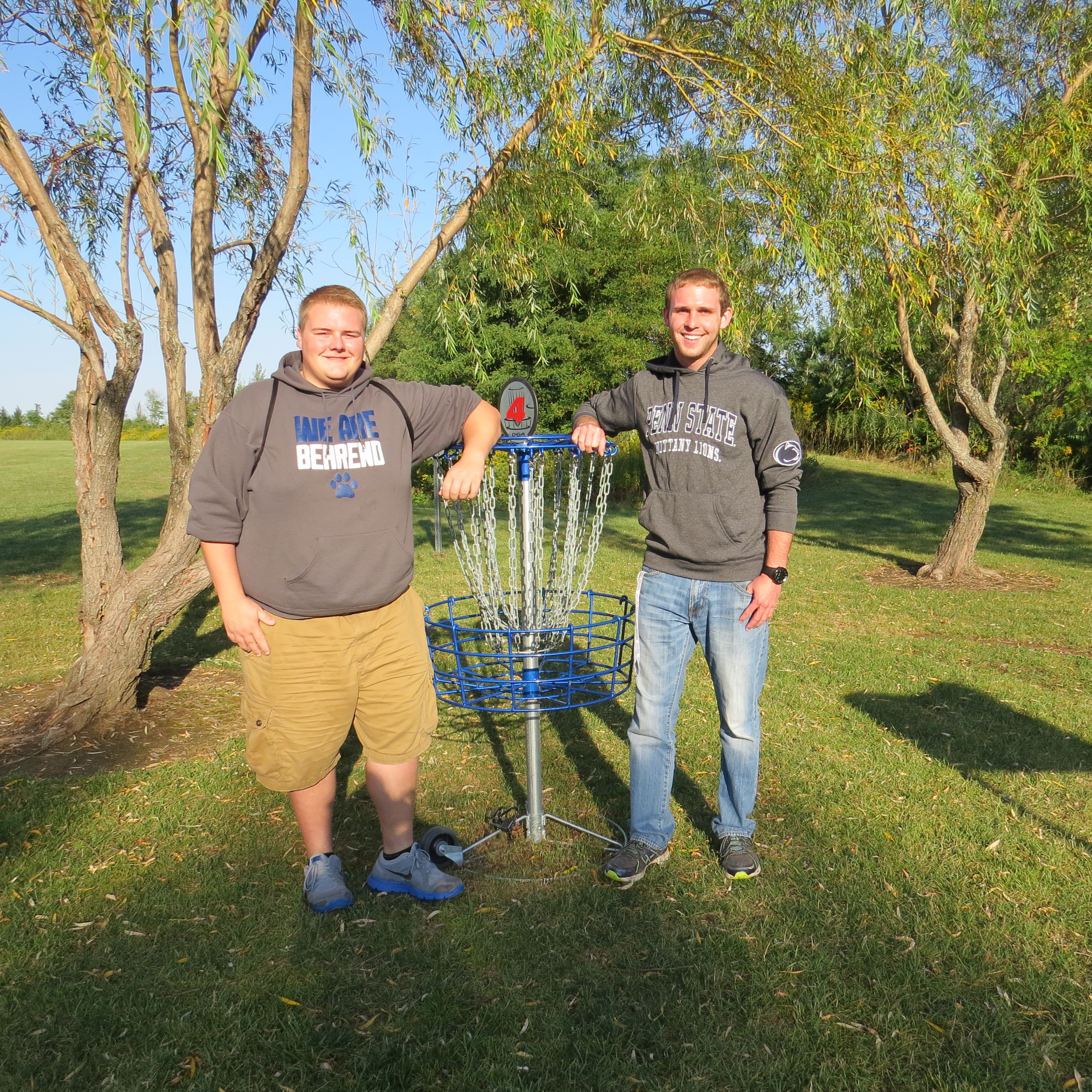
Tyler Ferraino, right, and Trey Neveux.

The course

Though the graphics for the tee markers are still under production, all of the targets/baskets are set and the tee markers (plain white signs) are in place.

The course starts in front of the tennis court/baseball fields near the Jordan road entrance to the college. From there, it snakes around to the old soccer field and then up and around the new track complex before finishing up in the woods across from the track near the bridge to Erie parking lot.

An online map that you can use on your Smartphone while you play can be found here.

Equipment

A basic disc golf set contains three discs—a driver, a mid-range disc, and a putter. Just like in golf, the driver is used for long drives from tee, the mid-range disc is used for shorter distances, and the putter is used when you’re close to the target.

There are at least ten sets of discs available for students to borrow for free at the RUB desk (and Neveux says there are more to come), or you can pick up your own set at a mass retailer or online for less than $30.

How to play/rules

Standing at the tee (currently marked with plain white signs…graphics are in production!), throw your driver disc toward the basket. Players — typically two to four, but more is OK, too — take turns throwing their discs with the one whose disc lands the farthest from the basket going first (like golf).

One point (stroke) is counted each time the disc is thrown and when a penalty is incurred. The goal is to play each hole in the fewest strokes possible. A disc that comes to rest in the basket or chains constitutes a successful completion of that hole.

Most of the holes on Behrend’s course are a par 3, but there are also two par 4s and a par 5. Map here.

The player with the lowest total strokes for the entire course wins.

Learn more about how to play disc golf here.

First-timers take

Neveux and Ferraino spent some time introducing me to the sport on a recent weekday morning.

It was a lot of fun and it wasn’t hard to figure out how to throw the discs to my advantage (most drivers arc left) and when to switch discs to make use of the mid-range and putter discs.

IMG_9962

By the third hole, I had a pretty solid grasp on the sport and enough skill to get the disc in the area I wanted it to be.

Learn more at YouTube, where you can find plenty of videos with tips on disc throwing technique.

Future expansion

Neveux, who serves as president of the Disc Golf club at Behrend, says they are already thinking of expanding.

“We’d like to add another nine holes, so we have an eighteen-hole course,” he said. “We’ve got plenty of space for it on campus.”

And, with the club’s dedication and promotion of the sport, they’re sure to have plenty of players, too.

This slideshow requires JavaScript.

Love of writing defines O’Neill’s time at Behrend

Katherine O'Neill

By Steve Orbanek
Marketing Communications Specialist, Penn State Behrend

As a child, Katie O’Neill always had a keen interest in writing and creative expression. This affinity continued when she got to grade school, and it was not long before others started to notice.

“I had a teacher when I was in first grade who told my mom to get me a journal,” O’Neill recalls.

That would seem to have been excellent advice. As O’Neill has grown up, her passion for writing has become a defining characteristic.

“I’ve always been a writer before anything else,” the Lake Winola, Pa., native says.

That passion is what brought her to Penn State Erie, The Behrend College. The college’s BFA in Creative Writing piqued her interest as the only such program in the Penn State system and one of only a few in the country.

“That was definitely the number one draw,” she says.

Through the inventive program, O’Neill, who graduated this past May, says she was able to focus intently on improving her inventive writing skills. She also improved her editing abilities serving on the staff of Lake Effect, an international literary journal published by the School of Humanities and Social Sciences at Penn State Behrend.

Along the way, O’Neill garnered accolades. This past year alone, her non-fiction story, “Achill Strikes Again,” won Behrend’s Farrell Nonfiction Award while her fiction piece “Juneau” was the college’s Smith Fiction Award winner. Her short fiction piece, “Tony and Rebecca” was also named an honorable mention in the Annual Creative Writing Awards, sponsored by Suffolk County Community College in Long Island, New York.

O’Neill says her inspiration comes from “the weirdest things,” but also a more traditional source. Thanks to the college’s Creative Writers Reading Series and professional conferences, O’Neill met and networked with numerous professional authors throughout her college career. With every interaction, she says she would pick up a tip or two that she put to good use.

During her time at Penn State Behrend, O’Neill was involved beyond creative writing activities. She was the captain of the college’s dance team, a member of the Behrend Choir and a writing tutor in the Learning Resource Center.

This past spring, O’Neill’s efforts were recognized with two awards: Behrend’s Eric A. and Josephine S. Walker Award and a university-wide Eclipse Award. The Walker Award recognizes a student whose character, scholarship, leadership and citizenship have been directed into student programs and services. The Eclipse Award recognizes Penn State students for service and volunteerism to their campus and local communities.

This fall, O’Neill will start pursuing her MFA in Creative Writing at Bowling Green State University in Bowling Green, Ohio. She reflects fondly on her time at Penn State Behrend and hopes new students will choose to follow a similar path.

“My advice is to get involved from the start. I’m so glad I got involved right away. It can be overwhelming, but it’s (worth it),” she says. “I’ve made some amazing friends. I’m going to miss everything about this place.”

Athletics to host cool 5K fun run (ice cream is involved!)

Ice Cream Run TV

By Heather Cass

Publications & Design Coordinator, Penn State Behrend

Some people run for fun. Some people run for fitness. Some people run to spend time with friends.

What would you run for?

How about free Berkey Creamery ice cream (and a cool T-shirt, too)?

Ah…now there’s a tempting reason and sweet reward for running (or walking) the Penn State Behrend Athletics first Ice Cream Run on Friday, August 28 at 6:30 p.m.

Not up for 3.1 miles? There’s also a Family Fun 1-Mile Walk.

The races start and finish in the Junker Center parking lot, near the new soccer complex. The course is on all paved paths through campus and Coach Greg Cooper (cross-country and track) was merciful when he designed the course as it goes up first, then is mostly flat or downhill. Course map here (also posted below).

Race registration is $25 and includes a long-sleeve shirt and free Berkey’s Creamery ice cream when you finish the race. Register here (online registration only). By the way, this is a family-friendly event – there’s a $5 discount for every additional family member you register.

Four legged friends are even welcome to run with you, too, but they must be leashed and under control at all times.

This is a fun run, so there will not be a timer or awards.

All proceeds benefit Behrend Athletics! For more information call 814-898-6240.

5k Course1

Move over, Bill Nye. Penn State Behrend has its own ‘Science Guy’

By Steve Orbanek
Marketing Communications Specialist, Penn State Behrend

Joel Solomon (3)
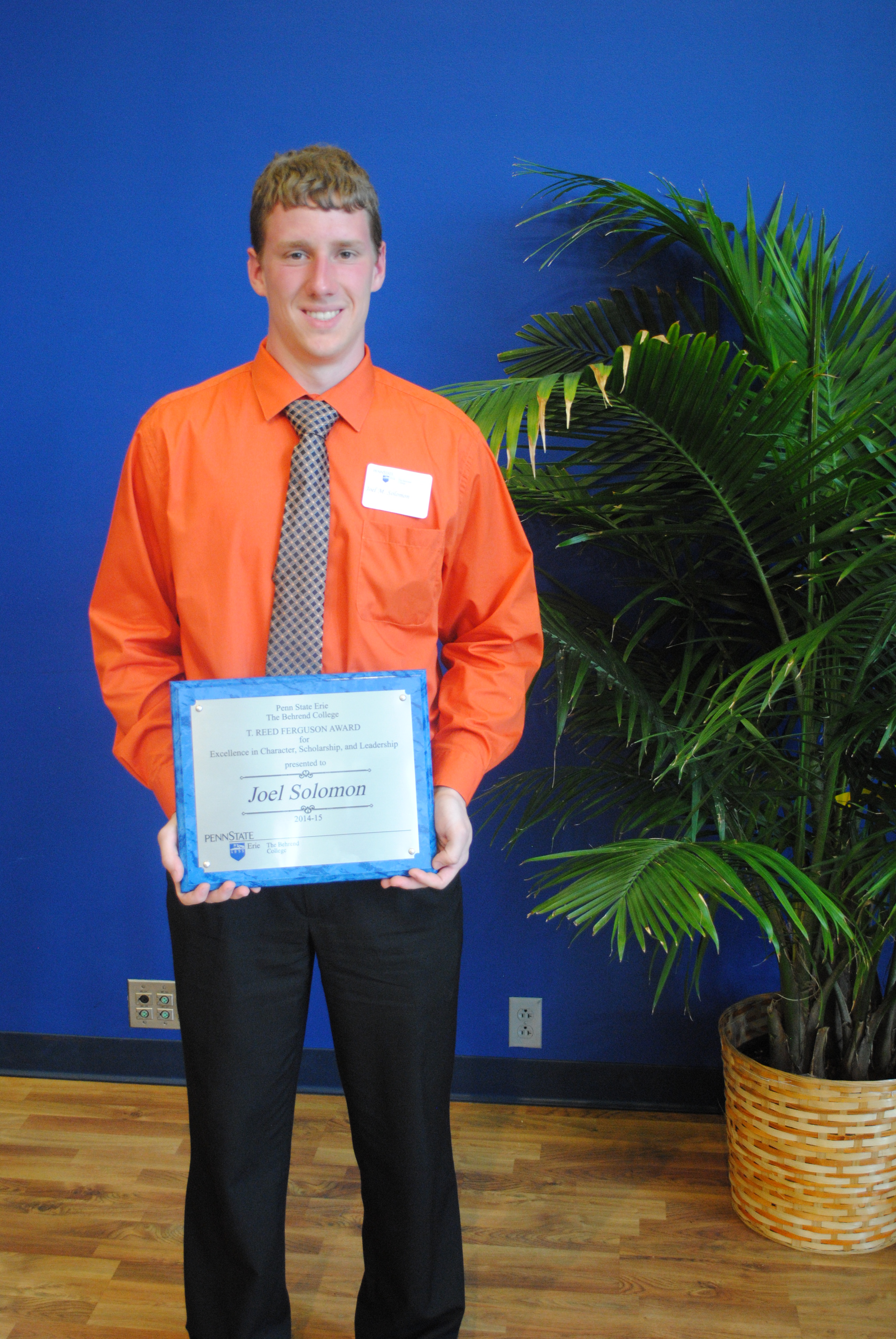
Joel Solomon, a physics major, was the recipient of this year’s T. Reed Ferguson Award. The award recognizes a junior who has demonstrated scholarship, leadership and citizenship through academic and out-of-class involvement and gives promise of further achievement in the senior year.

For some kids, it’s Cartoon Network. For others, it’s Nickelodeon. For Joel Solomon, it was the Science channel?

“Growing up, I just always watched that channel,” says Solomon, who recently completed his junior year at Penn State Erie, The Behrend College. “I was fascinated by what humanity has been able to do over the years, and I knew that I wanted to be a part of that.”

Math and science resonated with Solomon, and that interest led the New Wilmington, Pa., native to Penn State Behrend. As he got older, he knew he wanted to pursue research in college, and he could think of no better destination than Behrend.

“Being able to get a great education at a small campus is great,” says Solomon, a physics major. “I was looking for a research-oriented institution, and Behrend is one of the few schools in the region that offers such opportunities. I know that with a degree from here, I can go anywhere that I choose.”

This past year, Solomon collaborated with Bruce Wittmershaus, associate professor of physics, on a research project titled, “Concentration Dependence of Coated Gold Nanoparticles for Metal Enhanced Fluorescence.” The project was recognized as the Best Poster Presentation this past April at the Sigma Xi Undergraduate Student Research and Creative Accomplishment Conference.

Undergraduate research has been a big part of his time at the college, but Solomon’s interests go beyond the academic realm. For the past three years, he’s been a goalie on the men’s soccer team. This past year, Solomon was inducted into Chi Alpha Sigma, a national society that honors collegiate student-athletes who excel in both the classroom and in athletic competition. The society recognizes student-athletes who received a varsity letter in their sport while maintaining a cumulative GPA of 3.4 or higher throughout their junior and/or senior years. Solomon is also a former AMCC All-Academic selection.

“I feel as if soccer complements my academics. Just being physically active helps me keep up with my coursework,” he says.

Solomon’s accomplishments on the field and in the classroom played a key role in his receiving the 2014-15 T. Reed Ferguson Award last April at the college’s 66th annual Honors and Awards Convocation. The award recognizes a junior who has demonstrated scholarship, leadership and citizenship through academic and out-of-class involvement and gives promise of further achievement in the senior year.

“I was very happy to receive the award, and it was nice to know my work is paying off,” Solomon says. “It just reassured me that I’m on the right path, but I know there’s more that I can do.”

Solomon will get the chance to fulfill that promise of further achievement this fall, continuing his undergraduate research as the recipient of a grant to explore the topic of “Enhancing the Photostability of Fluorophores Using Metal Enhanced Fluorescence.”

For the future, Solomon plans to attend graduate school and possibly work with optics. His ultimate goal, though, has its roots in the programs he watched on Science as a boy.

“My dream job is always going to be something with NASA. I have always been fascinated by all of NASA’s accomplishments,” he says, “so that’s the dream, and that’s what I’ll keep working toward.”

Kunming, China, native comes to Penn State Behrend to ‘claim’ an education

By Steve Orbanek
Marketing Communications Specialist, Penn State Behrend

(Wang, Arthur) Rose_Cologne_Keystone Award
Arthur Wang, a Kunming China, native, is shown holding the Rose Cologne Keystone Citizen Award, a University-wide award that he received this spring.

Yuanheng “Arthur” Wang arrived in the United States for the first time in 2006. His parents felt it was time for him to see the world, so the Kunming, China, native went to live with his uncle in Seattle.

He knew there would be only one way to adapt.

“I really struggled back then because I basically knew nothing about English. I realized then that I had to master this language to survive,” Wang says.

Now a junior at Penn State Erie, The Behrend College, Wang is doing more than surviving — he’s thriving.

He has made the Dean’s List every semester so far, has joined the Lambda Sigma National Honor Society, has served as the regional vice president of the Student Pennsylvania State Education Association and was recently accepted into the University’s Schreyer Honors College. His greatest accomplishment though, might be the work he is doing to help his fellow international students, he says.

Wang serves as a teaching assistant for Penn State Behrend’s English Language Learners program and holds office hours each week, tutoring students in college-level reading, writing, speaking and listening skills. The English language has resonated with him.

“I like English, and I like communication. They just make me excited,” Wang says.

In fact, he’s so enthused about the language that English has become his major. Now he’s using that excitement to assist others.

“I want to help those who are learning English, but in order to do that, I have to master the language myself,” Wang says. “I use English and Chinese interchangeably, which we call ‘code-switching.’ I want to encourage those around me to realize and appreciate the beauty of language.”

Wang’s efforts were recognized this spring when he was honored with two awards: Behrend’s Irvin H. Kochel Award and the University-wide Rose Cologne Keystone Citizen Award. The Kochel Award is presented annually to an outstanding student who demonstrates character, scholarship, leadership and citizenship through efforts that positively influence students and the college community. The Cologne Award recognizes students for service and volunteerism to their campus and local communities.

After graduation, Wang plans to pursue a master’s degree in education or instructional communication and would eventually like to be a professor of language and literacy education. He’s not afraid to challenge stereotypical notions along the way.

“I wish to challenge the stereotype that Asian students or international students are not able to major in English or the humanities. I want to challenge the stereotype that says all international students are going to major in business, engineering or the sciences,” he says.

Guiding him along the way is a principle he picked up from a speech titled “Claiming an Education,” given by poet Adrienne Rich at the 1977 convocation of Douglass College in New Jersey.

“I’m not here to accept or receive an education. I’m here to claim an education. I want to claim all of the resources here available to me,” Wang says. “This term inspires me because it really confirms my dedication and informs my direction.”

He’s hoping other students are willing to follow his footsteps in claiming their education.

“College is all about choice,” he says. “If you want to be happy, if you want to be a success, then you make that choice and do it. Once you make that choice, no one can take it away from you.”

For adult student, degree is ‘one of those lifetime badges you get’

By Robb Frederick
Public Information Coordinator, Penn State Behrend

Michael Linhart (3) (682x1024)Michael Linhart took his time getting to Erie Insurance Arena, where he received a bachelor’s degree in general arts and sciences. He crossed the stage in May, 24 years after he first enrolled at Penn State Erie, The Behrend College.


“It’s hard to describe how that felt,” Linhart, 42, said. “To be honest, I just tried to soak it all in.”

The Fairview resident first arrived at Penn State Behrend in 1991. The Kochel and Burke centers had not yet been built. Ohio and Almy halls were still woodlots.

Linhart had trouble adjusting to college life. After three semesters, his GPA had flat-lined at 1.5.

“I wasn’t ready for college,” he said. “I didn’t have the focus or the determination to stay with it. I needed to grow up.”

So he left. He worked the cash register at a grocery store and helped manage a Taco Bell. He watched his friends go on to better things.

“All my friends were getting these great 9-to-5 jobs,” he said. “They were getting married, having kids, and I was stuck, still living hand-to-mouth.”

In 1998, after five years away, he came back to campus. He tried to be more active: He joined the Zeta Beta Tau fraternity and the Returning Adult Student Organization. He volunteered as an orientation leader.

“He had a renewed sense of what he needed to do to be successful here,” said Biddy Brooks, director of the Office of Adult Learner Services. “He was committed to putting in the work. So it was hard to see him leave again.”

After two years of study, Linhart was offered an internship at a property management company. He worked as a leasing consultant, matching renters to apartments in a 132-unit complex. When his boss offered him a full-time position – good pay, and a path up the organizational ladder – he accepted, leaving college for a second time.

Before long, however, the work bored him. He joined the U.S. Navy Reserve, training as an aviation supply worker. He completed basic training on Sept. 5, 2001.

Six days later, the nation went to war.

“I ended up in the Persian Gulf, on the USS Theodore Roosevelt, thinking, ‘Yeah, this was a great plan,’” Linhart said.

When his tour ended, he returned to Erie, wanting to be close to family again. He met a woman and had two children. He’d raise them on his own, tending bar and working as a massage therapist.

He married again in 2012. When his new wife, Amy, encouraged him to complete his degree, Linhart once more found himself in Biddy Brooks’ office.

“He just persevered,” Brooks said. “He was so positive and outgoing, and always willing to talk with other adult students. He wanted to help them through situations he’d already had to work through.”

He kept his own doubts to himself. “I was a lot more apprehensive, coming back that third time,” Linhart said. “I was like, ‘What am I doing here?’ But I stayed with it. I saw it as one of those lifetime badges you get: the ‘turn 40 and go back to college’ badge.”

It worked. He earned his final credits and was honored as the college’s top adult learner. The day of his last exam, he lingered on campus.

“This school has given me so much,” he said. “So many friends, so many experiences, so many nuggets of wisdom I can take with me anywhere. I just walked around and took it all in one more time.”

Before the commencement ceremony, he drove to the cemetery where his grandparents are buried. He placed an invitation in a zip-lock bag and tucked it between their headstones. Then he went home and taped a message to the top of his mortarboard: “I MADE IT.”

College packing 101

DSC_0209

By Heather Cass
Publications & Design Coordinator, Penn State Behrend

Ah…’tis the season for first-year students to clear the shelves at Bed, Bath & Beyond and Target in preparation for the big move to college. It’s a daunting and, at times, overwhelming task to pack up your life and move into a much smaller (and usually shared) living space.

Don’t stress, we are here to help! (By the way, that’s true not just for packing advice, but for any problem you encounter while you’re here. Never be afraid to ask for help!)

Keys to success

The keys to packing for college are the same things that will help you be successful once you get here:

  1. Do the research.
  2. Make a plan.
  3. Keep track of what you need to get done.
  4. Do not procrastinate.

What to bring

Now, the good news: We’ve done the research for you on what to bring.

Here’s the official list from Penn State’s Housing and Food Services Department:

  • Address book, stamps, stationery
  • Alarm clock
  • Backpack
  • Baskets for toiletries and storage
  • Bed Linen: sheets (extra-long twin), mattress pad (extra-long twin), bedspread/blanket, and pillow
  • Bike and bike lock
  • Cleaning supplies (cleaner, paper towels)
  • Clothing (bathrobe)
  • Computer, printer, and cables
  • Desk items (lamp, pens/pencils/highlighters, calendar, calculator, tape, scissors, stapler, paperclips)
  • Fan (portable)
  • Financial items (checking/savings account, credit/debit card, health insurance card, Social Security card, driver’s license or photo ID)
  • First Aid items (band aids, cotton balls, cotton swabs, cold/cough medicine, first-aid kit, aspirin)
  • Food items (can opener, bottled beverages, coffee maker with automatic shutoff, one set of silverware/plates/bowls/glasses, condiments, napkins, snacks, dish detergent/ towel)
  • Games (cards, board games)
  • Hangers
  • Laundry basket/bag, detergent, iron
  • Padlocks (desk, laptop, and bike)
  • Room decorations (note that posters/photos must be hung with plastic tack)
  • Sewing kit/safety pins
  • Snow shovel/snow brush to store in your car
  • Stereo system (CD player, radio, mini disc player, headphones, CDs, etc.)
  • Television
  • Toiletry Items
  • Towels
  • Umbrella
  • Vacuum Cleaner (although vacuums are available in each residence area, it is suggested that you bring a small one with you, such as a “stick” vacuum, if your room is carpeted)
  • VCR or DVD player (with cables)

Especially for Behrend bound students

There are some additional things you should add to your shopping list if you’re bound for Behrend. We asked current Behrend students, recent alumni, and staff and faculty members what they would add to the list. Here’s what they had to say:

  • Bring winter clothes/brush/gear with you. Last year, a good majority of people were caught surprised by a foot of snow the week before Thanksgiving break. — Zachary McCauley
  • A scientific calculator. — Robert Durbin
  • A flashlight. — Amanda VanBuskirk
  • Swiffer, dust rag, dish soap, and a sponge. — Megan Dunlap
  • Yaktrax (traction cleats designed that pull on over your shoes) give you better traction on ice. — Lauren Minner
  • A sleeping bag for staying in friends’ rooms. — Alysha Simmons
  • A boot mat to put wet footwear on and something to clean the floor with, such as a Swiffer. — Savannah Martin
  • Desk lamp. — Megan Dunlap
  • A small wash bin to do dishes. It’s easier than trying to do them in the sink. — Ashlyn Kelly
  • A warm scarf to cover your face in winter as you walk around campus, good winter boots, a sturdy umbrella, and rain boots, too. — Valeri Maye
  • Bring a pair of old shoes or boots that you can get dirty during walks in the gorge. — Jackie Gowen
  • A boot dryer. —Amanda Hall (Editor’s note: Oooh, good one, Amanda. Very smart investment!)
  • Extension cords and multi-plug outlet adapters. — Carol Brandon

Creating the Penn State Behrend Performance Band was one of Miranda’s many highlights

Print

SONY DSC
One of Craig Miranda’s favorite moments from this past academic year was creating the Penn State Behrend Performance Band, which performed a series of concerts on campus by the spring semester’s end.

By Steve Orbanek
Marketing Communications Specialist, Penn State Behrend

Editor’s note: Far from Home is an occasional series in which we document a year in the life of international students at Penn State Erie, The Behrend College.

When Craig Miranda arrived at Penn State Erie, The Behrend College, he had one goal.

“Even though I’m just a freshman, I want to start big. I want to make an impact,” the first-year computer science major said at the beginning of the academic year.

Miranda did more than start big. He finished big.

Through the course of the academic year, he excelled in the classroom, joined numerous campus organizations, started his own club, joined the tennis team and even presented a project at the Clinton Global Initiative University’s 2015 meeting, held this past March in Miami.

It’s not how Miranda expected his first year to go when he set foot on campus last August.

“I came here thinking that I would be more secluded. I thought I would just focus on getting my work done to get through, but it turned out to be the opposite,” he says.

Miranda credits the friends he made at Behrend with helping him get involved. Being so far away from home can be challenge, but he’s begun to build a strong support system at the college through the friends he has made.

“Friends are what help me to keep going,” he says. “They give me an escape to get away from whatever I’m feeling, whether it’s homesickness or something else.”

Together with his friends, Miranda created the Penn State Behrend Performance Band student organization as an outlet for anyone who enjoys singing or performing live music. By the end of the semester, the band had 12 members and had performed six concerts.

“We want to reach diverse groups of people, who come from different cultures and might have different tastes in music,” Miranda says of the student organization. “One of the songs we performed this year was an original written by two of our members, and it included both English and Chinese lyrics.”

An emphasis on musical diversity is a reason why Miranda, currently president of the club, has already begun the process of having the Penn State Behrend Performance Band brought under the college’s Multi-Cultural Council (MCC) banner. As the group grows, he envisions it being used even more to promote diversity on campus.

Miranda’s work with the band, coupled with his other accomplishments, made for a busy year, but he says he has no plans to slow down over the summer. Now back home in Kuwait, he reports that he’s already thinking about returning to Behrend in the fall, with plans to do “do something a lot bigger.”

This slideshow requires JavaScript.

Behrend students, faculty to lead fight against invasive species in Wintergreen Gorge

With funding from the Western Pennsylvania Conservancy, Pennsylvania Sea Grant and Behrend are working to develop a weed  management plan that brings students and community members together to remove invasive species.

By Anna McCartney

Communications and Education Specialist at  Pennsylvania Sea Grant, an outreach program of Penn State Behrend  

Wintergreen Gorge along Fourmile Creek is a popular destination for hikers, birders, fossil-hunters and others who simply use the stream to cool off on a hot day.

Because it’s also a favorite of Penn State Behrend students, they are involved in creating a weed management and implementation plan to develop best management practices that protect the Gorge from invasive species.

With funding from the Western Pennsylvania Conservancy (WPC), and help from Pennsylvania Sea Grant (PASG) and Behrend faculty, they are working to develop a Weed Warrior program that brings students and community members together to remove invasive species that are found there.

IMG_3440 PSU PASG Weed Warriors wintergreen gorge R

Students will also help develop a Best Practices Guide that can be used by other universities and communities to control invasive species on their campus or other natural areas.  

In May and June, students will learn to identify target invasive plant populations and use GPS equipment to inventory and track them on a baseline work map so they can prioritize future removal efforts. The data they collect will be added to existing information provided by the WPC about rare, threatened or endangered plant species so the plan will protect these assets while eliminating the harmful plants.

The management plan will require students to conduct research and determine immediate priorities and the best course of action to combat invasive species within the identified areas. Based upon the site conditions, students will also need to consider how to reintroduce native species once the invasives are removed.

Marti Martz, PASG senior outreach and project facilitator, anticipates that engaging Penn State students and community members in this effort will provide several benefits. “There will be more ‘boots on the ground’ to help with removal and more opportunities to discuss impacts of invasives on native plants and the insects and animals that rely on these natives. Once people understand how invasive species degrade a habitat, they will be more vigilant about what they bring into their own yards,” she said.

Sea Grant will also work with Ann Quinn, director of Greener Behrend, and the students to develop a Best Practices Guide that can be used by other universities or communities that want to control invasive species on their campus or other natural areas.

IMG_3463

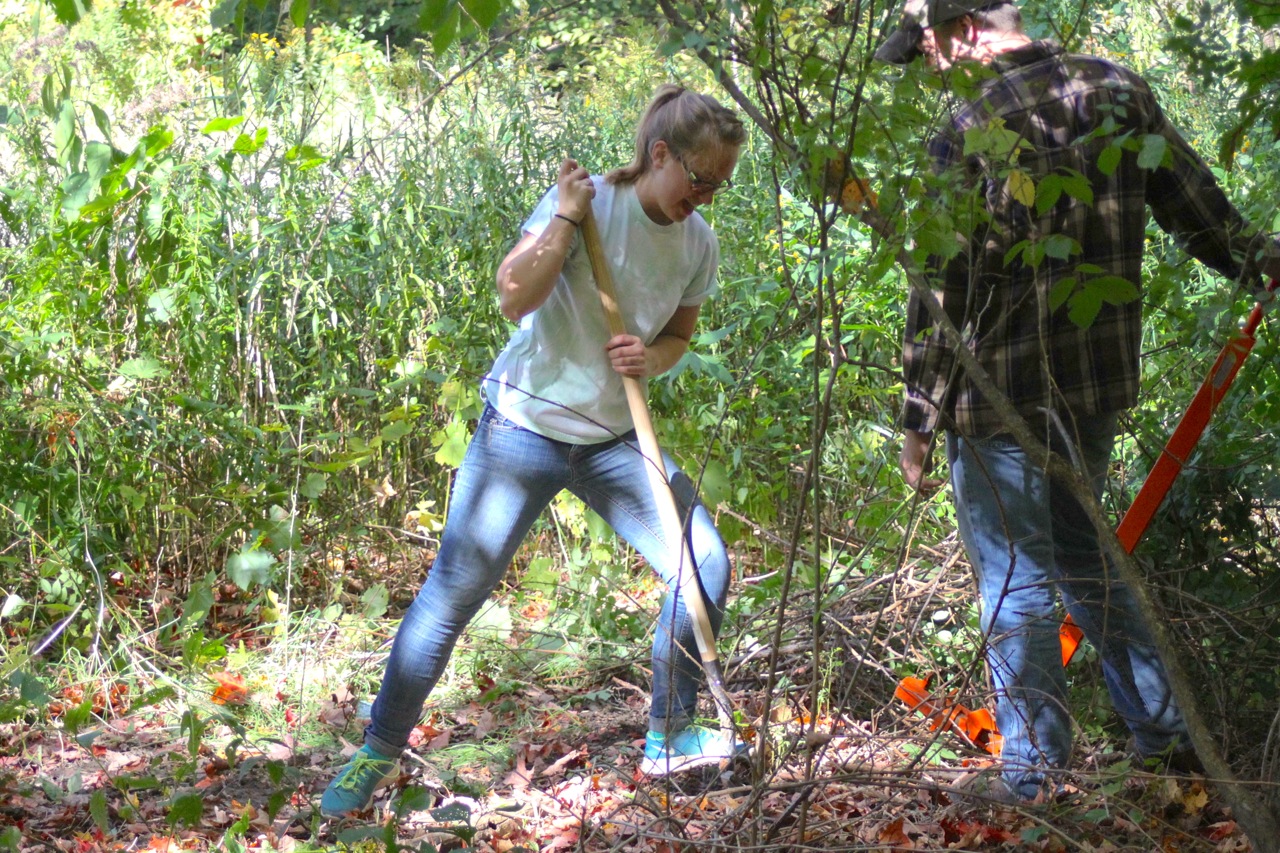
Tom Cermak, Pennsylvania Sea Grant coastal outreach specialist, helps Behrend students remove invasive bush honeysuckle from Wintergreen Gorge.

“This project not only provides valuable, hands on experiences for students, but it also protects and enhances the ecological integrity of a wonderful community asset,” said Tom Cermak, PASG coastal outreach specialist who is working with students to identify, track and remove invasives.

“We at Behrend are very excited to work with Sea Grant to eliminate invasive plant populations throughout Wintergreen Gorge. As these aggressive species are removed, they will be replaced with native plant communities, which will increase biodiversity and help keep the Wintergreen Gorge Ecosystem in balance, ” said Quinn.

You can help maintain the beauty of this popular hiking and biking trail by volunteering to remove plants at planned workdays this summer. Contact Ann Quinn at 898-6993 or abq1@psu.edu.

nps.gov bush honeysuckle1D0EC7E8-155D-451F-678FFC8BDF8B607F-large

Bush honeysuckle is a deciduous shrub that can grow up to 15 feet. This aggressive invader displaces many native plants, including wildflowers and dogwoods.

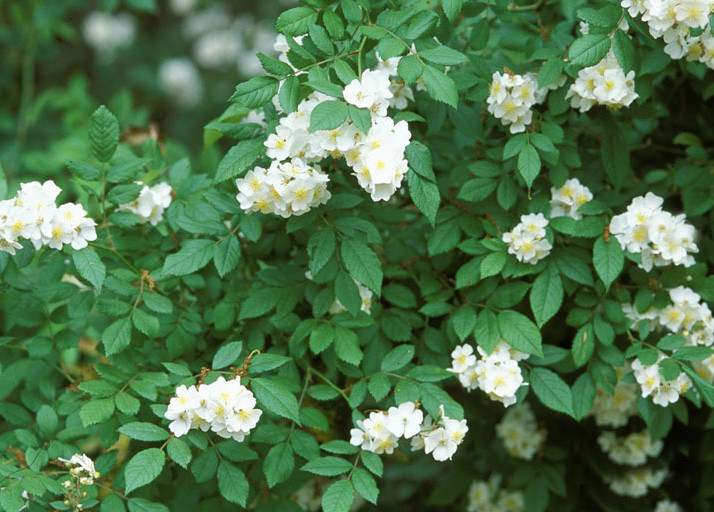
multiflora rose Penn State

Multiflora rose (above) steals space, nutrients, water, and sunlight from native plants and trees.