Behrend student offers disaster relief in Philippines over winter break

1546086_10151849088656262_1393937241_n

By Steve Orbanek
Marketing Communications Specialist, Penn State Behrend

So how’d you spend your winter break?

Relaxing?

Traveling?

Catching up on some z’s?

Penn State Behrend senior nursing major Andres Morales opted to spend his break in a less conventional way.

Morales, along with his wife Katie, father-in-law, and another member of the Federated Church of East Springfield, made a trip to the Philippines this December to offer disaster relief to victims of Typhoon Haiyan and the earthquake that hit the island of Bohol.

Morales, a native of Costa Rica, had been searching for a way to help the relief efforts for some time, and he found his answer after he searched Google and discovered the nonprofit organization, All Hands Volunteers. Like the name implies, All Hands Volunteers is a U.S.-based nonprofit organization offers hands-on assistance to communities around the world.

Through All Hands Volunteers, Morales and his church group set up a relief trip to the island of Leyte in the Philippines. To make the trip, Morales had to give up part of his winter break, but it was an easy sacrifice.

“If they can’t have a nice holiday, then why should I?” Morales said.

1560497_10151849112751262_217180321_n

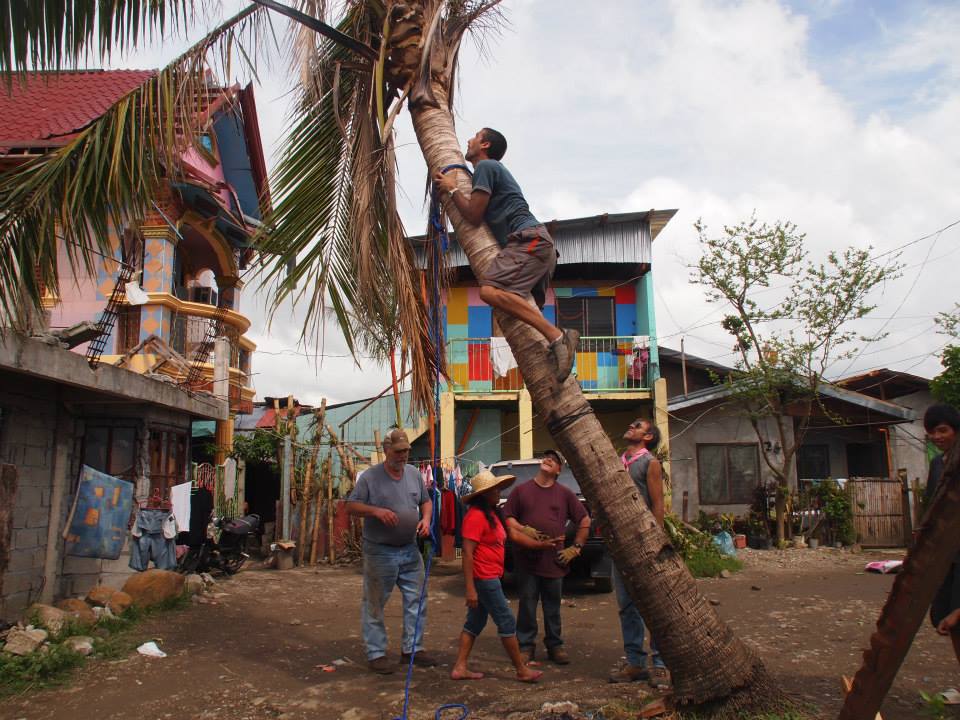
The group arrived at Leyte on December 10. A total of 65 volunteers from all over the world joined Morales’ group, and they spent the majority of their time doing deconstruction work. They took down unsafe homes and also cleared out rubble and trees with chain saws.

Morales said the experience was humbling, and that was especially true after his group took a ride on top of a jeepney.

The jeepney, which is the most popular form of public transportation in the Philippines, took Morales to the area that had been most affected by the typhoon.

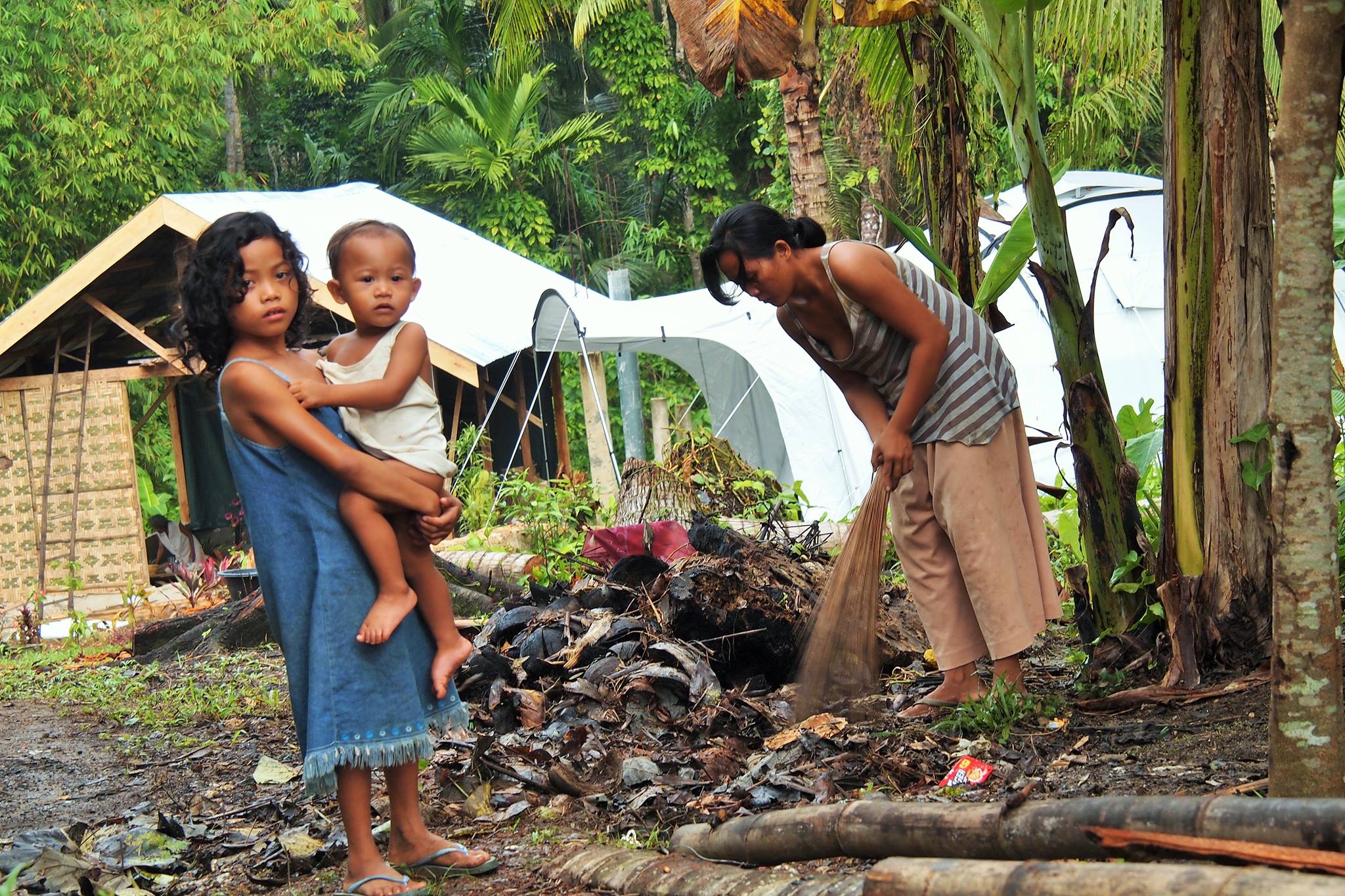
“Entire blocks were just flattened. You couldn’t recognize anything. You would go miles before seeing actual homes,” Morales said. “A lot of us just went speechless. It’s just hard to grasp because you think of the things back home, and then you see these people who lost everything.”

While the natives may have had next to nothing in the way of material possessions, Morales said they never hesitated to express their gratitude toward Morales and the other volunteers.

“Strangers would buy food for us during work time, and they didn’t have much,” Morales said. “All they could afford was a loaf of bread and a Coca-Cola. You didn’t want to accept it, but it meant everything to them.”

1612640_10151886755991262_1572491099_o

On December 20, Morales and his group then took two ferries to Bohol where they began to focus their relief efforts toward the 7.2 moment magnitude earthquake that had struck the island on October 15.

Once again, the group began to deconstruct homes and salvage materials.

On Christmas Day, Morales and his church group returned to the United States. Morales said the trip had a profound effect on him.

“On Sunday, I didn’t want to go out for an easy run,” said Morales, who is a member of Behrend’s track and field team.  “But if the people from the Philippines can get back up from nothing, then why can’t I go on a three-mile run?”

Most importantly, Morales’ trip to the Philippines may have provided him with a sneak peek at his future. He will graduate in May, and he hopes to use his nursing degree to benefit the less fortunate.

“The only reason I want to get a job in critical care and pediatrics is to utilize that experience in another country where there’s not as much access to healthcare,” Morales said. “Our mission was two-fold. Yes, we went there to help, but it also allowed us to get our feet wet as to what the future may hold. Disasters are going to keep happening, and someone needs to be there.”

Dr. Martin Luther King Jr. Annual Commemoration offers great message

MLK day (canstockphoto15309028)

By Steve Orbanek
Marketing Communications Specialist, Penn State Behrend

Dr. Martin Luther King Jr. may no longer be with us, but his dream is alive and well.

Monday marks Martin Luther King Jr. Day, and organizations across the country are prepared to celebrate Dr. King and his legacy. You can count Penn State Behrend among those organizations.

In honor of Dr. King and his dream, the college will hold the 2014 Dr. Martin Luther King Jr. Annual Commemoration. Numerous themed events will be held during the week, including an “I Am His Dream” March, a community service project, viewings of the film The Butler, and more.

Andy Herrera, director of the Educational Equity and Diversity Office, chaired Penn State Behrend’s MLK Committee this year and helped plan many of the events.

I talked with Herrera about the importance of Martin Luther King Jr. Day and the activities planned at Behrend.

Steve: The Dr. Martin Luther King Jr. Annual Commemoration has been a regular tradition at Behrend. Why is this an important week for the college?

Andy: I’ve been at Behrend for the past eleven years, and I’ve chaired the MLK Committee for most of those years. I’m very proud of the fact that Penn State Behrend has always been recognized in the Erie community for its MLK programming. We’ve had speakers ranging from Al Sharpton to Jesse Jackson. I recognized that when I started, and I wanted to continue the tradition of strong MLK programming.

It’s very important for two reasons. The first is the significance of that era in our nation’s history. It’s important for us and our students to learn about the Civil Rights Movement. It was not just about Dr. King, but he was the driving force behind that. The second reason is the message. The message of peace, justice, and equality for all is outstanding. It’s important to commemorate, celebrate, and promote the historic value and message within our campus community, especially to our students.

Steve: This year’s theme is titled “We Are His Dream.” How did you choose that theme?

Andy: Activities and events are planned by the Behrend MLK Committee, which includes faculty, staff, and students. A college-wide invitation is made in September and then different participants come together for discussions about the commemoration. For example, I ask each member of the committee, ‘Why are you on this committee? Why is this important to you?’ Everyone then shares their perspective on why it is important to them, and then we start looking for a theme. We may come up with a theme then and there, or we may look at possible events and performers to provide us with a theme.

When we were looking for performers this year, we ran across Michael Fosberg, who has a play called Incognito. The play details Fosberg’s life experience of being adopted and growing up to find out his father was an African American, which was an incredible realization for him. He then starts to try to figure out his background and identity. The story sounds incredible, so we decided to invite Michael and have our theme revolve around identity. We then started to think about who we are as a college. Of course, we are Penn State. But we also believe we are the type of community where all are respected, where there is equal justice, and where there is harmony. Hey, that sounds like Dr. King’s dream. So, in a way, we are his dream.

DSC_0800

Steve: How has the MLK Commemoration changed since you started at Behrend eleven years ago?

Andy: When I first started, the luncheon used to be a breakfast, and we wanted to do it before everyone went back to work, so it would be at 7:00 a.m. If we were lucky, we would have one student show up. At some point, we decided to turn it into a brunch, and it helped. This year, we made it a lunch to help us fit in the march. The events have remained similar, though. We always try to have events that are meaningful and entertaining. We also try to do at least one community service project. This year, we will be partnering with the Erie City Mission to feed needy families. In the past, we have done Habitat for Humanity, and we did a college fair for Diehl Elementary School.

Steve: I can tell that a lot of planning and preparation goes into all of these events. What’s the ultimate goal in mind?

Andy: I think the ultimate goal is for people to learn about this time period. Students have some level of knowledge now, but it’s always good for them further learn about these moments in our nation’s history. Most importantly, I want them to be inspired to become better people.

Steve: Do you see the Dr. Martin Luther King Jr. Annual Commemoration remaining a staple here at Behrend?

Andy: This is something that I think we’ll continue to do for as long as I’m here. This occasion is a good time to pause and ponder about that era and how it impacted our society for the better. Every year, I think this MLK Commemoration lends itself to a moment of reflection. Hopefully we can continue to learn about it, and also find inspiration in knowing that the efforts made during that time period have helped us become a better society and community.

Scheduled events:

Monday, Jan. 20:  Incognito. Acclaimed author and performer Michael Fosberg shares the story of his personal journey to discover himself, his roots, his family, and the difficult history behind the tragic American complexity of “race.”
Campus Family Luncheon, 11:30 a.m., McGarvey Commons
(Presentation begins at noon).

Tuesday, Jan. 21: Students and MLK Commemoration Committee members will visit the Early Learning Center and conduct activities with the children related to MLK.
Early Learning Center, 3:30 p.m.

Wednesday, Jan. 22: The Butler. The Lion Entertainment Board presents the story of White House butler Eugene Allen, who witnessed great social change while serving eight different presidents over thirty years.
9:00 p.m., Reed Auditorium
(The film will be shown again at 9:00 p.m. Thursday, Jan. 23, and at 10:00 p.m. Friday, Jan. 24, and Saturday, Jan. 25.)

Thursday, Jan. 23: “Who’s Cooking What?” The MLK Committee will partner with the Erie City Mission to help serve lunches to needy families. The committee will fundraise to purchase the ingredients, and students and volunteers will serve the families.
8:30 a.m., Erie City Mission

Penn State Behrend’s Highlights of 2013

By Steve Orbanek
Marketing Communications Specialist, Penn State Behrend

It’s hard to believe, but 2013 will soon be a thing of the past.

The year was a busy one here at Behrend. Most notably, we welcomed the second-largest freshmen class in school history, and our fall athletic teams also achieved unprecedented success.

Of course, those were just two of the more memorable happenings from this past year. I’ve always enjoyed the various “Year in Review” articles and videos that circulate toward the end of each year, and why should Behrend be left out of all the fun?

Take a moment to watch the video above to see a slew of the college’s 2013 highlights.

Happy New Year to all, and here’s to 2014!

Story behind the Hanging of the Greens (the college’s oldest tradition)

Hanging the Greens

By Robb Frederick
Public Information Coordinator, Penn State Behrend

In December 1948 – just two months after the dedication of what was then called the Behrend Center – T. Reed Ferguson, the administrator of the new campus, placed a wreath on the doors of a small chapel in Wintergreen Gorge Cemetery.

That was a favor to Mary Behrend, who had donated her family’s Erie farm property to Penn State. She had moved to Connecticut and was unable to visit the chapel, as she had in years past. She asked Ferguson to hang the wreath in honor of her husband and son, who were interred inside.

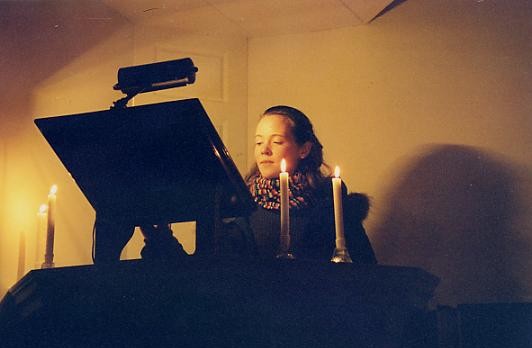
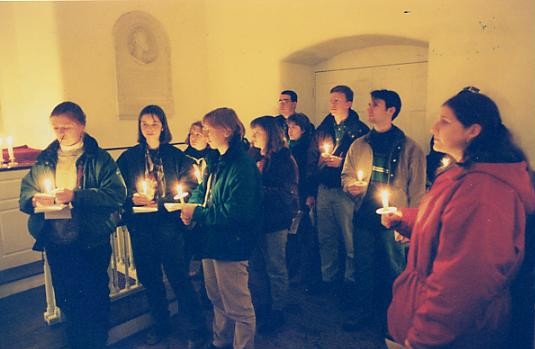
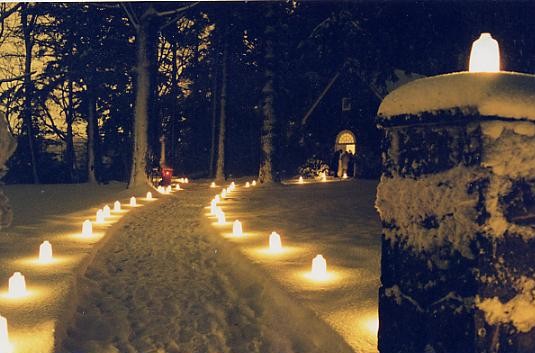
Every year since, a small group of students, faculty members, staff and alumni has returned to the chapel. Holding candles, they sing Christmas carols and give thanks to the family that made Penn State Erie, The Behrend College, possible.

A reading

This year’s program will begin at 7 p.m. Friday, Dec. 6. Shuttle service will be offered from the Reed Union Building.

“It’s a very different feeling, when you gather in there,” said Ken Miller, senior director for campus planning and student affairs. “You’re singing Christmas carols. Everybody’s holding a candle. It’s special.”

Singing

The program honors Ernst and Mary Behrend, whose 400-acre farm property is now a four-year college with 4,350 students. It also pays tribute to their son Warren, who died on Dec. 19, 1929, while driving to South Carolina for a family holiday. He had swerved to avoid a school bus, which a 16-year-old student was driving.

No one on the bus was hurt.

Warren’s death devastated the Behrends. “They say Ernst never got over it,” Miller said.

Mary Behrend spent less time at the farm, choosing instead to live at the family’s home in Connecticut. In the spring of 1948, while returning from a cross-country trip, she stopped at the property. From a window, she noticed two men walking. She went out to talk and learned they were scouting land for a new Penn State campus. Within six months, they would have it.

Entering the chapel

Paint the campus purple for #AJO

ajo

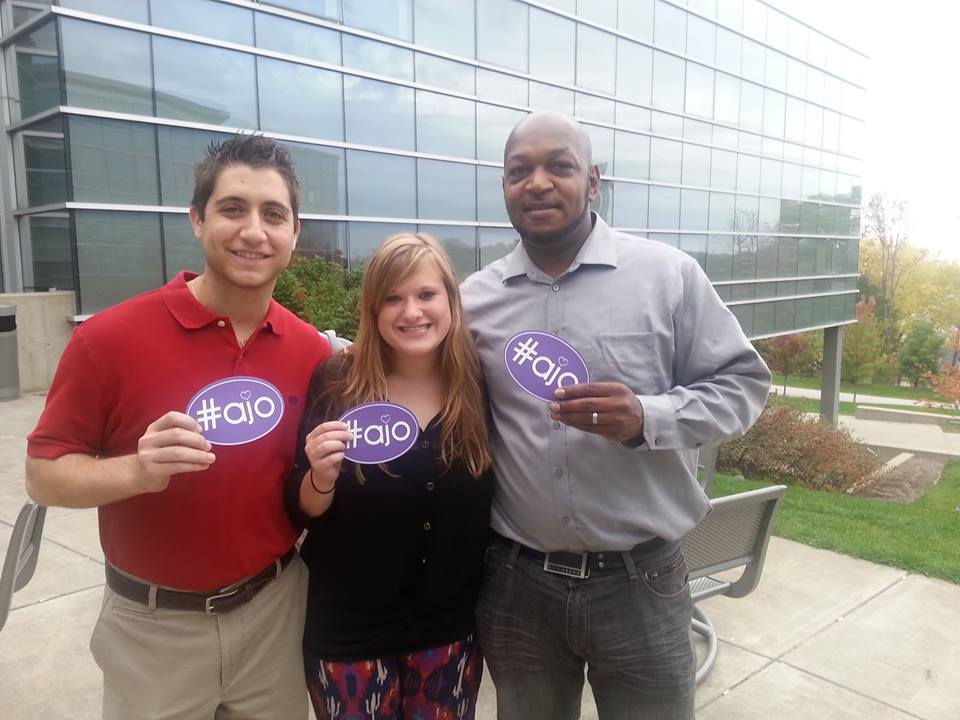
From left, Anthony Cremonese, Melissa Lichtinger, and Antoine Holman are part of the student team working on the #AJO Forever Foundation website.

By Heather Cass
Publications & Design Coordinator, Penn State Behrend

Melissa Lichtinger, a senior majoring in international business and marketing, was working at the Make a Wish booth at a women’s expo in Erie this October when she met Alyssa O’Neill’s father, Jason, and knew she wanted to do whatever she could to help with the #AJO campaign.

AJO stands for Alyssa J. O’Neill, 18, who was a first-year student at Penn State Behrend when she died after suffering a grand mal seizure at home. The day before her death, O’Neill had texted her mother, saying they should meet at Starbucks for a pumpkin spice latte. After her funeral, her parents, Jason and Sarah, bought ten of the drinks for strangers. The barista marked the cups—using purple, a color associated with epilepsy awareness—with #AJO.

That spurred a far broader pay-it-forward campaign. People paid for strangers’ meals, gas, groceries and layaway purchases. They sent #AJO photos from London, Iraq and the Canary Islands. It’s still going. The #AJO Forever in Our Hearts Facebook page has more than 41,000 “likes.”

“Jason said that he and his wife were overwhelmed just trying to keep up with the photos and correspondence pouring in through the AJO  Facebook page,” Lichtinger said. “I wondered how, with my background in marketing, I could help them.”

She asked Dr. Kathleen Noce, senior lecturer in management information systems, if Partnership Erie, a nonprofit outreach extension of the Sam and Irene Black School of Business, could develop a new eCommerce website and social media strategy for the AJO Forever foundation.

Noce agreed and Lichtinger recruited four more students—Anthony Cremonese, Antoine Holman, Kelsie Noce, and Michael Thompson—to work on the project with her.

The new site is expected to be completed by the end of the year.

But Lichtinger didn’t think that was enough. “I really wanted to do something to raise money for the foundation,” she said.

So she talked to Rhonda Reynolds, a Housing and Food Services employee who helped create a very successful employee service committee, and together they came up with the idea to “paint the campus purple” on Tuesday, Dec. 10.

Students, faculty, and staff are all invited to wear purple and take part in making the letters #AJO for a group photo on Dec. 10 at 4 p.m. in the Clark Café in the Jack Burke Research and Economic Development Center. Participants are asked to give at least $2 to the AJO Forever Fund to be a part of the photo.

Students will begin collecting donations at 3 p.m. The first 200 to donate will receive a free purple hat!

The event is sponsored by The Sam and Irene Black School of Business, Partnership Erie, Behrend Commission for Women, the School of Nursing, and Grimm’s Embroidery.

Hope to see you there!

Behrend students humbled by poverty simulation

image

By Steve Orbanek
Marketing and Communications Specialist, Penn State Behrend

According to the United States Census, 15 percent of Americans, roughly 46.5 million people, live at or below the government-defined poverty line.

For an hour this fall, Khardiata Mbengue and Teireik Williams could be counted among that group.

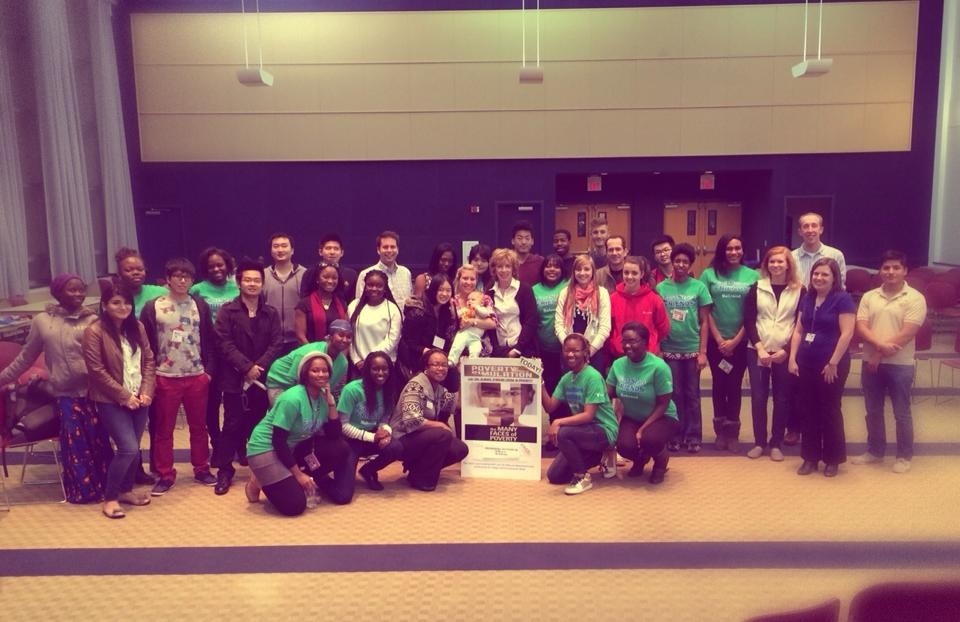
Mbengue and Williams were participants in a poverty simulation sponsored by the Office of Educational Equity & Diversity Programs and the Human Relations Programming Council.

The simulation is designed to help participants understand what it’s like to live in a low-income family, surviving from month to month. Individuals are grouped together as families and are tasked with providing for basic necessities and shelter during the course of four 15-minute “weeks.”

For Mbengue, a junior biology major, and Williams, a sophomore communication and creative writing double major, the simulation was a humbling experience.

The two were paired up as husband and wife as part of the simulation.

I caught up with them to get their thoughts on the program…

Steve: Hi Khardita and Teireik. Thanks for taking the time to join me today. So, to start, why don’t you provide me with a general overview on the poverty simulation?

Khardiata: The poverty simulation is basically designed to help you get insight on how you would live if you were less fortunate or part of a low-income family. Going through the poverty simulation makes you realize how people often live in impoverished conditions even when it’s not their own fault. The system is against them, so they can never work their way up. You also realize that you’re never too far away from the life that they live. After college, we might be doing the same thing that we were doing in the poverty simulation.

Teireik: The poverty simulation provided us with an opportunity to have the same responsibilities of a person who is poverty stricken. It was really designed for you to live a day in the life of the less fortunate.

Steve: How exactly was the simulation set up?

Teireik: The room is divided into different circles, and each circle had chairs that represented a family. Surrounding the housesholds were all of the different businesses and organizations that you had to visit. You also had to purchase a transportation pass for anywhere that you would go. Before the simulation, they gave you a portfolio that had every aspect of your life: how old you were, your family’s history, your savings and your belongings. Everybody’s budget was different. We had savings, and everybody had possessions and things that could be sold for extra money.

Khardiata: And there was a cop, so you could go to jail if you did something wrong.

DSC00083

Steve: Wow, so you could break the law during the simulation?

Khardiata: Someone actually did that, and that person was the only one in the entire simulation who was able to pay their own bills. It just goes to show that it can be difficult to survive, even if you live an honest life. It puts you in a situation where you do what you have to do.

Steve: So, can you give me an idea of what a typical day was like for the both of you?

Teireik: She had to go to work, we had to take the kids to school, we had to pay bills, we had to sign up for benefits like food stamps, and we had to sell our belongings if we ran out of money.

Khardiata: I literally had to run to work, so I would be there on time to receive the full benefits of my work. Even if your child did something wrong at school, it would affect your whole life.

Steve: What do you mean?

Teireik: Our daughter got suspended at school, so one of us had to be at home to take care of her. Khardiata had to go to work, so I was unable go out and pay our bills, search for a job or apply for benefits.

DSC00086

Steve: It seems like the simulation required you to balance a lot of different responsibilities. How humbling was this experience for you?

Khardiata: It was incredibly humbling. It showed me that you should be grateful for everything you have because not everyone is as fortunate. We did this for an hour, but the fact is that many people actually live this life. That was eye-opening for me.

Steve: People living in poverty sometimes get a bit of a bad reputation. Did this change your perspective on them at all?

Khardiata: When I went into the Poverty Simulation, I had that same idea. I thought that if people are in poverty, they could work themselves out. But my opinion changed after living through it. We were doing all we could just to pay our bills and raise the kids, but it still was not enough. Expenses pile up on top of each other. As soon as you thought you had something handled, something else would pop up. That was a major thing that I learned.

Teireik: This simulation shows that not everyone is afforded the same opportunities, and sometimes bad things happen to good people. It’s just out of their control. It’s not necessarily their fault, but they get a bad reputation for it.

Steve: This was the second year for the Poverty Simulation at Behrend. Is this something that you would recommend to others?

Khardiata: Yes, definitely I would. It makes you think, what if this does happen to me? It’s not farfetched to think that it could happen to you. It’s a very realistic thing, and it humbles you a bit. As college students, we seem to think that we’re all struggling, but it’s not as bad as it seems.

Teireik: People should definitely experience it. If you get an opportunity to do something like this, why not? It’s much better to experience poverty through a simulation rather than for real.

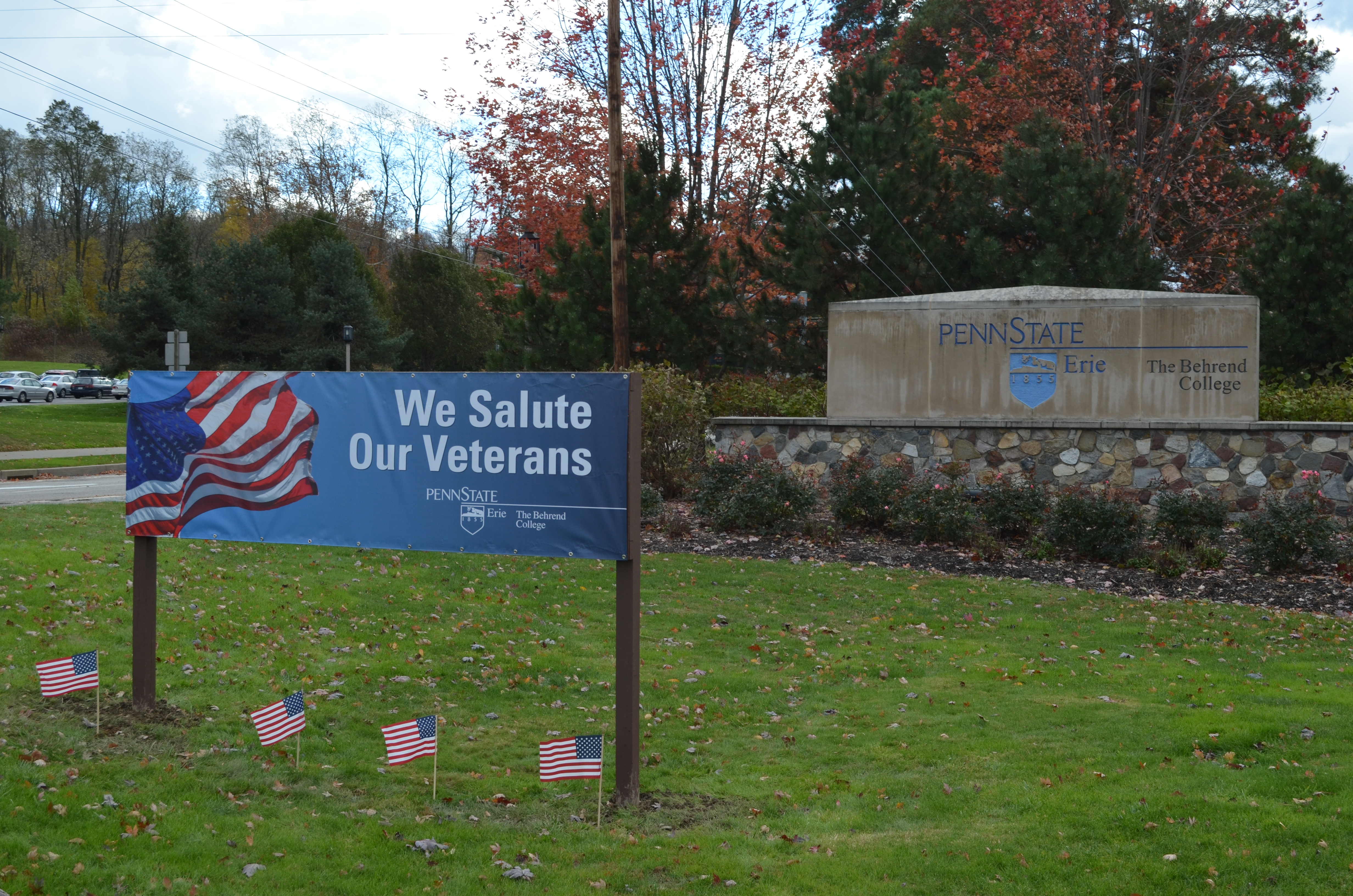
Veteran’s Day of particular significance for Behrend freshman

DSC_3367

By Steve Orbanek
Marketing Communications Specialist, Penn State Behrend

Papers and exams can be a point of stress for first-year students, but it’s not the kind of stress that Mike Wehrer knows.

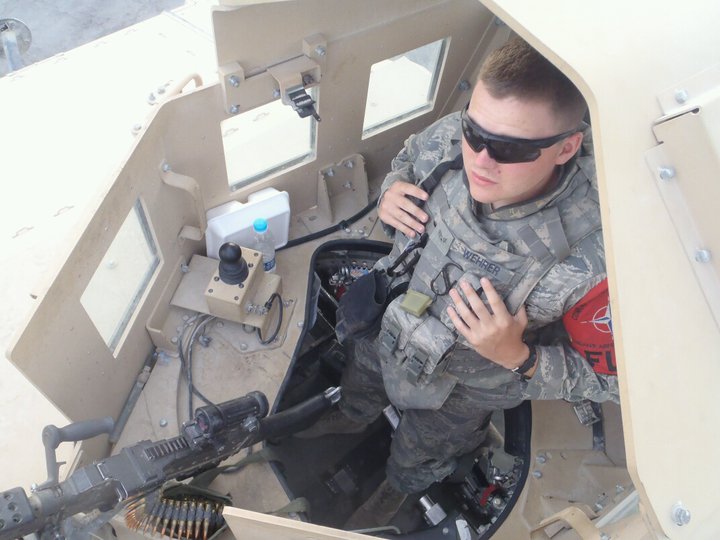
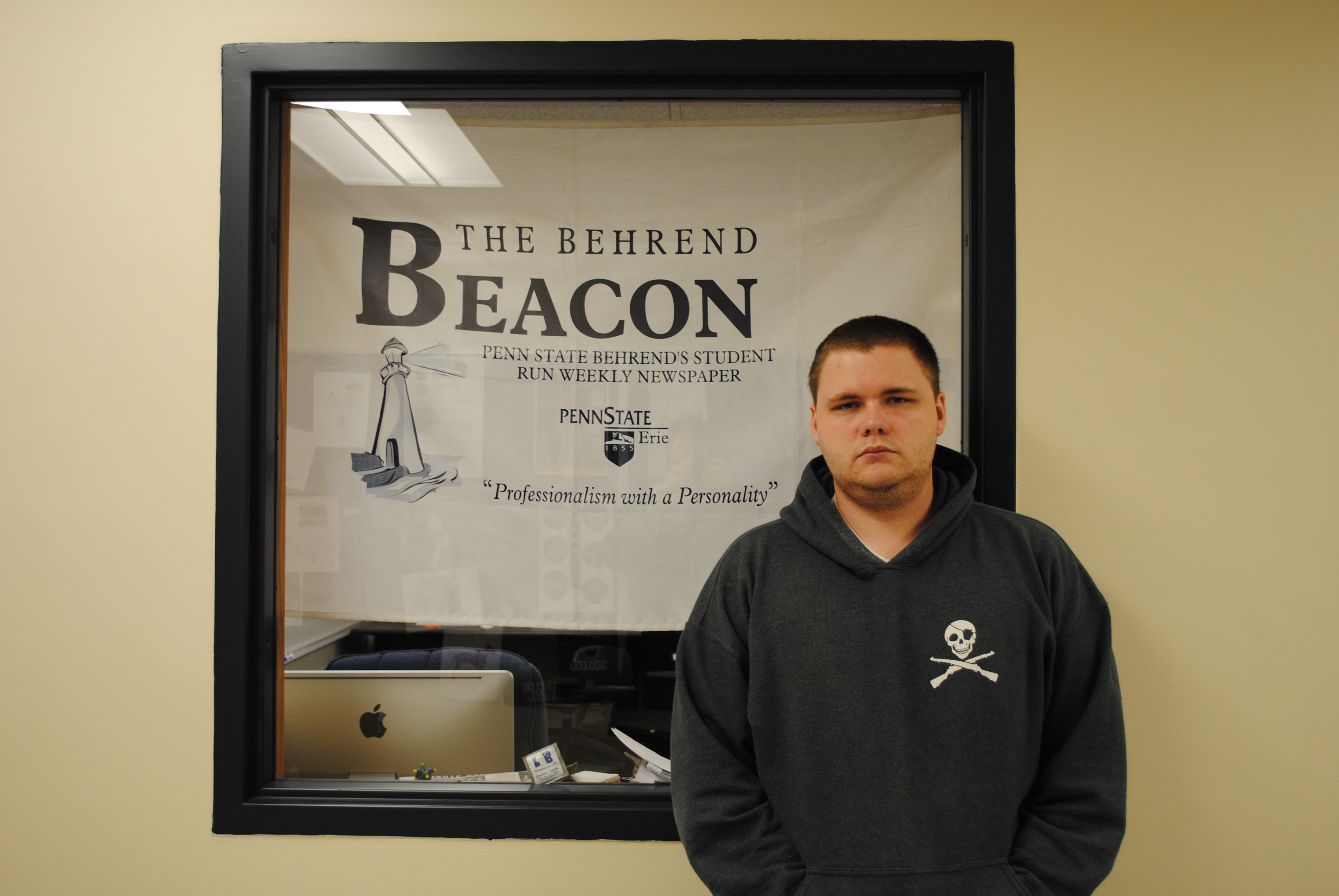
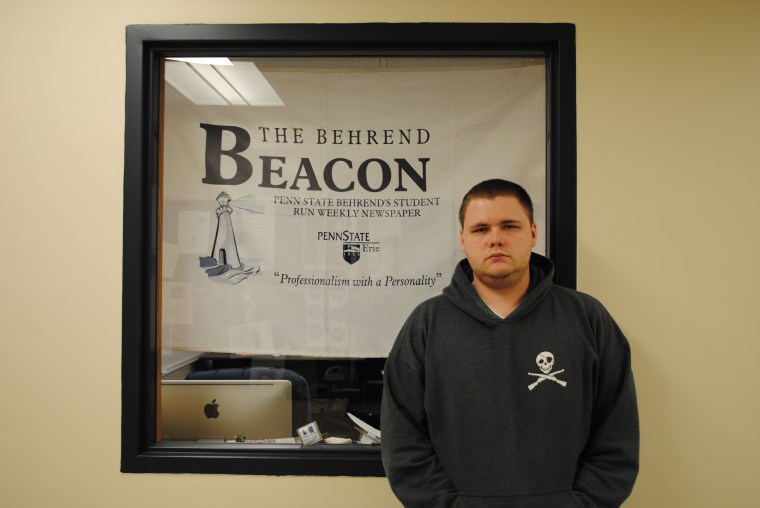
Wehrer, a freshman communications major and current managing editor of the Behrend Beacon, is a member of the United States Air Force Reserves. The 23-year-old Girard, Pa., native spent a half year deployed in Afghanistan in 2011, and it’s safe to say college exams pale in comparison to some of the things that Wehrer experienced.

In honor of Veteran’s Day, I decided to catch up with Mike to get his thoughts on the national holiday and find out what personal significance it holds for him. While many Americans may think of Veteran’s Day as just another day off of work, for Mike and more than 21 million others, this day is a part of their identities.

Here’s what Mike had to say on the topic:

Steve: Hi Mike, thanks for taking the time to chat with me. Could you give me a feel for your background and what ultimately led you to enlist in the military?

Mike: Well, I started out at (Penn State Behrend) out of high school, but basically ended up dropping out after two semesters. I wasn’t a good student and I lacked motivation. It made sense to join the military to help pay off the student loans I already had, and also to help provide the discipline and motivation I needed to grow up a bit.

Steve: When did you enlist in the Air Force Reserves, and what was your experience like from there?

Mike: It was December 2, 2009, and I was 19. I left for basic training in February, I think it might have been Valentines’ Day actually, and that was at Lackland Air Force Base in Texas. Then I entered the Air Force Security Forces Academy. From there, I joined my current unit at Niagara Falls at Niagara Falls Air Reserve Station. I was told when I got there that I’d be on the next deployment.

Steve: Wow, that had to be startling to have the deployment come so quickly. Was that scary?

Mike: It’s what I wanted. The reason I joined security is because it’s the most deployed career field in the Air Force. I thought it would be a good thing for my career. I want to be a war correspondent and an embedded reporter, and I thought it would be a good resume point.

Steve: When was it that you were actually deployed, and what was it like once you got to Afghanistan?

Mike: I left Erie in May, but I actually hit Afghanistan on July 7, 2011. There’s a famous quote, I’m not exactly sure what it is, but it’s along the lines of “there are long periods of boredom punctuated by moments of sheer terror.” I was security for Kandahar Airfield, which basically meant I was controlling access onto the airfield and responding to rocket attacks.

Steve: What was that pressure like? Was it difficult to have such responsibility right away?

Mike: You kind of didn’t have a choice but to do it. You had to accomplish it. If you didn’t, they’d find someone else who could.

268870_1842559423342_4954398_n

Steve: Switching gears a bit, when did you come back to the United States, and enroll back here at Behrend?

Mike: I left Afghanistan on January 15, 2012, and I got back on January 20. It’s been four years since I was last enrolled here, and I applied for and basically got an academic reset. That’s not what it’s called, but that’s basically what it did. It allowed my GPA to go back to zero, so I could start from scratch.

Steve: Was returning to college always a goal of yours?

Mike: It was always a goal. I knew what I wanted to do.

Steve: Why did you choose to come back to Behrend? This fall, Victory Media once again ranked Behrend among the top 20 percent of Veterans Affairs-approved institutions based on the services and resources they offer to military-connected students. Did that factor into your decision at all?

Mike: I had been freelancing last year for the Behrend Beacon, and I knew that I could get a good position on the paper right away. If I went to any other school, I didn’t know if I would have those opportunities right away.

Steve: Would you say your experiences overseas have had an effect on your current college experience?

Mike: Yeah, definitely. It’s small changes, like I always look around a room whenever I walk in it. Half of that is my deployment, and half of that’s just being a cop. As far as academically, it kind of made me realize how easy college really is.

Steve: To follow up on that, you mentioned earlier how you initially enlisted in the military to help improve your discipline and motivation. Do you feel as if your experience overseas has helped you do that?

Mike: I definitely got that. I have realized that not going out on the weekend, and having to stay in and do homework is not a big deal. There are much harder things that I’ve gone through, and that I’ve seen others go through. This is all easy, and it’s easy to make these sacrifices.
DSC_0577

Steve: With Monday being Veteran’s Day, can you give me an idea of how it feels for you personally on that day?

Mike: It’s hard to define. It makes me proud. I’ll probably wear a pin or something. The VA class defines me as a combat veteran because it was a combat mission, but I don’t see myself as a combat veteran because I never had to fire my weapon. So, I still don’t like to call myself a combat veteran because I know guys who have been shot, wounded, or had to kill someone, and to put myself in the same class as them seems not disrespectful but close to it.

Steve: As a veteran yourself, how would you suggest people go about honoring this holiday?

Mike: It’s the small things. Thanking people in uniform means a lot to veterans. Making a donation to something. And, of course, there are a thousand different organizations that you can donate to. Give time, money, whatever you can. My dad has worked with homeless veterans at the VA, and a lot of people don’t realize how many people can’t cope with coming back. You can also always send care packages to those who are still over there, especially now that we’re getting closer to Thanksgiving and Christmas.

6 spooooky things about Penn State Behrend

spooky

By Heather Cass
Publications & Design Coordinator, Penn State Behrend

In honor of the upcoming All Hallows’ Eve festivities, I dug up six spooky (and some just silly) things about Penn State Behrend.  Enjoy!

1. There’s a place in the Wintergreen Gorge on  the edge of campus called “Devil’s backbone.”

Wintergreen-Gorge-Photos_018

Devil’s backbone is the name given to the gorge’s highest vantage point in Wintergreen Gorge, about 250 feet above Four Mile creek. Read more about the gorge (page 13) and watch videos here (under “Extras from this issue”).

In the mood for a good ghost story? Check out this story we found online (but do not attest to): The Ghost Child of Wintergreen Gorge.

Speaking of enduring ghosts haunting campus…..

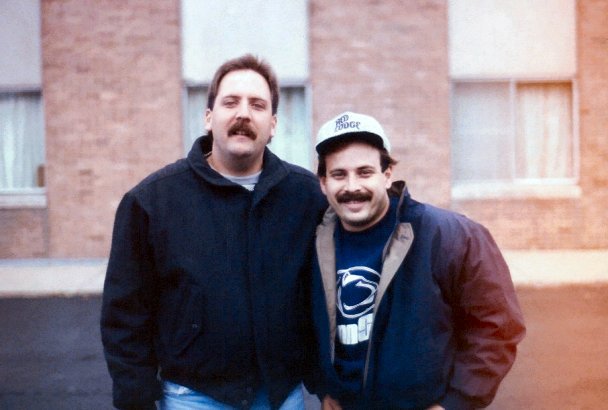
2. Ken Miller, senior director for campus planning and student affairs, has been working at Behrend since George Michael’s “Faith” topped the pop charts, “Heathers” was showing at the theatres,  and the average cost of a gallon of gas was just 91 cents.

Are we making him sound old? Nah, it’s only been 25 years. 😉 And, fortunately, he hasn’t lost his sense of humor…or that awesome ‘stache.

ken miller

Ken Miller, right, with his brother Tim outside of Lawrence Hall, circa 1989.

3. This tree by Wilson Picnic grove:

tree wart

According to Dr. Mike Naber, lecturer in geosciences, the “tumor” on this tree could be Agrobacterium tumefaciens that causes a plant disease called crown gall. Or, Nabor said, it is simply a “burl” caused by stress, injury, or a virus.

Or it could be a zombie calling card.

Speaking of signs from the dearly departed…

4. Bruno’s Café is named after a dead dog. Even spookier? Legend has it that said dog is buried on campus.

Bruno's Portrait

So, if you hear a German shepherd howling late at night…

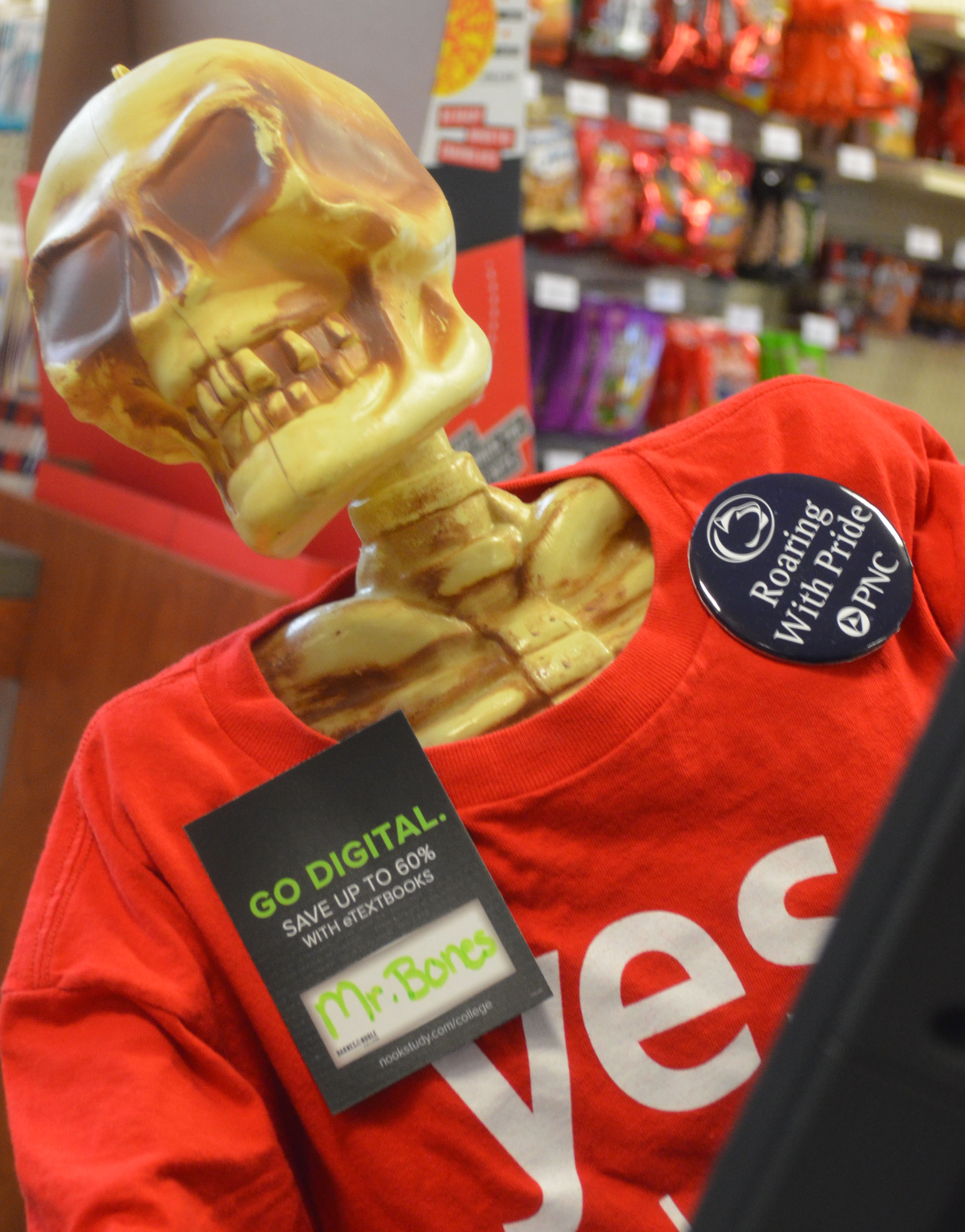
5.  The cashier at the bookstore has gotten really thin.

DSC_0979

Somebody get this guy a peanut butter sandwich.

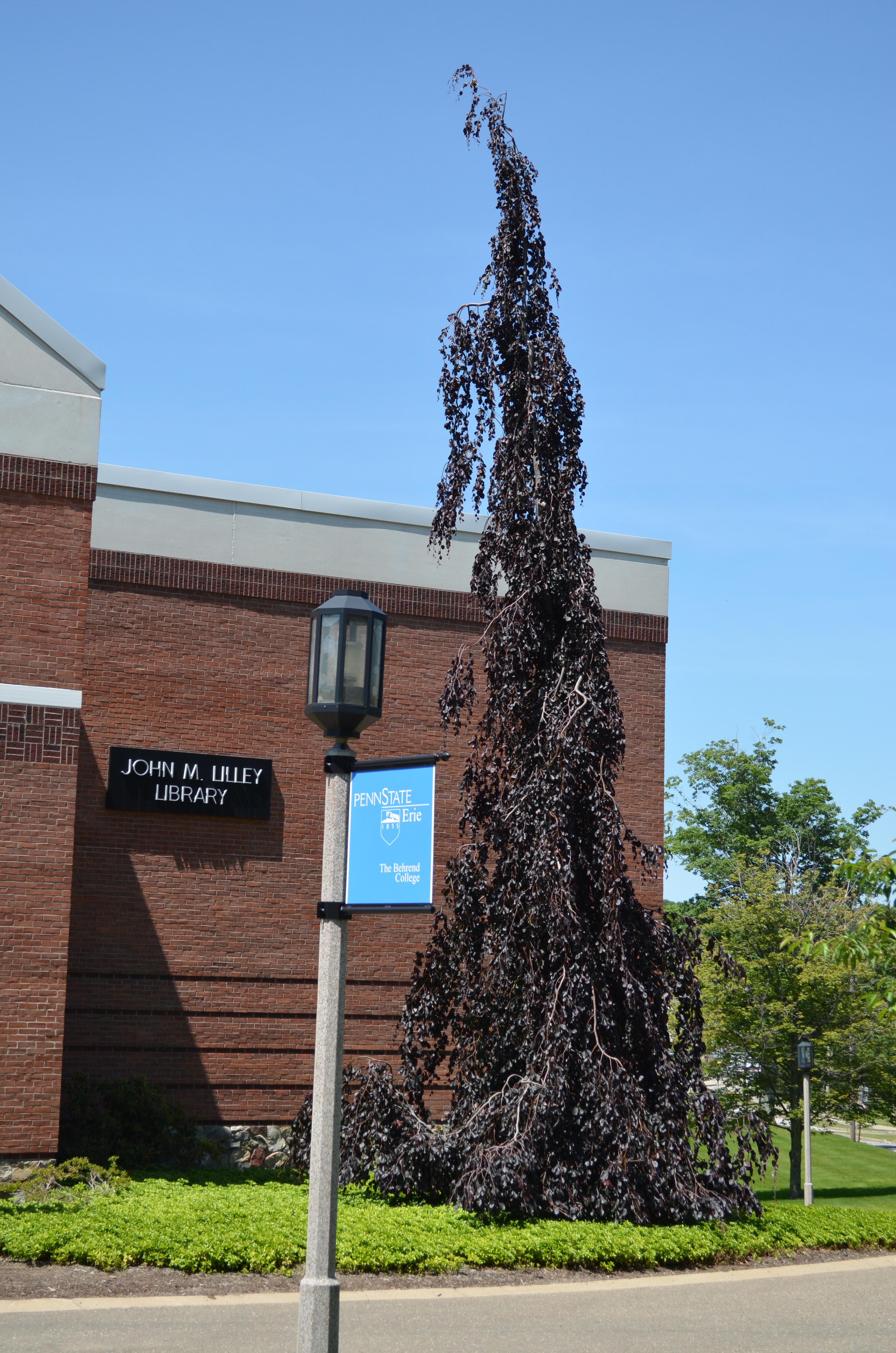
6. This tree by Lilley Library:

DSC_0551

While it’s shaped like a witch’s hat, this is actually a Purple Fountain Weeping Beech, native to Europe.

You know, Europe…where Transylvania is (just sayin’).

Happy Halloween, everyone!

Penn State Lives Here

Penn State Lives Here_010

If you’ve been anywhere near Penn State Behrend (or any Penn State campus across Pennsylvania) recently, you’ve probably noticed there is a new brand initiative — “Penn State Lives Here.”

The initiative was publicly introduced with a two-minute video during halftime of the Michigan game on Saturday, October 12, in Beaver Stadium on the University Park campus.

The theme made its appearance at Penn State Behrend yesterday:

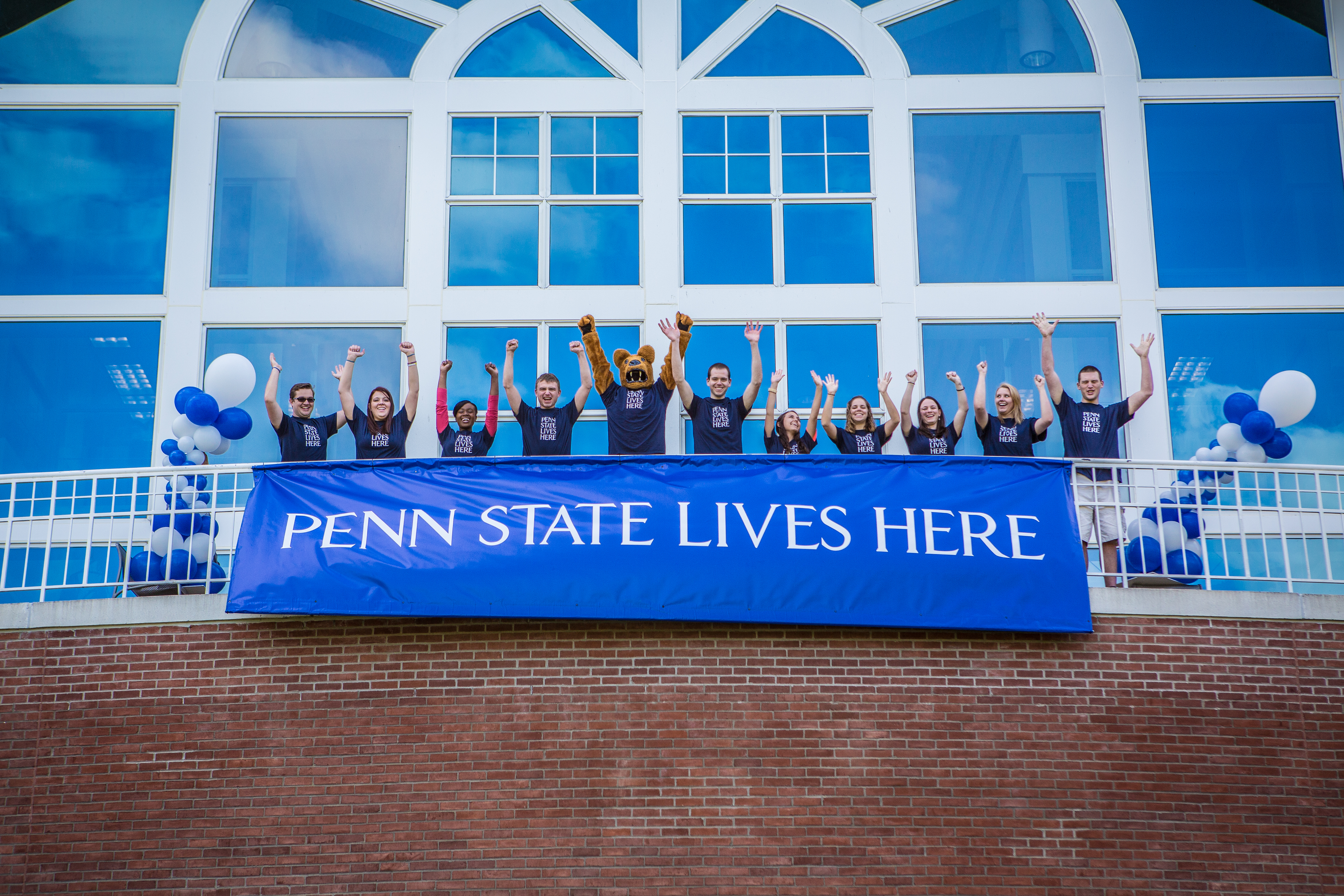
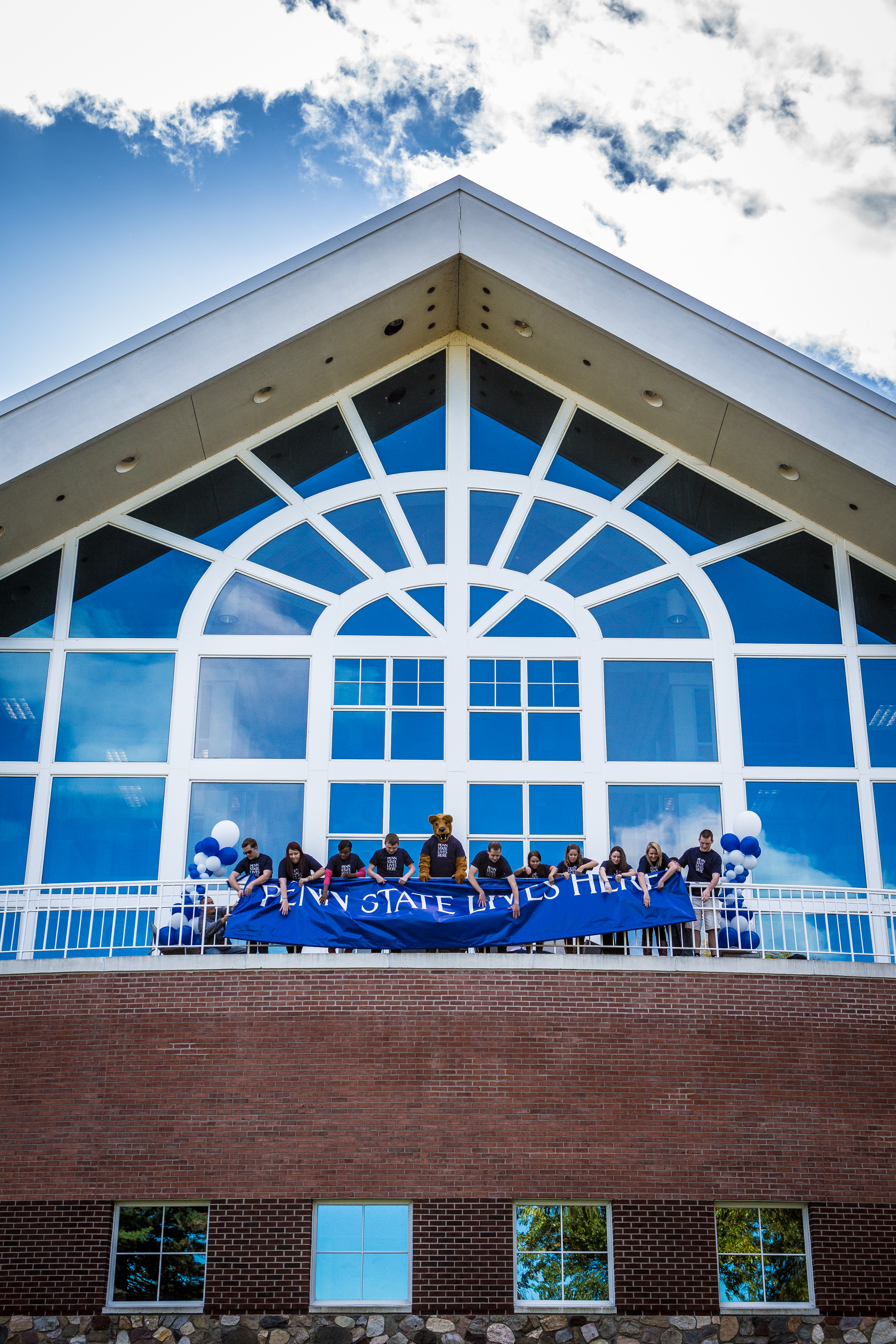
* Ten students and the Penn State lion unfurled a twenty-foot banner that now hangs off the balcony at John M. Lilley Library.  (Thank you, Mother Nature, for providing picture-perfect outdoor-event weather!)

Penn State Lives Here_004

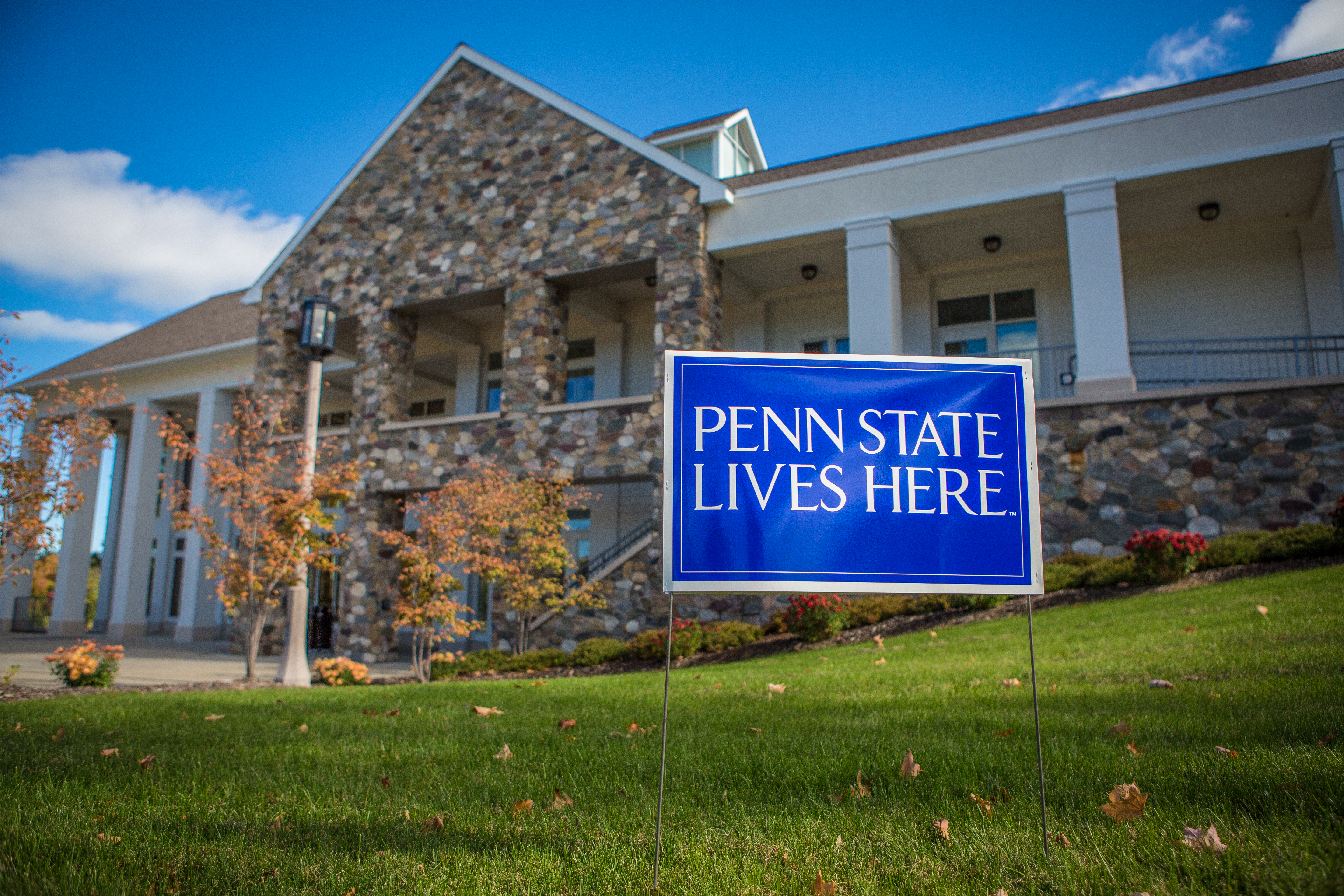
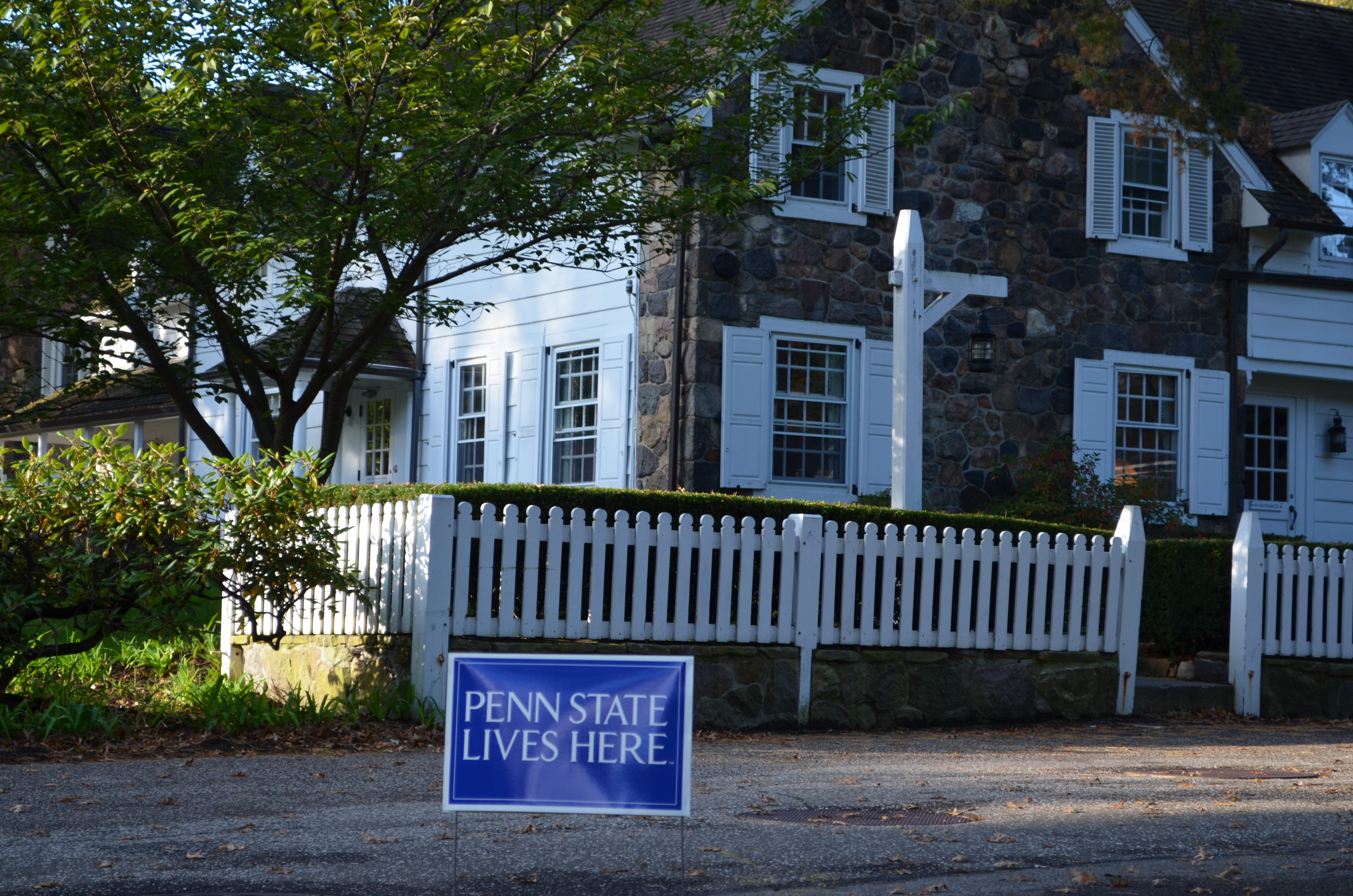
* Twenty lawn signs popped up all around campus.

DSC_1794
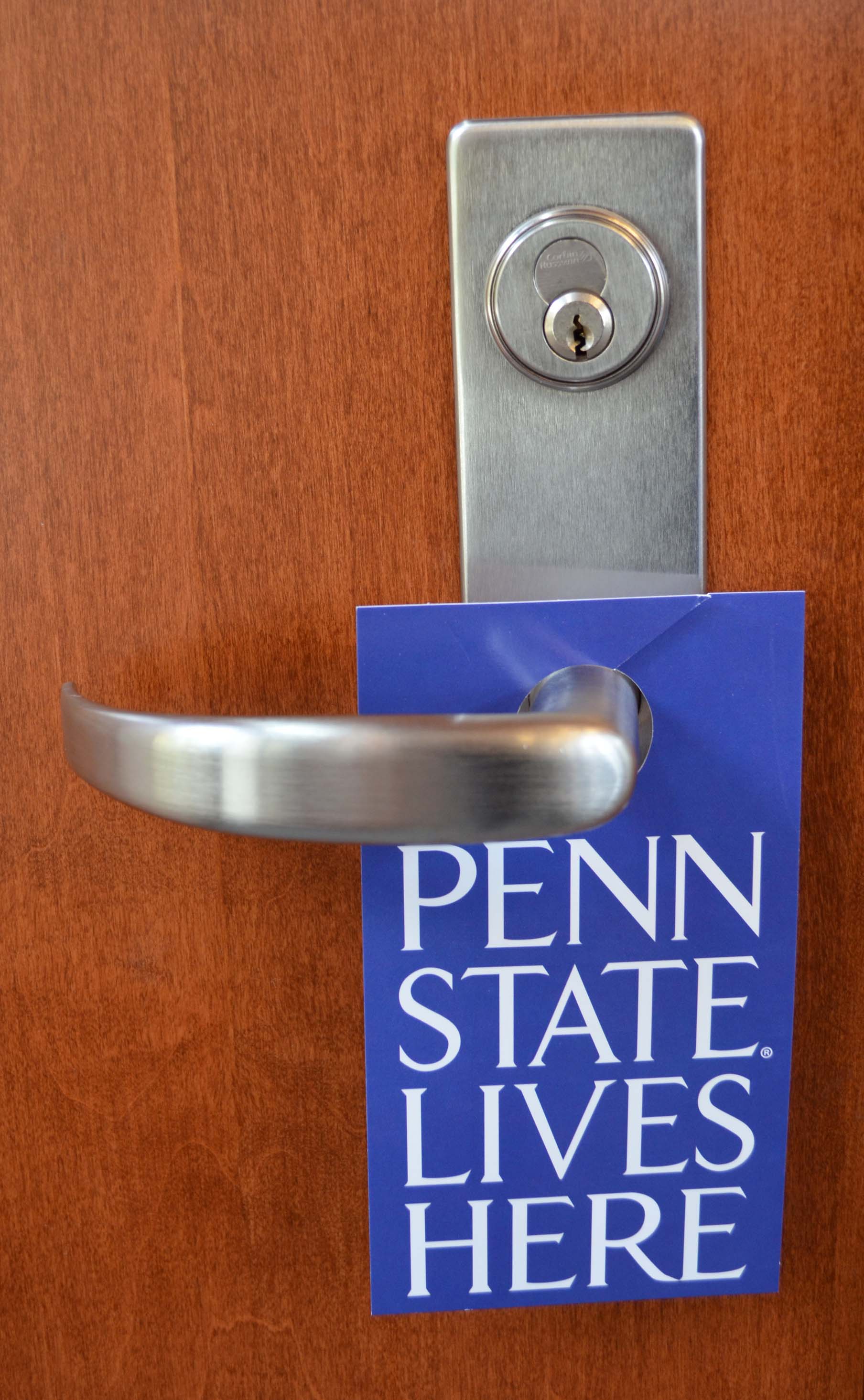
* “Penn State Lives Here” doorhangers were hung on throughout the residence halls.

doorhanger

* “Penn State Lives Here” buttons, vinyl window clings and paw print cookies (delish!) were distributed at lunchtime at Bruno’s, where the campaign video was aired for students, staff, and faculty.
DSC_1795

Clearly, Penn State lives here at Behrend.

So, what does it all mean? What is our branding message about?

Here is an explanation, from the folks who created it:

“Penn Staters are not only high academic achievers, they’re doers. They are nurtured by a culture that encourages setting lofty goals and investing the effort to achieve them. They are molded in an environment that values success, teamwork, and service to others—and graduate intent upon living purposeful, inspired lives. All universities talk about producing leaders, but ask employers where they go to find individuals who inspire others, know the value of hard work, and lead by example. They find them at Penn State.”

Excellence. Innovation. Passion. Collaboration.

These are the things that live at Penn State.

Watch the video here and see for yourself.

Penn State Lives Here_003

Students: Join us on Monday for unveiling of PSLH

branding

Penn Staters make an impact everywhere. Now, there’s a brand initiative that puts it right out there.

The University will introduce the initiative on Saturday, October 12 during halftime of the Michigan game in Beaver Stadium. Penn State Behrend will be unveiling the brand message on Monday (October 14), and students are invited to be part of the announcement.

At 11 a.m., Lilley Library Lawn:
Come watch as your fellow students unfurl a big banner with the theme of PSLH (that’s your only hint!) from the balcony of Lilley Library facing the Bayfront Highway. If you can attend, you’ll see the action from the lawn just below.

At 12:15 p.m, Bruno’s Cafe:
See a short yet dynamic video, grab a cookie, and get your free theme button and vinyl window cling–while supplies last!

Join us Monday to see and hear just how PSLH.