Political Science student published in Wall Street Journal

By Heather Cass, Publications Manager, Penn State Behrend
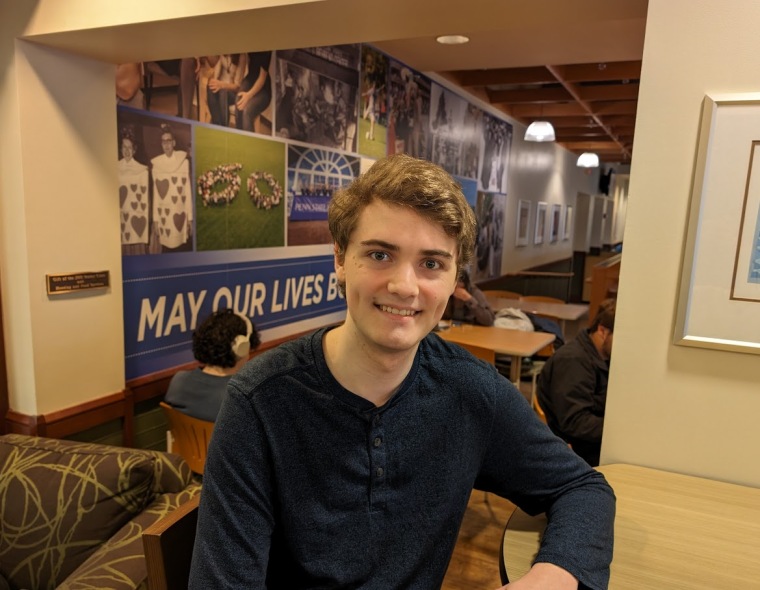
Eric O - WSJ contributor
Eric Oelhaf, Penn State Behrend Political Science major.

While at Penn State Behrend, Eric Oelhaf, a senior Political Science major, added something to his resume that few college students can claim: His work has been published in The Wall Street Journal.

In fact, he has had three pieces published in the WSJ’s “Future View” column, in which they invite undergraduate and graduate students to offer their opinion on current topics from Twitter’s rebranding to the future of the NFL to foreign policy to ChatGPT.

Oelhaf’s published essays address the topics of American support for aid to Ukraine; the U.S. border crisis, and why people don’t trust scientists anymore. He is in good company with students from such institutions as Brown University, Harvard University, and West Point Academy.

We talked with Oelhaf, a State College native, to learn more about why he wanted to contribute, how he got published, and what he has gained from the experience.

How did you learn about “Future Views”?  

Dr. Maggie Shum, assistant professor of Political Science, mentioned it in a class that I took with her in the fall semester. Though it’s known to be a conservative publication, The Wall Street Journal said it was trying to provide a diversity of viewpoints in this feature.

Did you immediately contribute?

No. I looked at it as a national writing competition and decided that I was only going to contribute if I had something unique to say. I felt that would improve my odds of being selected. I was surprised that they printed the first one I submitted, which was the piece on the border crisis. The second one was the piece on why people don’t trust scientists.

Then you submitted one about aid for Ukraine?

Yes. That one was a strategic choice. I wanted to dispel myths that are prominent in conservative information spaces about the costs of sending aid to Ukraine. Of course, the reason to support Ukraine is that it’s the right thing to do. Russia has historically tried to eradicate the Ukrainian language and identity from existence since the times of the Russian Empire. And languages are a particularly important part of European political philosophy.

Does the newspaper edit the pieces?

The one on the border crisis is nearly identical to what I submitted, and those are really my thoughts on the matter. There was light editing on the Ukraine piece. But the trustworthiness of scientists’ piece was heavily edited. Looking back on that, I realize that was my fault.

How so?

I had tried to have a more in-depth discussion than what the 250-word-limit would allow, and I didn’t end up making a clear argument in what I originally submitted. The editor then rewrote some of it operating under the assumption that I was trying to critique the behavior of just the authority figures, which I wasn’t. It was a misunderstanding that I know now I could’ve prevented.

What has been the response to your work?

It’s interesting to read through the comments. I’ve learned that people will complain about anything unless your reasoning is airtight or in line with what they believe. I was called an elitist for providing context on the border crisis. Sometimes, readers will even complain that they are listening to college students, despite clicking on a column clearly labeled “Future View.”

What have you learned by reading the feedback?

It seems the current American news consumer is addicted to anger, and the media is more than happy to feed that addiction.

What other topics interest you?

I care most about what is happening in Ukraine and, as a result, I’m concerned about the current state of Congress. I’m also interested in artificial intelligence and the ways in which it’s being handled by our government.

What would people be surprised to know about your generation regarding politics?

My generation seems to care about efficacy to a greater degree than older ones. We want our politicians to be good at what they do. We don’t want them to continually take half measures on humanitarian crises cause by our allies, nor do we want them to spend six months trying to pass a budget.

What do you want to do after college?

I like foreign relations, so I may pursue a career in government in that field. I would certainly take a job in journalism, too, if I had the opportunity.

Oelhaf’s published pieces

Did you know?

Penn State faculty, staff, and students have access to The New York Times and The Wall Street Journal at no cost through the Student News Readership Program. To take advantage of this program, you must register using your Penn State email. Learn more at Penn State’s Student Affairs website.

Standout Seniors: Meet Alexander Jackson (Mechanical Engineering)

Penn State Behrend’s Class of 2024 is ready to make its mark on the world!  We’re proud of our students and all that they have learned and accomplished here at Behrend. Over the next several weeks, we will introduce you to a few of our remarkable seniors who have engaged in college life in a big way, conducted valuable research, pioneered innovations, and overcome challenges during their time at Penn State Behrend.

alexander johnson2

Today, we’d like you to meet Alexander Jackson.

Major: Mechanical Engineering

Hometown: Cochranton, Pennsylvania

Scholarships: Defrees Family Foundation Endowment, STEM Leaders Program Scholarship, Behrend Excellence Award, Commonwealth Campus First Year Award.

On choosing Behrend: While I was job shadowing in high school, I learned that many engineers in northwestern Pennsylvania graduated from Penn State Behrend. As I talked with more people and broadened my connections, I realized that Behrend graduates were all over the world, working for some of the biggest companies. This gave me the confidence to put my trust in Behrend.

On choosing his major: Mechanical Engineering is a broad major that has allowed me to learn about many different industries and find the best career path for me. I also like that mechanical engineers can have an impact on the world through the design, manufacturing, testing, and implementation of new technology and innovations.

Proudest accomplishment at Behrend: I’m proud of the internships and career opportunities I’ve obtained. I’ve met and worked with some incredible people and clients. I’ve also visited major tech companies and talked with engineers who are pushing the limits of engineering. These experiences are rewarding.

Campus involvement: STEM Leaders Program, Behrend Engineering Ambassadors, Men’s Volleyball player, Student Athlete Advisory Committee.

Awards: Evan Pugh Scholar Award, President Sparks Award, National College Athlete Honor Society, Academic All-Conference, Men’s Volleyball Sportsmanship and Leadership Award, Men’s Volleyball MVP.

Highest priority for the coming years: My highest priority is to continue to learn. Learning doesn’t stop when we walk across that stage at graduation. A desire to learn and grow fuels innovation and creativity.

Sports rank high, too: Outside of work and school, I’m very passionate about sports! I’m a huge Pittsburgh fan (Steelers, Penguins, and Pirates), and enjoy playing and watching all kinds of sports. I love to be active.

Advice for first-year students: Surround yourself with a good group of people because the friends you hang out with will have a great influence on you and your goals. But don’t worry if you don’t find this group right away. As you go through school, you’ll meet others who share your interests and match your energy.

Parting thoughts: I’d like to thank all the faculty and staff members at Behrend. They deserve a lot of credit for the contributions and impact they have on generations of students. So I’d like to give a shout out to all the employees who keep Behrend up-and-running every year.

After graduation, Alex plans to work as a design engineer in the Rotary Wing Group at Parker LORD in Erie.

“Unissued Diplomas” Exhibition Urges Viewers To Bear Witness

By Heather Cass, Publications Manager, Penn State Behrend

This slideshow requires JavaScript.

Ivanna Obodzinska, 19, was the mother of twins and a Garden Design student at Polissia National University. She planned to be a landscape designer.

Serhii Molchanov, 19, was a student at the Ukrainian Leadership Academy who volunteered to fight for his country. While serving, he collected stories and photos for a book he hoped to write.

Oleksandra Borivska, 18, was an International Relations student at Vasyl Stus Donetsk National University. She dreamed of a diplomatic career, traveling the world, and seeing the Grand Canyon.

None of them achieved their goals. They were killed in Ukraine, including Obodzinska’s twins–victims of Russia’s invasion of Ukraine.

Obodzinska, Molchanov, and Borivska are three of forty Ukrainian students whose stories and photos are highlighted in “Unissued Diplomas,” an exhibition in Penn State Behrend’s Lilley Library that honors the memory of Ukrainian students who will never graduate.

The exhibition is one of dozens installed at institutions worldwide to remind people about the ongoing war and the price Ukrainians are paying daily in their fight for freedom. The exhibits were erected on February 24, the second anniversary of the invasion, which has resulted in the deaths of an estimated 70,000 Ukrainians to date.

While no one would wish a real-world trauma experience to affect their students, the course instructor of PSYCH 442: Trauma and Resiliency, Dr. Melanie Hetzel-Riggin, director of the School of Humanities and Social Sciences and a professor of psychology, saw “Unissued Diplomas” as an opportunity put lessons into practice.

Her class visited the exhibit last week.

This slideshow requires JavaScript.

“We talk a lot about how important it is for those who study trauma to bear witness to horrible events,” Hetzel-Riggin said. “Hearing and seeing the impact, elevating victim voices, and keeping space for those people affected by it is at the core of what trauma-informed work is.”

Hetzel-Riggin said the exhibit was particularly moving for Behrend students as they could see parts of  themselves in the Ukrainian students featured.

“The subjects of the exhibition were about the same age and might have had similar hobbies or majors or dreams and aspirations,” she said. “It brings the lessons from the course from abstract theory to affecting real people.”

Dr. Lena Surzhko-Harned, an associate teaching professor of political science, associate director of Behrend’s Public Policy Initiative, and a Ukrainian native, worked with Lilley Library to present the exhibition.

“The Russian full-scale invasion is also a war on Ukraine’s future,” Surzhko-Harned said. “The lives of the young Ukrainians, their future, their hopes and dreams were turned upside down on February 24, 2022. Many young people are losing their lives at the front lines and many more are dying as civilians targeted by artillery and drone strikes. With this exhibit, I hope we can honor this brave generation and remember to live our own lives to the fullest because your entire world can change in a moment.”

The “Unissued Diplomas” exhibition is located on the first floor of Lilley Library and is accessible during library hours. The exhibit will run through the end May.

Learn more at unissueddiplomas.org.

Captured History

Former math professor’s hobby produced one of Behrend’s greatest gifts

By Heather Cass, Publications Manager, Penn State Behrend

B.p. single

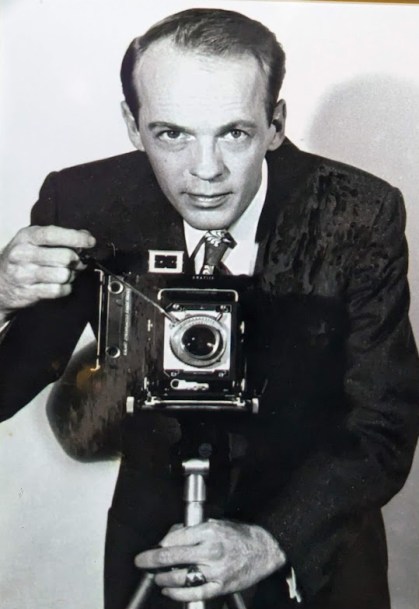
Though he taught generations of college students during his thirty-seven years as a mathematics professor at Behrend, Norman B. “Bill” Patterson, above, established a legacy that goes far beyond linear algebra, differential equations, and statistics. When he retired in 1990, he left a trove of photos documenting life at Behrend with intimacy and affection.

The camera he used to record much of it–a $129 model he saved all year to buy from Erie’s Boston Store in 1954–is in the archives at Lilley Library along with hundreds of his photos, a true gift to the college.

“If a picture paints a thousand words, Bill’s photos are surely the most expensive materials in the Behrend Archives,” said Jane Ingold, reference and instruction librarian and archivist at Behrend. “My ability to answer the many calls for photos for anniversary exhibits and stories like this one would be severely limited without them.”

In honor of Behrend’s 75th anniversary, a sampling of Patterson’s work is on exhibit in Kochel Center. “Behrend Begins: The Campus Photography of Norman B. Patterson” highlights some of his most evocative photos from the 1950s through the early 1970s.

The exhibit provides a fascinating look into the past, offering a visual record of how Behrend has grown and changed over time.

Signs

At 98 years old, Patterson, who resides in an Erie area senior facility, is happy to talk about photography and Behrend with visitors. When asked what type of camera he liked to shoot with, he quipped, “anything I could get ahold of,” adding, “Some things you are just interested in from Day One and I liked taking pictures.”

Patterson’s introduction to photography was in 1938 when his older brother brought a camera, and he became immediately fascinated with it. Much happened for Patterson in the next 15 years, including receiving an undergraduate degree in chemistry, serving a stint in the Army in World War II, and returning to graduate school to earn a mathematics degree courtesy of the GI Bill.

When he was offered a mathematics teaching position at the five-year-old Behrend Center in Erie, a place he had never been, he took the job.  “I said, ‘Well, I have nothing in mind at the moment, so why not?’” Patterson recalled.

When he arrived, no science buildings yet existed. The library was in what is now the Studio Theatre, and Turnbull Hall had been converted from a horse barn for the Behrend family into academic space. On his first day, the original Erie Hall opened.

He quickly fell for the campus and the city. “I liked Behrend, and I love Erie,” he said. “We have it all here.”

As was customary in higher education then, faculty members were heavily involved in the life of the campus and its students. There were few administrators and staff members. It was faculty members who helped with student clubs, activities, and events.

“I was up there at the college for events and things three, four nights a week,” he said. “And if you saw me, my camera would be right next to me. I took it with me everywhere I went.”

And he recorded history as it happened – one Winter Snowball dance, Hanging of the Greens, and Student Work Day at a time.  He also photographed the daily college life that so fascinates today – the “lunch ladies” making food in the Glenhill Farmhouse kitchen, students cannonballing into the pool and skiing down the hill behind today’s Science Complex, and the female students who lived on the second floor of the farmhouse, with bunkbeds stacked in each room.

4GirlsSleepingInBunkbeds

When night fell, he developed the photos.  “I didn’t have a darkroom, so I just had to wait until it got dark,” he said.

Later, he added a home darkroom in a corner of his basement. His son, Bob Patterson, a lecturer in accounting at Behrend, said that when he and his two sisters were growing up, they knew better than to flip on the basement lights without asking and risk ruining their dad’s work.

By the time Patterson retired, he had witnessed—and captured in photos—the remarkable growth of Penn State Behrend over nearly four decades. And, yet, he has a fondness for the earlier, leaner years.

“The lack of resources in the 1950s meant that you had to make do with what you had,” he said. “We didn’t have people to do the auxiliary, non-teaching work, so the faculty were much more involved in student activities and things.”

And, of course, Patterson, who was never without his camera, was there to document it all, and in retirement, he continued to enjoy photography, even mastering photo editing software programs.

“When dad retired, he got a computer,” Bob Patterson said. “I went over to help him set it up and he was the best student I ever taught. It wasn’t long before he was editing and restoring photos and turning them into 3-D images.”

To further cement Patterson’s legacy at Behrend, a third generation of his family now works at the college: Granddaughter Katie Patterson, Bob’s daughter, who serves as an admissions counselor.

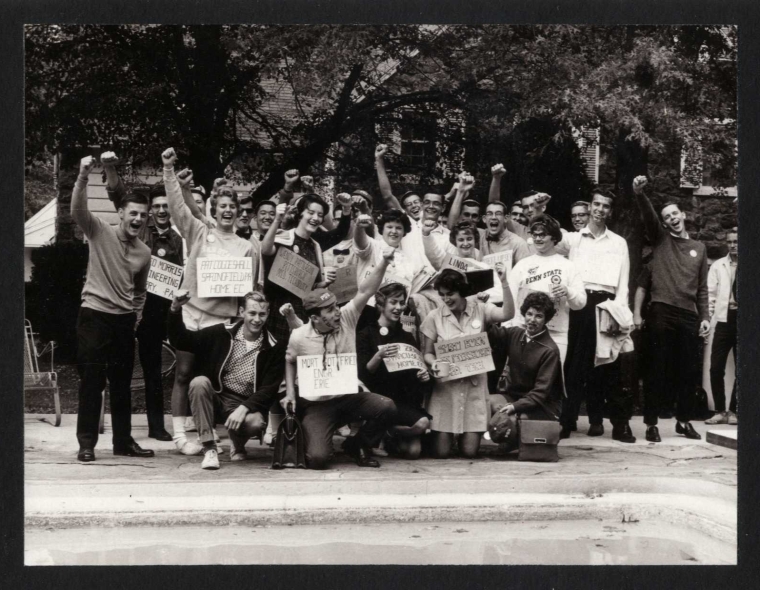
Here are just few of Patterson’s photos:

This slideshow requires JavaScript.