By Nicole Krahe Marketing Communication Student Assistant, Penn State Behrend
Author William A. Ward once said; “The mediocre teacher tells. The good teacher explains. The superior teacher demonstrates. The great teacher inspires.”
With so many dedicated professors on our campus, we asked Behrend students, who is their favorite and why?
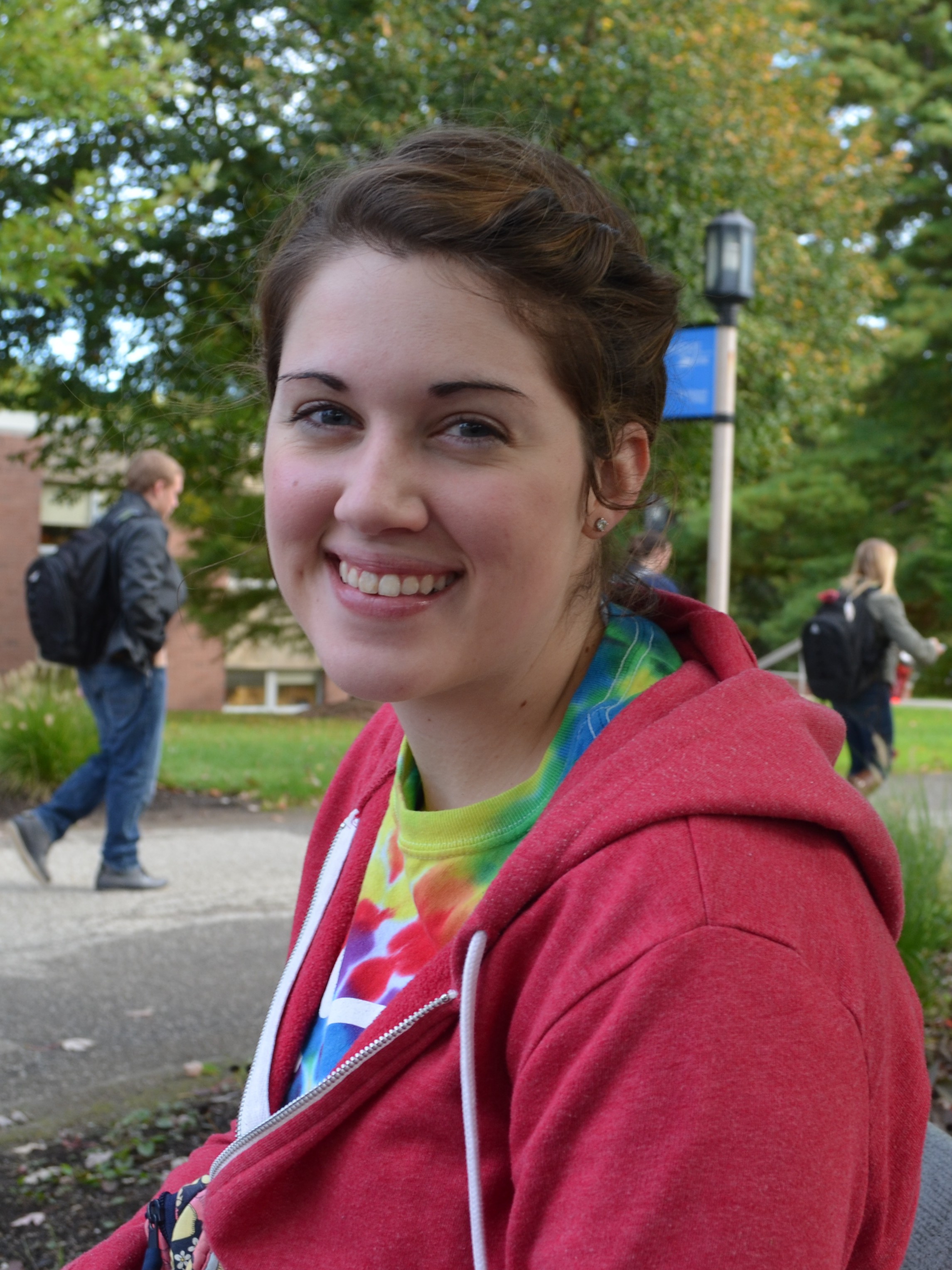
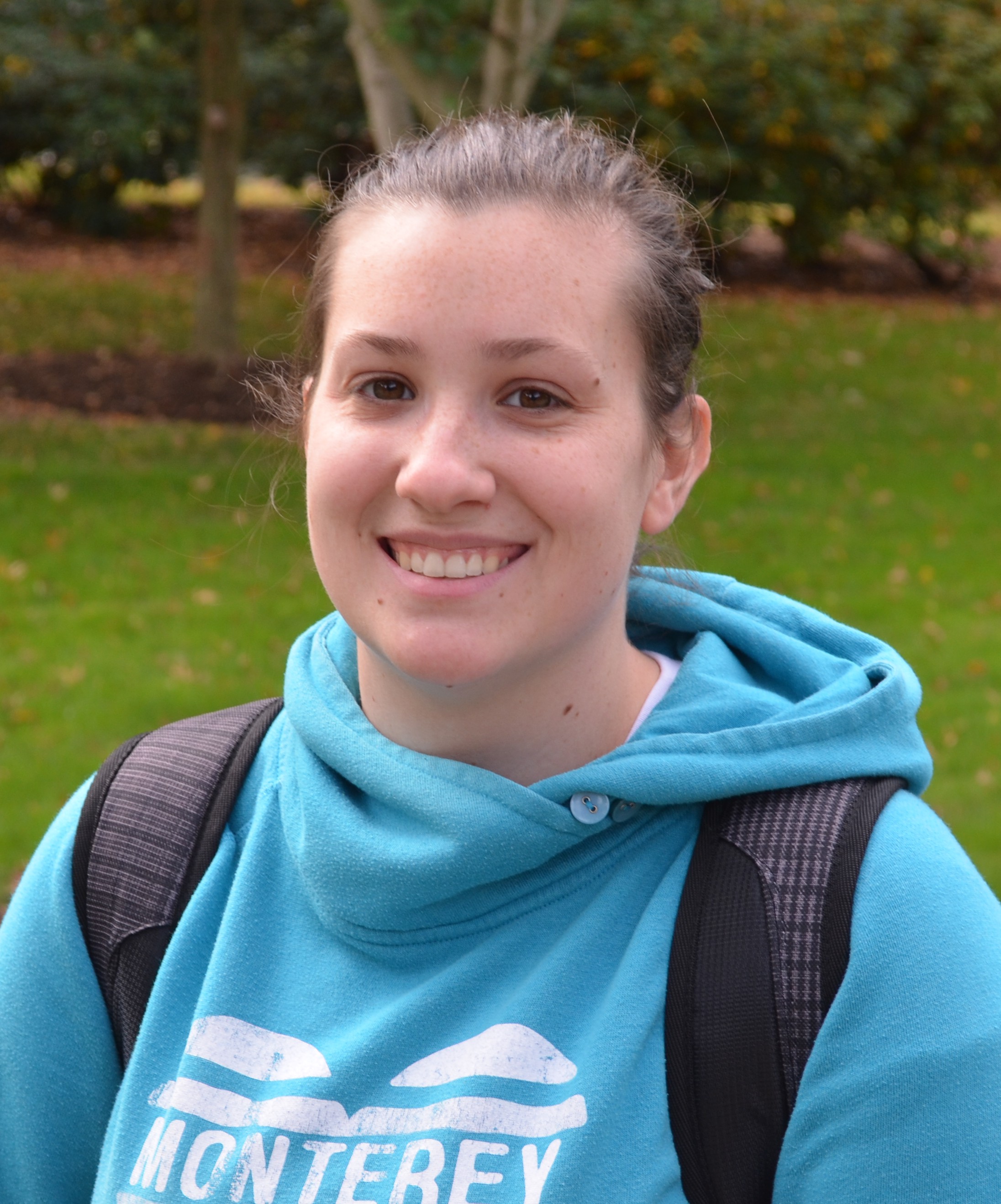
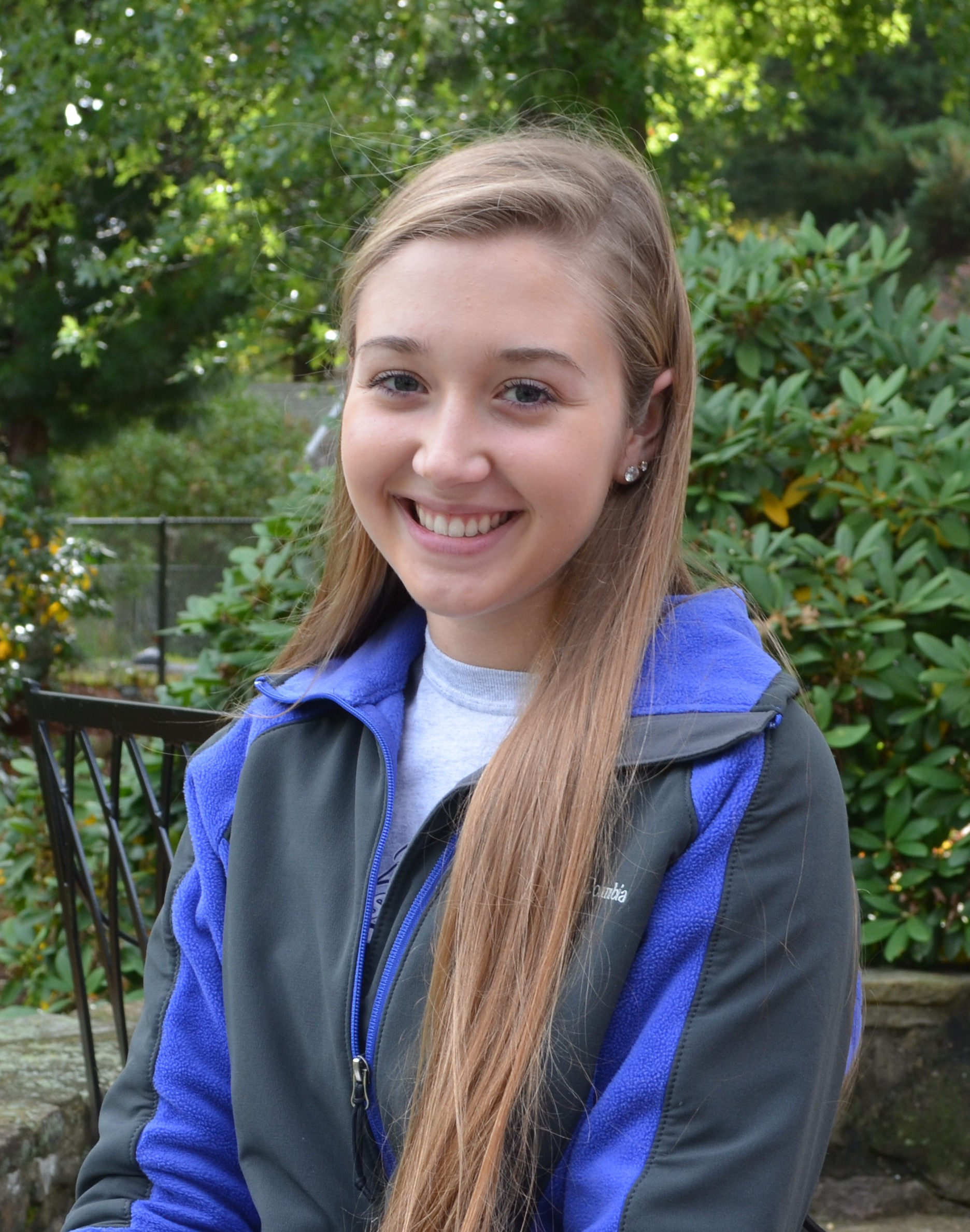
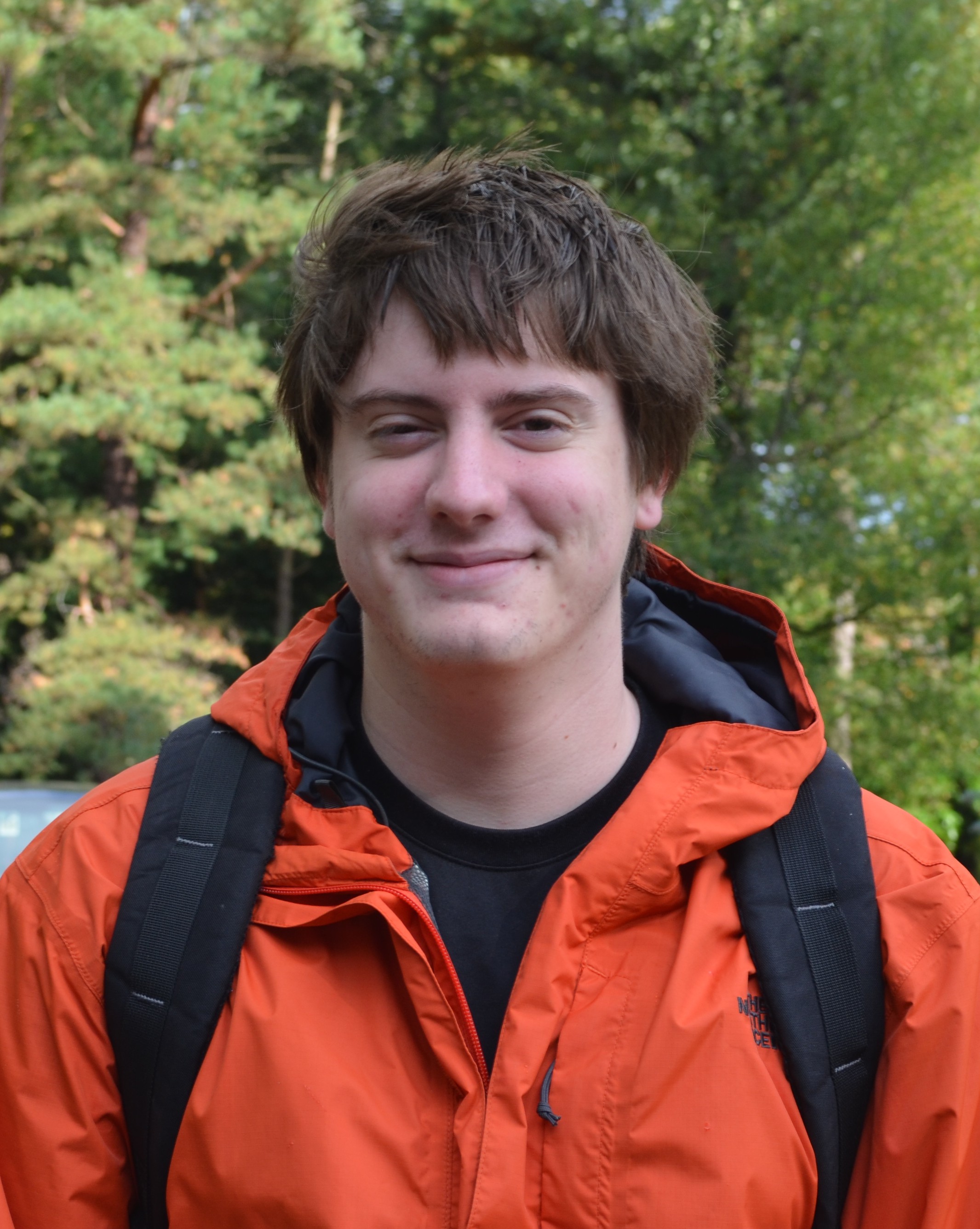
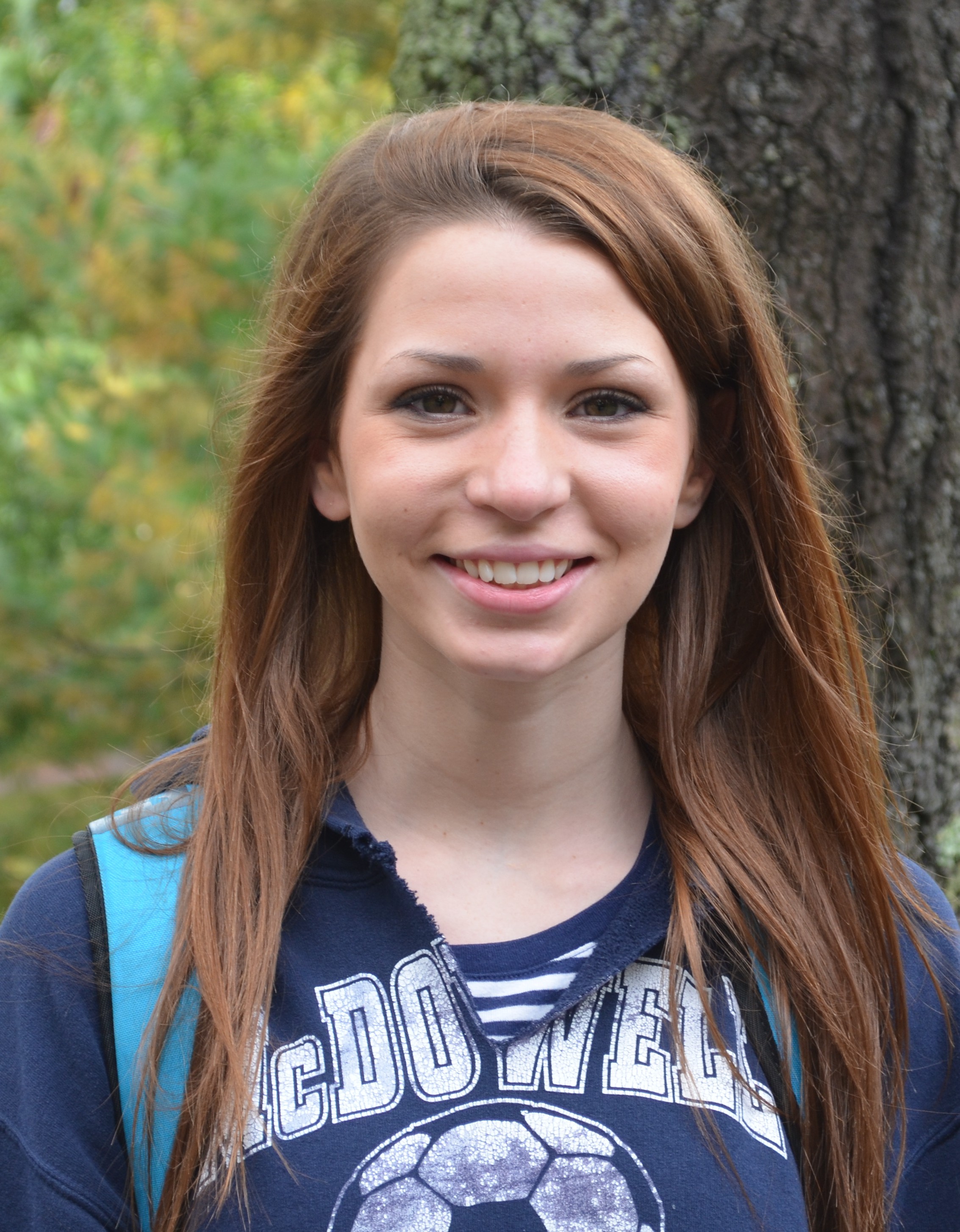
Samantha Raible, senior, Biology, from Pittsburgh: “I would have to say my favorite professor is Dr. Pam Silver, Professor of Biology. She was tough but always took the time to help students. She made things interesting enough to keep us awake at an 8:00 A.M class.”
Cat Hensley, first-year student, Geography, from Michigan: “Dr. Michael Naber, lecturer in geosciences. He’s easygoing, funny, and has Harry Potter glasses.”
Cassie Peters, sophomore, Veterinary and Biomedical Sciences, from Erie: “I would say Ms. Luciana Aronne, lecturer in chemistry. She is supportive, motivational and keeps class interesting.”
Ronnie Cox, sophomore, Physics, from Erie: “My favorite professor would have to be Mr. Adam Combs, lecturer in mathematics. He is not going to take it easy on you but will take the time to go over things you don’t understand.”
Lindsey Chase, first-year student, Kinesiology, from Randolph, N.Y: “Mr. Scott Rispin, lecturer in art. He makes things fun and interesting, and is very personable. You can tell he cares about his students.”
Pat Kress, sophomore, Finance, from Erie: “I would say my management professor, Dr. Ryan Vogel, assistant professor of management. He is enthusiastic and relates concepts to college students well. He makes an 8:00 A.M class bearable.”
Matthew Moreau, senior, Biology, from Massachusetts: “Dr. Michael Campbell, a professor of biology. He engages you and makes things interesting. If you pay attention in class, it’s really rewarding.”
Katie Powers, first-year student, Biology, from Clearfield: “I would say Mr. Scott Simpson, lecturer in chemistry. He’s young and you can tell he’s excited about teaching. He also does experiments every day which is really cool.”
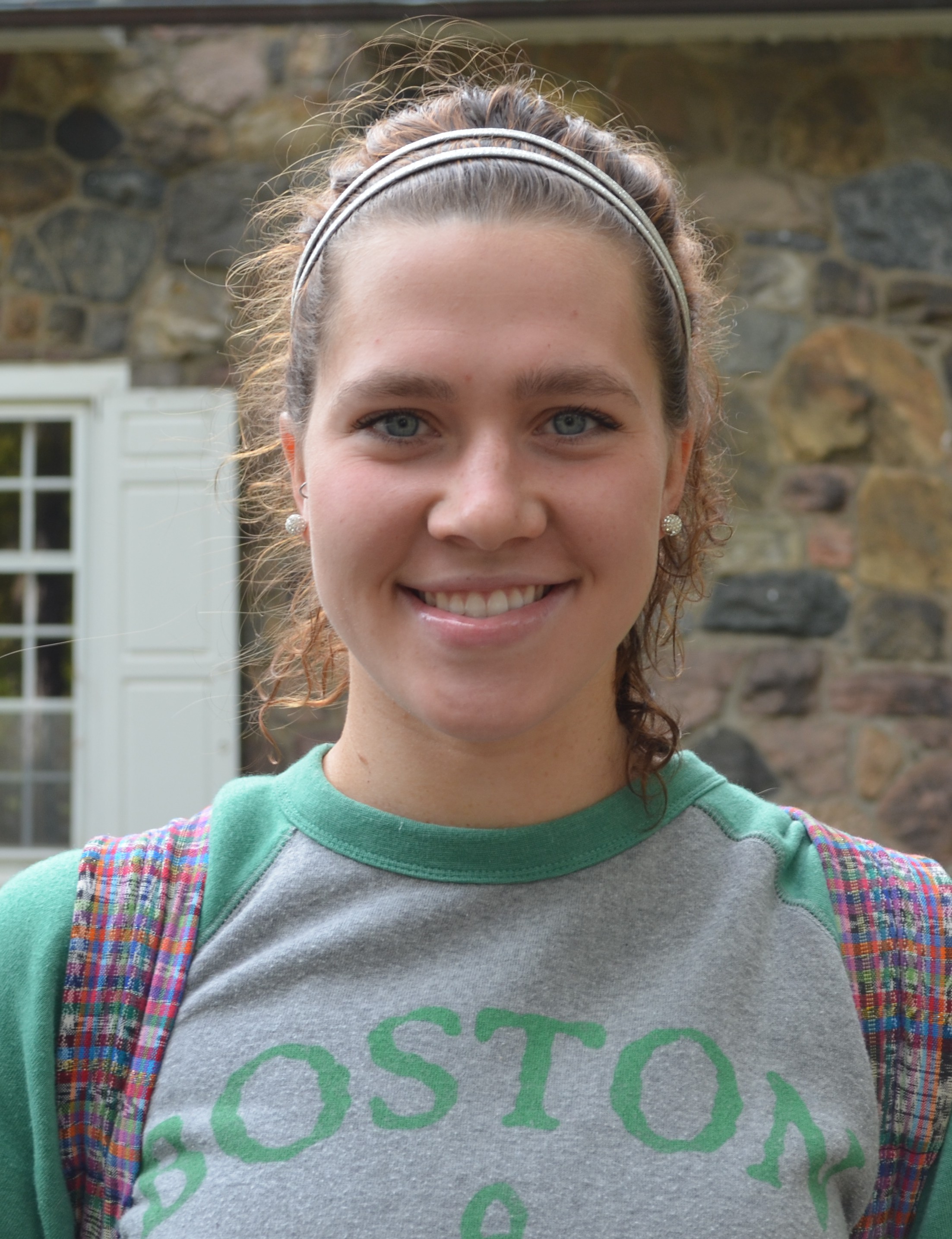
Mary Bradley, first-year student, Division of Undergraduate Studies, from Erie: “My favorite professor is Dr. Angela Rood, lecturer in psychology. She breaks the class down to make it easier to understand and does activities every day to keep things fun and interesting.”
Behrend Reacts is a regular Thursday feature at the Behrend Blog that tries to get the campus pulse on a current topic, whether it’s serious or trivial. If you have a question to suggest for Behrend Reacts, please email Nicole Krahe at ndk5089@psu.edu.
By Nicole Krahe Marketing Communication Student Assistant, Penn State Behrend
World-renowned photographer Sally Mann once said, “Photographs open doors to the past, but also allow a look into the future.”
Keeping this in mind, we asked Behrend students what the most recent photo in their phone was, and what it meant to them.
Ben Katsarsky, first-year student, Plastics Engineering Technology, from Syracuse, N.Y.: “The last photo in my phone is a screenshot of an Instagram post I made 98 weeks ago. I was missing home, so I was scrolling through my old posts and found this one of a duffel bag full of shirts. I used to have a clothing line and it was the first time I took the shirts to school to sell them to my friends.”
Brandon Blasic, first-year student, Division of Undergraduate Studies, from Erie: “My last photo is of my friends and I hanging out before we all went our separate ways to different colleges.”
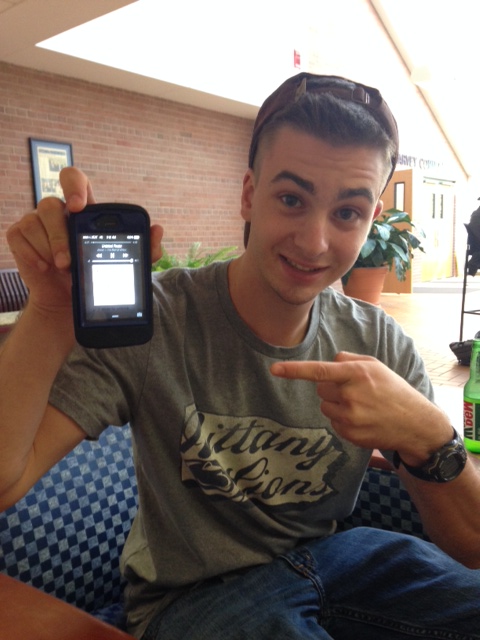
Tyler Dunlap, first-year student, Division of Undergraduate Studies, from Erie: “My most recent photo is a screenshot of Untitled Finale by Atreyu, on Pandora.”
Ryan Kepner, sophomore, Mechanical Engineering, from Williamsport, Pa.: “This is a photo of a tattoo I’m about to get. I enlisted in the army a year ago because I wanted to be a part of something bigger than myself and to support this country. I feel like this tattoo will represent that.”
Dan Kozubal, sophomore, Chemical Engineering, from Saegertown, Pa.: “This is just a photo of chemistry notes. I’m working really hard this year to get good grades.
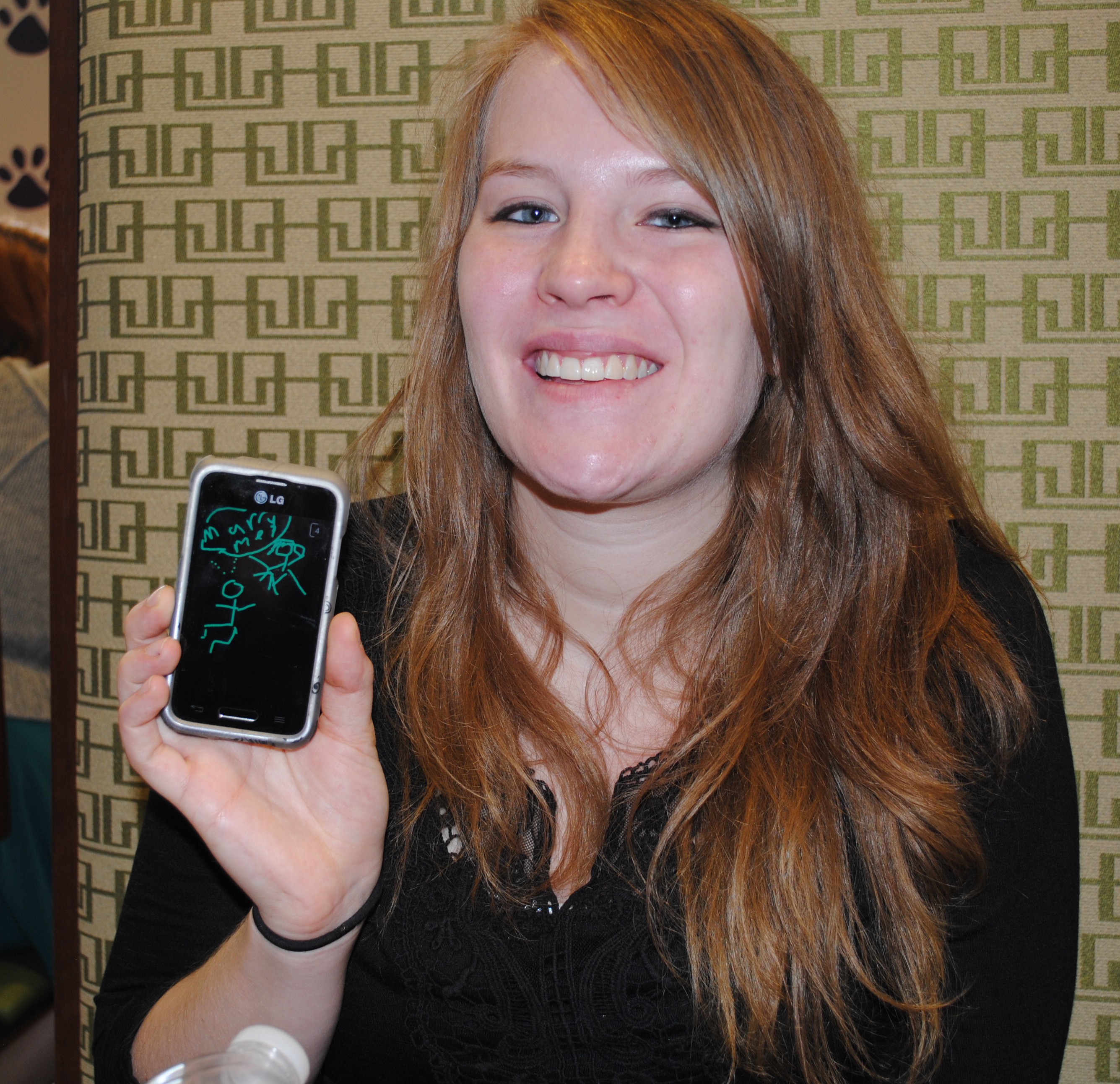
Julia Gabreys, first-year student, Psychology, from Franklin, Pa.: “My most recent photo is actually a screenshot of a Snapchat my boyfriend sent me. It says, ‘Marry me.’”
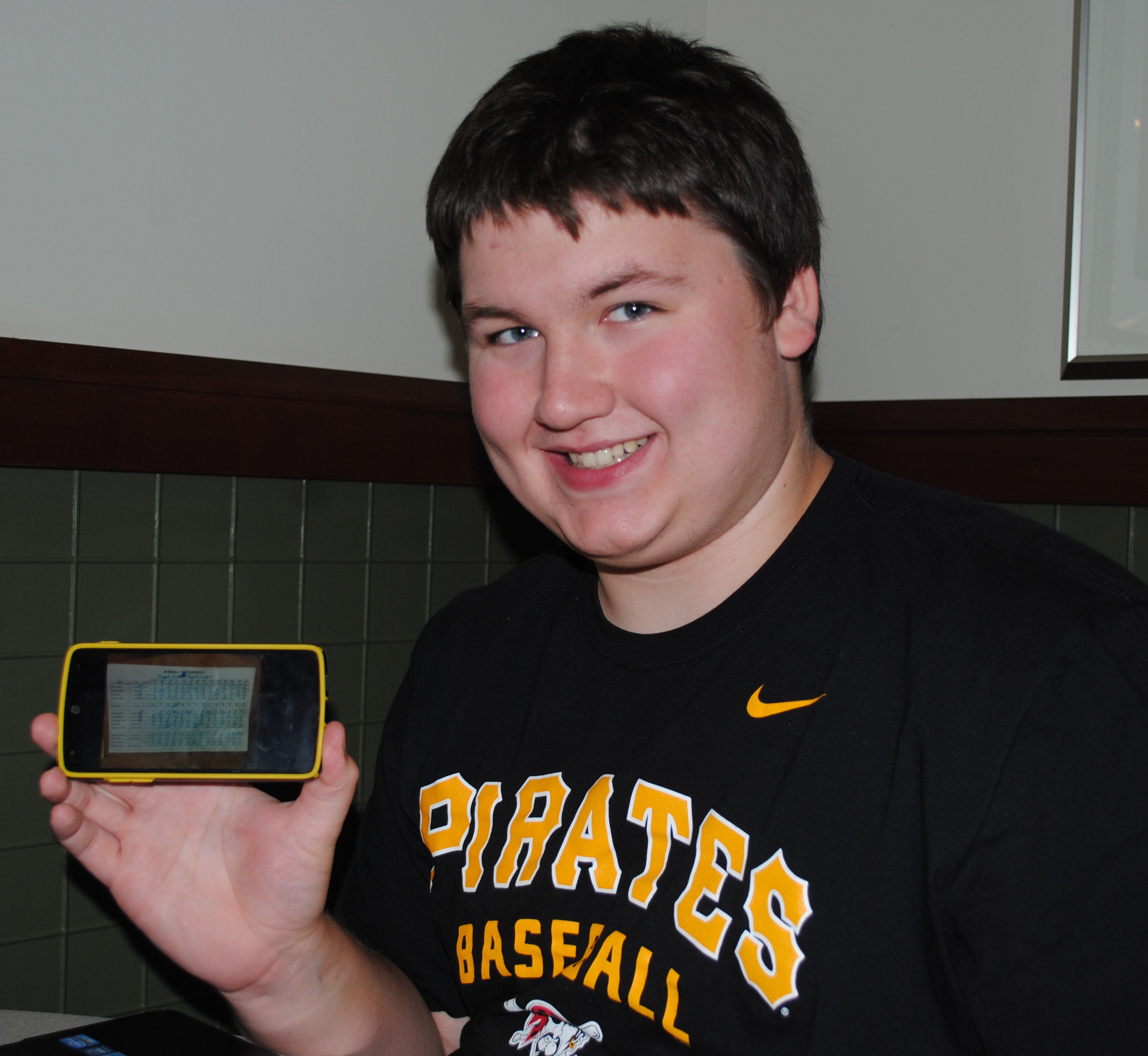
Rob Strain, sophomore, Management Information Systems, from Erie: “My last photo is of my work schedule at the Sara Reed Retirement Center. I love working there because I feel like I am making a difference in the residents’ lives.”
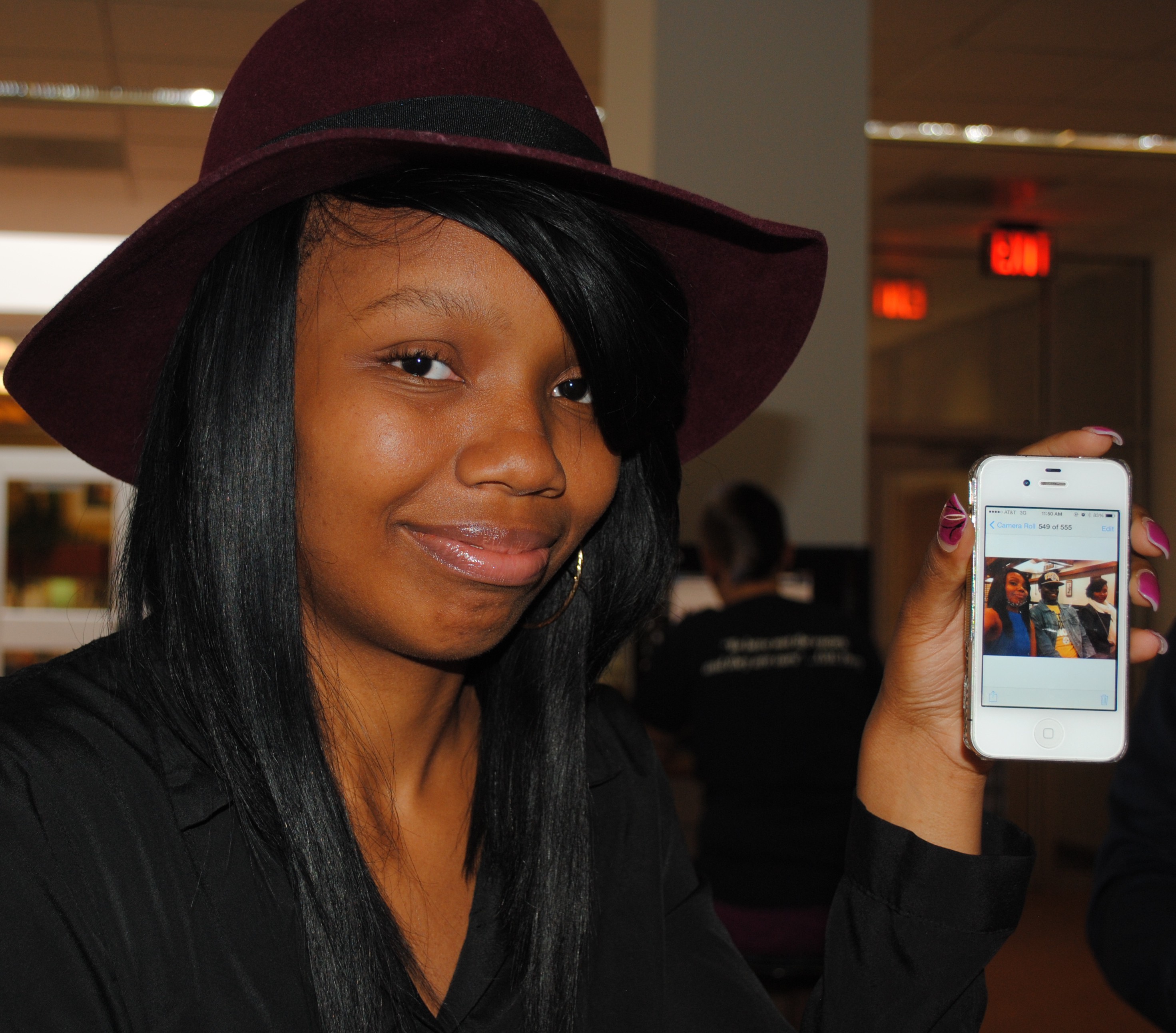
Monique Lebrun, Junior, Communication, from New York, N.Y.: “This is a photo of my friend and I at Aoyama for her birthday dinner. We went to three different restaurants before deciding to go there.”
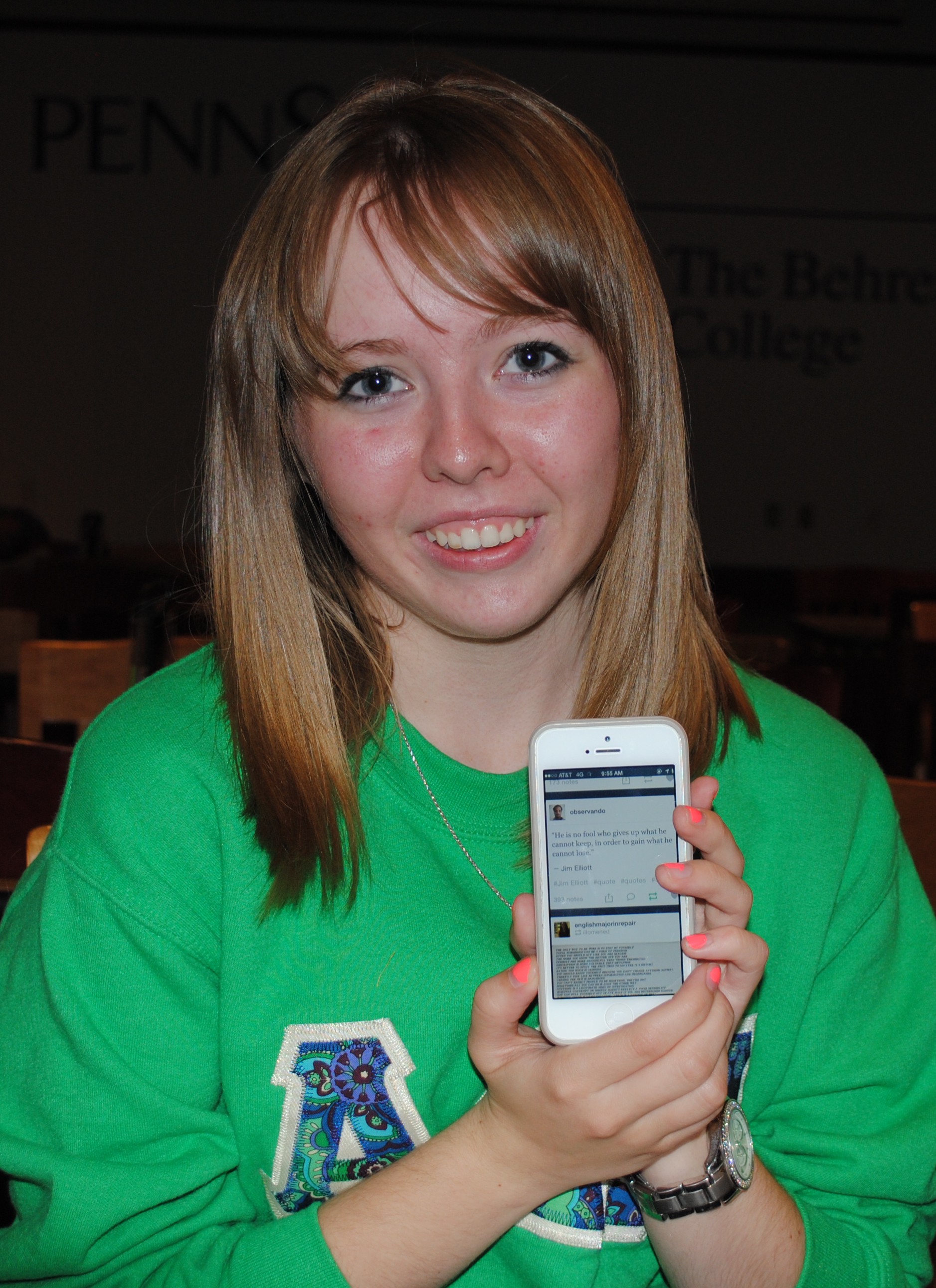
Sydney Sample, sophomore, English, from Corry, Pa.: “This is a screenshot of a quote by Jim Elliott that I found on Tumblr. It says, ‘He is no fool who gives up what he cannot keep, in order to gain what he cannot lose.’ I just like the message.”
Julie Pace, sophomore, Nursing, from Erie: “My most recent photo is of my sister and I at our birthday dinner. We are really close, so it’s always good to see her.”
Behrend Reacts is a regular Thursday feature at the Behrend Blog that tries to get the campus pulse on a current topic, whether it’s serious or trivial. If you have a question to suggest for Behrend Reacts, please email Nicole Krahe at ndk5089@psu.edu.
By Christine Palattella Marketing Communications Specialist, Penn State Behrend
Photo by Andy Colwell ’11 COMM
The secret to optimizing your Behrend bird watching experience? Have a great photographer with you, and hope that he or she owns a lens the size of a dinner plate.
I was lucky to be in the company of Andy Colwell ’11 COMM two Saturdays ago when a pair of large raptors started circling high above Junker Center. Andy used his Nikon Nikkor 400mm f/2.8 manual telephoto lens to capture this image of a red-tailed hawk, Buteo jamaicensis.
Any lens with its own handle is a serious piece of business, but Andy’s also has an interesting provenance: Before finding its way to him, the Nikkor spent twenty years on the sidelines at Beaver Stadium, shooting Nittany Lion football games. Andy learned the patience and finesse needed to coax crisp images from his mega-manual lens while earning his two undergraduate photography degrees, in visual journalism and in art photography.
As for Buteo jamaicensis, they are year-round residents of the region and common sight over campus. Assistant Professor of Biology Dr. John Steffen told me that the males are indistinguishable from the females, to humans at least. Red-tails themselves clearly have it worked out, because they are monogamous and somewhat infamous in the bird world for their elaborate mating display: After a series of aerial swoops and dives, the pair will rest in a tree. The male will stoop down in front of the female, and if she’s into him, she rolls over so that their cloacas can meet. They’ll build a stick nest in the crotch of a tree to incubate their clutch of two or three eggs; Steffen says it’s not unusual for these nests to reach four feet in diameter. He added that in many places, red-tails are the top-dog predator; their diet of songbirds, small mammals, reptiles, and amphibians keeps the population of smaller vertebrates regulated.
Learn more about the red tailed-hawk and hear its call here (it will be a familiar sound to you if you’ve been at Behrend for a while).
Learn more about photographer Andy Colwell (below) and see more of his work here.
By Steve Orbanek Marketing Communications Specialist, Penn State Behrend
Call it extra motivation. Call it an added incentive. Call it a chip on her shoulder.
However you label it, it’s clear there’s something that drives Kristina Peszel.
“When I first went to grade school, I was one of the youngest kids in my class. Because of that, I felt as if people questioned me and my ability,” says Peszel, a senior English major with the professional writing option at Penn State Erie, The Behrend College. “Since then, it’s driven me. I have always had this need to stand out and prove myself.”
Mission accomplished.
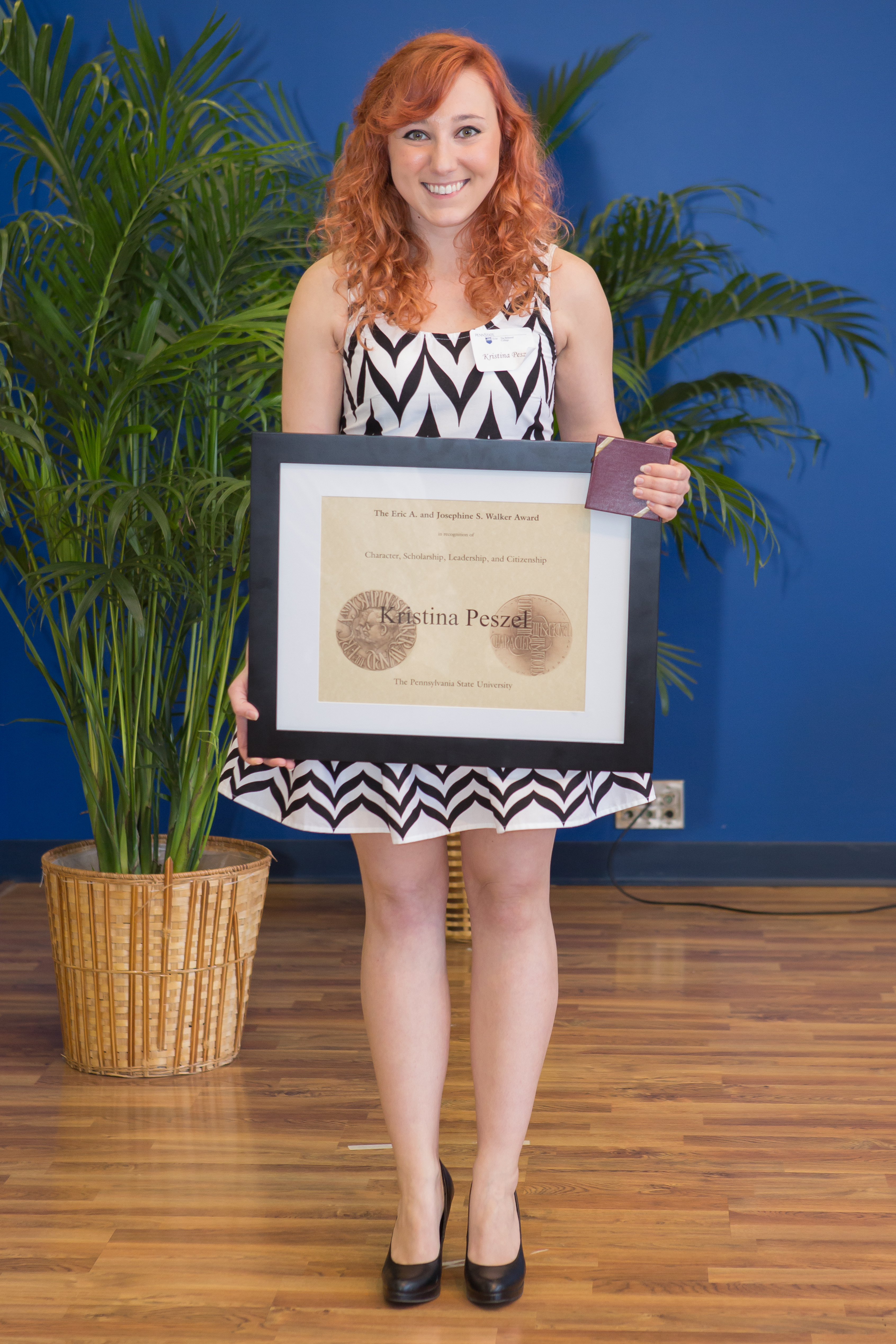
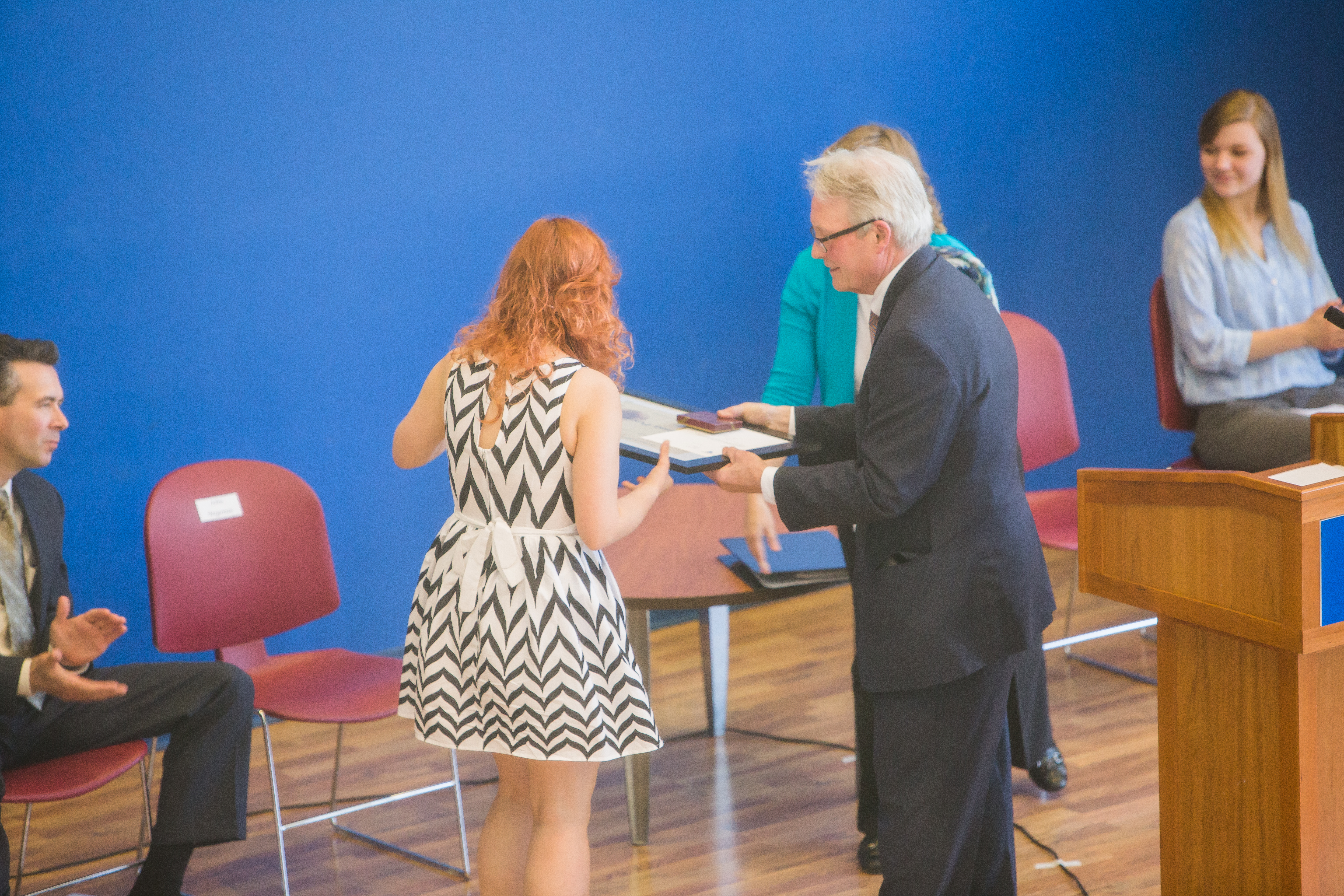
In her time at the college, Peszel has been a standout student, as evidenced by the Eric A. and Josephine S. Walker Award she won at this year’s Honors and Awards Convocation on April 27. The award recognizes a student whose outstanding qualities of character, scholarship, leadership, and citizenship have been directed into student programs and services.
Peszel was thrilled to have been chosen for the award.
“It was really exciting, and it felt like recognition of everything that I’ve done on campus,” Peszel says.
It was a much deserved honor.
The Erie native has a 3.96 GPA and is the lead writing tutor at the Learning Resource Center. She’s served as the vice president and secretary for both the Alpha Sigma Tau sorority and Omicron Delta Kappa, the national leadership honor society. She’s also been a member of the Lion Entertainment Board, Reality Check, Studio Theatre, and a contributing writer for the Behrend Beacon.
Through her campus involvement, Peszel learned that she prefers to be busy. She thrives on activity, one reason she believes she’s been successful.
“If I have enough time to watch television, I feel as if I’ve forgotten something,” says Peszel, who will graduate in December.
Things have not slowed down this summer for Peszel, who is interning at Erie Insurance in the company’s IT department. The work she is doing relates directly to her experiences as lead writing tutor in the Learning Resource Center.
As a tutor, Peszel often edited various engineering papers, which provided her with skills and experience in technical writing. It has led her to think of her future in a different light.
“I realized that I’m not just a humanities student, but I can do the technology thing too,” Peszel says.
Ruth Pflueger, director of the Learning Resource Center, has worked with Peszel for the past three years at Penn State Behrend.
“Kristina is remarkable in the number of students she has impacted during her time at Behrend. She has tutored literally hundreds of students and also has a leadership role in the Learning Resource Center, organizing the Composition Support Program and mentoring new writing tutors,” Pflueger says. “Her professionalism, energy, and sincere desire to help others succeed will serve her well in all her future endeavors.”
With one semester left until graduation, Peszel plans to make some great memories and leave a legacy.
“I like surrounding myself with genuine, good people who like to help others,” Peszel says. “We can be remembered for all kinds of things, but how we affect other people’s lives is most important.”
By Steve Orbanek Marketing Communications Specialist, Penn State Behrend
What does 7,219 pounds look like?
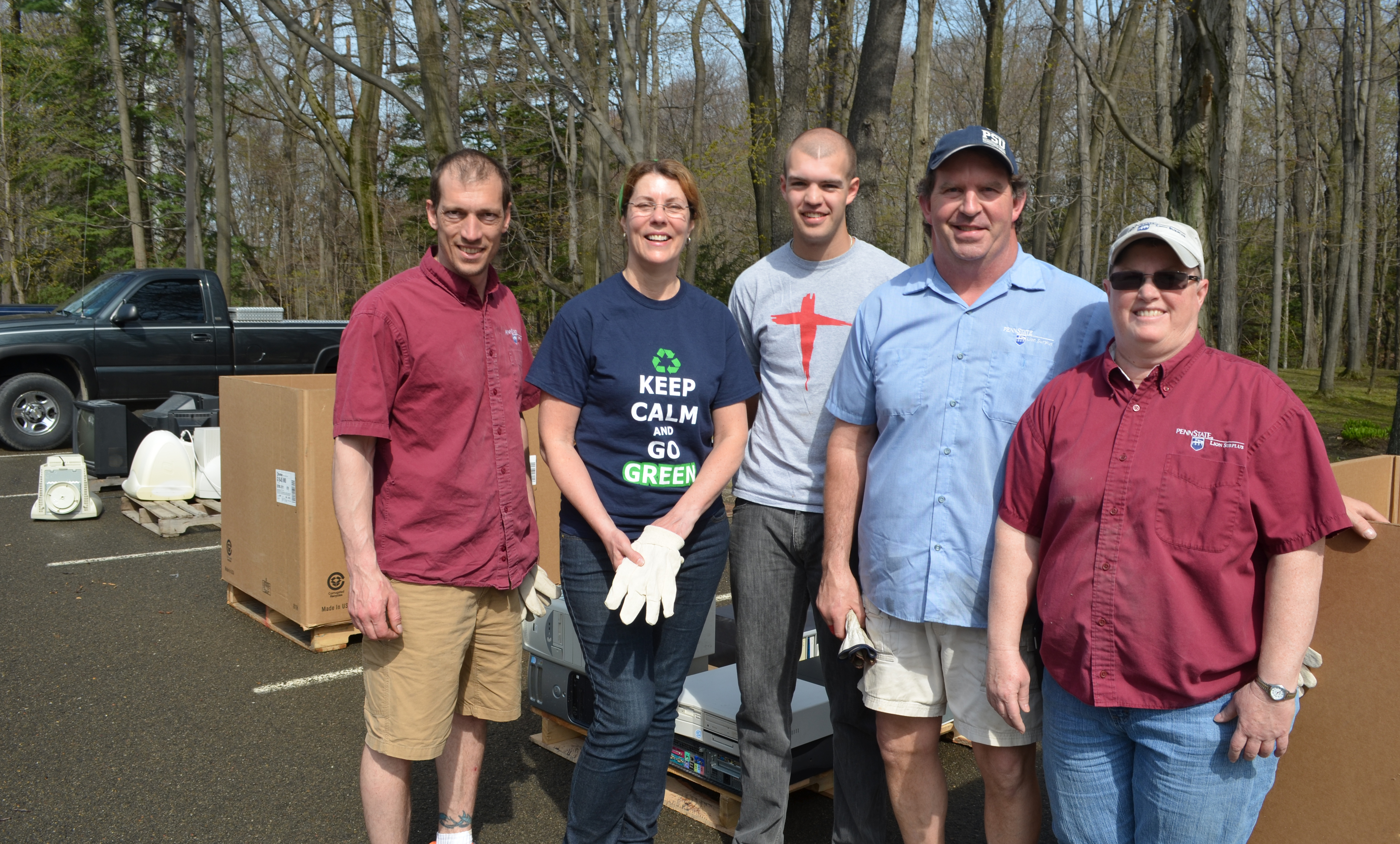
Imagine two hippopotamuses, fourteen gorillas, or two cars, and you’ll have an accurate picture of the amount of electronics collected May 8 at the first Electronic Recycling Event at Penn State Erie, The Behrend College.
The event, co-sponsored by the Greener Behrend Task Force and Lion Surplus, allowed Penn State Behrend faculty members, staff, and students an opportunity to dispose of used electronics in an environmentally friendly way. Television sets, monitors, hard drives, printers, and DVD players were among some of the most collected items.
The 7,219 pounds filled ten pallets. From Erie, the items will be taken to the Lion Surplus facility at University Park to be sorted and sent out to various recycling vendors.
“With a television, the plastic, glass, and parts inside will be separated and go to different vendors,” said Annette Bottorf, a computer technician for Lion Surplus. “We are totally green. Nothing will go to the landfill, and when we contract a company, they have to guarantee us the same thing. Everything will be recycled and reused.”
Ann Quinn, faculty adviser for the Greener Behrend Task Force, said she was impressed with the turnout for the event, and she would like to see it return in the future.
“We really exceeded our expectations, and we filled a need,” Quinn said. “It also did not cost us a thing, which is wonderful.”
By Steve Orbanek Marketing Communications Specialist, Penn State Behrend
Bangladesh women do not typically come to America to pursue a college education, but there’s nothing typical about Ramisa Fariha, this year’s recipient of the Outstanding First-Year Student Award.
For starters, the Narayanganj, Bangladesh, native, who recently completed her first year as a Biomedical Engineering student at Penn State Erie, The Behrend College, is a diehard professional wrestling fan. She draws inspiration from her favorite World Wrestling Entertainment wrestler, Batista.
As a child, Fariha would watch wrestling with her brother, Sajjadul Karim Chowdhury. They both had their share of favorite wrestlers, but there was something about Batista that resonated with Fariha.
“Batista’s favorite quote is, ‘Work hard and the sky is the limit,’” Fariha says. “That’s become my favorite quote.”
But it’s more than just an inspirational catchphrase for Fariha. It’s a guiding philosophy that she has taken to heart.
Fariha has a lofty goal.
“In my country, a woman is always blamed when she cannot give birth, even when it’s not her fault,” Fariha says. “I want to one day create an artificial ovary, and I want it to be non-mechanical, so it can work inside the human body.”
While she knows her aim is high, she’s confident that hard work will get her there, and she’s wasted no time at Penn State Behrend, swinging for the fences in her very first year.
Not only does she have a 3.82 GPA, but she is a member of the Lion Entertainment Board, event correspondent for The Behrend Beacon, Residence Life Service Leader for Center of Service, a member of the Lambda Sigma national honor society and the 2014-2015 elected president for the Muslim Student Association.
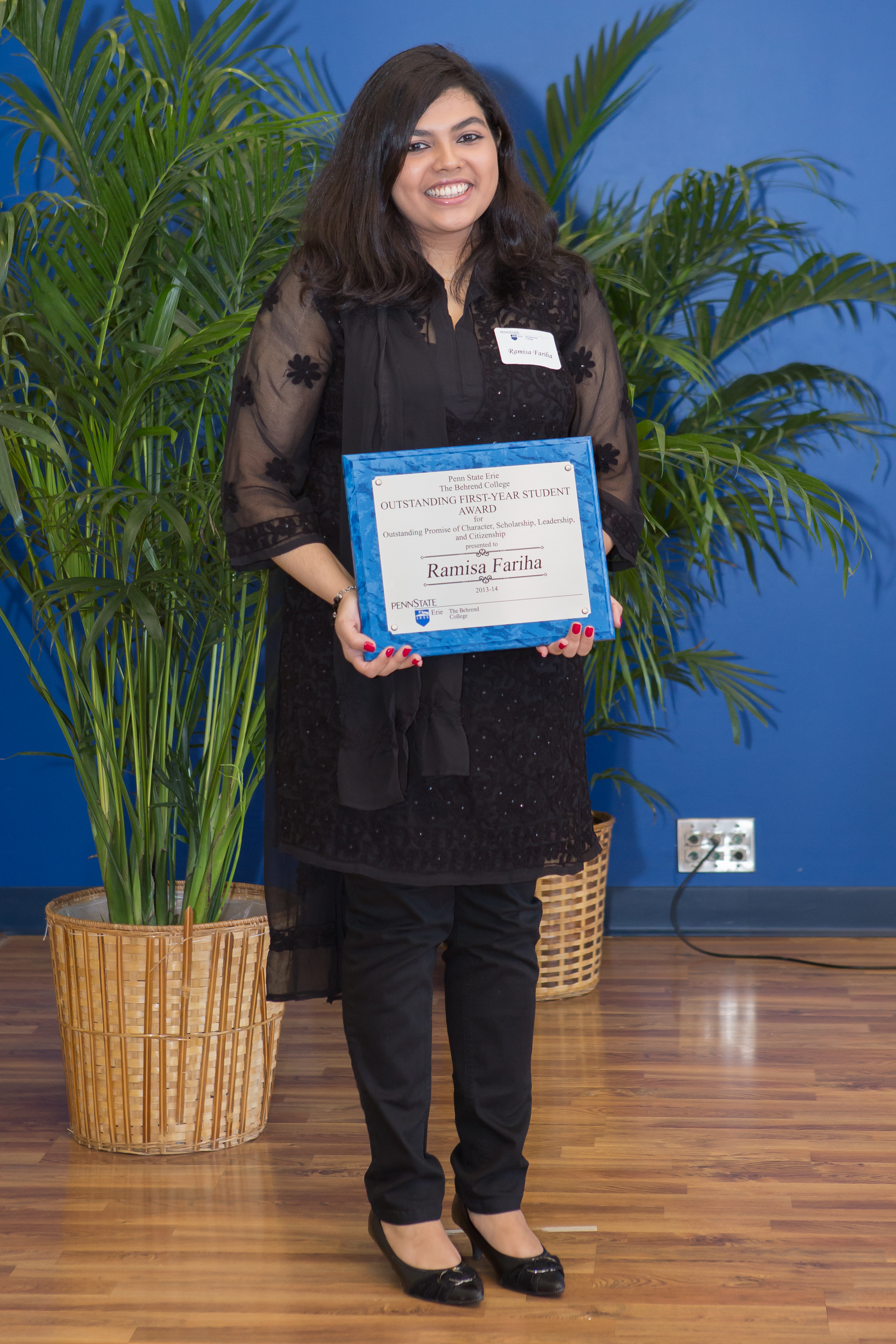
Fariha says she thought of Batista often during her studies and even rewarded herself with a silver Batista pendant after winning the Outstanding First-Year Student Award at the sixty-fifth annual Honors and Awards Convocation on April 27.
She says she also attributes some of her success at Penn State Behrend to the warm welcome she has received. She describes Dr. Mary-Ellen Madigan, director of enrollment management, as a “second mother,” and says her professors and friends have also made her feel at home.
Fariha says winning the award, which recognizes a first-year student who demonstrates outstanding promise of character, scholarship, leadership, and citizenship through achievements in his or her first year of study, was a moment she will never forget.
“For me, when I heard Kelly Shrout, (presenter and associate director of Student Affairs), say ‘Bangladesh,’ that was the proudest moment of my life,” she says. “A lot of people think of Bangladesh and only think about the negative things.”
Fariha says the award made her family very proud. Her father, Ahsanul Karim Chowdhury, is one of the top lawyers in Bangladesh and has always emphasized education. Fariha’s mother, Laila Nahar Chowdury, taught her to work hard and to not take anything for granted. Her brother, Sajjadul Karim Chowdhury, has encouraged her at every step along the way.
“This award shows that I’m here to do something special,” Fariha says.
Fariha says she is excited to return to Narayanganj this summer, so she can watch wrestling with her nieces and start a new generation of fans. She knows some people say professional wrestling is fake, but she doesn’t care.
“If you start to rationalize everything, you lose the fun in life,” Fariha said.
Fariha hopes that more students from Bangladesh will consider coming to Penn State Behrend in the future. From the moment she started to look at colleges, Fariha said Behrend just felt like home, and she believes other Bangladesh natives could have a similar experience.
Her best advice to new students?
“Don’t be afraid to be yourself. There will always be people who will like who you are and some who don’t,” Fariha says. “I would change nothing about my first year at Penn State Behrend because I’ve been myself.”
In recognition of Women’s History Month, we’d like to introduce you to just a few of the dynamic women in Penn State Behrend’s history. Our college has a rich history of leadership and involvement by strong, forward thinking, and generous women. Each Monday in March, we’ll highlight a woman who has made, or is currently making, her mark on the college.
Today, we’d like you to meet Dr. Diana Hume George, Professor Emerita of English and Women’s Studies.
Diana Hume George at JFK International Airport. Photo by John Edwards.
I caught up with her by email to ask her about the importance of women’s studies, why she doesn’t (yes, you read that right!) miss teaching at Behrend, and what she’s been doing lately.
You taught women’s studies at Penn State Behrend. Why is it important for college students to learn about this subject?
Yes, I taught women’s studies and I worked for years on founding what became the women’s studies program at Behrend—I’m so glad it’s still going.
As much progress as women have made in this country and around the world, there’s nothing like genuine equity yet. Women can still be owned, enslaved, beaten, and maimed in many places, including in some parts of this country—and control of women’s bodies is still a primary political aim. Sometimes I am heartened by all the advances—no one’s surprised by women in the so-called professions any more, as doctors or professors or politicians or talking heads on TV, and that progress is genuine. But it’s just as true that in many cultures and countries, there’s still a war against women’s equality that is violent and terrifying.
Without women’s studies, younger women would be even more likely to backslide, to lose touch with all that has gone before, and to become re-enculturated in ways that disable and disenfranchise them—I see it every day. The lack of a feminist awareness among young women scares me deeply and daily and a lot.
What do you miss about teaching at Behrend?
I don’t miss teaching at Behrend, because I took the best of it with me. I’m still in contact with a bunch of my previous students over the years—one became among the best friends of my life, another student-turned-friend I meet up with at the Cleveland Film Festival every year. I visit one in Baltimore regularly, another is getting ready to run the Boston Marathon and makes me great beach-glass earrings, and yet another sends me his wonderful poems. And there’s another fellow writer, and another is a magazine editor—come to think of it, I’m in touch with someone from every generation of my career there.
I also stay in touch with department colleagues—I met up with John Champagne and Sharon Dale in Rome last year and stayed at John’s place in Perugia, and I see George Looney because along with Phil Terman at Clarion, we run the Chautauqua Writers’ Festival together, which is how I also run into Greg Morris as well as newer colleagues like Kim Todd and Tom Noyes. Other writer colleagues from long ago, names current people might not even remember, like Melissa Bender and Ann Pancake, are part of my life, too. And after leaving Behrend, I got to know a couple of colleagues that I never had time to know when I was working constantly—I love and miss Toby Cunningham, whom I barely knew at Behrend, but once we were gone, we ended up in a writers’ group together and my partner John Edwards published his wonderful book.
My son Bernie is back at Behrend finishing up his degree—so put it all together and it’s like I never left.
What have you been working on since leaving Behrend?
Since I left Behrend, I’ve been teaching creative nonfiction in an MFA program at Goucher College in Baltimore. I’ve also been to several colleges and universities as a visiting writer, teaching for a few weeks or even a semester, at places such as Davidson in North Carolina, UNC/Wilmington, and Ohio University.
What do you enjoy about teaching in the MFA program at Goucher College?
I live in Pennsylvania, and work online, going to Baltimore a couple of times a year. I mentor writers who always wanted to write a book. Our program is geared toward helping them write voice-driven narrative—some have been professional journalists all their lives and they haven’t yet gotten to write long-form. It’s great fun and I get to learn as much as I teach, because whatever they’re writing a book about, I’m reading that book as they write it. And we also get doctors and psychologists and professors, as well as people who want to write about their own lives, so I edit memoirs on trauma and on travel, and sometimes that can be the same book.
You mentioned in our email exchanges that you have been traveling. Please tell us more.
I have the privilege of shaping my life so that I can do my favorite thing, which is to travel with my friends or my partner, John Edwards. I wrote one travel book and I’m always writing the next one. I try to go to Italy for about a month every other year. Lately I’ve been alternating Italy with the Yucatan peninsula, from which I’m just back right now. I stay on Isla Mujares, an undeveloped island right off Cancun, where I first went with a fellow writer on a retreat back when I was at Behrend. I got hooked on those Caribbean breezes in January.
What are your other interests?
Even more than travel and writing, I want to read. I don’t get to read enough. That’s my goal, lots of good books, the kind where you can throw yourself down on a bed and get lost in an imaginary world.
And I love long-form drama on TV, where a lot of the best storytelling takes place, both comic and tragic—Deadwood, The Sopranos, and Breaking Bad were almost as important to me as literature.
You wrote and edited books on the American poet Anne Sexton. Does her work still resonate with you? How has your relationship with her work changed?
I wrote or edited three books about Anne Sexton, and she was a wondrous enough poet that I never got weary of her writing—but I did get battle fatigue about her psyche. She was a joyful and delightful person, witty, wicked smart, and ironic, but she was also bipolar, and being in the presence of that kind of mind can yank you around. My friend and the co-editor with me of Sexton’s Selected Poems, Diane Wood Middlebrook, lived inside Sexton’s head for a decade, and she said it was nearly too much.
I was attracted to her sense of joy, and I still admire her willingness to also say the depth of her pain—but she couldn’t live, in the end, and I can. So although my affection for her poetry remains, and I think she was tremendously important, and deserves to endure, I am a bit distant from her now.
But if you’re lucky, your old literary loves from early in your life stay with you in some sense throughout, they get internalized and are part of who you are, and all of my early loves became part of me—Sexton and Adrienne Rich and William Blake and Freud.
If someone is unfamiliar with your writing, what might be a good introductory work? Personal essays I wrote, such as “Wounded Chevy at Wounded Knee” or “The Last of the Raccoon,” still represent my work.
Diana Hume George will do a public reading at Clarion University of Pennsylvania on April 17, 2014. The second edition of her book The Lonely Other: A Woman Watching America will be released in April, with several new essays.
By Steve Orbanek Marketing Communications Specialist, Penn State Behrend
In recognition of Women’s History Month, we’d like to introduce you to just a few of the dynamic women in Penn State Behrend’s history. Our college has a rich history of leadership and involvement by strong, forward thinking, and generous women. Each Monday in March, we’ll highlight a woman who has made, or is currently making, her mark on the college.
Today, we’d like you to meet Jane Ingold, a reference librarian in the John M. Lilley Library.
It’s not believed that any member of the Behrend family still lives in the Erie area, but Mary Behrend’s grandsons might beg to differ.
“The grandsons (Dick and Bill Sayre) have told me I’m an adopted Behrend,” Penn State Behrend reference librarian Jane Ingold said.
Given Ingold’s knowledge of the Behrend family history, it’s an appropriate remark.
Since 1999, she has worked as a librarian at the John M. Lilley Library. On a typical day, Ingold might be helping a student with a research project or reorganizing library materials, but there’s a good chance that she’ll be working in the archives, located on the bottom floor of the library.
The archives at Penn State Behrend are comprised of three permanent collections: the Behrend Family Collection, the Hammermill Paper Company Collection, and the Penn State Behrend Collection. Since 2006, Ingold has worked to organize and categorize the collections, and she’s become something of an expert when it comes to Behrend history.
Ingold has a great knowledge for every detail surrounding Behrend’s history, dating back to when Mary Behrend donated her family’s Glenhill Farm estate to Penn State in 1948.
Through the years, Ingold has received countless relics and souvenirs that somehow tie into the Behrend family, the college, or the Hammermill Paper Company, the company owned by Mary Behrend’s husband Ernst as well as his brothers, Otto and Bernard, and their father, Moritz.
Ingold has made a meticulous effort to carefully keep track of everything she’s found or been given since she first came to Behrend. She’s viewed as the historical expert on campus, and the archives even earned the Local History Award in July 2011 from the Erie County Historical Society.
Ingold said she has seen plenty of interesting artifacts in the archives, but there’s one particular item that stands out above the rest.
“It’s the letters that Mrs. Behrend wrote to her son Warren right before he died in a car accident in 1929.” Ingold said. “It made me cry.”
Because of her knowledge, Ingold has become a great resource, both to students and former Hammermill employees. Many of the Hammermill retirees recognize the importance of the archives, and they help to contribute and spread the word.
This is especially true of Harry Hahn, a 104-year-old Hammermill retiree. Hahn communicates frequently with Ingold, and he’s always doing what he can to help grow the archives.
“He’s one of the joys of my life,” Ingold said.
In a newspaper story discussing his impending open-heart surgery at age 101, Hahn even encouraged former employees to donate materials to the archives.
For all the work that Ingold does with the archives, her main passion remains the Penn State Behrend students.
“My favorite part of the job is helping students. It’s like a treasure hunt when you’re looking for something for someone, and they’re always so grateful,” Ingold said.
This was true a few years back when a student came to Ingold in the eleventh hour for help with a program on Behrend’s history. Ben Lane, the former director of admissions and author of Behrend Remembered, had been scheduled to make a presentation on Behrend’s history, but he had to cancel. Ingold quickly gathered up all the information she could and stepped in to replace Lane.
“It tickled me,” Ingold said. “It made me feel very helpful.”
In the future, Ingold said she would like to possibly update Lane’s book.
Considering her wealth of knowledge, that seems like a realistic goal.
About Jane Ingold
Birthplace: Cranesville, Pa.
Education: B.A. in English from Gannon University, M.S. in library and information science from the University of Texas at Austin
Family/pets: “I spend a lot of time being what Elizabeth Gilbert terms a “sparent” or spare parent to my nieces and their children. I have a brown tabby, Tye, who was adopted from a local shelter.”
Favorite thing about Behrend: “The resources we have to help students are great. We have access to almost anything in the world that a student would need.”
Advice for today’s students: “Having a librarian in your corner can make a big difference in your academic career. Befriend one.”
Favorite hobbies: “Reading (now there’s a surprise), organizing anything from papers to events, genealogy.”
Last book read:Eleven Rings by Phil Jackson
Three books that everyone should read:The Art of Possibility by Rosamund and Benjamin Zander, The War of Art by Steven Pressfield, and Getting Things Done by David Allen
Why is it important that we preserve history?: “This series that you and your colleagues are writing on Women of Behrend wouldn’t be possible if we hadn’t chosen to preserve our history.”
By Steve Orbanek Marketing Communications Specialist, Penn State Behrend
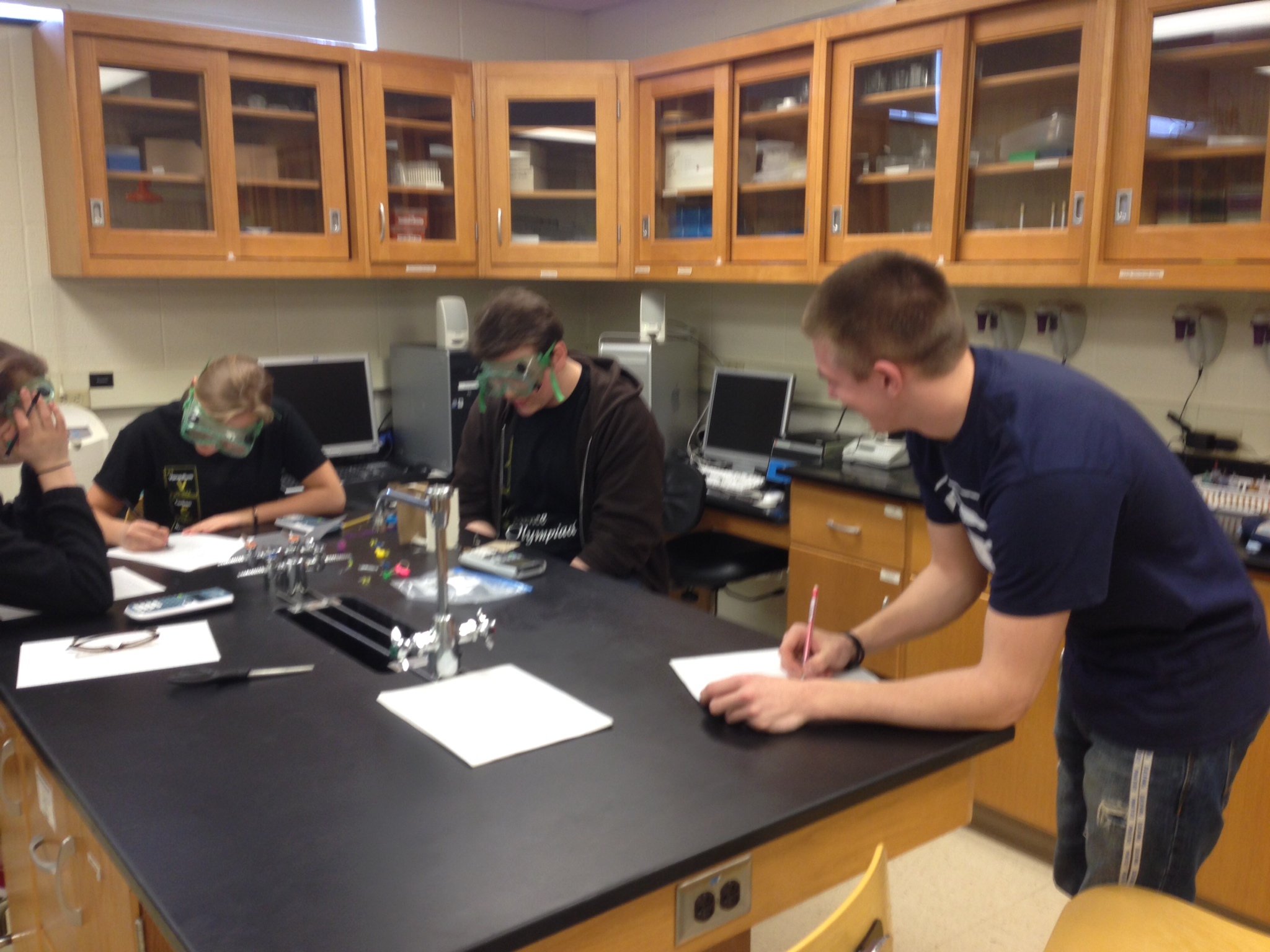
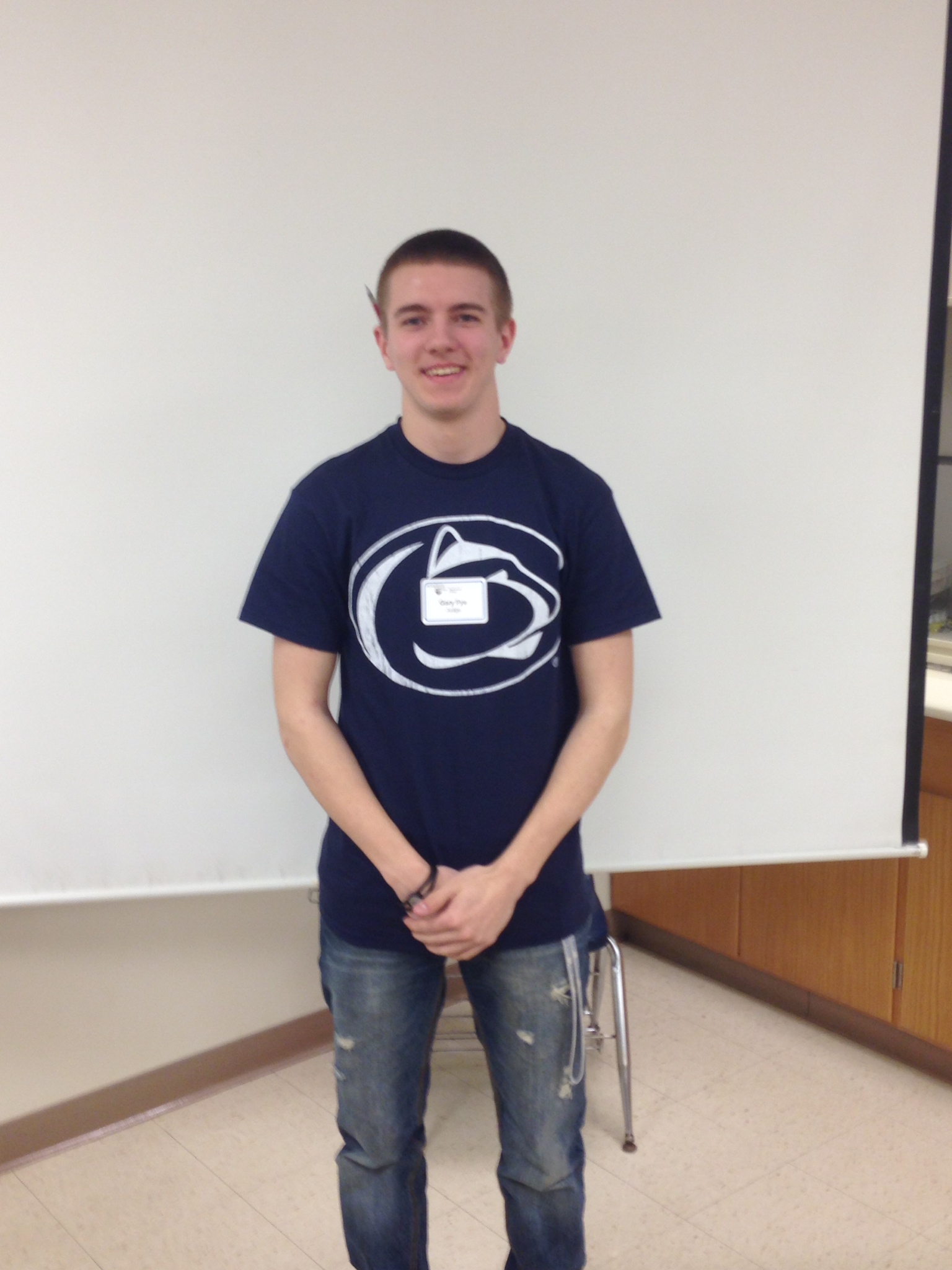
One of the Science Olympiad’s stated goals is “to create a passion for learning science.” If the organization is looking for an ambassador, it need not look any further than Gary Fye.
Fye, a first-year Biomedical Engineering major at Penn State Erie, The Behrend College, was a volunteer judge at the regional Science Olympiad held at Behrend this March.
More than 400 students from thirty-three area school districts competed in forty-six science-related events. Among the participating schools was North Clarion High School, which happens to be Fye’s high school alma mater.
From grades seven through twelve, Fye participated in the Science Olympiad. In fact, he took first place in at least one event every year but ninth grade.
“The time just never seemed to last long enough,” Fye said. “It was something I really, really enjoyed.”
That enjoyment is still present today. Although Fye was at home in Leeper, Pa., for spring break, he traveled on a bus with his former high school just so he could volunteer his time at the Science Olympiad.
Experimental Design, the event Fye judged, had participants experiment with a springboard and then propose a hypothesis based on that experiment. Experiments like this are what helped pique Fye’s interest in science and engineering years ago.
“It broadens your horizons. You really get a feel for lab work,” he said.
After attending his first Science Olympiad, Fye’s interest in science only grew. In middle school and early high school, he was appropriately nicknamed “Gary Fye the Science Guy.” The name referred to Fye’s love of science, but it was also a word play on Bill Nye, who was the host of the popular PBS children’s show “Bill Nye the Science Guy.” Fye also happened to be a big fan of Nye, which made the nickname an even better fit.
The Science Olympiad influenced Fye in another way as well. The event exposed him to Penn State Behrend.
“I would actually put that as one of the number one reasons as to why I’m here at Behrend,” Fye said. “It definitely introduced me to engineering concepts.”
By Steve Orbanek Marketing Communications Specialist, Penn State Behrend
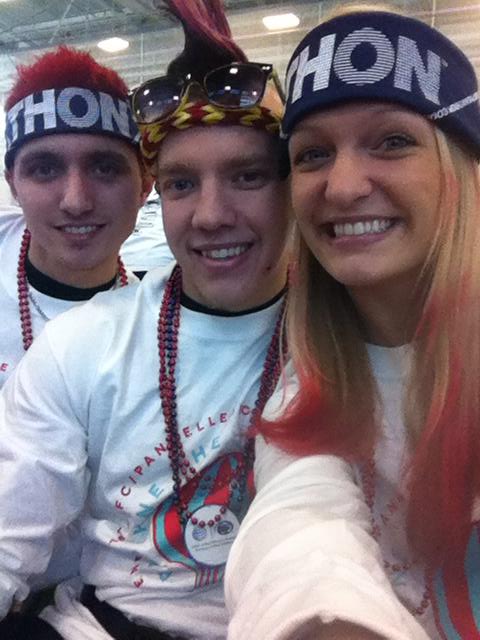
After attending the last two THONs as a spectator, Wes Dorrenbacher thought he had a good idea of what to expect when he was selected as a dancer for this year’s event.
That all changed around hour thirty-four.
“It was probably around 3:00 a.m. on early Sunday morning,” Dorrenbacher said. “It was finally real to me. I was just so humbled and thankful for this experience. For the next twenty minutes, I drew on a towel ‘Thank you’ and just started walking around the Bryce Jordan Center.”
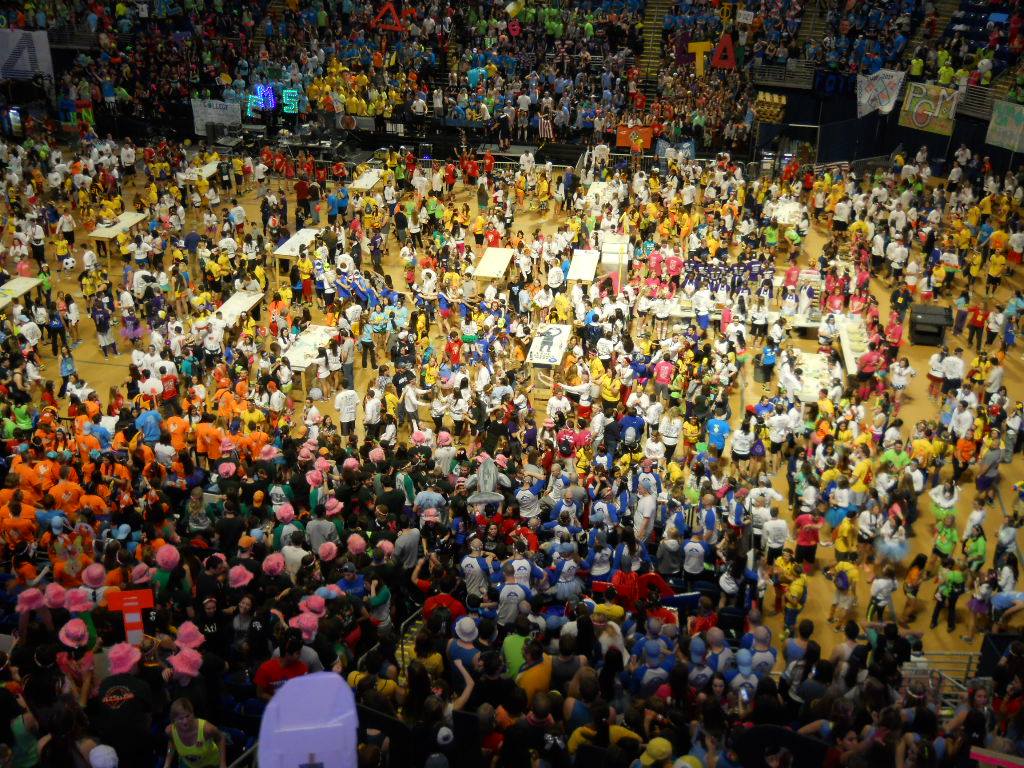
More than 15,000 students participate each year in the Penn State IFC/Panhellenic Dance Marathon (THON), a 46-hour no-sitting, no-sleeping event that has raised more than $114 million since 1977 for the Four Diamonds Fund at Penn State Hershey Children’s Hospital. The fund pays for counselors, social workers, music therapists, and other specialists whose work with children fighting cancer often is not covered by insurance.
Dorrenbacher, a senior psychology major at Penn State Behrend, was one of 708 dancers at this year’s THON, which was held February 21-23 at University Park. He was joined by two other Behrend dancers, senior mechanical engineering major Nick Hirsch and freshman kinesiology major Rachael Hazen.
During the dance marathon, participants are assigned a “moraler” who encourages them to keep going. The support this person provides is essential as the dancers’ battle to stay awake is as much mental as it is physical.
Hirsch learned this the hard way Sunday morning.
“I got to Sunday morning, and I thought it was later than it actually was,” Hirsch said. “When my brain realized it wasn’t as late as I thought it was, my body just shut down.”
Thankfully, Hirsch’s moraler was there and managed to feed him some apples and bananas to help restore his energy. Frequent eating is one of the keys to getting through the marathon.
Of course, there are other methods. Spectators and kids patrol the Bryce Jordan Center with squirt guns filled with ice-cold water. Hirsch will be the first to admit that a splash to the face never felt so good.
“As soon as you get hit with that water, your brain just resets. The pain goes away, and your mind stops thinking about being tired,” Hirsch said.
However, even with the food, moralers, and squirt guns, participants inevitably struggle as they dance and force their minds and bodies to stay awake.
When a person’s body and mind gets pushed to such limits, emotions are inevitable. That’s exactly what Dorrenbacher felt early Sunday morning, but he feels that’s one of the draws of participating in THON.
“The delirium brings out the emotions you normally would not want to show,” Dorrenbacher said. “But that’s the point of the weekend — to bring out those weaknesses and show how much we care for this cause.”
When the event finally ended Sunday evening, an exhausted Dorrenbacher, Hirsch, and Hazen headed to Berkery Creamery for ice cream. It’s a tradition for Behrend participants to go to the creamery after THON.
Dorrenbacher said the emotion he experienced during that weekend was unparalleled to anything else he has felt in his life. In fact, the emotion stayed with him, even days after the event.
Both “Good Morning America” and ABC News World News covered THON in the days that followed the event. The Behrend dancers were even pictured briefly in the segments.
Dorrenbacher admitted that he started to tear up at just seeing a teaser for the segments. His emotion is indicative of the THON weekend and the profound effect it had on his life.
“THON was honestly the best weekend of my life to date,” Dorrenbacher said. “There’s nothing quite like fighting for a cause that is bigger than yourself.”

 By Nicole Krahe