One of Craig Miranda’s favorite moments from this past academic year was creating the Penn State Behrend Performance Band, which performed a series of concerts on campus by the spring semester’s end.
By Steve Orbanek Marketing Communications Specialist, Penn State Behrend
Editor’s note:Far from Home is an occasional series in which we document a year in the life of international students at Penn State Erie, The Behrend College.
When Craig Miranda arrived at Penn State Erie, The Behrend College, he had one goal.
“Even though I’m just a freshman, I want to start big. I want to make an impact,” the first-year computer science major said at the beginning of the academic year.
Miranda did more than start big. He finished big.
Through the course of the academic year, he excelled in the classroom, joined numerous campus organizations, started his own club, joined the tennis team and even presented a project at the Clinton Global Initiative University’s 2015 meeting, held this past March in Miami.
It’s not how Miranda expected his first year to go when he set foot on campus last August.
“I came here thinking that I would be more secluded. I thought I would just focus on getting my work done to get through, but it turned out to be the opposite,” he says.
Miranda credits the friends he made at Behrend with helping him get involved. Being so far away from home can be challenge, but he’s begun to build a strong support system at the college through the friends he has made.
“Friends are what help me to keep going,” he says. “They give me an escape to get away from whatever I’m feeling, whether it’s homesickness or something else.”
Together with his friends, Miranda created the Penn State Behrend Performance Band student organization as an outlet for anyone who enjoys singing or performing live music. By the end of the semester, the band had 12 members and had performed six concerts.
“We want to reach diverse groups of people, who come from different cultures and might have different tastes in music,” Miranda says of the student organization. “One of the songs we performed this year was an original written by two of our members, and it included both English and Chinese lyrics.”
An emphasis on musical diversity is a reason why Miranda, currently president of the club, has already begun the process of having the Penn State Behrend Performance Band brought under the college’s Multi-Cultural Council (MCC) banner. As the group grows, he envisions it being used even more to promote diversity on campus.
Miranda’s work with the band, coupled with his other accomplishments, made for a busy year, but he says he has no plans to slow down over the summer. Now back home in Kuwait, he reports that he’s already thinking about returning to Behrend in the fall, with plans to do “do something a lot bigger.”
With funding from the Western Pennsylvania Conservancy, Pennsylvania Sea Grant and Behrend are working to develop a weed management plan that brings students and community members together to remove invasive species.
ByAnna McCartney
Communications and Education Specialist at Pennsylvania Sea Grant, an outreach program of Penn State Behrend
Wintergreen Gorge along Fourmile Creek is a popular destination for hikers, birders, fossil-hunters and others who simply use the stream to cool off on a hot day.
Because it’s also a favorite of Penn State Behrend students, they are involved in creating a weed management and implementation plan to develop best management practices that protect the Gorge from invasive species.
With funding from the Western Pennsylvania Conservancy (WPC), and help from Pennsylvania Sea Grant (PASG) and Behrend faculty, they are working to develop a Weed Warrior program that brings students and community members together to remove invasive species that are found there.
Students will also help develop a Best Practices Guide that can be used by other universities and communities to control invasive species on their campus or other natural areas.
In May and June, students will learn to identify target invasive plant populations and use GPS equipment to inventory and track them on a baseline work map so they can prioritize future removal efforts. The data they collect will be added to existing information provided by the WPC about rare, threatened or endangered plant species so the plan will protect these assets while eliminating the harmful plants.
The management plan will require students to conduct research and determine immediate priorities and the best course of action to combat invasive species within the identified areas. Based upon the site conditions, students will also need to consider how to reintroduce native species once the invasives are removed.
Marti Martz, PASG senior outreach and project facilitator, anticipates that engaging Penn State students and community members in this effort will provide several benefits. “There will be more ‘boots on the ground’ to help with removal and more opportunities to discuss impacts of invasives on native plants and the insects and animals that rely on these natives. Once people understand how invasive species degrade a habitat, they will be more vigilant about what they bring into their own yards,” she said.
Sea Grant will also work with Ann Quinn, director of Greener Behrend, and the students to develop a Best Practices Guide that can be used by other universities or communities that want to control invasive species on their campus or other natural areas.
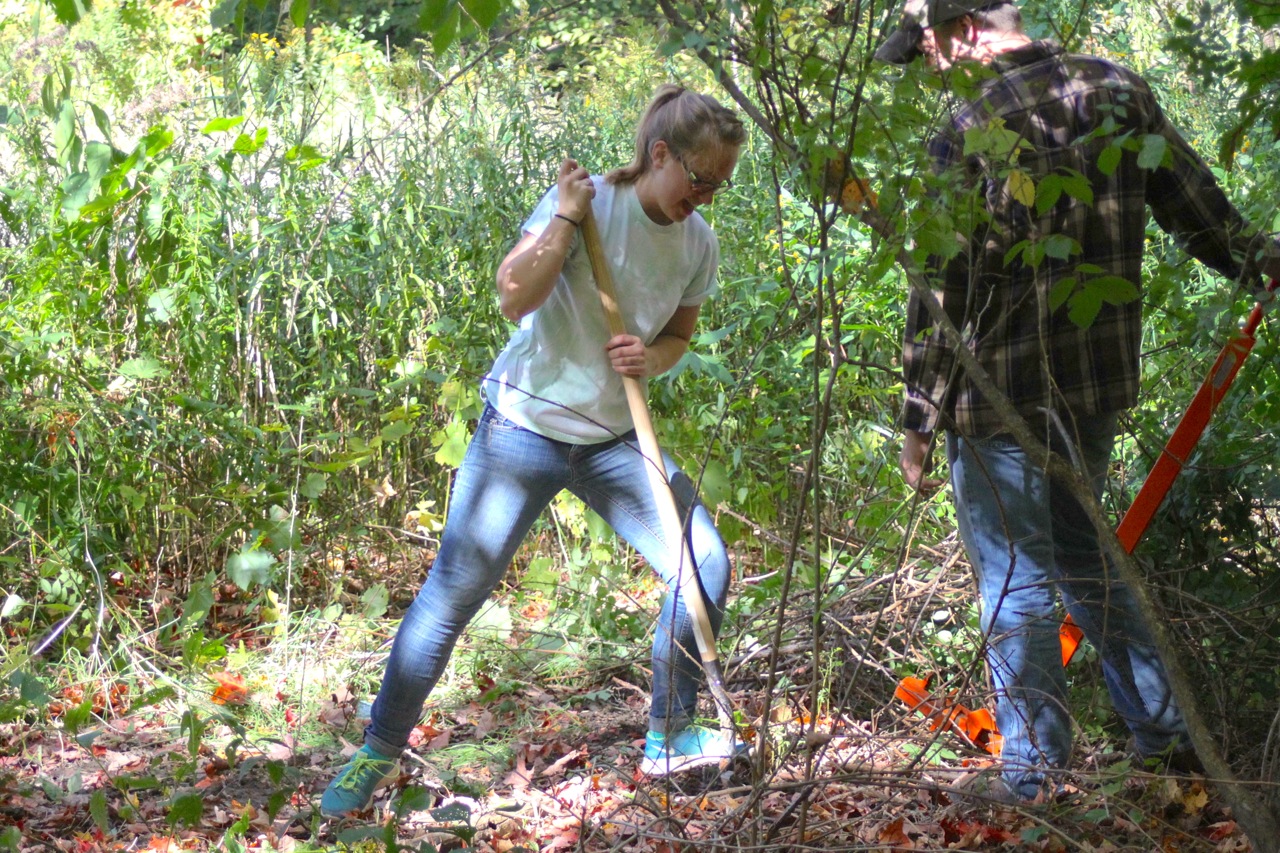
Tom Cermak, Pennsylvania Sea Grant coastal outreach specialist, helps Behrend students remove invasive bush honeysuckle from Wintergreen Gorge.
“This project not only provides valuable, hands on experiences for students, but it also protects and enhances the ecological integrity of a wonderful community asset,” said Tom Cermak, PASG coastal outreach specialist who is working with students to identify, track and remove invasives.
“We at Behrend are very excited to work with Sea Grant to eliminate invasive plant populations throughout Wintergreen Gorge. As these aggressive species are removed, they will be replaced with native plant communities, which will increase biodiversity and help keep the Wintergreen Gorge Ecosystem in balance, ” said Quinn.
You can help maintain the beauty of this popular hiking and biking trail by volunteering to remove plants at planned workdays this summer. Contact Ann Quinn at 898-6993 or abq1@psu.edu.
Bush honeysuckle is a deciduous shrub that can grow up to 15 feet. This aggressive invader displaces many native plants, including wildflowers and dogwoods.
Multiflora rose (above) steals space, nutrients, water, and sunlight from native plants and trees.
By Steve Orbanek Marketing Communications Specialist, Penn State Behrend
First impressions go a long way. Just ask Amyelia Payne.
Four years ago, while searching for colleges, the New Castle native toured Penn State Behrend. That’s all it took for her to make up her mind.
“We had this awesome tour guide, and right away, I knew Behrend was for me. I instantly fell in love with the campus,” the senior interdisciplinary business with engineering studies (IBE) and international business major recalls.
Payne’s experience that day would later influence her campus involvement as a student. When she looked into organizations to join, one club resonated with her.
“I loved Lion Ambassadors because a Lion Ambassador was the first person that I met when I came to campus,” Payne says. “I remember how that influenced me, and I wanted to have that same impact on students when they came to tour Behrend.”
Joining Lion Ambassadors was just the start of Payne’s influence and involvement. She joined Lambda Sigma and Beta Gamma Sigma, both national honor societies, and also became very active in Student Government Association (SGA). As a junior, she was SGA vice president before serving as president this past year.
Through SGA, Payne has left her mark. She’s helped spearhead discussions and preliminary plans to transform Erie Hall into a fitness and recreation center and Behrend’s SGA played a part in expanding Penn State’s smoking policy to include electronic and vapor cigarettes.
As SGA president, Payne also introduced an international seat on the organization’s board in response to the college’s growing international student population. This past fall, Penn State Behrend welcomed 186 international students, the largest such class ever at the college.
“We’ve seen such an influx of international students, and this was done to ensure that they had equal representation,” Payne says.
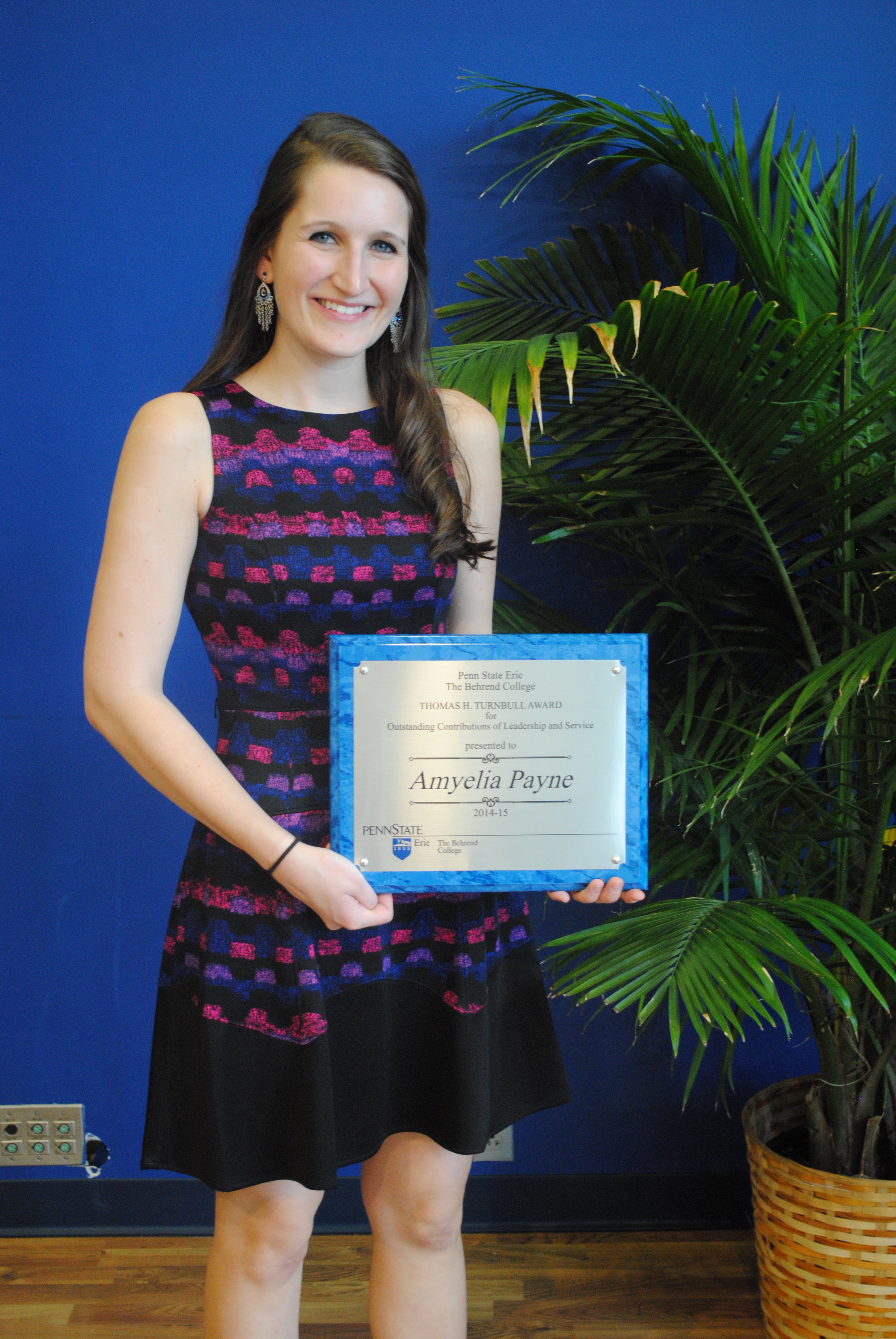
Payne’s involvement on campus was recognized in April at the 66th Honors and Awards Convocation where she was named the recipient of the Thomas H. Turnbull Award. The award recognizes a Penn State Behrend student who has contributed to the college community through outstanding qualities of character, scholarship, leadership and citizenship.
As it happens, when it came time for the naming of the Turnbull Award winner, Payne was already on stage handing out awards as part of her duties as SGA president.
“I had been standing up there for more than two hours smiling, and by the time they got to the final awards, my face hurt. I heard them say IBE and international business major and I thought, ‘Wait a minute; I’m the only one here with that double major,’” she recalls. “I was so shocked, but it was an incredible feeling to be recognized. I’ve given a lot to Behrend in four years, but I could never repay the experiences that it’s given to me.”
This week, Payne will graduate with her IBE degree and head to Cary, North Carolina, to intern with LORD Corporation this summer. She will study abroad in Barcelona this fall before graduating with her international business degree in December.
She says she will miss her time at Behrend, but she’s also hopeful and excited for the future.
“I’m not sad. There have been times over the past month when I’ve thought about it, but why be sad? It’s inevitable, so there’s no reason to dwell on it,” Payne says. “Everyone comes to college to get a degree and for their academics, but it’s what you do outside your degree that makes your experience unique. I’ve done all that I could, and I think I’m looking forward to that next stage of my life. ”
By Steve Orbanek Marketing Communications Specialist, Penn State Behrend
One by one, Jack Herzing sent them down. Between the left-hander’s strong fastball and biting curveball, Penn State Altoona hitters found themselves helpless at the plate.
When the April 6th game had finished, the Penn State Behrend pitcher had struck out 16 batters, tying the school record set in 2001 by Troy Williams.
His source of motivation that day came from an unexpected place — fear.
“In the back of my head, there was just this fear of getting rocked. It’s happened to me before, and it’s a very bad feeling when you’re up there getting hit around, and I was really motivated to get out there and help our team win,” Herzing said.
The Lions did win the game, defeating Penn State Altoona 4-1 in the AMCC contest. Herzing’s strong performance earned him recognition as Louisville Slugger National Player of the Week, but it was just a snapshot of what’s become a breakout sophomore season for the St. Marys native.
Overall, Herzing is 7-1 with a 2.82 ERA in 44 1/3 innings of work and leads the team with 58 strikeouts while averaging 11.69 strikeouts per game. His success has given a huge boost to the Lions, which own a 23-10-1 record and begin play in the AMCC Championship Tournament on Friday, but the seeds to Herzing’s 2015 breakout had been planted at the end of last year.
While he showed glimpses of his talent during his first year as a collegiate player, Herzing says he felt a need for improvement.
“After my freshman season, I really wasn’t pleased with how I performed,” the project and supply chain management major says. “The day after I came home (from college), I started a new lifting routine to get myself ready for the next season.”
The extra time in the gym has paid dividends for Herzing, who is penciled in to start the Lions’ first game of the AMCC Championship Tournament against Mount Aloysius.
“Herz has been big time for us this spring,” says Behrend head coach Paul Benim. “Our assistant coach Jay Condit has done a tremendous job of helping Herz evolve, simplifying his process. Herz has really focused, stepped up and elevated his performance, especially after the team lost three senior pitchers from last year’s ECAC Championship team.”
Perhaps no one is more familiar with Herzing’s mentality on the mound than teammate Brian Bohman, who has caught every one of his games this season. As a catcher, Bohman is often charged with keeping Herzing calm, even when things turn sour.
“Jack is that bulldog out there,” Bohman, a sophomore history major, says. “He wants to go 110 miles all the time, but sometimes you have to slow him down, say a little joke and get on with it. We work really well together.”
Herzing credits Bohman with much of his success.
“They say it’s 50-50 catchers and pitchers, but it’s really 60-40 catchers, if not more,” he says. “Bohman has been so great this year. He studies the batters. He knows where we should throw it, and I just throw it where he wants me to. He deserves most of the credit.”
While he’s clearly very serious with regard to baseball, there is another side to Herzing, and Hunter Hux will attest to that. As the only left-handed pitchers on the team, Herzing and Hux immediately developed a bond, but it goes beyond baseball.
“We’re the two goofiest kids on the team. We’re always laughing and cracking jokes,” Hux says. “We saw this one story online called ‘17 Reasons That You and Your Best Friend Are Joey and Chandler,’ and we started crying laughing afterwards because it described us perfectly.”
Hux is one of Herzing’s greatest supporters, and he has high hopes for his friend’s future. Last year, former Behrend pitcher Chad Zurat signed a professional contract with the Colorado Rockies organization.
That leaves big shoes for any Behrend pitcher to fill, but Hux says Herzing could be the guy to do it.
“If anyone on this team has the potential to do that, it’s Jack,” Hux says. “If he just develops a third pitch, there is no ceiling for him. And if Jack decides he wants to do it, I think he will.”
Eric Wehler will graduate next week from Penn State Behrend, but the senior project and supply chain management major is committed to seeing StudentTrade.net succeed.
By Steve Orbanek Marketing Communications Specialist, Penn State Behrend
Next week, Eric Wehler will be one of more than 500 students to graduate from Penn State Erie, The Behrend College. Like many other successful graduates, he has a job lined up, but he also has a unique connection to Behrend that likely will not be ending anytime soon.
In December, Wehler created StudentTrade.net, an online marketplace where members of the Penn State Behrend community can exchange or purchase textbooks, school supplies, appliances and furniture. The site began as a class project for Wehler’s MIS 430: Systems Analysis course but has expanded since then.
Today, StudentTrade.net has more than 90 registered users and forums for nine different colleges and universities. Earlier this month, Wehler established the site as a limited liability company (LLC). There have been growing pains along the way, including a redesign that resulted in the loss of previously registered users, but Wehler is committed to the cause.
“It keeps fueling me because I really believe this has a chance of succeeding,” says the senior project and supply chain management major who will begin work as a supply chain associate at the University of Pittsburgh Medical Center in May. “It’s really just a better version of a classifieds website, but it’s able to help students save money. I feel as if this could be the next big thing.”
Wehler is not alone in his enthusiasm for the project. Faculty members in the Black School of Business have encouraged him to continue enhancing and promoting the site, and Wehler sees Penn State Behrend as an integral part of any future success that the site may have.
“I’m aware that it’s going to take time, but if it takes off at Behrend, then I think it will just grow from there. I give so much credit to the college, the School of Business and the Office of Marketing Communication for their help with this. Even if the site grows, I always envision it being ‘housed’ at Behrend,” he says.
Wehler envisions the site remaining a free service for students, but he hopes to eventually charge property owners for posting information. He also believes the site could generate ad revenue.
For any of that to happen, however, StudentTrade.net needs significant web traffic, which is what Wehler is working to increase during his final days as a student at Behrend. Right now, the site is running a campaign in which students are automatically entered to win a $25 gift card if they post an item on the site.
“The site is like a second full-time job for me, and I plan on continuing to do what I can, so it eventually will become my full-time job,” Wehler says. “I see myself one day going from college to college and pitching the site to schools. In the process, I hope that I will also be able to inspire students to pursue their own paths as entrepreneurs.”
Wehler will certainly continue pursuing his.
“As long as the site is running and it’s helping students out, I’m committed,” he says. “I plan on running this thing for as long as it lasts.”
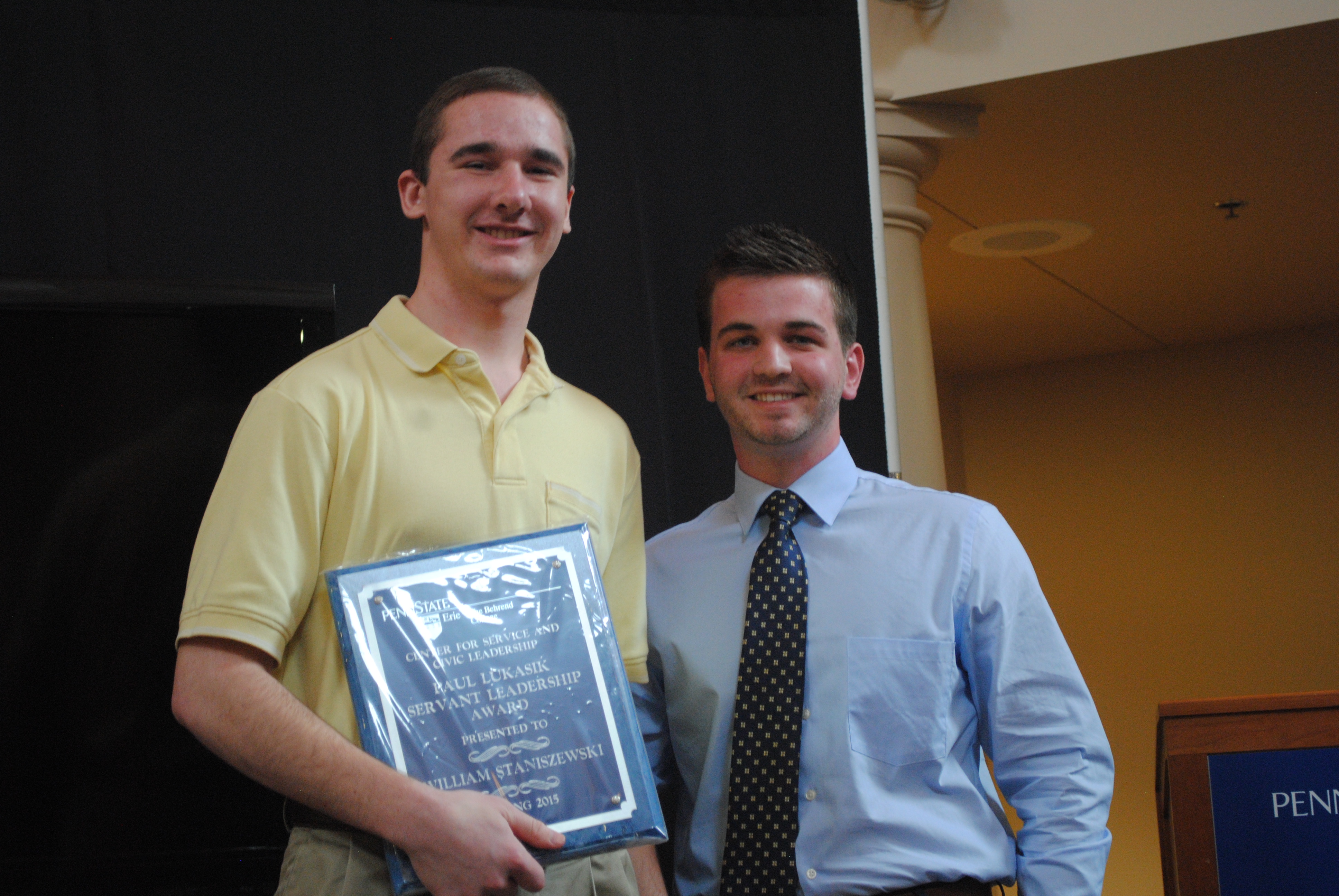
Bill Staniszewski (left) was the recipient of the Paul Lukasik Servant Leadership Award at this year’s Center for Service and Civic Leadership’s Service Awards.
By Steve Orbanek Marketing Communications Specialist, Penn State Behrend
Paul Lukasik unassumingly walked to the podium, flashing an abashed smile at the crowd of more than 50 people in attendance at Penn State Behrend’s Center for Service and Civic Leadership’s Service Awards.
“Just so you know, my face gets red when I get nervous,” said Lukasik, displaying humility that’s fitting in light of the award he was about to present: The Paul Lukasik Servant Leadership Award.
The award, created and presented to Lukasik in 2014 and subsequently named in his honor, recognizes a Penn State Behrend junior who, through leadership in a student organization or class, encourages others to engage in service and civic engagement.
This year’s honoree was Bill Staniszewski, a junior mechanical engineering major who has completed numerous service projects with THON and Triangle Fraternity.
“Being honored with this award was the highlight of my semester. It really means a lot to me, especially as one of the leaders of Behrend Benefitting THON,” Staniszewski said. “When I heard that I was the recipient, it helped to reaffirm my commitment to leading by example.”
For Lukasik, having an award named in his honor has been a humbling experience.
“It’s hard to put words to it. Presenting the award hammered home to me that this is something that will stay even after I’m gone,” said Lukasik, a senior project and supply chain management major. “My hope, though, is that people will look beyond the name of the award and see its intention.”
Naming an award after a current student is an unconventional practice, but according to Carrie Egnosak, an academic adviser and a member of the Service Awards Committee that created the award, Lukasik is especially deserving of the honor.
“Paul has just been so involved with service from the very first moment he stepped onto campus,” Egnosak said. “He’s one of the few students who has participated in every Alternative Spring Break trip since he’s been here, and he tends to take on a leadership role with any club or organization that he becomes involved with. Everybody who knows him loves him because he would do anything for anyone.”
Since arriving at Behrend, Lukasik has performed services projects through Reality Check, Behrend’s community service-oriented club; Omicron Delta Kappa, the national leadership honor society; Relay for Life; and Alternative Spring Break; and has served as a resident assistant.
Lukasik said his commitment to service dates back to childhood, helping out at Fair Haven’s Church, founded in North Tonawanda, N.Y., by his grandparents.
He contends his commitment to service won’t be changing anytime soon. After graduation, he plans to do volunteer work through GE Transportation, where he has accepted a position in the Commercial Leadership Program, and also hopes to make a service trip to David’s Home, an orphanage founded in Haiti by Fair Haven’s Church.
Lukasik said he is grateful for all of the opportunities he’s received at Behrend, and he hopes new students will continue to pursue service work.
“Behrend as a whole has given me so many opportunities. I’ve had internships, gone on service trips and had leadership positions,” he said. “The service work just draws you in. It’s mutually beneficial and so rewarding. No matter how busy you are, there’s always something you can do, and I think it’s our civic duty to give back.”
By Steve Orbanek Marketing Communications Specialist, Penn State Behrend
Jessica Schubert has heard it all too many times.
“I’m so OCD.” “Oh, that’s my OCD acting up.” They’re the explanations many people offer to explain their little quirks.
The problem is that a quirk — a peculiar behavioral habit — is much different from obsessive compulsive disorder (OCD) — a potentially severe mental illness that affects more than three million Americans in the United States.
“People don’t mean harm when they make generalizations like that, but I do think it perpetuates this mindset that mental illness is not a big deal,” says Schubert, who graduated from Penn State Erie, The Behrend College, in 2009 with a degree in psychology. “OCD is a real, chronic and disabling condition. It’s a broader disorder than a lot of people think.”
Bringing awareness to OCD and its complications is one of the Harborcreek native’s goals. Now a Ph.D. candidate at Binghamton University – SUNY, Schubert has developed an interest in OCD, partially because treatment of the disorder remains a relatively new concept.
“It’s only in the last 30 years where we’ve had any effective treatment for OCD. Before that, the field was very psychodynamic, but over time, the theoretical focus changed to behaviorism. That small change in focus has really led to the treatment of OCD,” she says.
According to Schubert, treatment can take many forms. Medications may be used, but Schubert says they’re often not a long-term fix.
Instead, she proposes exposure-and-ritual prevention, a type of cognitive-behavioral therapy. The idea is to encourage the person suffering from OCD to face his or her fears.
“The problem with someone who has OCD is that they’re avoiding what they’re afraid of. Having them stay with their anxiety will allow them to see it go down over time,” she says.
Schubert’s doctoral research specializes in sleep patterns and how they potentially affect OCD. This was also her topic of discussion when she returned to Behrend this semester to speak as part of the college’s Colloquium Series in Psychological Sciences and Human Behavior.
Schubert estimates that at least half of those diagnosed with OCD are unable to maintain regular sleep schedules. In fact, OCD sufferers tend to stay awake through the night time hours, only to sleep throughout the day. Schubert’s research examines the role that disrupted circadian timing of sleep plays in the severity of obsessions and compulsions. Often referred to as the “body clock”, the circadian rhythm is a 24-hour cycle that tells our bodies when to sleep and regulates many other physiological processes.
“It’s not that people with OCD are not sleeping enough, but that they’re sleeping at the wrong time,” she says. “My research looks at whether we can normalize sleep, so they can engage in normal treatment.”
Although Schubert is still conducting more research on the topic, she says she’s encouraged by her findings, which suggest that sleep patterns do play a role in the severity and effectiveness of treating OCD symptoms.
Schubert plans to dive further into the topic in the years to come, but she is also excited about the other potential paths her professional future could take.
“There’s this huge array of opportunities available to someone in this field,” she says. “You can teach, you can see patients, you can do research or you can do a combination of all three. It’s a field you can never get bored in.”
The Penn State Behrend Spring Art Show includes works by students, faculty, and staff.
Penn State Behrend’s Spring Art Show brings color and beauty to campus. The show presents works by twenty-five artists from the college community through May 8. It is the first time that it will be displayed in the college’s John M. Lilley Library gallery.
Heather Cole, lecturer in digital arts, and Scott Rispin, lecturer in art, collaborated on the show, which received support from the Mary Behrend Cultural Fund. Together, they expanded it from a straightforward student photography show to a professional exhibition in the gallery located on the main floor of the library.
“In the past, we exhibited unframed works in the hallway of a classroom building,” Cole explained. “We were looking for a more professional viewing space. The Lilley Library gallery gave us the opportunity to exhibit the art in a framed, professional manner.”
Rispin had been talking to Dr. Rick Hart, library director, for a few years about using space on the lower level and in the gallery for exhibits. Things came together last fall, when the Faculty Art Show made its debut in the gallery space.
The Spring Art Show promotes the diverse talents and interests of the Penn State Behrend community. Submissions include student works in a variety of media, as well as pieces by faculty and staff. In addition to photography, the show features paintings, drawings, and digital art such as collages, scanograms (scanner art), 3D graphics, and 3D-printed sculptures. Many of the student works were created for photography, digital arts, and painting classes.
The artwork is not arranged by format or artist. “It’s always best to hang a show in a way that creates a better experience for the gallery patron,” Rispin said.
Students demonstrate diverse artistic talents
Hayden Seibert, Big Sky Mixed Media on Canvas
Hayden Seibert, a sophomore Mechanical Engineering major from Erie, Pa., submitted two paintings to the show. “One was displayed last year in the Erie Art Museum Spring Show and the other is being shown for the first time,” he said. “I’m an artist, and I like to share my work.”
Krystal Elliott, Spring is Near Watercolor on paper
Krystal Elliott, a sophomore Software Engineering major from New York City, created her watercolor painting Spring is Near, which depicts a bird on a tree branch, specifically for the show. She said she submitted it to challenge herself to do something new, and she wanted to paint something others could identify with.
“I finally saw a bird outside and it reminded me that winter was nearly over,” she said.
Nick Ranayhossaini, Burning Oil Charcoal on paper
Nick Ranayhossaini, a senior majoring in General Arts and Sciences from Harmony, Pa., had started his charcoal drawing of a skull before learning about the show but finished it for the submission deadline.
“I often draw skeletal figures, largely because I enjoy dark themes and just think that skeletons look cool, but also because they don’t represent anyone specific,” Ranayhossaini said. “Seeing the piece in the gallery makes me extremely happy. When I get to watch someone walk in and start examining my work I am extremely proud.”
Digital Arts step into the spotlight
3D Prints and Digital Sculptures
The exhibition includes a display case with 3D objects designed by students in Cole’s ART168 The Digital Medium course. They hadn’t even seen their creations until they went on display. The students created the models with Autodesk Mudbox, a 3D painting and sculpting program, and Cole printed them with a 3D printer recently purchased by the School of Humanities and Social Sciences.
“These are their first projects,” Cole said. “They wanted to get down to the library to see them right away.”
Peter Kalmar, Sword Model Digital Sculpting
Peter Kalmar, a junior Computer Science major from Cabot, Pa., created a 3D-printed turtle and also drew concept art for a sword design and implemented it in Blender, a 3D modelling program. He said doing the project was a great way to learn the computer program.
Art at Penn State Behrend will continue to grow
Cole and Rispin say that there are ample opportunities to further expand the show, which would give Arts Administration majors experience in planning, executing, and promoting gallery exhibitions.
Both instructors hope more artists will participate as they become aware of the blossoming art scene on campus. Cole and Rispin often find that fear or inexperience holds back new artists, who may think their work isn’t good enough or might not know how to frame or display artwork.
“All they really need to do is talk to us and we’ll help them,” Cole said. Rispin has even loaned or built frames for students’ work.
Don’t expect all of the art to disappear from the Lilley Library—or campus—after the show is over. Rispin says additional wall space on the lower level of the library will be used as “ongoing exhibition space.”
The show also was highlighted at a recent Community Arts Walk that took place during the college’s Spring Open House. The event included temporary art displays on bulletin boards and mobile frames around campus, a display in the windows of a residence hall, and performances at Bruno’s Cafe.
“The walk went well,” said Cole, who may “look to inviting clubs to participate next year.” She has lots of other creative projects in the works, too.
Students say that’s good news. “I have high hopes that the college will continue to provide opportunities like this on campus,” Seibert said.
About the Spring Art Show
Admission to the show is free and open to the public during library hours.
Parking is available at the adjacent Reed Union Building or in any campus visitor parking lot. Visitor Parking Permits may be obtained from Police Services in Erie Hall.
The Penn State Behrend Spring Art Show runs through May 8. The annual exhibition, which includes works by twenty-five members of the Penn State Behrend community, has expanded and moved to the Lilley Library gallery.
By Steve Orbanek Marketing Communications Specialist, Penn State Behrend
A flyer for Emma and Dan’s Route 6 Journey hangs from the fridge at the Harborcreek home of the Perritano family. Sixteen-year-old Emma Perritano’s face lights up whenever she catches a glimpse of it.
So far, she is enjoying the journey, eagerly waving her hands when they pass someone on the street. All the while, humming her favorite songs, a collection of tunes from Wicked, Disney movies and some old-fashioned rock ‘n’ roll.
Her parents, Penn State Behrend men’s soccer coach Dan Perritano and college registrar Jane Brady, said it’s exactly what they hoped for.
“I wanted to take Emma and do something special,” Dan Perritano said. “While she doesn’t understand what we’re doing completely, she points to that flyer now, and she knows we’re doing something special.”
What they’re doing is a 360-mile trek across Pennsylvania’s historic Route 6 to help raise funds for the Arc of Erie County. Emma is a non-verbal life skills student at North East Middle School and has benefitted from the Arc, which provides advocacy and support for individuals with intellectual and developmental disabilities and their families.
Dan is pushing Emma in her Team Hoyt running chair, a custom-built chair designed for physically-challenged individuals that was purchased through grants from ACHIEVA and Billy’s Friends Foundation, two non-profit organizations for persons with disabilities. The two have already begun checking off some of the western miles on Route 6 during weekend outings.
The duo hopes to finish at least 100 miles before setting out on May 18 to finish the trip.
“Once we get on the road, we aren’t coming back,” said Perritano, who will use the MapMyWalk app to track completed miles.
Perritano said the two average about 15-minute miles when moving consistently, and he hopes to do between 15 to 20 miles per day.
“The plan is to do 10 or 11 miles in the morning, have lunch and then do maybe another 10 in the afternoon,” he said.
Perritano said they won’t carry many supplies and will mostly rely on purchasing things on the go.
However, if supplies get too low, Perritano does have a lifeline.
“I can’t imagine them going three of four days without me coming to the rescue,” Brady said.
Perritano plans to finish the journey on May 30, but knows challenges could arise. Hazardous weather could cause a delay, so he said the completion date is tentative.
“It’s going to be so rewarding,” Perritano said. “It’s something special that we will always remember.”
To learn more about the Arc or how you can contribute to Emma and Dan’s Journey, please visit their website at thearcoferie.org or contact Arc president Dr. Karen Morahan at kmorahan@edinboro.edu or Dan Perritano at dpp2@psu.edu.
Follow Emma and Dan’s Journey on their Facebook page.
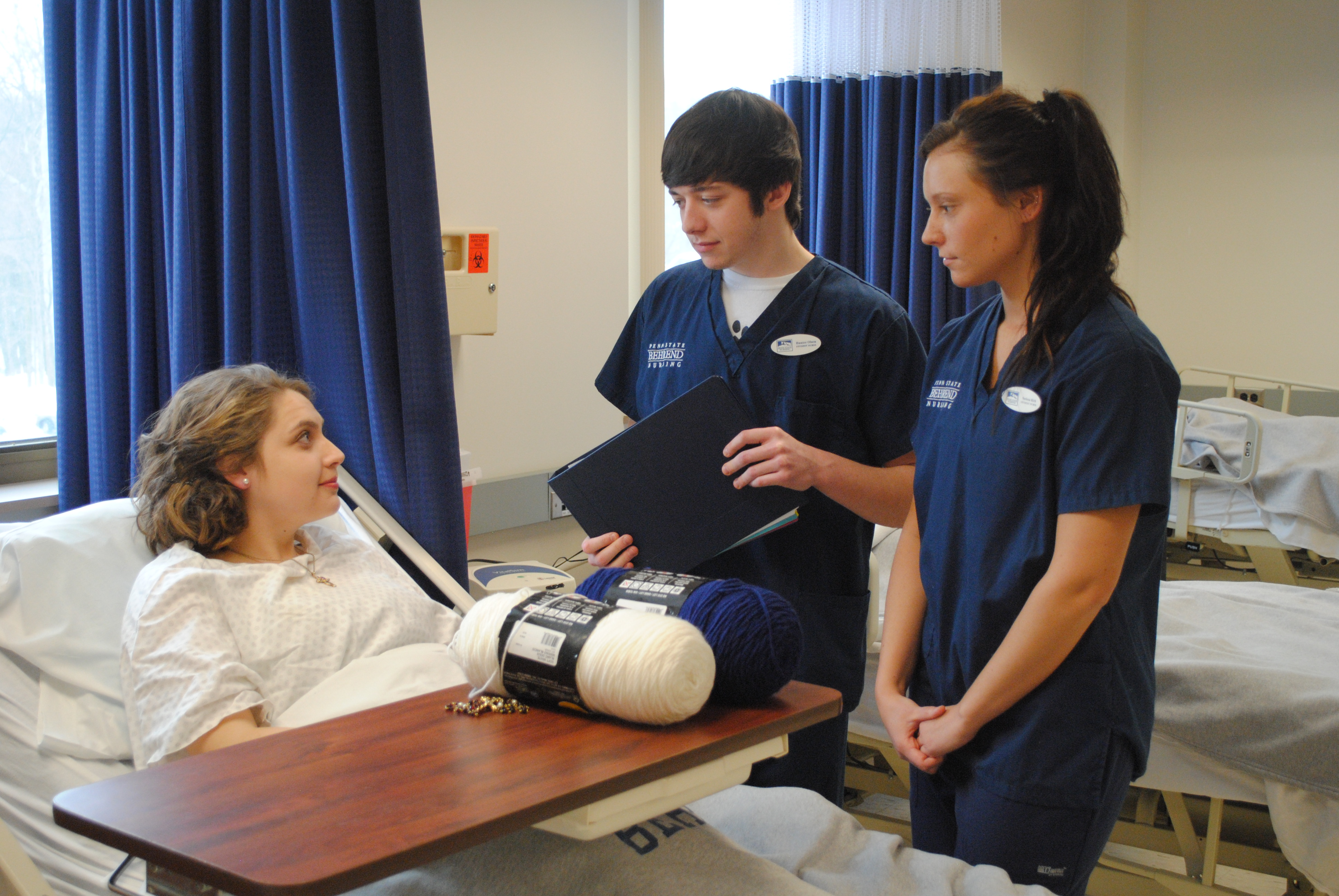
Brenna Lanager played the role of an elderly patient this past fall in a NURS 112 class. Students Hunter Olsen and Nerissa Rich were tasked with trying to prepare Lanager for surgery as part of the simulation.
By Steve Orbanek Marketing Communications Specialist, Penn State Behrend
When Margaret Kertis, a lecturer in nursing at Penn State Erie, The Behrend College, pulled back the curtain that hung over the bed where a mannequin would normally lie, students in her NURS 112 course were quickly taken aback. The mannequin that they had grown accustomed to was no longer there.
In its place laid a young woman, but if not for her soft complexion and inherent youth, you might think otherwise. Her clothing looked to be something straight out of a Laura Ingalls Wilder novel. Her hair was dabbled in talcum powder. Her hands clenched a rosary.
“Their faces were priceless when they pulled the curtain back and saw that there was a person there,” said Brenna Lanager, a sophomore psychology major who happened to be the woman lying in the bed.
Lanager’s role that day was as a patient actor.
“The first-year nursing students had gotten so accustomed to performing skills on the low-fidelity mannequins that do not communicate, so I wanted them to focus on interacting and communicating with a ‘real’ person,” said Kertis, who taught the NURS 112 course this past fall. “The scenario involved preparing an elderly patient for surgery.”
As the students soon learned, preparing an elderly patient for surgery is easier said than done.
Lanager, who has previous acting experience from a theater course she took at Behrend, was not exactly the model patient.
“I was playing the role of Brenna Brake, an old woman who had fallen down the stairs while doing laundry. I was supposed to have a hearing aid, but I left it at home, so I kept asking the nursing to repeat what they were saying. I was also very religious and refused to give up my rosary.” Lanager said. “I could tell everyone was nervous, but they did a great job of putting on that nurse face, and getting the job done.”
For the students, the interaction with Lanager was invaluable.
“You get real emotions. Yes, they’re acting, but they’re still a real person, and it’s still person-to-person contact,” said Hunter Olsen, a sophomore nursing major who was part of the NURS 112 class.
For her part in the course, Lanager earned extra credit points as part of her THEATER 102 course. It also was an eye-opener for the Hawk Run native: her mother works as a nurse.
In the future, Kertis said she hopes to again utilize patient actors. Lanager is also eager to volunteer her services one more time.
“It was really cool to see what the nursing students were going through from that perspective,” Lanager said. “I would definitely do it again. It was so much fun.”














 BEHREND BLOG