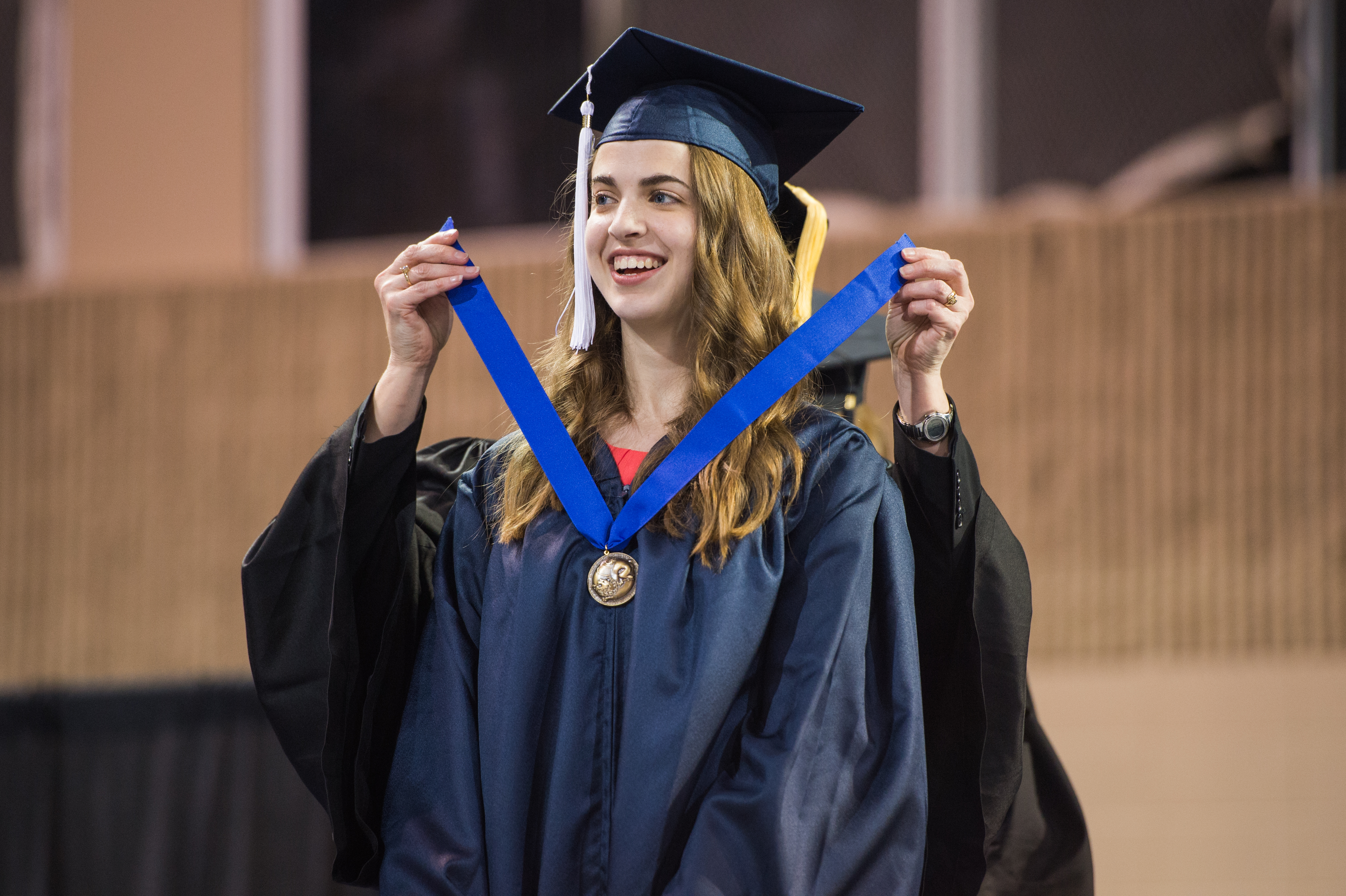
‘Looks Like We Made It’: Behrend choristers perform alongside Barry Manilow

Manilow-Concert_017 (smaller)

By Steve Orbanek
Marketing Communications Specialist, Penn State Behrend

It was not until the lights came on that Elizabeth Seng fully realized the significance of the moment.

Behind her was a jumbotron. In front stood a multi-platinum singer-songwriter. Beyond him was a crowd of thousands of people.

Seng, a senior psychology major at Penn State Behrend, has made many memories in her four years at the college, but performing alongside Barry Manilow as part of the Choirs of Penn State Behrend might take the cake.

“We were out on the stage, and then they shined the lights on us,” said Seng, a Seattle native who has been a regular member of the choir during her time at the college. “There were all these people there, and it was just really exhilarating. It was probably my most memorable experience I’ve had here at Behrend.”

Manilow invited the Behrend Choirs to perform alongside him at his April 25 concert at Erie Insurance Arena. Tone-Acious, Penn State Behrend’s student a cappella club, joined the choir for the performance, which was part of Manilow’s “One Last Time!” tour.

“This was a really unique opportunity, and it highlighted Behrend’s arts offerings in front of a huge audience,” said Gabrielle Dietrich, director of choral ensembles at the college. “It also provided a fun and highly motivating year-end experience for our students.”

“When I found out, I was like, ‘Oh my gosh, are you serious?’” Seng said. “It just felt so special to think that Barry Manilow thought we were good enough to be a part of his concert.”

The choirs’ performance was especially meaningful because they joined him for the three final songs of the concert, which were amongst his greatest hits: “Copacabana,” “Miracle” and “I Write the Songs.”

The day of the concert, the choirs arrived at the arena at 3:30 p.m. and practiced before going on stage at 9:30 p.m.

“We were sent to holding rooms in which they had us practice a lot and learn the choreography,” said Taylor May, a junior software engineering major and member of both the Behrend Choirs and Tone-Acious. “We even ran through it once on the stage with the soundtrack, but thankfully we got to relax a bit before the concert.”

To honor the occasion, choristers created “Behrend Hearts Barry” t-shirts which they wore under their gowns during the concert. They even gave an extra t-shirt to Manilow as a memento.

The shirts are a reminder of what was truly a once-in-a-lifetime experience for many of the choristers.

“Before you knew it, you could see the streamers (coming down from the ceiling), and that was it. It just went by so fast,” Seng said. “To be part of one of his final tours was just really, really cool. I’ll remember it forever.”

This slideshow requires JavaScript.

Students escape to Madagascar via Washington, D.C.

Reem Elhafiz Abdalla, Jillian Dunn, Lillie Gabreski, Dalia Tenda Batuuka
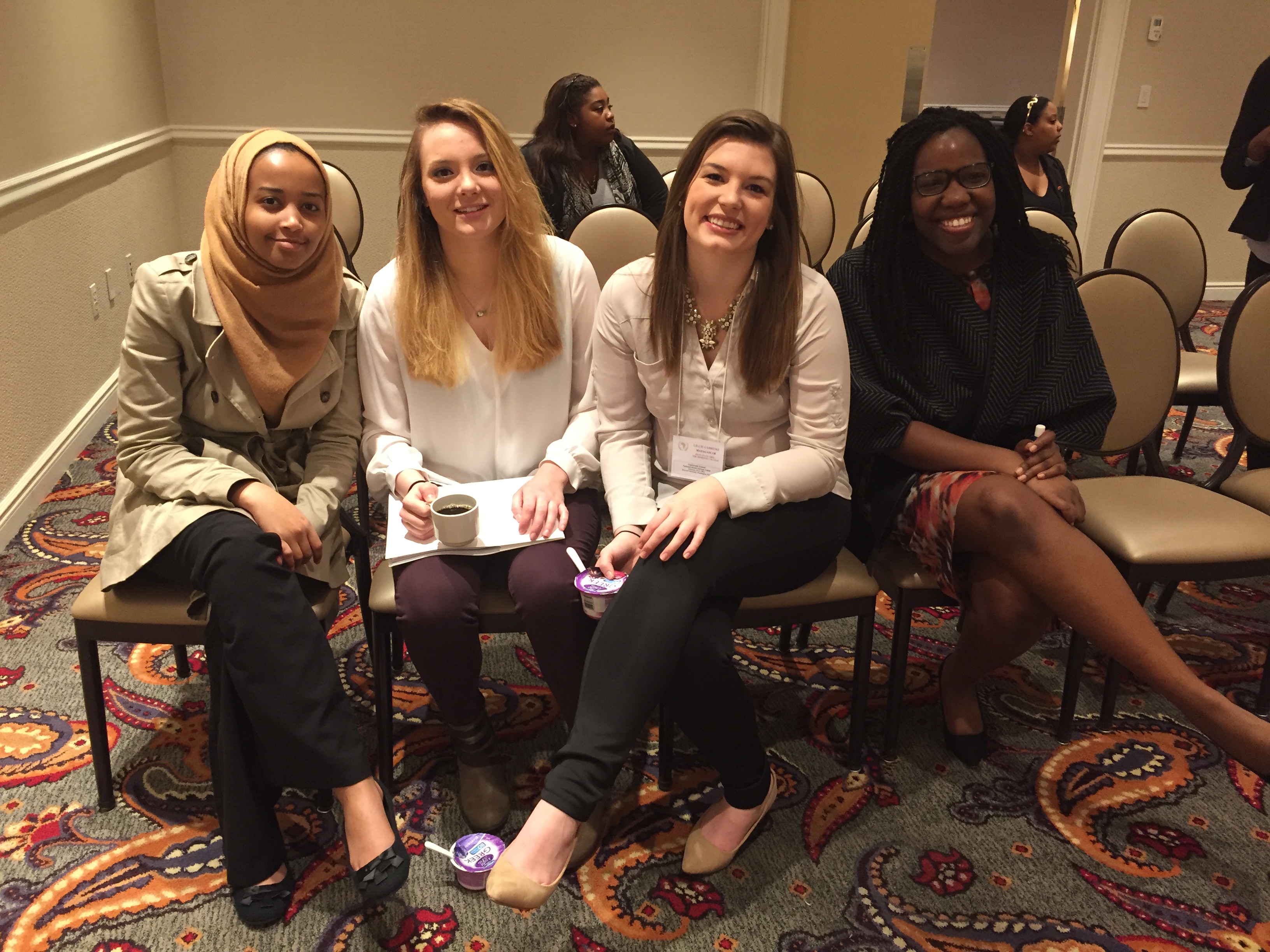
Reem Elhafiz Abdalla, Jillian Dunn, Lillie Gabreski and Dalia Tenda Batuuka represented Penn State Behrend at Howard University’s 14th Annual National Model African Union Summit last month.

By Steve Orbanek
Marketing Communications Specialist, Penn State Behrend

Dalia Tenda Batuuka, Jillian Dunn, Lillie Gabreski and Reem Elhafiz Abdalla are not natives of Madagascar. None of them has ever stepped foot in the country.

Talk to any of these four Penn State Behrend students for even a few minutes though, and you might just think they were native-born Malagasy.

Last month, the students attended and participated in Howard University’s 14th Annual National Model African Union Summit. Sponsored by the African Union Mission and Member State Embassies in Washington, D.C., the four-day summit is a simulation of the proceedings of the African Union, requiring participants to research their assigned countries in-depth before attending the conference.

This marked the first time that Penn State Behrend was represented at the summit, held in February with more than 45 colleges and universities participating. The Behrend students’ assigned country was, of course, Madagascar. The group represented the college well, winning the Michelle Tooley Outstanding Delegation in Committee Award in recognition of their performance on the Social Matters Committee.

“Students really do have to act as delegates and adopt the stance of the country they’re representing,” said Naaborle Sackeyfio, a lecturer in comparative politics who also attended the summit.

The students chose to participate after taking Sackeyfio’s Introduction to Contemporary Africa course during the fall semester.

“We were in the course together, and Dr. Sackeyfio mentioned this summit. It just seemed like such a great opportunity,” said Batuuka, a first-year psychology major.

Each student was assigned a different committee for the summit, in this case Economics (Gabreski), Peace and Security (Batuuka), Social Matters (Abdalla) and Regional Economic Matters (Dunn). This meant that the group had plenty of studying to do beforehand.

“The whole point was to go there and play the role of actual delegates from Madagascar, so you had to be very familiar with the country in advance,” Batuuka said.

The group met several times a week and spent long hours preparing for the event. There were times during the summit where other countries’ delegates would call their expertise into question, but the students held their ground.

“People would contest things over even the smallest words. There were times where you definitely had to stand up and make your case heard,” said Gabreski, a senior political science major.

“The margin for error was very small,” added Dunn, a sophomore political science major.

While the students were happy to receive an award for how they represented Madagascar, it was not the only thing they took away from the summit.

“After this experience, I have such a newfound appreciation for politicians,” Batuuka said. “You always hear, ‘What’s wrong with Congress? Why aren’t they passing this?’ but you realize that it’s not that easy.”

Sophomore creates Behrend’s first Model United Nations chapter

By Steve Orbanek
Marketing Communications Specialist, Penn State Behrend

Delegate-Ivan Pan, Moustafa
Ivan Pan, left, and Moustafa Elhadary were two of the student delegates who represented Penn State Behrend at the 62nd annual Harvard National Model United Nations.

Weibin “Ivan” Pan was optimistic prior to attending the Penn State Behrend Student Leadership Conference in February 2015. The Xiamen, China native had just started his second college semester and was looking to get more involved on campus.

But he did more than just get involved. He paved the way for others to get involved, too.

“I came out of that conference knowing that I wanted to create a Model United Nations at Penn State Behrend. I was very involved in Model UN in high school, and I knew that a lot of students at Behrend would be interested in the group,” says Pan, a sophomore Finance major.

Within a month, he had found a faculty adviser and plenty of interested students. Today, the group, now an official Model UN chapter, has more than 30 members.

Pan said a key reason he wanted to start a chapter was to provide opportunities for the college’s growing international student population. Last year, Penn State Behrend welcomed 186 new international students, the largest international class in its history.

“Model UN is a great place for international students to practice their public speaking skills, English skills and to learn to negotiate with others,” Pan said.

In February, Pan and an additional seven Penn State Behrend student delegates attended the 62nd annual Harvard National Model United Nations (HNMUN). More than 3,000 student delegates from more than 70 countries and 100 universities attended the four-day international relations simulation in downtown Boston. Founded in 1955, the conference is the largest and oldest of its kind, and this year was the first time that Penn State had ever been represented.

For the simulation, Pan and the other student delegates (Stephanie Zhao, Naman Tanwar, Tyagadipta Biswal, Deniz Himmetoglu, Hank Pinge, Moustafa Elhadary, and Keshav Prabhu) were assigned the country of Poland. They spent nearly a year researching the country and its policies to prepare for the event.

“We prepared and met regularly before the event,” Pan said. “It was a great honor to be invited to the conference. Everyone wants to be invited, but there was only a limited number who went.”

While they did not take home any of the major awards at HNMUN, the team plans to apply to attend the conference next year. The group has also applied to attend the eleventh annual Los Angeles Model United Nations (LAMUN) in April at the University of California, Los Angeles.

“There are so many great opportunities for students here at Behrend,” Pan said. “The fact that I was able to start a Model UN chapter just shows that Behrend really does provide great opportunities for its international students.”

This slideshow requires JavaScript.

Marketing alum finds calling with Make-A-Wish Foundation

Penn State Behrend alumna Melissa Lichtinger works as online communication manager for Make-A-Wish International but also volunteers for the organization. The first wish she granted was for Lucas, who suffers from lung disease, cerebral palsy and can only communicate through non-verbal expression. A splash pad was installed in his backyard, so he would be able to play safely in water.

By Steve Orbanek
Marketing Communications Specialist, Penn State Behrend

Melissa-Lichtinger_1Melissa Lichtinger no longer worries about life’s everyday stresses. Those concerns went away after she started to work for Make-A-Wish Foundation.

“Whenever life gets tough, I’ll just watch a wish story. It always instills positivity, and you realize that your day-to-day struggles are nothing compared to what these kids go through,” the 2013 Penn State Behrend graduate said.

Lichtinger, who earned degrees in marketing and international business, works as online communications manager for Make-A-Wish International, headquartered in Phoenix, Arizona. Every day, the Erie native works to manage the organization’s social media and website presence while being attentive to the needs of the 50 different countries in which Make-A-Wish operates.

Her commitment to the nonprofit’s mission is nothing new. While in college, Lichtinger got involved with Make-A-Wish thanks to the urging of her aunt, who was a volunteer, and interned in the organization’s Erie office.

“At my internship, I did a lot of the wish story writing, so it really connected me to the mission, and I had the chance to meet a lot of wish kids. It really changed my life and made me realize I wanted to work in this sector,” she said.

Lichtinger happened to be in luck. Following her college graduation, she was hired as a digital production coordinator for Make-A-Wish America before being promoted to digital production specialist. She was promoted to her current position last June.

However, while she enjoyed her work, something was missing. At the corporate office, Lichtinger often helps with managing the global brand, sponsorships and high-level tasks. It was time to get back to basics.

“I reached out to the local office here in Arizona, so I could start the process of (volunteering) and granting wishes. It was important to get back to the mission, and remind myself of why I wanted to get involved to begin with,” she said.

Her first wish granted was for Lucas, who suffers from lung disease, cerebral palsy and can only communicate through non-verbal expression. After speaking with his mother, Lichtinger learned that Lucas loves playing in the water, but it’s difficult for him to do so because he cannot be in the water without someone holding his head up.

His family and Lichtinger ultimately decided to install a splash pad in the family’s backyard for Lucas. Commonly seen in public parks, splash pads eliminate the risks of pools while still providing plenty of water fun as ground nozzles spray water upwards.

When he was introduced to the pad, Lucas immediately started to laugh and giggle, and Lichtinger was reminded why the Make-A-Wish cause resonates with her so much.

“You get to take a kid who doesn’t get to be a kid right now, and you get to help them imagine something that they never thought was possible. You get to see the transformation where they become a little kid again,” she said.

Lichtinger is currently in the process of planning an additional two wishes. She knows her career path may one day change, but she wants to continue to make a difference in the nonprofit sector.

She also remains very thankful for all the knowledge she gained from her time at Behrend.

“I am a driven person, but Behrend instilled all of the steps of how to get there while giving me an opportunity to work with professors who really care about your success. My international business degree and the projects I worked on is what really helped me get this job,” she said. “I still talk to my marketing professors today, and they still help me if I have questions or need advice. They’re my mentors, not just for those four years, but they’re my mentors through life.”

Recommended gift ideas from faculty and staff members

By Steve Orbanek
Marketing Communications Specialist, Penn State Behrend

Still got some holiday shopping left to do? Don’t worry, Penn State Behrend’s faculty and staff members have you covered. Here are some of their top suggestions for gifts that are both fun and educational.

irkt_marvel_gotg_holiday_dancing_groot

Ideas provided by Tracy Halmi, senior lecturer in chemistry

  • Weather station. Any future meteorologists on your gift list? This is perfect as it accurately measures the temperature, humidity, and wind speed. $100.
  • Elements: A Visual Exploration of Every Known Atom in the Universe. This book offers never-before-seen photographic representations of the 118 elements in the periodic table. We’re all familiar with aluminum and copper, but what exactly does Copernicium look like? This book will show you. $15.
  • ThinkGeek products. Whether it’s Marvel, Minecraft or the Millennium Falcon, everyone knows geek is the new cool. This website offers items that will surely satisfy any “geek” on your gift list. Various prices.

k2-_4c7fc749-3b72-4ff1-9ce5-bd9f911e1cc5_v1

Ideas provided by Dr. Richard Zhao, lecturer in computer science and software engineering

  • Custom photo jigsaw puzzle. It never hurts to give a gift with a personal touch, and jigsaw puzzles can be a fun, challenging task. $14.
  • LEGO Star Wars. The new movie is right around the corner, so anything Star Wars is guaranteed to be a hot item this holiday season. However, why not inspire a little creativity with a LEGO Star Wars set? There’s one available in every price range. Various prices.
  • Make-Your-Own Robots. Thanks to Makershed.com, you can choose from a number of options and create your own small robot from scratch. $20-$500.

61ZhXMb3yRL__SL1280_

Ideas provided by Melanie Ford, director of Youth Education Outreach

  • Blink Blink DIY kits. These kits are perfect for girls interested in any of the STEAM fields as they integrate art, fashion, simple circuits, and e-textiles into the hands-on building process. Kids can create a number of fun items, including cards, paper lamps, origami, scarves, and light-up leggings. $39-$89.
  • Makey Makey. Dubbed the “Invention Kit for Everyone,” Makey Makey makes it possible to connect a computer to almost any object. It could be a banana, an ice cube or a living person, but basically any material that can conduct at least a tiny bit of electricity can be used. $50.
  • K’Nex. These are similar to LEGOs but a bit more advanced. K’Nex really emphasize engineering and physics principles, allowing the builder to create some pretty awesome things like roller coasters and Ferris wheels. Various prices.

61DETogR+IL

Idea provided by Dr. Mary Ellen Madigan, director of enrollment management

  • Adult Coloring Books. Have someone on your gift list who is always stressed-out? Adult Coloring Books  are an Amazon No. 1 National Bestseller, and provide hours and hours of stress relief, mindful calm, and fun, creative expression. $9.

Pre-Health students sew first stitches in medical career

By Heather Cass
Publications & Design Coordinator, Penn State Behrend

IMG_1133

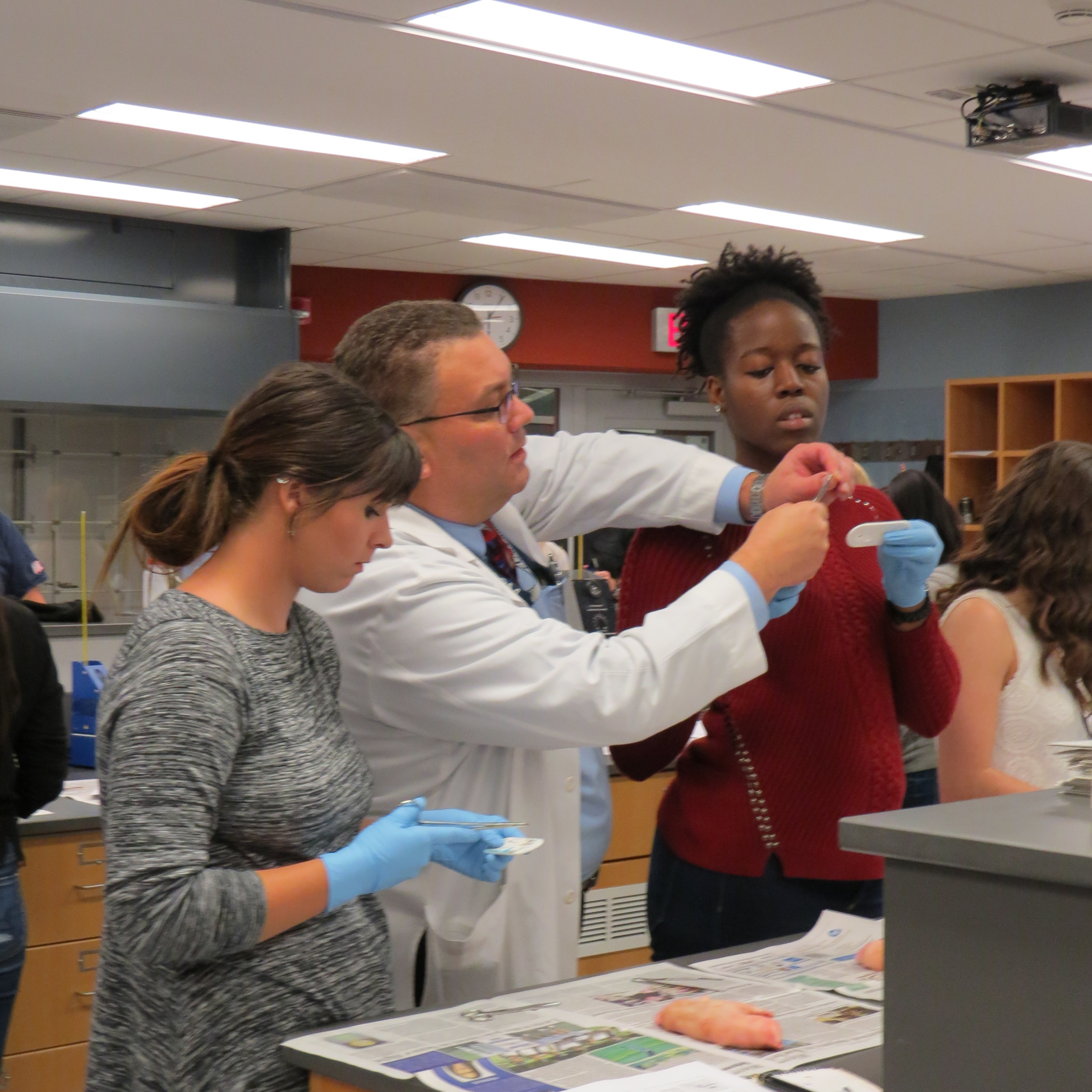
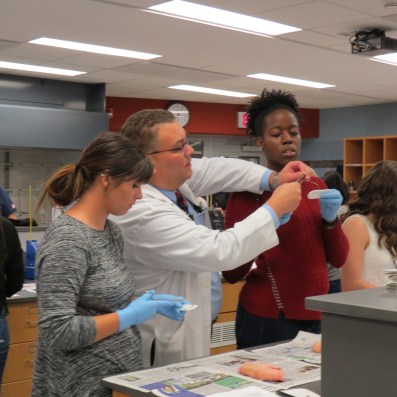
Suturing—sewing together incisions or torn flesh—is a basic technique every doctor must master. It is, however, a skill that few undergraduate students have the opportunity to practice before entering medical school. But, thanks to the U.S. Army and Penn State Behrend’s Pre-Health Professions program, nearly thirty undergraduate students from four area universities were able to try their hand at three types of basic stitches at a suturing seminar earlier this month.

The class, offered by the Army Health Care Recruiting office in Pittsburgh and held at Penn State Behrend, was taught by Dr. Regan Shabloski, assistant dean for clinical education at Lake Erie College of Osteopathic Medicine, and a member of the Army National Guard’s Medical Corps.

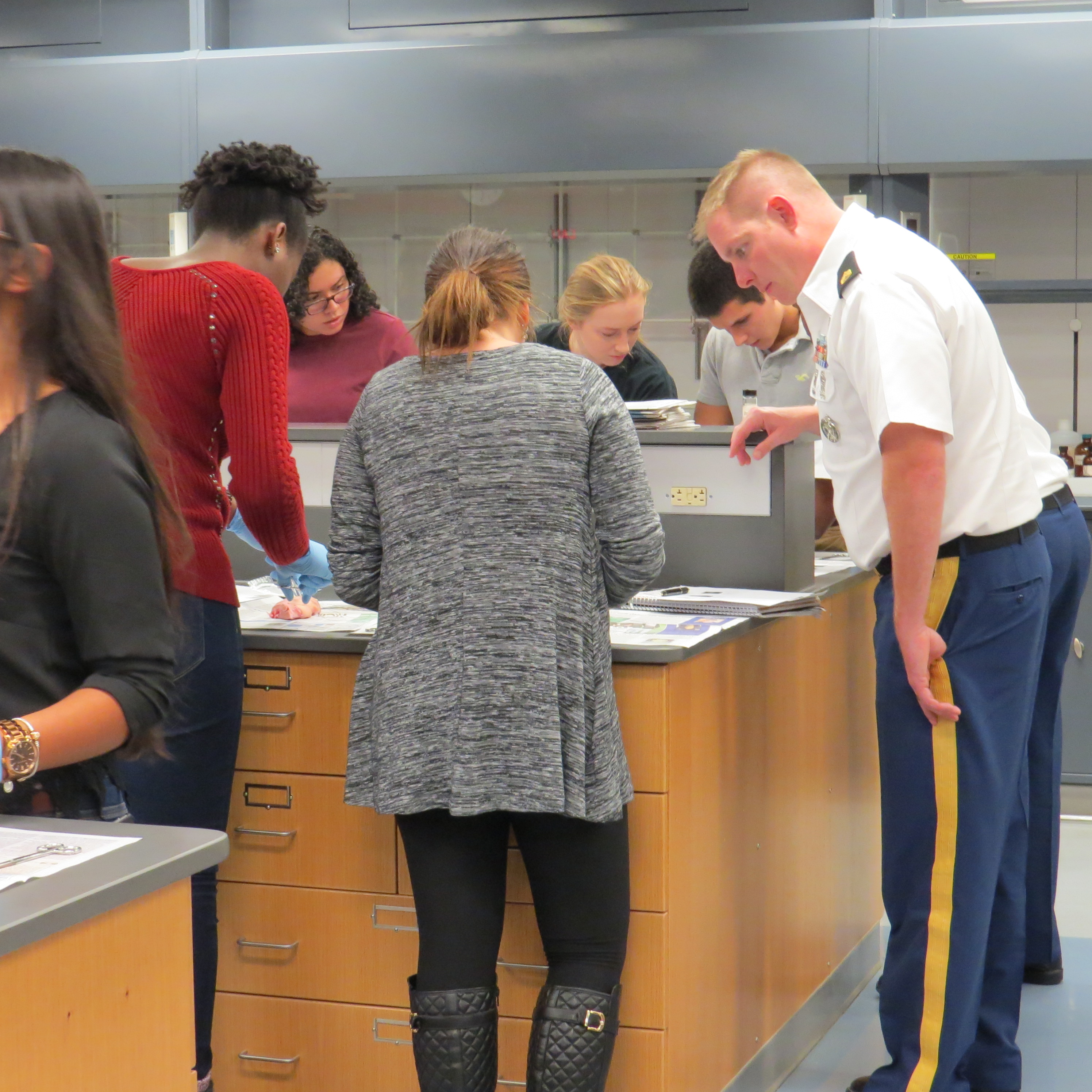
For two hours, students from Penn State Behrend, Allegheny College, Gannon University, and Mercyhurst University worked on severed pigs’ feet, practicing simple interrupted, running, and mattress stitches, using suturing kits provided by the Army.
IMG_1122

Shabloski taught students how to hold the tools, how to start and finish stitching, how to know which stitches to use, how to choose the proper sutures, and the importance of symmetrical sewing.

Straight, evenly spaced stitches are paramount for patients.

“Neatness counts,” Shabloski said as he moved around the room, peering over shoulders at the students’ work. “Suture scars are one of the most visible reminders of your work. Patients care deeply what their scars look like, even if they are in a place where nobody will ever see them.”

Staff Sgt. Benjamin Earle and Staff Sgt. Ricardo Grey, both Army medics, were on hand to assist Shabloski with training.

IMG_1128

The event was sponsored by the Army to bring attention to its Health Professions Scholarship Program, which provides tuition for up to four years of medical school to students pursuing an education at any accredited medical, dental, optometry, clinical or counseling psychology, or veterinary school, in exchange for a four-year commitment to working on an Army base after graduation.

“Students have to apply for this program before they enter medical school, and we were finding that many didn’t know about it until it was too late, so we’ve been making an effort to reach students at the undergraduate level and make them aware of the opportunities available to them through the Army,” Earle said.

Earle is quick to point out that being a doctor in the military does not necessarily mean working in a combat zone.

“We have Army bases all over the world, and on those bases, we have a tremendous need for all kinds of doctors for our soldiers and their families,” Earle said. “We need all the same doctors and specialists that are found in civilian life — OB/GYNs, pediatricians, general practitioners, dentists, and even veterinarians.”

Christina Hilaire, a junior Biology major who wants to be a doctor, participated in the suturing class and said the scholarship program is worth exploring.

“My mother was in the military, so I’ve thought about it,” Hilaire said.

“It is a pretty sweet deal for students inclined to spend a few years working at a military base,” said Dr. Michael Justik, associate professor of chemistry and chair for the Pre-Health Professions programs. Justik helped bring the suturing class to Behrend.

Among the perks? Full tuition paid directly to the medical school, a $20,000 signing bonus, a $2,000+ monthly living stipend, and health insurance, in addition to coverage of school-related expenses, including books, fees, and medical supplies.

It’s a deal that, according to Earle, only gets sweeter after graduation when the newly-minted doctors are admitted to the Army at the level of an officer.

“They are able to practice medicine at Army bases throughout the world without concerns about billing, overhead expenses, or malpractice premiums,” he said. “Many enjoy the lifestyle and stay in the service past their required commitment,” Earle said. “But, even if they don’t and they only put in their four years, we feel that’s a fair deal.”

The military recruits medical professionals in northwestern Pennsylvania because it’s rich in universities and medical facilities.

“Erie is a wonderful place to prepare for a medical career,” Justik said. “We have three hospitals in the area as well as LECOM, a top osteopathic medical school, all of which provide various learning opportunities for pre-health students.”

Here is what some of the students had to say about the suturing experience at Behrend:

  • “It was a fantastic event that helped solidify my career choice. I want to be a surgeon and the suturing class made me realize that it really is what I want to do for a living.” — Stephen Wells, a Penn State Behrend senior Biology major.
  • “It was really helpful to have Dr. Shabloski and the Army medics right there helping us and giving us tips. I took a similar suturing class in high school, but I learned some new and different techniques in this class.” —Thalia Soto, a Penn State Behrend sophomore majoring in Chemistry. Soto wants to be a pediatric surgeon.
  • “I really enjoyed it because it was an opportunity to do some hands-on learning, which is not often a part of the pre-med curriculum.” —Margaret Dunlop, a Penn State Behrend sophomore majoring in Psychology. Dunlop wants to be an orthopedic surgeon.
  • “The suturing class was a great learning experience in a fun, low-pressure setting. It was an excellent opportunity to do one of the many tasks that doctors and health professionals perform almost daily.” — Bethany Kelley, a Mercyhurst University sophomore Pre-Medical major. Kelley wants to be a physician assistant.

Click here for more information about Penn State Behrend’s Pre-Health Professions programs.

Click here or email Benjamin.d.earle2.mil@mail.mil for more information about the Army’s Health Professions Scholarship Program.

This slideshow requires JavaScript.

Behrend alumni lead textbook company’s transition to digital age

Totzke, Dauber Berlin (32)
Behrend alumni Erika Dauber Berlin and Matthew Totzke are challenged with running a textbook company, Larson Texts, in the 21st century.

By Steve Orbanek
Marketing Communications Specialist, Penn State Behrend

In an age dominated by tablets and tweets, the prospect of running a textbook company might seem daunting. There’s nothing “textbook” about the operations of Larson Texts, however.

Technology has changed the game, but the Erie-based company has continued to adapt.

“The physical book is still valuable, but the way you get your hands on it is much different,” says Matthew Totzke, CEO of Larson Texts and a Penn State Behrend mathematics alumnus. “The technology now allows us to do a much better job of enhancing the learning experience.”

Larson Texts was founded more than 30 years ago by Ron Larson, then a professor of mathematics, now emeritus at Penn State Behrend. At the time, Larson was responding to what he saw as the need for more student-friendly math textbooks.

Today, the company produces math textbooks for sixth grade through college-level calculus classes that are used by more than five million students each year. Larson has also published textbooks for such well-known educational publishers as Cengage Learning, Houghton Mifflin Harcourt, Pearson, and W. H. Freeman and also publishes its own textbooks through Big Ideas Learning and AndYou.com.

Publishing a book, involves more than producing a physical textbook. With every college-level textbook that Larson Texts creates, the company also develops a fully-responsive companion website for all platforms: desktops, tablets and smartphones.

“We’re able to access so much more information than ever before. Now, we can really blend a great print book with strong digital content,” Totzke says.

That type of digital content featured on the companion sites includes worked-out proofs, instructional videos, rotatable graphs and downloadable data. All of these tools are great reference materials for students.

“There’s a lot of modeling in mathematics that you just can’t show on a print page,” Totzke says. “We put together interactive explorations that bring three-dimensional concepts to a workable medium.”

Being ahead of the digital curve is no new development for Larson. In 2001, the company created the website CalcChat as a tool that students could use to double check answers to questions posed in textbook exercises.

The site has since been supplemented by a tutor component and corresponding Twitter and Facebook accounts where students can talk with an actual tutor if they are struggling with a particular problem. Larson Texts monitors the tutor conversations as a way to gain feedback and develop solutions in areas in which students are continually struggling. According to Totzke, an estimated six million upper-level high school and college students have used the CalcChat service since 2010.

Through Big Ideas Learning, Larson publishes its own primary-school level books, a market segment the company expects to see expand as schools catch up to colleges and universities in terms of technology.

“Schools are beginning to have the infrastructure to embrace some of this technology,” says Erika Dauber Berlin, vice president of technology at Larson Texts and a Penn State Behrend communication & media alumna. “We have to draw inspiration from a lot of different areas and then anticipate how we’ll meet teachers’ needs into the future.”

It may not be the “textbook” method for creating educational publications, but Totzke would not have it any other way.

“We consider this to be an opportunity,” he says. “We’re able to deliver high-quality educational materials like we’ve never done before.”

9-hole disc golf course open at Behrend

By Heather Cass

Publications & Design Coordinator, Penn State Behrend

IMG_9956

Have you noticed the medieval-looking baskets with chains on metal poles around campus and wondered what they are for?

They’re for your entertainment.

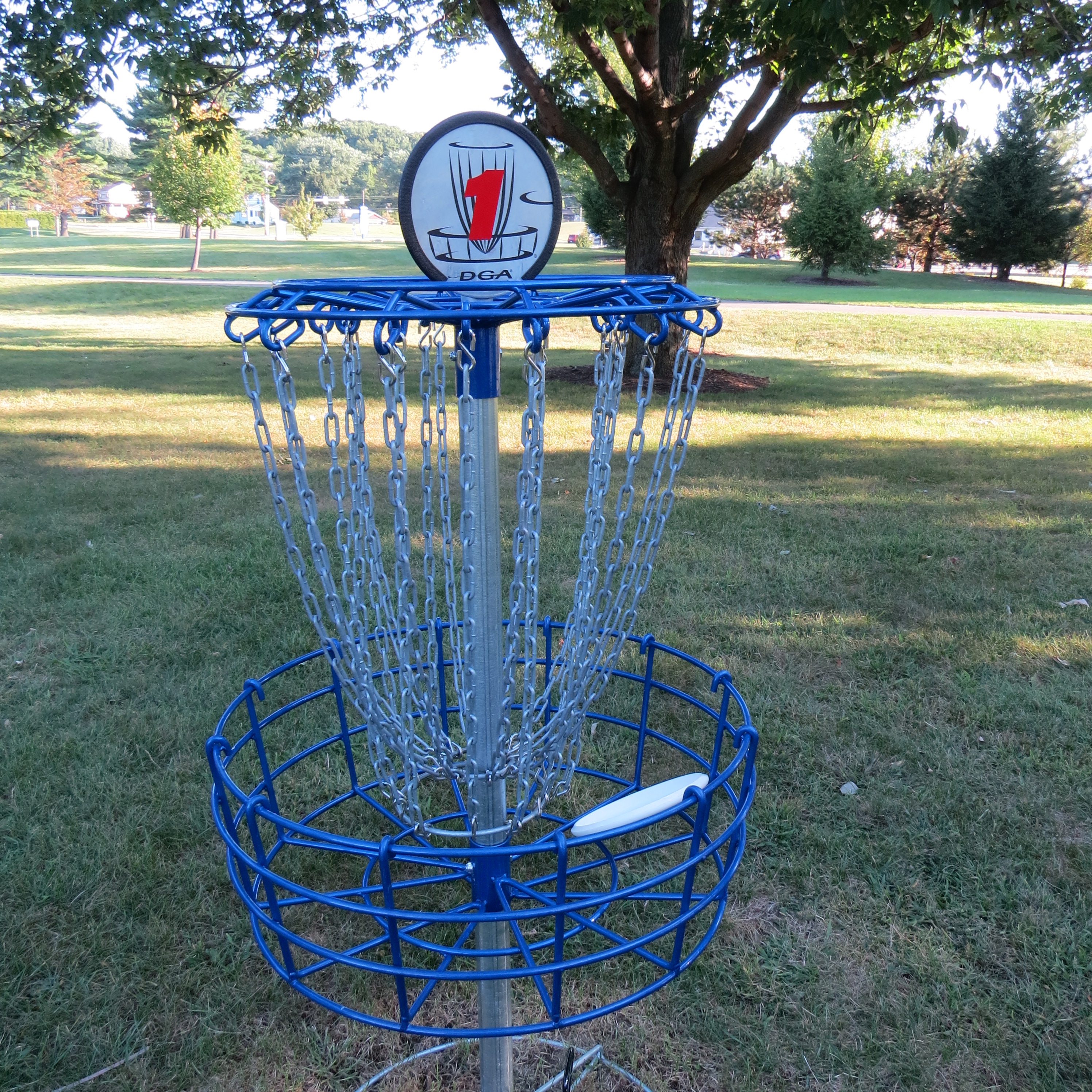
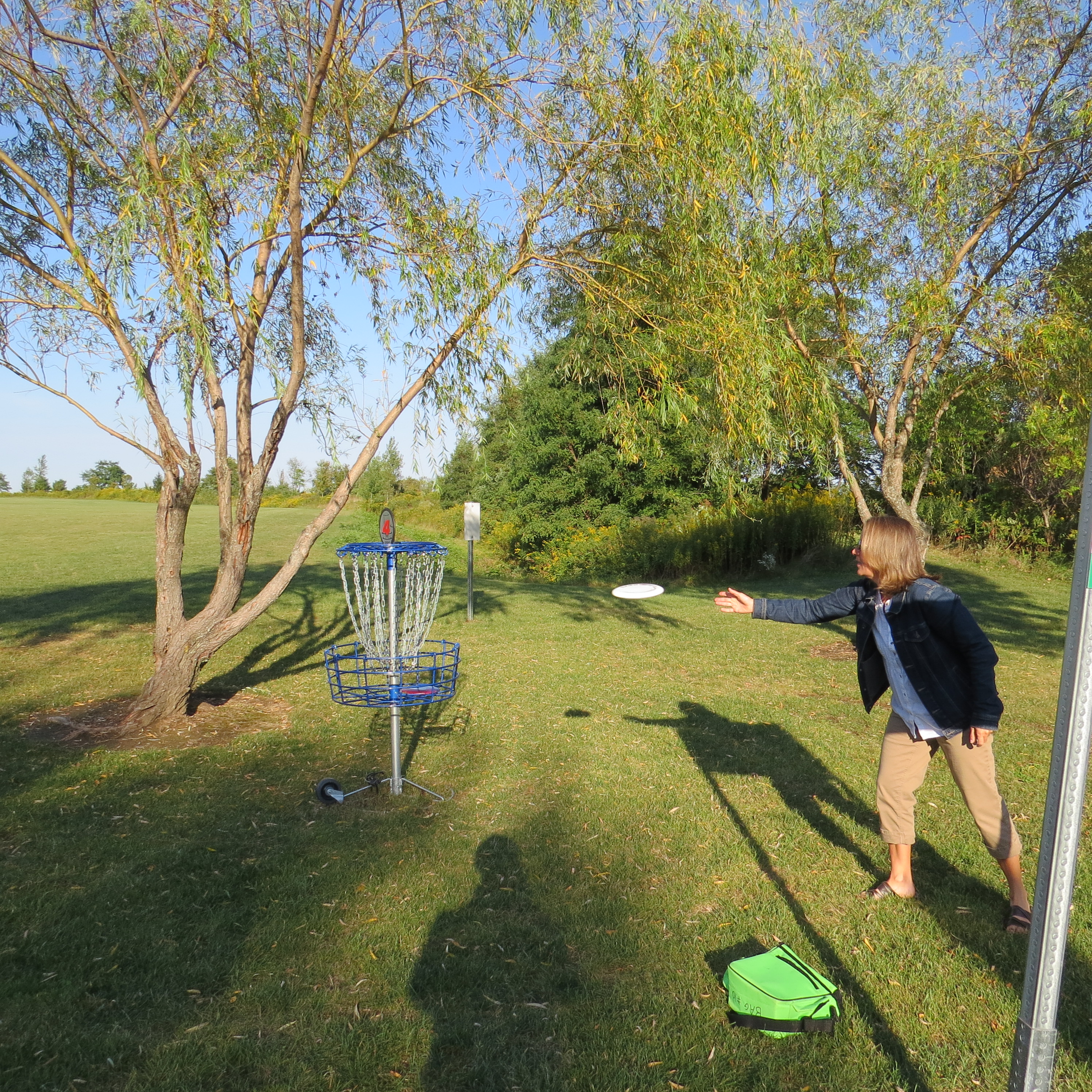
The baskets are targets for a new nine-hole disc golf course that snakes around the perimeter of campus. Disc golf is played much like traditional golf but with flying discs instead of balls and clubs. Players stand near the tee and try to get their disc into the basket in the fewest number of throws.

Student-driven fun

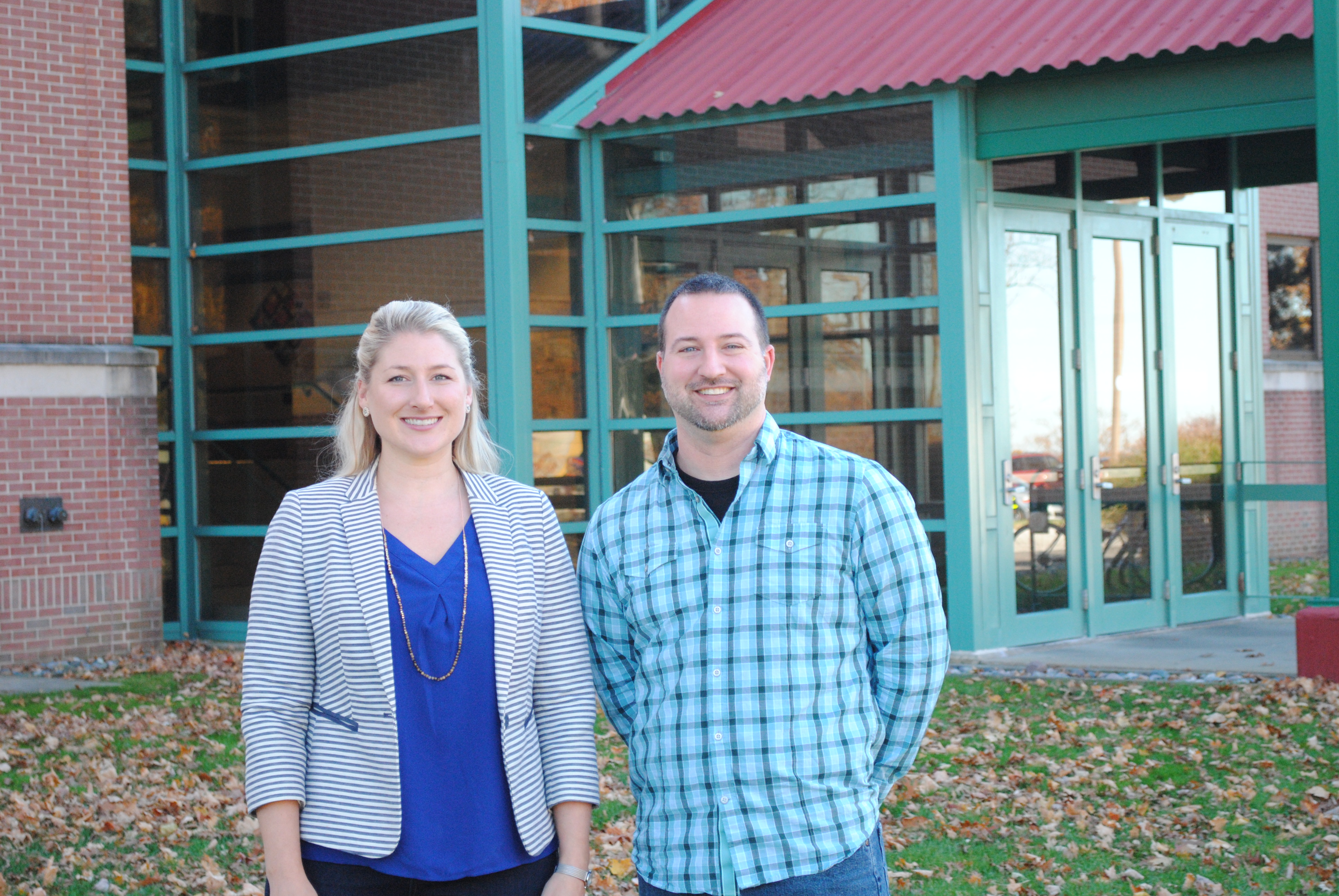
The project was initiated by Kyle Stephan ’14, a former SGA president, who got the ball rolling discs flying, by approaching the Student Activities and Athletics departments to obtain approval, advice, and, eventually, funding to establish a course on campus.

Stephan was joined by Mechanical Engineering majors Trey Neveux and Mark Malecky, and Psychology major Tyler Ferraino, who worked together to design the course, locate equipment, and secure funds.

The students did the majority of the work on the course themselves, with assistance from the Erie Disc Golf Club, the college’s Maintenance and Operations department, and with instruction from Dr. Mike Naber, lecturer in geosciences, on using Geographic Information System (GIS) to layout and measure the course.

IMG_9963

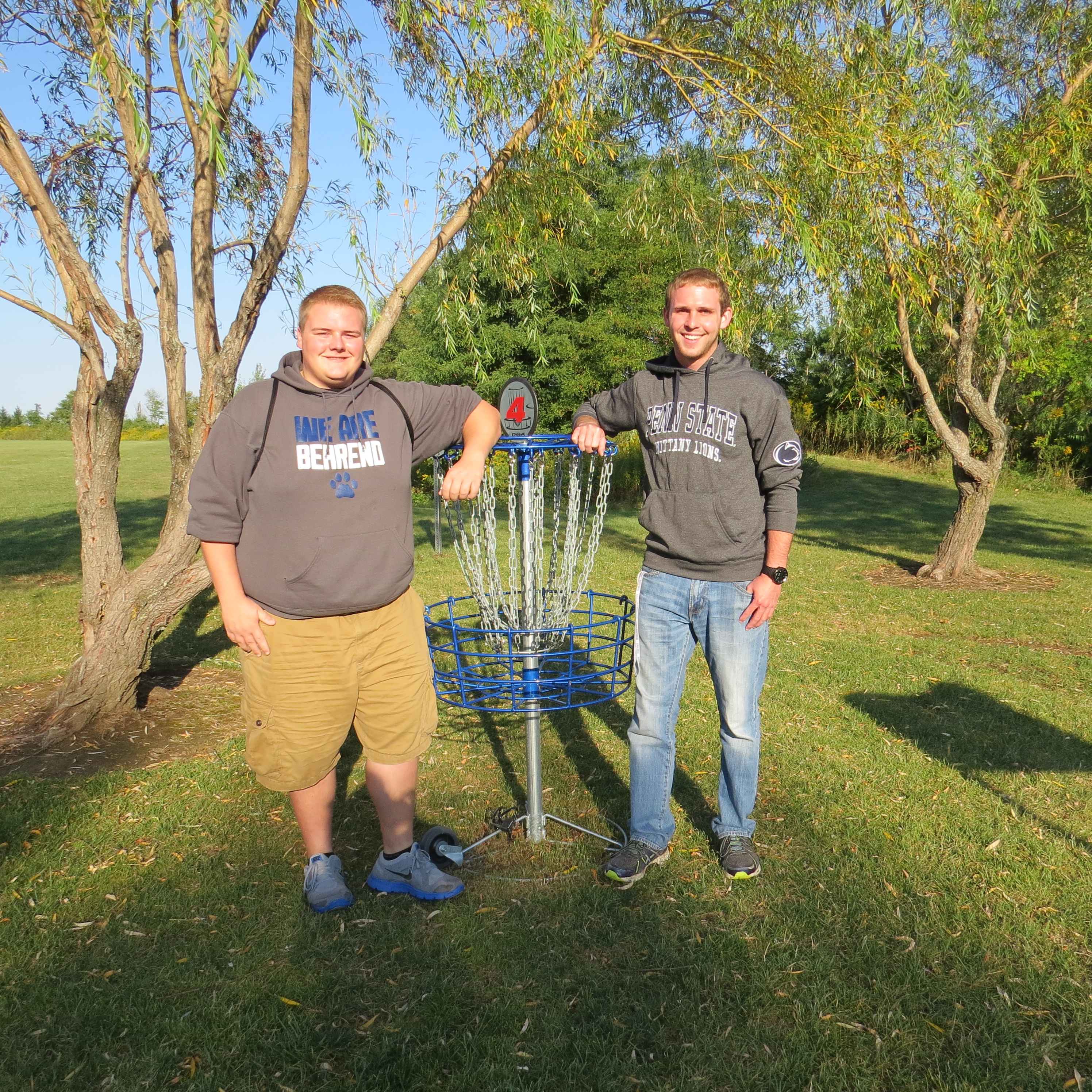
Tyler Ferraino, right, and Trey Neveux.

The course

Though the graphics for the tee markers are still under production, all of the targets/baskets are set and the tee markers (plain white signs) are in place.

The course starts in front of the tennis court/baseball fields near the Jordan road entrance to the college. From there, it snakes around to the old soccer field and then up and around the new track complex before finishing up in the woods across from the track near the bridge to Erie parking lot.

An online map that you can use on your Smartphone while you play can be found here.

Equipment

A basic disc golf set contains three discs—a driver, a mid-range disc, and a putter. Just like in golf, the driver is used for long drives from tee, the mid-range disc is used for shorter distances, and the putter is used when you’re close to the target.

There are at least ten sets of discs available for students to borrow for free at the RUB desk (and Neveux says there are more to come), or you can pick up your own set at a mass retailer or online for less than $30.

How to play/rules

Standing at the tee (currently marked with plain white signs…graphics are in production!), throw your driver disc toward the basket. Players — typically two to four, but more is OK, too — take turns throwing their discs with the one whose disc lands the farthest from the basket going first (like golf).

One point (stroke) is counted each time the disc is thrown and when a penalty is incurred. The goal is to play each hole in the fewest strokes possible. A disc that comes to rest in the basket or chains constitutes a successful completion of that hole.

Most of the holes on Behrend’s course are a par 3, but there are also two par 4s and a par 5. Map here.

The player with the lowest total strokes for the entire course wins.

Learn more about how to play disc golf here.

First-timers take

Neveux and Ferraino spent some time introducing me to the sport on a recent weekday morning.

It was a lot of fun and it wasn’t hard to figure out how to throw the discs to my advantage (most drivers arc left) and when to switch discs to make use of the mid-range and putter discs.

IMG_9962

By the third hole, I had a pretty solid grasp on the sport and enough skill to get the disc in the area I wanted it to be.

Learn more at YouTube, where you can find plenty of videos with tips on disc throwing technique.

Future expansion

Neveux, who serves as president of the Disc Golf club at Behrend, says they are already thinking of expanding.

“We’d like to add another nine holes, so we have an eighteen-hole course,” he said. “We’ve got plenty of space for it on campus.”

And, with the club’s dedication and promotion of the sport, they’re sure to have plenty of players, too.

This slideshow requires JavaScript.

Love of writing defines O’Neill’s time at Behrend

Katherine O'Neill

By Steve Orbanek
Marketing Communications Specialist, Penn State Behrend

As a child, Katie O’Neill always had a keen interest in writing and creative expression. This affinity continued when she got to grade school, and it was not long before others started to notice.

“I had a teacher when I was in first grade who told my mom to get me a journal,” O’Neill recalls.

That would seem to have been excellent advice. As O’Neill has grown up, her passion for writing has become a defining characteristic.

“I’ve always been a writer before anything else,” the Lake Winola, Pa., native says.

That passion is what brought her to Penn State Erie, The Behrend College. The college’s BFA in Creative Writing piqued her interest as the only such program in the Penn State system and one of only a few in the country.

“That was definitely the number one draw,” she says.

Through the inventive program, O’Neill, who graduated this past May, says she was able to focus intently on improving her inventive writing skills. She also improved her editing abilities serving on the staff of Lake Effect, an international literary journal published by the School of Humanities and Social Sciences at Penn State Behrend.

Along the way, O’Neill garnered accolades. This past year alone, her non-fiction story, “Achill Strikes Again,” won Behrend’s Farrell Nonfiction Award while her fiction piece “Juneau” was the college’s Smith Fiction Award winner. Her short fiction piece, “Tony and Rebecca” was also named an honorable mention in the Annual Creative Writing Awards, sponsored by Suffolk County Community College in Long Island, New York.

O’Neill says her inspiration comes from “the weirdest things,” but also a more traditional source. Thanks to the college’s Creative Writers Reading Series and professional conferences, O’Neill met and networked with numerous professional authors throughout her college career. With every interaction, she says she would pick up a tip or two that she put to good use.

During her time at Penn State Behrend, O’Neill was involved beyond creative writing activities. She was the captain of the college’s dance team, a member of the Behrend Choir and a writing tutor in the Learning Resource Center.

This past spring, O’Neill’s efforts were recognized with two awards: Behrend’s Eric A. and Josephine S. Walker Award and a university-wide Eclipse Award. The Walker Award recognizes a student whose character, scholarship, leadership and citizenship have been directed into student programs and services. The Eclipse Award recognizes Penn State students for service and volunteerism to their campus and local communities.

This fall, O’Neill will start pursuing her MFA in Creative Writing at Bowling Green State University in Bowling Green, Ohio. She reflects fondly on her time at Penn State Behrend and hopes new students will choose to follow a similar path.

“My advice is to get involved from the start. I’m so glad I got involved right away. It can be overwhelming, but it’s (worth it),” she says. “I’ve made some amazing friends. I’m going to miss everything about this place.”

A Textbook Case of Win-Win: Student filmmakers, professors, textbook company team up to create educational videos

Papiya

Dr. Papiya Bhattacharjee

By Christine Palattella
Marketing Communications Specialist, Penn State Behrend

Associate professor of mathematics Dr. Papiya Bhattacharjee’s daily summer lectures have an audience of just one unblinking video camera, but the potential to reach millions of math students.

Bhattacharjee is one of four calculus teachers chosen by regional audition to act as talent in supplemental video content to be distributed by Erie-based Larson Texts. The video series is being produced using equipment provided by Greater Erie Arts Rental (GEAR), a new outreach services of the School of Humanities and Social Sciences, and with the assistance of Behrend students working as production interns for Larson.

“I think the videos are going to be extremely helpful for any student, but especially the visual learners,” says Bhattacharjee, who spends four hours each morning in the Kochel Center television studio, working aloud while illustrating her commentary in grease marker on a large pane of glass. (The glass will be flipped in post-production to make the pane readable.)

Years of teaching have left Bhattacharjee comfortable speaking in public. It’s the addition of technology that’s the challenge. “I need to remember to always look at the camera while speaking, move away from my writing so it can be seen clearly in the camera, and so on,” she says. “I am trying to have fun. All I have to remember is that the camera is my student, and I am tutoring my student.”

But this is no average student: The camera is an Epic-M Red Dragon Pro, the same model used to film Game of Thrones, The Hobbit, and Avenger: Age of Ultron. This camera is just one piece of equipment in GEAR’s inventory, which includes high-end cameras, lighting kits, and other hardware and software. The equipment is available to professional and student filmmakers and regional artists. GEAR’s equipment inventory, purchased using a $500,000 gift commitment from the Samuel P. Black Family Fund of the Erie Community Foundation, also includes lenses, tripods and stage legs; six-channel sound mixers; shotgun and wireless mics; Fresnal, LED, and HMI lighting systems; and Mac Pro, Adobe and DaVinci Resolve editing and rendering software.

Tim Larson ’87 is a partner in Grant Larson Productions, creator of the calculus video series. He anticipates filming 700 individual videos averaging seven minutes in length by the time the shoot wraps in August. Larson calls GEAR “a wonderful resource. It’s so nice to have this kind of equipment in Erie. On previous shoots we’ve had to rent cameras and equipment from Columbus and Buffalo, so this is an astounding benefit to us.”

An additional GEAR benefit is a ready-made film crew, since a rental discount is available to GEAR clients who hire Penn State Behrend students. “I feel so incredibly lucky to be able to work on this project,” says Erik Brown, a spring Communication graduate and one of six Behrend students and young alumni working for Grant Larson as paid production interns. “The great thing about working here is not only learning about the film industry itself, but also being exposed to high-quality equipment. We’re not using just a couple house lights and DSLR cameras, but industry-standard gear for lighting, sound recording, and cameras. I’ve always wanted to work in the film industry and, now, working on this shoot, I feel like I have a realistic chance of doing that.”

Erik Brown, left, Josh Lapping

Erik Brown, left, and Josh Lapping, (above) are two of six Behrend students and recent alumni working on the videos for Grant Larson Productions using equipment from the Greater Erie Arts Rental, or GEAR, a new outreach service of the School of Humanities and Social Sciences that provides professional and student filmmakers and regional artists access to high-end cameras, lighting kits, and other hardware and software. 

Josh Lapping, Ciara Smith

Penn State students, Josh Lapping, left, and Ciara Smith, work on a series of videos for Grant Larson Productions.

Shelby Dailey

Shelby Dailey, Penn State Behrend Communication major and intern for Grant Larson Productions.

Intern Shelby Dailey, pictured above, a Communication major starting her senior year at the college, appreciates that Grant Larson rotates its student workers. “We’re given the chance to experience all the moving parts of film, such as camera operating, producing, directing, and script supervising. I’ve learned things that textbooks can’t adequately prepare students for, such as (crew) dos and don’ts, set etiquette, and (the importance) of networking.”

“We want to offer an educational experience that is at the same time a close facsimile of what students will experience once they enter the professional environment of producing film and television,” says GEAR coordinator Michael Berlin, whose previous professional experiences include managing crew and equipment for New York City’s Fashion Week and the E! and Pop television networks and production management for ABC World News, CNBC, and ESPN. “The students working on these calculus videos are gaining technical know-how and a type of muscle memory that characterizes this industry, plus they are learning the responsibility that comes with arriving on-set day in and day out. They also are enjoying the benefit of getting paid for their hard work—believe me when I tell you that this type of arrangement is a very rare and very special as a teaching tool that is fair to all parties involved.”

For additional information about GEAR, email Michael Berlin at mbb21@psu.eduLarson Texts and Grant Larson Productions online.