Engineers = cool (Track the Behrend shuttle bus in real time)

the e -holli levan

Holli Levan boards “the e” Behrend shuttle bus

By Heather Cass
Publications & Design Coordinator, Penn State Behrend

When I started working here two years ago, if you would have told me that engineers would become some of my favorite people to deal with, I’d have thought you sprained your brain doing a few too many Suduko puzzles or something (engineers like those, right?).

Engineers are all about math and science and, well….writers are not. I figured that I’d have nothing in common with these sensible, logical, numbers-loving people.

My mistake was assuming that sensible, logical numbers lovers = no fun.

Silly me.

Engineers do all kinds of fun things around here such as sticking a receiver on the Behrend shuttle  that tracks the bus in real time.  Then, following it up with a hilarious FAQ page that made me giggle for the next three days.

The funny man behind the FAQ is Dr. Chris Coulston, associate professor of electrical and computer engineering, who oversaw the engineering students — Daniel Hankewycz and Austin Kelleher — who worked on this project.  Dr. Coulston is endlessly energetic and cheerful, always entertaining, and has a knack for explaining complicated engineering projects in such a way that anyone can understand (Um, I guess that’s why he’s a teacher).

(By the way, Dr. Coulston can also run like the wind for miles and miles and miles — like 100 of them in a weekend. But that’s a story for another day, kids.)

So, the next time you think engineers are boring, read this.

And the next time you’re waiting for the campus shuttle bus to arrive, check this.

And for the love of the world wide web, stop using Internet Explorer!

~ Heather

P.S. Cool engineering projects aren’t limited to campus. In fact, most of the projects that our students work on are for outside industry partners.  They have helped rescue draft horses, designed award-winning supermileage vehicles, and improved the bubble exhibit at the ExpERIEnce Children’s Museum.

Windows 8 cheat sheets

images

By Heather Cass
Publications & Design Coordinator, Penn State Behrend

One of the greatest things about working at a university is having access to experts in nearly anything you can think of.

Have a question about the geology of the Wintergreen Gorge? Ask Dr. Tony Foyle, associate professor of Geology. Wondering how you can build a better mousetrap? Call Dr. Robert Weissbach, associate professor of engineering. Need help identifying the strange bird you saw? Ask Dr. Margaret Voss, associate professor of biology.

You get the picture.

But the experts on campus aren’t limited to the classroom. They can be found all over campus, from The Learning Resource Center to the Academic & Career Planning Center to the Computer Center.

For instance, Carolyn Dudas, web developer/information specialist, recently compiled a list of “cheat sheets” full of helpful hints and tips for those making the transition to Windows 8.

“If you’re new to Windows 8, you may be feeling somewhat lost and experiencing frustration, especially since it is drastic change from the former operating system.  So to ease a bit of the learning curve, I’ve compiled a few resources that you might find helpful.  You can access the list here.”

I recently bought a new personal laptop that has Windows 8 on it and I have found it very challenging to adapt to. I was grateful for Carolyn’s expertise and her thoughtfulness in sharing what she found.

So now, I’m compounding that by sharing it with all of you. Pass it on.

Good luck with Windows 8 and remember:

It  is not the strongest of the species that survives, nor the most intelligent that  survives. It is the one that is the most adaptable to change. — Charles  Darwin

~ Heather

Stay informed in an emergency: Sign up for PSUTXT

cell phone

By Heather Cass
Publications & Design Coordinator, Penn State Behrend

One of the first pieces of advice I received from colleagues when I started working in the Office of Marketing Communication at Penn State Behrend was: When dealing with students, get a cell phone number.  Smartphones are the preferred means of communication for today’s college students, especially if you want to spread news fast.

That’s why Penn State developed PSUTXT, a service designed to alert the University community when situations arise that affect the ability of a campus to function normally. Subscribers can receive alerts by text message to their cell phones, and also can elect to have alerts sent to an email address.

Why sign up? Three words for you, my Penn State Behrend friends: Winter is coming.

PSUTXT is the fastest way to receive communication about campus closure, delays, and, occasionally, information about major traffic problems on I-90 and I-79.

The service is used sparingly and only in the event of an emergency or situation that may affect your health or safety.

You can sign up here. Note that you can elect to receive alerts only from Penn State Behrend, if you wish.

Community Service Team collecting items for soldiers

By Heather Cass

Publications and Design Coordinator, Penn State Behrend

Rhonda Reynolds a food service worker in Dobbins Dining Hall and founder of the Housing and Food Services’ Community Service Team, is always looking for opportunities to give back. (There’s a reason Rhonda was chosen to receive the 2013 Achieving Women Award!). So when she recently met Tina Lindsey, who told her about her son, R.J., a Lance Corporal in the 2nd Tank Bn., 2nd Marine Division currently serving in Afghanistan, Rhonda wanted to help (of course).

“Tina told me how much her son and the other guys look forward to getting care packages and I thought maybe that would be a good thing for the Community Service Team to get involved with,” Rhonda said.

“It’s like Christmas every time they get a box,” said Tina Lindsey, who said her son would be serving in Afghanistan until at least February.

The H&FS Community Service Committee, which includes, Shelly Sonney, Char Snyder, Dan Hutchins, Bill Underhill, Renee’ Pure, Sally Newcomer,Bonnie Stearns, Annie Rogala & Brenda Horvath, agreed it would be a great project as did Mike Lindner, director of Housing and Food Services, who gave the team permission to put donation boxes in campus dining facilities.

The team will collect nonperishable items (list below) until Nov. 22. Shortly after, items will be boxed up and shipped off to 2nd Tank Bn., 2nd Marine Division in Afghanistan.

Donations can be dropped off in the “Operation Care Package” boxes located in Bruno’s Cafe, Dobbins Dining, Clark Cafe, Elements, and The Galley.

What should you buy?  Here’s a printable list you can take shopping with you:

operation care package

~ Heather

Ice cream, ziplines, and balloon animals. (Oh, my!) Welcome Week wrap-up and photos.

By Heather Cass
Publications & Design Coordinator, Penn State Behrend

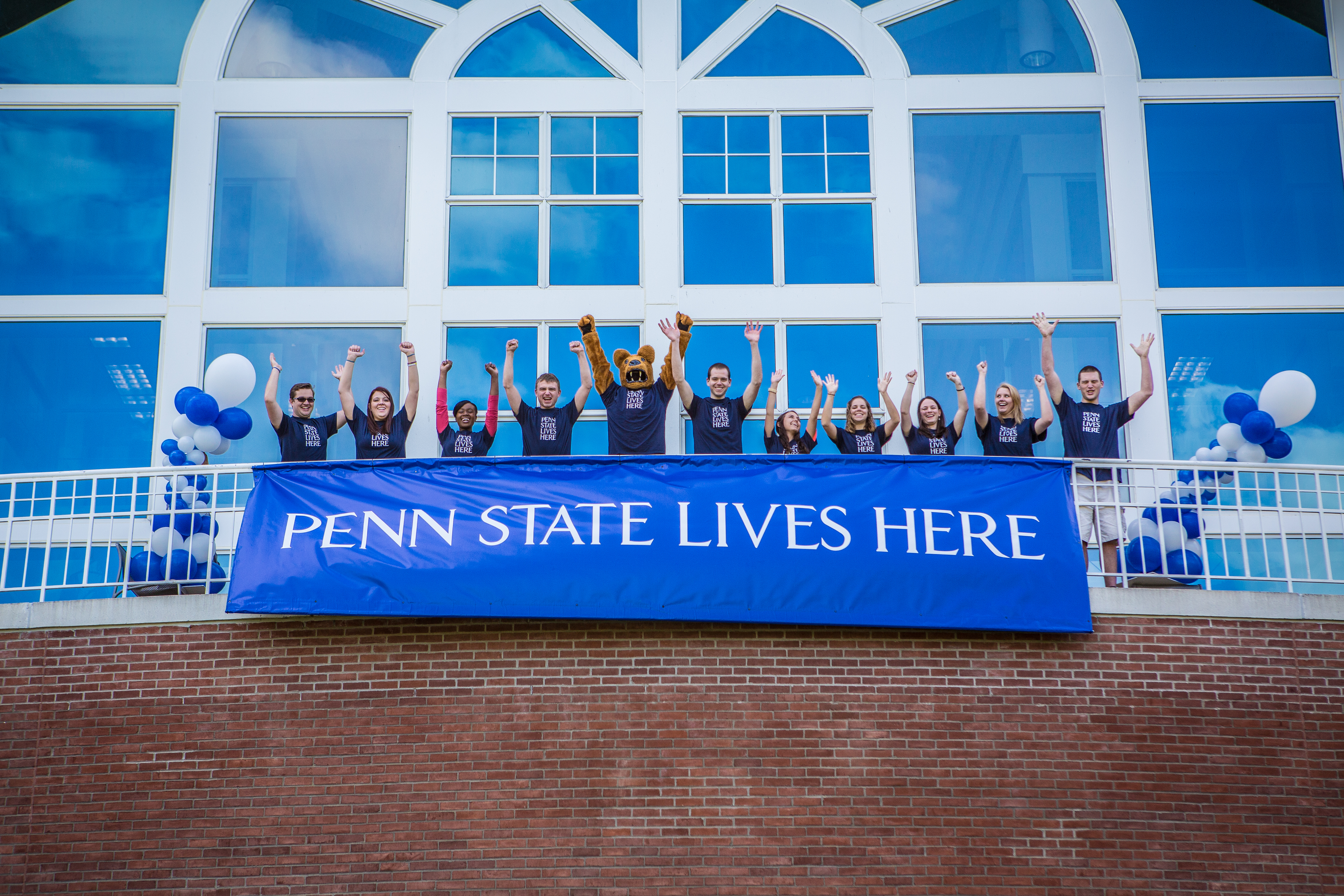
Our newest students began arriving early last week, and we were so happy to see them that we could not stop taking photos.

Our International students were the first to arrive. We have dozens of students who traveled from all over the globe to study at Penn State Behrend. Here are a few students we found in the gaming lounge as they arrived on Monday:

This slideshow requires JavaScript.

On Thursday, our first-year students who will live on campus began arriving with lots and lots and lots of boxes and bins and food and clothes and bulletin boards and computers and printers…. You get the picture.  Move-in Day story here.

This slideshow requires JavaScript.

Friday morning was convocation at Junker Center where students heard from various speakers, including a moving and hilarious presentation by Dr. Pelin Bicen, asssistant professor of Marketing, whose life path was altered by a flyer nailed to a tree in Turkey  (if you missed it…don’t worry, that is a story we’re definitely going to have to tell in a future Behrend Magazine!).  We asked new students to wear their “Class of 2017” T-shirts so we could get a group photo. Look at how wonderful they all looked:

This slideshow requires JavaScript.

Also at convocation, Maria Madigan Palmieri ’98, president of the Penn State Behrend Alumni Society, taught our Class of 2017 a very important Penn State lesson:

After convocation and academic meetings, the fun began. The Office of Student Activities planned a whole weekend of ice breakers, get-togethers, and meet-and-greets over ice cream, fruit smoothies and….gulp…even over Reed parking lot via zipline. Check it out:

This slideshow requires JavaScript.

See…I told you we couldn’t stop taking photos! Though, we have to credit our student photographer Sarah Jelinek with the photos in the slideshow above. She’ll be out and about all semester, so …when you see her, give her a smile, then look for your photos on our Facebook page and Twitter feed.

So while summer offers a refreshing change of pace, the pin-drop-quiet campus (save for the hundreds of little ones taking part in College For Kids — see a slideshow of images here) gets a little too quiet sometimes. It’s nice to have lots of students filling up the parking lots, residence halls, classrooms, and chairs in the gaming lounge once again. (Heck, I don’t even mind that I have to park in the back row of the Erie lot if I leave for lunch. Yes, I’m that happy to see the students again ;-)).

I think I speak for all the faculty members and staff when I say that we’re looking forward to another great fall semester. Beautiful things are coming.  Exhibit A:

Autumn Stock Imagery_029

~ Heather

Making a game of Ancient history

Students in Dr. Glenn Kumhera’s 406W Research in Medieval Sources class used the research work they completed this semester to create a board game, titled Gesta miserororum or “Deeds of the Ill-fated,” to teach players about eleventh-century Europe.

They unveiled the game last night and invited faculty members, friends, and administrators to Reed 114 to play a game or two.

The students not only produced the board and developed the game concept, but they created more than 600 individual cards, too.

Who knew learning about ancient history could be so much fun?

Oh, right, we did!

This slideshow requires JavaScript.


Alumna shares her 2013 Boston Marathon story

boston - ellen

Penn State Behrend alumna Ellen Goldberg ’89 was running the Boston marathon on Monday, April 15 and was stopped at 24.8 miles after two bombs exploded near the finish line.

It was Goldberg’s eighth marathon and her fourth time running Boston, a race for which she raised money for the Massachusetts Association for the Blind and Visually Impaired .

“This was the first year I raised over $10K ($10,150) in one season, for a four-year total of $27,334! People are generous,” she said.

Goldberg graduated from Behrend in 1989 with a BA in psychology and a minor in English. She attended the Ph.D. program in clinical psychology at Clark University for several years, but ultimately went on to earn an MBA from the High Technology program at Northeastern University in Boston.

She currently manages operations at a non-profit in Boston called Clean Production Action, which works to get toxic chemicals out of products and the supply chain (cleanproduction.org).  She is also a freelance photographer who crafts seaglass and beach stone jewelry, and lives in Nahant, Mass., with her husband Michael, and their two children, Ben and Sarah, ages 10 and 6.

Here is Goldberg’s personal account of her experience at this year’s Boston Marathon:

What do I want to tell you?  This was a race I could not finish.  And not because I was struggling, shuffling, cramped, slow, sunburned, and wondering why the sidelines had thinned, but because, at mile 24.8, the metal gates crossed Park Street at the intersection of Beacon, and I was physically stopped, told the race was over, and that there was no finish line.

The day dawned bright and blue; logistics to the start were perfect. I think over the supportive emails I got in the closing days, make us proud, believe in yourself the whole way.  I cross the start, wiping tears I will not allow to come.  Crossing the start of the Boston Marathon means you did something really good to get there.

If all goes well, I could hope for a 4:30 today.

Mile 1:  10:14  Ok

Mile 2:  10:13   Fine

Mile 3:  10:21  This is the pace I need to maintain.  I feel ok.

Mile 4:  10:04  A little faster than pace but not enough to kill me.  Ok.

Mile 5:  10:21

Mile 6:  10:13

Mile 7:  10:14  I’m really pleased! I’m keeping my pace.  It doesn’t feel hard.  It feels normal.

Mile 8 & 9:  Something happens in my calf.  I feel a twinge, the beginnings of a cramp, and my mind flies back to Boston 2010, when debilitating leg cramps overcame me.  I run to the side of the road and take a salt pill.

Mile 10:  11:11, I stop to stretch out a calf.  I’m fearful.  I can still feel it.  It’s subsided, but hasn’t completely gone away.  It’s also warmer than I thought it was going to be.  I pour water on my head.

Mile 11:  11:31.  I keep it dialed back.  I am afraid to try to go faster.  I am afraid I’ll lose myself to calf cramps completely.

I start to think, 15 more miles is a long way to run with leg cramps.

Mile 12:  I really doubt I can do this.  I don’t think I can.  And then, Wellesley.  The women are here for me, again, reaching over the barriers, yelling, Ellen, you can do this, Ellen you’ve got this, Ellen you kick ass, go Ellen, go Ellen Go, Go!  

I wish I could explain to them, listen, it’s a long way to go, I’m not cut out for this, not with cramps, not the rest of the way and instead I run as close to them as I can, bow my head, hold out my arm, touch their outstretched hands, maybe next year I’ll be brave enough to kiss one of them myself. They make me run this mile.  I don’t do it for me, because I’m nothing now; I do it for them and their belief in me.

Mile 13:  12:48   I pass the half in 2:20.  A little over pace, but maybe there’s still a chance to pull off something respectable.

Mile 14:  11:41

Mile 15:  14:13  A cramp really hurts now, and I actually cry out.  I walk through a water stop, stretch, take another salt pill.  Keep the calf cramps just under the surface.

I think, I’m not having a good race day.  I think, at mile 16.5 I get to see my kids.  Karen will be there with Ben and Sarah and the turquoise lobster umbrella.

Mile 16:  11:36

And there they are – I throw my arms in the air, hear the joyful There she is!  I run to the side of the road. I am wet from pouring water on myself and even too sweaty and disgusting for my kids to touch.  They give me more GU, pour water on me.  I stay there longer that I should.  I tell Karen I’m never doing this again.  I take my inhaler out of the back of my bra, take two precautionary puffs, and warily face the road again.

What do I have to look forward to next?  Arnie at the Mile 18 clock.  I can shuffle that far.

Mile 17: 18:34, including however many minutes I refused to get back on the course after seeing Karen & the kids.

There he is, and I throw my arms up and yell, “ARNIE!!!” and I come full force at him, somehow I find the energy. I don’t even slow down, just throw myself around him, push him backwards, almost knock him down, and I am as gross as ever, wet from Gu and water and salt. He tries to separate himself from me, takes a picture at the Mile 18 clock, shows me his wife, and starts to walk me further up the course.

I tell him I’m struggling, it’s not a great day for me, and he keeps walking me towards the water stop.  I think, why are you moving me forward? Why am I running this race? Why must I finish?  And he says, it’s all downhill after mile 21. And I’m off again, a mixture of walk breaks and determined angry thoughts.  I forget to hit my lap button at Mile 18.

Mile 18 and 19: 27:30. I say to a woman looking about as good as I do, Nobody quits at Mile 20.

What else do I have to look forward to?

Why do you run? Why do you do anything? Examine your motives.  I snarl to myself.

Mile 20:  13:07

It’s hilly, now, more so than usual, and that means it must be Newton.  I feel the hills in my quads, I am shuffling, straining, take another Gu, a bystander tells me, this is it, this is the hill, and I ask, Heartbreak?

Four years running this race and I don’t remember where Heartbreak Hill is until I feel it under me, see the huge broken heart drawn in chalk across the road. I stomp right in the middle of it and curse out loud.

And then it’s Boston College, behind the crowd barriers, Ellen! Ellen! If I don’t move to touch them, I will fall down. I need them and whatever they have, because I have nothing.  I talk to them in my head, please, give me what you have, I need you, and every hand I touch gives me something I can hold for later.

Mile 21:  14:00  Some odd behavior on the course.  Runners start talking on their cell phones.  Water station volunteers call out that there was an explosion at the finish.  The race is being diverted.  People are walking, talking on their phones, the bystanders start to back away.

Mile 22:  12:25  Choppers overhead.  Sirens.

Mile 23:  13:26  One more mile and I can see my kids.

Mile 24:  13:10  A half mile more.  But Beacon Street is usually much more crowded.  Spectators are walking on the sidewalk.  Army guys start barking instructions, “Off the road! Off the road!” I assume he means pedestrians?  Police cars zoom past me.

There they are:  Karen, Mike, Ben, Sarah, Cynthia.  I know there’s only a mile and a half to go.  I yell, run over to them, hug Ben and Sarah.  Cynthia is not yelling, and she does not look happy.  She tells me she thinks I should get off the course.

I have no idea why she would say this to me, 24.5 miles into this thing and I don’t care how I get there but I’m finishing this painful race.  “No!” I yell happily, “I’m going to finish! Yeah! I’m going to finish!” I jump back on Beacon Street, and a New Republic reporter hops in next to me, asks if I’ve heard what happened.  I say, “they tell me there’s an explosion and the race is being diverted.”  She asks if I will keep running and I say, “Well, who is going to stop me?”  

You’ve all heard the saying, “You and what army?”  Well, it’s THAT army.  The one at mile 24.8, setting up metal gates, standing in front of them, police cars flashing, a medical tent with chairs and Vaseline, jugs of water, mylar blankets in a box.  The Citgo Sign is in front of us.  We’re at mile 24.8 in a 26.2 mile race, and we’re stopped.

Mile 24:8:  4:59:40.

I sit.  Am I really not going to finish? What happened? Are people hurt? Where do we go? Is there food? I huddle, try to get out of the wind.

I put my head down.  I think, I raised $10,000 and couldn’t finish this race.  I couldn’t even finish the race. I meant to, I tried, and couldn’t.  What is pride? What is determination? What is my side of the deal?  What will I tell people?

A medical volunteer kneels.  “Are you OK?” he asks, and my eyes are big and wet and I say, “What would happen if I went around those gates? Could I keep going? Could I get to the finish myself? Would anybody stop me? I want to finish.”

He says, kindly, “You are finished.  It’s over.”

boston3

Photo by Howie Hecht

What happens next involves five hours of confusion.  On my person I have a leftover salt tablet in a baggie and an albuterol inhaler, both stuck in the back of my bra.  No money, no cell phone, no car key, no food.  I’ve just run 24.8 miles, and I don’t know what to do.

A woman sits next to me, tells me she’s Sarah, and she is a nurse, is there anything she can do?  I repeat my question, “Do you think I can finish? Do you think I can finish the race?”  I am teary and sniffling.  She lets me use her cell phone to try Karen and Mike; nobody has reception.

What’s next?

For two hours, we follow conflicting instructions, walk several miles, try to find a bus to some official place.  Sarah and her boyfriend Howie stay with Matt, another stymied runner at 40K, and me. They help us navigate the streets, wrap mylar around us, and let us use their phones.

boston2

Photo by Howie Hecht

We straggle to a bus that brings us to a secure lockdown on the Boston Common, surrounded by SWAT teams and the National Guard.  A paramedic gives me a yellow marathon jacket, says he doesn’t like the looks of me.  I race Sarah’s dying phone battery to text Karen, who pecks back that Mimi and Lisa are looking for me, and the Public Health people let them in the area.

 I throw my arms around them when I see them at the door of the bus.

boston1

Ellen, left, hugs her sister-in-law, Mimi Quigley.  Photo by Howie Hecht

At Mile 16, when I told Karen I would never do this again, what did I mean?  As of this writing, I’ve raised $10,050 – over ten thousand dollars – for a local organization that provides services to the blind, the visually impaired, the brain injured, the developmentally disabled – those who need help and have no other means of getting it.  Over four years, that is $27,234, all by running this race.

That’s the end of my story.  It’s a strange one that I read aloud as I type; now my voice chokes and I stop to wipe my eyes.  I’m safe.  My family is safe.  I ran 24.8 miles before I couldn’t run anymore.   An eight-year-old boy died.  People lost limbs to a bomb.  I’ve no right to bitch about not finishing a race.

I have a yellow jacket, the phone number of a nurse named Sarah in Brookline who seems destined to be my new friend, a couple of duct-taped mylar blankets, and hundreds of emails from all of you, with one that ends, “It is still a victory.”

I like that.  Victory.  Not for all of us, true, but to think about crossing the start in Hopkinton again, in the memory and honor of those who would cheer us on again, if they could? That’s victory.

I hope I did what you asked.

I hope I made you proud.

— Ellen

boston - family

Ellen, her husband, Mike, and their children Ben, 10, and Sarah, 6

GDC ’13: Happy to have beat the crowd

Dr. Matthew White, lecturer in game development, and student Stephen Chalker, a senior majoring in software engineering, are currently in San Francisco, California, attending the Game Developers Conference (GDC), the world’s largest and longest-running professionals-only game industry event. They’ll be reporting back to the Penn State Behrend community through this blog.

By Stephen Chalker, senior software engineering major

The last day of GDC (Friday, March 29) was actually pretty calm. The few talks that I went to were informative and the expo floor was packed with students so I really couldn’t get around to see the things I missed the past two days. While uneventful it was still a good day to end on.

The first session was a 25-minute talk on creating a game with audio-only mechanics. I didn’t even know the talk was going happening until the night before, but I am glad I found it.  I was excited because a few friends and myself designed a completely auditory game for Global Game Jam recently. It was really cool to see another project taking on the same challenge we were. I learned that having high quality sound is imperative for making an auditory game and you can increase and decrease the difficulty of the game by changing the properties of the sound. It was very informative and I am excited to apply the concepts I learned to our game.

The second lecture I went to was part of the career seminar on how you can make games with all kinds of free tools. There are free programs to help you do art, such as Blender, and free tools to help you program, such a Visual Studio Express Edition. There are also free game engines, including Unity and Gamemaker, with which you can make any game you want. All in all in the main theme for the lecture was just to try new things and to always be making stuff. Use the tools and the knowledge available on the internet to make games – any kind of games – to gain experience.

The rest of the day was spent on the expo floor trying to see everything that I missed before. Unfortunately, the floor was packed with new folks with the student pass. The student pass is the cheapest pass you can get for GDC, but you only get Friday to explore the expo floor. This means the floor was packed with hundreds of students looking for jobs.  I am thankful to Penn State Behrend that I was able to get in on Wednesday to get my resumes out before the crowd arrived!

— Stephen

2013-03-27 11.53.48 2013-03-27 11.53.50 2013-03-27 11.53.54 2013-03-28 18.44.59 2013-03-28 22.30.44 2013-03-29 12.46.49

All in all it was a slow relaxing day to round the week off. I have really enjoyed my time in San Francisco and I learned a lot. Next week though will be just as crazy as I send out follow up emails and send more applications off. But now its time to go back to Erie and get to work.

GDC ’13: “Today was probably the greatest day of my life to date”

Dr. Matthew White, lecturer in game development, and student Stephen Chalker, a senior majoring in software engineering, are currently in San Francisco, California, attending the Game Developers Conference (GDC), the world’s largest and longest-running professionals-only game industry event. They’ll be reporting back to the Penn State Behrend community through this blog.

2013-03-27 09.36.26

By Stephen Chalker, senior software engineering major

Today was probably the greatest day of my life to date. I heard a talk that made me want to leave and immediately go to work on a new HTML 5 game, I saw all kinds of new tech on the expo floor, and I got an invite to a private party being put on by one of my favorite companies.

Going in to the actual start of the conference I wasn’t sure what to expect. I have never been to a major conference and I wasn’t sure what it would be like. Before hitting the expo floor of the conference, there was a presentation by Mozilla, the company that makes Firefox web browser. They talked about a way to develop very high quality games for the web by programming in C++ and compiling it into Jscript using a program called Emscripten. Essentially what this means is that you can create triple A titles that run in a web browser without any plugins or a high end PC. This will be a huge step forward for developers as they would be able to get their product to a large market with little effort. I am very interested in this new technology and will find a way to work with it soon.

After the first talk, I had some time to hit the expo floor. The floor was an explosion of sound, all the exhibitors were talking about their tools. Some of the tools we saw included Unity, which we use almost exclusively in the game dev program, and Autodesk which donated their entire suite of programs to Penn State Behrend last fall.

For about an hour, Dr. White and I went around to different companies to talk about Penn State Behrend and make sure they were aware of the graduates the school has to offer. We hope to start seeing some of these companies at our career fairs now.

After that, I went off on my own to check out the HR booths in hopes of findinga job. I handed out a few resumes to various companies which showed some interest but they pretty much told me to look at their jobs page online. However, one of my favorite companies showed enough interest to invite me to their private party. Working for Riot Games, which makes the multiplayer online battle arena game League of Legends, would be an absolute dream, and I can’t believe that I will be enjoying a few beers with a few of my heros.

Tomorrow will be one of the most important days of my life as I try to make an impression on a company I would love to work for. The next two days will continue to be filled with interesting lectures, exciting new tech, and new opportnities.

— Stephen

______________________________

About the conference

The Game Developers Conference (GDC) is the world’s largest and longest-running professionals-only game industry event. The GDC attracts over 22,500 attendees, and is the primary forum where programmers, artists, producers, game designers, audio professionals, business decision-makers and others involved in the development of interactive games gather to exchange ideas and shape the future of the industry. The GDC is produced by the UBM Tech Game Network.

GDC ’13: First impressions of San Francisco

Dr. Matthew White, lecturer in game development, and student Stephen Chalker, a senior majoring in software engineering, are currently in San Francisco, California, attending the Game Developers Conference (GDC), the world’s largest and longest-running professionals-only game industry event. They’ll be reporting back to the Penn State Behrend community through this blog.

By Stephen Chalker, senior software engineering major

I am not a morning person. There I said it. Unfortunately for me, our flight to San Francisco was at 5 a.m. and I had to be up at 4 a.m. To be honest, I didn’t sleep at all that night partly because of excitement for the week ahead and partly because of nerves knowing this week has a huge impact on my career and life.

After the early wake up call it was a quick drive to the airport and then the 6-hour plane ride to San Fran. We landed at about 11:00 a.m. in the morning, and I was immediately happy. Not because of what I saw, but because of what is didn’t see. There wasn’t a single snowflake in sight. It was 65 degrees and the sun was out, pretty much the complete opposite of the climate in Erie.

2013-03-24 14.00.11

Since we had such a an early flight we had the whole day to tour the city. We quickly went towards the water and walked along the coast until we hit the well known Fisherman’s Wharf. The pier is full of very touristy shops and restaurants including Bubba Gump’s Shrimp Company and a shop that sells items for left handed people called Lefty’s.

2013-03-24 14.50.26

After walking around the pier for a little longer we made our way into the midst of the city. After walking for a bit and up some steep hill that would put Jordan Road to shame we came to the famous Russion Hill, a.k.a one of the most winding streets on the planet. Why anyone would make a road like Lombard Street is completely inconceivable to me as it makes six hairpin turns that you have to take at five miles per hour or you risk not making it. We took a street car from the top of the hill, then walked to the convention center to pre-register and get our passes. This marked the end of tourist time and the start of Game Developers Conference.

2013-03-24 15.24.15

There was a pre-GDC get together at a restaurant where we were able to mingle with a few of the organizers of GDC. Business cards were passed out, networking happened, and fun was had by all. The beginning was over and soon GDC would be upon us with all of it’s glory.

— Stephen

______________________________

About the conference

The Game Developers Conference (GDC) is the world’s largest and longest-running professionals-only game industry event. The GDC attracts over 22,500 attendees, and is the primary forum where programmers, artists, producers, game designers, audio professionals, business decision-makers and others involved in the development of interactive games gather to exchange ideas and shape the future of the industry. The GDC is produced by the UBM Tech Game Network.