STEAM ideas to keep kids learning, engaged

By Heather Cass,

Publications Manager, Penn State Behrend

With schools closed across the country, parents have found themselves suddenly thrust into the role of teacher and activities director. It’s no easy task.

The experts in Penn State Behrend’s Youth Education Outreach (YEO) program are here to help you. They have plenty of experience holding kids’ attention while teaching them about Science, Technology, Engineering, Arts, and Math (STEAM). They have put together a few fun activities/resources that you can use.

Sweet Chemistry Experiment

In light of the number of students now learning remotely, The American Chemical Society has made the American Association of Chemistry Teachers website more available to the public. Tracy Halmi, associate teaching professor of chemistry, said the site offers high-quality information and activities for students of all ages, including elementary students.

Halmi shared one activity that caught her eye as an experiment that kids would find fun: Analyzing root beer floats is suggested for students in grades 1-5, but we’re guessing “kids” of any age would enjoy it.

root beere

You can see a full list of unlocked activities on the website.

Easter/Spring STEAM Fun

Robyn Taylor, K-12 program educator for YEO, said the website littlebinsforlittlehands.com offers several STEAM activities with eggs that are easy and fun to do at home. Here are a few of her favorites:

Easter Egg Catapults. Experiment with motion, design, and basic engineering and physics principals by designing a simple machine to launch plastic eggs into the air.

catapult

Photo credit: Little Bins for Little Hands

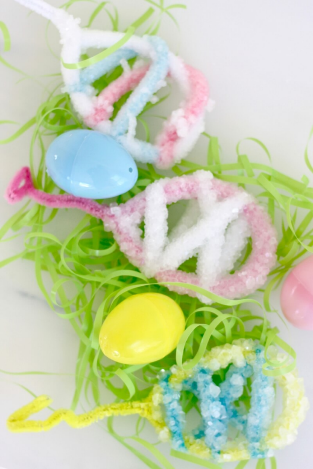
Egg Crystals: With just a few simple materials, your young learners will be ready to start growing cool crystals in the shape of eggs in this hands-on chemistry experiment disguised as a fun holiday craft.

egg crystals

Photo credit: Little Bins for Little Hands

Suncatchers: Bring some sun and color into your home by making suncatchers that incorporate a little science into the art, especially if you choose to make the crystal or slime suncatchers.

Crystal-Suncatchers-BABBLE-DABBLE-DO-displayed

Photo credit: Babbledabbledo.com

Lego Maze Challenge. If you have a bin full of building bricks, kids will have a blast making their own Lego mazes while also learning about engineering, design, and physics. There is no limit to how elaborate or creative the mazes can be – students can incorporate buildings and figures into their mazes and then compete with siblings to see who can race the marble through fastest!

marble maze

Photo credit: Mammapappabubba.com

Take a tour!

Send the kids on an adventure from the comfort and safety of your own home. You can tour a whole host of museums and zoos virtually, including the National History Museum in London and the The National Museum of Computing, where you can take a 3-D virtual tour.

computer musuem

Photo credit: The National Museum of Computing


Eye on Medical Careers: Behrend’s Pre-Health Program Seniors Stand Out

By Heather Cass

Publications Manager, Penn State Behrend

IMG_1000

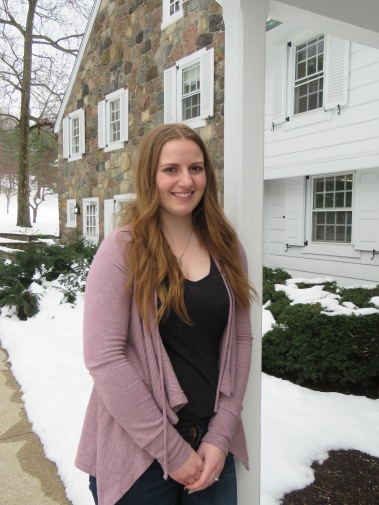
Ashley Price

You may have heard that the eyes are the window to your soul, but did you know they also offer a pretty clear view of your overall health?

“The eye is really interesting because it can reveal a lot of health problems,” said Ashley Price, a senior Biology major and Chemistry minor in the Pre-Optometry program at Penn State Behrend. “Many people learn they have diabetes from their eye doctor because the disease affects the small capillaries in the retina.”

Other health issues that can be spotted in the eyes include hypertension, autoimmune disorders, high cholesterol, thyroid disease and even some types of cancer and tumors.

Price had planned to be a family physician but switched to optometry after shadowing an eye doctor in high school. “I just thought it was so cool,” Price said. “You’re always looking at something different. And I like the personal aspect of optometry. You see the same patients year after year and can form relationships with them.”

Like her career choice, Price’s college plan changed course after a first-hand experience.

“I was totally set on going to Pitt, but then a friend talked me into touring Behrend, and as soon as I set foot on campus, it felt like home,” she said.

For the last four years, Behrend has been her home. Price, who will graduate in May, has been a Resident Assistant for three years. She’s currently an R.A. in Ohio Hall, but this fall, she’ll move to another Ohio—Ohio State University—where she will attend optometry school.

She had a lot of options. She applied to and was accepted at six different schools that offered four scholarships, with two at the highest amount the schools offered.

Price is well prepared for the next step in her career, something she credits, in part, to several School of Science faculty members who kept her on the right path and moving forward.

“The professors at Behrend make sure you get to where you want to go,” she said. “They are always behind you and, at the same time, offering to show you the way.”

Price had one recognized adviser, Dr. Beth Potter, associate professor of microbiology. But, she also gathered several more unofficial advisers related to her course of study—Dr. Todd Cook, assistant professor of biology and chair of Pre-Health Programs, and Dr. Jason Bennett, associate professor of chemistry. “I could, and did, go to any of them with any questions I had or if I just wanted advice.”  

Behrend’s Pre-Health Professions Programs in dentistry, medicine, optometry, pharmacy, physician assistant, physical or occupational therapy, and veterinary medicine, require more precise planning than most other majors.  

 “In my first year at Behrend, I went to a pre-health program in which Dr. Mike Campbell (distinguished professor of biology) talked about how to put together the ‘perfect package’ for medical school, and basically gave us a list of things we could do and accomplish during our undergraduate years that would make us attractive to medical schools later.”

Price, who is also a Scheyer Honors College scholar, took Campbell’s suggestions as a to-do list, assuming leadership opportunities, gaining experience in her field through internships and job shadowing, and working on research projects with her professors.

It’s turned out to be a formula for success, not only for Price, but for several pre-health program participants who will be graduating in May and starting the next chapter in their careers, including: Jessie Kibbe and Taylor Hibbard, who have been accepted into physician assistant programs; Dillon Patel, who was offered admission to four dentistry schools; Aldyn Poston, who will attend optometry school, and Zainab Kareen, who was accepted to osteopathic medical school but has decided to attend graduate studies at Penn State College of Medicine.”

Price, who is also the vice president of the college’s Scrubs Club and a Lion Ambassador, said she will miss Behrend, but she’s looking forward to taking the next step toward her career goal.

“Optometrists are literally improving people’s outlooks,” she said. “I’m really looking forward to being able to do that for patients.”  

About Behrend’s Pre-Health Programs

As they navigate the application process for admission into health professional schools, students enrolled in Behrend’s Pre-Health Programs are guided by the Pre-Health Advisory Committee, comprising of faculty members from the School of Science and the School of Humanities and Social Sciences, This includes continuous advising and the composition of a committee letter that highlights the student’s academic and extracurricular accomplishments and readiness for the rigors of health professional school. Over the last three application cycles, more than forty Penn State Behrend students have successfully been to various health professional schools and medical-related graduate programs.

To learn more about Behrend’s pre-health programs, visit behrend.psu.edu/prehealth.  

Crossing Disciplines Pays Off

First-year business student and senior engineering major win short story contest

Short-Edition-4CCLs-story-dispensers_0

By Heather Cass

Publications Manager, Penn State Behrend

Look, $100 is $100, OK? So when Senior Mechanical Engineering student Sam Cabot saw the opportunity to earn some cold hard cash (er, Visa card) by whipping up a little story about brunch for Penn State’s University Libraries Short Edition short story dispensers, he was on it like, well, syrup on French toast, if we’re going to stick with the brunch theme here.

It was that delicious hybrid morning meal that students, faculty, and staff were invited to write about for a chance to win money, bragging rights, and a spot in the Libraries’ short story dispensers. There are ten of them spread out among seven University locations, including Behrend’s Lilley Library. With the press of a button, the dispenser prints out a short story that users can take with them to enjoy when they have one to five minutes to spare.

Four “Brunchin’ Around” contest winners were chosen recently by the Short Stories all-student editorial team and two of the authors—Cabot and Isaac Barringer—are Penn State Behrend students.

Barringer, a first-year Finance and Accounting dual major, wrote “The Daffodil House,” about a couple found in their yellow house covered in flies and bellied up to what turned out to be their last meal—brunch, of course, “for the Connors were of a practical stock and believed that breakfast was more efficient if it included lunch as well.”

Cabot, who writes under the pen name Johann Lecker for no particular reason other than the fact that he likes the name (“Lecker” means delicious in German), wrote “To Brunch?” in which the main character finds himself on a mountain in Brasher State Forest in upstate New York trying to make it to Sunday brunch at his grandmother’s house.

“Basically, it’s about someone who tries to remedy an uncomfortable situation, then abandons it altogether, for better or worse,” Cabot said.

sam cabot

Sam Cabot

Cabot said he entered the contest not only for the potential prize money but for fun and the chance to challenge himself.

“From what I have noticed, engineering students enjoy creative activities as much as any other students, but internships and course load limit the amount of time they can devote to other things,” Cabot said. “Most of the writing that engineers must make time to do is formal and impersonal, so that may be why there’s a stereotype that they are not creative writers.”

Like most authors, Cabot didn’t have a story outlined in his head. Rather, he had a few ideas to start with and the story emerged from there. It’s purely fictional. Cabot has never been anywhere near Brasher State Park, and his grandma didn’t host monthly family brunches.

Asked if it’s unusual that a business major and an engineering major would win a writing contest, Cabot cites the value and of cross-disciplinary learning, which can be beneficial to students in any major.

“It’s easy to grow absorbed in disciplines, like engineering, that are extremely career-focused and require huge amounts of time spent on very specific tasks,” he said. “Adding courses in history or psychology or any of the humanities can provide a healthy balance. The knowledge gained from an occasional hour spent studying the humanities can be as relevant in the real world as the knowledge gained during any of the last eight or ten hours spent sizing a planetary gear train or debugging a C++ program. They both have value.”

But, Cabot said, the ultimate reward for him in exploring the humanities is finding something new and interesting to scratch his creative itch and expand his skills beyond the lab.

You can find links to Cabot and Barringer’s stories as well as the other winners and honorable mention entries here.

Darwin, Sharks, and Cake (Oh, my!)

sharks 2

February 12 event at Penn State Behrend celebrates Darwin and his Theory of Evolution

By Heather Cass

Publications Manager, Penn State Behrend

One of nature’s greatest success stories is one of its most fearsome creatures. Look no further than the top of the oceanic food chain– sharks—for the ultimate lesson in evolutionary survival.

“Sharks have a fossil record that extends back more than 420 million years,” said Dr. Todd Cook, assistant professor of biology at Penn State Behrend, who has done extensive research work on sharks and rays from the Mesozoic and Cenozoic eras. “As a group, they have been able to survive several mass extinctions and events that have wiped out countless terrestrial and marine species.”

Learn how these predators have adapted and evolved on Wed., Feb. 12 when Penn State Behrend’s School of Science hosts Darwin Day, an international celebration of the life and work of Charles Darwin.

“Darwin’s Theory of Evolution by means of natural selection is the central tenet that unites all areas of biology,” Cook said. “This day recognizes his immeasurable contribution to science, but especially to the natural sciences.”

Don’t be fooled by the word “theory,” Cook cautions.

“Common everyday use of the word ‘theory’ would imply that it’s simply an idea or a guess,” Cook said. “But Darwin’s Theory of Evolution is a well-substantiated explanation for natural phenomena that is supported by vast amounts of evidence. It has been, and continues to be, extensively scrutinized, and it holds up as a solid scientific theory.” 

The public is invited to celebrate Darwin at Behrend from 6:00 to 8:00 p.m., beginning with “Life: A Cosmic Story” at 6:00 p.m. in Yahn Planetarium, followed by a presentation “The Evolutionary History of Sharks” by Cook in Room 101 of Otto Behrend Science Building.

The event is free, open to the public, and geared toward those of all ages. After Cook’s lecture, attendees are invited to stay for a celebratory piece of cake.

Alumna honored for professional achievements

By Heather Cass, Publications Manager at Penn State Behrend

PSB-Ainsle_006

Ainslie Brosig, a 2001 Communication graduate, was recently chosen to receive the Behrend Commission for Women’s 2019 Woman of Impact Award.  The award honors women who are significantly involved with Penn State Behrend and have served as a positive force in their community.

As Brosig, executive director of the ExpERIEnce Children’s Museum, accepted the award at a luncheon at Behrend on Wednesday, the first thing she did was share the spotlight.

“I feel like I get all the credit, but it’s because of all the awesome work that they do,” she said, gesturing to members of her museum team seated at a nearby table. “They make me look good.”

Also in attendance at the luncheon were several of her former professors including Dr. Rod Troester, Dr. Miriam McMullen-Pastrick, Dr. Colleen Kelley, and Cathy Mester, who Brosig remembered had given her a “B” in her class.

“I’d like a retest,” Brosig joked.

She would surely get an “A” today. Brosig is credited with breathing new life into the children’s museum, which was struggling to stay open when she took the helm five years ago.  Brosig and her staff made slow and steady improvements as well as developing corporate and community partnerships that ultimately helped the museum double attendance and triple memberships.  The increased activity has led to even bigger things: Brosig just announced plans for a $15.1 million expansion and renovation of the children’s museum.

A mother of three, Brosig said the most rewarding part of her job is providing opportunities for families to have fun together.

“Children remember their mom going down the slide or their dad helping them build a dam in the water table,” she said. “Those types of interactions are precious and few for many families today.”

This year, Brosig worked with Melanie Ford, director of the college’s Youth Education Outreach program, on a partnership that allowed Behrend’s College for Kids program to offer week-long STEAM (Science, Technology, Engineering, Art, and Math) camps for youngsters at the ExpERIEnce Children’s Museum.

“Up until this summer, College for Kids had not been able to offer a lot of programming for very young kids,” Brosig said. “Of course, that’s what we specialize in, so we were happy to fill that need.”

Ford spoke highly of Brosig’s leadership skills at the luncheon: “You’ve heard the adage that it takes a village to raise a child,” Ford said. “Ainslie is making a huge impact on the children in our village through her work at the museum.”

Commission for women 2019 - ainslie brosig and comm professors

Communication alumna Ainslie Brosig ’01, executive director of the ExpERIEnce Children’s Museum, center, was awarded the Behrend Commission for Women’s 2019 Woman of Impact Award at a luncheon in November. Brosig, center, was joined by some of her former professors, from left, Cathy Mester, Dr. Rod Troester, Dr. Miriam McMullen-Pastrick, and Dr. Colleen Kelley.

Student Wins Bronze in State Equestrian Competition

By Heather Cass, Publications Manager at Penn State Behrend

Faith Wheeler1

While many college students spend their weekends working or catching up on sleep, one Penn State Behrend Marketing major spends her free time in a saddle, and she wouldn’t have it any other way.

Faith Wheeler, a first-year student from Edinboro, Pennsylvania, has been riding horses since she was in preschool. She began participating in 4-H horse shows when she was ten years old.

“I started out showing a little pony that I got for Christmas,” Wheeler said. “I still have him!”

It was Ziggy, however, Wheeler’s faithful Quarter Horse, on which she rode to third place in Pennsylvania in the Ranch Horse Pleasure division of 4-H equestrian competition last month. The two also placed fifth in the state in Reining.

The Behrend Blog recently chatted with Wheeler to find out more about her equestrian hobby and accomplishments.

What equestrian events do you compete in?

For the most part, I compete in reining and ranch riding. Reining is a pattern class that consists of large fast circles, small slow circles, spinning, and sliding stops. Ranch riding is a class that also has a pattern. You do multiple things including loping, trotting fast, slow riding, spinning, and backing up. In this class, you want to have a western outfit and ride like you’re out west working on a ranch.

What type of horse is Ziggy?

Ziggy is his barn name. His registered name is Ima Dream Chex. He is an 8-year-old registered Quarter Horse. His grandfather is the famous Hollywood Dunit.

Horses are said to have distinct personalities. What is Ziggy’s personality like?

Horses absolutely have personalities. Not everyone can see them, but when you have a bond between you and your horse, you can definitely see it. Ziggy has great personality. He is very loyal toward me and willing to do things that he is not 100 percent sure about. I believe he puts in just as much effort as I do and that’s why we compete so well together.

How do you train while you’re a student at Behrend?

I live on campus but go home on weekends. My weekends are devoted to my family and horses. I practice on Saturdays and Sundays for about two hours each day. The shows I compete in are usually on weekends, so it doesn’t interfere with classes.

What does it mean to have gone to 4-H state competition?

States is the largest Pennsylvania 4-H horse show.  You have to qualify by placing in the top three in your class at the district show. Ziggy and I placed in September at the Crawford County fairgrounds.

What does it take to do well in this sport?

It takes commitment, a lot of hard work, and dedication to your horse. It takes both horse and rider competing as one. The horse needs to enjoy what they are doing. If they don’t like it, it would be a constant battle and that would be no fun for the horse or rider.

What would people be surprised to know about your sport?

The level of discipline, exercise, and practice required. The rider is an athlete! Riding requires strength in the arms, legs, and core. Riders also have to have patience and courage to build a working relationship with a 1,200-pound animal. Horses have good and bad days and riders must learn to adapt and figure out what works on any given day.

What are your career goals?

I’d like to work in marketing for a national, brand-name company in the horse/western industry.


This slideshow requires JavaScript.

PLET student travel to Germany — final report

Guest Post by Lauren Hampton, Plastics Engineering Technology major

No matter how vivid the photos or descriptive the lecture, there’s nothing quite like seeing and experiencing another country in person. And, in today’s increasingly global business climate, it’s vital that students be versed in the culture and business practices of international partners. There is much to be learned from seeing how others do it. That’s why, every year, students in the Plastics Engineering Technology (PLET) program have the opportunity to travel overseas to visit plastics companies and universities and attend a plastics trade show, too.

On Thursday, Oct. 17th, a group of PLET majors embarked on an 11-day trip to Germany. We asked student Lauren Hampton to keep a travel log and tell us about the trip. Here is her final report on the experience: 

Day 9 — Friday

Today, we visited Rosenheim University of Applied Sciences. They have a plastics engineering program similar to the one we have at Penn State. Additionally, students from both Penn State Plastics Engineering Technology and Rosenheim Plastics Engineering can participate in a semester study abroad program at the respective school. During our visit, we had a wonderful tour of their labs and got lots of information about the different research projects they are currently working on.

After our tour at Rosenheim, students had a free afternoon in Munich. Some toured the Allianz Arena where FC Bayern Munich plays. Others explored the city.

Group Photo at RosenheimStudents at Allianz ArenaStudents at Allianz Arena

Day 10 — Saturday

Today, we had a free day in Munich and it was our last (non-travel) day of the trip. Students did a variety of activities during the day. A couple of students visited Eagle’s Nest. Others went to some museums and went shopping in Marienplatz. In the evening, we had a group dinner at Schneider Bräuhaus.

Students at Eagle’s Nest

Students at Eagle’s Nest.

Glockenspiel at Marienplatz

Glockenspiel at Marienplatz.

Parting thoughts

I would like to give a special thanks to all of the faculty members—Jon Meckley, Dr. Gary F. Smith, Lucy Lenhardt, and Dr. Israd Jaafar—who took us on this once-in-a-lifetime trip. I can say on behalf of all of the students, we had a wonderful time and this is an experience that we will remember and cherish for many years to come.

Auf Wiedersehen, Deutschland!


PLET Students travel to Germany — Travel Log #2

Guest Post by Lauren Hampton, Plastics Engineering Technology major

No matter how vivid the photos or descriptive the lecture, there’s nothing quite like seeing and experiencing another country in person. And, in today’s increasingly global business climate, it’s vital that students be versed in the culture and business practices of international partners. There is much to be learned from seeing how others do it. That’s why, every year, students in the Plastics Engineering Technology (PLET) program have the opportunity to travel overseas to visit plastics companies and universities and attend a plastics trade show, too.

On Thursday, Oct. 17th, a group of PLET majors embarked on an 11-day trip to Germany. We asked student Lauren Hampton to keep a travel log and tell us about the trip. Here is her report latest report from Germany:

Day 6 — Tuesday

Today, we toured the Mercedes Benz engine plant in Stuttgart. We learned about the company’s history in the Neckar Valley. The afternoon was spent doing various activities. Students toured museums, visited landmarks, and explored the town.

at Mercedes

Students at the Mercedes engine plant in Stuttgart.

Birkenkopf

Students at Birkenkopf.

Dr. Smith and Cake

Dr. Smith likes cake. 

Day 7 — Wednesday

Today we toured Arburg, a prominent injection molding machine manufacturer. Following the tour, we traveled to Füssen. In Füssen, students went out for dinner and explored the town afterwards. Throughout the day, we rode on a total of seven trains – which is a lot of trains, if you ask me.

Group Photo at Arburg

Group photo at Arburg.

Happy Train Travelers featuring Dr. Smith, Dr. Jaafar, and Ryan Malatesta (Rye Bread)

Happy train travelers — Dr. Smith, Dr. Jaafar, and Ryan Malatesta.

Mr. Meckley

The lonely traveler: Mr. Meckley.

students at dinner

Students at dinner.

Day 8 — Thursday

Today we hiked up to Neuschwanstein Castle. We had a private tour inside the castle and then explored the surrounding area. Some went shopping while others hiked up Säuling Mountain.  Then, we travelled to Munich – our final destination.

neuschwanstein castle

Group photo at Neuschwanstein Castle.

Dr. Jaafar at the top of Säuling Mountain

Dr. Jaafar at the top of Säuling Mountain.


PLET students travel to Germany – Travel Log #1

Guest Post by Lauren Hampton, Plastics Engineering Technology major

No matter how vivid the photos or descriptive the lecture, there’s nothing quite like seeing and experiencing another country in person. And, in today’s increasingly global business climate, it’s vital that students be versed in the culture and business practices of international partners. There is much to be learned from seeing how others do it. That’s why, every year, students in the Plastics Engineering Technology (PLET) program have the opportunity to travel overseas to visit plastics companies and universities and attend a plastics trade show, too.

On Thursday, Oct. 17th, a group of PLET majors embarked on an 11-day trip to Germany. We asked student Lauren Hampton to keep a travel log and tell us about the trip. Here is her report from the first five days:

DAY 1 — Thursday, Oct. 17

Day One… Here we go! All the professors showed up to the airport bright-eyed and bushy-tailed (specifically Mr. Meckley rocking his flip-flops and plaid cargo shorts). However, the students were slightly less bright-eyed and bushy-tailed. Some would say they looked like zombies. Nevertheless, everyone was excited and raring to go!

first flight

First Flight

The first flight went very well. Most slept, some listened to music. Then… DUN DUN DUNNNNNNNNN…. THE. EIGHT. HOUR. LAYOVER. Below are some of the activities students chose to participate in to pass the time, including: homework, card games, chit-chat, and of-course some sleep.

layover homework

Homework! Of course!

 card games

Card games

Days 2 & 3 — Friday & Saturday

We arrived in Cologne (Köln), Germany early Friday morning. We had two free days in the city. During that time, we explored the city, ate lots of good German food, and took in all the beautiful views.

cologne

Cologne Cathedral and the Rhein River (Awesome Photo Taken by Dr. Jaafar!)

gelato

Jon Meckley, associate professor of engineering, with gelato. 

cathedra

Cologne Cathedral

jaafar and pretzel

Dr. Israd Jaafar, assistant teaching professor of engineering, and a giant pretzel. 

Day 4 – Sunday

We attended the K Show in Düsseldorf – the world’s number one tradeshow for plastics and rubber. We visited a number of companies and learned many new things!

smith and meckley with race car

Dr. Gary F. Smith, assistant professor of engineer, and Mr. Meckley with a Race Car at the K Show

interacting with lifting machine

Interacting with Lifting Machine


stduents at K show

Students at the K Show

Day 5 — Monday

We attended our second day at the K Show.  We met with companies and got to see the new generation of molding machines!  Then, we hopped on a two-and-one-half-hour train ride to Stuttgart.  We arrived in Stuttgart around dinner time and spent the evening relaxing and getting ready for our next tour.

virtual reality of the K show

Virtual Reality at the K Show  (Inside of a Blow Molding Machine)

group pix at the train station

Group Photo at the train station. 

NEXT: The PLET students will tour the Mercedes Benz engine assembly plant followed by tours of the Mercedes Benz and Porche Museums. Then, they’ll visit several other cities in Germany before ending in Munich where they will tour the University of Applied Sciences Rosenheim.  We’ll post updates from Lauren as they arrive.


TV Game Show Appearance Fulfills Lifelong Dream of Alumnus

By Heather Cass, Publications Manager at Penn State Behrend

Answer: This 2008 Penn State Behrend alumnus appeared on Jeopardy a decade after earning dual degrees in Physics and Mathematics.

Question: Who is Jeffrey Machusko?

Though he didn’t win, Manchusko walked away with $1,000 and lifelong memories of a dream come true.

Manchusko grew up near Pittsburgh watching Jeopardy, the classic answer-and-question quiz show, with his family.

“I used to keep track on my fingers of how many I could get right,” he said. “I considered it a good night when I made it to my toes.  When my wife and I started dating, we learned early on that we were both big Jeopardy fans.  Watching the show was a great cheap date for us broke college students.”

Fortunately, Machusko, 33, a data engineer for a tech consulting firm in Colorado, is no longer broke, but he and his wife still enjoy the nightly quiz show. Last year, he had the opportunity to appear on the show and meet show host Alex Trebek.

Machusko - Jeopardy

We caught up with Machusko to ask him a few questions about his experience:

When did you appear on the show?

I filmed on November 1, 2017, and the episode aired January 25, 2018. It was a crazy time in my life. In the span of a week, I got married, went to Mexico for our honeymoon and flew from the honeymoon directly to LA to film.

How did you end up on the show?

There is an online pre-screening where participants face fifty rapid-fire clues. If you pass through that screening, you can sign up to be on the show. People who do very well on the screening are invited to live auditions that are held across the country.  The auditions feature another round of testing, then there is some live play where you get to use the buzzers from the show.

How did you do?
Not well! All three of us did poorly.  It was an unusually difficult game.  I did get a True Daily Double though, so it wasn’t a total loss.

Did anything surprise you about the experience?
I was caught off guard by how warm and friendly everyone who works there was.  It eased everyone’s jitters about being on TV.  I expected a show that’s been running for more than thirty years to be a bit of a cold, business-as-usual experience.  I enjoyed spending the day with the show employees and the other contestants.

Did any questions stump you?
Unfortunately, too many! I was never much of a fiction reader, and there were a lot of literature clues as well as other things I just don’t know much about, like trains and Will Rogers.

What makes a good Jeopardy player?
I think the best thing you can possess is a skin-deep knowledge of a broad variety of topics. It also helps to be very fast on the buzzer. And, one thing I think has been overlooked until James Holtzhauer’s recent 32-game-winning streak is a willingness to take risks.

Are you just naturally curious about a variety of things?
Almost to a fault. I tend to get distracted easily.  My dad always had documentaries on when I was a child, and I think it helped foster my curiosity about the world.

What advice do you have for others who want to be on Jeopardy?
Just go for it!  I had to audition three times over ten years to get on the show. The first time I auditioned, I was a student at Behrend and I tried out for the college tournament.  In general, I’d suggest those who want to be contestants watch the show and try to understand the game. There’s a lot more to winning than just knowing the questions.

Were you involved in any clubs, sports, or activities while you were at Behrend?

My peers and I revived the Physics Club and put together a few events and a trip to Fermilab in Chicago.  I was also one of the founding members of the Rugby Club and its first president.

What is one of your fondest memories of Behrend?
Playing rugby.  It was a huge part of helping me find confidence outside of the classroom.  I also really enjoyed the astronomy nights.  Seeing Saturn through the campus observatory was breathtaking.  Overall, being in an environment where I was able to grow and learn was so important and it set me up for success in my career.

Machusko and wife rebecca at skypond

Jeffrey Machusko and his wife Rebecca at Sky Pond in Rocky Mountain National Park.