Marketing students to explore buyer behavior for Sprint

By Heather Cass
Publications and Design Coordinator, Penn State Behrend

This semester, students in Dr. Mary Beth Pinto’s MKTG 344 Buyer Behavior class will have a unique opportunity to work on a collaborative research project with a leading wireless telecommunications company, and it is all thanks to one of the first classes that Pinto ever taught three decades ago at the University of Maine.

Pinto made a strong impression on student Mark Nachman who recalls that Pinto was a “highly engaged” professor who kept her classes fun and relevant. “The things she taught were applicable, not just theory,” he said.

So when Nachman, who is now a regional president for Sprint, covering Pennsylvania, Ohio, and West Virginia, was looking for a new regional marketing director, he thought of Pinto, professor of marketing, and connected with her on LinkedIn.

“I was looking for a young person with fresh perspectives and cutting-edge ideas who would not be afraid to take risks,” he said. “I thought: ‘What better way to get an inside track on recent marketing graduates than to reach out to a few professors?’”
nachman-mark_2016

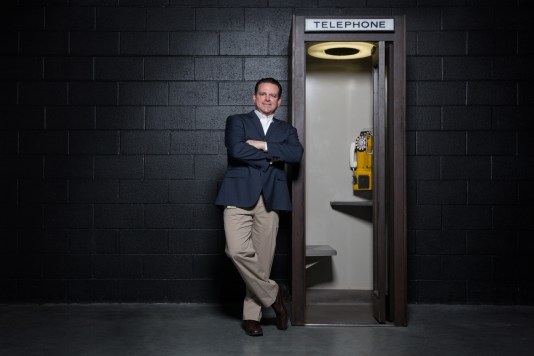
Mark Nachman, regional president for Sprint

Pinto happily supplied Nachman with several leads, and then opened the door on other ways Sprint could get involved at Behrend, including offering internships, participating in a “Corporate Day” at the Black School of Business (where representatives can meet directly with students about internship and career opportunities), and engaging students in doing research work for the company.

“I suggested he think about any ways he could put upper-level marketing students to work doing a hands-on project for Sprint,” she said.

Nachman didn’t have to think about it for long. He knew that, despite substantial investment in technology and cell towers in the Erie region, Sprint had been struggling to gain market share in the area among its key demographic (18 to 25 year olds), but he didn’t know why.

This spring, he’ll have forty-plus MKTG 344 Buyer Behavior students on the case.

Students will work in small teams using a variety of marketing strategies, including market analysis, focus groups, personal interviews, and more, to learn more about the perceptions, attitudes, and cell-phone provider preferences among Sprint’s target demographic in the Erie area.

“This is real market research for an actual client,” Pinto said. “It’s an unbelievable opportunity for these students to get hands-on experience and put some of the things they’ve been learning into practice.”

mary-beth-pinto

Dr. Mary Beth Pinto, professor of marketing

Students will also assess current Sprint promotions in the Erie area and, based on the team’s research findings, offer recommendations and develop “guerrilla” marketing plans that can be used to boost Sprint’s profile and users in the region.

Guerrilla marketing is an advertising strategy that focuses on low-cost unconventional marketing tactics that yield maximum results. The original term was coined by Jay Conrad Levinson in his 1984 book Guerrilla Advertising.

The top six teams will present their work to a team of executives from Sprint in April.

Nachman can’t wait to learn what they discover.

“I’m super fired up about this collaboration,” he said. “I love the whole concept and the grass-roots initiative of this project. I anticipate the students will come up with ideas that could be implemented nationwide at Sprint.”

Nachman has invested both time and money in the project. He and other Sprint executives will be on campus for the kickoff and final presentations and Sprint will be providing each student with Sprint T-shirts and demo phones so that they can be familiar with the company’s products and services.

“When I was a college student, I remember sometimes feeling disappointed and empty as I jumped through hoops and did research that was all theory,” he said. “This exercise will be entirely tangible and executable. If I were still a student, I’d find that inspiring and motivating.”

It bears noting that the college-age researchers are themselves in Sprint’s target demographic. Who better to find out what 18-24 year olds think about a company and product than their own friends and peers?

“Young adults are influencers, especially when it comes to technology decisions,” Nachman said. “They are intentionally and unintentionally steering their parents and friends on products and services daily.”

The same could be said for Pinto, whose influence on Nachman thirty years ago has clearly led to opportunities for Penn State Behrend students today.

MEET WITH SPRINT

Sprint executives will be on campus on January 12 for the class project kickoff and will participate in a “Corporate Day” at the Black School of Business. Sprint representatives will be in the Clark Café to talk with students about internship and job opportunities and, at 4:00 p.m., Nachman will be giving a talk about “Warrior Leadership” in the Black Conference Room at Burke Center. Nachman’s presentation is free and open to all.
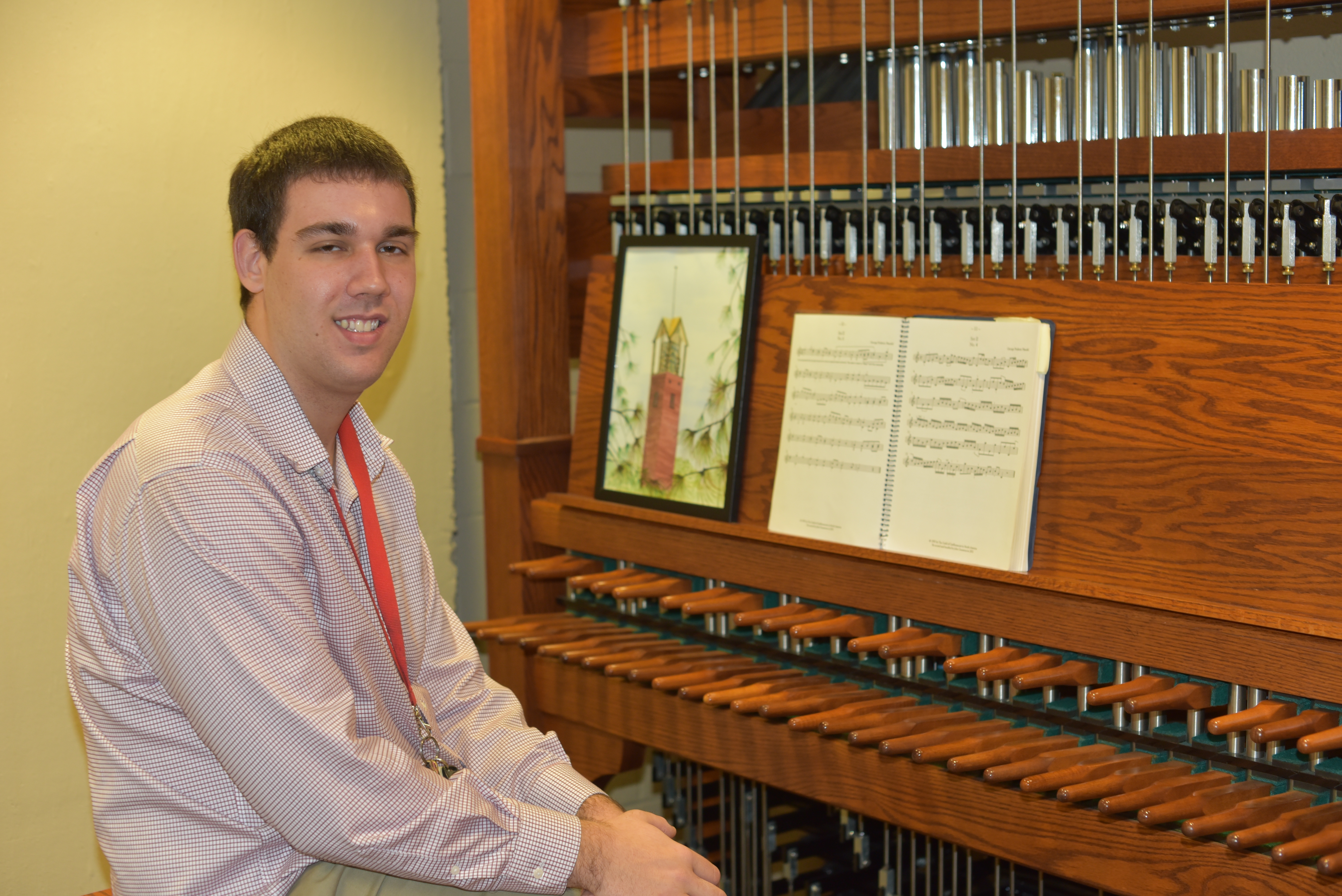



Student finds niche playing Smith Carillon

james-lisi-7
Penn State Behrend sophomore James Lisi began playing the campus’ Smith Carillon this fall. He plays regularly throughout the week on the campus’ practice carillon (pictured) and played a concert during finals week for the campus community. While he’s been a musician since he was a child, mastering the carillon has been a new kind of challenge. “Instead of having the keys right next to you, you have to branch out,” Lisi said. “This wears your hands out a lot faster because you have to move them all over, but there are pedals too, so some of the notes you can play with your feet, which makes it easier.”

By Steve Orbanek
Marketing Communications Specialist, Penn State Behrend

Walk into Penn State Behrend’s Larry and Kathryn Smith Chapel on a weekday morning and chances are you’ll hear James Lisi before you see him.

He’ll be playing one of the building’s many pianos. Or pedaling away on the practice carillon.

“I start every day by playing music here,” said Lisi, a sophomore psychology major. “When I play the piano or the carillon, it gets me going and sets the tone for the day.”

Lisi, a Cleveland native, has always appreciated music. He started singing in third grade and began playing the piano two years later. He is also a member of the Choirs of Penn State Behrend.

While he has experience playing several other instruments, Lisi said he was taken aback to learn about the college’s carillon.

“I had never heard of one before. There are only 200 or so in the country,” he said. “It’s just a really, really rare instrument.”

The 48-bell carillon, along with the chapel’s bell tower, was installed at Penn State Behrend in 2002 as a gift of the late Floyd and Juanita Smith, parents of Larry Smith, president and owner of Automation Devices in Fairview, Pa., and a longtime supporter of the college.

The carillon is an unconventional instrument, to say the least, according to Lisi.

“Instead of having the keys right next to you, you have to branch out,” he said. “This wears your hands out a lot faster because you have to move them all over, but there are pedals too, so some of the notes you can play with your feet, which makes it easier.”

Lisi’s past musical experience is serving him well, as is regular practice and lessons with Daniel Frankforter, professor emeritus of history and the college’s carillonneur.

Lisi is now playing the carillon on a weekly, sometimes daily, basis. He spends hours in Smith Chapel, both studying and playing the pianos and carillon.

“I just love this whole building,” Lisi said. “I get to come here and play three different instruments. It’s a nice way for me to relieve stress. It’s definitely my favorite thing about Behrend.”

During finals week, Lisi played several holiday songs as part of a half-hour carillon concert for the campus community. Students, faculty and staff members were encouraged to gather at Ben Lane Plaza to enjoy hot chocolate as they listened to the bells chime from atop the carillon tower.

“I made some mistakes,” Lisi said with a smile, “but I knew I was not going to be perfect the first time I played publicly. Thankfully, I don’t think anyone noticed.”

He will get another chance to impress this spring at a second carillon concert to be held during finals week.

And if things go his way, Lisi will not be the only one performing. He is currently introducing the carillon to several of his friends.

“I’m really working to persuade some of my friends to play it as well,” he said. “It’s just a totally different kind of instrument. I love the high notes on it, and it’s great that we have one of these right here at Behrend.”

No age limit on Penn State pigskin pride

Dick Koeck ’47 and his wife, Susan ’49 fell in love at University Park—with each other and with Penn State football. Throughout the next few decades, the couple periodically traveled to Happy Valley to attend games, tailgating with friends and cheering on their alma mater’s team.

“It’s just more fun to watch with friends,” Dick Koeck said.

That’s why, when he and Susan moved to an Erie retirement community, Dick decided to bring the spirit of Beaver Stadium to Springhill Senior Living on game days, offering to organize PSU pigskin parties in the common room.

“I knew there were a few Penn Staters at Springhill and I just thought ‘Why not try and get them all together to watch games?’” he said.

Anywhere from twenty to thirty enthusiastic residents, including many alumni and former Penn State Behrend faculty members and administrators, gather for each game.

Among the attendees Penn State Behrend alums may recognize are: Dr. Ed Masteller, professor of biology emeritus; Virginia McGarvey, who along with her late husband, Ray, was a great supporter of Behrend; and Ethel Kochel, wife of Behrend’s first leader, Irv Kochel, and an honorary alumna of the college.

“Oh, yes, Ethel is always there with her cowbell,” Koeck said with a chuckle.

Another resident brings a stuffed Nittany Lion mascot that sings a Penn State tune, blue and white flags are hung. The Springhill tailgaters sing the school Alma Mater and Fight Song and they do Penn State cheers, complete with pom-poms. Penn State apparel is practically required.

“Except for white-out games, of course,” Koeck said.

And what would a football party be without food?

Springhill does it right, serving up traditional tailgate favorites, such as hamburgers and hot dogs, sausage sandwiches with peppers and onions, pizza, wings, etc.

One benefit of tailgating at Springhill? It’s not an alcohol-free zone.

“Oh, sure, we might have a few beers,” Koeck said. “Gotta have that at a tailgate party.”

Plans are already underway for Penn State’s next big game – the Rose Bowl on January 2, 2017.

“It has been amazing to watch the team rise to the challenge and win each week and make Penn State proud,” Kochel said. “It is always fun to have Penn Staters together to watch the game, and we are all so excited that we are going to the Rose Bowl again!”

Koeck can hardly wait to see his team in the “Granddaddy of Them All.” He already knows what he’s wearing.

“The last time Penn State played in the Rose Bowl was in January of 1995, and I’ll be wearing my sweatshirt from that game,” he said.

Penn State won that game, defeating the Oregon Ducks 38-20, so Koeck has good reason to don his lucky shirt when the Nittany Lions take on the University of Southern California Trojans at the 2017 Rose Bowl on Monday, January 2.

Koeck’s parting thoughts?

In typical Penn State football fan fashion: “WE ARE…!”

Rose Bowl Trivia: Why Monday?

The Tournament of Roses has had a “Never on Sunday” tradition since 1893, the first year since the beginning of the Tournament, that New Year’s Day fell on a Sunday. The Tournament wanted to avoid frightening horses that would be hitched outside churches and thus interfering with worship services so the events were moved to the next day, January 2. Though horses are no longer outside local churches, the tradition remains to this day. —tournamentofroses.com

This slideshow requires JavaScript.


Still have some holiday shopping to do? Behrend faculty and staff members have you covered

By Steve Orbanek
Marketing Communications Specialist, Penn State Behrend

The mad dash is almost here. It’s time to get those final holiday gifts before it’s too late.

Still scrambling for ideas? Don’t worry, Penn State Behrend’s faculty and staff members have you covered. Here are some of their top suggestions for gifts that are both fun and educational.

jewelbots_kickstarter

Ideas provided by Melanie Ford, director of Youth Education Outreach

Jewelbots. Look pretty while you learn about programming? That’s exactly what girls can accomplish with Jewelbots, the friendship bracelet that teaches kids to code. $69

Robot Turtles. Designed for children ages four and up, this interactive board game helps teach young people how to program. $15

Pokemon. Unless you’ve been living under a rock, you know that Pokemon are once again hotter than ever.  Whether it’s the cards or the video games, there are plenty of ways to “catch ‘em all” this holiday season. Prices vary

Ideas provided by Tracy Halmi, senior lecturer in chemistry

Molecules: The Elements and the Architecture of Everything. Quite literally, molecules make up everything. How exactly does one visualize that, though? Theodore Gray does that for you in this book, which features stunning photography of the chemical structures that make up every material in the world. $20

Instant Snow. Even as one of America’s snowiest cities, the white stuff has been mostly absent from the region so far. We cannot make snow fall from the sky, but this gift allows a person to actually make snow (and learn about chemistry while he or she is at it.) $18

Minecraft Cookie Cutters. Every child seems to love Minecraft. Every child definitely loves cookies. This is a no-brainer. $10

Ideas provided by Dr. Richard Zhao, assistant professor of computer science and software engineering

Merge VR Goggles. 2016 is the year that virtual reality headsets hit the mainstream. The Merge VR Googles turn a person’s smartphone into a virtual reality headset. You’re then able to enjoy fully-immersive virtual environments and games right from the comfort of your living room. $60

Google Cardboard. While Google Cardboard might not look as cool as the Merge Goggles, it offers a similar experience and at a great price. $15

Idea provided by Tom Noyes, professor of English and creative writing

“Best American” book series. For bibliophiles on your list, you might check out the annual “Best American” series. Each year, 2016 included, editors compile the best examples of writing from magazines around the country. The three standards, “Best American Short Stories,” “Best American Poetry,” and “Best American Essays” are great, as are some of the other volumes, including “Best American Mystery Stories,” “Best American Sports Writing,” “Best American Science and Nature Writing,” and “Best American Science Fiction and Fantasy.” $10-$15

Idea provided by Mary-Ellen Madigan, director of enrollment management

Tile Mate. Is there someone on your list who is notorious for losing his or her keys? They won’t be anymore. This Bluetooth tracking device is small, durable and water resistant, and it can easily be attached to keys, luggage, backpacks, or anything else you carry. $25

Trip to Japan becomes ‘defining memory’ for Behrend students

dsc_0117
Fifteen Penn State Behrend students visited Japan this summer as part of the PSYCH 232 Cross-Cultural Psychology and PSYCH 499 Foreign Studies in Psychology embedded courses. While there, they attended the International Congress of Psychology (ICP 2016), a premiere psychology conference held once every four years.

By Steve Orbanek
Marketing Communications Specialist, Penn State Behrend

Grace Waldfogle expected Aug. 6 to be a somber day. Not only was it the last day of her trip to Japan as part of a Penn State Behrend embedded course, but it also marked the 71st anniversary of the Hiroshima bombing.

It turned out to be the opposite.

Fireworks engulfed the sky. The sadness she had expected was not present. Rather, there was a tone of optimism.

“We asked people about it, and they said, ‘It’s not something we dwell on,’” said Waldfogle, a senior psychology major. “It was just so different from how we approach that type of thing here in the United States.”

Cultural differences like this were one of the biggest takeaways for Waldfogle and the 14 other students who visited Japan for 18 days in July and August. The students visited the country as part of the PSYCH 232 Cross-Cultural Psychology and PSYCH 499 Foreign Studies in Psychology embedded courses, which were taught by faculty members Dawn Blasko, associate professor of psychology; Heather Lum, assistant professor of experimental psychology; and Victoria Kazmerski, associate professor of psychology.

Their trip began with a visit to Yokohama to attend the International Congress of Psychology (ICP 2016), a premiere psychology conference held once every four years. Several of the students presented research poster presentations during the five-day conference.

ICP 2016 also offered networking opportunities for the students, who heard from a number of prominent speakers, including famed animal rights activist Jane Goodall.

“The whole conference itself was a total blast,” said Emily Galeza, a senior Psychology major who presented research on the effectiveness of a dog therapy program with students with autism. “The size of (the conference) was just incredible, and we had the freedom to go to any session we liked.”

Stephen Dartnell, a general business student who will graduate in December, agreed.

“I got to interact with people from all over the world,” Dartnell said. “It was kind of the icing on the cake on my educational experience, and I definitely would love to attend a psychology conference like this again.”

Beyond the conference, the students also spent time in Kamakura and visited several temples across the country. To help prepare for the cultural changes, students met with MBA student Yuki Takahashi, a native of Japan, for language and culture lessons prior to the trip.

Even with the advance lessons, the language barrier was a challenge. However, the students were impressed at how easily it could be overcome with some patience (and Google Translate, of course).

“Everyone was just so friendly and willing to help,” Dartnell said. “There was one instance where I needed a trash bag for my camera because it was raining. I just kind of explained it, and a woman at the hotel helped me. You just constantly saw language barriers being broken down.”

The numerous public art displays and eastern-style architecture were also a point of culture shock for students.

Perhaps the most significant cultural difference for students, however, was the food.

“I thought I liked fish, but then I got there, and I realized I did not. They’d give you the entire fish, and you’d have to just use chopsticks,” Waldfogle said. “Every meal was a workout.”

Not all of the food differences were negative, though.

“They had so many different items that they called ‘sweets.’ They were really, really good,” Dartnell said.

From attending the conference to visiting temples across the country, the trip provided students with a once-in-a-lifetime cultural experience. It might have only been an 18-day visit, but the memories will last.

“This will be one of my defining memories of Behrend,” Galeza said. “I could never have planned all of these activities by myself.”

This slideshow requires JavaScript.

Secret Lives of Faculty: Inspired by patients, nursing instructor runs long-distance race in all 50 states

By Heather Cass

Publications & Design Coordinator, Penn State Behrend

There’s much more to Penn State Behrend’s faculty and staff members than what you see on campus. In this occasional series, we’ll take a look at some of the interesting, unconventional, and inspiring things that members of our Behrend community do in their free time.

pic3

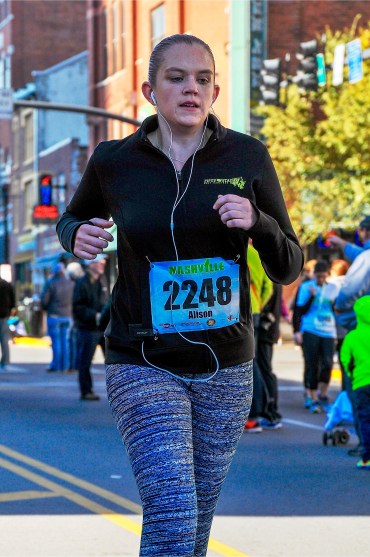
Inspired to start running to help her patients suffering from cancer, Alison Walsh, 34, lecturer in nursing, recently finished a 50-state running challenge—completing a marathon (26.2 miles) or half marathon (13.1 miles) in each state from Alabama to Wyoming.

We recently got Walsh to stop moving for a few minutes (no easy task, we’ll have you know) and tell us about her all-American feat:

How long have you been at Penn State Behrend? I was an adjunct instructor in 2010 and became full-time instructor in 2011.

Do you still work as a nurse? I work per diem at Saint Vincent Hospital in the float pool, which means I work in whatever unit needs me that day.

When did you start running? I have been terribly un-athletic my whole life! I really did not run seriously until 2009.

Why did you start running? In 2008, I was working on an oncology unit and I was quite connected to my cancer patients. A fellow nurse on that unit asked if I wanted to run a half marathon with her to raise money for the Leukemia & Lymphoma Society, and I agreed. I severely underestimated how hard it would be to run 13.1 miles! That first race was rough. During the race, I remember thinking that I was quite sure I would never put myself through it again!

And, yet, you ended up deciding to do a distance race in all 50 states. How did that happen? There was just no feeling like crossing that finish line. Runner’s high is a real thing and I became an addict. I did my first full marathon in 2010.

How long did it take you to accomplish a race in all 50 states? It took about seven years. Last year, I ran the most races—thirteen half marathons.

What was your last state and when did you finish? I checked the last state off my list on October 9 in Wichita, Kansas. I know what you’re thinking: Why wasn’t it Hawaii or someplace more amazing? Poor planning on my part. But Kansas was actually a great race which is part of the fun of doing a 50-state challenge. You never know what nook-or-cranny in this country will surprise you with an awesome experience.

pic1

Which was your favorite race/state? Surprisingly, one of my favorite races was the Pittsburgh Marathon in 2010. It’s a hilly course and it poured rain the entire time, and I remember halfway through the 26.2 miles that maybe I needed to reevaluate my life choices. But the crowd support was phenomenal. Despite the rain, every inch of that course was covered with people cheering and screaming no matter how fast or slow anyone was running. Their energy, as well as a beautiful course, made that race unforgettable.

What was your most unique race? In July, I went on an Alaskan running cruise! Instead of excursions and the usual activities you do on a cruise, every place we docked, there was a race. The scenery was phenomenal, the locals at each port were very supportive of our races, and it was really cool to hang out with a couple hundred people that were just like me and would sign up for something like that!

Were there any races that you thought were overrated? I have to say the Disney World races. I’d suggest anyone try it once because there’s nothing quite running through the parks and having Disney characters cheer you on! But, when I ran it a second time, I was annoyed by the insanely steep registration price, the early start (you have to be at the start line at 3:30 a.m. because of road closures), and the large number of participants. This is definitely not a race you run to get a good finish time because there are just too many people.

Were there any you didn’t think you’d finish? Why? I injured my knee at Grandma’s Marathon in Duluth, Minn., around mile 15. The pain was terrible. I called my sister mid-race, bawling because it was going to be my first DNF (did not finish). I was inconsolable. I kept saying to myself: ‘OK, just get to the next medical tent and then you can stop.’ But when I got there, I realized I could go a little further, and that happened at each opportunity to stop. When I got to mile 21, I knew I was going to finish. It was my worst time ever, but I finished, despite running on a bad knee for 11.2 miles.

How do you get through a tough race? Are there any mantras you repeat or mind-games you play with yourself? During Grandma’s Marathon someone was holding a sign that said ‘Pain is Temporary, Pride is Forever.’ I think that random stranger holding that sign was the thing that inspired me to finish that race.

Why do you like distance racing? The coolest thing about a marathon is seeing so many different people of all ages, fitness levels, sizes, and ethnicities coming together and sharing an experience. In those few hours, we are all one big family, supporting each other.

Have you had to deal with any injuries? Thankfully, that knee injury resolved quickly and was never an issue again. My first major injury happened in March, when I got bursitis in my hip. It was terrible. I had to stop running for a few months to let it heal, and that was when I really saw how much running meant to me and how much I rely on it as a stress reliever.

What is your training schedule like? I run about four days a week, anywhere from four to eight miles, depending on what race I’m training for and when it is.

What do you enjoy most about running? Why do you do it? It took me years to actually enjoy running. For quite a while, I hated training and only did it for the medal at the finish line. It was only in the past few years, that I realized how much I enjoy running just for the sake of it. It’s a great stress reliever. It also helps me stay in shape and has given me a great excuse to travel to places I never would have otherwise.

What’s your next big goal? I’m not quite sure! I have not run a full marathon in a few years, so I would like to do that in 2017. In January, I’m running the Louisiana half marathon in Baton Rouge. Running and traveling have become a huge part of my life, and I’m not planning to stop anytime soon.

pic5

At the Las Vegas Rock ‘N Roll 1/2 marathon, Alison, left, stopped for a photo with “Elvis.”

pic2

Alison’s 50 States jacket. States are colored in as they are completed. Alison’s is fully colored now!

pic6

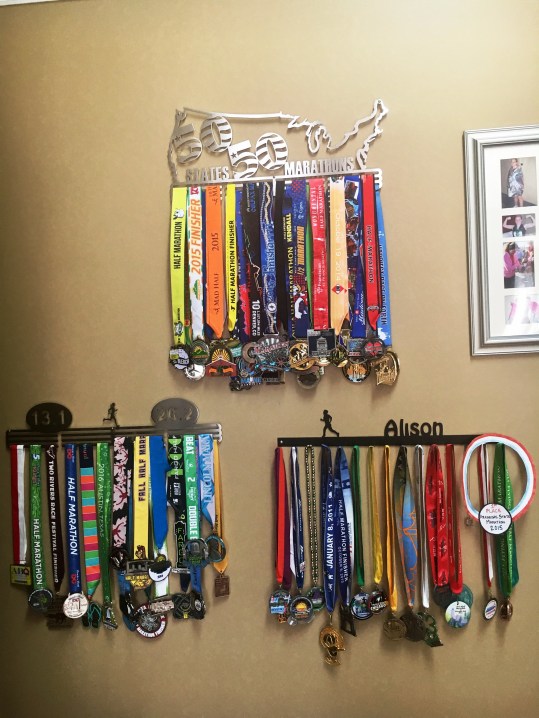
Another by-product of distance racing—lots of “bling,” I.e. finisher’s medals.


Cross-Country Coach’s Voice Goes Viral

Image result for greg cooper coach

Penn State Behrend cross-country coach, Greg Cooper, found himself (or at least his voice) part of a stunning video that went viral this week. The video, shot at the DIII Mid-East Regional Championships at DeSales University where Behrend’s men’s XC team were competing last week, depicts Justin DeLuzio from Gwynedd-Mercy College taking a severe hit from a whitetail deer mid-race.

Coach Cooper can be heard on the video yelling “Watch out for the deer!”  Cooper said that when he yelled, most of the runners looked up and heeded his warning, save for Justin who kept his head own and ended up a five rows into the cornfield next to him.

Watch it here: http://www.yourerie.com/sports/sports/behrend-cross-country-tied-to-viral-video

Ouch!

Cooper, who ran to DeLuzio after the collision, said the runner looked disoriented and stunned, but continued the race. Reports say he suffered no major injuries.

It’s not the first time runners have had to dodge deer on the XC course.  Cooper said it happened a few times when he was a college runner.

Only in Pennsylvania….

(OK, and probably Ohio and other rural areas, too, but at least it wasn’t a bear, right?)

PLET Students in Germany – Days 6-10

Guest Post by Ian Duchene, Plastics Engineering Technology major

No matter how vivid the photos or descriptive the lecture, there’s nothing quite like seeing and experiencing another country in person. And, in today’s increasingly global business climate, it’s vital that students be versed in the culture and business practices of international partners. There is much to be learned from seeing how others do it. That’s why, every year, students in the Plastics Engineering Technology program have the opportunity to travel overseas to visit plastics companies and universities and attend a plastics trade show, too.

On Thursday, Oct. 20th, thirty-three PLET majors embarked on a 10-day trip to Germany. We asked them to tell us about their journey. In this blog post, students give us a report on the remaining days of the trip:

Image result for Mercedes-Benz Museum

Day 6 — Tuesday, October 25, 2016

An early morning checkout from our hostel lead to a couple sleepy train rides to Stüttgart. Upon arrival the group split in two, one exploring the city while the other boarded yet another train to the Mercedes-Benz Museum.

Once at the Mercedes-Benz Museum, the students were guided through the spiral halls which showcased the many automobiles produced by the company throughout their long history.

The students who stayed back from the museum went sightseeing in the city with a couple of professors. First, they went to the Schlossplatz and the palace Neues Schloss. Neues Schloss was the seat of the Kings of Wurtemburg and had multiple neat statues.

They also checked out the Schillerplatz, which was named after the famed poet Friedrich Schiller, but today houses many market stalls. For sale at the stalls were a multitude of goods, including exotic fruits and freshly baked bread.

The Stiftskirche, next to the plaza, is a beautiful church that was home to evangelical Lutherans in Stuttgart. Johanneskirche is another church the students visited. It had a spectacular view, showcasing a pond full of ducks and a swan. For lunch, they went to a German brauhaus to eat traditional German food, including spätzle.

After the tour, the two groups met again at the Stüttgart HBF and proceeded to the hostel. The hostel was perched high on a hill which provided a beautiful overlook of the city.

Schlossplatz was a hub for foot traffic as the setting sun lit the city’s small streets just in time for dinner. Shops, restaurants, and historical bullrings created a maze around Schlossplatz. The extra exercise gave way to an early night for the young student globetrotters; although a 6 am wake up call the previous and ensuing day may have been a factor as well.

Ian Duchene, Myles Mike, Eric Santini, and Glenn Spiering 

Day 7 — Wednesday, October 26, 2016

Needing to be at the train station by 8:15 a.m., it was yet another early morning wake-up call. Everyone was reaching for a cup of coffee!

By 10:00 a.m., the class reached the Arburg injection molding manufacturing plant in Loßburg, Germany. Upon arrival, everyone received a name tag with their full name.

At the facility, we went to a brief video presentation which gave an overview of the company and their current strides within the plastics industry. Following the video, we split in two groups to tour the facility.

For a private, family-owned company, their facility was enormous. Everyone was in awe with the size of the facility as well as the project management and creative thinking that goes into running an operation this large. There were automatic robots on rail tracks from the ceiling that would carry parts from one work station to the next. The robots had sensors prevent collisions.

Unfortunately, we were not permitted to take any pictures while in the facility. So, you’ll have to trust us when we tell you that it was incredible.

At the end of the tour, students received a delicious free lunch. Before leaving, everyone was given a parting gift, an Arburg umbrella. We then boarded a train back to Stüttgart where we would yet again split in two groups.

One group would head to the Porsche Museum while the other began their journey to Munich where we will be for the remainder of the trip.

— Ian

Image result for Neuschwanstein castle

Neuschwanstein Castle

Day 8 — Thursday, October 27, 2016

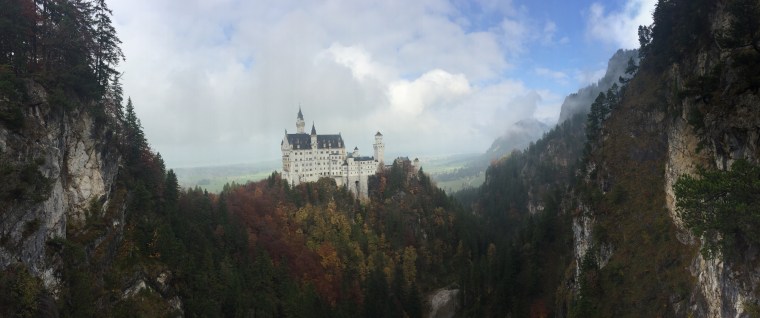
A 6:45 a.m. train took us to Neuschwanstein Castle in Fußen, Germany. The castle was built for King Ludwig II in 1869 and took many years to build. Unfortunately, he only lived there for 172 days before he was found dead in a nearby pond. To this day, his death is still a mystery. Neuschwanstein became open to the general public within six months of the Kings passing. Since then, it has grown to be a major tourist attraction in Southern Germany. (I wonder if he was killed so they could make a small fortune on tours! LOL.).

Following a tour of the inside of the castle, everyone took a ten-minute hike up a pathway that led to a bridge with a beautiful view of the castle. A foggy morning led to great speculation of whether or not we would be able to see the castle from the bridge. Thankfully, the fog had cleared by the time we reached bridge and the view was astounding…

img_5652

Following the trip to Neuschwanstein groups parted ways to explore Munich with many students eating dinner at the original Hofbräuhaus.

— Ian

Image result for rosenheim university of applied sciences

Rosenheim University of Applied Sciences

Day 9 — Friday, October 28, 2016

Students had yet another early morning wake up call—this time for Rosenheim University of Applied Sciences. Every student was in shock upon learning that there is no tuition for students of Rosenheim. The only fee is 52€ per semester for activity and facility fees. After viewing two presentations, the students split into two groups to tour the plastics engineering facilities.

Spread across a few different buildings, the labs consisted of a few different injection molding machines, multiple different extruders, thermoformers, a few stamping presses, and something that was new to many of us, a wood chipper and grinder for wood fiber additives.

The plastics program itself seemed very research-oriented and heavily influenced by industry needs. The tour was interesting and it was interesting to learn how another plastics program runs on the other side of the world.

— Ian

Image result for dachau concentration camp today

Dachau Concentration Camp today

Day 10 (Final Day) — Saturday, October 30, 2016

Many of the students took the morning to visit the nearby Dachau Concentration Camp from WWII. The weather for the visit was appropriately somber and heavy and the students carried that with them while trying to imagine the horrors that took place on the very ground on which they walked. For the first time on the trip, there was no jubilant conversation or laughter, just simple and respectful silence.

Following the trip to Dachau, the students were granted the day to explore Munich and collect souvenirs for their loved ones back home. There was a mandatory check-in at 6:00 p.m. after which students were led to their final dinner where the professors and Chancellor Ralph Ford were present!

— Ian


PLET Students in Germany – Days 4 & 5

Guest Post by Ian Duchene, Plastics Engineering Technology major

No matter how vivid the photos or descriptive the lecture, there’s nothing quite like seeing and experiencing another country in person. And, in today’s increasingly global business climate, it’s vital that students be versed in the culture and business practices of international partners. There is much to be learned from seeing how others do it. That’s why, every year, students in the Plastics Engineering Technology program have the opportunity to travel overseas to visit plastics companies and universities and attend a plastics trade show, too.

On Thursday, Oct. 20th, thirty-three PLET majors embarked on a 10-day trip to Germany. We asked them to tell us about their journey. In this blog post, students Ian  Duchene gives us a report from days 4 & 5 of the trip:

Image result for plastic k-show

Day 4

Finally the moment we’ve all been waiting for… Day one of the K-Show. After two short train rides to Düsseldorf, we arrived. Unsure of what to expect, we were in for quite the surprise when we saw the size of the company booths. Many of which are larger than classrooms on campus at Behrend!

With the show spanning 17 buildings, there are endless places for the 33 Behrend plastic enthusiasts that came on the trip to get lost in a plastic engineering wonderland. Many injection molding companies offered samples of parts they were running fresh off the press. A couple of the most popular items include a collapsible step stool and watch from Arburg.

There is so much to do and see; it is impossible to see everything in one day.

Day 5

This was our second day at the K-Show. Even with eight more hours to spend, we still did not see every booth. Each building we went to, we saw different technologies. The size of the show still baffles everyone.

The automation was one thing that blew everyone away. One automation company had a display of the capabilities of their robots where the robots were dribbling and shooting basketballs. Injection molding machine manufacturers were a hit with the class as they were not only revealing new presses but also supplying everyone with cool gear such as watches, stools, screwdrivers, personalized cups, bottle openers, performs for 2-liter bottles, and countless other items.

One thing that many of the students seemed to dislike was the amount of civilians at the show that did not truly appreciate everything. It seemed they were just there for the free gear. Also, with many of the machines, many of these same people were disregarding safety guards and shoving their hands in harm’s way. Our shock was probably reflective of the amount of training we have all gone through, both at Behrend as well as at our internship sites, where safety is stressed more than anything.

Overall, the K-Show was a great experience and we all are itching to go back in four years to see the emerging technologies after we have been in industry for a few years. It was certainly an eye opening experience as well as a great learning experience. Many, if not all, of the students had the opportunity to receive beneficial information about their senior projects from some of the industry’s most experienced and knowledgeable experts.

 ~ Ian 


Science Alum, Ivy League Ph.D., Bound for Singapore

By Heather Cass
Publications & Design Coordinator, Penn State Behrend

dr-jason-bennett-and-james-pander

James Pander ’12, seated, and Dr. Jason Bennett, associate professor of chemistry, photographed in 2011 at Penn State Behrend.

James Pander ’12 knew he wanted to be a scientist before he even knew what that might entail.

“I think the inspiration came from movies and TV shows, where you’d have an eccentric scientist character who could seemingly solve any problem,” Pander said. “While those programs were a big exaggeration of reality, I’ve always thought it very inspiring that you can, with enough time, money, and effort, solve just about any problem with science.”

Pander, who graduated from Penn State Behrend with degrees in Chemistry and Mathematics and minors in Physics and Statistics, recently successfully defended his Ph.D. at Princeton University, where he also earned a graduate degree in Chemistry.

He has accepted a research position at the Singapore Berkley Research Institute for Sustainable Energy, and will be moving overseas as soon as all his travel documents are in order and approved.

We caught up with James before he left to learn more about his future plans, his time at Princeton, and how his Penn State Behrend education helped him get there.

What do you like about chemistry?

Out of all the fields of science, I think chemistry is the most interesting because everything is chemistry. Chemistry occupies this interesting space between biology and physics. You can look at the chemistry of living things with biochemistry, or you can delve into the quantum mechanical world to look at the fundamentals of how atoms and molecules interact with each other using physical chemistry. And, in that way, you have a subject that has the flexibility to cover almost everything.

Did you do any research projects with faculty members while you were here?

Yes! I think that research is the single most important part of any science education. In lecture and lab courses, there is always a correct answer and a specific series of steps you take to get to that answer. That is not how the world really works. Actual science is much more open-ended. You have to figure out what information you are trying to find, how to design an experiment to best find that information, and how to interpret your results. It’s so much less straightforward and so much more exciting.

While at Behrend, I worked with Dr. Jason Bennett, associate professor of chemistry. I started in the second semester of my freshman year and worked with him until graduation. My advice for anyone interested in science is to start doing research work early! Talk to a faculty member and jump in. It’s the best way to supplement your education and to get to know the faculty. Dr. Bennett was an amazing mentor and I certainly couldn’t have been as successful as I have been without his support and the support of the rest of the chemistry department.

Was Princeton your first choice for graduate school?

Overall, when I looked at the departmental atmosphere, the professors who work there, and the location, yes, Princeton was my first choice.

Do you think the research experience you had at Behrend helped you get into Princeton?

There is no doubt in my mind that my undergraduate research experience was a big benefit as I was applying to graduate school. In graduate school, your primary job is to do research (classes and teaching are secondary) so there really is no better way to prove to them that you can be successful in that type of environment.

The best thing about Behrend is that you work directly with professors on research work, and that mentorship is invaluable.

Did you feel Behrend prepared you for an Ivy League graduate school?

Definitely. Graduate school was by far the most challenging thing I’ve ever done. A small fraction of people continue on to post-graduate education, so you naturally end up with a group of really smart individuals from all over the world. And that is really intimidating!

You quickly go from being one of the best to middle of the pack. It’s very comparable to the transition between high school and college, and just like during that transition, the most important skill is knowing how to learn. Your job in college is to gain a broad knowledge of a subject, whereas in graduate school your job is to become an expert on a very, very specific topic. So you end up going from having virtually no specific knowledge of a field to becoming an expert in a few years, and most of that is fairly self-focused education, so you need to know how to learn.

I definitely think that Behrend did a great job at preparing me for that, even if though it felt overwhelming at first.

On a lighter note…how did Princeton’s winters compare to Behrend’s?

It was a nice change. Winters got very cold in New Jersey, but there was nowhere near as much snow, which was nice. My least favorite part of winters in Erie was driving in the snow.

You just successfully defended your Ph.D. at Princeton, correct?

Yes. It was a really surreal experience. You spend four or five years working on one specific problem and then it all culminates in writing your thesis and then trying to summarize what feels like your life’s work into a single presentation, which means so much gets left out!

After I was done, everyone was congratulating me and calling me doctor, and I just felt like, wait, I’m the same person I was an hour ago, nothing’s really changed. But, in reality it’s the biggest accomplishment of my life so far. It didn’t really sink in right away. But when it did, it was a great feeling. I’m really proud of the work that I did in graduate school.

So what’s next?

I’ll be working for the Singapore Berkley Research Initiative for Sustainable Energy. It’s a collaborative effort between a few different institutions, including the National University of Singapore and University of California, Berkeley, to research different aspects of sustainable energy with the goal of using solar energy to convert carbon dioxide into fuels. It’s an exciting opportunity!

When will you start there?

Hopefully soon. I’m navigating the visa process right now, so as soon as the Singapore government approves that, I’ll be able to move.

Have you always wanted to work overseas?

No, not at all! The thought had never really crossed my mind, but in graduate school I was given the opportunity to make friends with people from all over the world. Several of them are prolific world travelers and they had a big influence on me. It’s really exciting to travel and see the world, and it really opens your eyes to different cultures and ways of life. It helps you to grow as a person and I’m excited for more of those types of experiences.

What are your long-range career goals?

I’d like to go into industrial research and development. Graduate school is great because you’re adding to the body of knowledge in your field, but in an academic environment, you rarely get to see the direct fruits of your labor. I’m interested in industry because I think I’ll get more of a sense of finality to projects because there will always a specific product in mind.

Anything else you’d like to add?

I just want to thank everyone who has helped me to get where I am today: My parents for teaching me the importance of education and helping me get through college, the faculty members at Behrend—especially in the Chemistry and Math departments—who were all wonderful teachers and mentors, and my colleagues throughout graduate school.