
Infinite Lizards, Infinite Beauty

Math and art converge in Behrend’s growing “geometry gallery”

By Heather Cass, Publications Manager, Penn State Behrend
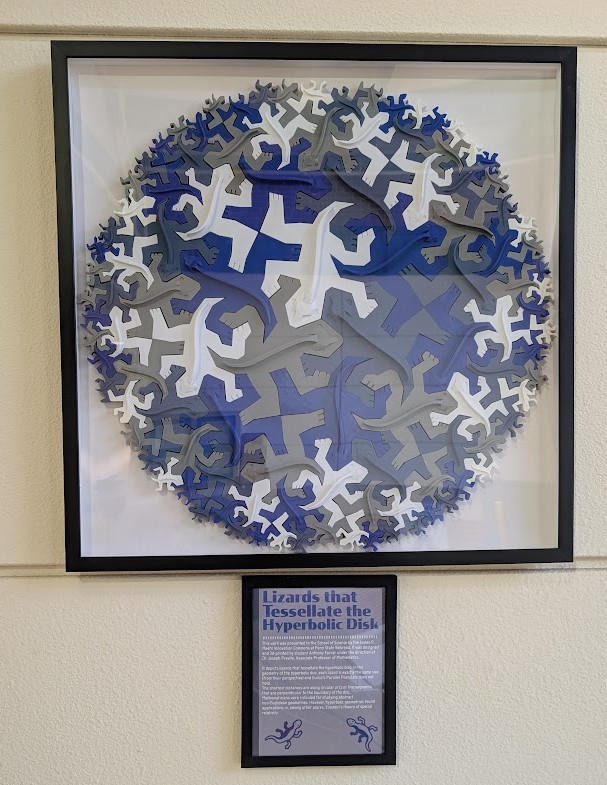
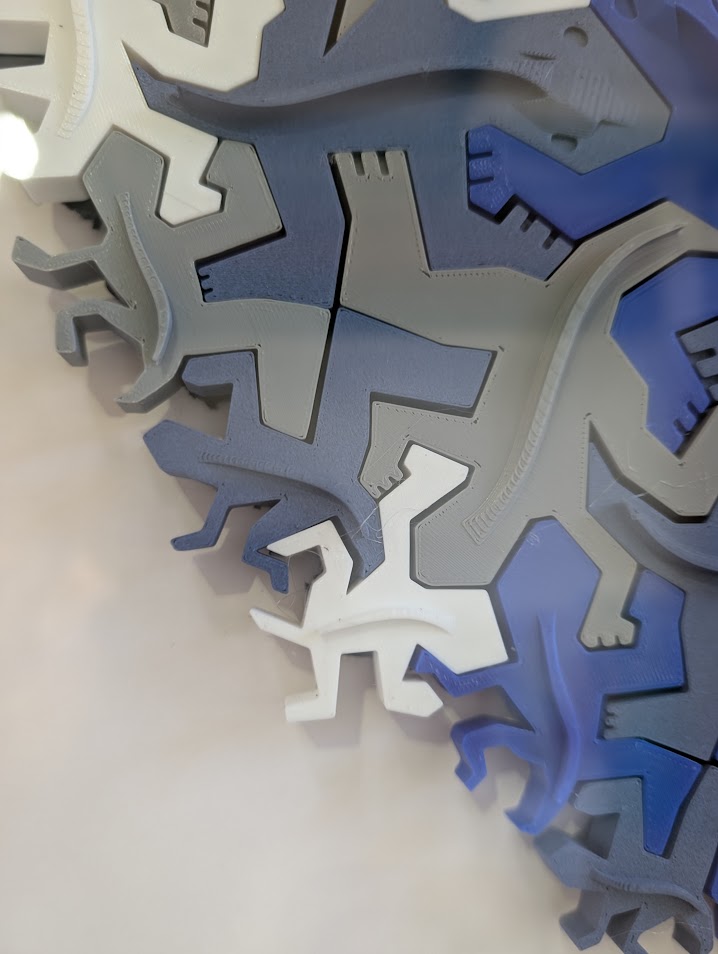
Math isn’t always numbers on a chalkboard. Sometimes it’s a work of art—a swirl of repeating lizards, 3-D printed in Penn State blue and white, then installed in a building where math, art, and science intersect. The lizards blend together in a hypnotic pattern, each appearing to shrink as it spirals toward infinity.  

The piece, Lizards that Tessellate the Hyperbolic Disk, was imagined by Dr. Joseph Previte, professor of mathematics, who wanted to capture the beauty of mathematics in a form anyone could see.

He took the design to the James R. Meehl Innovation Commons, the college’s open ideation lab, where engineering students Anthony Farrar and Quinlan Barnes transformed Previte’s concept into reality with 3-D-printed tiles and a sharp eye for symmetry.

The result is art born from math—or perhaps math revealed as art.
Dutch artist M.C. Escher showed the world that geometry could be beautiful with his mesmerizing tessellations and optical illusions, where patterns unfolded in ways both precise and poetic.

“For centuries, mathematicians questioned the value of studying this type of geometry, dismissed it as impractical and useless, with no relation to reality,” Previte said. “But it later proved essential to modern science, including helping Einstein describe how time and space work in his theory of relativity.”

While some mathematicians ridiculed the study of abstract math, others reveled in it. English mathematician G.H. Hardy argued that mathematics was a pure art form, divorced from practicality—something he took great pride in. Hardy’s theories later laid the groundwork for encryption, proving that beauty and utility often travel together.

That same tension—between abstraction and application, imagination and reality—now hangs on the wall at Behrend.  

Lizards that Tessellate the Hyperbolic Disk joins an existing sculpture, Math in Flight, a stage-5 Sierpinski tetrahedron, a fractal shape featuring a pattern of infinite triangles, that hangs high above the entrance to Roche Hall in the Science Complex.  
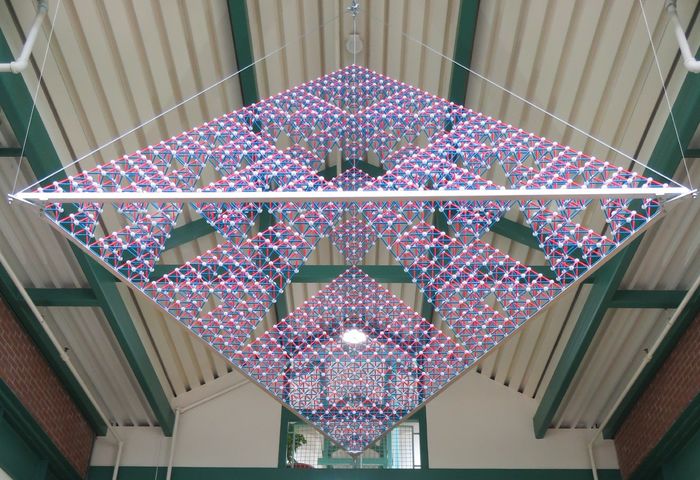
Math Club students built the sculpture using Zometool construction parts. It consists of 2,050 white balls and 6,144 red-and-blue struts.

Previte has plans to continue adding to the mathematics art gallery.

“I’d like to do the Platonic solids next,” he said. “I am currently looking for a student in Innovation Commons to make that project a reality.”


Standout Seniors ’25: Meet Ali Ostowar (Management Information Systems)

Penn State Behrend’s Class of 2025 is ready to make its mark on the world. We’re proud of our students and all that they have learned and accomplished here at Behrend. Over the next several weeks, we will introduce you to a few of our remarkable seniors who have conducted valuable research, pioneered innovation, overcome challenges, and engaged in college life in a big way.

Today, we’d like you to meet Ali Ostowar:

Major: Management Information Systems

Minor: Computer Science

Hometown: Olomouc, Czech Republic

Why he chose Behrend: I wanted a quiet and focused academic environment. University Park sounded too crowded for me, so I opted for Behrend, where I could fully concentrate on my studies.

Why he chose his major: My passion for artificial intelligence (AI) led me to explore various academic paths. I chose Management Information Systems because it allowed me to dive deeper into AI while leveraging my previously earned business credits.

Proudest accomplishment at Behrend:  Writing my Schreyer Honors Thesis has been the highlight of my academic journey. Having the opportunity to collaborate with professors I admire on a topic I’m deeply passionate about—and successfully completing it—stands as my proudest achievement.

Thesis topic: My thesis explored the role of emotions in economic decision-making, particularly whether they promote or hinder rational economic choices. This question has long been debated and has recently gained renewed interest as artificial intelligence advances, raising the question of the necessity of emotions in decision-making. While some argue that emotions are fundamental to decision-making, others suggest that an emotionless approach might be more desirable in specific contexts.

Challenges overcome: Transferring from the United Kingdom, where I studied International Business for a year, was already a challenge. However, the biggest challenge was shifting my focus from business to AI and cognitive science. Fortunately, with the support of my adviser, I was able to tailor my curriculum to align with my evolving interests, ultimately leading to my acceptance into a top AI graduate program in the Netherlands. (Editor’s note: Ostowar was accepted into three of the top AI graduate programs in the world!)

Advice for first-year students: Don’t feel locked in your initial major. The flexibility of the curriculum and my willingness to explore courses outside my field led me to discover my true passion. Take the opportunity to experiment, and you might find a path you never expected.

Ali has been accepted into the master’s program in Artificial Intelligence at Utrecht University in the Netherlands. After completing his degree, he plans to pursue a career in academia, focusing on AI and Cognitive Science.