Standout Seniors ’25: Meet Anna Smith (IBE and PSCM)

Penn State Behrend’s Class of 2025 is ready to make its mark on the world. We’re proud of our students and all that they have learned and accomplished here at Behrend. Over the next several weeks, we will introduce you to a few of our remarkable seniors who have conducted valuable research, pioneered innovation, overcome challenges, and engaged in college life in a big way.

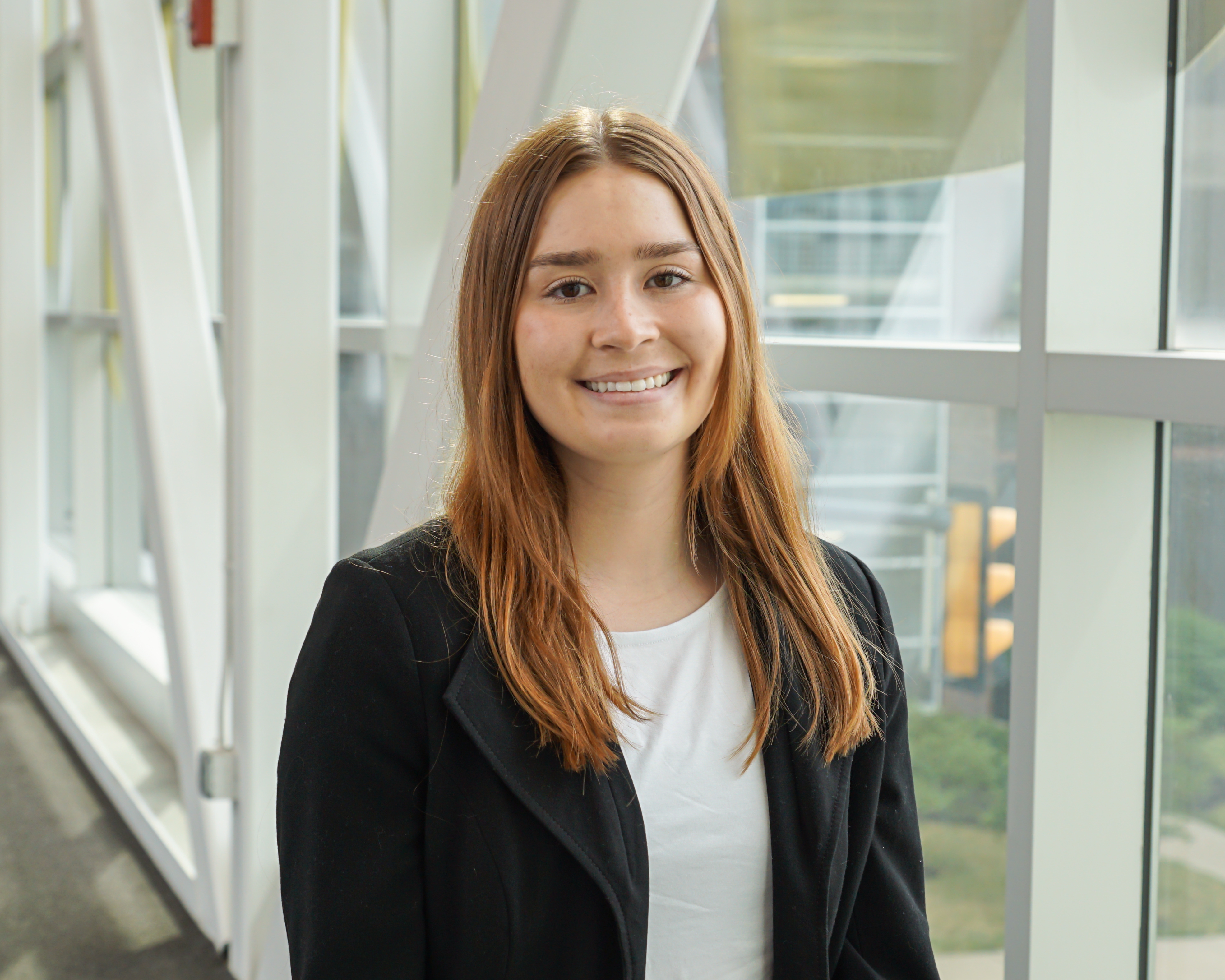
Today, we’d like you to meet Anna Smith.
Majors: Interdisciplinary Business with Engineering (IBE) Studies and Project and Supply Chain Management (PSCM)

Hometown: Cleveland, Ohio  

Scholarships: Lawrence and Elizabeth Held Scholarship and Penn State Discover Award  

Why she chose Behrend: Because of the unique opportunity it provided for me to excel both academically and athletically. I really liked the idea of being able to thrive both in the classroom and on the field all while working toward a Penn State degree. I’ve always been a part of a team, so I knew going into college that I wanted to continue playing soccer, and Behrend seemed to be the best fit for me.

Why she chose her majors: This decision was driven by my interest in global logistics and operations. Some of my strengths include strategic and logical thinking, which is why supply chain management has always been of interest to me. Additionally, IBE is a unique way of combining both business and engineering practices that only further develops my supply chain knowledge.
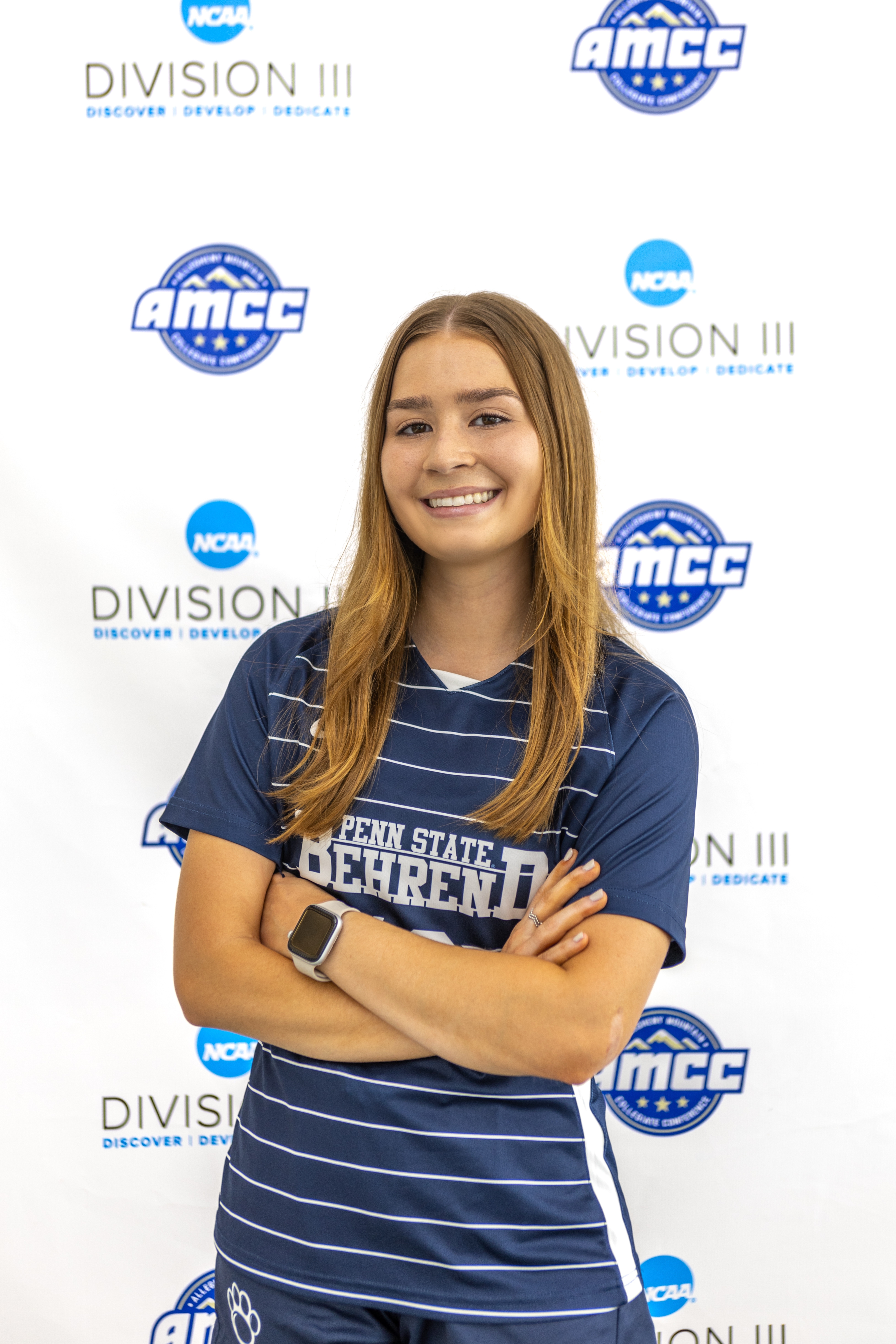
Proudest accomplishment at Behrend: Being selected for the AMCC All-Sportsmanship team in our conference, despite losing my entire season to injury (fractured femur) and never once stepping on the field. This recognition meant so much to me because it highlighted the impact that I had off the field. Throughout my recovery, I remained dedicated to supporting my teammates, embodying the spirit of sportsmanship by encouraging and motivating them from the sidelines. This experience taught me that true leadership and sportsmanship extend beyond physical performance. It’s all about showing up for your team, maintaining a positive attitude, and contributing to the collective success in any way possible. Winning this award reaffirmed my belief in the importance of character and resilience, and it remains a testament to my commitment and value that I was able to bring to the team.  

Challenges: Overcoming the challenge of losing my entire senior season of college soccer due to injury has been a transformative experience for me. It has taught me all about resilience and determination as I navigated the physical and emotional hurdles of recovery. This period of adversity pushed me to develop a positive mindset and focus on personal growth. I learned the importance of patience and perseverance, which not only helped me regain my physical strength but also made me mentally stronger.

A team player: Throughout my recovery, I always wanted to be there for my teammates, supporting them from the sidelines and showing up for them no matter what. This experience deepened my understanding of the value of loyalty and commitment, reinforcing the significance of being present for others in their times of need. Through this journey, I was able to gain a deeper understanding of my own capabilities and understand the value of supporting others facing similar challenges.  

Awards and accolades: Dean’s list most semesters,  Academic All-Conference all four years, Chi Alpha Sigma National Student-Athlete Honor Society, and AMCC All-Sportsmanship team.   

After her graduation in May, Anna will join the Supply Chain Rotational Program at Goodyear Tire & Rubber Company’s global headquarters in Akron, Ohio.

Standout Seniors ’25: Meet : S. N. “Nic” Darrell (English)

Penn State Behrend’s Class of 2025 is ready to make its mark on the world. We’re proud of our students and all that they have learned and accomplished here at Behrend. Over the next several weeks, we will introduce you to a few of our remarkable seniors who have conducted valuable research, pioneered innovation, overcome challenges, and engaged in college life in a big way.

Today, we’d like you to meet: S.N. “Nic” Darrell:

Darrell during a semester abroad in France at Pont du Gard, the largest ancient Roman aqueduct in Europe.

Major: English — Literature, Film, and Culture option

Minor: French and Francophone Studies

Hometown: Perkasie, Pennsylvania

Scholarships: Chancellor’s Scholarship

Why they chose Behrend:  It was far enough from home that it made me I feel I was branching out. It is also the only Penn State Commonwealth Campus with NCAA Water Polo.

Why they chose their major: I have always been involved and interested in languages and the arts. The English Literature, Film, and Culture option offered a diverse learning path that continues to interest me.

Proudest accomplishment at Behrend: I am most proud of the independence I gained while studying abroad for a semester in Montpellier, France. Living with a host family helped me to truly immerse myself in the French language and culture. I gained a global perspective on politics, sustainability, and life, and I can finally call myself multilingual.

Challenge accepted: Balancing work and play is always a challenge. I have had a job throughout my years at Behrend and each semester, I get burned out toward the end. I try to remember to take time for myself and to spend time in nature, with my dog, or with the people I love.

Clubs/activities: I’m a member of Greener Behrend and the French and Francophone clubs.

Awards: Association of Collegiate Water Polo Coaches (ACWPC) Water Polo All-Academic Team, President’s Freshman Award (4.0 in first semester at Behrend).

Captain ‘O Captain: I am the senior captain of the water polo team. I have been playing for nine years. I love the sport. It keeps me healthy and disciplined.

What you’d be surprised to know about them: Although people look at me and assume that I am a woman, I am non-binary and pansexual. Queer/gender studies have been a focus for me in my English classes. I am doing my senior thesis on Orlando by Virginia Woolf, which is a 1928 biographical fiction about a genderfluid aristocrat. LBGTQIA+ studies are underrepresented, and I want to bring light to these unique, queer ideas.

Highest priority for the coming years: I want to travel and understand cultures different from my own as much as possible. I know the best way to do that is to get paid while traveling, so I plan to find a career that accommodates this lifelong dream.

Love for art and nature: I am passionate about consuming and creating art, whether that is through dancing, painting, crocheting, writing, or making music. I also love nature and constantly seek out ways to preserve the Earth through vegetarianism, reducing waste, and giving back to the place we all call home.

Advice for first-year students: Someone told me that in the first month of school, I should say “yes” to any new opportunity that came my way. It was great advice as it allowed me to branch out and take advantage of the diverse student life at Behrend.

After graduation in May, Nic plans to pursue a job that allows them to see the world, perhaps teaching English abroad or being a flight attendant.

Behrend Barbershop Quartet Wins District Competition

By Heather Cass, Publications Manager, Penn State Behrend

IMG_1549
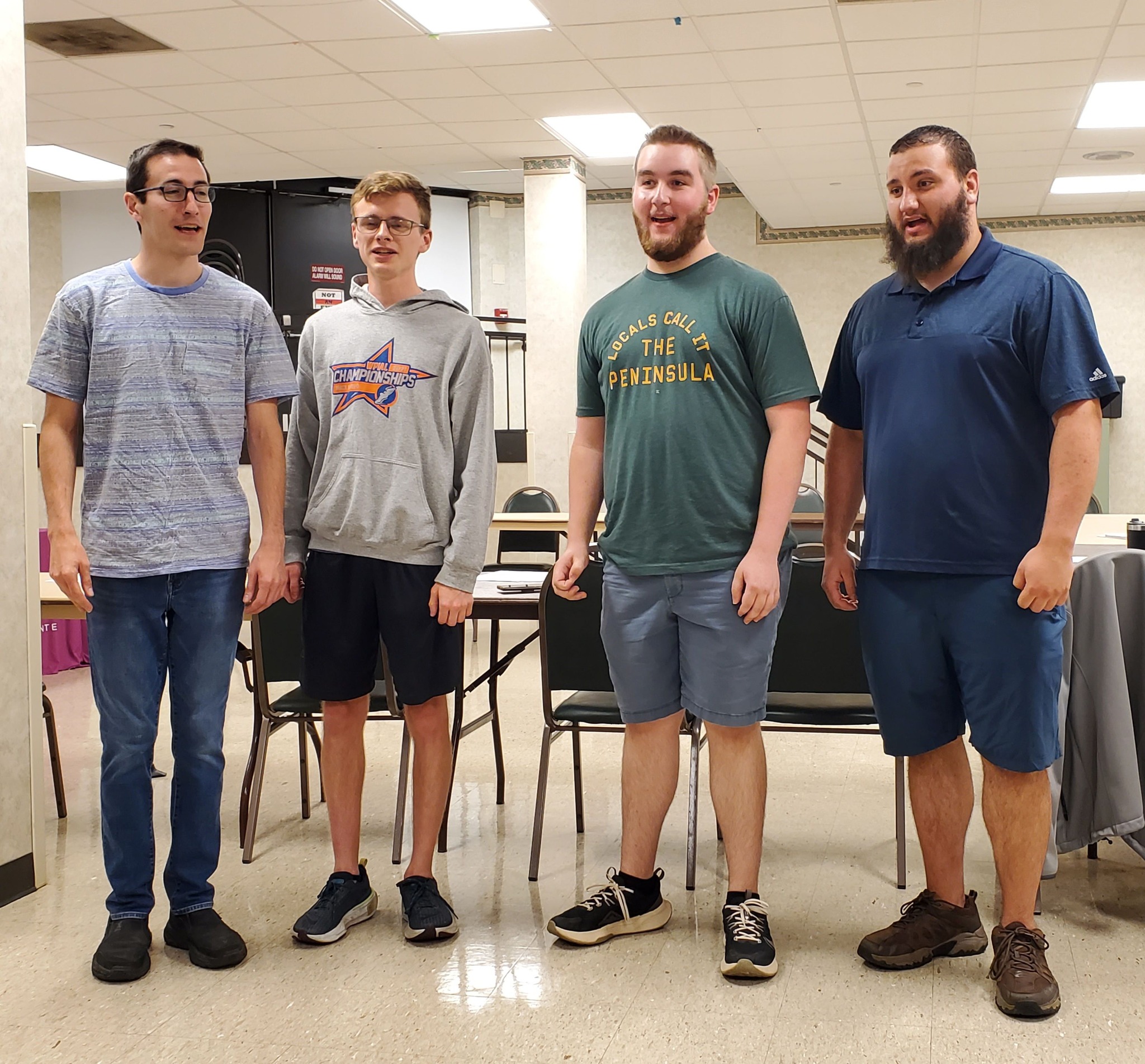
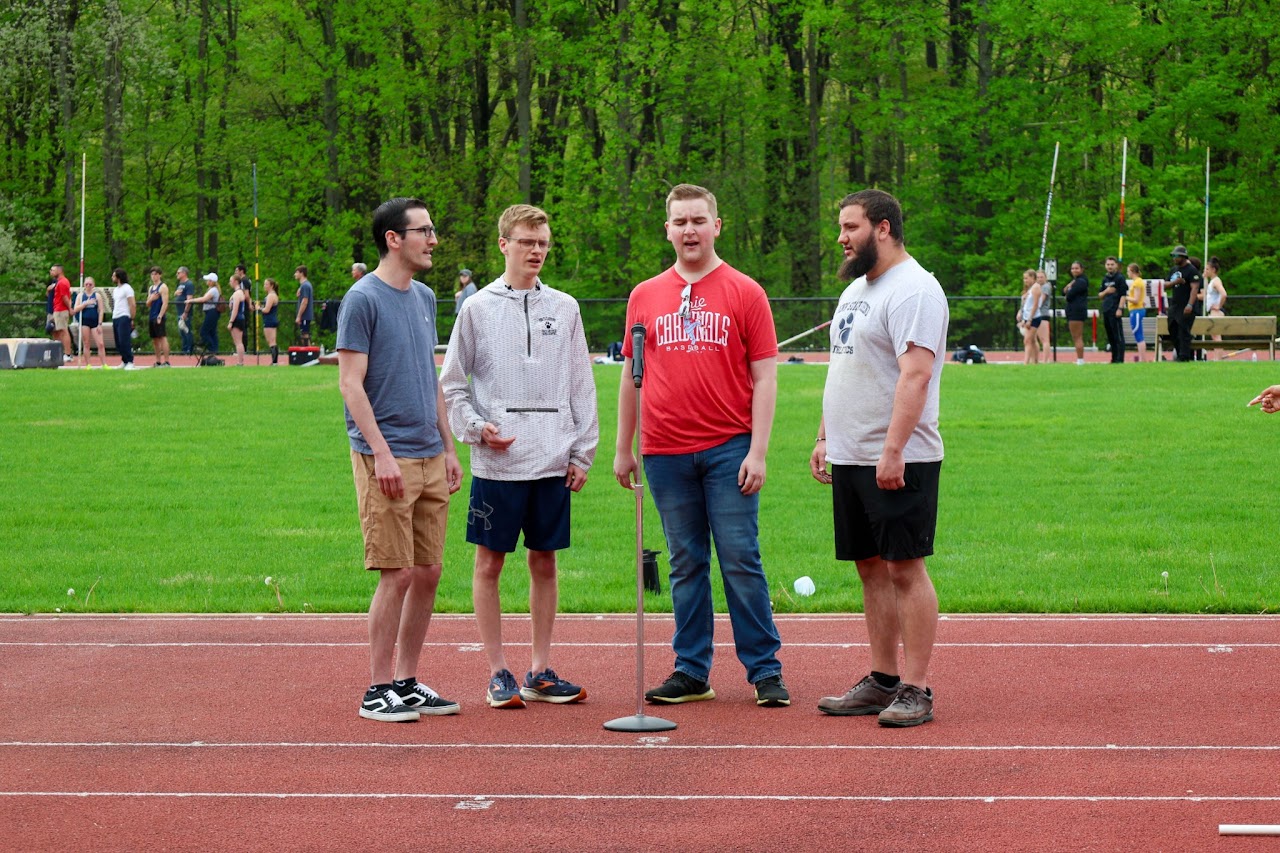
Four Score, a barbershop quartet that includes three Behrend students and one alumnus, perform the National Anthem at a home track meet at Penn State Behrend in spring 2024.

One of the most amazing aspects of college is that a single class can have a profound effect on your life. It might inspire you to change your career plans. It might be the place you meet your best friend or future spouse. It might ignite a lifelong passion or lead you to a place you never expected. 

Max Rohl, a senior Interdisciplinary Science and Business major, never dreamed he would be on stage accepting first place in a barbershop quartet competition in Rochester, New York. He had never even sung in a group until he signed up for Concert Choir class in his first year at Behrend.

“Some of us in the class started a kind of club where we would meet up in Ohio Hall to work on our songs,” Rohl said.

One night, at the end of a choir meet-up, he asked if anyone in the group had any other styles of songs they wanted to work on. Rohl, who had been a fan of the barbershop quartet classic, 76 Trombones, was about to suggest barbershop songs when Wade Williams, now a junior History major, said, “I’ve always wanted to start a Barbershop Quartet.”

“Me, too,” Rohl said.

Wade is a bass singer, Rohl is a baritone, so they needed a tenor and a lead.

They found both in Joey George, a senior Computer Engineering major, who had grown up singing in choirs and at church and could sing both tenor and lead.

The trio looked all over Behrend for a fourth member before Wade did an internet search and found Lake Erie Sound, an established Erie barbershop chorus. He reached out to its leader, John Donohue, who directs the chorus of about two dozen men.

“He probably thought, ‘Why are these college kids bugging me?’ but we talked him into coming to listen and sing with us,” Rohl said.

After that one practice, Donohue, a 2015 Mechanical Engineering alumnus, was in.

“It just sounded so good when we sang together that I knew we had to put our efforts toward getting better and refining our performance,” Donohue said.

The group began practicing a couple of times a week, meeting when Donohue, who is about ten years older and has a job and family, could join them.   

“It was great to meet young people who had been bitten by the ‘barbershop bug,’” Donohue said. “They were eager from the start and soaked up any knowledge I shared with them.”

They chose a name—Four Score Quartet—and performed the National Anthem at a Behrend home track meet in the spring. They hadn’t considered doing much more until Donohue mentioned a nearby competition—the Seneca Land District of Barbershop Harmony Society District Competition in Rochester, New York.

“He said, ‘Hey, there’s this competition in twenty days. Do you guys want to do it?’” Rohl said.

They not only did it; they won it and were named district champions.

“John was not surprised, but we were!” Rohl said.

The group sang four songs, two in preliminaries and two in the finals: “Wait ‘Til the Sun Shines, Nellie,” “A Son of the Sea,” “Sweet and Lovely,” and “That Old Black Magic,” which earned them their highest score of the day. Each song is scored separately, and then song scores are added together to get a final score.

scores

If it sounds easy, Rohl will assure you that it is not.

“It’s actually really difficult to sing barbershop harmony, but I love challenging myself and doing hard things,” Rohl said. “When you have to work hard at something, mastering it is much more rewarding.”

Barbershop singing is different from any other type of choral group singing but it still requires plenty of talent and practice.

 “Although the technique is different than in a classical choir, it’s still very demanding from a musical perspective and can really push an individual both vocally and emotionally,” Donohue said.

Donohue is happy to see younger people interested in barbershop quartet and said that while it is sometimes viewed as an old-fashioned type of singing, that perception is changing.

“In the past ten to fifteen years, quartets have began to adopt more musical theater pieces and songs from pop-culture,” he said.

 Winning the competition solidified the students’ commitment to the quartet.

“We’re all very dedicated to it now, even more so than before,” said Rohl.

Hear the Four Score Quartet for yourself at the group’s YouTube page. 

WHY IS IT CALLED BARBERSHOP QUARTET?

In the late 1800s and early 1900s, every barbershop had its own quartet. The term “barbershop” in reference to harmonizing was first documented in 1910, alongside the release of the song Play That Barbershop Chord.

During this time, barbers were more than just hairdressers; they also pulled teeth and performed minor surgeries. Barbershops gradually became social hubs where locals could gather, play instruments, and sing while waiting for their turn in the chair.

DID YOU KNOW?

Barbershop harmony is believed to be rooted in the Bllack community. According to a post on The Barbershop Harmony Society blog: “Lynn Abbott, a jazz archivist at Tulane University, was an expert on early African-American popular music and gospel quartets. He discovered overwhelming evidence that barbershop quartetting was pervasive in African-American culture in the late 1800s and early 1900s, including among many men who went on to become the pioneers of jazz. Abbott published his findings in a 1992 academic paper that forever changed the way Barbershoppers understand their roots.”

461750648_1101244505337426_3581344516470634633_n
The Four Score Barbershop Quartet includes, from left, John Donohue ’15, and Behrend students, Joey George, Wade Williams, and Max Rohl.

‘Understaffed, underfunded, and under attack’

Alumnus, deputy director of elections in Michigan, to speak at Penn State Behrend Monday

adam fracassi speaker
Adam Fracassi-Wier, deputy director of elections for the state of Michigan.

Adam Fracassi-Wier, deputy director of elections at the Michigan Bureau of Elections, will discuss the state of elections and election security when the Speaker Series returns to Penn State Behrend at 7:30 p.m. Monday, Oct. 21. His talk, “Facing the Storm: Resilience in Elections after 2020,” will be held in the Metzgar Center. The program is free and open to the public.

Fracassi-Wier graduated from Penn State Behrend in 2012 with Bachelor of Arts degrees in Political Science, International Studies, and English. He earned his law degree from Michigan State University College of Law in 2014. His career includes serving as Michigan’s assistant attorney general from 2015 to 2018, as an adjunct professor at Michigan State University College of Law, and currently as deputy director of elections at the Michigan Bureau of Elections.

Behrend Blog talked with Fracassi-Wier to learn more about what it’s like to work in elections and election law in an increasingly partisan environment.

What are your biggest challenges right now?

Election administrators across the country are understaffed, underfunded, and under attack. This is the biggest challenge. We have to manage elections and election administration in a hyper-partisan environment that fuels misinformation, all while ensuring the safety of ourselves, our staff, other election officials, and poll workers. I’ve had to add different facets to my job that I never thought I would have to add. For example, I’m no longer just an attorney – I’ve had to add communications and marketing into my daily responsibilities.

What does it feel like to oversee election integrity when so many are distrustful of our elections today?

This is a heavy burden, especially in this era where misinformation and distrust are rampant.  Being a nonpartisan civil servant who ensures elections are fair is critical, but it brings risks and requires constant communication and transparency. I take very seriously my responsibility to ensure that every eligible citizen can vote while balancing it against the necessary security checks in the system. It’s hard when something you have dedicated your life to is constantly under threat, and things that you have always done because the law requires it, now are the things making you a target.

How do you fight that disinformation and assure voters that Michigan’s elections are secure?

Transparency and communication are vital. We have had a lot of success going to folks directly with messaging. What I’ve seen in the last four years is that many people are interested in the system but don’t understand it. I have allocated and created new resources in the last several years that are focused on providing educational materials and clearly communicating what we’re doing in advance of doing it. Engaging with voters directly and providing them with accurate information is key to building trust.

I’ve also had a lot of success by coordinating with local officials (clerks, township supervisors, etc.) on the messaging. In many instances, voters will trust their local officials.

The key is just to be a constant source of truth. I’ve been able to build trust with both Democrats and Republicans, voters and elected officials, because I’m consistent in what I do, and the decisions I make are not based on politics.

You secured a $40M budget increase to improve election operations in Michigan. What were you focused on improving?

Voters in 2022 passed a constitutional amendment that dramatically changed elections in Michigan. They implemented early in-person voting, mandated that drop boxes be available in all jurisdictions, and required the state to pay for the return of all absent voter ballots. But this required significant funding for us and the local clerks. I was very fortunate to be able to obtain $40 million to fund the constitutional amendment and the subsequent legislation that passed, but it wasn’t enough to fully fund our office and the local clerks’ offices.

Michigan has more than 1,600 township, city, and county clerks who all have different election roles. We are one of, if not the, most decentralized systems in the country for running elections. More than 900 clerks’ offices are single-precinct jurisdictions that likely have only one staff member—themselves.  This is not enough to run elections. When I sought funding, I sought approximately $125 million for our office and the local clerks.  Everyone thought I was crazy for asking for that, but I had the numbers to back me up. I obtained $40 million, and we spent it almost immediately, with more than $30 million being allocated to clerks directly. With this money, we were able to fund thirty-five additional staff members at the Bureau of Elections, more than doubling our staff.

Since 2020, clerks have seen the number of ballots being returned by mail more than double. We went from approximately 25 percent voting by mail to approximately 55 percent. The funding allocation allowed us to buy new equipment for clerks to account for this increase and ease processing. This funding also allowed us to build a new pollbook to be used to better detect and prevent double voting during the early voting period, buy equipment for clerks to administer early voting, and fund poll workers for jurisdictions.

What do you wish people knew about the election and election security?

Trust your election administrators. Almost every single election administrator – regardless of party affiliation – administers the election the same. We all believe in upholding the integrity of the election while ensuring that voters can exercise their most fundamental right of casting a ballot. If you have questions about the process or want to know more, contact your election official. Start that dialogue with them in a respectful manner, and you will find that they will engage and help you to the best of their ability.

It’s also important to know that there are backups for everything.  Michigan uses paper ballots, as do many other states. Even if you don’t have a paper ballot, there are still backup records to do recounts and audits. All of these are done to verify the accuracy of the results.

After 2020, our office conducted more than 250 audits across the state. The Auditor General audited our office, and the Senate Oversight Committee, led by Republican Senator Ed McBroom, examined everything as well. The audits showed that while there are always improvements to be made, the system worked as it should. We have not seen and do not continue to see massive voter fraud like what is suggested by several candidates.

Is there a better way to handle elections in the U.S.?

Our system is very similar to systems across the world. There are positives and negatives with every system, but I think a “better” way is dependent on the eye of the beholder. What you’re seeing in several states are different methods of electing officeholders that are affecting the policies, starting with redistricting.

Several states—Michigan included—have an independent redistricting commission that draws lines in a nonpartisan manner. In Michigan, this has resulted in a more evenly split legislature. Right now, democrats control both chambers, but only by two seats in each house. If either chamber flips, it would likely only be a two-to-four seat majority for either party.  This results in less partisan bills passing in several states.

Additionally, other states have changed from a plurality-based approach to rank choice voting, where voters rank the candidates in order of preference to ensure that whoever wins obtains a majority of support rather than a plurality.  Alaska has a system where everyone runs together in the primary and the top four vote earners advance to the general election, regardless of party, to run in a rank choice election.

Retired faculty members add perspective to Behrend’s 75th anniversary celebration

By Robb Frederick, Associate Director, News & Information

Penn State Behrend

Behrend faculty, 1968-69

The yearlong celebration of Penn State Behrend’s 75th anniversary has been an opportunity to reflect on the growth of the college and the contributions of those who helped make Behrend what it is today.

With help from Rod Troester, associate professor emeritus of speech communication, we have collected stories and life lessons from retired faculty members who remember a very different Behrend. Here are some of their reflections:

“I never looked at my time at Behrend as ‘work.’ I felt comfortable slipping into my office in the evening or on weekends in my slippers, often bringing my dog, Ginger, with me for company.

bob-tauber-emeritus (Copy)

“I took advantage of the swimming pool and the ski slope behind the Otto Behrend Science building. I recall my daughter, Rebecca, then just a youngster, proudly coming over from the swimming pool to my office and informing me that she was able to swim two lengths of the pool. This entitled her to be on the forward deck of our sailboat.

“I loved teaching, and doing so at Behrend. I found it a joy to go to work each day.”

~ Robert Tauber, professor emeritus, education

**************************

“I remember traveling with Dean Baldwin and students to the College English AssociationGreg Morris (copy) conference in Pittsburgh, where we shared an elevator with John Updike. We also went to the Shakespeare Festival in Stratford, Ontario, where we saw Christopher Plummer perform the title role in ‘King Lear”; and to the PEN International conference in Toronto, where I had a conversation about melons with Arthur Miller in an open-air market.

“None of this would have happened without the help of the terrific Behrend community of faculty, staff and students.”

~ Greg Morris, professor emeritus, American literature and English

**************************

“I was hired in 1968. My husband, Ben Scott, taught in the Physics department. He was hired the same year I was and retired in 1988.Mary Chisholm (copy)

“I was a chemist. During my 36-year tenure at Behrend, I saw the college develop from a two-year feeder institution to University Park to a flourishing, four-year campus.

“I retired in 2004. I stay in touch with the chemists, and with a few other faculty members in the School of Science.”

~ Mary Chisholm, professor emerita, chemistry

**************************

“I was hired in 1970. That makes me second-generation Behrend Center faculty, but first-Dan Frankforter (copy)generation Behrend College faculty. I was part of the crowd of newbies hired that year to staff the four-year majors that were to make Behrend a baccalaureate-granting institution.
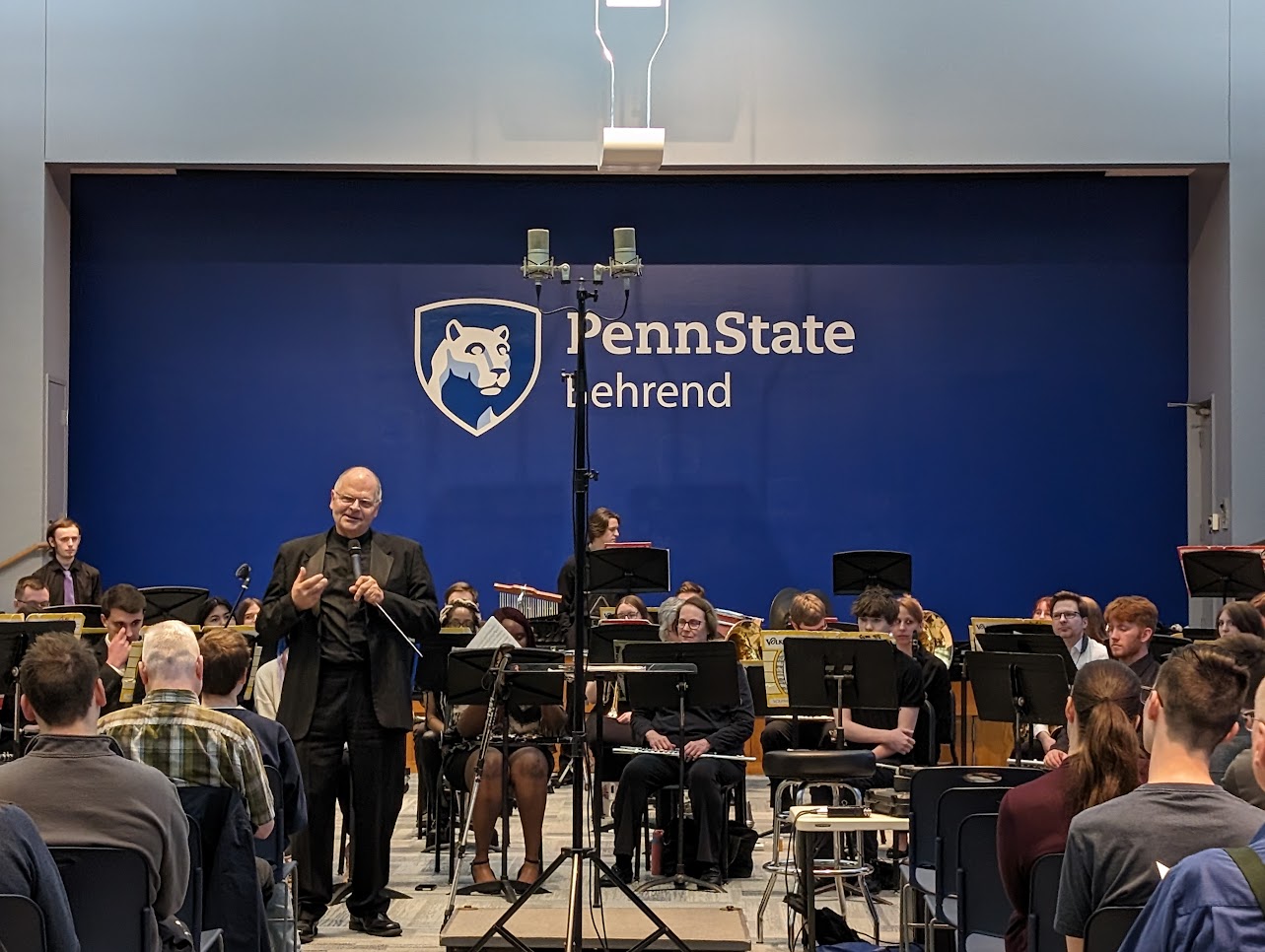
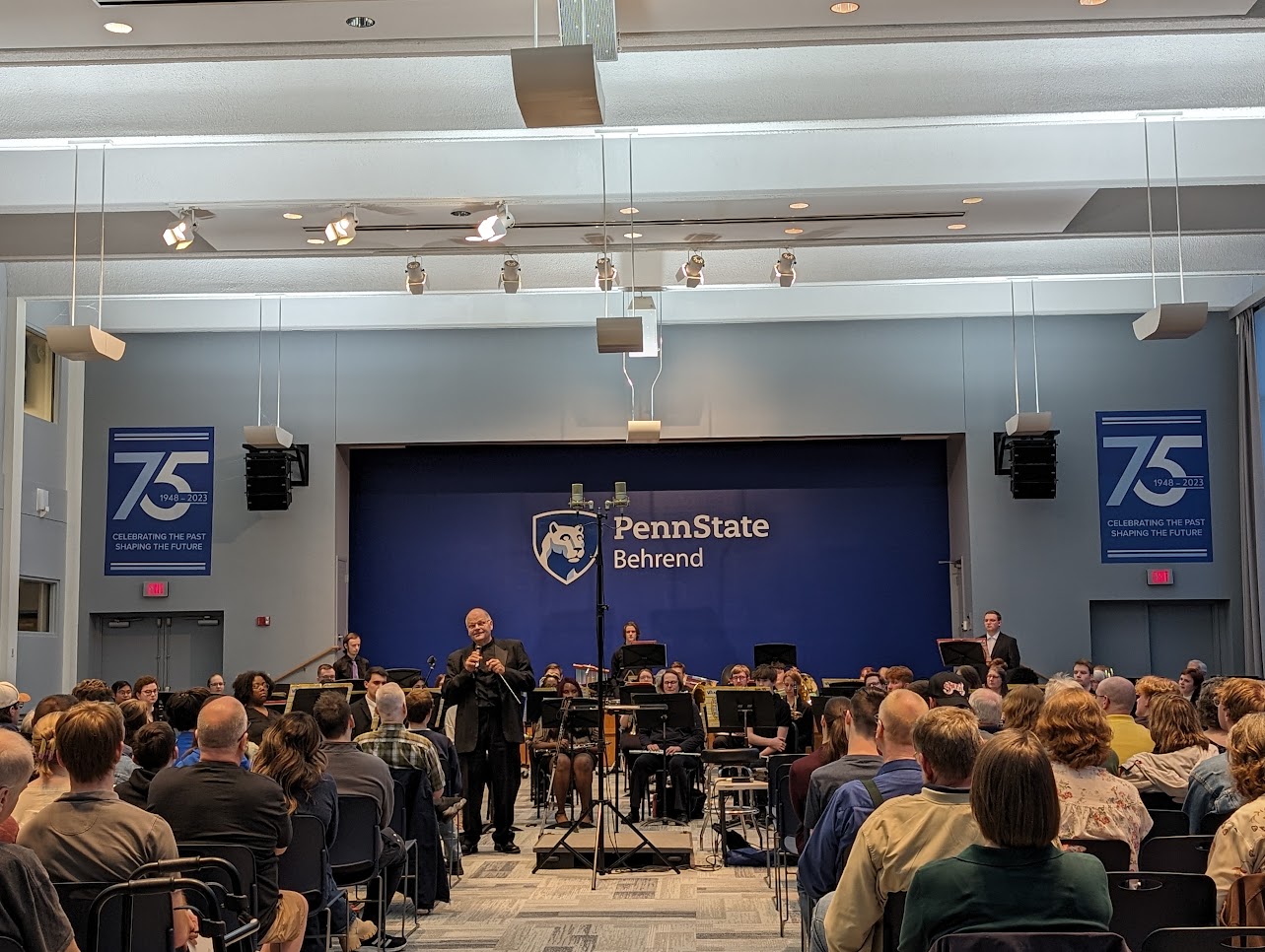
“There was little to work with at the time. Some of us joked that launching the college was like an old Mickey Rooney—Judy Garland movie: ‘Gee, kids, let’s put on a show in the barn.’ But Behrend provided a wonderful and unique opportunity for a career. In an age of academic retrenchment, Behrend bucked the trend and gave us a shot at a much more exciting and fulfilling project. It’s growing success is an achievement well worth celebrating.”

~ Dan Frankforter, professor emeritus, history

The Music Man Takes a Bow: After 25 years, Dr. Gary Viebranz, will retire in June

By Heather Cass, Publications Manager, Penn State Behrend

PXL_20240416_235733498
Dr. Gary Viebranz, professor of music and director of instrumental ensembles, at Penn State Behrend.

Music is as close to time travel as humans can get. Hearing a particular song can transport you to your early childhood dancing in the kitchen with your mom, to your first solo drive after getting your license, to your high school prom, to the day you buried a loved one.

“Music is a visceral thing that can actually cause changes to our body chemistry,” said Dr. Gary Viebranz, professor of music and director of instrumental ensembles, which includes jazz, concert, and pep bands. “It can make us happy or provide an outlet for pain or grief. Some songs are forever burned into our memories. I can remember songs that I played when I was seven years old.”

And, yes, he has been making music since he was a child. Viebranz got his first instrument—a paper-headed drum set—for his fourth birthday. By six years old, he was playing the trumpet.

“It came somewhat naturally to me, and I practiced a lot because I enjoyed it, so work ethic was easy for me to find,” he said.

Fortunately, he had parents who encouraged his musical inclinations as he grew up in Strongsville, Ohio.

He knew early on that he wanted to be a music teacher. For several years after college, he taught music at the high school level in the Cleveland area. A return to graduate school opened his eyes to the possibility of teaching college students.

“Crazy as it can be at times, teaching at the collegiate level is much calmer and more predictable than public high school,” he said.

He joined Behrend in July 1999 and will retire in June, after his twenty-fifth year. We sat down with Viebranz to learn more about music education, his career, and his post-retirement plans.

Can anyone learn to play an instrument?

Yes, but it takes more persistence than some people want to put into it. It’s never too late, though.

How many instruments can you play today, and what is your favorite?

Tuba, baritone, trombone, and bass guitar. Tuba is my first love and my go-to.

Is there an instrument you want to learn in retirement?

There are things I’d like to play around with, like my theremin, which is an electronic instrument that you don’t actually touch, and I’d like to get back to playing bass guitar again.

Not everyone who participates in a band wants to be a musician, so why do you think students make time for it?

The point of music education isn’t to have a career in music. It’s to spawn creative thinking and to make something abstract into something you can hear and feel. Also, it can serve a lot of purposes in a person’s life. It can be a way to escape or grieve or relax or find joy or relieve stress.

What is your most memorable teaching moment?

To be honest, it wasn’t a positive one, but I think it’s worth sharing. In a general education music class, I shared something interesting that was outside the curriculum of the class and said, “That won’t be on the test, though,” and a student asked, “Then why are you wasting our time?” I was shocked by the idea this student had that because something wouldn’t be on the exam, it wasn’t important or worth knowing.

What other changes have you noticed in teaching for twenty-five years?

It’s become harder to find inroads into students’ mindsets, to widen the focus and have them entertain the idea that there is not always a single solution or result, but that there can be many ways to achieve an expected result.

One of your most popular classes was about the Beatles. What did you cover?

We studied everything from pre-Beatles to Beatlemania and on though the group’s breakup. They recorded thirteen commercial albums, which made it easy to set up the course by covering one album each week through the semester.

Music at Noon, which you also directed, is one of the college’s most enduring musical traditions. How did you get involved?

The program had been going on for ten years when I came to Behrend. Several years later, I said I would do it for a year, and here we are. It’s been going strong for thirty-four years. I have been involved for seventeen of them.  And, yes, it will continue after me.

Are there any Music at Noon performances that stick out in your memory?

In their own way, they have all been memorable. You have to live each concert in the moment. One of the unique things about the program is that it draws an all-ages audience, from Erie City elementary school children to college students to older community members.

What would people be surprised to find on your Spotify playlist?

Well, you might be surprised to know that I don’t have Spotify. That said, I have eclectic musical tastes. I’m open to listening to anything, and I don’t worry about labels. Of course, I enjoy the music of my youth, things that were popular in the mid- to late-1980s, the most.

What will you miss most about Behrend?

The people: Many students, staff, and faculty members become like family.

PXL_20240417_000812930
Dr. Gary Viebranz, professor of music and director of instrumental ensembles, conducting his final Concert Band performance at Penn State Behrend in April 2024.

VITAL STATS AND PARTING THOUGHTS

Family: Wife, Mari; Daughters, Sofia, 26, and Elizabeth, 23.

First concert: “My older sister took me to see John Denver at the Blossom Music Center in Cuyahoga Falls, Ohio, when I was young.”

Perfect song: “I don’t know that perfection exists because it’s an arbitrary measure. Perfect presents itself in the moment when the right song comes on at the right time.”

A song he will always sing along with: “’Jar of Hearts’ by Christina Perri. I love to blast it in the car and harmonize along.”

Non-music hobbies: “I love to bike, kayak, and travel.”

Retirement plans: “My wife is still working, and she loves her job, so I’ll be in Erie for the foreseeable future. There are some passions I’d like to revive, like singing, bowling, and fishing.”

PXL_20240417_000904316

Standout Seniors: Meet Hannah Olanrewaju (Mechanical Engineering)

Penn State Behrend’s Class of 2024 is ready to make its mark on the world!  We’re proud of our students and all that they have learned and accomplished here at Behrend. Over the next several weeks, we will introduce you to a few of our remarkable seniors who have engaged in college life in a big way, conducted valuable research, pioneered innovations, and overcome challenges during their time at Penn State Behrend.

Today, we’d like you to meet Hannah Olanrewaju:

Hannah Olanrewaju 5

Major: Mechanical Engineering

Hometown: Erie

Scholarships: D. Schreyer Renaissance Scholarship, Gerald Bayles Memorial Scholarship, Bunton Waller Scholarship, Mead Family Scholarship, Presidential Scholarship, Chancellor Award Scholarship, and Society of Distinguished Alumni Trustee Scholarship.

On choosing Behrend: Penn State has always been a large part of my family: All my immediate family as well as two uncles have chosen Penn State. I always wanted to follow in their footsteps and felt that Behrend was the campus that best fit my needs because of the size, location, and great engineering programs.

On choosing her major: I chose to pursue mechanical engineering because it allows me to combine my academic strengths with my creativity through a broad study of topics and applications. The variety of skills I have learned allow for career flexibility, which gives me the opportunity to better explore my interests.

Her proudest accomplishment at Behrend: During the fall semester of my junior year, my term GPA fell to a 3.02, which is below the Schreyer Honors College requirement of a 3.40. The following semester, I worked diligently and earned a 3.54 for the spring of 2023. During this time, I had to prove to myself that I could overcome my academic obstacles and doing so has been my proudest accomplishment during my time here.

Campus involvement: I was a Lion Scout campus tour guide and a peer mentor for a group of five students in the STEM Leaders Program. I was also a member of the Schreyer Honors College and the Behrend Honors Program.

Awards and recognitions: In my first year, I received the Division of Undergraduate Studies Award.

What makes her unique: I love exploring different styles of music and playing instruments. From elementary to high school, I played the upright bass in the school orchestra. Currently, I enjoy playing the piano and the ukulele.

What you might be surprised to know about her: I can conversationally speak and understand Mandarin. My mom is Taiwanese, and she taught my sister and me the language when we were young.

Advice for first-year students: Get involved! The more you engage with campus life, the more likely you are to make friends, define and then refine your career goals, experience leadership opportunities, and have fun. Also, it really helps to do your homework early enough that you have time to ask the professor questions if you need to. Lastly, it is important to find a balance of school, work, and fun.

Parting thoughts: I would like to thank my mom, sister, stepdad, and friends for supporting me during college. I truly could not have done it without them!

After her graduation in May, Hannah plans to work in her field, and possibly pursue a Master of Business Administration degree.

Standout Seniors: Meet Matthew Enos (Accounting and Finance)

Penn State Behrend’s Class of 2024 is ready to make its mark on the world!  We’re proud of our students and all that they have learned and accomplished here at Behrend. Over the next several weeks, we will introduce you to a few of our remarkable seniors who have engaged in college life in a big way, conducted valuable research, pioneered innovations, and overcome challenges during their time at Penn State Behrend.

Matthew Enos

Today, we’d like you to meet Matthew Enos.

Majors: Accounting and Finance

Hometown: Sharpsville, Pennsylvania

Scholarships: Penn State Provost Award

On choosing Behrend: I came to Behrend because of the opportunity to double major in business. On top of that, it is easy to get active and involved in clubs at Behrend.

On choosing his major: I have always enjoyed the stock market, so I started more toward finance. Accounting works well with finance, and I just really enjoyed dealing with numbers, doing taxes and auditing.

His proudest accomplishment at college: The way Behrend developed who I am. My senior year of high school, I would have been afraid to talk to a crowd of people or to someone I didn’t know. Now, I enjoy giving tours of the campus and talking to professionals in the accounting field. I am not afraid to talk in front of big crowds and share my experience at Behrend.

Bring on game night: I enjoy playing board games with my family and friends.

His definition of living a good life: Being close and able to spend time with my family is important to me. I want to be able to live without stressing about bills. To be able to separate work and personal life and enjoy both.

His priorities for the coming years: Doing well at work, getting promoted, and starting to save money for a house.

Advice for first-year students: Do not be afraid to try new things and get out of your comfort zone.

After his graduation in May, Matthew plans to work at KPMG in Pittsburgh in their audit department.

Political Science student published in Wall Street Journal

By Heather Cass, Publications Manager, Penn State Behrend

Eric O - WSJ contributor
Eric Oelhaf, Penn State Behrend Political Science major.

While at Penn State Behrend, Eric Oelhaf, a senior Political Science major, added something to his resume that few college students can claim: His work has been published in The Wall Street Journal.

In fact, he has had three pieces published in the WSJ’s “Future View” column, in which they invite undergraduate and graduate students to offer their opinion on current topics from Twitter’s rebranding to the future of the NFL to foreign policy to ChatGPT.

Oelhaf’s published essays address the topics of American support for aid to Ukraine; the U.S. border crisis, and why people don’t trust scientists anymore. He is in good company with students from such institutions as Brown University, Harvard University, and West Point Academy.

We talked with Oelhaf, a State College native, to learn more about why he wanted to contribute, how he got published, and what he has gained from the experience.

How did you learn about “Future Views”?  

Dr. Maggie Shum, assistant professor of Political Science, mentioned it in a class that I took with her in the fall semester. Though it’s known to be a conservative publication, The Wall Street Journal said it was trying to provide a diversity of viewpoints in this feature.

Did you immediately contribute?

No. I looked at it as a national writing competition and decided that I was only going to contribute if I had something unique to say. I felt that would improve my odds of being selected. I was surprised that they printed the first one I submitted, which was the piece on the border crisis. The second one was the piece on why people don’t trust scientists.

Then you submitted one about aid for Ukraine?

Yes. That one was a strategic choice. I wanted to dispel myths that are prominent in conservative information spaces about the costs of sending aid to Ukraine. Of course, the reason to support Ukraine is that it’s the right thing to do. Russia has historically tried to eradicate the Ukrainian language and identity from existence since the times of the Russian Empire. And languages are a particularly important part of European political philosophy.

Does the newspaper edit the pieces?

The one on the border crisis is nearly identical to what I submitted, and those are really my thoughts on the matter. There was light editing on the Ukraine piece. But the trustworthiness of scientists’ piece was heavily edited. Looking back on that, I realize that was my fault.

How so?

I had tried to have a more in-depth discussion than what the 250-word-limit would allow, and I didn’t end up making a clear argument in what I originally submitted. The editor then rewrote some of it operating under the assumption that I was trying to critique the behavior of just the authority figures, which I wasn’t. It was a misunderstanding that I know now I could’ve prevented.

What has been the response to your work?

It’s interesting to read through the comments. I’ve learned that people will complain about anything unless your reasoning is airtight or in line with what they believe. I was called an elitist for providing context on the border crisis. Sometimes, readers will even complain that they are listening to college students, despite clicking on a column clearly labeled “Future View.”

What have you learned by reading the feedback?

It seems the current American news consumer is addicted to anger, and the media is more than happy to feed that addiction.

What other topics interest you?

I care most about what is happening in Ukraine and, as a result, I’m concerned about the current state of Congress. I’m also interested in artificial intelligence and the ways in which it’s being handled by our government.

What would people be surprised to know about your generation regarding politics?

My generation seems to care about efficacy to a greater degree than older ones. We want our politicians to be good at what they do. We don’t want them to continually take half measures on humanitarian crises cause by our allies, nor do we want them to spend six months trying to pass a budget.

What do you want to do after college?

I like foreign relations, so I may pursue a career in government in that field. I would certainly take a job in journalism, too, if I had the opportunity.

Oelhaf’s published pieces

Did you know?

Penn State faculty, staff, and students have access to The New York Times and The Wall Street Journal at no cost through the Student News Readership Program. To take advantage of this program, you must register using your Penn State email. Learn more at Penn State’s Student Affairs website.

Standout Seniors: Meet Alexander Jackson (Mechanical Engineering)

Penn State Behrend’s Class of 2024 is ready to make its mark on the world!  We’re proud of our students and all that they have learned and accomplished here at Behrend. Over the next several weeks, we will introduce you to a few of our remarkable seniors who have engaged in college life in a big way, conducted valuable research, pioneered innovations, and overcome challenges during their time at Penn State Behrend.

alexander johnson2

Today, we’d like you to meet Alexander Jackson.

Major: Mechanical Engineering

Hometown: Cochranton, Pennsylvania

Scholarships: Defrees Family Foundation Endowment, STEM Leaders Program Scholarship, Behrend Excellence Award, Commonwealth Campus First Year Award.

On choosing Behrend: While I was job shadowing in high school, I learned that many engineers in northwestern Pennsylvania graduated from Penn State Behrend. As I talked with more people and broadened my connections, I realized that Behrend graduates were all over the world, working for some of the biggest companies. This gave me the confidence to put my trust in Behrend.

On choosing his major: Mechanical Engineering is a broad major that has allowed me to learn about many different industries and find the best career path for me. I also like that mechanical engineers can have an impact on the world through the design, manufacturing, testing, and implementation of new technology and innovations.

Proudest accomplishment at Behrend: I’m proud of the internships and career opportunities I’ve obtained. I’ve met and worked with some incredible people and clients. I’ve also visited major tech companies and talked with engineers who are pushing the limits of engineering. These experiences are rewarding.

Campus involvement: STEM Leaders Program, Behrend Engineering Ambassadors, Men’s Volleyball player, Student Athlete Advisory Committee.

Awards: Evan Pugh Scholar Award, President Sparks Award, National College Athlete Honor Society, Academic All-Conference, Men’s Volleyball Sportsmanship and Leadership Award, Men’s Volleyball MVP.

Highest priority for the coming years: My highest priority is to continue to learn. Learning doesn’t stop when we walk across that stage at graduation. A desire to learn and grow fuels innovation and creativity.

Sports rank high, too: Outside of work and school, I’m very passionate about sports! I’m a huge Pittsburgh fan (Steelers, Penguins, and Pirates), and enjoy playing and watching all kinds of sports. I love to be active.

Advice for first-year students: Surround yourself with a good group of people because the friends you hang out with will have a great influence on you and your goals. But don’t worry if you don’t find this group right away. As you go through school, you’ll meet others who share your interests and match your energy.

Parting thoughts: I’d like to thank all the faculty and staff members at Behrend. They deserve a lot of credit for the contributions and impact they have on generations of students. So I’d like to give a shout out to all the employees who keep Behrend up-and-running every year.

After graduation, Alex plans to work as a design engineer in the Rotary Wing Group at Parker LORD in Erie.