Behrend Barbershop Quartet Wins District Competition

By Heather Cass, Publications Manager, Penn State Behrend
IMG_1549
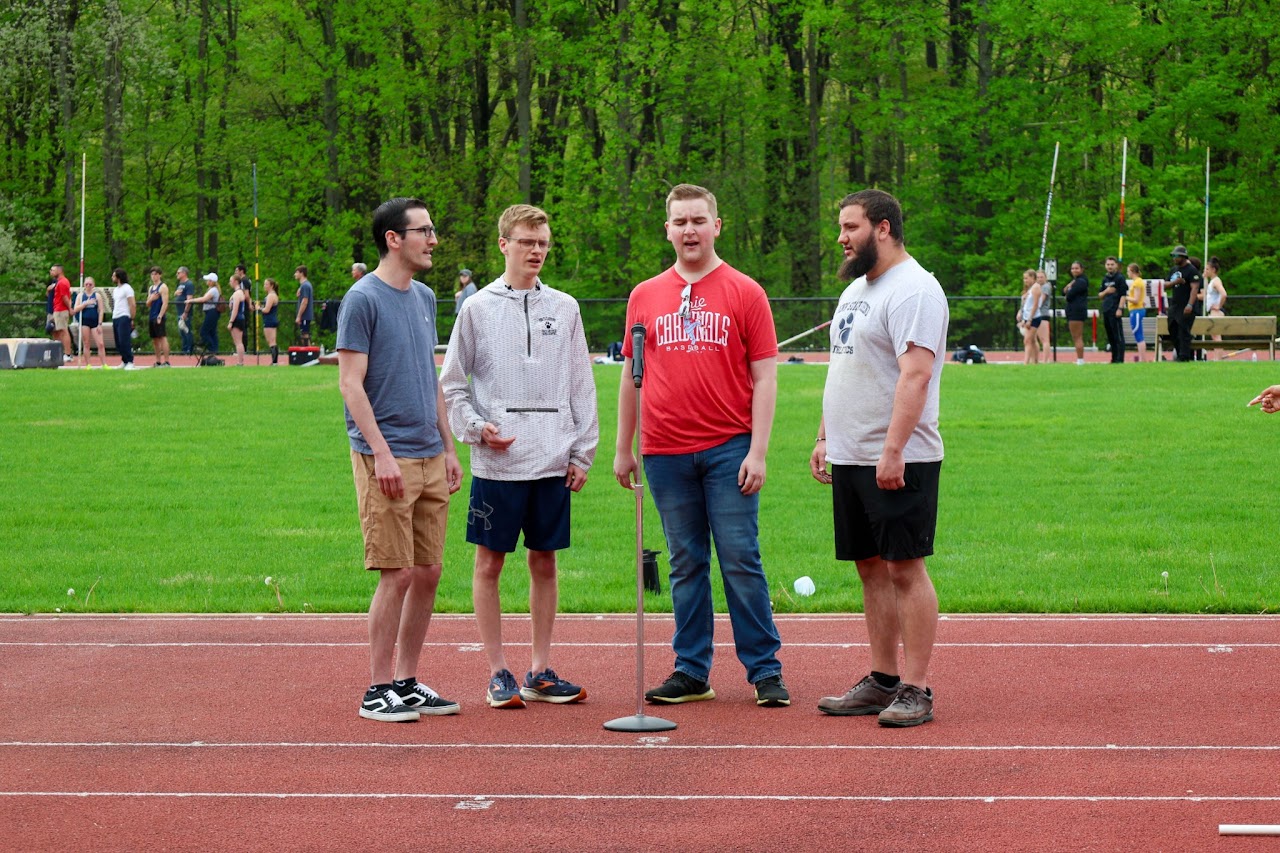
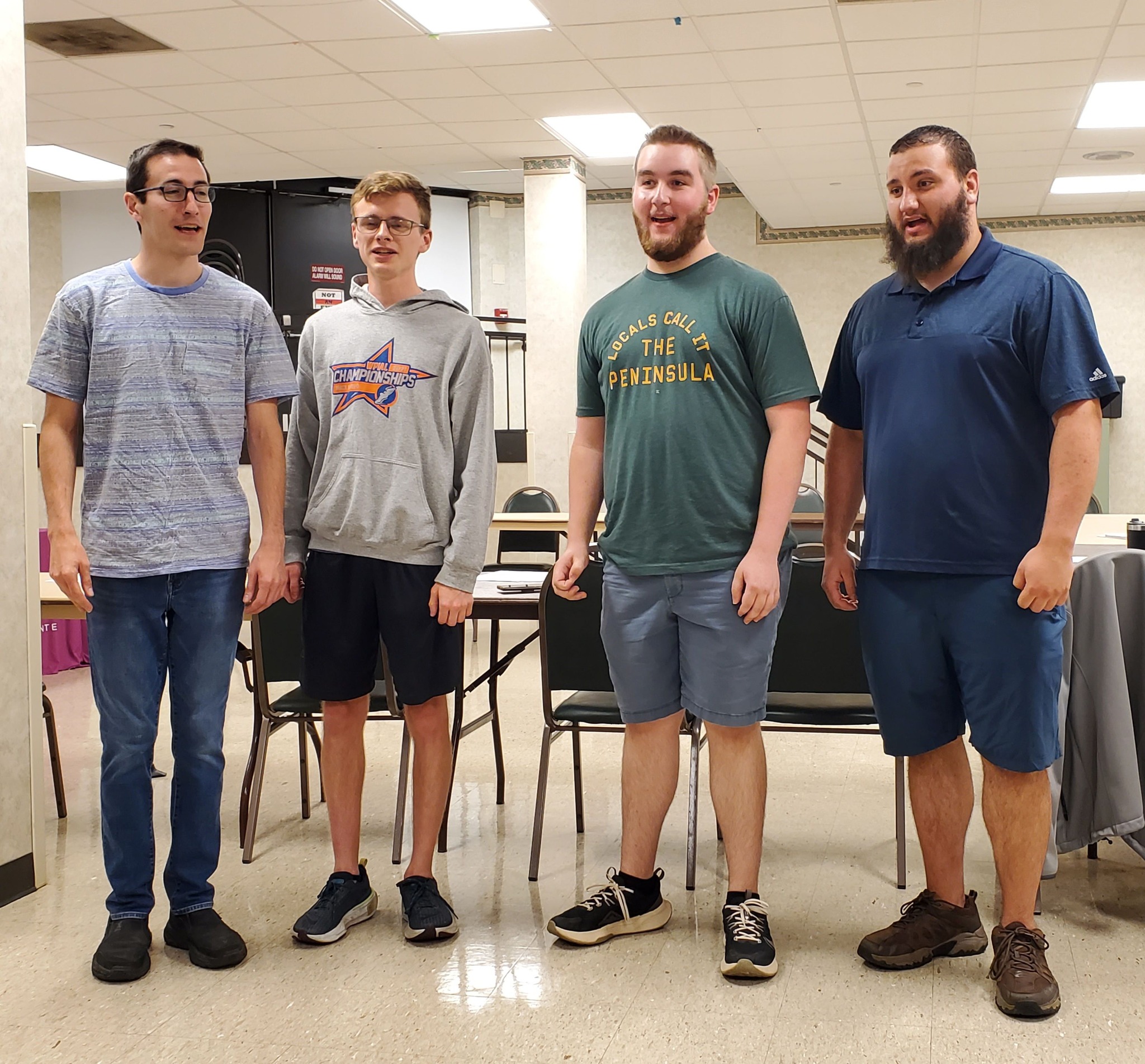
Four Score, a barbershop quartet that includes three Behrend students and one alumnus, perform the National Anthem at a home track meet at Penn State Behrend in spring 2024.

One of the most amazing aspects of college is that a single class can have a profound effect on your life. It might inspire you to change your career plans. It might be the place you meet your best friend or future spouse. It might ignite a lifelong passion or lead you to a place you never expected. 

Max Rohl, a senior Interdisciplinary Science and Business major, never dreamed he would be on stage accepting first place in a barbershop quartet competition in Rochester, New York. He had never even sung in a group until he signed up for Concert Choir class in his first year at Behrend.

“Some of us in the class started a kind of club where we would meet up in Ohio Hall to work on our songs,” Rohl said.

One night, at the end of a choir meet-up, he asked if anyone in the group had any other styles of songs they wanted to work on. Rohl, who had been a fan of the barbershop quartet classic, 76 Trombones, was about to suggest barbershop songs when Wade Williams, now a junior History major, said, “I’ve always wanted to start a Barbershop Quartet.”

“Me, too,” Rohl said.

Wade is a bass singer, Rohl is a baritone, so they needed a tenor and a lead.

They found both in Joey George, a senior Computer Engineering major, who had grown up singing in choirs and at church and could sing both tenor and lead.

The trio looked all over Behrend for a fourth member before Wade did an internet search and found Lake Erie Sound, an established Erie barbershop chorus. He reached out to its leader, John Donohue, who directs the chorus of about two dozen men.

“He probably thought, ‘Why are these college kids bugging me?’ but we talked him into coming to listen and sing with us,” Rohl said.

After that one practice, Donohue, a 2015 Mechanical Engineering alumnus, was in.

“It just sounded so good when we sang together that I knew we had to put our efforts toward getting better and refining our performance,” Donohue said.

The group began practicing a couple of times a week, meeting when Donohue, who is about ten years older and has a job and family, could join them.   

“It was great to meet young people who had been bitten by the ‘barbershop bug,’” Donohue said. “They were eager from the start and soaked up any knowledge I shared with them.”

They chose a name—Four Score Quartet—and performed the National Anthem at a Behrend home track meet in the spring. They hadn’t considered doing much more until Donohue mentioned a nearby competition—the Seneca Land District of Barbershop Harmony Society District Competition in Rochester, New York.

“He said, ‘Hey, there’s this competition in twenty days. Do you guys want to do it?’” Rohl said.

They not only did it; they won it and were named district champions.

“John was not surprised, but we were!” Rohl said.

The group sang four songs, two in preliminaries and two in the finals: “Wait ‘Til the Sun Shines, Nellie,” “A Son of the Sea,” “Sweet and Lovely,” and “That Old Black Magic,” which earned them their highest score of the day. Each song is scored separately, and then song scores are added together to get a final score.

scores

If it sounds easy, Rohl will assure you that it is not.

“It’s actually really difficult to sing barbershop harmony, but I love challenging myself and doing hard things,” Rohl said. “When you have to work hard at something, mastering it is much more rewarding.”

Barbershop singing is different from any other type of choral group singing but it still requires plenty of talent and practice.

 “Although the technique is different than in a classical choir, it’s still very demanding from a musical perspective and can really push an individual both vocally and emotionally,” Donohue said.

Donohue is happy to see younger people interested in barbershop quartet and said that while it is sometimes viewed as an old-fashioned type of singing, that perception is changing.

“In the past ten to fifteen years, quartets have began to adopt more musical theater pieces and songs from pop-culture,” he said.

 Winning the competition solidified the students’ commitment to the quartet.

“We’re all very dedicated to it now, even more so than before,” said Rohl.

Hear the Four Score Quartet for yourself at the group’s YouTube page. 

WHY IS IT CALLED BARBERSHOP QUARTET?

In the late 1800s and early 1900s, every barbershop had its own quartet. The term “barbershop” in reference to harmonizing was first documented in 1910, alongside the release of the song Play That Barbershop Chord.

During this time, barbers were more than just hairdressers; they also pulled teeth and performed minor surgeries. Barbershops gradually became social hubs where locals could gather, play instruments, and sing while waiting for their turn in the chair.

DID YOU KNOW?

Barbershop harmony is believed to be rooted in the Bllack community. According to a post on The Barbershop Harmony Society blog: “Lynn Abbott, a jazz archivist at Tulane University, was an expert on early African-American popular music and gospel quartets. He discovered overwhelming evidence that barbershop quartetting was pervasive in African-American culture in the late 1800s and early 1900s, including among many men who went on to become the pioneers of jazz. Abbott published his findings in a 1992 academic paper that forever changed the way Barbershoppers understand their roots.”
461750648_1101244505337426_3581344516470634633_n
The Four Score Barbershop Quartet includes, from left, John Donohue ’15, and Behrend students, Joey George, Wade Williams, and Max Rohl.

The Music Man Takes a Bow: After 25 years, Dr. Gary Viebranz, will retire in June

By Heather Cass, Publications Manager, Penn State Behrend

PXL_20240416_235733498
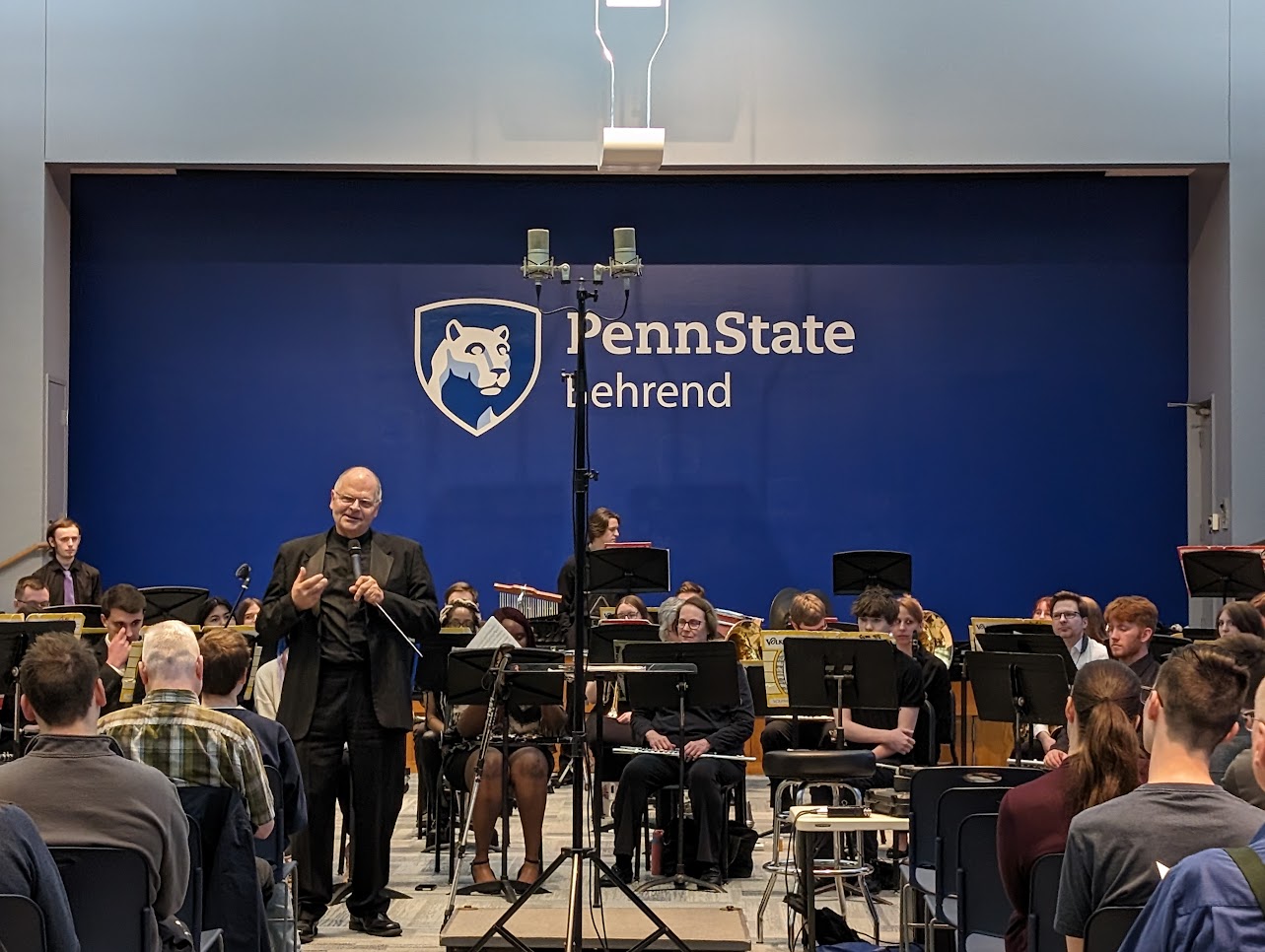
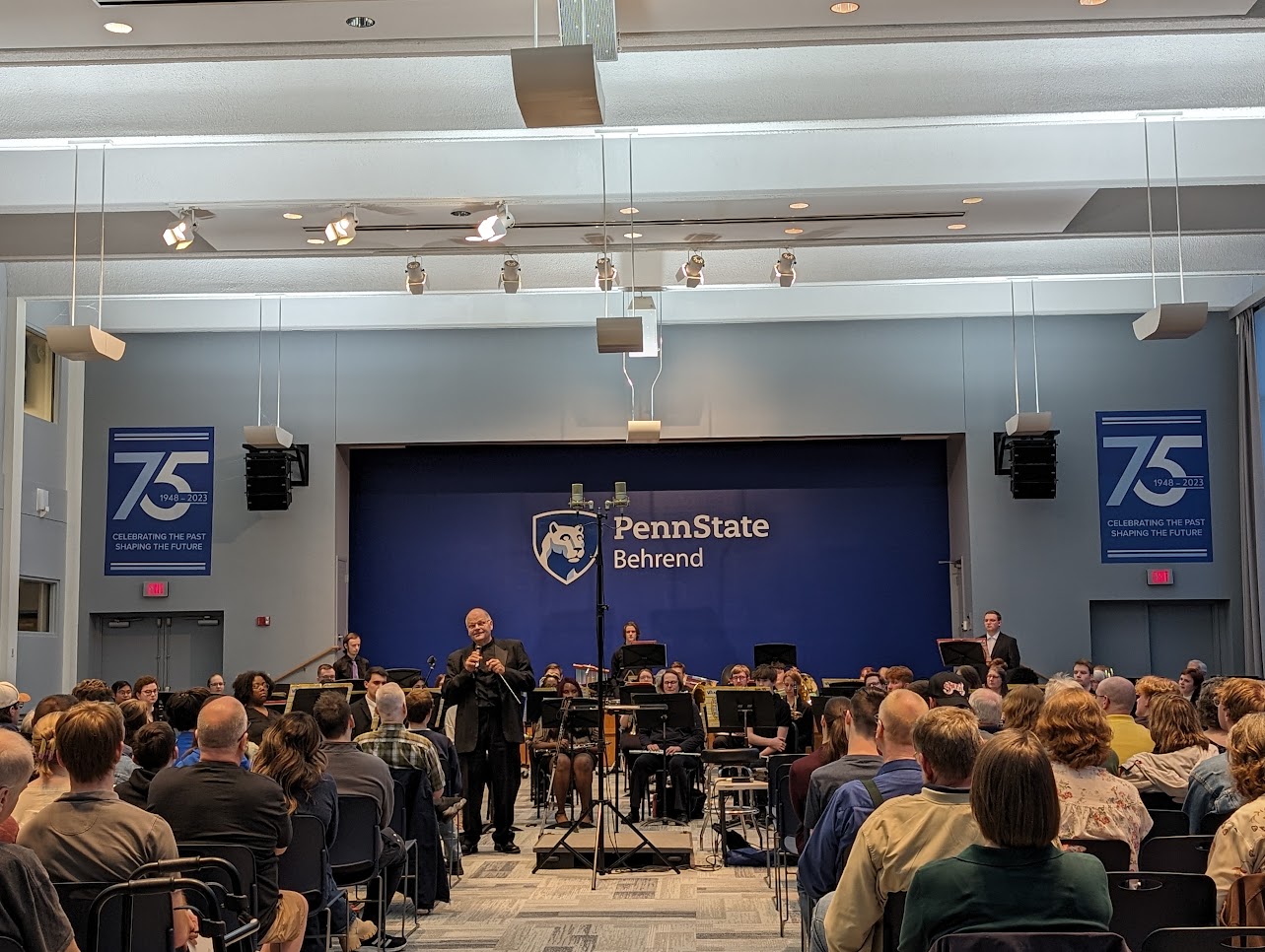
Dr. Gary Viebranz, professor of music and director of instrumental ensembles, at Penn State Behrend.

Music is as close to time travel as humans can get. Hearing a particular song can transport you to your early childhood dancing in the kitchen with your mom, to your first solo drive after getting your license, to your high school prom, to the day you buried a loved one.

“Music is a visceral thing that can actually cause changes to our body chemistry,” said Dr. Gary Viebranz, professor of music and director of instrumental ensembles, which includes jazz, concert, and pep bands. “It can make us happy or provide an outlet for pain or grief. Some songs are forever burned into our memories. I can remember songs that I played when I was seven years old.”

And, yes, he has been making music since he was a child. Viebranz got his first instrument—a paper-headed drum set—for his fourth birthday. By six years old, he was playing the trumpet.

“It came somewhat naturally to me, and I practiced a lot because I enjoyed it, so work ethic was easy for me to find,” he said.

Fortunately, he had parents who encouraged his musical inclinations as he grew up in Strongsville, Ohio.

He knew early on that he wanted to be a music teacher. For several years after college, he taught music at the high school level in the Cleveland area. A return to graduate school opened his eyes to the possibility of teaching college students.

“Crazy as it can be at times, teaching at the collegiate level is much calmer and more predictable than public high school,” he said.

He joined Behrend in July 1999 and will retire in June, after his twenty-fifth year. We sat down with Viebranz to learn more about music education, his career, and his post-retirement plans.

Can anyone learn to play an instrument?

Yes, but it takes more persistence than some people want to put into it. It’s never too late, though.

How many instruments can you play today, and what is your favorite?

Tuba, baritone, trombone, and bass guitar. Tuba is my first love and my go-to.

Is there an instrument you want to learn in retirement?

There are things I’d like to play around with, like my theremin, which is an electronic instrument that you don’t actually touch, and I’d like to get back to playing bass guitar again.

Not everyone who participates in a band wants to be a musician, so why do you think students make time for it?

The point of music education isn’t to have a career in music. It’s to spawn creative thinking and to make something abstract into something you can hear and feel. Also, it can serve a lot of purposes in a person’s life. It can be a way to escape or grieve or relax or find joy or relieve stress.

What is your most memorable teaching moment?

To be honest, it wasn’t a positive one, but I think it’s worth sharing. In a general education music class, I shared something interesting that was outside the curriculum of the class and said, “That won’t be on the test, though,” and a student asked, “Then why are you wasting our time?” I was shocked by the idea this student had that because something wouldn’t be on the exam, it wasn’t important or worth knowing.

What other changes have you noticed in teaching for twenty-five years?

It’s become harder to find inroads into students’ mindsets, to widen the focus and have them entertain the idea that there is not always a single solution or result, but that there can be many ways to achieve an expected result.

One of your most popular classes was about the Beatles. What did you cover?

We studied everything from pre-Beatles to Beatlemania and on though the group’s breakup. They recorded thirteen commercial albums, which made it easy to set up the course by covering one album each week through the semester.

Music at Noon, which you also directed, is one of the college’s most enduring musical traditions. How did you get involved?

The program had been going on for ten years when I came to Behrend. Several years later, I said I would do it for a year, and here we are. It’s been going strong for thirty-four years. I have been involved for seventeen of them.  And, yes, it will continue after me.

Are there any Music at Noon performances that stick out in your memory?

In their own way, they have all been memorable. You have to live each concert in the moment. One of the unique things about the program is that it draws an all-ages audience, from Erie City elementary school children to college students to older community members.

What would people be surprised to find on your Spotify playlist?

Well, you might be surprised to know that I don’t have Spotify. That said, I have eclectic musical tastes. I’m open to listening to anything, and I don’t worry about labels. Of course, I enjoy the music of my youth, things that were popular in the mid- to late-1980s, the most.

What will you miss most about Behrend?

The people: Many students, staff, and faculty members become like family.

PXL_20240417_000812930
Dr. Gary Viebranz, professor of music and director of instrumental ensembles, conducting his final Concert Band performance at Penn State Behrend in April 2024.

VITAL STATS AND PARTING THOUGHTS

Family: Wife, Mari; Daughters, Sofia, 26, and Elizabeth, 23.

First concert: “My older sister took me to see John Denver at the Blossom Music Center in Cuyahoga Falls, Ohio, when I was young.”

Perfect song: “I don’t know that perfection exists because it’s an arbitrary measure. Perfect presents itself in the moment when the right song comes on at the right time.”

A song he will always sing along with: “’Jar of Hearts’ by Christina Perri. I love to blast it in the car and harmonize along.”

Non-music hobbies: “I love to bike, kayak, and travel.”

Retirement plans: “My wife is still working, and she loves her job, so I’ll be in Erie for the foreseeable future. There are some passions I’d like to revive, like singing, bowling, and fishing.”

PXL_20240417_000904316

Standout Seniors: Meet Matthew Enos (Accounting and Finance)

Penn State Behrend’s Class of 2024 is ready to make its mark on the world!  We’re proud of our students and all that they have learned and accomplished here at Behrend. Over the next several weeks, we will introduce you to a few of our remarkable seniors who have engaged in college life in a big way, conducted valuable research, pioneered innovations, and overcome challenges during their time at Penn State Behrend.

Matthew Enos

Today, we’d like you to meet Matthew Enos.

Majors: Accounting and Finance

Hometown: Sharpsville, Pennsylvania

Scholarships: Penn State Provost Award

On choosing Behrend: I came to Behrend because of the opportunity to double major in business. On top of that, it is easy to get active and involved in clubs at Behrend.

On choosing his major: I have always enjoyed the stock market, so I started more toward finance. Accounting works well with finance, and I just really enjoyed dealing with numbers, doing taxes and auditing.

His proudest accomplishment at college: The way Behrend developed who I am. My senior year of high school, I would have been afraid to talk to a crowd of people or to someone I didn’t know. Now, I enjoy giving tours of the campus and talking to professionals in the accounting field. I am not afraid to talk in front of big crowds and share my experience at Behrend.

Bring on game night: I enjoy playing board games with my family and friends.

His definition of living a good life: Being close and able to spend time with my family is important to me. I want to be able to live without stressing about bills. To be able to separate work and personal life and enjoy both.

His priorities for the coming years: Doing well at work, getting promoted, and starting to save money for a house.

Advice for first-year students: Do not be afraid to try new things and get out of your comfort zone.

After his graduation in May, Matthew plans to work at KPMG in Pittsburgh in their audit department.

Wednesdays at Bruno’s Café have never been so fun thanks to Hump Day

DSC_1160
DJs from BVZ Radio entertain the Behrend community through their weekly Hump Day broadcasts. Students (left to right) Anna Waterson, Zach California, Rayna Ganabathi, Monique Lebrun, Ethan Buckley, and Joseph Rock are some of the DJs who broadcast.

By Steve Orbanek
Marketing Communications Specialist, Penn State Behrend

In need of a midweek pick-me-up? BVZ Radio has just the thing for you.

Every Wednesday, from 11:00 a.m. to 1:00 p.m., DJs from Penn State Behrend’s student-run radio station broadcast from the stage in Bruno’s Café. They take requests during the broadcasts, which have been appropriately named “Hump Day” in honor of the day they fall on.

“This all started back on College Radio Day on October 1, 2013,” says Monique Lebrun, a junior Communication major and marketing and promotions director at BVZ Radio. “We wanted to do something to get the students to notice us.”

The first broadcast proved to be a success; by the final hour, students were requesting songs via text message and Twitter.

Housing and Food Services was pleased with the response as well. They invited BVZ Radio back to do weekly broadcasts, and Wednesdays are now one of the busiest days at Bruno’s each week.

It’s also helped with recruiting for the station.

“It’s built brand awareness,” Lebrun says. “We now have students asking us how they can get involved, which then pushes them to take the class (COMM 003: Radio Practicum).”

With finals week right around the corner, Hump Day has now ended for the semester, but it will be back again next year. There are even talks of expanding the live broadcasts to other days as well.

“We hope that BVZ Radio continues to expand. That’s what will ultimately get more students involved,” Lebrun says.

To send in a Hump Day request, tweet BVZ Radio at @BVZradio. To learn more about the station, visit their website.

Behrend Beatlemania (Faculty and Staff share their favorites from the Fab Four)

beatles-1964

By Heather Cass
Publications & Design Coordinator, Penn State Behrend

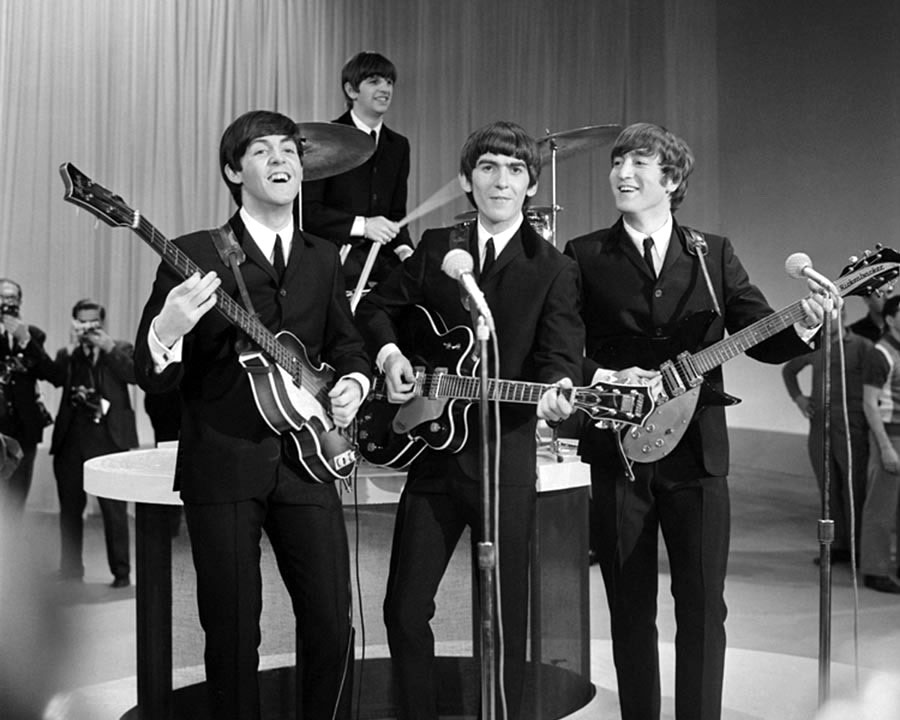
In honor of the 50th anniversary of the Beatles’ appearance on the Ed Sullivan Show this Sunday, February 9, we thought it would be fun to ask faculty and staff members to tell us which Beatles tune is their favorite.  Seems we’ve got a lot of Fab Four fans on campus.  Here are their top choices:

“I’m torn between ‘Here Comes the Sun’ and ‘In My Life.’” — Dr. Gabrielle Dietrich, lecturer in music/director of choral ensembles/artistic director of YPC of Erie (fit all that on a business card!)

“’Blackbird,’ hands-down! Hope springs eternal.” — Kelly Shrout, associate director of student affairs

“I have always loved the Beatles. It is hard to pick just one song as my favorite but if forced to I would have to say ‘All You Need is Love.’ I think the meaning behind the song held true in ’67 and is just as applicable today. It also happens to be the song my husband and I walked down the aisle to for the recessional after we took our vows.  I’m also very partial to ‘Blackbird,’ ‘Across the Universe,’ and ‘I am the Walrus.’ — Dr. Heather Lum, research associate in psychology

In My Life.” — Chris Fox, assistant director, clubs and organizations

“My favorite Beatles song is ‘Eleanor Rigby.’  I have always loved the lyrics line by line.  However, if you piece them together the song can be depressing.  I also love the intensity of the strings.  Fun Fact: The Beatles don’t play any instruments on this song, as it is all strings.” — Mike Rutter, associate professor of statistics

“My favorites are ‘Yesterday’ and ‘Hey Jude.’ — Dr. Bruce Wittmershaus, associate professor of physics

“’Revolution.’ It’s an awesome message overall.  Anytime a friends is feeling down, I’ll sing to the line, ‘Don’t you know it’s gonna be all right?’ — Kristen Comstock, assistant director of alumni relations

“’Let it Be.’ It reminds me of good times in high school.” — Dr. Robert Light, senior associate dean for research, and outreach & COO

‘I Will’ is my favorite.  It was our house lullaby for both of my sons.” — Mary Beth McCarthy, director, academic and career planning center.

“My favorite is ‘Let it Be.’ Why? It’s moving and offers timeless wisdom for navigating the complexities of life.” — Dr. Ralph Ford, director school of engineering, professor of electrical and computer engineering and associate dean for industry and external relations

“If I had to choose, it would be between two songs:  ‘Let it Be,’ and the combination ‘Golden Slumbers/Carry That Weight/The End.’  Both songs resonate with me in their musical quality and their ability to make me introspective.  I feel like I’m in a better state after listening to their music.” — Dr. Robert Weissbach, associate professor of engineering

“My favorite is ‘Norwegian Wood (This Bird Has Flow),’ for no particular reason other than I like the way it sounds.” — Kris Motta Torok, director of student activities and Reed Union Building.

“’Here, There and Everywhere’ gets my vote!” — Dr. Sharon Dale, associate professor of art history

“My favorite Beatles song is ‘Let it Be.’  It reminds me of the value of being a support to those in need so they have less to worry about. Also, it reminds me to be grateful for all my blessings. — Dr. Kathleen Noce, senior lecturer in management information systems

“’Come Together.’ Very strange tune, but it sticks in the head.” — Dr. Al Warner, associate professor of management

‘All my Lovin’’ and ‘Michelle.’ Why do I love ‘em? Memories of a time gone by!” — Dr. Carl Kallgren, director of CORE and associate professor of psychology

“I’m not a huge Beatles fan, but I’d have to say that my favorite tune of theirs is the ‘Golden Slumbers/Carry that Weight/TheEnd’ medley.” — Dr. Joseph Beilein, assistant professor of history

‘Paperback Writer.’ It has one of the best guitar riffs of all-time.” — David Vegh, lecturer in theatre

“I think their songs are so timeless.  As for my favorite, it depends on my mood and activity.  When I’m feeling nostalgic, ‘In My Life’ and ‘Penny Lane’ are excellent choices.  For an impromptu sing-a-long, you can’t get much better than ‘Hey Jude,’ which is why it has been covered so many times.  I also really enjoy ‘Across the Universe.’” — Ian McGinnity, assistant director, civic engagement and The Smith Chapel

Your turn …

What’s your favorite Beatles tune? Post a comment below.