Still have some holiday shopping to do? Behrend faculty and staff members have you covered

By Steve Orbanek
Marketing Communications Specialist, Penn State Behrend

The mad dash is almost here. It’s time to get those final holiday gifts before it’s too late.

Still scrambling for ideas? Don’t worry, Penn State Behrend’s faculty and staff members have you covered. Here are some of their top suggestions for gifts that are both fun and educational.

jewelbots_kickstarter

Ideas provided by Melanie Ford, director of Youth Education Outreach

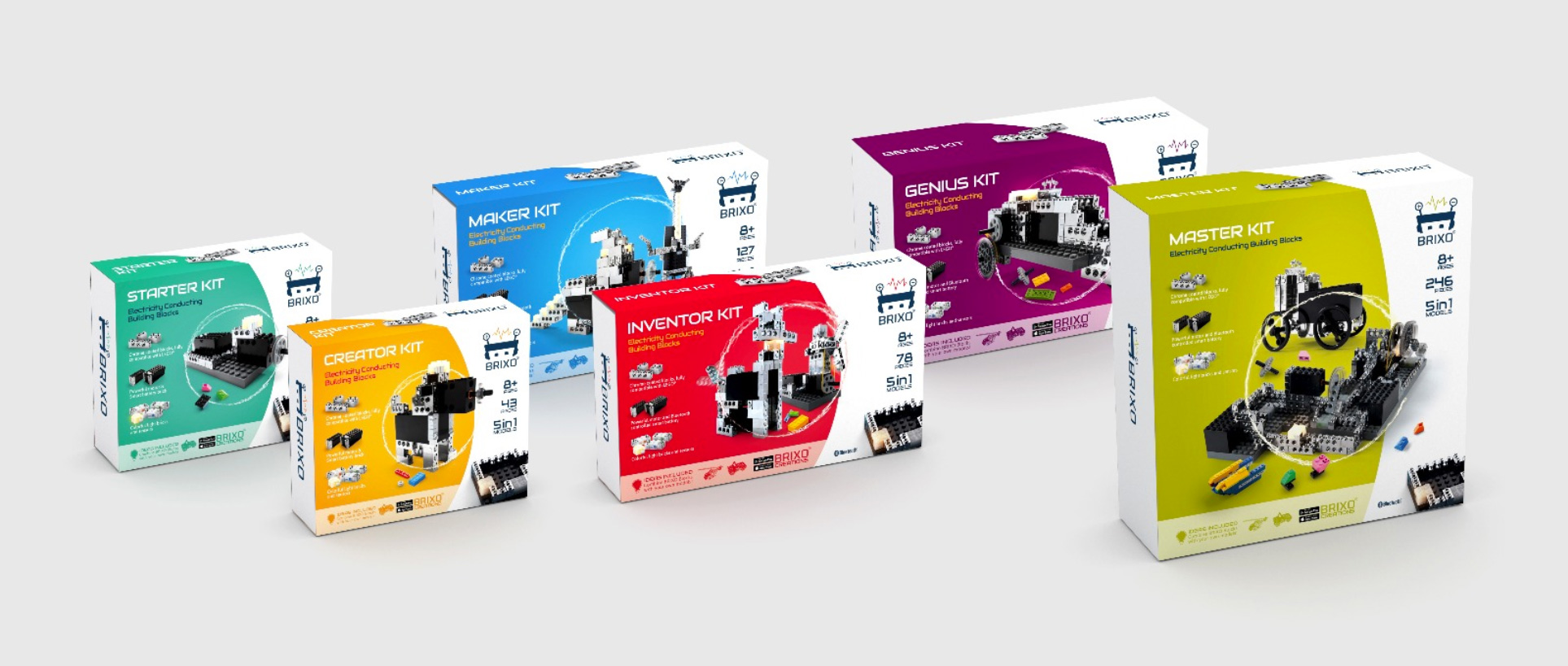
Jewelbots. Look pretty while you learn about programming? That’s exactly what girls can accomplish with Jewelbots, the friendship bracelet that teaches kids to code. $69

Robot Turtles. Designed for children ages four and up, this interactive board game helps teach young people how to program. $15

Pokemon. Unless you’ve been living under a rock, you know that Pokemon are once again hotter than ever.  Whether it’s the cards or the video games, there are plenty of ways to “catch ‘em all” this holiday season. Prices vary

Ideas provided by Tracy Halmi, senior lecturer in chemistry

Molecules: The Elements and the Architecture of Everything. Quite literally, molecules make up everything. How exactly does one visualize that, though? Theodore Gray does that for you in this book, which features stunning photography of the chemical structures that make up every material in the world. $20

Instant Snow. Even as one of America’s snowiest cities, the white stuff has been mostly absent from the region so far. We cannot make snow fall from the sky, but this gift allows a person to actually make snow (and learn about chemistry while he or she is at it.) $18

Minecraft Cookie Cutters. Every child seems to love Minecraft. Every child definitely loves cookies. This is a no-brainer. $10

Ideas provided by Dr. Richard Zhao, assistant professor of computer science and software engineering

Merge VR Goggles. 2016 is the year that virtual reality headsets hit the mainstream. The Merge VR Googles turn a person’s smartphone into a virtual reality headset. You’re then able to enjoy fully-immersive virtual environments and games right from the comfort of your living room. $60

Google Cardboard. While Google Cardboard might not look as cool as the Merge Goggles, it offers a similar experience and at a great price. $15

Idea provided by Tom Noyes, professor of English and creative writing

“Best American” book series. For bibliophiles on your list, you might check out the annual “Best American” series. Each year, 2016 included, editors compile the best examples of writing from magazines around the country. The three standards, “Best American Short Stories,” “Best American Poetry,” and “Best American Essays” are great, as are some of the other volumes, including “Best American Mystery Stories,” “Best American Sports Writing,” “Best American Science and Nature Writing,” and “Best American Science Fiction and Fantasy.” $10-$15

Idea provided by Mary-Ellen Madigan, director of enrollment management

Tile Mate. Is there someone on your list who is notorious for losing his or her keys? They won’t be anymore. This Bluetooth tracking device is small, durable and water resistant, and it can easily be attached to keys, luggage, backpacks, or anything else you carry. $25

Trip to Japan becomes ‘defining memory’ for Behrend students

dsc_0117
Fifteen Penn State Behrend students visited Japan this summer as part of the PSYCH 232 Cross-Cultural Psychology and PSYCH 499 Foreign Studies in Psychology embedded courses. While there, they attended the International Congress of Psychology (ICP 2016), a premiere psychology conference held once every four years.

By Steve Orbanek
Marketing Communications Specialist, Penn State Behrend

Grace Waldfogle expected Aug. 6 to be a somber day. Not only was it the last day of her trip to Japan as part of a Penn State Behrend embedded course, but it also marked the 71st anniversary of the Hiroshima bombing.

It turned out to be the opposite.

Fireworks engulfed the sky. The sadness she had expected was not present. Rather, there was a tone of optimism.

“We asked people about it, and they said, ‘It’s not something we dwell on,’” said Waldfogle, a senior psychology major. “It was just so different from how we approach that type of thing here in the United States.”

Cultural differences like this were one of the biggest takeaways for Waldfogle and the 14 other students who visited Japan for 18 days in July and August. The students visited the country as part of the PSYCH 232 Cross-Cultural Psychology and PSYCH 499 Foreign Studies in Psychology embedded courses, which were taught by faculty members Dawn Blasko, associate professor of psychology; Heather Lum, assistant professor of experimental psychology; and Victoria Kazmerski, associate professor of psychology.

Their trip began with a visit to Yokohama to attend the International Congress of Psychology (ICP 2016), a premiere psychology conference held once every four years. Several of the students presented research poster presentations during the five-day conference.

ICP 2016 also offered networking opportunities for the students, who heard from a number of prominent speakers, including famed animal rights activist Jane Goodall.

“The whole conference itself was a total blast,” said Emily Galeza, a senior Psychology major who presented research on the effectiveness of a dog therapy program with students with autism. “The size of (the conference) was just incredible, and we had the freedom to go to any session we liked.”

Stephen Dartnell, a general business student who will graduate in December, agreed.

“I got to interact with people from all over the world,” Dartnell said. “It was kind of the icing on the cake on my educational experience, and I definitely would love to attend a psychology conference like this again.”

Beyond the conference, the students also spent time in Kamakura and visited several temples across the country. To help prepare for the cultural changes, students met with MBA student Yuki Takahashi, a native of Japan, for language and culture lessons prior to the trip.

Even with the advance lessons, the language barrier was a challenge. However, the students were impressed at how easily it could be overcome with some patience (and Google Translate, of course).

“Everyone was just so friendly and willing to help,” Dartnell said. “There was one instance where I needed a trash bag for my camera because it was raining. I just kind of explained it, and a woman at the hotel helped me. You just constantly saw language barriers being broken down.”

The numerous public art displays and eastern-style architecture were also a point of culture shock for students.

Perhaps the most significant cultural difference for students, however, was the food.

“I thought I liked fish, but then I got there, and I realized I did not. They’d give you the entire fish, and you’d have to just use chopsticks,” Waldfogle said. “Every meal was a workout.”

Not all of the food differences were negative, though.

“They had so many different items that they called ‘sweets.’ They were really, really good,” Dartnell said.

From attending the conference to visiting temples across the country, the trip provided students with a once-in-a-lifetime cultural experience. It might have only been an 18-day visit, but the memories will last.

“This will be one of my defining memories of Behrend,” Galeza said. “I could never have planned all of these activities by myself.”

This slideshow requires JavaScript.

‘I feel so much more comfortable now.’ — Summer Bridge program prepares incoming students

Summer Bridge (Brent Sutula, Sujata Chhetri, Joseph Lombardi, Sydnie Moore) cropped
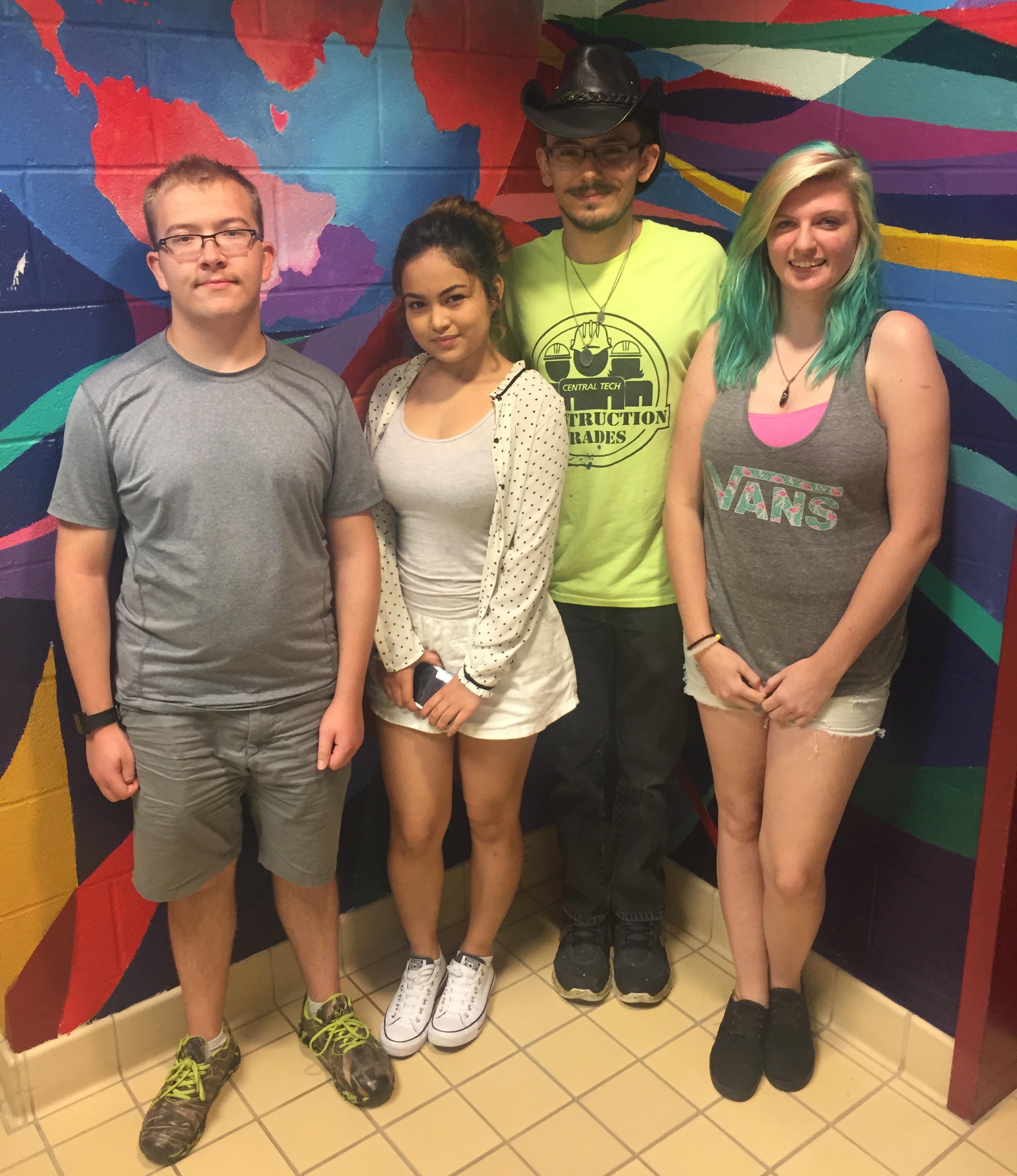
Brent Sutula, Sujata Chhetri, Joseph Lombardi, and Sydnie Moore, pictured left to right, were four of the participants in the Summer Bridge Program at Penn State Behrend. The six-week program is designed for students who want to sharpen their study, note taking, critical reading and time management skills, among others.

By Steve Orbanek
Marketing Communications Specialist, Penn State Behrend

Penn State Behrend welcomed 1,280 new first-year students to campus last week.

For 28 of them, the setting felt more than a little familiar, since they had only recently completed a Summer Bridge Program to ease the transition to college.

The six-week program is designed for students who want to sharpen their study, notetaking, critical reading and time management skills, among others.

“I feel so much more comfortable now. This has just been great to meet new people and learn how to get around campus,” said Joseph Lombardo, a first-year History major from Erie.

The program even included a scavenger hunt in which students learned how to navigate campus by finding places and objects. They also spent time learning about the college’s numerous resources such as the Academic and Career Planning Center and Lilley Library.

“Transition is key. There is such a disconnect from what students did in high school to what they will do here,” said Mary Connerty, a lecturer in English who taught the program.

The program was sponsored by the college’s Office of Student Success and Retention. Half of the program’s attendees were immigrants or refugees.

“We’re obligated to help prepare these students who may need the extra help to succeed,” Connerty said.

To get students accustomed to a college workload, participants in the program received weekly homework assignments, including regular critical readings and a requirement to write multiple-page papers. Connerty estimates that each week’s assignments took students a minimum of three to four hours to complete.

That type of workload can be daunting for any first-year student, but it was also helpful for these students to become aware of college expectations.

Sujata Chhetri, a first-year International Business major, estimated that on a scale of 1-10, her nervousness about college was a 9. She says that after completing the Summer Bridge Program, that number was down to a manageable 5.

“It was a great program,” said Chhetri, a Nepal native who immigrated to Erie. “It really taught me about the workload I’ll be getting. It was somewhat overwhelming, but it also taught me about all of the resources I have that I didn’t know that I have. I don’t feel lost anymore.”

If she or any of the other attendees do happen to feel lost, the good news is that they now know where to go.

“There’s always someone you can go to talk to,” Chhetri said. “I’ve already found so many people who are going to help me with my math.”

Twenty-four hours. Three cities. One community.

Arthur 1

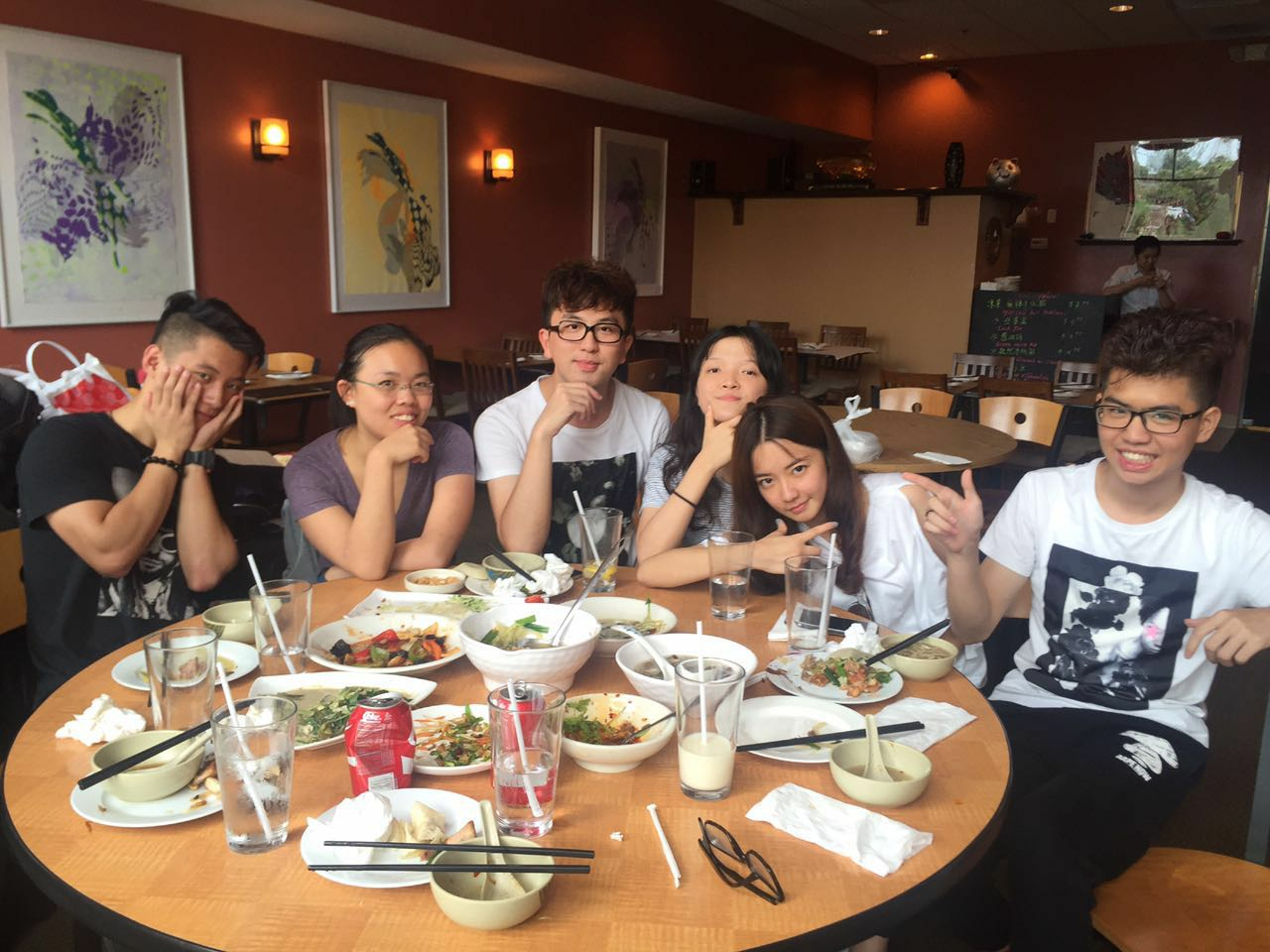
Editor’s Note: The following is a first-person account from Arthur Wang, a senior English major from Kunming, China, pictured in the center of the image above. International travel rarely goes as planned, and Arthur and several other international students learned that firsthand just two weeks ago. This was many of the students’ first time in the United States, and concern started to settle in as to whether they would make it to Erie. However, they banded together and found a way. Arthur shares their story below.

By Arthur Wang
Senior English Major, Penn State Behrend

My heart began to sink when I received an email from the airline company announcing that my flight from Chicago to Erie had been canceled due to mysterious “air traffic control conditions.” After a 14-hour international flight, I was hoping to spend the very last teaspoon of my energy on another two-hour domestic flight back to Erie, with my sophomore Italian friend Wen, move into my reserved hotel room, enjoy a hot bath, and go to sleep. Of course, things that involve international-domestic flights never go easy.

Wen had been at O’Hare International Airport waiting for my arrival; she met Lang (Mike) Mai, Runzhong (Terk) Tan, and Suiya Zhou, three freshman Chinese fellows whose flight to Erie was also canceled. A natural-born leader with phenomenal problem-solving skills and a generous heart for helping others in need, Wen already explored all possible solutions, sought assistance from the airport staff, and messaged me with some new “workable” ideas. When I landed in Chicago with Kerun (Elodie) Chen, another Chinese girl who had suffered the same flight cancelation, I was thrilled to discover that Wen had prepared two plans.

Plan 1: Cancel our flight and request a reasonable refund; take an overnight, 9-hour train to Erie.

Plan 2: Stay in Chicago for one night; rebook the flight to Cleveland for the next day; take a bus, a train, an Uber, or whatever transportation was most convenient to help us return to Erie.

As Wen and I were deciding that the second plan might be a better option because one night on the train would be “too much” for all of us, I sensed immense frustration among the four new students. I then realized that this was perhaps their first time traveling abroad on their own, experiencing a horrible flight cancelation in a foreign country, and having to initiate a handful of communication not conducted in their native language, without any family or friends there to support them. Becoming aware of their panic, I assured them that all of us would cooperate as a team, and that no one would be left behind. A natural sense of unity began to manifest itself, with everyone knowing their duties: when I was holding everybody’s passport and waiting for rescheduling our flight, Mike and Terk took turns to accompany my side, ensuring that I stayed energized. Wen, Elodie, and Suiya came back with bottled water and snacks after we sent them to eat dinner. While I negotiated with the shuttle driver over the phone, the rest of the peers started to move the fourteen suitcases to the pick-up lot. Yes, the six of us had fourteen pieces of gigantic luggage. Then, when we were “squeezed” into one taxi vehicle with all luggage, I observed that everyone, the four new fellows in particular, was laughing and joking around, creating a warm and relaxing atmosphere. I knew that we were all exhausted, but none of us revealed it. We remained sanguine.

The sense of unity continued to grow and expand the next day. Prepared, all of us went down to the hotel’s lounge at 3:30 a.m. and waited for the shuttle to take us to the airport. No one complained about getting up so early or not having enough rest. After we passed the security check at 4:45 a.m., Elodie, Terk, and I volunteered to buy breakfast while Mike, Suiya, and Wen went to find seat. Wen even acted so quickly by booking us six greyhound bus tickets right before we boarded our flight to Cleveland. Upon arriving in Cleveland, I had consulted a friend and had found an authentic Chinese restaurant to invigorate us all – what could be more soothing than a wild food hoopla after an endless travel? And, in large, what could be more effective than sharing a meal together in terms of enhancing our friendship?

The meal was beyond gorgeous, though we did stun the restaurant’s waitress when we showed up with our fourteen suitcases. Then, as planned, we took two Uber vehicles to the bus station, arrived there on time, and managed to leave Cleveland promptly at 1:30 p.m. Wen and I also negotiated with our hotels to request extra beds in our rooms, so that the four freshman fellows, whose hotel reservations had been canceled because of all the travel changes, were able to stay with us for the night. While on the bus, Terk asked how I would react if I were in their shoes, being the first time in a foreign country and having zero experience handling situations like this. I jokingly teased him that I would probably cry a river at the airport. Laughing at my goofy response, Terk and Elodie genuinely expressed that they appreciated everything Wen and I had done for them, that they could only imagine what would have happened if they had not met us, and that they already felt a community being formed among us.

The word “community” inspired me. Though it has accompanied me throughout my journey at Behrend, I haven’t had a chance to let it marinate in my mind: I heard this word the first day I came here. I heard it in all kinds of student meetings and celebrations. It also appeared repeatedly in many GenEd and major classes I had taken. Surely, the word “community” includes various meanings, or more precisely, layers of meaning depending on the context. However, one insight I could draw from this particular experience is that behind the word “community” is a powerful bond, one that is not necessarily determined by the similarities we have, like our Chinese background, but by the collectivity we share, such as the Behrend identity that glues us together. This is how the six of us traveled between three cities within twenty-four hours, carried fourteen suitcases, and eventually formed a Behrend team long before we actually arrived at Behrend. And what a team, one that is truly a community.

This slideshow requires JavaScript.

Secret Lives of Staff: Dave Lesher—Beekeeper (and much more)

By Heather Cass
Publications & Design Coordinator, Penn State Behrend

There’s much more to Penn State Behrend’s faculty and staff members than what you see on campus. In this occasional series, we’ll take a look at some of the interesting, unconventional, and inspiring things that members of our Behrend community do in their free time.
IMG_7719

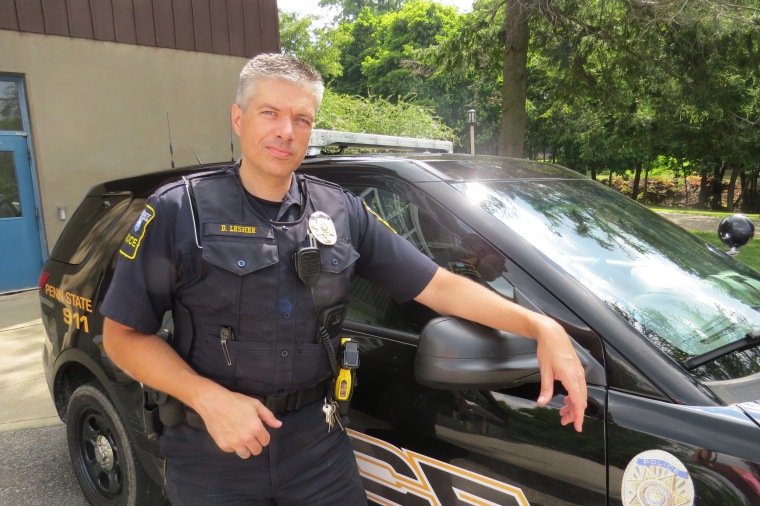
Give me a half hour with anyone and I’ll come away with a story. Every person has one. Some have more than a few. Take Dave Lesher, for example.

This piece was supposed to be about Lesher’s beekeeping hobby, but his activities, interests and talents—his “secret lives”—are many.

In addition to being a police services officer at Penn State Behrend and a beekeeper, Lesher is also a professional photographer, distance trail runner, cyclist, gardener, home brewer, clean-eater, and a website programmer/designer. Oh, and he’s also a veteran, husband, and father.

Clearly, when Lesher is interested in something, he goes all in. But serendipity plays a role in most of his ventures, too.

Twenty-five years ago, when he was working at a grocery store after having completed basic training in the U.S. Army Reserves, a coworker mentioned she was attending a municipal police training academy. Lesher enrolled a week later.

After graduation, he was hired at Behrend. It’s a job he said he has enjoyed since day one.

“I really like the people here,” he said. “In my role, I come in contact with a wide variety of people and I enjoy interacting with everyone from the janitorial staff to the Chancellor.”

He even likes educating students who have gotten themselves into a bit of trouble.

“Often, the student has just been misguided or made a mistake and the incident can be turned into a learning experience,” he said. “I’d say we can do that 95 percent of the time.”
IMG_8671

Honey habit leads to hobby

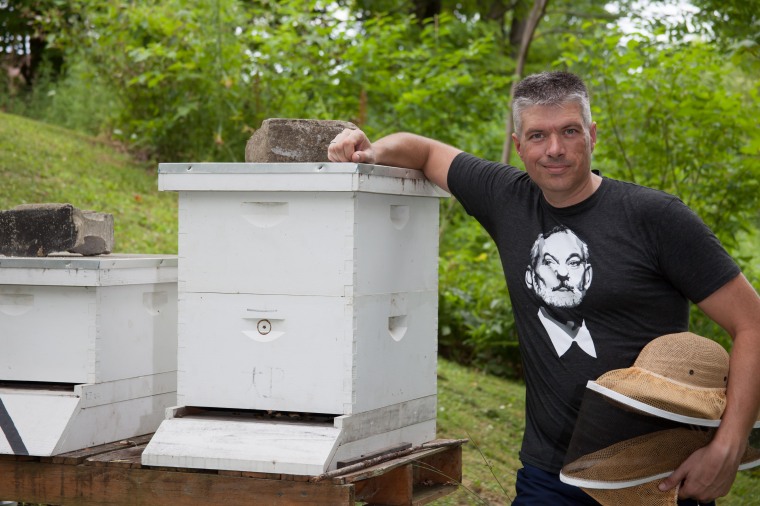
A serious health scare a decade ago inspired Lesher to begin exercising and taking a closer look at the foods he was putting into his body. He eats clean now, avoiding processed foods, meat, caffeine, artificial dyes and additives, and most forms of sugar, with one sweet and all-natural exception—honey.

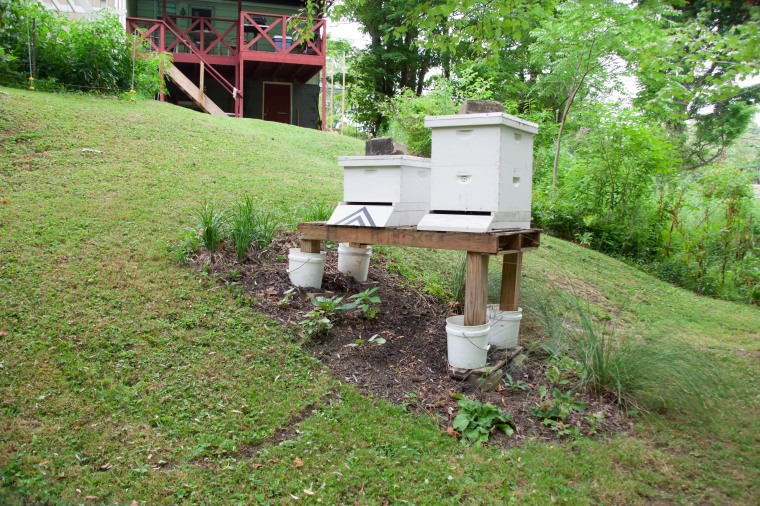
“It’s expensive, though, and I was eating a lot of it,” he said. “So I started doing some research on beekeeping and got some bee boxes.”

He found his first set of bees on Craigslist.

“This guy was tearing a house down and found the walls were full of honey-bees, so he offered them up to anyone who would come take them,” Lesher said.

“Cut-outs,” as such bee acquisitions are called, are tougher than simply scooping up a homeless swarm and encouraging them into a new home.

“With a cut-out, you’re invading their territory and they will defend it,” Lesher said. “Swarming bees are actually safer to collect. They swarm when they are looking for a new home, so they have nothing to protect and are usually happy to climb right into a bee box.”

Lesher is pleased to offer them a home, and the college’s maintenance and operations staff are just as thrilled to have someone nearby to call when swarms are found on campus.

Except for the occasional replacement queen, Lesher doesn’t buy bees. He prefers to collect native bees since they are used to Erie’s climate.

Lesher has a beekeeper’s hat, but doesn’t wear a full suit because honey-bees are rarely aggressive. He’s been stung only twice.

The average hive makes sixty to eighty pounds of honey a year, which is harvested in the fall. Only a portion of the honey is taken, however, as the bees have to have food for the winter.

“My hives are new this year, so I won’t take any honey,” he said. “I want to keep them happy so they’ll stay and produce more next year and then I can take some.”

From programming to photography to political science 101

A different kind of buzz—talk about the then-new World Wide Web—caught Lesher’s attention twenty-plus years ago. He began reading about, then dabbling in, website programming and design. He soon had paying clients (he still has some today) and a concern about finding adequate photography for their sites.

So he began reading about photography. You see where this is going, right? Today Lesher also works as a professional photographer. He shoots family portraits, senior pictures, and weddings.

Another hat he wears? College student. This fall he’ll complete his degree in General Arts and Sciences with an emphasis in Political Science.

Man in motion

You may wonder where Lesher gets the stamina to keep up all of his hobbies, jobs, and activities. It’s a strength that is, no doubt, hard earned on the trails and roads around Penn State Behrend where he’s logged thousands of miles.

Last summer, he did his first ultra run, the Megatransect, a formidable thirty-mile race up, on, and around Bald Eagle Mountain, just south of Lock Haven—with former Behrend engineering professor and trail-runner Dr. Chris Colston.

“The funny thing is that when I was in the Army, I hated running,” he said. “I never thought I’d start doing it competitively. But then I got interested in it and ended up buying the gear and doing some races and… you know, how it goes.”

Yes, with Lesher, we do know how it goes now—all the way.
IMG_8662

8 fun honey-bee facts

  1. Honey-bees are not native to the United States. They were imported by European settlers.
  2. Honey-bees, while instinctual, aren’t very smart. “I have to have different landing strips on my hives or the bees will go in the wrong hive and be killed as invaders,” Lesher said.
  3. Honey-bees use dances to communicate. For example, when honey-bees find food, they do a choreographed “waggle” dance that instructs the rest of the hive where to find a food source.
  4. Honey-bees keep each other warm and fed over winter. Honey-bees keep the hive at about 92 degrees in winter, feasting on the honey they have collected all summer.
  5. Honey is harvested in the fall. Hives typically contain about sixty to eighty pounds of honey; some must be left for the bees to eat.
  6. Unhappy honey-bees will leave. If conditions in the hive are not suitable, the queen will call for a swarm and they’ll swarm and depart.
  7. The honey-bee queen is the sole reproductive female in the colony. She lays 1,000-to-3,000 eggs per day. Female worker bees perform all other colony duties. Male drones exist only to mate with a virgin queen.
  8. Drones are dead before winter. Drones are a liability to the wintering hive and are not allowed in after fall, so they die outside.

IMG_8703

Collecting a swarm

Lesher provided this video of a swarm he collected:

 

Students create blankets for NICU babies

20160428_145345

By Steve Orbanek
Marketing Communications Specialist, Penn State Behrend

When Ashley Sullivan, assistant professor of early childhood education at Penn State Behrend, suggested that students in two of her spring 2016 classes plan a community service project, one idea was top of mind for Karlie Aschenbrenner.

Aschenbrenner, a sophomore Elementary and Early Childhood Education major from Pittsburgh, thought of the concept behind Brady’s Blankets, a program of the Fairfield, CT, children’s non-profit Brady’s Smile, which provides homemade fleece blankets to babies and children in the Neonatal Intensive Care Unit and Pediatric Intensive Care Unit.

“This was the one idea that really made so much sense,” Aschenbrenner said. “If we all donated $5, we would be able to purchase fabric to make tie blankets. We could then donate the blankets to babies in the NICU.”

The students voted on the service project ideas, and Aschenbrenner’s suggestion was the clear winner.

Every student in both Sullivan’s Instruction in Early Childhood Education Derived from Development Theories and Competing Rights: Issues in American Education courses donated $5 each to participate in the project. They spent their last day of class cutting and tying to create 75 blankets, which were donated to Brady’s Smile and then sent to University of Pittsburgh Medical Center’s Children’s Hospital of Pittsburgh.

Aschenbrenner was not the only student with whom the cause resonated.

“The children that we’re donating these blankets to could eventually become the kids that we’re going to teach, so just giving them a better chance to thrive and survive can mean a lot,” said Madison McFeely, a first-year Elementary and Early Childhood Education major from North East.

In addition to creating the blankets, Sullivan’s students volunteered at the Second Harvest Food Bank of Northwest Pennsylvania where they packed more than 200 food boxes to distribute to local seniors.

“As future teachers, I think all of us really appreciate these causes,” said Gionna Fonseca, a sophomore Elementary and Early Childhood Education major from Pittsburgh. “It was really nice to see that big pile of blankets sitting there.”

This slideshow requires JavaScript.

‘Looks Like We Made It’: Behrend choristers perform alongside Barry Manilow

Manilow-Concert_017 (smaller)

By Steve Orbanek
Marketing Communications Specialist, Penn State Behrend

It was not until the lights came on that Elizabeth Seng fully realized the significance of the moment.

Behind her was a jumbotron. In front stood a multi-platinum singer-songwriter. Beyond him was a crowd of thousands of people.

Seng, a senior psychology major at Penn State Behrend, has made many memories in her four years at the college, but performing alongside Barry Manilow as part of the Choirs of Penn State Behrend might take the cake.

“We were out on the stage, and then they shined the lights on us,” said Seng, a Seattle native who has been a regular member of the choir during her time at the college. “There were all these people there, and it was just really exhilarating. It was probably my most memorable experience I’ve had here at Behrend.”

Manilow invited the Behrend Choirs to perform alongside him at his April 25 concert at Erie Insurance Arena. Tone-Acious, Penn State Behrend’s student a cappella club, joined the choir for the performance, which was part of Manilow’s “One Last Time!” tour.

“This was a really unique opportunity, and it highlighted Behrend’s arts offerings in front of a huge audience,” said Gabrielle Dietrich, director of choral ensembles at the college. “It also provided a fun and highly motivating year-end experience for our students.”

“When I found out, I was like, ‘Oh my gosh, are you serious?’” Seng said. “It just felt so special to think that Barry Manilow thought we were good enough to be a part of his concert.”

The choirs’ performance was especially meaningful because they joined him for the three final songs of the concert, which were amongst his greatest hits: “Copacabana,” “Miracle” and “I Write the Songs.”

The day of the concert, the choirs arrived at the arena at 3:30 p.m. and practiced before going on stage at 9:30 p.m.

“We were sent to holding rooms in which they had us practice a lot and learn the choreography,” said Taylor May, a junior software engineering major and member of both the Behrend Choirs and Tone-Acious. “We even ran through it once on the stage with the soundtrack, but thankfully we got to relax a bit before the concert.”

To honor the occasion, choristers created “Behrend Hearts Barry” t-shirts which they wore under their gowns during the concert. They even gave an extra t-shirt to Manilow as a memento.

The shirts are a reminder of what was truly a once-in-a-lifetime experience for many of the choristers.

“Before you knew it, you could see the streamers (coming down from the ceiling), and that was it. It just went by so fast,” Seng said. “To be part of one of his final tours was just really, really cool. I’ll remember it forever.”

This slideshow requires JavaScript.

Students escape to Madagascar via Washington, D.C.

Reem Elhafiz Abdalla, Jillian Dunn, Lillie Gabreski, Dalia Tenda Batuuka
Reem Elhafiz Abdalla, Jillian Dunn, Lillie Gabreski and Dalia Tenda Batuuka represented Penn State Behrend at Howard University’s 14th Annual National Model African Union Summit last month.

By Steve Orbanek
Marketing Communications Specialist, Penn State Behrend

Dalia Tenda Batuuka, Jillian Dunn, Lillie Gabreski and Reem Elhafiz Abdalla are not natives of Madagascar. None of them has ever stepped foot in the country.

Talk to any of these four Penn State Behrend students for even a few minutes though, and you might just think they were native-born Malagasy.

Last month, the students attended and participated in Howard University’s 14th Annual National Model African Union Summit. Sponsored by the African Union Mission and Member State Embassies in Washington, D.C., the four-day summit is a simulation of the proceedings of the African Union, requiring participants to research their assigned countries in-depth before attending the conference.

This marked the first time that Penn State Behrend was represented at the summit, held in February with more than 45 colleges and universities participating. The Behrend students’ assigned country was, of course, Madagascar. The group represented the college well, winning the Michelle Tooley Outstanding Delegation in Committee Award in recognition of their performance on the Social Matters Committee.

“Students really do have to act as delegates and adopt the stance of the country they’re representing,” said Naaborle Sackeyfio, a lecturer in comparative politics who also attended the summit.

The students chose to participate after taking Sackeyfio’s Introduction to Contemporary Africa course during the fall semester.

“We were in the course together, and Dr. Sackeyfio mentioned this summit. It just seemed like such a great opportunity,” said Batuuka, a first-year psychology major.

Each student was assigned a different committee for the summit, in this case Economics (Gabreski), Peace and Security (Batuuka), Social Matters (Abdalla) and Regional Economic Matters (Dunn). This meant that the group had plenty of studying to do beforehand.

“The whole point was to go there and play the role of actual delegates from Madagascar, so you had to be very familiar with the country in advance,” Batuuka said.

The group met several times a week and spent long hours preparing for the event. There were times during the summit where other countries’ delegates would call their expertise into question, but the students held their ground.

“People would contest things over even the smallest words. There were times where you definitely had to stand up and make your case heard,” said Gabreski, a senior political science major.

“The margin for error was very small,” added Dunn, a sophomore political science major.

While the students were happy to receive an award for how they represented Madagascar, it was not the only thing they took away from the summit.

“After this experience, I have such a newfound appreciation for politicians,” Batuuka said. “You always hear, ‘What’s wrong with Congress? Why aren’t they passing this?’ but you realize that it’s not that easy.”

Sophomore creates Behrend’s first Model United Nations chapter

By Steve Orbanek
Marketing Communications Specialist, Penn State Behrend

Delegate-Ivan Pan, Moustafa
Ivan Pan, left, and Moustafa Elhadary were two of the student delegates who represented Penn State Behrend at the 62nd annual Harvard National Model United Nations.

Weibin “Ivan” Pan was optimistic prior to attending the Penn State Behrend Student Leadership Conference in February 2015. The Xiamen, China native had just started his second college semester and was looking to get more involved on campus.

But he did more than just get involved. He paved the way for others to get involved, too.

“I came out of that conference knowing that I wanted to create a Model United Nations at Penn State Behrend. I was very involved in Model UN in high school, and I knew that a lot of students at Behrend would be interested in the group,” says Pan, a sophomore Finance major.

Within a month, he had found a faculty adviser and plenty of interested students. Today, the group, now an official Model UN chapter, has more than 30 members.

Pan said a key reason he wanted to start a chapter was to provide opportunities for the college’s growing international student population. Last year, Penn State Behrend welcomed 186 new international students, the largest international class in its history.

“Model UN is a great place for international students to practice their public speaking skills, English skills and to learn to negotiate with others,” Pan said.

In February, Pan and an additional seven Penn State Behrend student delegates attended the 62nd annual Harvard National Model United Nations (HNMUN). More than 3,000 student delegates from more than 70 countries and 100 universities attended the four-day international relations simulation in downtown Boston. Founded in 1955, the conference is the largest and oldest of its kind, and this year was the first time that Penn State had ever been represented.

For the simulation, Pan and the other student delegates (Stephanie Zhao, Naman Tanwar, Tyagadipta Biswal, Deniz Himmetoglu, Hank Pinge, Moustafa Elhadary, and Keshav Prabhu) were assigned the country of Poland. They spent nearly a year researching the country and its policies to prepare for the event.

“We prepared and met regularly before the event,” Pan said. “It was a great honor to be invited to the conference. Everyone wants to be invited, but there was only a limited number who went.”

While they did not take home any of the major awards at HNMUN, the team plans to apply to attend the conference next year. The group has also applied to attend the eleventh annual Los Angeles Model United Nations (LAMUN) in April at the University of California, Los Angeles.

“There are so many great opportunities for students here at Behrend,” Pan said. “The fact that I was able to start a Model UN chapter just shows that Behrend really does provide great opportunities for its international students.”

This slideshow requires JavaScript.

Marketing alum finds calling with Make-A-Wish Foundation

Penn State Behrend alumna Melissa Lichtinger works as online communication manager for Make-A-Wish International but also volunteers for the organization. The first wish she granted was for Lucas, who suffers from lung disease, cerebral palsy and can only communicate through non-verbal expression. A splash pad was installed in his backyard, so he would be able to play safely in water.

By Steve Orbanek
Marketing Communications Specialist, Penn State Behrend

Melissa-Lichtinger_1Melissa Lichtinger no longer worries about life’s everyday stresses. Those concerns went away after she started to work for Make-A-Wish Foundation.

“Whenever life gets tough, I’ll just watch a wish story. It always instills positivity, and you realize that your day-to-day struggles are nothing compared to what these kids go through,” the 2013 Penn State Behrend graduate said.

Lichtinger, who earned degrees in marketing and international business, works as online communications manager for Make-A-Wish International, headquartered in Phoenix, Arizona. Every day, the Erie native works to manage the organization’s social media and website presence while being attentive to the needs of the 50 different countries in which Make-A-Wish operates.

Her commitment to the nonprofit’s mission is nothing new. While in college, Lichtinger got involved with Make-A-Wish thanks to the urging of her aunt, who was a volunteer, and interned in the organization’s Erie office.

“At my internship, I did a lot of the wish story writing, so it really connected me to the mission, and I had the chance to meet a lot of wish kids. It really changed my life and made me realize I wanted to work in this sector,” she said.

Lichtinger happened to be in luck. Following her college graduation, she was hired as a digital production coordinator for Make-A-Wish America before being promoted to digital production specialist. She was promoted to her current position last June.

However, while she enjoyed her work, something was missing. At the corporate office, Lichtinger often helps with managing the global brand, sponsorships and high-level tasks. It was time to get back to basics.

“I reached out to the local office here in Arizona, so I could start the process of (volunteering) and granting wishes. It was important to get back to the mission, and remind myself of why I wanted to get involved to begin with,” she said.

Her first wish granted was for Lucas, who suffers from lung disease, cerebral palsy and can only communicate through non-verbal expression. After speaking with his mother, Lichtinger learned that Lucas loves playing in the water, but it’s difficult for him to do so because he cannot be in the water without someone holding his head up.

His family and Lichtinger ultimately decided to install a splash pad in the family’s backyard for Lucas. Commonly seen in public parks, splash pads eliminate the risks of pools while still providing plenty of water fun as ground nozzles spray water upwards.

When he was introduced to the pad, Lucas immediately started to laugh and giggle, and Lichtinger was reminded why the Make-A-Wish cause resonates with her so much.

“You get to take a kid who doesn’t get to be a kid right now, and you get to help them imagine something that they never thought was possible. You get to see the transformation where they become a little kid again,” she said.

Lichtinger is currently in the process of planning an additional two wishes. She knows her career path may one day change, but she wants to continue to make a difference in the nonprofit sector.

She also remains very thankful for all the knowledge she gained from her time at Behrend.

“I am a driven person, but Behrend instilled all of the steps of how to get there while giving me an opportunity to work with professors who really care about your success. My international business degree and the projects I worked on is what really helped me get this job,” she said. “I still talk to my marketing professors today, and they still help me if I have questions or need advice. They’re my mentors, not just for those four years, but they’re my mentors through life.”