Students Will Spend Spring Break Aiding in Hurricane Cleanup

canstockphoto263367

By Heather Cass

Publications Manager, Penn State Behrend

When Hurricane Harvey blew into Houston, Texas, in August of 2017, it altered everything in its path, causing at least $125 billion in damages and claiming 108 lives.

More than 1,350 miles away, Harvey continued to effect change, motivating those planning Penn State Behrend’s Alternative Spring Break service trip to veer off course.

“We had spent all summer looking for a trip that would focus on homelessness, but once Harvey happened, we felt that the need for volunteers would be more prevalent in the south,” said Elizabeth Mamros, a senior Mechanical Engineering major and president of Reality Check, the service club that orchestrates Alternative Spring Break each year.

“We got in touch with Community Collaborations International, a company that coordinates experiential education projects, and they already had people there assessing the volunteer situation and potential projects for spring break,” Mamros said.

Twenty-four students and four advisers will be leaving Behrend early Saturday morning to spend a week working in Beaumont, Texas.

“I think students are going to be surprised at the disarray that still exists six months after the hurricane. Most people have forgotten about it or assume it’s all cleaned up by now,” said Chis Fox, assistant director of civic engagement and the Smith Chapel. “But there’s still plenty of work to be done, especially in less populated and less affluent areas.

The Behrend group will be joined by students and advisers from other Penn State campuses, including Greater Allegheny, Harrisburg, Scranton, University Park, and York. In total, 100 Penn Staters are expected to be in Beaumont next week, helping residents recover from the catastrophic flooding that occurred as a result of Hurricane Harvey.

Teams of students will be dispatched to various sites around Beaumont to work on projects ranging from mucking out and gutting flooded homes to cleaning and reconstruction.

Groups will stay in the Community Collaborations International Volunteer Facility, and sleep in a gym or classrooms with men and women in separate quarters. Volunteers will work, rain or shine, and time will be spent each evening reflecting on the work of the day.

Penn State Behrend students attending are: Emily Archer, Hannah Carlino, Seth Cowen, Safinaz Elhadary, Joshua Hecht, Janelle Housler, Ashley Jankowski, Ashlyn Kelly, Kris Knorr, Nicole Kuhn, Kaitlyn Lacey, Max Magera, Celeste Makay, Liz Mamros, Kelly Miller, Angelica Miller, Katie Murphy, Priya Patel, Pearl Patterson, Brianna Riley, Gretchen Shaffer, Alex Sienerth, Lidong (Thomas) Wang, and Danielle Wieczorek.

The four staff members who volunteered to accompany the students are: me — Heather Cass, publications manager in the Office of Strategic Communication; Chis Fox, assistant director of civic engagement and the Smith Chapel; Chris Harben, assistant teaching professor of management; and Will Taylor, an Americorps VISTA intern at Penn State Behrend.

Behrend’s ASB group have been preparing for the trip by discussing the disaster in Texas and relief efforts, participating in safety and basic maintenance workshops, and watching Trouble the Water, a documentary about the devastating flooding that occurred in New Orleans’ 9th Ward after Hurricane Katrina. They have also been taking part in ice breakers and other activities to get to know one other better.

Check back here….or follow this blog (click on the “follow” button in the lower right hand side of your screen)…to see updates from Texas all next week.

Note: If you wish to support the students efforts in Texas with a donation to the Alternative Spring Break Program, contact Kathryn Buesink, assistant director of development, at klb44@psu.edu.

Finance students rub elbows with 3,000 professionals at industry conference

By Heather Cass

Publications Manager, Penn State Behrend

Penn State Behrend Finance majors Paige Espenshade and Jared Orr recently attended TD Ameritrade Institutional’s National LINC conference in Orlando, Florida, where they were able to get an insider’s view of their chosen field of study.

Espenshade and Orr, who were accompanied by Eric Robbins, lecturer in finance, were two of fifty-six financial planning students from twenty-eight colleges and universities who attended the annual conference in late January.

While there, they had the opportunity to explore job opportunities and connect with more than 3,000 financial advisors and other financial services industry professionals and experts from across the nation.

ameritrade pix 1

Finance students Jared Orr and Paige Espenshade are flanked by TD Ameritrade Institutional President Tom Nally, left, and Kate Kealy, managing director of TD Ameritrade’s Generation Next Program. LILA PHOTO for TD Ameritrade Institutional.

TD Ameritrade is a leading provider of brokerage custody, technology and practice management services for more than 6,000 independent registered investment advisors (RIAs). Since 2007, the firm has been inviting undergraduate financial planning students and their program directors from schools across the U.S. to attend its annual conference, covering travel and hotel expenses for them to do so.

Being Penn State students, Espenshade and Orr garnered special attention from some alumni in the finance industry.

“I was very honored to be actively sought out by alumni and advisors looking to talk specifically with Penn State students,” Espenshade said. “I spoke to an alumnus with an alternative investment firm as well as one with a firm in North Carolina. Altogether, I exchanged contact information with about ten advisors and five vendors.”

At this year’s conference, students attended feature sessions by Ian Bremmer, president, Eurasia Group; Viola Davis, award-winning actress of film, television and theater; Marc Goodman, New York Times best-selling author of Future Crimes;  April Rinne, advisor, Pathfinder, and member of the World Economic Forum; and Jeremy Siegel, the “Wizard of Wharton” Wharton School finance professor.

They also heard about the convergence of financial services and technology from a keynote panel on innovation that included Adena Friedman, president of CEO, Nasdaq; Tim Hockey, president and CEO, TD Ameritrade; Ric Edelman, executive chairman, Edelman Financial Services; and Lex Sokolin, director of fintech strategy, Autonomous.

“Throughout the week I was able to learn about the role of wholesalers, which is a division of the industry that I had never been exposed to,” Orr said. “I now understand the importance of this niche and have a greater understanding of the financial services industry as a whole.”

The students also participated in smaller breakout sessions and panel discussions on investing and evolving as a financial advisor, and attended networking events with advisors and leaders of our firm, including Tom Nally, president of TD Ameritrade Institutional, and Kate Healy, TD Ameritrade’s managing director, Generation Next.

Both Espenshade and Orr say the trip exceeded their expectations.

“It was an amazing event that has had a positive impact on my both my professional network and my awareness of the financial services industry as a whole,” Espenshade said.

“It was a transformative experience,” Orr said. “I now have a better understanding of the different roles within the Registered Investment Advisor (RIA) industry,” Orr said. “The conference exposed me to several aspects of the industry, and because of this, I was able to see what a great community RIAs across the country have created. I hope to attend the conference one day as an RIA so that I, too, can give back to the students as the advisors did for me this year.”

ameritrade pix 2

Secret Lives of Faculty — Dr. Chris Harben, musical/stage star

By Heather Cass

Publications Manager, Penn State Behrend

There’s much more to Penn State Behrend’s faculty and staff members than what you see on campus. In this occasional series, we’ll take a look at some of the interesting, unconventional, and inspiring things that members of our Behrend community do in their free time.

Image result for erie playhouse annie

Photo courtesy of Erie Playhouse (Credit: Julie Lokahi/ DV8 Photography)

Lecturing can be viewed as form of performance art. Faculty members take center stage, staring in their own daily productions to keep students engaged in the subject matter.

“Performing is what I do in front of the classroom all the time,” said Dr. Chris Harben, assistant teaching professor of management.

It’s also what he does in his free time.

Shortly after accepting a teaching position at Behrend this summer, Harben landed a lead role in the Erie Playhouse’s production of Annie: Harben plays Daddy Warbucks, orphan Annie’s wealthy savior, in the show which is onstage at the playhouse this month.

Harben as Daddy Warbucks

Photo courtesy of Erie Playhouse (Credit: Julie Lokahi/ DV8 Photography)

“During the interview process at Behrend, I learned that Dr. Greg Filbeck (director of the Black School of Business) was a board member at the Erie Playhouse,” Harben said. “I looked at the playhouse’s website and saw they were going to be doing Annie. This was around June when I was currently in rehearsals as Daddy Warbucks at a theater in Upper Sandusky, Ohio, so I thought it was fortuitous!”

Harben, who was a faculty member at Bowling Green State University, nailed both of his “auditions,” and was offered a position at the Black School of Business and a starring role at the Erie Playhouse.

We caught up with Harben to learn more about his love of musicals, his role as Daddy Warbucks, his unusual part-time job, and why he’s been making it a priority to start hitting the gym again.

Why did you choose Behrend?

It was really because it had a small school feel with all the benefits of a big state school, such as research opportunities.

How long have you been acting or singing on stage?

I was in a couple of shows in high school, but then didn’t do any stage work until I completed my doctorate a few years ago. I met an actor who had played Valjean from Les Misérables on Broadway and was inspired to get back into it. My first show as an adult was three years ago.

Do you prefer musicals?

Yes. I don’t consider myself a great actor, so I prefer to audition for roles that require a lot of singing.

What has your experience been like so far at the Erie Playhouse?

The playhouse is an incredible Erie asset. I have never performed any place like it. It is closer to professional theater than it is to a community theater. The experience of rehearsing and getting ready has been fairly typical with ups and downs—especially “tech week,” which is always the hardest week as all the technical aspects and bugs are worked out. But, to work on such a great stage with wonderful sets, a full experienced crew, a full-time professional costumer (who is also in the show, starring as Rooster), a director as professional as Kate Neubert-Lechner, and an incredibly talented orchestra, is an amazing thing that makes me smile every time I walk into the theatre.

There are a couple of Penn State Behrend students in Annie, too?

Yes. Anthony Ventura, a senior Political Science major, has multiple roles but I interact with him the most in his role as “Drake” my butler. Jacqueline Dumont, a junior Communication major, is also in the cast and plays several roles as part of the ensemble.

What do you enjoy most about musicals/stage performance?

I love being able to transform into someone else. Many of my roles have been similar in terms of their character, though, so I’d like to try something different soon, perhaps a comedic role. But the very best part of participating in stage shows are the relationships I’ve been able to build with other cast members. I can honestly say that I keep in touch with people from every show I’ve ever been in. Theater really is a small world.

What’s the most challenging aspect of theatre?

Well, there is drama in drama. Also, things happen that force actors out of our comfort zones. For Annie, we didn’t have the rehearsal time we might have liked because the playhouse’s stage was undergoing renovations, which threw the schedule off a bit. But you just have to roll with it. It is part of being in theater. Stuff happens. Sometimes it happens live on stage.

There are real dogs in Annie?

Yes. Two shelters dogs. One is a sweet, docile pitbull from the Northwestern PA Humane Society and the other, Romeo, is a younger mixed breed dog from the A.N.N.A. Shelter. Romeo is a little hyper, but that’s probably to be expected with all the commotion, lights, audience, and cast members on stage.

What’s your favorite musical?

The Phantom of the Opera! It was the first musical I learned to sing. I’d love to play the Phantom some day.

What has been your favorite show/role, so far?

Daddy Warbucks has been my favorite role and Annie my favorite show, but playing Javert in Les Misérables is a very close second.

What’s your dream role?

I already mentioned the Phantom, but on a more realistic note, I’d love to play Dr. Jekyll in Jekyll and Hyde. I have sung “The Confrontation” from that show at a cabaret in Ohio. It is an incredible song in which both Jekyll and Hyde are singing, and it’s the same actor!

What’s next for you on stage?

I’ll be playing King Triton in The LIttle Mermaid at the Academy Theatre in Meadville. We start rehearsing in February and open in April. The director asked me how comfortable I was going shirtless for that role. So, suffice to say, I’m working on getting in shape for that role now.

Switching topics, let’s talk about your work as an Emergency Medical Technician?

Yes. I’ve been an EMT for five years now. I was a volunteer EMT in Ohio while I was working on my doctorate. I’m still trying to get my certification in Pennsylvania, but I hope to do some volunteer work here, too.

Being an EMT is quite a change from the corporate world. What appeals to you about it?

I became an EMT for a couple of reasons. First, my family is full of medical professionals. My dad was an EMT when I was very young. My mom is a nurse. My sister is a cardiovascular perfusionist, and my brother is a physical therapy assistant/athletic trainer. So I grew up around the language and culture of medicine. But, for me, becoming an EMT was more about giving back. I tried joining service clubs like Optimist and the Rotary Club, but I never felt the impact I feel when I show up at someone’s house who really needs help.

It’s also a summer job for you, right?

It is. For the past few years, I’ve been working as an EMT at Cedar Point, which is a large amusement park in Sandusky, Ohio. One of the benefits of that job is that I’ve developed a great relationship with the leadership team there. I actually just had the park’s vice president and general manager come to Behrend to speak to one of my classes. I do hope to work there this summer, too. It’s only a couple of hours away from Erie.

Any other hidden talents?

I can play the drums, trumpet, and French horn. I also love photography and owned a photography business for several years. All the art in my office in Burke are photos that I’ve taken.

What words do you live by?

When I was finishing my doctorate, I had the Chinese symbol for perseverance tattooed on my arm. That is a word that I live by.

Annie is on stage at the Erie Playhouse, 13 W. 10th St., through December 31, 2017. Visit erieplayhouse.org for show dates and ticket information.


A Maryland State of Mind: Staying Social

Pic for 3rd Blog post (1 of 1)

By Brandon Moten
Senior Communication Major

Hello Penn State Behrend students, faculty, and staff. This is Brandon Moten, and I’m back with another post in my new blog series, “A Maryland State of Mind,” where I share my experience of attending Penn State Behrend as an out-of-state student from Bowie, Maryland. If you’ve missed my previous posts, I have touched on my transition to Erie and coming to Penn State Behrend.

Today’s post is about the challenges I faced as I wanted to stay social and meet friends while getting acclimated to a new environment. Before coming to Behrend, I was hopeful that I would be able to use my social skills to help make great friends and create amazing memories. I’m a very social person, and I knew I would need people to help me get through the transition of being an out-of-state college student. My roommate was assigned to me over the summer, but I was still nervous and anxious about meeting him.

Once August came, all of my fears of being able to make friends were put to rest once I met my roommate Giovanni Carrera. To this day, he is still one of the best friends I met here at Penn State Behrend. Also, I have met so many amazing individuals through him, which also helped me branch out and meet people through my classes, work, and extracurricular activities because my experience with him gave me so much confidence. So many amazing people attend Penn State Behrend, and the campus setup makes it easy to meet friends because you are likely to see them often, whether it’s through Brunos, Dobbins, class, or common areas in the residence halls.

Today, I have many friends and connections that will stay with me for years. I attribute that to Penn State Behrend matching with a roommate that fits my personality. In a few weeks, I will graduate, but I know the friendships I started here will last a lifetime. That’s just another reason why I love this school and the experiences I have enjoyed as an out-of-state student.

Stay tuned for more… WE ARE PENN STATE!

PLET students explore Austria and Germany

Guest Post by Haley Palys, senior Plastics Engineering Technology major

No matter how vivid the photos or descriptive the lecture, there’s nothing quite like seeing and experiencing another country in person. And, in today’s increasingly global business climate, it’s vital that students be versed in the culture and business practices of international partners. There is much to be learned from seeing how others do it. That’s why, every year, students in the Plastics Engineering Technology program have the opportunity to travel overseas to visit plastics companies and universities and attend a plastics trade show, too.

On Thursday, Oct. 12th, a group of PLET majors embarked on a 10-day trip to Austria and Germany. We asked student Haley Palys to keep a travel log and tell us about her trip. Here’s her report:

Oct. 12-13 — The Journey Begins.

Our bus to Toronto-Pearson Airport left at 9:00 a.m., so a few of us in the group decided to enjoy the Breakfast Place’s food one final time. We later arrived at Toronto early, leaving ourselves PLENTY of time to enjoy the airport’s free Wi-Fi and long lines. A couple hours later, and we were off to Austria (not Australia).

As soon as we arrived in the Vienna Airport, I knew this city was beautiful. Unfortunately, the jet lag wiped out majority of the group. I decided to walk to the famous Museum-Quartier square, and in the Volksgarten, enjoying the perfect weather and sunny skies. Others in our group opted to check out the Natural History Museum and explore.

Everyone got to experience the famous Viennese food, including my first bites of the wiener-schnitzel (and my favorite now)! Meat, cheese, bread, and Italian food were on menus across the town, yet it was all in German, so we couldn’t read it anyways. Later into the night (7:30 p.m.), I was fighting the jet lag while others were still getting to know the city.

Oct. 14 — Exploring Vienna

Everyone met at 8:30 a.m. after a refreshing breakfast of orange juice, sliced meats and cheeses, and bread. Within 30 minutes of walking through the fresh air, I was awake and feeling good.

Our group of six got to the Schloss Schönbrunn as it opened and began to walk the yards. The entire estate was jaw-dropping, especially how large it was. Then we learned it was only a summer-house for the royal family. We then toured thirty-six of the rooms in the palace, which all were stunning—my favorite being the ballroom and porcelain room. Out of the whole experience though, the pretzels and fresh-pressed orange juice at the café blew our minds. We were all done sooner than expected, giving us time to head over to the St. Stephen’s Cathedral. There we toured the catacombs, saw some bones, and then climbed 343 steps for a gorgeous view of the city. After a long day of walking, we found a spot on the Danube River to sit and watch the river boats do 180°s.

For lunch I had a grilled salmon with hollandaise sauce, while the others enjoy more traditional dishes like bratwurst. Some even opted on trying out the non-alcoholic beers, and I struggled to avoid ordering “fizzy” water. Later for dinner, we shared some laughs at a nice outdoor-patio café and wine bar.

Oct. 15 — Saying Goodbye to Vienna

At 8:30 a.m., we were all packed and ready to head out to start the day. After locking up our stuff, we headed off to the Technology Museum. It was located close to the Schönbrunn, and had gorgeous views of the palace.

The exhibits were awesome, and the whole place was huge! We were enjoying the interactive exhibits along with the kids for a while, then realized just how much information there was. The whole museum was about four stories high, with about ten different areas ranging from Energy to Media based technology. After rushing through to get a look at everything, we enjoyed some delicious pizzas and pastas before heading back to pack up. We hopped on the train, and got a stunning view of the countryside and Alps.

Oct. 16 — ENGEL Tour

Our group started the day with some more cold cuts and cheese and bread, then an hour long bus ride to Schwertberg. We were lucky enough to be touring ENGEL, a global injection molding machine manufacturer. We spent the morning there and were served the fanciest lunch plates I have ever seen, with of course sparkling water and orange juice.

After touring the Schwertberg headquarter plant, we set off to the Dietech plant where the automation, or robot, equipment is manufactured. It was a quick tour, but we got to see a lot.

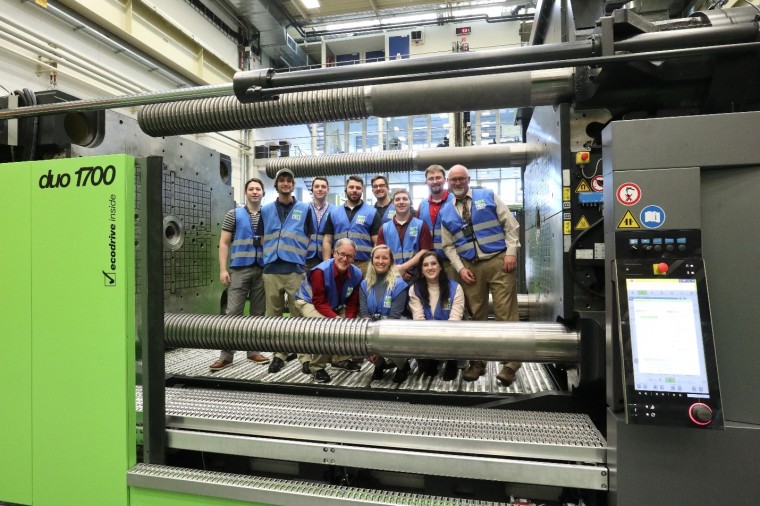
Afterwards, we left for St. Valentine where the big machinery is manufactured. This was truly incredible to see, because everything was bigger than anything I have seen or worked with. Tommy Vervoort and Joe Donofrio were familiar with these large tonnage machines thanks to past internships, and were able to ask questions to the engineers. At the end of the tour, my group was allowed to step inside the machine platens for a picture—that’s how big it was!

We said our thank-you’s and goodbyes, and headed off to the train station. We then left for Munich, enjoying even more views of the Alps along the way to Germany.

A small portion of the group will spend tomorrow in Innsbruck, Austria to spend some time on the slopes of the glacier, so they left to catch their own connection train. They stayed the night there and will spend the next day skiing until their train to Munich arrives.

PLET in germany3

Innsbruck, Austria

We who went straight to Munich found their way to our own hostels. After the long day of traveling I needed some comforts of home—so we went to the KFC down the block for dinner, while the others spent a little more time trying to find a good place to eat and walked around Munich.
PLET in germany2

ENGEL tour, Austria

Oct. 17 — Munich Adventures

Today was another free cultural day, and I had planned to visit the Dachau Concentration Camp. Our group arrived close to the opening time, so the already somber camp seemed even more chilling and empty. The actual museum was moving and gave an in-depth look into life at Dachau. The grounds were serene, despite the immense history surrounding us.

After the solemn tour, I wanted to cheer myself up, so we wandered through Munich past the Marienplatz, and ended up at the Hofbrau Haus for lunch. We each enjoyed some traditional Bavarian meals and drinks, and I was ready to buy all the pretzels I could find.

Image result for german pretzels

With our stomachs full, we decided to walk it off and check out the famous English Garden. Specifically, we wanted to see the Eisbach, or the man-made “perfect surfing wave” in the streets of Munich.

On the way there we ran into some others in our group at an art museum. Ryan Bauer then clued us in on some architectural history of the museum. It was once a Nazi headquarters, and was converted to an officers’ mess hall after WW2, but evidence of its origin, swastika tiling, could be found on the ceiling right outside the front door.

After we had out fill of the street surfers, we strolled past a nude park [unexpected], and began our walk back to the hostel. We walked through the Hofgarten and saw the Bavarian State Chancellery, which also had evidence of the war. Along the front columns, large bullet holes painted the façade.

Oct. 18 — Neuschwanstein Castle

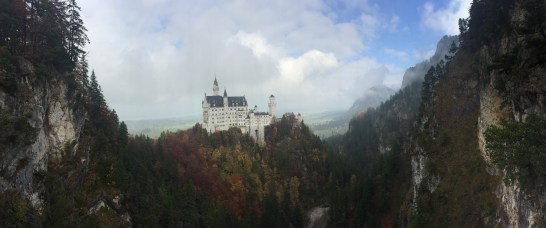
Everyone made their way to the train station at 6:30 a.m. promptly, and boarded the train towards Füssen. Half the group got their tickets for the tours of both castles, and we started our uphill trek towards Neuschwanstein. The fifteenth-century castle was stunning from all views, but the scenery around us was even more breathtaking. We climbed the mountain adjacent to the castle for a birds-eye view of not only the castle, but the mountainous landscapes, pristine lake reflections, and miles of farm land.

Once we had our fill of Neuschwanstein, we took a horse carriage ride down the hill and headed to the other side of the valley to see Hohenschwangau castle. And once again the views took my breathe away. After eating some bratwursts for lunch, we met up with another group to head back to Munich.
img_5652

Oct. 19 — Rosenheim University Tour

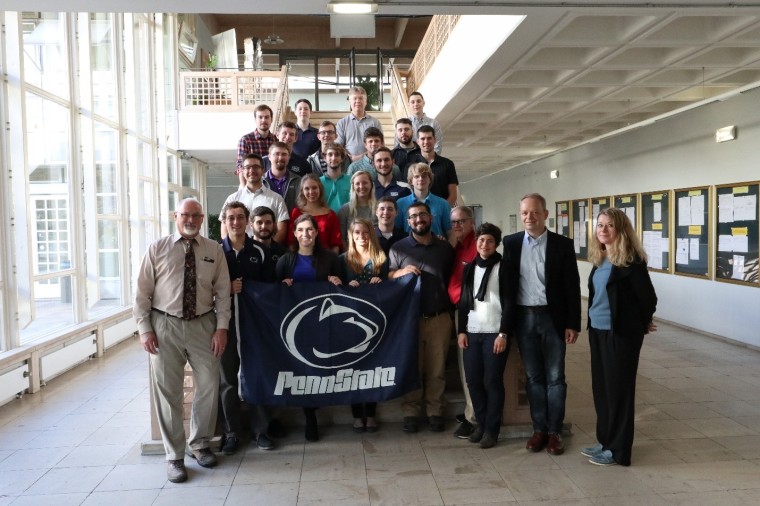
Today we were fortunate enough to spend the day at Rosenheim, a university in which some Behrend students have studied abroad at. We were shown around their plastics lab, and got to see all the machines and capabilities they had. We were then treated to lunch, and then sprinted to catch our train back to Munich. We retrieved our bags, and headed to Bieberach to spend the night and rest.
PLET in germany1

Rosenheim University, Germany

Oct. 20 — FAKUMA Show

After enjoying some more lunch meat, orange juice, and bread for breakfast, we left for the FAKUMA show, a case show for companies in the plastics industry to network to customers and showcase their newest technologies and capabilities. We had about five hours to walk around eight different buildings which were each jammed-packed with companies.

We somehow made it through everything (and still missed a lot), and showed off our gadgets and trinkets with each other. The highlight of this was a watch that Arburg, and injection molder manufacturer, was assembling and giving away.

Oct. 21 — Heidelberg

As this was our last day to enjoy Germany, I decided to relax and just walk and see how much of the city I could see. One group hiked up to a famous outlook of the city and Heidelberg Palace, and discovered some more castles along the way. We even found an American themed bar next to the hostel, and showed everyone there how to properly eat a burger (not with a fork and knife).

Auf wiedersehen, Deutschland!



Plastics Engineering Technology Students Off to Austria and Germany

Guest Post by Haley Palys, senior Plastics Engineering Technology major

No matter how vivid the photos or descriptive the lecture, there’s nothing quite like seeing and experiencing another country in person. And, in today’s increasingly global business climate, it’s vital that students be versed in the culture and business practices of international partners. There is much to be learned from seeing how others do it. That’s why, every year, students in the Plastics Engineering Technology program have the opportunity to travel overseas to visit plastics companies and universities and attend a plastics trade show, too.

On Thursday, Oct. 12th, a group of PLET majors will begin a 10-day trip to Austria and Germany. We asked them to send us some photos and tell us about their journey. In this blog post, student Haley Palys gives us a preview of what the group will be seeing while overseas.

With the advancement of technology, foreign partnerships are becoming more and more common for many businesses. This is especially relevant for the growing plastics industry.

That’s why faculty members in the Plastics Engineering Technology program try to help us get the experience and be prepared to take on unfamiliar situations and cultures. In order to get the full experience, each year a group of seniors are given the opportunity to spend ten days studying abroad. The destination changes every year, but is often dependant on tours and technical caseshows.

On October 12, twenty-one students will be begin a journey to Austria and Germany. Our group will travel to Vienna, Munich, and Hiedelberg, while also visiting some smaller cities along the way.

The first major tour is at the Engel headquarters, an injection molding machine manufacturer. We also plan to tour Rosenheim University, a college with which Behrend is currently collaborating through an exchange program. The FAKUMA caseshow is another stop on our map. There, we will network and learn about many companies active in the plastics industry.

With about two weeks left before we depart, some of us students—including myself—are bubbly with excitement. For the majority of the group, this will be our first trip abroad. We are allowed a few cultural days, where we can form groups and schedule our own plans to enjoy the cities.

I asked around the group to see what everyone was most excited about, and it was nice to see such a broad range of interest.

Kevin Orndorf eagerly replied “skiing,” while Mitch Garus said he was just excited to experience the different countries and culture. Joe Donofrio is most excited to tour the Engel headquarters, and to see all the innovative technology they are producing.

heidelbergHeidelberg Palace

Inflatable obstacle race coming to Junker pool

By Heather Cass
Publications Manager, Penn State Behrend

SwimJitsuIsComingErie (002)

Obstacle races are all the rage lately, including inflatable obstacle races, but Penn State Behrend Athletics is taking it one step further and hosting an inflatable obstacle course race in the pool!

The event—called SwimJitsu—is open to swimmers of any age, including adults. The $20 advance registration price gets you two-hours of swimming/sliding/jumping fun.

From the race organizer:

SwimJitsu participants, also known as ‘swimjas,’ aim to complete entertaining obstacles such as balancing across beams, swimming through trenches, and cannonballing off the top of Mt. Swimja. Once participants conquer the course and the three sacred traits of speed, agility, and wisdom, they can claim the title of Grand Master Swimja.”

Penn State Behrend’s event will be held on Sunday, October 8. Participants can register for one of three two-hour sessions: 9:00-11:00 a.m.; 11:30-1:30 p.m.; or 2:30-4:30 p.m.

Swimjas are separated into age groups and they get two hours to attempt unlimited runs on the course. Awards will be given at the end of each session for the best times per age group. There will also be four ninja-themed swimming games for competitors to practice their newfound abilities.

Penn State Behrend Athletics and Behrend Swimming and Diving are hosting the event, which has never been presented in the Erie area before.

“We’re excited to bring SwimJitsu to our facility as a fun activity for the Erie community to enjoy,” said Jen Wallace, head swimming and diving coach.

Visit SwimJitsu.com to register or to learn more about the event!


Secret Lives of Faculty — Ashley Weber, tiny terrarium artist

By Heather Cass
Publications Manager, Penn State Behrend

There’s much more to Penn State Behrend’s faculty and staff members than what you see on campus. In this occasional series, we’ll take a look at some of the interesting, unconventional, and inspiring things that members of our Behrend community do in their free time.

terrarium1

When Ashley Weber, lecturer in English language learners (ELL) composition, wants to relax, she reaches for her glue gun and escapes into a world of itty-bitty terrariums. Using a mixture of miniature materials, she creates scenes in a variety of containers, including those as unique as Altoid boxes and gum ball machines.

“I started making my ‘Wild World Terrariums’ when I was in graduate school and needed a creative outlet,” she said. “I stumbled across Twig Terrariums and was inspired to make my own.”

It is a hobby that harkens back to her youth.

“As a child, I loved to make little houses for squirrels out of sticks, rocks, and other materials I found in the woods, so it’s no surprise that I would be attracted to creating small-scale worlds as an adult.”

Her first terrarium was a scene of a bear chasing a woman through the forest. “Dark, I know,” she said with a laugh.

She found early on that making her terrariums living pieces was not feasible.

“When I first started, I tried to keep them alive like traditional terrariums by watering them,” she said. “It was disaster. They grew mold, and the moss died. I quickly learned that I should consider them mixed-media pieces of art that do not have to be kept alive. The moss dries out a bit, but it still maintains a green shade without watering.”

She started out making them for herself, but now custom-designs them for friends and family and other customers.

Her most unique creation so far?

“I made a series of seven terrariums that, when placed next to each other in sequence, look like one long, winding, connected path,” she said. “They followed a couple through dating, marriage, buying a house, having children, and growing old together. I displayed them at my wedding.”

ashley at wedding

Weber said her miniature masterpieces provide a much-needed mental break.

“Making terrariums calms my mind in a meditative way,” she said. “I like to have complete silence and be alone in my basement workshop while I’m making them. This gives my mind a chance to quiet down, take a break from screens, and exercise the creative part of my brain.”

They also provide her with a little extra income. She sells her artwork for anywhere from $25 to $300 depending on the size and materials involved. Her terrariums have also been exhibited and sold at Erie art galleries, including Glass Growers and Kada Gallery.

She has no pieces at the galleries now, however, as she’s working on her next big masterpiece.

“I’m pregnant with my first child, a daughter, due January 20,” she said.

At Penn State Behrend, you can see Weber’s terrariums on display in the Humanities and Social Sciences Office and in Otto Behrend Annex II. Online, you can see her work on Instagram or at her online shop.   


This slideshow requires JavaScript.

Behrend Lecturer Travels to Nairobi to Present Research Work

By Heather Cass
Publications Manager, Penn State Behrend

Peter Olszewski

Peter Olszewski, lecturer in mathematics


The adage that two heads are better than one is certainly true at universities where faculty members often collaborate with colleagues on research projects. Sometimes, the partners sit a few offices away from each other. Other times, they are a several states away. Occasionally, they are on the other side of the globe.

Such is the case for Peter Olszewski, a lecturer in mathematics, whose research partner, Dickson Owiti, is 7,600 miles away in Kenya.

Olszewski and Owiti met at the Joint Math Meetings conference in San Diego in 2013 and realized they had similar research interests.

“We are both interested in how math education should be set up at the high school level to adequately prepare students for the transition to college,” Olszewski said.

Olszewski said he appreciated and recognized the assertive tone that Owiti took in his work.

“We are very similar in that way and I thought we’d work well together,” Olszewski said.

Owiti agreed and the two began a joint research project surveying their first-year students and teaching them effective study skills.

While you might think two countries would have different problems, Olszewski said math students in Kenya struggle in the same ways students in the United States do, namely transition problems from high school to college, and a lack of strong algebra and trigonometry skills, and too many modern distractions.

In June, Olszweski traveled to Nairobi, Kenya, to join Owiti and present their findings at the Strathmore International Mathematics Conference. They shared three papers and led a workshop on researchable problems in mathematics education for undergraduate mathematics education students.

19601429_10213896795119967_4196190263886178524_n

Owiti and Olszewski

“Both Owiti and I gave the students some ideas of current topics they could use in their senior research projects,” Olszewski said. “Our suggestions were well received; they loved our ideas.”

Among their top findings: High school teachers are not using homework effectively and are giving students lots of the same work, rather than challenging them to problem-solve through critical thinking; students are not being taught how to study (something they will need to do in college); and they are often looking at improper sources for more information, i.e. YouTube, Wikipedia, etc.

“We are seeing two major trends,” Olszewski said. “Students are not using equal signs correctly and they are not making connections between concepts; they are cramming for assessments and not looking at the big picture.”

While in Kenya, Olszewski also got an education of a different sort.

“My mother traveled with me as she had always wanted to visit Africa, and we went on a safari in the Nairobi National Park,” he said. “It was really wonderful, but it turned a little gruesome when we witnessed a lion killing a water buffalo calf.”

They also toured an elephant orphanage and a giraffe sanctuary, where things were a little more upbeat.

Olszewski and Owiti are polishing up their research paper now and are looking forward to their next project, which they have already been invited to speak about at the next conference in Nairobi in 2019.

This slideshow requires JavaScript.


Secret Lives of Staff – Jerry Magraw, Hot Rod Restoration

By Heather Cass

Publications manager, Penn State Behrend

There’s much more to Penn State Behrend’s faculty and staff members than what you see on campus. In this occasional series, we’ll take a look at some of the interesting, unconventional, and inspiring things that members of our Behrend community do in their free time.

IMG_20170526_132753530

Back in the era of Atari, stonewashed jeans, and Members Only jackets, Jerry Magraw ’87, a Physical Science major, commuted to his classes at Penn State Behrend in a 1964 Chevy Impala he had bought when he was 18.

Today, Magraw is a few years older, but he still occasionally rolls up in that Impala to the School of Science building where he has been a senior laboratory technician for twenty-plus years.

“I hung around a lot of old car guys when I was a kid, and every one of them said they wished they’d kept their first car,” he said, “So I decided to keep mine. It’s moved around with me from garage to garage to garage.”

A born mechanic

The Impala runs like a champ because Magraw is a born mechanic. He was the kid tearing apart toasters, fixing his buddy’s bikes, and taking a blowtorch to his mom’s car.

“When I was 15, my mom bought her first new car, a Dodge Aries, and I talked her into letting me put a sunroof in it,” he said. “It was pretty awesome. Can you imagine trusting your kid do that?”

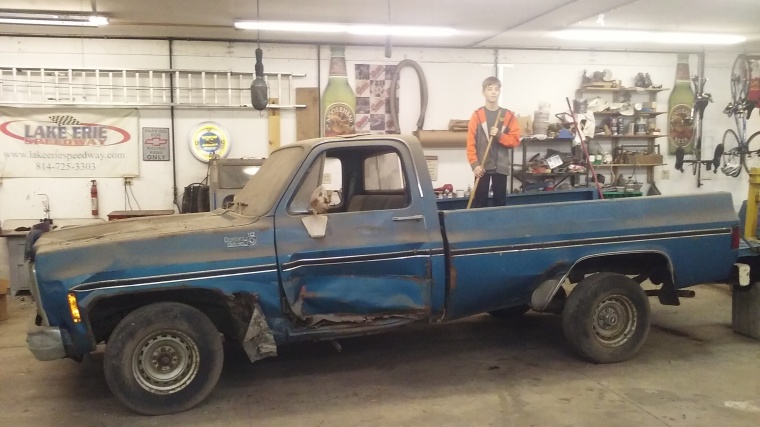
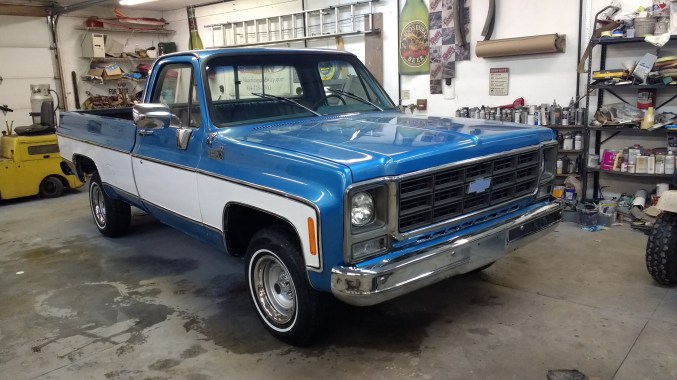
Magraw can. He and his 15-year-old son, Mitchell, are currently rebuilding Magraw’s late father’s ’79 Chevy pickup truck, resurrecting the boxy two-tone with a small-block Chevy engine that he pulled out of a 1988 Camaro a few decades ago.

“It was the last vehicle my father ever owned, and it will be Mitchell’s when we’re done,” he said.

1127151455

Mitchell, 15, in his grandfather’s ’79 Chevy pickup.

IMG_20161228_170342239

The same truck today!

Magraw enjoys working on engines, transmissions, suspensions, and electrical systems. He prefers GM products, but he has worked on Fords and Chryslers, too. He likes old cars.

“Everything today is function over form,” he said. “In the ‘50s and ‘60s a lot of cars were built for style. They weren’t always practical, but they were cool. And loud. They were made to draw attention.”

Magraw said the only part of auto restoration he doesn’t like is body work.

“I’d much rather weld a new frame or rebuild an entire engine than do body work,” he said. “I just prefer the mechanical side of things.”

Applied science

Magraw’s mechanical aptitude comes in handy in his role as a senior laboratory technician in the School of Science. He has responsibility for the physics and chemistry departments, ordering lab supplies, stocking the labs, preparing solutions, serving as a laboratory safety adviser, assisting in designing experiments, and maintaining scientific instruments. He also sets up—and occasionally builds—necessary apparatus.

As you might imagine, Magraw loves nothing more than when a faculty member or student asks him to put his mechanical mind, creativity, and ingenuity to work designing a piece of equipment to assist them in their research work.

“Many times, professors or students will thank me up and down, and I’ll just say, ‘This is my job. I get paid to help you,’’’ Magraw said. “It is pretty cool, though. I’m treated as a colleague, and I get to have wonderful conversations about interesting topics.”

That willingness to help and share his knowledge with others extends to his garage where he often helps friends—and sometimes complete strangers—solve their most puzzling mechanical problems.

“There aren’t that many people who do this kind of work anymore,” he said, “so people come to me when they need help making their old car run.” (See some of the cars he’s worked on in the photo slideshow at the end of this post.)

0603142119

Roses, shmoses… How about a car?

Magraw’s wife, Candace, has a 1977 Camaro that he restored (above). Their daughters, Marie, 20, a Software Engineering student at Behrend, and Julie, 18, both have cars carefully chosen and inspected by their father.

“I express my love for people in cars,” Magraw said.

Fortunately, he has a wife who understands and supports his hobby.

“It helps that she can see how vehicles appreciate over time,” he said. “My Impala that I bought for $3,500 in the 1980s is now valued at $35,000.”

It’s worth noting that Magraw arrived to pick up his wife for their first date in that Impala.

“In fact, if you look in the glovebox, there’s still a map she drew me to find her house for our first date,” he said.

And with that, Magraw reveals that for all his manly mechanical aptitude and macho hotrods, he is at heart a sentimental guy.

To that end, he does not part with the cars he has rebuilt. There are currently five in his 2,400-square-foot, heated-and air-conditioned garage. One more car will fill the spots available. Magraw is saving that space for his dream car—a 1957 Corvette.

“Completely junked and stripped, a ’57 Corvette is still $25,000, but once I restore it, it will be worth as much at $125,000,” he said.

What happens when he fills the garage?

“I’ll have to build another garage,” he said, completely seriously.

You won’t find him in the garage much this time of year, though.

“We work on the cars in the winter,” he said. “Summer is driving time!”

This slideshow requires JavaScript.