Science Alum, Ivy League Ph.D., Bound for Singapore

By Heather Cass
Publications & Design Coordinator, Penn State Behrend

dr-jason-bennett-and-james-pander

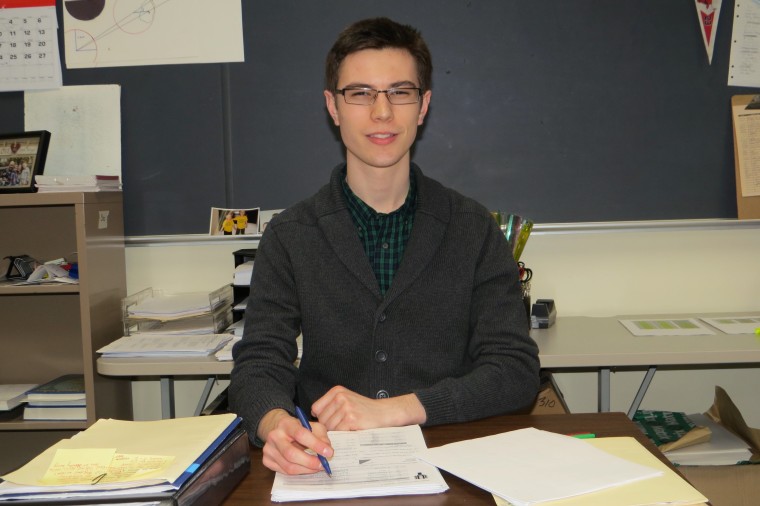
James Pander ’12, seated, and Dr. Jason Bennett, associate professor of chemistry, photographed in 2011 at Penn State Behrend.

James Pander ’12 knew he wanted to be a scientist before he even knew what that might entail.

“I think the inspiration came from movies and TV shows, where you’d have an eccentric scientist character who could seemingly solve any problem,” Pander said. “While those programs were a big exaggeration of reality, I’ve always thought it very inspiring that you can, with enough time, money, and effort, solve just about any problem with science.”

Pander, who graduated from Penn State Behrend with degrees in Chemistry and Mathematics and minors in Physics and Statistics, recently successfully defended his Ph.D. at Princeton University, where he also earned a graduate degree in Chemistry.

He has accepted a research position at the Singapore Berkley Research Institute for Sustainable Energy, and will be moving overseas as soon as all his travel documents are in order and approved.

We caught up with James before he left to learn more about his future plans, his time at Princeton, and how his Penn State Behrend education helped him get there.

What do you like about chemistry?

Out of all the fields of science, I think chemistry is the most interesting because everything is chemistry. Chemistry occupies this interesting space between biology and physics. You can look at the chemistry of living things with biochemistry, or you can delve into the quantum mechanical world to look at the fundamentals of how atoms and molecules interact with each other using physical chemistry. And, in that way, you have a subject that has the flexibility to cover almost everything.

Did you do any research projects with faculty members while you were here?

Yes! I think that research is the single most important part of any science education. In lecture and lab courses, there is always a correct answer and a specific series of steps you take to get to that answer. That is not how the world really works. Actual science is much more open-ended. You have to figure out what information you are trying to find, how to design an experiment to best find that information, and how to interpret your results. It’s so much less straightforward and so much more exciting.

While at Behrend, I worked with Dr. Jason Bennett, associate professor of chemistry. I started in the second semester of my freshman year and worked with him until graduation. My advice for anyone interested in science is to start doing research work early! Talk to a faculty member and jump in. It’s the best way to supplement your education and to get to know the faculty. Dr. Bennett was an amazing mentor and I certainly couldn’t have been as successful as I have been without his support and the support of the rest of the chemistry department.

Was Princeton your first choice for graduate school?

Overall, when I looked at the departmental atmosphere, the professors who work there, and the location, yes, Princeton was my first choice.

Do you think the research experience you had at Behrend helped you get into Princeton?

There is no doubt in my mind that my undergraduate research experience was a big benefit as I was applying to graduate school. In graduate school, your primary job is to do research (classes and teaching are secondary) so there really is no better way to prove to them that you can be successful in that type of environment.

The best thing about Behrend is that you work directly with professors on research work, and that mentorship is invaluable.

Did you feel Behrend prepared you for an Ivy League graduate school?

Definitely. Graduate school was by far the most challenging thing I’ve ever done. A small fraction of people continue on to post-graduate education, so you naturally end up with a group of really smart individuals from all over the world. And that is really intimidating!

You quickly go from being one of the best to middle of the pack. It’s very comparable to the transition between high school and college, and just like during that transition, the most important skill is knowing how to learn. Your job in college is to gain a broad knowledge of a subject, whereas in graduate school your job is to become an expert on a very, very specific topic. So you end up going from having virtually no specific knowledge of a field to becoming an expert in a few years, and most of that is fairly self-focused education, so you need to know how to learn.

I definitely think that Behrend did a great job at preparing me for that, even if though it felt overwhelming at first.

On a lighter note…how did Princeton’s winters compare to Behrend’s?

It was a nice change. Winters got very cold in New Jersey, but there was nowhere near as much snow, which was nice. My least favorite part of winters in Erie was driving in the snow.

You just successfully defended your Ph.D. at Princeton, correct?

Yes. It was a really surreal experience. You spend four or five years working on one specific problem and then it all culminates in writing your thesis and then trying to summarize what feels like your life’s work into a single presentation, which means so much gets left out!

After I was done, everyone was congratulating me and calling me doctor, and I just felt like, wait, I’m the same person I was an hour ago, nothing’s really changed. But, in reality it’s the biggest accomplishment of my life so far. It didn’t really sink in right away. But when it did, it was a great feeling. I’m really proud of the work that I did in graduate school.

So what’s next?

I’ll be working for the Singapore Berkley Research Initiative for Sustainable Energy. It’s a collaborative effort between a few different institutions, including the National University of Singapore and University of California, Berkeley, to research different aspects of sustainable energy with the goal of using solar energy to convert carbon dioxide into fuels. It’s an exciting opportunity!

When will you start there?

Hopefully soon. I’m navigating the visa process right now, so as soon as the Singapore government approves that, I’ll be able to move.

Have you always wanted to work overseas?

No, not at all! The thought had never really crossed my mind, but in graduate school I was given the opportunity to make friends with people from all over the world. Several of them are prolific world travelers and they had a big influence on me. It’s really exciting to travel and see the world, and it really opens your eyes to different cultures and ways of life. It helps you to grow as a person and I’m excited for more of those types of experiences.

What are your long-range career goals?

I’d like to go into industrial research and development. Graduate school is great because you’re adding to the body of knowledge in your field, but in an academic environment, you rarely get to see the direct fruits of your labor. I’m interested in industry because I think I’ll get more of a sense of finality to projects because there will always a specific product in mind.

Anything else you’d like to add?

I just want to thank everyone who has helped me to get where I am today: My parents for teaching me the importance of education and helping me get through college, the faculty members at Behrend—especially in the Chemistry and Math departments—who were all wonderful teachers and mentors, and my colleagues throughout graduate school.

Artistic barrels allow Behrend to save for a non-rainy day

By Heather Cass
Publications & Design Coordinator, Penn State Behrend

abloom

Penn State Behrend is known for its park-like campus with lush lawns, natural wooded areas, raingardens, landscaped pathways, and colorful flowerbeds.

While Mother Nature does a pretty good job of watering at Behrend, there are times the college’s groundskeeping crew has to step in and give parched plants a drink.

But just as a mother’s milk is best for babies, Mother Nature’s “milk” is best for plants. They thrive on natural rain water, which contains no chlorine, ammonia, fluoride, or other chemicals found in municipal water systems.

Now, thanks to a public art project—Don’t Give Up the Drip—conceived and orchestrated by Erie-area environmental agencies, Behrend is able to collect and save rain water for plants in three new fifty-five gallon rain barrels on campus—one at the Health and Wellness building, one at Turnbull Hall, and one at Erie Hall.

These aren’t just plain plastic rain barrels though; they are works of art.

“Our goal was to showcase our local art talent while educating the community about the benefits of harvesting rainwater and water conservation and health,” said Kristen Currier, environmental educator at the Erie County Conservation District, one of the organizations behind the art project.

A total of fifty-two plastic barrels were transformed by forty-six different artists. The barrels then were placed in publically accessible locations throughout the Erie area, including three at Penn State Behrend.

The rainwater will be used to quench the thirst of Behrend’s vast flora.

“Erie receives above average rainfall annually. Still, throughout the summer we experience shortages and the rain barrels are extremely useful then,” said Ann Quinn, director of Greener Behrend, an environmental service club on campus. “The water stored will be used to water nearby plants on our campus in a sustainable, simple way.”

Resulting, of course, in a greener Behrend.

4 reasons to collect rainwater:

  • It is better for your plants — it’s fluoride and chlorine free.
  • It will lower your water usage (and water bills).
  • It cuts down on flooding and erosion of the land around buildings.
  • It reduces runoff — the water that washes pollutants into our streams and lakes during rainstorms.

Behrend’s Barrels

Health & Wellness

“The Green Man” by artist Luke Gehring

Location: Health and Wellness Center


Turnbull

“Save our water” by artist Lewis Prest

Location: Turnbull Hall


Erie Hall

“The Life Cycle of the Monarch Butterfly” by artist Downia Glass

Location: Erie Hall

Want to see all the barrels?

For a map to the location of all the rain barrels in the Erie area, click here.


Class of 2016: Meet Olivia D’Annibale (Biology)

By Heather Cass
Publications & Design Coordinator, Penn State Behrend

Penn State Behrend’s class of 2016 is ready to make its mark on the world!  We’re proud of our students and the things they’ve accomplished and learned while here at Behrend.  We sat down to talk to some remarkable seniors before they left school and we’d like to a few of our students who have overcome challenges, pioneered new technology, participated in important research projects, and left an impression at Penn State Behrend.

Today, we’d like you to meet Olivia D’Annibale:

olivia d'annibale1

Major: Biology, Molecular & Biochemistry option

Minor: Sociology

Hometown: Erie

On choosing to major in Biology: I chose Biology because I wanted to go to medical school. In my sophomore year, I quickly realized that I had a major fear of blood, hospitals, and needles, so being a doctor wasn’t going to work for me. I stuck with Biology, though, because I took a genetics class and absolutely fell in love with it.

Proudest accomplishment at Behrend: I’ve been involved in undergraduate research since my freshman year. I received a Council of Fellows Undergraduate Student Research Award to work with Dr. Michael Campbell in his molecular lab doing research on potatoes and their reaction to a sprout suppressant. Dr. Campbell and I submitted a paper to the American Journal of Potato Research and I just got the news that the paper is officially published online. (Read it here.)

What you’d be surprised to know about her: I’m always carrying a Starbucks cup in my hand, but I actually hate coffee; it’s hot chocolate.

In service to others: I’ve always wanted a career that would allow me to help others, so I was pretty upset when I realized that I wasn’t going to be a doctor. I think that’s why I have enjoyed being involved with the Random Acts of Kindness club. We do things for people without wanting anything, even a thank you, in return. I’ve enjoyed being a resident assistant for the same reason.

On gaining confidence and wisdom: I’m not the same person I was when I came to Behrend four years ago. I was a very shy, timid, 18-year-old who thought she had it all figured out. Now, I’m a confident, 21-year-old who knows she doesn’t have it all figured out and that it’s perfectly OK. I’m not afraid to take life head on. I’ve grown so much here. I wouldn’t trade this experience for anything.

Advice for current students: Don’t be afraid to try new things. I thought I was going to hate the sociology course I took in my first semester of college, and I ended up minoring in it! Some of my best experiences in college have been when I initially felt the most uncomfortable.

Olivia plans to attend graduate school following her graduation in May. In the future, she hopes to be a genetic counselor and help those dealing with genetic diseases and concerns.

Class of 2016: Meet Tyler Tracy (Secondary Math Education and Mathematics)

By Heather Cass
Publications & Design Coordinator, Penn State Behrend

Penn State Behrend’s class of 2016 is ready to make its mark on the world!  We’re proud of our students and the things they’ve accomplished and learned while here at Behrend.  Over the next couple months, we’ll be introducing you to a few of our remarkable seniors who have overcome challenges, pioneered new technology, participated in important research projects, and left an impression at Penn State Behrend.

Today, we’d like you to meet Tyler Tracy

tyler tracy1

Major(s): Secondary Math Education and Mathematics

Minor: Statistics

Hometown: Chippewa, Pennsylvania

On choosing to major in Secondary Math Education: Teaching math is something I’ve enjoyed since high school. Seeing students succeed and grow as individuals is worth all the invested time.

Proudest accomplishment at Behrend: Receiving the Outstanding Math Tutor Award from the college’s Learning Resource Center. My time working as a head math tutor for the LRC and helping so many of my fellow students figure out how math works has been a truly rewarding experience for me.

Mind over math: I think the biggest obstacle for some people who don’t like math is the belief that they are not good at math and never will be. A fixed mindset like that will hinder learning. But if you go into it with a growth mindset and an attitude that you can accomplish anything with hard work and dedication, you’ll be able to learn it.

Campus involvement: I’m the head math tutor for the LRC, a GRE Prep Session instructor, and a teaching assistant in physics. I’m also a member of the math club.

Pre-Health students sew first stitches in medical career

By Heather Cass
Publications & Design Coordinator, Penn State Behrend

IMG_1133

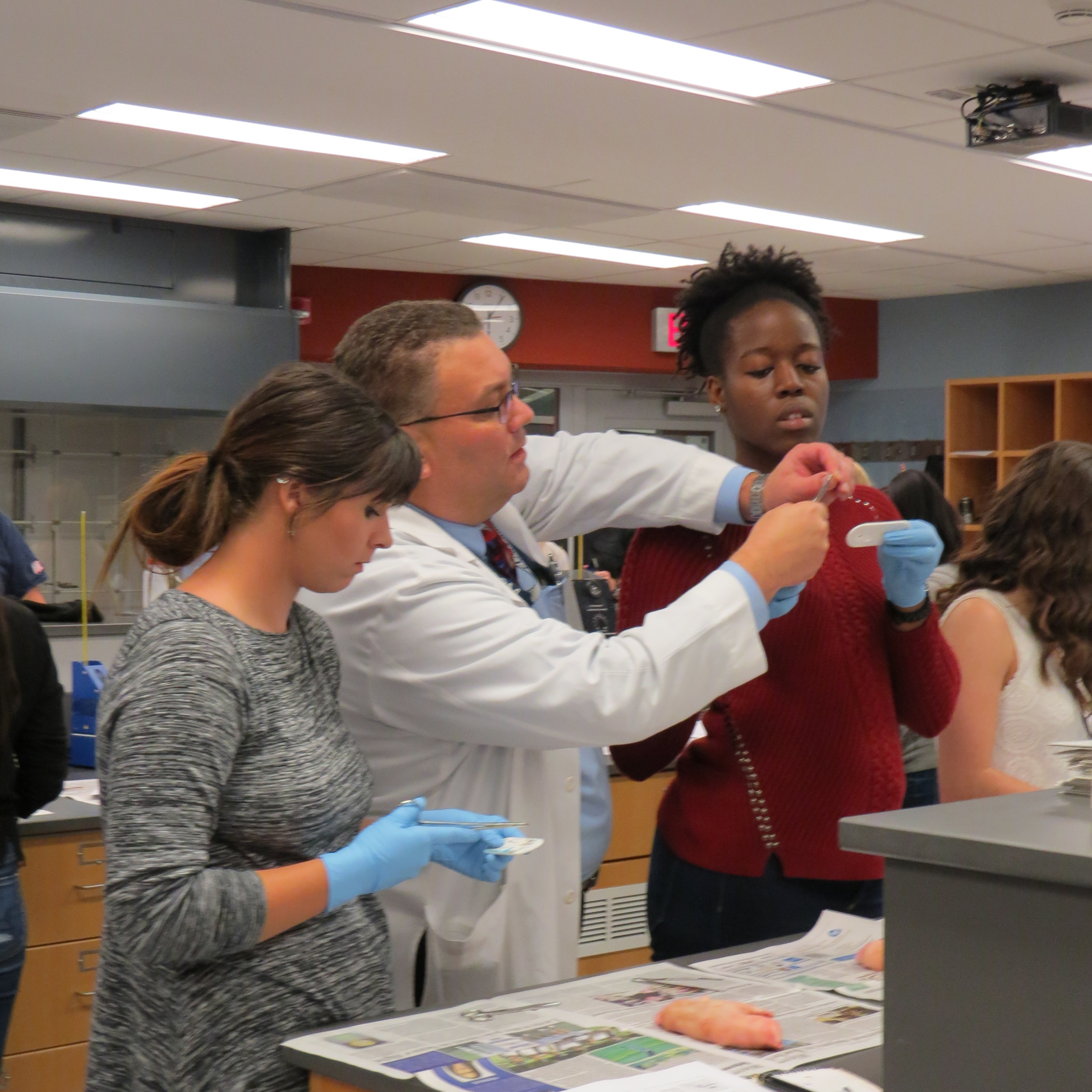
Suturing—sewing together incisions or torn flesh—is a basic technique every doctor must master. It is, however, a skill that few undergraduate students have the opportunity to practice before entering medical school. But, thanks to the U.S. Army and Penn State Behrend’s Pre-Health Professions program, nearly thirty undergraduate students from four area universities were able to try their hand at three types of basic stitches at a suturing seminar earlier this month.

The class, offered by the Army Health Care Recruiting office in Pittsburgh and held at Penn State Behrend, was taught by Dr. Regan Shabloski, assistant dean for clinical education at Lake Erie College of Osteopathic Medicine, and a member of the Army National Guard’s Medical Corps.

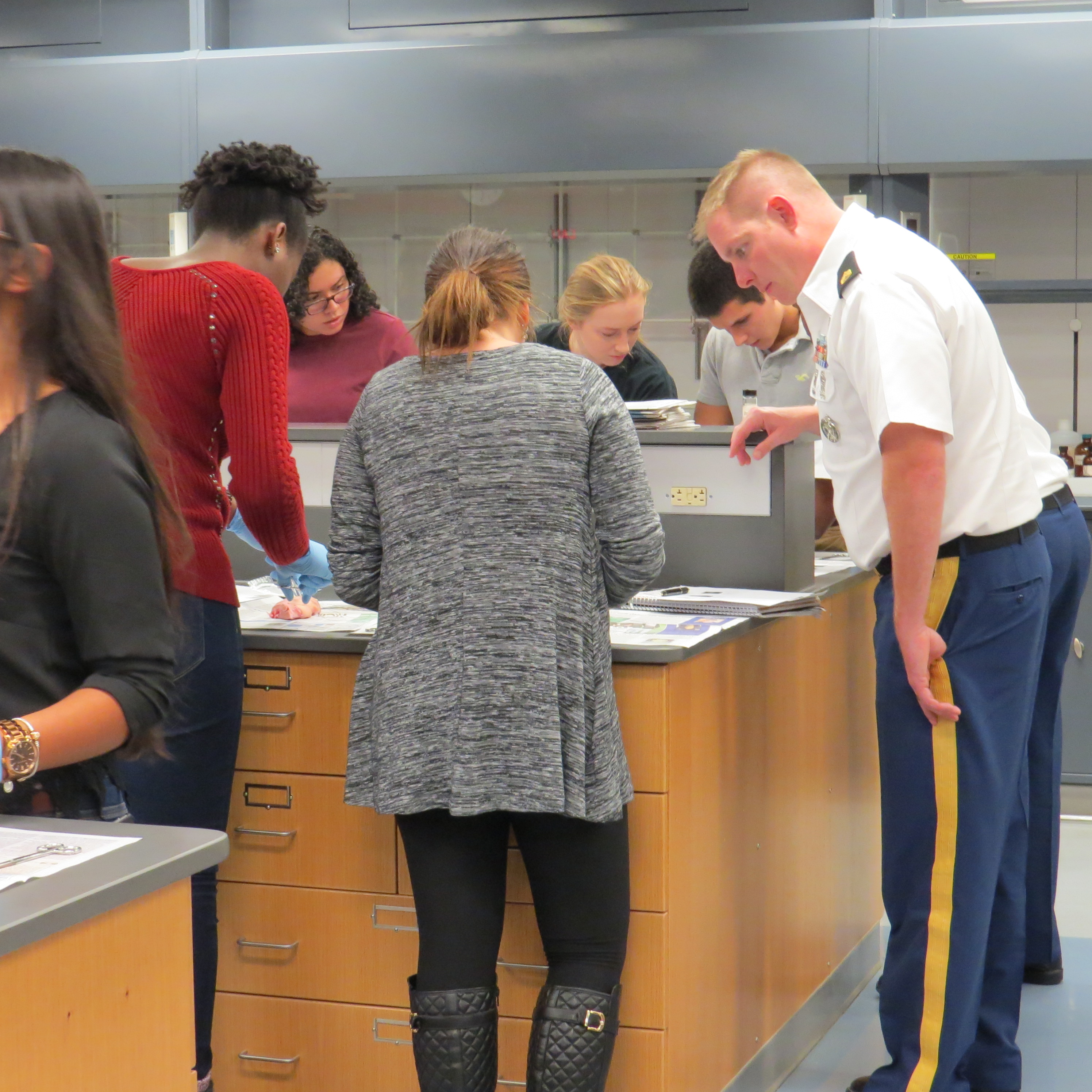
For two hours, students from Penn State Behrend, Allegheny College, Gannon University, and Mercyhurst University worked on severed pigs’ feet, practicing simple interrupted, running, and mattress stitches, using suturing kits provided by the Army.

IMG_1122

Shabloski taught students how to hold the tools, how to start and finish stitching, how to know which stitches to use, how to choose the proper sutures, and the importance of symmetrical sewing.

Straight, evenly spaced stitches are paramount for patients.

“Neatness counts,” Shabloski said as he moved around the room, peering over shoulders at the students’ work. “Suture scars are one of the most visible reminders of your work. Patients care deeply what their scars look like, even if they are in a place where nobody will ever see them.”

Staff Sgt. Benjamin Earle and Staff Sgt. Ricardo Grey, both Army medics, were on hand to assist Shabloski with training.

IMG_1128

The event was sponsored by the Army to bring attention to its Health Professions Scholarship Program, which provides tuition for up to four years of medical school to students pursuing an education at any accredited medical, dental, optometry, clinical or counseling psychology, or veterinary school, in exchange for a four-year commitment to working on an Army base after graduation.

“Students have to apply for this program before they enter medical school, and we were finding that many didn’t know about it until it was too late, so we’ve been making an effort to reach students at the undergraduate level and make them aware of the opportunities available to them through the Army,” Earle said.

Earle is quick to point out that being a doctor in the military does not necessarily mean working in a combat zone.

“We have Army bases all over the world, and on those bases, we have a tremendous need for all kinds of doctors for our soldiers and their families,” Earle said. “We need all the same doctors and specialists that are found in civilian life — OB/GYNs, pediatricians, general practitioners, dentists, and even veterinarians.”

Christina Hilaire, a junior Biology major who wants to be a doctor, participated in the suturing class and said the scholarship program is worth exploring.

“My mother was in the military, so I’ve thought about it,” Hilaire said.

“It is a pretty sweet deal for students inclined to spend a few years working at a military base,” said Dr. Michael Justik, associate professor of chemistry and chair for the Pre-Health Professions programs. Justik helped bring the suturing class to Behrend.

Among the perks? Full tuition paid directly to the medical school, a $20,000 signing bonus, a $2,000+ monthly living stipend, and health insurance, in addition to coverage of school-related expenses, including books, fees, and medical supplies.

It’s a deal that, according to Earle, only gets sweeter after graduation when the newly-minted doctors are admitted to the Army at the level of an officer.

“They are able to practice medicine at Army bases throughout the world without concerns about billing, overhead expenses, or malpractice premiums,” he said. “Many enjoy the lifestyle and stay in the service past their required commitment,” Earle said. “But, even if they don’t and they only put in their four years, we feel that’s a fair deal.”

The military recruits medical professionals in northwestern Pennsylvania because it’s rich in universities and medical facilities.

“Erie is a wonderful place to prepare for a medical career,” Justik said. “We have three hospitals in the area as well as LECOM, a top osteopathic medical school, all of which provide various learning opportunities for pre-health students.”

Here is what some of the students had to say about the suturing experience at Behrend:

  • “It was a fantastic event that helped solidify my career choice. I want to be a surgeon and the suturing class made me realize that it really is what I want to do for a living.” — Stephen Wells, a Penn State Behrend senior Biology major.
  • “It was really helpful to have Dr. Shabloski and the Army medics right there helping us and giving us tips. I took a similar suturing class in high school, but I learned some new and different techniques in this class.” —Thalia Soto, a Penn State Behrend sophomore majoring in Chemistry. Soto wants to be a pediatric surgeon.
  • “I really enjoyed it because it was an opportunity to do some hands-on learning, which is not often a part of the pre-med curriculum.” —Margaret Dunlop, a Penn State Behrend sophomore majoring in Psychology. Dunlop wants to be an orthopedic surgeon.
  • “The suturing class was a great learning experience in a fun, low-pressure setting. It was an excellent opportunity to do one of the many tasks that doctors and health professionals perform almost daily.” — Bethany Kelley, a Mercyhurst University sophomore Pre-Medical major. Kelley wants to be a physician assistant.

Click here for more information about Penn State Behrend’s Pre-Health Professions programs.

Click here or email Benjamin.d.earle2.mil@mail.mil for more information about the Army’s Health Professions Scholarship Program.

This slideshow requires JavaScript.

Behrend alumni lead textbook company’s transition to digital age

Totzke, Dauber Berlin (32)
Behrend alumni Erika Dauber Berlin and Matthew Totzke are challenged with running a textbook company, Larson Texts, in the 21st century.

By Steve Orbanek
Marketing Communications Specialist, Penn State Behrend

In an age dominated by tablets and tweets, the prospect of running a textbook company might seem daunting. There’s nothing “textbook” about the operations of Larson Texts, however.

Technology has changed the game, but the Erie-based company has continued to adapt.

“The physical book is still valuable, but the way you get your hands on it is much different,” says Matthew Totzke, CEO of Larson Texts and a Penn State Behrend mathematics alumnus. “The technology now allows us to do a much better job of enhancing the learning experience.”

Larson Texts was founded more than 30 years ago by Ron Larson, then a professor of mathematics, now emeritus at Penn State Behrend. At the time, Larson was responding to what he saw as the need for more student-friendly math textbooks.

Today, the company produces math textbooks for sixth grade through college-level calculus classes that are used by more than five million students each year. Larson has also published textbooks for such well-known educational publishers as Cengage Learning, Houghton Mifflin Harcourt, Pearson, and W. H. Freeman and also publishes its own textbooks through Big Ideas Learning and AndYou.com.

Publishing a book, involves more than producing a physical textbook. With every college-level textbook that Larson Texts creates, the company also develops a fully-responsive companion website for all platforms: desktops, tablets and smartphones.

“We’re able to access so much more information than ever before. Now, we can really blend a great print book with strong digital content,” Totzke says.

That type of digital content featured on the companion sites includes worked-out proofs, instructional videos, rotatable graphs and downloadable data. All of these tools are great reference materials for students.

“There’s a lot of modeling in mathematics that you just can’t show on a print page,” Totzke says. “We put together interactive explorations that bring three-dimensional concepts to a workable medium.”

Being ahead of the digital curve is no new development for Larson. In 2001, the company created the website CalcChat as a tool that students could use to double check answers to questions posed in textbook exercises.

The site has since been supplemented by a tutor component and corresponding Twitter and Facebook accounts where students can talk with an actual tutor if they are struggling with a particular problem. Larson Texts monitors the tutor conversations as a way to gain feedback and develop solutions in areas in which students are continually struggling. According to Totzke, an estimated six million upper-level high school and college students have used the CalcChat service since 2010.

Through Big Ideas Learning, Larson publishes its own primary-school level books, a market segment the company expects to see expand as schools catch up to colleges and universities in terms of technology.

“Schools are beginning to have the infrastructure to embrace some of this technology,” says Erika Dauber Berlin, vice president of technology at Larson Texts and a Penn State Behrend communication & media alumna. “We have to draw inspiration from a lot of different areas and then anticipate how we’ll meet teachers’ needs into the future.”

It may not be the “textbook” method for creating educational publications, but Totzke would not have it any other way.

“We consider this to be an opportunity,” he says. “We’re able to deliver high-quality educational materials like we’ve never done before.”

Move over, Bill Nye. Penn State Behrend has its own ‘Science Guy’

By Steve Orbanek
Marketing Communications Specialist, Penn State Behrend

Joel Solomon (3)
Joel Solomon, a physics major, was the recipient of this year’s T. Reed Ferguson Award. The award recognizes a junior who has demonstrated scholarship, leadership and citizenship through academic and out-of-class involvement and gives promise of further achievement in the senior year.

For some kids, it’s Cartoon Network. For others, it’s Nickelodeon. For Joel Solomon, it was the Science channel?

“Growing up, I just always watched that channel,” says Solomon, who recently completed his junior year at Penn State Erie, The Behrend College. “I was fascinated by what humanity has been able to do over the years, and I knew that I wanted to be a part of that.”

Math and science resonated with Solomon, and that interest led the New Wilmington, Pa., native to Penn State Behrend. As he got older, he knew he wanted to pursue research in college, and he could think of no better destination than Behrend.

“Being able to get a great education at a small campus is great,” says Solomon, a physics major. “I was looking for a research-oriented institution, and Behrend is one of the few schools in the region that offers such opportunities. I know that with a degree from here, I can go anywhere that I choose.”

This past year, Solomon collaborated with Bruce Wittmershaus, associate professor of physics, on a research project titled, “Concentration Dependence of Coated Gold Nanoparticles for Metal Enhanced Fluorescence.” The project was recognized as the Best Poster Presentation this past April at the Sigma Xi Undergraduate Student Research and Creative Accomplishment Conference.

Undergraduate research has been a big part of his time at the college, but Solomon’s interests go beyond the academic realm. For the past three years, he’s been a goalie on the men’s soccer team. This past year, Solomon was inducted into Chi Alpha Sigma, a national society that honors collegiate student-athletes who excel in both the classroom and in athletic competition. The society recognizes student-athletes who received a varsity letter in their sport while maintaining a cumulative GPA of 3.4 or higher throughout their junior and/or senior years. Solomon is also a former AMCC All-Academic selection.

“I feel as if soccer complements my academics. Just being physically active helps me keep up with my coursework,” he says.

Solomon’s accomplishments on the field and in the classroom played a key role in his receiving the 2014-15 T. Reed Ferguson Award last April at the college’s 66th annual Honors and Awards Convocation. The award recognizes a junior who has demonstrated scholarship, leadership and citizenship through academic and out-of-class involvement and gives promise of further achievement in the senior year.

“I was very happy to receive the award, and it was nice to know my work is paying off,” Solomon says. “It just reassured me that I’m on the right path, but I know there’s more that I can do.”

Solomon will get the chance to fulfill that promise of further achievement this fall, continuing his undergraduate research as the recipient of a grant to explore the topic of “Enhancing the Photostability of Fluorophores Using Metal Enhanced Fluorescence.”

For the future, Solomon plans to attend graduate school and possibly work with optics. His ultimate goal, though, has its roots in the programs he watched on Science as a boy.

“My dream job is always going to be something with NASA. I have always been fascinated by all of NASA’s accomplishments,” he says, “so that’s the dream, and that’s what I’ll keep working toward.”

Behrend students, faculty to lead fight against invasive species in Wintergreen Gorge

With funding from the Western Pennsylvania Conservancy, Pennsylvania Sea Grant and Behrend are working to develop a weed  management plan that brings students and community members together to remove invasive species.

By Anna McCartney

Communications and Education Specialist at  Pennsylvania Sea Grant, an outreach program of Penn State Behrend  

Wintergreen Gorge along Fourmile Creek is a popular destination for hikers, birders, fossil-hunters and others who simply use the stream to cool off on a hot day.

Because it’s also a favorite of Penn State Behrend students, they are involved in creating a weed management and implementation plan to develop best management practices that protect the Gorge from invasive species.

With funding from the Western Pennsylvania Conservancy (WPC), and help from Pennsylvania Sea Grant (PASG) and Behrend faculty, they are working to develop a Weed Warrior program that brings students and community members together to remove invasive species that are found there.

IMG_3440 PSU PASG Weed Warriors wintergreen gorge R

Students will also help develop a Best Practices Guide that can be used by other universities and communities to control invasive species on their campus or other natural areas.  

In May and June, students will learn to identify target invasive plant populations and use GPS equipment to inventory and track them on a baseline work map so they can prioritize future removal efforts. The data they collect will be added to existing information provided by the WPC about rare, threatened or endangered plant species so the plan will protect these assets while eliminating the harmful plants.

The management plan will require students to conduct research and determine immediate priorities and the best course of action to combat invasive species within the identified areas. Based upon the site conditions, students will also need to consider how to reintroduce native species once the invasives are removed.

Marti Martz, PASG senior outreach and project facilitator, anticipates that engaging Penn State students and community members in this effort will provide several benefits. “There will be more ‘boots on the ground’ to help with removal and more opportunities to discuss impacts of invasives on native plants and the insects and animals that rely on these natives. Once people understand how invasive species degrade a habitat, they will be more vigilant about what they bring into their own yards,” she said.

Sea Grant will also work with Ann Quinn, director of Greener Behrend, and the students to develop a Best Practices Guide that can be used by other universities or communities that want to control invasive species on their campus or other natural areas.

IMG_3463

Tom Cermak, Pennsylvania Sea Grant coastal outreach specialist, helps Behrend students remove invasive bush honeysuckle from Wintergreen Gorge.

“This project not only provides valuable, hands on experiences for students, but it also protects and enhances the ecological integrity of a wonderful community asset,” said Tom Cermak, PASG coastal outreach specialist who is working with students to identify, track and remove invasives.

“We at Behrend are very excited to work with Sea Grant to eliminate invasive plant populations throughout Wintergreen Gorge. As these aggressive species are removed, they will be replaced with native plant communities, which will increase biodiversity and help keep the Wintergreen Gorge Ecosystem in balance, ” said Quinn.

You can help maintain the beauty of this popular hiking and biking trail by volunteering to remove plants at planned workdays this summer. Contact Ann Quinn at 898-6993 or abq1@psu.edu.

nps.gov bush honeysuckle1D0EC7E8-155D-451F-678FFC8BDF8B607F-large

Bush honeysuckle is a deciduous shrub that can grow up to 15 feet. This aggressive invader displaces many native plants, including wildflowers and dogwoods.

multiflora rose Penn State

Multiflora rose (above) steals space, nutrients, water, and sunlight from native plants and trees.

Nursing students greeted with ‘surprise’ patient

Brenna Lanager, Hunter Olsen, Nerissa Rich (2)
Brenna Lanager played the role of an elderly patient this past fall in a NURS 112 class. Students Hunter Olsen and Nerissa Rich were tasked with trying to prepare Lanager for surgery as part of the simulation.

By Steve Orbanek
Marketing Communications Specialist, Penn State Behrend

When Margaret Kertis, a lecturer in nursing at Penn State Erie, The Behrend College, pulled back the curtain that hung over the bed where a mannequin would normally lie, students in her NURS 112 course were quickly taken aback. The mannequin that they had grown accustomed to was no longer there.

In its place laid a young woman, but if not for her soft complexion and inherent youth, you might think otherwise. Her clothing looked to be something straight out of a Laura Ingalls Wilder novel. Her hair was dabbled in talcum powder. Her hands clenched a rosary.

“Their faces were priceless when they pulled the curtain back and saw that there was a person there,” said Brenna Lanager, a sophomore psychology major who happened to be the woman lying in the bed.

Lanager’s role that day was as a patient actor.

“The first-year nursing students had gotten so accustomed to performing skills on the low-fidelity mannequins that do not communicate, so I wanted them to focus on interacting and communicating with a ‘real’ person,” said Kertis, who taught the NURS 112 course this past fall. “The scenario involved preparing an elderly patient for surgery.”

As the students soon learned, preparing an elderly patient for surgery is easier said than done.

Lanager, who has previous acting experience from a theater course she took at Behrend, was not exactly the model patient.

“I was playing the role of Brenna Brake, an old woman who had fallen down the stairs while doing laundry. I was supposed to have a hearing aid, but I left it at home, so I kept asking the nursing to repeat what they were saying. I was also very religious and refused to give up my rosary.” Lanager said. “I could tell everyone was nervous, but they did a great job of putting on that nurse face, and getting the job done.”

For the students, the interaction with Lanager was invaluable.

“You get real emotions. Yes, they’re acting, but they’re still a real person, and it’s still person-to-person contact,” said Hunter Olsen, a sophomore nursing major who was part of the NURS 112 class.

For her part in the course, Lanager earned extra credit points as part of her THEATER 102 course. It also was an eye-opener for the Hawk Run native: her mother works as a nurse.

In the future, Kertis said she hopes to again utilize patient actors. Lanager is also eager to volunteer her services one more time.

“It was really cool to see what the nursing students were going through from that perspective,” Lanager said. “I would definitely do it again. It was so much fun.”

Career Roundtable educates School of Science students on available opportunities

DSC_0963
Todd Thorniley, a 2014 Penn State Behrend biology graduate, now works as a quality control technician at Southern Tier Brewing Company in Lakewood, New York. On Wednesday, March 25, he was one of the alumni who returned to Behrend to educate current School of Science students on the opportunities available to them during the Career Roundtable for Biology and Chemistry Majors.

By Steve Orbanek
Marketing Communications Specialist, Penn State Behrend

For a biology or chemistry graduate, there’s no shortage of opportunities. Environmental consultant, genetic counselor — even a quality control technician for a brewery.

“Students have no idea how much they can do with their degree,” said Todd Thorniley, a 2014 biology graduate of Penn State Erie, The Behrend College, who now works as a quality control technician for Southern Tier Brewing Company in Lakewood, New York. “It’s not just medical. It’s not just research. You can go work with beer, too.”

Emphasizing the diverse career paths available to students was one of the purposes of the Career Roundtable for Biology and Chemistry Majors, a networking event hosted by the School of Science at Penn State Behrend on Wednesday, March 25.

Designed like a round of speed dating, professionals who work in science-related fields were seated at tables in McGarvey Commons. A group of six to eight students was also seated at the table.

For ten minutes, professionals discussed the tasks, challenges and requirements of the jobs they perform every day. At the end of ten minutes, the professionals moved on to the next table, and the process repeated.

“The structure of the event really allows students to hear about a number of career paths in a relatively short amount of time and begin networking,” said Beth Potter, assistant professor of biology who coordinated the event. “The event is great for freshman as well as seniors, who still may not know what they want to do.”

During the two-hour event, more than 100 students interacted with 10 professionals, many of whom were Penn State Behrend alumni, representing companies that included Michael Baker International, the Pennsylvania State Crime Lab, PerkinElmer Genetics, Southern Tier and Lake Erie College of Osteopathic Medicine.

One of the alumni in attendance was 2013 graduate Leah Wolfe, who attended the same event while she was a student.

“When I attended, I wasn’t sure who I wanted to be, what I wanted to be or where I wanted to go,” said Wolfe, who is now pursing a master’s degree in orthotics and prosthetics from the University of Pittsburgh. “But actually hearing from these professionals was so helpful.”

Denise DeVore, a sophomore biology major, was one of the students in attendance at the Career Roundtable. She hoped the event would have the same effect on her that it had on Wolfe years earlier.

“I’m interested in pediatrics, but I’m not entirely sure that’s for me,” DeVore said. “I feel like this is going to help me narrow it down to what I want to do because there are so many options out there for a science major.”