Penn State Behrend’s class of 2022 is ready to make its mark on the world! We’re proud of our students and the things they’ve accomplished and learned while here at Behrend. Over the next several weeks, we’ll be introducing you to a few of our remarkable seniors who have overcome challenges, pioneered new technology, participated in important research projects, and left an impression at Penn State Behrend.
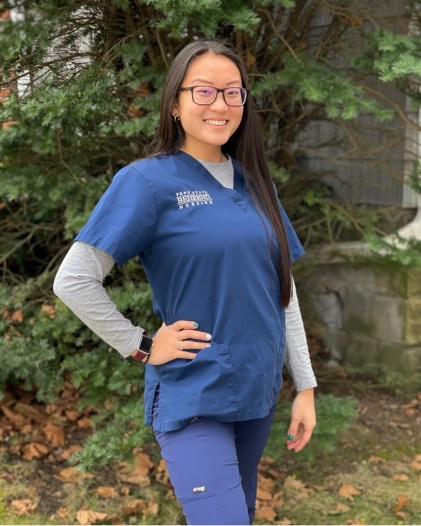
Today, we’d like you to meet Danielle Kosslow:
This slideshow requires JavaScript.
Major: Dual major in Mathematics and Secondary Education in Mathematics
Hometown: Pittsburgh, Pennsylvania
Scholarships: I have received the Chancellor’s Scholarship, Council of Fellows Leadership Scholarship, Riley Ride Alumni Scholarship, Schreyer Honors College Scholarship, and Robert Noyce Teacher Scholarship.
On choosing Behrend: I felt right at home when I walked on campus. It feels like we are tucked away in our own little world. Also, the opportunities are endless. Because Behrend is a smaller school, it allowed me to develop great professional relationships with my professors, while also gaining life-long friends.
On choosing her major: I started at Behrend as a nursing major. It was a big switch to mathematics, but I love math and I have always loved working with people and helping others. So Secondary Math Education allowed me to do both. I added a Mathematics degree because I am a big nerd and math is a perfect fit for me, so why not?
Proudest accomplishment at Behrend: I am on the Behrend volleyball team, so my proudest accomplishment here would have to be winning the AMCC championship twice and getting to participate in the NCAA D3 volleyball championships. I learned and played a new position, and made first-team, all-section, this year, which was just awesome. From an academic standpoint, my proudest accomplishment would have to be maintaining a 3.96 GPA while at Behrend.
Campus involvement: I am on the Behrend women’s volleyball team, the National College Athlete Honors Society (Chi Alpha Sigma), and the Math Club.
Awards and recognitions: I received the President’s Freshman Award, Academic All-AMCC, First Team All-Conference AMCC, Third Team All-Conference AMCC, and All-Academic AMCC.
What makes her unique: What sets me apart is that I am a student athlete, a dual major, a Noyce scholar, and I work at three different jobs at Behrend. I am involved in many different activities, and I juggle all of them while also having time to have some fun with friends.
What you’d be surprised to know about her: I think people would be surprised to know that I used to play the drums and had a full set at home.
Her passions: I am deeply passionate about contributing to teaching the next generation. I have loved every second of working with kids so far, and I am excited to continue. I am also extremely passionate about volleyball. It has been a part of my life for the past ten years, so it plays a significant role in my day-to-day schedule. I want to keep incorporating this sport in my life and plan to coach my own team. I volunteer as a coach every summer, so I would like to build on that.
Advice for first-year students: My main advice would be to just get involved in many different things. My freshman year I was shy and nervous about everything I did. As the years went on, the more involved I got, the more I grew as a person. If I had not forced myself to get involved around campus, I would not have made as many friends and had the same opportunities I have now. Study hard but make sure you have some fun. It goes quick and you never want to look back and say to yourself, “what if?”
After her graduation in May, Danielle plans to stay in Erie and teach mathematics in a high-needs school district.
Penn State Behrend’s class of 2022 is ready to make its mark on the world! We’re proud of our students and the things they’ve accomplished and learned while here at Behrend. Over the next several weeks, we’ll be introducing you to a few of our remarkable seniors who have overcome challenges, pioneered new technology, participated in important research projects, and left an impression at Penn State Behrend.
Today, we’d like you to meet Marie Tomasula:
Major: Nursing
Hometown: Buffalo
Why she chose Behrend: I love the small class sizes, which give you a chance to really get to know the faculty and staff. I fell in love with Behrend as soon as I toured it. I knew it would make a great home away from home.
On choosing Nursing: I have always been passionate about caring for others, especially in medicine. I want to give back like the amazing nurses who have cared for loved ones in my family.
Proudest accomplishment at Behrend: Stepping out of my comfort zone in my personal and academic life. I joined several clubs and organizations and did things that I could never have imagined myself doing before. Behrend has allowed me to grow in ways that I never thought I could.
Campus involvement: Member of Alpha Sigma Alpha and the Student Nurses’ Association Pennsylvania (SNAP), where I’ve held several leadership positions. I served as a Welcome Week guide in my sophomore year.
On being kind: I would say my ability to easily empathize and relate to others makes me unique. I love being able to connect with people and to hear their stories. Making others smile is what makes me happy. I enjoy spreading kindness, especially to those who need it most.
What you’d be surprised to know about her: I played the flute for nine years and participated in the New York State Conference All-State Wind Ensemble during my junior year of high school. Playing flute was my “escape” during my high school years.
Her definition of the good life: Living a life that you are proud of. I am a firm believer that our life should consist of things that fulfill us and make us the happiest. Surround yourself with people who make you feel good and do things that feed your soul.
For the kids: I am very passionate about pediatric oncology. I am currently a member of the Coalition Against Childhood Cancer, a collaborative network of nonprofits, corporations, and individuals from 36 states and five countries, supporting and serving the childhood cancer community. We work to help families experience improved outcomes through collaborative projects, optimizing research efforts, and by creating awareness of childhood cancer.
On helping others fight cancer: I’m currently working as a nurse intern on the leukemia unit at Roswell Park Cancer Institute in Buffalo. It has helped me to understand the role of an oncology nurse, and I have loved being able to help patients and their families during a very hard time in their lives.
Advice for first-year students: Step out of your comfort zone. College can be intimidating in your first year, but going to events on campus and getting involved can really transform your entire college experience.
After her graduation in May, Marie plans to work as a Registered Nurse at Roswell Park Cancer Institute in Buffalo.
Penn State Behrend’s class of 2022 is ready to make its mark on the world! We’re proud of our students and the things they’ve accomplished and learned while here at Behrend. Over the next several weeks, we’ll be introducing you to a few of our remarkable seniors who have overcome challenges, pioneered new technology, participated in important research projects, and left an impression at Penn State Behrend.
Today, we’d like you to meet Phoebe Will
Major: Biology – Ecology, Evolution, and Behavior option
On choosing Behrend: I thought the campus was gorgeous and really liked that there was wildlife surrounding the campus. Since attending, I’m even happier I chose Behrend because the professors in my program are amazing and have been so much fun to work with!
On choosing her major: I really love working with animals and always knew I wanted to work with them in some capacity, so I thought biology was the best option.
Proudest accomplishment at Behrend: Participating in three years of salamander population dynamics research with professors. I also designed “Amphibian Crossing” signs that were installed on Technology Drive to help protect a lot of different types of amphibians that cross the road each spring from the forest to the spring breeding ponds near the AMIC building.
Campus involvement: I was vice president of Tri-Beta (Biological honors fraternity) for two years and a Resident Assistant for two years.
What makes her unique: I’m one of only a few biology majors who chose the Ecology, Evolution, and Behavior option.
What you’d be surprised to know about her: I have twenty-four pets: a dog, three cats, six chickens, two ducks, four axolotls (a type of salamander), a betta fish, five snails, a snake, and a gecko.
And those pets are her passion: I can’t imagine living without them. They’ve made college stress so much easier to deal with.
Advice for first-year students: Do some research on what your options are after college, so you can plan accordingly. You don’t have to know exactly what you’re going to do, but think about your next step and whether you want to find work right away or go onto a master’s program.
After her graduation in May, Phoebe plans to attend graduate school to earn a master’s degree in biology.
In a big (T-Rex size) twist on the traditional Easter egg hunt, the Penn State Behrend Biology department is hosting a Prehistoric Egg Hunt for children on Saturday, April 16, from 11:00 a.m. to 1:00 p.m.
Kids in preschool through sixth grade are invited to sign up to participate in this fun event that will include individual dig sites to excavate plastic eggs, dinosaur-themed trivia games, fossil-making, and a recycling project to celebrate Earth Day.
Dino décor, a costumed character, dinosaur game prizes, and cookies are all part of the fun.
“I have wanted to do this event for so long,” said Dr. Beth Potter, associate professor of biology. “Kids find dinosaurs fascinating and we need to celebrate their first love in the field of biology!”
The event is free, but attendance is limited and registration – in half-hour time slots — is required. Students must be accompanied by an adult caregiver to the event, which will be held in the college’s Science Complex on the second floor of Roche Hall.
Planetarium Director Jim Gavio will be doing 15-minute presentations beginning at 11:00 a.m. about the Chicxulub Crater, a 125-mile-gash in the Yucatan Peninsula’s Gulf of Mexico created by an asteroid. Researchers have new evidence suggesting the asteroid blocked the sun’s light on earth for decades, explaining the extinction of the dinosaurs.
While you’re there, catch a show at Yahn Planetarium: The 1:00 p.m. show, “Unveiling the Invisible Universe,” for youth ages 9 and up; or the 2:30 p.m. show, “The Sky Above Mister Rogers’ Neighborhood,” for children ages 4 and up.
All Yahn Planetarium programs will be free on April 16.
By Heather Cass, Publications Manager, Penn State Behrend
Why did the amphibian cross the road? To lay eggs on the other side.
The area around Penn State Behrend’s Advanced Manufacturing and Innovation Center (AMIC) in Knowledge Park is an amphibian’s paradise. Woods give way to marshy areas and small ponds, some tucked safely behind trees and shrubs, providing the perfect habitat for frogs, salamanders, and newts that live in woods but breed in water.
Each spring, a parade of amphibians crosses Technology Drive and the AMIC parking lot to reach the ponds where they can lay their eggs. Many don’t make it, falling victim to vehicle traffic or plunging through the grates that cover road drainage tubes. Motorists passing by may not notice, but the faculty members and students in Behrend’s Biology program who study spotted salamanders do.
“Frankly, we’ve seen too many road-killed amphibians and egg-laden females stuck in the drains to not try to do something about it,” said Dr. Lynne Beaty, assistant professor of biology. “They’re not alone, though, as many wood frogs, red-spotted newts, and spring peepers also face those same hazards to reach breeding ponds in the spring.”
Beaty reached out to the college’s Maintenance and Operations (M&O) department with two solutions to mitigate the problem. One was to install “amphibian migration route” signs to encourage drivers to pay attention to amphibians on the asphalt. The second solution involves placing a mesh covering over the drains in the area to prevent small amphibians from falling through on their way to their breeding sites.
The signs, which were designed by senior Biology student Phoebe Will, are now installed, and a team of engineering students is working with M&O to create the mesh coverings for the drains.
“Our Maintenance and Operations group is always willing to help the college achieve its academic and research missions, especially when that involves protecting wildlife,” said Randy Geering, senior director of operations.
So, if you regularly travel Technology Drive, please go slow and keep an eye out for wildlife!
Penn State Behrend’s class of 2022 is ready to make its mark on the world! We’re proud of our students and the things they’ve accomplished and learned while here at Behrend. Over the next couple of months, we’ll be introducing you to a few of our remarkable seniors who have overcome challenges, pioneered new technology, participated in important research projects, and left an impression at Penn State Behrend.
Today, we’d like you to meet Brianna Scanga:
Major: Nursing
Hometown: Vandergrift, Pennsylvania
Scholarships: Dr. and Mrs. Arthur W. Phillips Scholarship for Schreyer Scholars; Council of Fellows Leadership Scholarship; Audrey Herbert Sweny Scholarship for Nursing; Behrend Academic Excellence Award; and Irvin Kochel Lion Ambassador Fund.
On choosing Behrend: It was one of the most beautiful campuses I have ever seen. Also, it was far enough, but not too far from home and I liked the professor–to-student ratio. I got to know my professors well and they got to know me, too. I felt like I was part of a family here.
On choosing her major: From personal experience, I’ve seen the impact that nurses have in people’s lives. It inspired me to want to be like them. I have always enjoyed taking care of children, and I believe being a pediatric nurse is what I was destined to do.
Proudest accomplishment at Behrend: Maintaining a GPA above 3.9 while also taking on multiple leadership positions, participating in a variety of clubs, and working on and off campus.
Campus involvement: I was a member of Behrend Benefitting THON for 2 years and traveled to THON at University Park. I have been a Lion Ambassador since my first year and serve as Treasurer for the group. I’m a member of Alpha Sigma Alpha Sorority, the Behrend Honors Program and Schreyers Honors College, and the Student Nurses Association of Pennsylvania. I have been a tutor with the Learning Resource Center and a Resident Assistant for three years. This year, I was finally able to participate in Welcome Week as a guide. It was so much fun!
Awards and recognitions: President’s Freshman Award for maintaining a 4.0 GPA my first year at Behrend and the Irvin H. Kochel Award for outstanding involvement, and I’ve been on the Dean’s List every semester.
What makes her unique: I was adopted from China when I was nine months old and brought to the United States. I am forever grateful for my parents, family, and friends who I have loved growing up, and I wouldn’t change my life for anything. I was given such a great life, and I have learned to never take what I have for granted. I have not been back to China since, but I do wish to visit my hometown when the pandemic is over.
Sunny side up: I am pretty good at staying positive and keeping morale up when things go bad. I always try to see the good in people and in situations.
Her definition of the good life: Living a life without regret. Try new things. Do things that scare you and do not let fear get in the way of your dreams.
Advice for first-year students: Join as many clubs as you can and attend lots of social events on campus. I loved attending the Lion Entertainment Board (LEB) events and the Lion Ambassador’s Midnight Bingo. I made some of my best friends in college this way.
Brianna has accepted a position at UPMC Children’s Hospital of Pittsburgh in the Pediatric ICU (PICU) after her graduation in May. She also plans to go back to graduate school to become a pediatric nurse practitioner.
By Heather Cass, Publications Manager, Penn State Behrend
The weeks between Thanksgiving and the end of the semester are notoriously rough for almost everyone on a college campus. Professors kick it into high gear to cover remaining material before final exams. Students scramble to stay on top of their work and study for finals. Staff and administrators work feverishly to plan for the start of the new semester that will follow break.
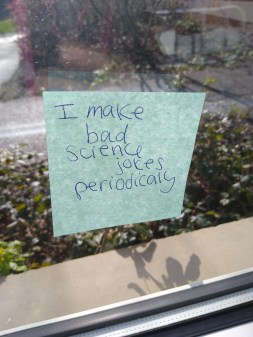
Penn State Behrend’s School of Science Ambassadors are no strangers to the tense atmosphere in those few weeks, so they decided to toss a little sodium hydride into the water with a bunch of eye-catching colorful sticky notes plastered on the glass walls in the breezeway between the Otto Behrend building and the Science Complex.
“At our first Science Ambassadors meeting this year, we discussed doing something fun to brighten up the science buildings,” said Lauren Barmore, a senior Biology major, who helped spearhead the project. “There was a group of four of us who put the wall up the Friday before Thanksgiving break. We wanted it to be a surprise for the students when they returned.”
The students who wrote the initial notes—Barmore, Taylor Romania, Briona Bargerstock, and Jacob Kessler—penned notes that reflect the material taught in the School of Science.
“We wanted to put our own spin on it,” Barmore said. “A lot of our professors put jokes and memes into their learning materials, so we were sort of influenced by them.”
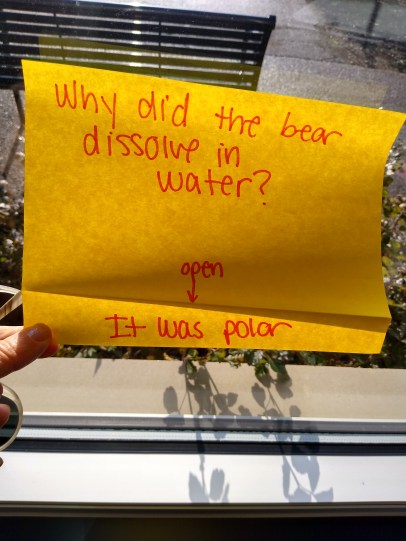
The messages on the notes range from inspirational to encouraging to laugh-out-loud funny. Most contain math or science references guaranteed to make readers chuckle:
Or groan:
Or, if they are non-science majors, scratch their heads.:
A similar display of sticky notes can be found in the stairwell in the Reed Union Building. That project began several years ago and continues. thanks to the college’s Random Acts of Kindness (RAK) club.
It’s a popular campus feature and one that Barmore has used.
“I always loved taking notes from the RAK stairwell and giving them to my friends before exams or if they were having a rough day, or needed a laugh,” she said. “I’ve found that the smallest acts of empathy or service can have a big effect on people. We wanted to bring some of that color and joy to our side of campus.”
The notes are meant to be shared and to multiply: A container of sticky notes and pens hangs in the middle of the display, inviting anyone to share a note or joke or drawing. Take what you need. Leave what you want to say.
“We hope people enjoy reading them as much as we did writing them,” Barmore said.
There’s so much more to Penn State Behrend’s faculty and staff members than what you see them doing on campus. In this occasional series, we take a look at some of the interesting, unconventional, and inspiring things that members of our Behrend community do in their free time.
By Heather Cass Publications Manager, Office of Strategic Communications, Penn State Behrend
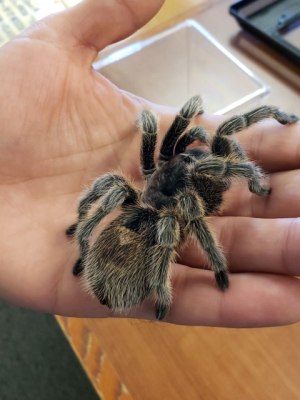
Two of the most frightening things known to humans – advanced math and tarantulas – are some of Dr. Dan Galiffa’s favorite things. The associate professor of mathematics owns thirteen tarantulas and says the highly venomous spiders make great pets.
“They are one of cleanest and most fascinating animals,” Galiffa said, as his Honduran curlyhair “Curly” (Tliltocatl albopilosus), a thirteen-year-old tarantula about the size of his palm, slowly walks over and around his hand. “Each spider has a unique personality.”
Dr. Dan Galiffa with two of his pet tarantulas
Rosalinda, a Chilean rose, was his first tarantula. Galiffa acquired her eight years ago and liked her so much that he has since gathered twelve more tarantulas, for a total of thirteen spiders of twelve different species, including greenbottle blue, Venezuelan sun tiger, Costa Rican zebra, Chilean copper, Mexican red knee, Arizona blonde, Brazilian salmon pink, Columbian giant red leg, and Mexican red rump.
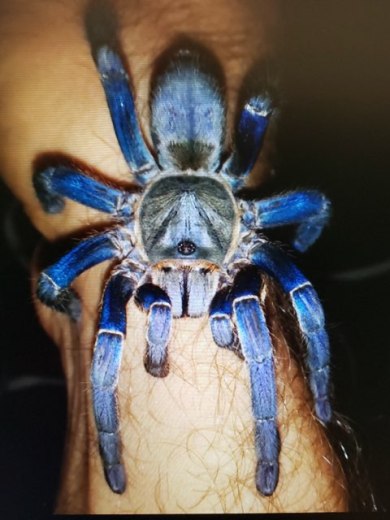
One of his most beautiful and exotic is Blue, a cobalt blue tarantula native to Myanmar and Thailand. As with most things in nature, the vibrant color is a warning.
“They’re high venomous, extremely fast-moving, and one of the most defensive species of tarantula,” he said. “Many people who own them don’t handle them.”
Galiffa does and said she is a calm and “sweet” spider. That said, he is always respectful of the spider’s space and temperament. No stranger to deep research, Galiffa has done his homework.
“I spend a lot of time learning about them, reading whatever I can find, including some scientific articles and papers that can be pretty specific,” he said. “But I actually did a lot of my mathematical research work in epidemiology, so I’m familiar with the biological science.”
There is much work to do in tarantula taxonomy. “Scientists are still learning a lot of basic things about them,” he said. “The classifications are still not solid.” He estimates there are more than 1,000 species of tarantulas and new discoveries lead to changes in taxonomy. “There are about 45,000 known spider species, in general,” he said.
We talked with Galiffa and Curly (though she was pretty quiet) to learn more about tarantulas and how they can sometimes serve as teaching aids.
What types of courses do you teach at Behrend?
The entire calculus sequence, differential equations, linear algebra, and other advanced math classes.
What is appealing to you about tarantulas?
They make really great pets. They are clean, quiet, easy to care for and they all have their own personalities. It is an exciting challenge to try and understand a species that is so far removed from humans. They communicate with their actions and behaviors.
Why do you think people are so afraid of spiders?
I think spiders get a bad rap. Anytime someone has an odd welt, and it has a visible hole, they call it a spider bite. I always ask the question, “Did you see the spider bite you?” I’ve never had anyone say yes. More than likely, the injury was inflicted by a different insect. Spiders rarely bite unless they are directly threatened.
Where did you get your tarantulas?
I bought them at pet stores, online, and at exotic animal expos. A couple of them are rescues from people couldn’t care for them anymore.
What do they eat?
Worms, crickets, roaches. Basically, they eat anything alive that is smaller than they are. They only eat a few times a month.
You handle all of your tarantulas. Does each species feel different?
Oh, yes. The bristles can be soft, hard, very long, short, thick, or thin. Additionally, some tarantulas are much faster than others. Blue’s speed would blow you away. She could be on the other side of my office in seconds. The same is true of the Sun Tiger.
Are they venomous?
Yes, every one of them is venomous, but they are not aggressive. The venom is not all bad. It is used in some medicines, and it’s not lethal to humans.
What would happen if you got bit?
I have held my tarantulas thousands of times and have never been bitten. If someone were to get bitten, it would probably because they were careless in handling the spider. In any event, there are two types of bites, dry and wet. A dry bite is a puncture wound from fangs. A wet bite is when the tarantula actually uses their venom. They rarely do that. They don’t even use venom when catching their prey unless it is absolutely necessary. A dry bite would be handled like any normal puncture wound with some antibiotic cream and a bandage. A wet bite should probably be seen by a doctor but, again, it’s rare and the venom is not lethal.
How long do they live?
Twenty to forty years with females living longer than males. I have eleven females and two males. When the males mature, they seek out females for mating and will die shortly after, so if a keeper has a male, it’s best to send him to a breeder after he matures. I will have to do this with both of my males, and I’ll be very sad when that time comes. By the way, females can produce egg sacs with over 1,000 eggs!
You’ve used your tarantulas as teaching aids before in Behrend’s K-12 outreach programs. What do you teach with them?
There are many things we can teach with spiders – web strength and construction, genetics, population dynamics, gait analysis, and blood flow, which is quite fascinating in tarantulas since their blood flows through their entire body. They don’t have veins like humans do.
How can you use them to teach math modeling?
We can model them as predators and as prey. We can also study the genetic probability of obtaining certain variations of a given species using probabilistic models. For example, there are three forms of Chilean rose tarantulas – the gray, red, and pink color forms. My spider, Rosalinda, is gray form and Charlotte is a red form. The students in my workshops do a basic version of this very type of modeling and then get to see the differences in the color forms in my actual tarantulas.
Do you have any other pets?
I also have Madagascar hissing cockroaches and a skinny pig (hairless guinea pig) named Hamilton. I previously had two skinny pigs—Perry and Ty—who played games and did tricks.
What do you want people know about tarantulas beyond what we have covered above?
Here are some interesting facts:
Tarantulas do have eight eyes, but scientists are not sure how well they see.
Tarantulas have bristles, not hair. Only mammals have hair. The bristles give them a lot of information. So, yes, “spider senses” are a real thing, not just something made up for the Spider-Man comics.
Tarantulas use their senses to assess everything that’s happening around them and they have amazing perception despite the fact that they cannot smell and have no ears.
At the end of each of the tarantulas eight legs are two retractable claws, similar to those in a cat. They use these for mobility.
In addition to their eight legs, they possess two pedipalps or additional appendages that are located at the front of their bodies.
Since tarantulas are arthropods, they have to molt in order to grow. When a tarantula molts, it can often change color and grow exceedingly large.
Tarantulas can spin webs. The webs are not like commonly seen ones used to catch prey but are used to line their burrows and keep them safe, for example, spinning a trip “wire” near their home to sense prey and potential predators.
Tarantulas are opportunistic predators, which means they wait for the prey to come near their home, then attack it with extreme speed and accuracy.
Tarantulas have a wide variety of coloration and patterns. They are quite stunning when viewed in the right light.
By Heather Cass Publications Manager, Office of Strategic Communications, Penn State Behrend
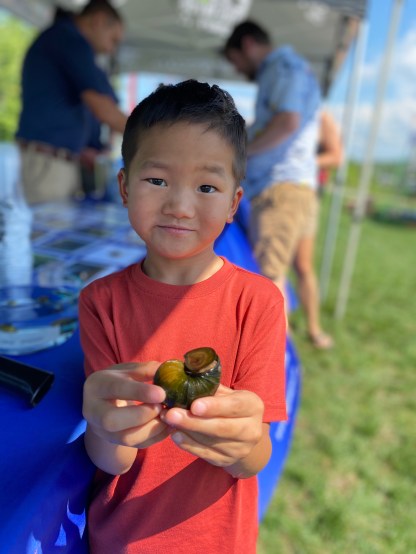
On a sunny August Saturday, a half dozen fans are lined up in front of the Mysterysnail Speedway, a four-foot plastic box with plexiglass dividers creating race lanes for a field of ten large snails. They place their “bets” and cheer for their chosen snail, each marked with a race number on its shell.
This slideshow requires JavaScript.
As the oversized gastropod invaders make their way to the finish line, Dr. Lynne Beaty, assistant professor of biology at Penn State Behrend, explains why we don’t want them in our waterways.
“Mysterysnails are so named because females produce young, fully developed snails that ’mysteriously‘ appear. They’re a group of invasive species that originate in Asia but have found their way to Lake Erie,” Beaty said. “They compete with native species, alter nutrient ratios, and transmit parasites to wildlife.”
Aquatic invasive species (AIS) are non-native plants, animals, or pathogens that harm the environment, the economy, and human and animal health. They are one of the greatest threats to biodiversity and native communities of other species, and they can spread easily through unwitting human assistance and connected waterways.
Beaty and two other Biology faculty members, Dr. Adam Simpson and Dr. Sam Nutile, have been working with Kristen McAuley, lecturer in marketing, and Sara Stahlman, extension leader for Pennsylvania Sea Grant, to raise awareness about invasive snails (and other species) in the waters around the Erie region. Last summer, the team came up with a novel idea to reach adults: craft beer.
“Good beer needs high-quality, clean water and invasive species threaten our freshwater supply,” Beaty said. “So we thought a collaboration with Erie Brewing Company in Behrend’s Knowledge Park was a great way to promote AIS awareness because controlling invasive species can help improve water quality. We were thinking too that this might be an excellent way to reach adult audiences who are more likely to accidentally transfer AIS when they move boats to different water bodies.”
The group met with Erie Brewing’s brewmaster, Tate Warren, who was on board with creating a ‘draft series’ of special AIS-themed brews for invasive species awareness.
The first, Mysterysnail Ale, “an amber ale loaded with flavors of bread, biscuit, and caramel malt,” debuted at a launch party, complete with the aforementioned mysterysnail racing, at Erie Brewing. Visitors had the opportunity to try a new brew and also learn about many AIS at tables manned by Behrend School of Science faculty members and staff members from Sea Grant, a research, education, and outreach program administered by Behrend.
The event was well-attended, and the Mysterysnail Ale was well-received. It currently has a 3.6-star review (out of five) on Untapped.com, a website where beer lovers rate and review brews.
Three more brews are planned in the AIS series: a Round Goby Rye, a Zebra Mussel Malt, and a Hazy Hydrilla. Each beer will launch with an event to raise awareness of the AIS the brew is meant to thwart.
In addition, for each of the beers, a promotional poster will be developed that will highlight the beer, the flavor, and the facts about the highlighted species. QR codes on the posters, which will be displayed at Erie Brewing and other locations on the Lake Erie Ale Trail, will lead users to even more information about the featured AIS.
Mysterysnail Ale is currently on tap at Erie Brewing and other participating Ale Trail breweries, including Lavery Brewing, Arundel Cellars and Brewing, Twisted Elk Brewing, Brewerie at Union Station, Nostrovia, and Erie Ale Works. For more information about aquatic invasive species, visit seagrant.psu.edu.
There’s so much more to Penn State Behrend’s faculty and staff members than what you see them doing on campus. In this occasional series, we take a look at some of the interesting, unconventional, and inspiring things that members of our Behrend community do in their free time.
By Heather Cass Publications Manager, Office of Strategic Communications, Penn State Behrend
After just a few minutes of chatting with Dr. Courtney Nagle, associate professor of mathematics, one thing becomes clear: She’s a team player. As chair of the Secondary Education in Mathematics program, Nagle is also quick to share any credit for accomplishments with her colleagues.
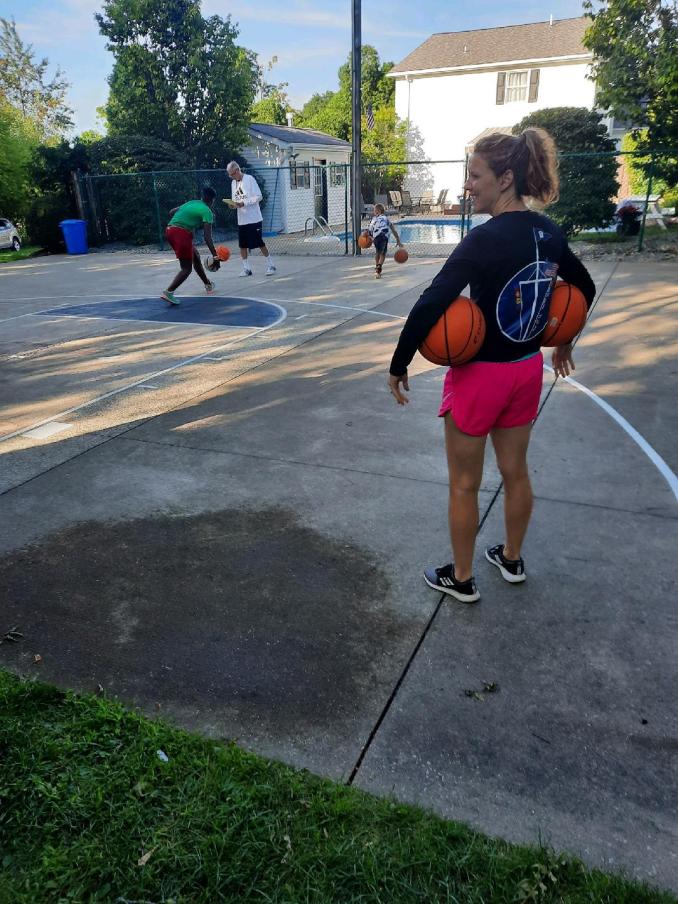
Nagle can trace those team skills back not only to her schooling, but to a blacktopped basketball court behind her childhood home. It was there that Nagle and her older sister learned some of the most important lessons in life –resilience, teamwork, selflessness, and how to win and lose gracefully — from time spent on the court with their father, Terry Thompson.
For more than fifty years, Thompson has coached basketball in one form or another at the elementary school through college levels. In 1998, as the assistant coach of the girls’ basketball team at Girard High School, he helped lead his team, including his two daughters, to the state championship.
Today, he is still coaching – offering summer-long basketball skills camp on his backyard court for free to any area youth who want to attend. He has an assist from his basketball-loving daughter, Nagle, who enjoys teaching on the court as much as in the classroom.
Behrend Blog talked with Nagle to learn more about her “secret life” as a basketball coach.
What are some of your father’s career highlights as a basketball coach?
The largest number of years were spent coaching high school boys, including stints as the head varsity coach for Fairview and Girard as well as teams south of the Erie area. He was an assistant coach for the Girard girls’ basketball team during the years my sister and I played in the late 1990s. He even spent a few years as an assistant men’s basketball coach at Penn State Behrend in the early 1990s.
Was it hard being coached by your dad in high school?
At times, yes. He pushed me, and we spent a lot of extra time practicing. That wasn’t always easy. However, he was really good at leaving the games on the court. I often hear about parent coaches who rehash games and go over mistakes around the dinner table. We never did that. We left it all on the court.
He has a court in his backyard?
Yes. We moved to that house in Girard when I was 14, and that’s when they had the court put in. We grew up playing games on it. Kids in the community still use it regularly. It’s almost like a community playground.
Tell us about the Sunday clinics and how they got started.
The Girard community has always embraced basketball with many kids attending summer skills camps and summer-long clinics. Three years ago, when my son, Jack, and niece, Ainsley, were 5, my dad decided to start doing free clinics in his backyard. It was a way for him to get his grandchildren interested in playing basketball, but he also just enjoys working with young people on the fundamentals of the game. That is his favorite aspect of coaching.
Most of the kids who attend are from the surrounding community, including some of the children of my former teammates and classmates who still live in the Erie area. It’s fun to see the next generation start in the same way we did – playing on the same court we did.
After an hour of basketball drills and skills, my parents open their pool for an hour to anyone who wants to stay and swim. The kids love that part of the night!
What is your role on the court?
I’m in an assistant coach role. I do some of the drill demonstrations and work with the kids as we go through the various drills. I also help my dad get the word out about the clinics with social media posts and such.
What do you enjoy about the clinics?
I love watching kids learn the game and improve week after week. It’s such a fun and laid-back environment and the kids who attend are so excited to be there. We have a wide range of ages and abilities, but they all work together.
On a more personal note, seeing my older son learn from my dad on the same court I grew up playing on is pretty special. My 2-year-old, Benny, isn’t quite ready to play, but he joins in on the occasional drill.
My sister lives in Grove City, but usually drives up for the clinics, bringing her kids. My mom prepares the pool area and keeps the freezer stocked with popsicles for the kids to enjoy after playing.
Do you still play basketball yourself?
I hadn’t played much in the last ten years or so, but now that my son is starting to play, I am getting back into it. It’s mostly just family pick-up games. And, yes, my 79-year-old father still plays.











 BEHREND BLOG