What if your classroom wasn’t just a classroom, but a creative agency with real clients, real deadlines, and real impact?
That’s the idea behind COMM 481: Advanced Multimedia Production, a new course taught by Tom Deau, lecturer in media and communication. Students in the course don’t just learn production skills — they use those skills to help community partners.
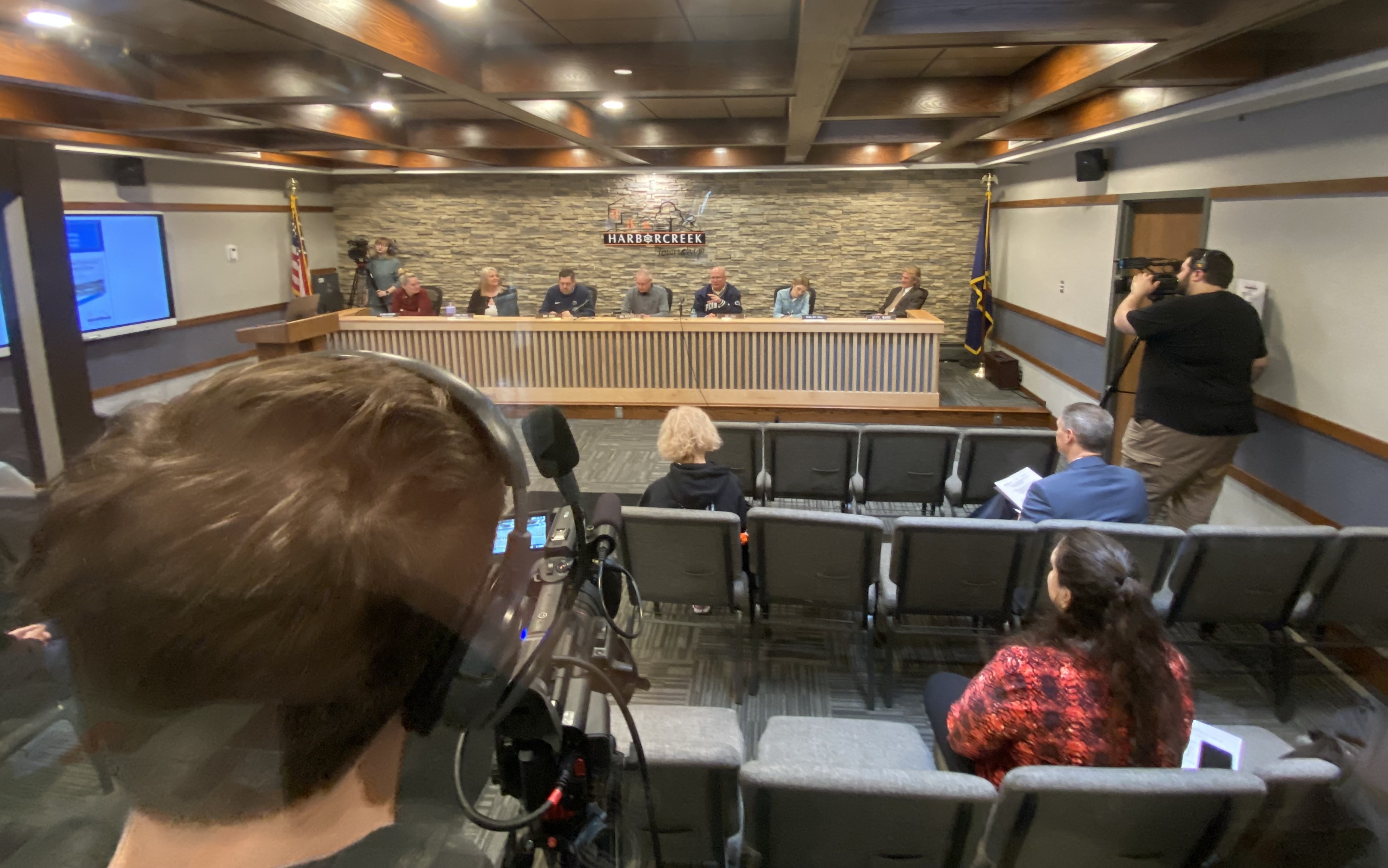
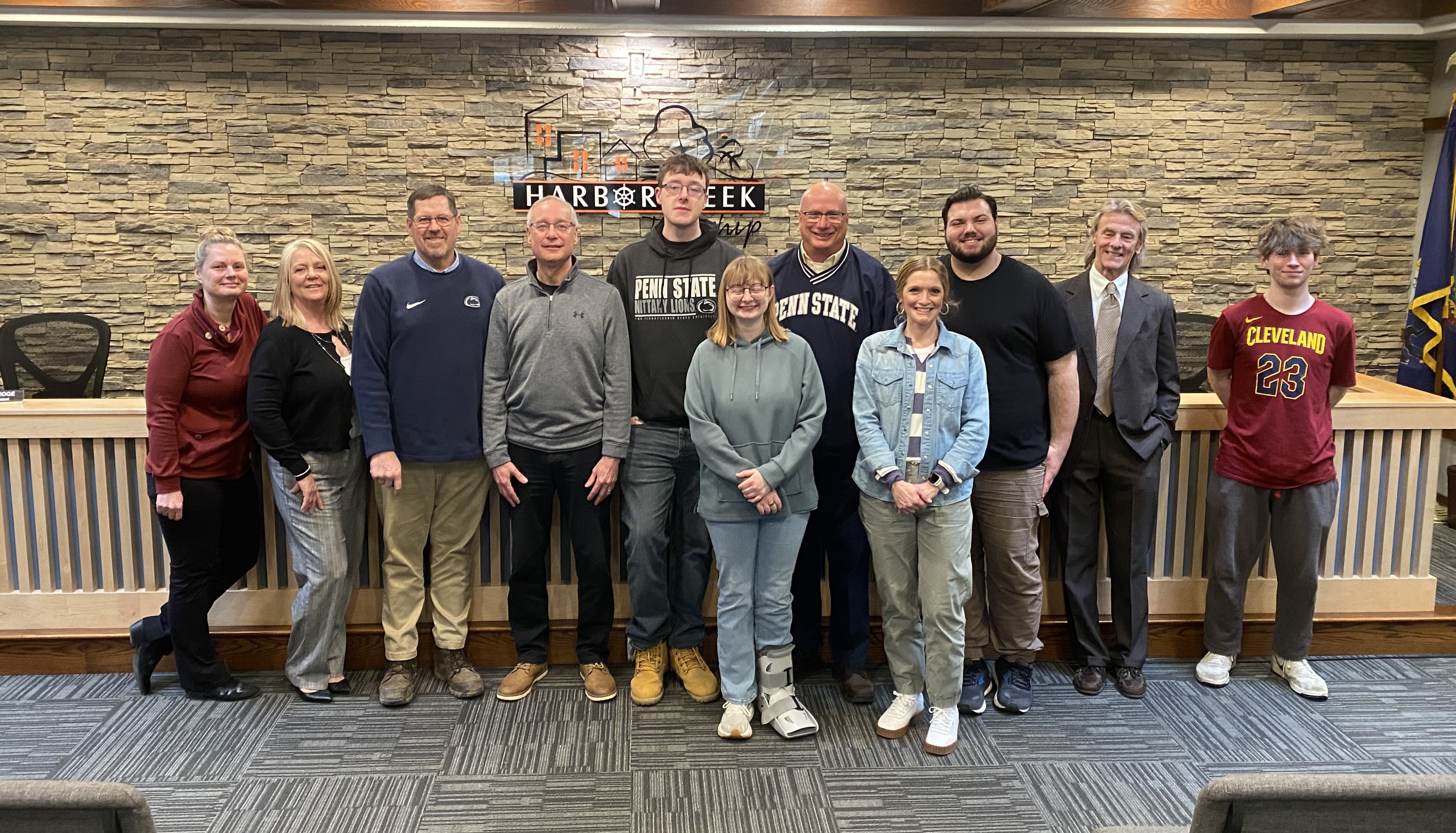
After connecting with Harborcreek Township Supervisor Dean Pepicello, students recently launched a live-streaming initiative for the township’s bi-monthly public meetings, giving community members easier access to local government. The first stream went live on March 4. The next is scheduled for March 18, at 5 p.m. The live streams can be viewed on the Wintergreen Media YouTube channel.
The township streaming project is just one of several new initiatives this semester. Deau’s students also are producing a promotional video for HARVEST 912, a nonprofit that supports individuals who are experiencing homelessness. Other projects include employee profile videos for the School of Humanities and Social Sciences, “Day in the Life” features for social media, and a promotional video for the “Empower Her Summit,” a Junior Achievement of Western PA event that will be held on campus later this month.
These experiences embody the college’s Open Lab model of learning, in which students and faculty members partner with business, industry, and community organizations to design new products, develop new services, or solve specific business challenges. The projects benefit the community, but they help students, too: By applying the fundamentals they learn in class, students gain résumé-building, real-world experience.
The School of Engineering’s annual Fasenmeyer Design Conference is a big day for senior engineering student, the culmination of a two-semester capstone project. Faculty, industry sponsors, family, and friends fill the presentation rooms. Students wear suits and aim to impress.
So, when one team’s project literally fell apart outside the classroom minutes before their presentation, you can imagine the panic it induced. The project, months of work, lay in pieces.
Then Chris and Andy Bartlett arrived.
With tools in hand, Penn State Behrend’s resident machinists and problem-solvers dropped to their knees beside the students.
“It was like a NASCAR pit crew in the hallway,” Chris recalls with a laugh.
They got it working. The students presented. The project succeeded.
It’s exactly the kind of moment Chris and Andy relish and show up for—even when they don’t have to.
“They don’t have to come in over the weekends to machine parts for the Society of Automotive Engineers (SAE) club’s competition car the week before our competition,” said Hunter Kamensky, a senior Mechanical Engineering Technology major and a member of the club’s executive board. “They didn’t have to become Environmental Health and Safety coordinators of the SAE/Robotics Lab to ensure our safety, and they didn’t have to come to the SAE club’s car-testing day at Lake Erie Speedway to show their support, but they did. They care about students.”
Chris has been at Behrend for five years; Andy, his uncle, for three. Combined, they bring sixty years of tool-and-die industry experience to the School of Engineering.
They also bring a willingness to show up, say yes, and help students turn drawings into reality.
We sat down with Chris and Andy to talk about their work, why manufacturing matters, and what they hope students learn from them.
For someone unfamiliar with machining, how would you describe what you do here day-to-day?
Chris: We make things the engineering students and faculty design.
Andy: We try to help them succeed by giving them the best approaches and let them know when something is not feasible. 3D printing is cool, but it’s fictitious. You can design and build parts with a 3D printer that won’t hold up in the real world.
What kinds of projects do you most often help with? Do any stand out as especially challenging?
Chris: We help with research projects, molds for the Plastics Engineering Technology program, welding, fabrication, capstone projects, and student clubs. We’re big supporters of the clubs because students learn a lot tinkering and working on side projects.
Andy: One of the most challenging projects we work on every year is the Cast in Steel capstone project, where students design and build functional replicas of traditionally forged items using modern steel casting. It’s reverse engineering. You basically have to work backward to create the piece. It’s technical, hands-on, and really fun.
When a student brings you a design that isn’t quite manufacturable, how do you handle it?
Chris: We can usually tell just by looking at plans what will work and what won’t. We mark it up, make suggestions, and show them the empirical data on what they are trying to do and why they need to revise.
Andy: Students do challenge us sometimes. We allow them to think it through or even try it, unless it’s going to be catastrophic. Failure teaches more than success.
The difference for us, having worked years in industry, is that we know manufacturing is inherently challenging. But in the shop, where they’re making a profit, everything has to be perfect. Failure is not something they embrace. The education environment is quite the opposite—we let them think through a bad idea. Then they really understand it.
What do engineering students learn in the shop that they can’t learn in a classroom?
Andy: In manufacturing, you learn that there are things that can be perfect in theory but impractical in real life. Tolerancing is a concept that clicks in the machine shop. The weight of materials and size of parts matter. Plastic is light, steel is very heavy. The physical reality matters.
Chris: Before they get to the machine shop, they’re working on fundamentals and hypotheticals. It’s all theoretical in the classroom, but when they see it, they really get it.
Andy: We have a dozen MET students, mostly seniors, who work with us on a weekly basis now. We wish we could get them in the shop in their first year. It would aid everything they’re learning in the classroom.
Can you share a memorable moment working with students?
Chris: That hallway moment with the senior design team—the NASCAR pit crew moment—that’s one.
Andy: Attending the SAE vehicle club’s training sessions at Lake Erie Speedway. We were testing on the track, doing modifications right there. We try to teach students to stay calm, even when things fall apart—because they will. You can’t be in a panic and do good engineering work.
How does your industry experience influence how you teach and support students?
Andy: At 22, young people tend to think they know everything, but I tell them when they get their first job, try to find a guy who is 50 or 55 and learn as much as you can from him. Those guys have real-world experience. You can learn a lot from them.
We also tell them to work on their interpersonal and teamwork skills, and we just try to instill the reality that manufacturing is hard work, and they will have mundane days. That’s just life.
Chris: We also encourage internships. That real-world experience is invaluable. They’re getting an excellent education at Penn State Behrend, but that physical contact with manufacturing matters.
Safety regulations limit the students’ access to the shop. How have you tried to help maintain hands-on opportunities?
Andy: We started to think about ways that we could legally allow students to work in the shop and have been making some headway. There’s a danger factor. We have limitations we have to work with. There’s a lot of training involved.
We’re very involved in America’s Cutting Edge (ACE), which offers hands-on CNC training at Behrend for students over sixteen. It’s ideal for those who are interested in exploring engineering, manufacturing, or hands-on technical careers.
Chris: ACE gave us the ability to get mechanical engineers on the floor for a forty-hour boot camp. They construct an air engine. In total, we’ve had about sixty students take part in the boot camps.
Andy: We also offer support for the METAL program—a four-day hands-on training experience in casting and forging. The goal of these programs is to get young people involved in manufacturing. The next round of skilled manufacturing workers are being developed here.
There are camps scheduled for spring break and right after the semester ends, in May.
What’s the most rewarding part of your job?
Chris: Working with students. Teaching them what I love to do.
Andy: I love it when a student has that lightbulb moment. When they think…“Now that thing I learned in class a year ago makes sense.”
We also love that Behrend emphasizes hands-on experiences. We hear back from friends in the field that Behrend students stand out on the manufacturing floors. One told us: “If I go into a shop and I see a student or young employee who is really sharp, I ask where they go to school—it’s almost always Behrend.”
What do you hope students carry with them from their time working with you?
Andy: We talk about life a lot. We tell them: The most stressful jobs make the most money. What is your life worth to you? How important is that money? Consider if you want to walk that walk.
Chris: We want them to understand that this is real. This is how things are made. This is how you solve problems. And we want them to know they can do it.
Andy: Manufacturing is such a noble thing. Man is meant to make things.
Their mistake is understandable. In just three years, Orange, an immersive administrator in the college’s Virtual/Augmented Reality (VAR) Lab, has left his mark on campus—literally. From 3D scanning equipment and building video game consoles in the VAR Lab to creating 360-degree virtual tours for industry partners, Orange’s work can be seen all over Behrend.
“He oversees several of the undergraduate employees in the lab, working with them across a half dozen or more projects, helping them to achieve their own goals,” said Dr. Chris Shelton, associate professor of psychology and director of the VAR Lab. “He goes out of his way to learn and help others who are trying new techniques in the lab, while also improving the atmosphere with his positive attitude and calm demeanor.”
Orange is also collaborating with Jane Ingold, reference and instruction librarian and Behrend’s archivist, to digitally preserve college artifacts as part of his Schreyer Honors College thesis project.
“He is so engaged and is a real champion of Behrend history through the preservation work that he’s doing,” Ingold said. “This spring, he did 3D scans of Ernst Behrend’s old steamer trunk, the bust of Moritz Behrend’s head, and Bruno’s headstone.”
Behrend Blog caught up with Orange before he returned home to New Bethlehem for the summer.
How did you get involved in the VAR Lab? I met another student, Marcus Jacobs (a ’22 Business Economics and International Business grad), who worked there, and he roped me in. I was interested in what they were doing in the lab. Now I do a lot of the project managing. I joke that I’m Marcus 2.0.
What are some projects you’ve worked on? Most recently, I helped create a 360-degree virtual tour for Snap-tite, an Erie company, and I’m working on the Echoes of HistERIE project—scanning historical sites and artifacts like the Presque Isle Lighthouse. If something ever happens to these places, at least we’d still have them digitally.
We heard you built a turntable to help scan people in 3D? Yes! It’s hard to do 360-degree scans of people while lugging around the camera and cables, so it’s easier if the person rotates on a platform while the camera stays put. You can buy turntables like this, but my true gumption is being frugal—so I wanted to build one. My dad and I used the motor from a pig roaster, since it offers a slow, strong spin. It turned out great.
You also created an augmented reality sandbox. Tell us about that. It’s an interactive display that lets users shape and manipulate 3D topographic maps in real time. A 3D camera senses the shape of the sand, and a projector overlays a topographic map onto it. You can build mountains and valleys right in front of you. Again, you can buy these, but we made ours out of plywood and an old projector.
And the VARcade? That’s an arcade machine I built from an old kitchen cabinet. It runs classic games and also gives students a platform to test new games they create in computer science or game design classes.
You sound like an engineer. Why did you choose DIGIT? DIGIT is the best of both worlds. I get to work with emerging technology but in a more creative or artsy way. I like 3D modeling, photography, making movies, and videogames. I’m also minoring in game development.
What are some practical uses for VR and 3D images? A lot of people think VR is just for video games, but it has serious real-world uses—training simulations, for instance, where it’s safer to make mistakes. It’s also great for exposure therapy for phobias and PTSD. And 3D tours can give people a sense of what a place looks and feels like without needing to physically go there.
What motivates you? My faith—especially Jeremiah 29:11: “I know the plans I have for you, declares the Lord, plans to prosper you and not to harm you, plans to give you hope and a future.”
What are you looking forward to when you return in August? My Schreyer thesis project, which is a continuation of the work I do in the lab. I’ll be using different scanners on various artifacts to find the most efficient methods for digital preservation. And I’m excited to see what else comes my way in the VAR Lab. I’m up for anything.
Students in Photo 202: Fundamentals of Professional Photography recently completed a photo essay project based on “The Land Ethic,” an essay written by Aldo Leopold in 1949 that argues for a deeper connection between humans and the natural world.
Leopold suggests that humans need to expand their concept of ethics beyond just people and animals to include the land—soil, water, plants, and more. The “land” is not something we own, but something we are a part of, and we should treat it with care and respect. Leopold proposes that we should think of ourselves as caretakers, responsible for maintaining balance and harmony with nature.
Urban park. CREDIT: Chelsea Quijas
Tommy Hartung, assistant professor of digital media, arts, and technology, instructed students in the class to choose an area and create a series of five 360-degree panoramic images that document the landscape and the biome it contains.
“The site they chose could be anywhere from urban to complete wilderness,” Hartung said. “Students were also required to take notes documenting the ecosystem and use their notes to draft a 500-word essay to go with the images.”
A second part of the assignment involved time-lapse photography.
“The element of time and motion related to photography has allowed humans to see systems develop by compacting time into short motion clips,” Hartung said. “It allows a focus that the human experience may overlook about the location.”
Dobbin’s Landing in Erie. CREDIT: Evan Gerdes
The students’ essays are impressive and thought-provoking. See for yourself at the links below:
By Heather Cass, Publications Manager, Penn State Behrend
Eric Oelhaf, Penn State Behrend Political Science major.
While at Penn State Behrend, Eric Oelhaf, a senior Political Science major, added something to his resume that few college students can claim: His work has been published in The Wall Street Journal.
In fact, he has had three pieces published in the WSJ’s “Future View” column, in which they invite undergraduate and graduate students to offer their opinion on current topics from Twitter’s rebranding to the future of the NFL to foreign policy to ChatGPT.
We talked with Oelhaf, a State College native, to learn more about why he wanted to contribute, how he got published, and what he has gained from the experience.
How did you learn about “Future Views”?
Dr. Maggie Shum, assistant professor of Political Science, mentioned it in a class that I took with her in the fall semester. Though it’s known to be a conservative publication, The Wall Street Journal said it was trying to provide a diversity of viewpoints in this feature.
Did you immediately contribute?
No. I looked at it as a national writing competition and decided that I was only going to contribute if I had something unique to say. I felt that would improve my odds of being selected. I was surprised that they printed the first one I submitted, which was the piece on the border crisis. The second one was the piece on why people don’t trust scientists.
Then you submitted one about aid for Ukraine?
Yes. That one was a strategic choice. I wanted to dispel myths that are prominent in conservative information spaces about the costs of sending aid to Ukraine. Of course, the reason to support Ukraine is that it’s the right thing to do. Russia has historically tried to eradicate the Ukrainian language and identity from existence since the times of the Russian Empire. And languages are a particularly important part of European political philosophy.
Does the newspaper edit the pieces?
The one on the border crisis is nearly identical to what I submitted, and those are really my thoughts on the matter. There was light editing on the Ukraine piece. But the trustworthiness of scientists’ piece was heavily edited. Looking back on that, I realize that was my fault.
How so?
I had tried to have a more in-depth discussion than what the 250-word-limit would allow, and I didn’t end up making a clear argument in what I originally submitted. The editor then rewrote some of it operating under the assumption that I was trying to critique the behavior of just the authority figures, which I wasn’t. It was a misunderstanding that I know now I could’ve prevented.
What has been the response to your work?
It’s interesting to read through the comments. I’ve learned that people will complain about anything unless your reasoning is airtight or in line with what they believe. I was called an elitist for providing context on the border crisis. Sometimes, readers will even complain that they are listening to college students, despite clicking on a column clearly labeled “Future View.”
What have you learned by reading the feedback?
It seems the current American news consumer is addicted to anger, and the media is more than happy to feed that addiction.
What other topics interest you?
I care most about what is happening in Ukraine and, as a result, I’m concerned about the current state of Congress. I’m also interested in artificial intelligence and the ways in which it’s being handled by our government.
What would people be surprised to know about your generation regarding politics?
My generation seems to care about efficacy to a greater degree than older ones. We want our politicians to be good at what they do. We don’t want them to continually take half measures on humanitarian crises cause by our allies, nor do we want them to spend six months trying to pass a budget.
What do you want to do after college?
I like foreign relations, so I may pursue a career in government in that field. I would certainly take a job in journalism, too, if I had the opportunity.
Penn State faculty, staff, and students have access to The New York Times and The Wall Street Journal at no cost through the Student News Readership Program. To take advantage of this program, you must register using your Penn State email. Learn more at Penn State’s Student Affairs website.
Office of Strategic Communication, Penn State Behrend
One thing Sophia DiPlacido knew for sure when she started at Penn State Behrend is that she wanted to leave — for at least a semester.
“I have always wanted to study abroad,” said DiPlacido, a junior dual majoring in Marketing and Psychology. “I was slightly worried about language barriers, though, so I looked at countries with residents who spoke English as a first or second language.”
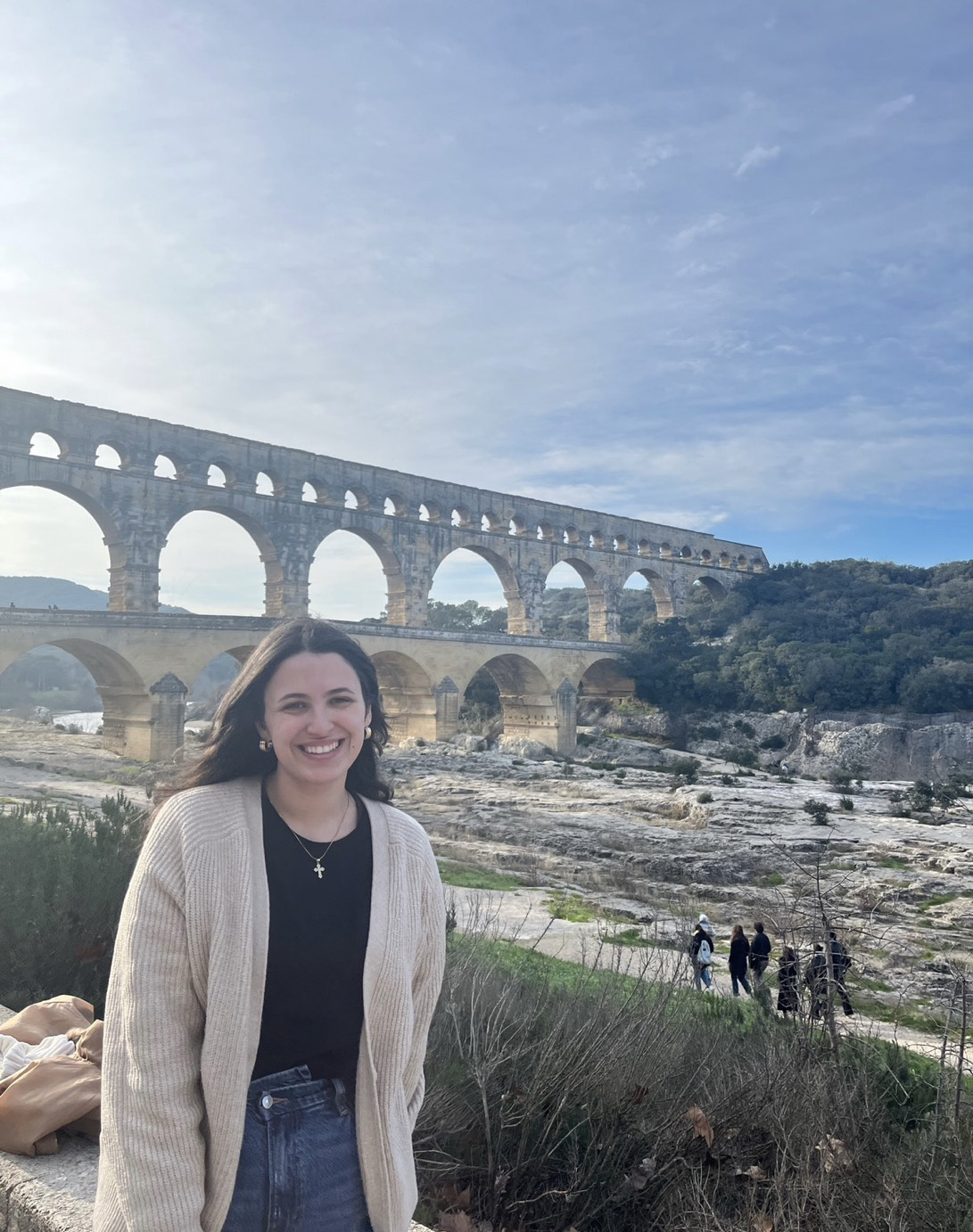
She ultimately chose France and set off in January to spend the spring 2023 semester in Aix-en-Provence, known as “Little Paris.” She lived with a host family in a home with three other students who were also studying abroad from other U.S. universities.
“My host mother had done a study abroad experience, so she wanted to help others have that opportunity,” DiPlacido said.
She took five classes–International Business, French, History of Christianity, Wine Marketing, and Drawing and Painting–at the Institute for American Universities, where DiPlacido said curriculum is king.
“Extracurricular activities are not a thing in European universities,” she said. “College in France is actually closer to what I had been told in high school that college would be like, which is to say that instructors would not be very accessible, the classes would be mostly lectures, and your grade was made up of a few exams.”
While her college experience was quite different from the experience at Behrend, DiPlacido said she quickly felt at home in France.
“I easily adjusted,” she said. “The geography reminded me of California, and the people were very welcoming, which is not what you sometimes hear about the French. I expected to encounter some resistance because I didn’t speak their language, but everyone was nice about it.”
She didn’t have classes on Fridays, so she was able to explore several nearby countries as travel throughout western Europe is relatively easy and inexpensive. Among her many adventures: visiting the Eiffel Tower in Paris; skydiving in Switzerland; scuba diving in Marseille; making pasta in a cooking class in Venice; and seeing the Cliffs of Moher in Ireland. She also visited Budapest, Brussels, London, Madrid, Nice, and Prague as well as cities in Germany and Luxembourg.
DiPlacido said that all that travel helped her develop important life skills.
“I didn’t have a strong sense of direction,” she said, “but I developed it getting around on my own. It gave me a lot of self-confidence.”
DiPlacido said she would recommend a study abroad experience to students in any major but cautions that it takes work to prepare for it, even with guidance from Behrend’s Learning Resource Center, the campus experts on global programs.
“You have to be proactive and get your visa and passport and stay on top of what needs to be done when,” she said. “But in that responsibility is personal growth. Studying abroad was the most amazing thing I have ever done. You come back a whole different person with an entirely new perspective on the world.”
This slideshow requires JavaScript.
STUDY ABROAD BASICS
Does it have to be a full semester?
No, at Behrend, the international study experience can be as short as ten days or as long as a full academic year, depending on the type of program a student selects. International study programs are happening throughout the year—during fall and spring semesters, at semester breaks, and over the summer.
Do you need to speak a second language?
No, but you do have to be a strong student, academically, to be eligible for international study. The minimum grade point average is a 2.5, and many programs require a 3.0. Prerequisites vary by program.
How much does it cost?
Cost varies depending on the program and location a student chooses, but you can expect to pay tuition, travel expenses, and for meals and personal expenses while abroad.
Scholarship funds are available for those who qualify. DiPlacido received funding from Penn State Behrend’s Study Abroad program and the University’s Schreyer Honors College, and she won a competitive Gilman Scholarship, which is administered by the U.S. Department of State.
How can a student learn more?
Attend a Study Abroad Information Session. Meetings are held weekly at Behrend throughout the semester. A list of upcoming sessions is available at behrend.psu.edu/studyabroad, where students can also learn about the different types of programs; explore upcoming opportunities; and find out about the application process and deadlines, as well as financial aid and scholarships.
Office of Strategic Communication, Penn State Behrend
After a three-year hiatus, Penn State Behrend’s Black School of Business reintroduced its annual spring trip for students in March. More than forty Behrend business students, including Finance majors studying through World Campus, traveled to Pittsburgh for two days of company visits and networking opportunities.
The group toured Schneider Downs, an accounting, tax, and business advisory firm, and the investment banking firm of BNY Mellon together, and major-specific breakout sessions were also offered. For example, Marketing majors toured the marketing agency, Brunner; Finance and Business Economics majors visited Waldron Private Wealth, and Accounting and Management Information Systems majors went to the accounting, tax, and advisory firm of BDO. Company visits included tours, presentations on the business and industry, and time for questions.
One notable session was held at the Pittsburgh Penguins office where Marketing and Project and Supply Chain majors got a firsthand look at how a top sports franchise operates, from ticket and retail sales to social media and game-day operations.
The students also had the opportunity to interact and network with Black School of Business alumni at a gathering at the Rivers Club in downtown Pittsburgh.
Students who participated in the spring trip described it as a valuable and enlightening experience.
“It’s a great chance to meet alumni and both establish and strengthen relationships so that when it comes time to search for a job, you have a robust network to contact,” Tristan Leopold, a junior Finance major, said.
“The trip provides an opportunity to see businesses through an insider’s eyes and gives you the chance to form connections and hone networking skills. It is well worth the cost and time to attend,” Anita Laughner, a junior World Campus Finance major, said.
“I liked hearing advice from employees about entering the business workforce. I also enjoyed networking with Behrend alumni. It was a fun experience,” Ella Cuccaro, a junior Project and Supply Chain Management major, said.
“I would definitely recommend this trip to any student who wants to broaden their contact list, meet young professionals, and learn what will be expected of them in their first years on the job. It provided a lot of insight into what it will be like day-to-day,” Keara Mollenauer, a senior dual majoring in Accounting and Management Information Systems, said.
“It was a great networking experience that provides students with the opportunity to get their foot in the door for prospective job opportunities. It was very well organized and thought out. If you’re a business student, this trip is a must,” Zane Lewis, a first-year student dual majoring in Accounting and Finance, said.
Plans are already underway for the spring 2024 trip with the destination city to be announced in the fall.
Penn State Behrend’s class of 2022 is ready to make its mark on the world! We’re proud of our students and the things they’ve accomplished and learned while here at Behrend. Over the next several weeks, we’ll be introducing you to a few of our remarkable seniors who have overcome challenges, pioneered new technology, participated in important research projects, and left an impression at Penn State Behrend.
Today, we’d like you to meet Michael Gibilterra
Major: Plastics Engineering Technology
Hometown: Hershey, Pennsylvania
Scholarships: The Joseph and IsabelPrischakTrusteeScholarship.
On choosing his major: Originally, I came to Behrend for Computer Engineering. But, after getting involved with Innovation Commons (see below), I realized I wanted to do more with 3D printing. In doing that work, I learned that I didn’t have a strong knowledge of what happens to plastics when printing. After talking to some of faculty members, especially Jason Williams, assistant teaching professor of engineering, I switched to Plastics Engineering Technology.
About Innovation Commons: It is an open ideation, product development, and prototyping center staffed by students who help guide innovators and entrepreneurs through the early stages of development. It is open to all entrepreneurs and innovators throughout Erie County and the surrounding region, including students, who are looking for support to organize, collaborate, compose, and construct their ideas.
Proudest accomplishment at Behrend: Becoming the first student volunteer at Innovation Commons. This is where my entrepreneurial spirit grew and where I learned about starting my own company. I’m incredibly thankful for the opportunities Innovation Commons has created for students.
Campus involvement: I was a member of Alpha Phi Omega, a service fraternity. I also helped to revive the Entrepreneurship Club and served as president. The club brought in guest speakers, including a variety of entrepreneurs and/or those who support them, and we helped with Penn State Behrend’s Global Entrepreneurship Week activities.
What makes him unique: I can become very focused on a topic, which has been a “superpower” that helps me tackle big problems and led to my ability to develop new products, machines, or designs in a relatively short amount of time.
People would be surprised to know: That I have autism and it’s one of my biggest strengths. While it has certainly had its hindrances, it has helped me significantly in my professional life and has enabled me to approach problems in a different light.
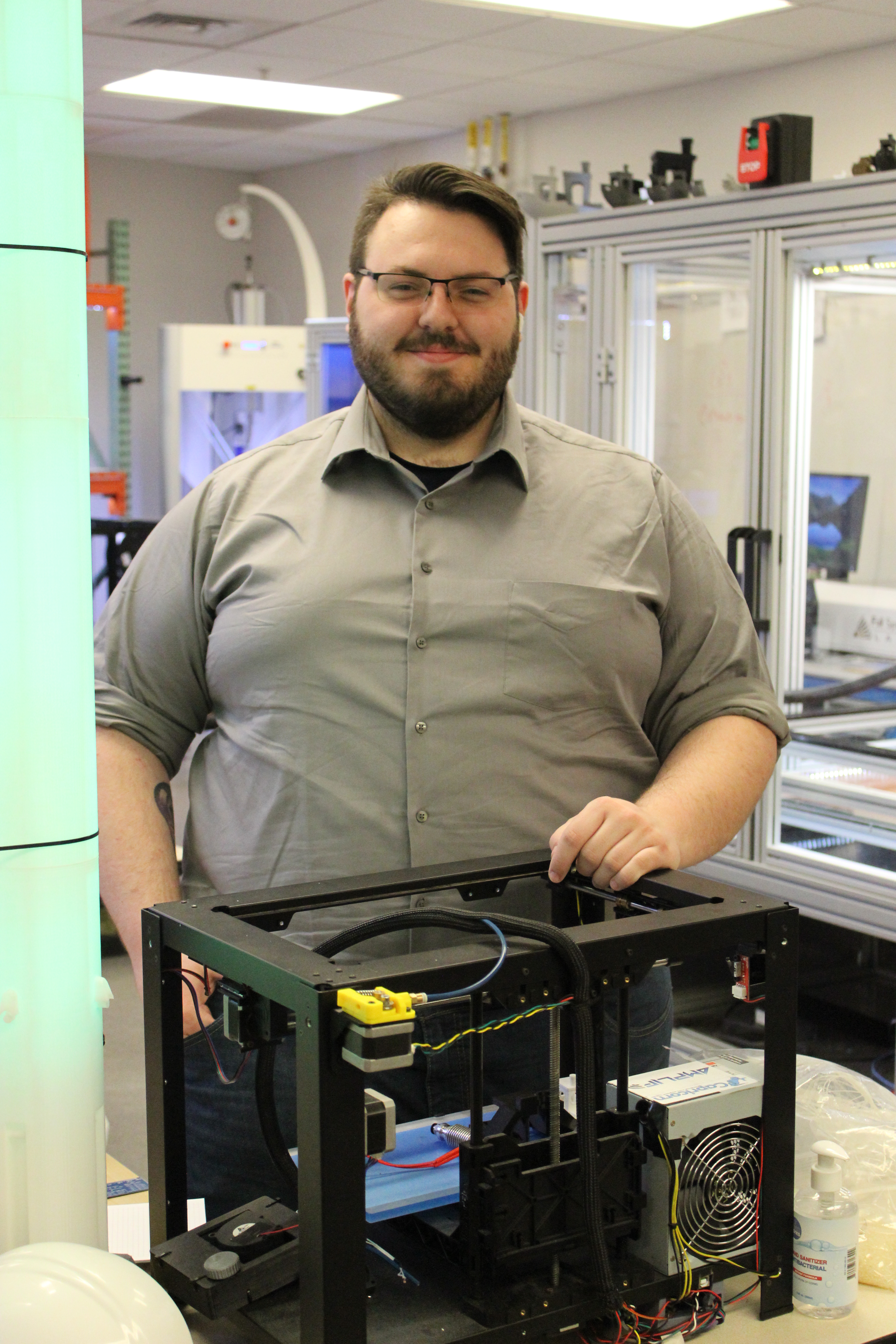
A printing passion: I have an obsession with 3D printing. It started back in high school when I built my first 3D printer using motors from some CD drives, a microcontroller kit, zip ties, cardboard, and the cheapest 3D doodler pen I could find at the time. I really enjoyed writing the code and then getting to see my creation print. I went on to build myself a 3D printer farm selling 3D printed parts and developing new 3D printers that each solve a different problem.
Advice for first-year students: Don’t be afraid to ask questions to get a deeper understanding. I’ve learned so much by just asking why or how something happens. Also, your professors want you to succeed. Don’t be afraid to ask them for help.
Michael is working to launch his own company, Additive Manufacturing System — a 3D printer manufacturing company that focuses on producing 3D printers, materials, and software for engineering applications in sectors such as aerospace, automotive, and medical.
By Heather Cass Publications Manager, Office of Strategic Communications, Penn State Behrend
Plastics recycling class opens eyes, options for high school students
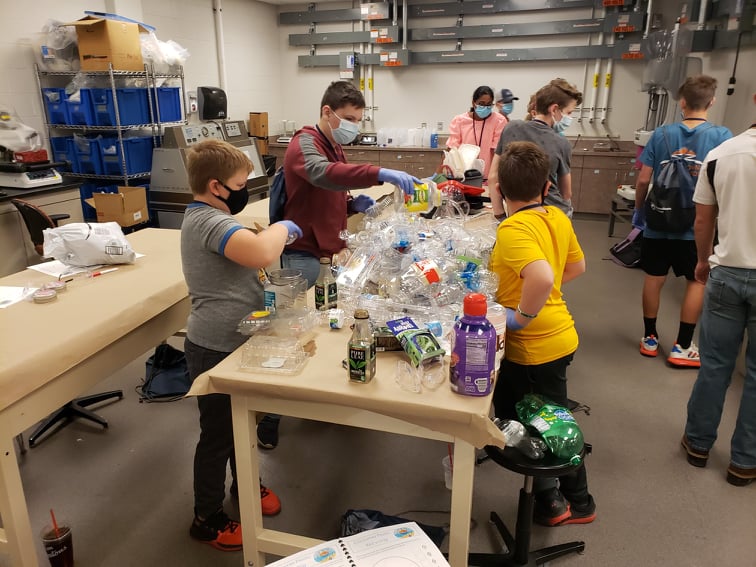
When you toss your 2-liter soda bottle or yogurt container in the recycling bin, you may not think about where it ends up or how it might be recycled, but ten Erie-area students, recent “graduates” of Penn State Behrend’s Recycling Bootcamp, sure do.
The students, ages 14-18, saved their home plastic waste for a week before the all-day bootcamp event in August in Burke Center. It was led by Plastics Engineering Technology (PLET) faculty members—Dr. Alicyn Rhoades, associate professor of engineering; Dr. Gamini Mendis, assistant professor of engineering; Anne Gohn, assistant research professor; and Dr. Xiaoshi Zhang, engineering researcher. Several Behrend PLET students helped throughout the day, as well.
The students started the day identifying the different types or families of plastics they collected. They then counted the number of pieces in each family and calculated the weight fractions of each type of material, which is critical for cost-effective recycling.
“Students shredded their high-density polyethylene (recycling code #2) materials, extruded to pelletized form, and injection-molded test samples and plastic building bricks,” Gohn said. “Samples were tensile- and impact-tested at various levels of recycling content. The students then stretched and impact-tested the samples to analyze changes in material properties.”
The work they put into recycling their plastic waste opened their eyes to the challenges involved in the process.
“They were surprised by how much recycling affects the strength of plastic material and how complicated the process can be,” Gohn said.
Comments from student participants reflect the value of outreach efforts and learning in a hands-on environment. Several students said they were now “excited about plastics” and at least one is considering a career in plastics engineering. That’s just what organizers of the event hoped would be the result.
The bootcamp was funded through a $500,000 National Science Foundation Faculty Early Career Development (CAREER) Program grant awarded to Rhoades. The CAREER program is designed to support early-career faculty members who serve as academic role models in research and education.
By Heather Cass Publications Manager, Office of Strategic Communications, Penn State Behrend
On a sunny August Saturday, a half dozen fans are lined up in front of the Mysterysnail Speedway, a four-foot plastic box with plexiglass dividers creating race lanes for a field of ten large snails. They place their “bets” and cheer for their chosen snail, each marked with a race number on its shell.
This slideshow requires JavaScript.
As the oversized gastropod invaders make their way to the finish line, Dr. Lynne Beaty, assistant professor of biology at Penn State Behrend, explains why we don’t want them in our waterways.
“Mysterysnails are so named because females produce young, fully developed snails that ’mysteriously‘ appear. They’re a group of invasive species that originate in Asia but have found their way to Lake Erie,” Beaty said. “They compete with native species, alter nutrient ratios, and transmit parasites to wildlife.”
Aquatic invasive species (AIS) are non-native plants, animals, or pathogens that harm the environment, the economy, and human and animal health. They are one of the greatest threats to biodiversity and native communities of other species, and they can spread easily through unwitting human assistance and connected waterways.
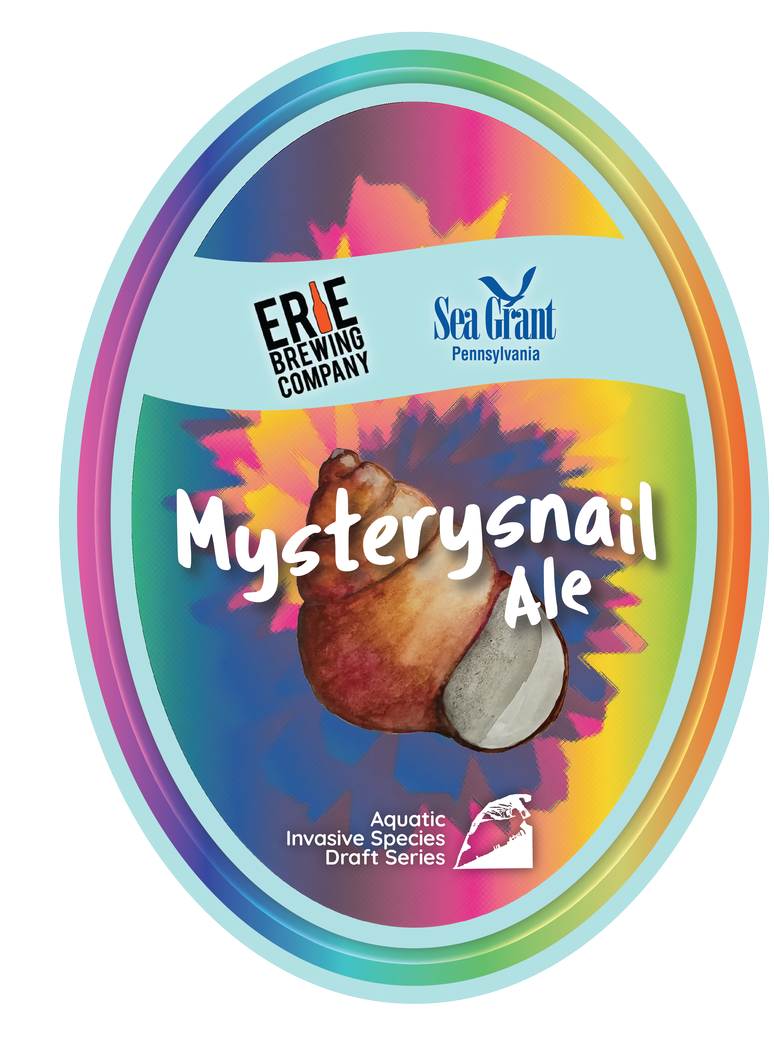
Beaty and two other Biology faculty members, Dr. Adam Simpson and Dr. Sam Nutile, have been working with Kristen McAuley, lecturer in marketing, and Sara Stahlman, extension leader for Pennsylvania Sea Grant, to raise awareness about invasive snails (and other species) in the waters around the Erie region. Last summer, the team came up with a novel idea to reach adults: craft beer.
“Good beer needs high-quality, clean water and invasive species threaten our freshwater supply,” Beaty said. “So we thought a collaboration with Erie Brewing Company in Behrend’s Knowledge Park was a great way to promote AIS awareness because controlling invasive species can help improve water quality. We were thinking too that this might be an excellent way to reach adult audiences who are more likely to accidentally transfer AIS when they move boats to different water bodies.”
The group met with Erie Brewing’s brewmaster, Tate Warren, who was on board with creating a ‘draft series’ of special AIS-themed brews for invasive species awareness.
The first, Mysterysnail Ale, “an amber ale loaded with flavors of bread, biscuit, and caramel malt,” debuted at a launch party, complete with the aforementioned mysterysnail racing, at Erie Brewing. Visitors had the opportunity to try a new brew and also learn about many AIS at tables manned by Behrend School of Science faculty members and staff members from Sea Grant, a research, education, and outreach program administered by Behrend.
The event was well-attended, and the Mysterysnail Ale was well-received. It currently has a 3.6-star review (out of five) on Untapped.com, a website where beer lovers rate and review brews.
Three more brews are planned in the AIS series: a Round Goby Rye, a Zebra Mussel Malt, and a Hazy Hydrilla. Each beer will launch with an event to raise awareness of the AIS the brew is meant to thwart.
In addition, for each of the beers, a promotional poster will be developed that will highlight the beer, the flavor, and the facts about the highlighted species. QR codes on the posters, which will be displayed at Erie Brewing and other locations on the Lake Erie Ale Trail, will lead users to even more information about the featured AIS.
Mysterysnail Ale is currently on tap at Erie Brewing and other participating Ale Trail breweries, including Lavery Brewing, Arundel Cellars and Brewing, Twisted Elk Brewing, Brewerie at Union Station, Nostrovia, and Erie Ale Works. For more information about aquatic invasive species, visit seagrant.psu.edu.







 BEHREND BLOG