For adult student, degree is ‘one of those lifetime badges you get’

By Robb Frederick
Public Information Coordinator, Penn State Behrend

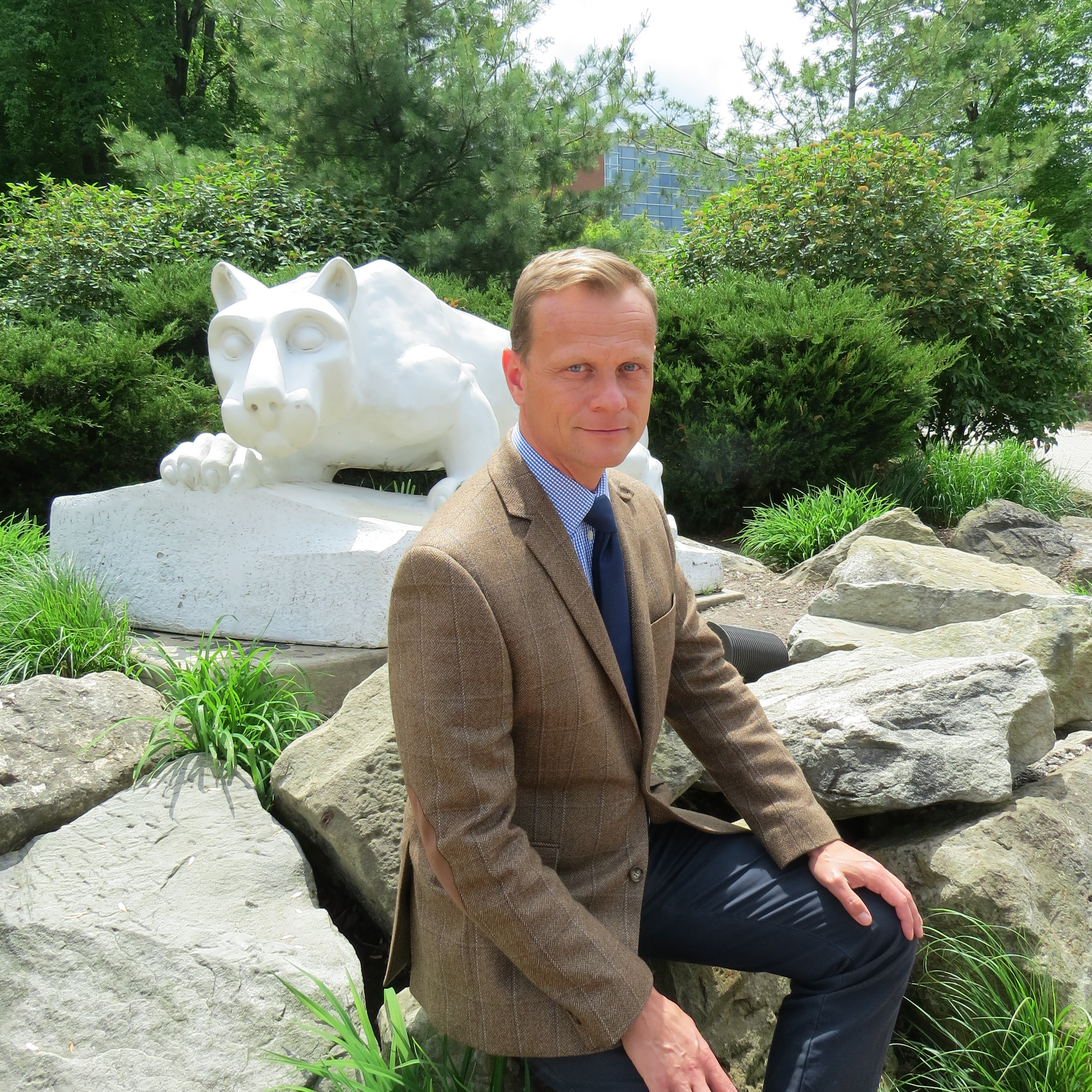
Michael Linhart (3) (682x1024)Michael Linhart took his time getting to Erie Insurance Arena, where he received a bachelor’s degree in general arts and sciences. He crossed the stage in May, 24 years after he first enrolled at Penn State Erie, The Behrend College.

“It’s hard to describe how that felt,” Linhart, 42, said. “To be honest, I just tried to soak it all in.”

The Fairview resident first arrived at Penn State Behrend in 1991. The Kochel and Burke centers had not yet been built. Ohio and Almy halls were still woodlots.

Linhart had trouble adjusting to college life. After three semesters, his GPA had flat-lined at 1.5.

“I wasn’t ready for college,” he said. “I didn’t have the focus or the determination to stay with it. I needed to grow up.”

So he left. He worked the cash register at a grocery store and helped manage a Taco Bell. He watched his friends go on to better things.

“All my friends were getting these great 9-to-5 jobs,” he said. “They were getting married, having kids, and I was stuck, still living hand-to-mouth.”

In 1998, after five years away, he came back to campus. He tried to be more active: He joined the Zeta Beta Tau fraternity and the Returning Adult Student Organization. He volunteered as an orientation leader.

“He had a renewed sense of what he needed to do to be successful here,” said Biddy Brooks, director of the Office of Adult Learner Services. “He was committed to putting in the work. So it was hard to see him leave again.”

After two years of study, Linhart was offered an internship at a property management company. He worked as a leasing consultant, matching renters to apartments in a 132-unit complex. When his boss offered him a full-time position – good pay, and a path up the organizational ladder – he accepted, leaving college for a second time.

Before long, however, the work bored him. He joined the U.S. Navy Reserve, training as an aviation supply worker. He completed basic training on Sept. 5, 2001.

Six days later, the nation went to war.

“I ended up in the Persian Gulf, on the USS Theodore Roosevelt, thinking, ‘Yeah, this was a great plan,’” Linhart said.

When his tour ended, he returned to Erie, wanting to be close to family again. He met a woman and had two children. He’d raise them on his own, tending bar and working as a massage therapist.

He married again in 2012. When his new wife, Amy, encouraged him to complete his degree, Linhart once more found himself in Biddy Brooks’ office.

“He just persevered,” Brooks said. “He was so positive and outgoing, and always willing to talk with other adult students. He wanted to help them through situations he’d already had to work through.”

He kept his own doubts to himself. “I was a lot more apprehensive, coming back that third time,” Linhart said. “I was like, ‘What am I doing here?’ But I stayed with it. I saw it as one of those lifetime badges you get: the ‘turn 40 and go back to college’ badge.”

It worked. He earned his final credits and was honored as the college’s top adult learner. The day of his last exam, he lingered on campus.

“This school has given me so much,” he said. “So many friends, so many experiences, so many nuggets of wisdom I can take with me anywhere. I just walked around and took it all in one more time.”

Before the commencement ceremony, he drove to the cemetery where his grandparents are buried. He placed an invitation in a zip-lock bag and tucked it between their headstones. Then he went home and taped a message to the top of his mortarboard: “I MADE IT.”

College packing 101

DSC_0209

By Heather Cass
Publications & Design Coordinator, Penn State Behrend

Ah…’tis the season for first-year students to clear the shelves at Bed, Bath & Beyond and Target in preparation for the big move to college. It’s a daunting and, at times, overwhelming task to pack up your life and move into a much smaller (and usually shared) living space.

Don’t stress, we are here to help! (By the way, that’s true not just for packing advice, but for any problem you encounter while you’re here. Never be afraid to ask for help!)

Keys to success

The keys to packing for college are the same things that will help you be successful once you get here:

  1. Do the research.
  2. Make a plan.
  3. Keep track of what you need to get done.
  4. Do not procrastinate.

What to bring

Now, the good news: We’ve done the research for you on what to bring.

Here’s the official list from Penn State’s Housing and Food Services Department:

  • Address book, stamps, stationery
  • Alarm clock
  • Backpack
  • Baskets for toiletries and storage
  • Bed Linen: sheets (extra-long twin), mattress pad (extra-long twin), bedspread/blanket, and pillow
  • Bike and bike lock
  • Cleaning supplies (cleaner, paper towels)
  • Clothing (bathrobe)
  • Computer, printer, and cables
  • Desk items (lamp, pens/pencils/highlighters, calendar, calculator, tape, scissors, stapler, paperclips)
  • Fan (portable)
  • Financial items (checking/savings account, credit/debit card, health insurance card, Social Security card, driver’s license or photo ID)
  • First Aid items (band aids, cotton balls, cotton swabs, cold/cough medicine, first-aid kit, aspirin)
  • Food items (can opener, bottled beverages, coffee maker with automatic shutoff, one set of silverware/plates/bowls/glasses, condiments, napkins, snacks, dish detergent/ towel)
  • Games (cards, board games)
  • Hangers
  • Laundry basket/bag, detergent, iron
  • Padlocks (desk, laptop, and bike)
  • Room decorations (note that posters/photos must be hung with plastic tack)
  • Sewing kit/safety pins
  • Snow shovel/snow brush to store in your car
  • Stereo system (CD player, radio, mini disc player, headphones, CDs, etc.)
  • Television
  • Toiletry Items
  • Towels
  • Umbrella
  • Vacuum Cleaner (although vacuums are available in each residence area, it is suggested that you bring a small one with you, such as a “stick” vacuum, if your room is carpeted)
  • VCR or DVD player (with cables)

Especially for Behrend bound students

There are some additional things you should add to your shopping list if you’re bound for Behrend. We asked current Behrend students, recent alumni, and staff and faculty members what they would add to the list. Here’s what they had to say:

  • Bring winter clothes/brush/gear with you. Last year, a good majority of people were caught surprised by a foot of snow the week before Thanksgiving break. — Zachary McCauley
  • A scientific calculator. — Robert Durbin
  • A flashlight. — Amanda VanBuskirk
  • Swiffer, dust rag, dish soap, and a sponge. — Megan Dunlap
  • Yaktrax (traction cleats designed that pull on over your shoes) give you better traction on ice. — Lauren Minner
  • A sleeping bag for staying in friends’ rooms. — Alysha Simmons
  • A boot mat to put wet footwear on and something to clean the floor with, such as a Swiffer. — Savannah Martin
  • Desk lamp. — Megan Dunlap
  • A small wash bin to do dishes. It’s easier than trying to do them in the sink. — Ashlyn Kelly
  • A warm scarf to cover your face in winter as you walk around campus, good winter boots, a sturdy umbrella, and rain boots, too. — Valeri Maye
  • Bring a pair of old shoes or boots that you can get dirty during walks in the gorge. — Jackie Gowen
  • A boot dryer. —Amanda Hall (Editor’s note: Oooh, good one, Amanda. Very smart investment!)
  • Extension cords and multi-plug outlet adapters. — Carol Brandon

Women in Engineering: Meet Sara Bell ’12

By Heather Cass
Publications & Design Coordinator, Penn State Behrend

sara bell

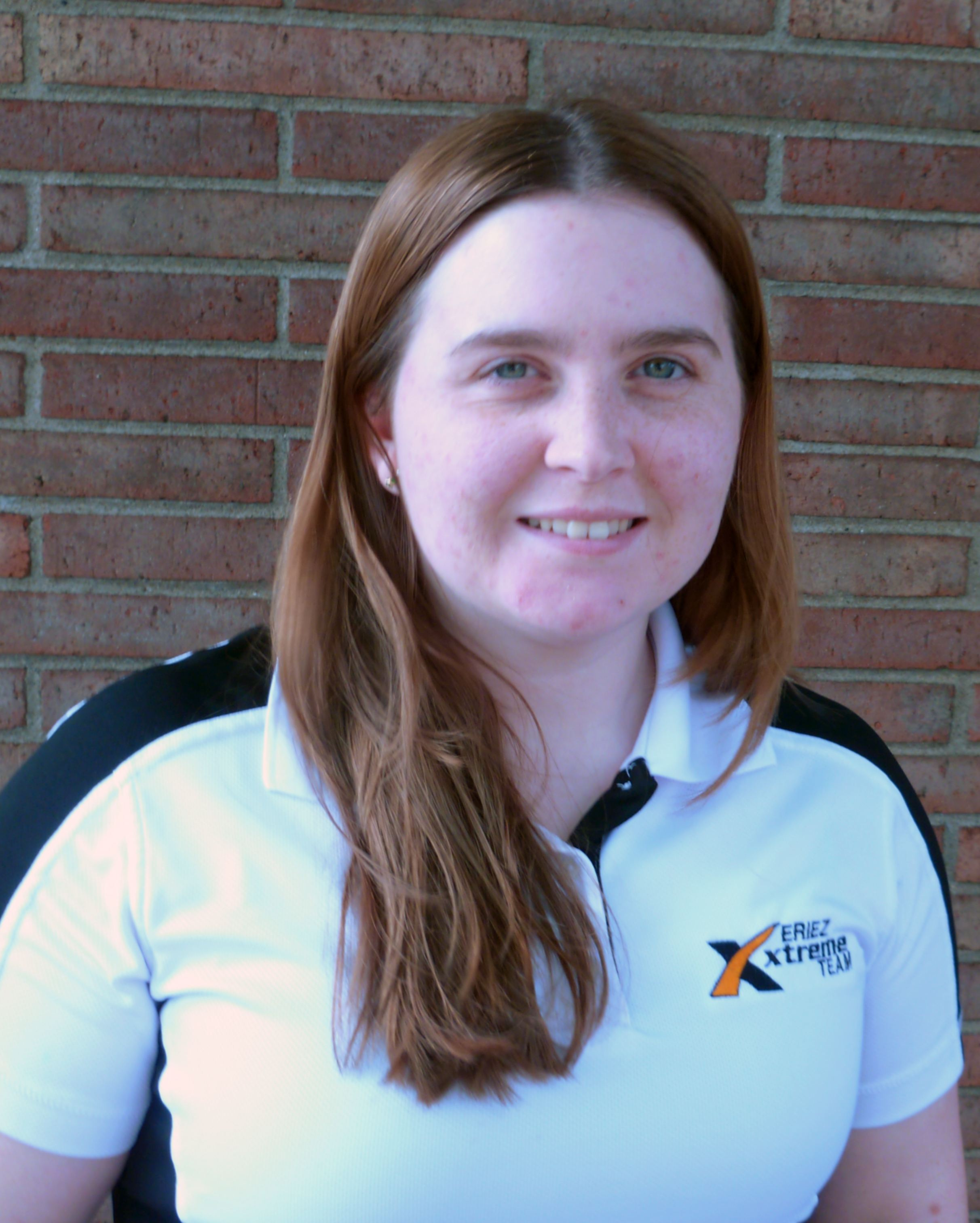
When people find out that Sara Bell ’12 is a mechanical engineer, they usually say something like, “Oh, well, good for you!”

Bell said she doesn’t perceive the response to be patronizing; rather she thinks it reflects a general lack of understand about the field of engineering.

“They usually have no idea what being an engineer entails or what I actually do, so I think that’s why they say it,” Bell, who works at Eriez (formerly Eriez Magnetics) in Erie, said. “Sometimes they ask me about my job, but it’s often based on things they’ve seen about engineers on TV, and they ask if I work on a big team or make big machines and equipment. They seem disappointed when I tell them ‘no.’”

Bell works with detection systems, helping design conveyor systems and reject systems and working with metal detector heads. She says her job may not be as glamorous as that of a NASA engineer, but it’s no less important or rewarding.

“The world needs engineers for everything, even for things that don’t seem ‘cool,’” she said. “I really enjoy seeing my designs and ideas come to life.”

Born with an engineer’s mind

Bell says she has always had an aptitude for math and science. As an Erie-area native, she participated in some of Penn State Behrend’s outreach programs, including Math Options for Girls and the FIRST robotics league in her senior year.

“Robotics had the largest impact,” she said. “That’s where I saw how cool it was to see something come together and work.”

A friend suggested that Bell look into a career in engineering.

“I wanted to do something where I could learn and use my brain,” she said. “I chose mechanical engineering because it is a catch-all engineering field. I thought it would be a really versatile degree that would allow me to do a variety of things but still hone in on something specific down the road if I wanted to.”

She’s been a mechanical engineer at Eriez for two and a half years, though she’s worked there longer, having interned there for several semesters before graduating,” she said.

Encouraging future generations

Bell has returned to Behrend to volunteer at Women in Engineering Day for the past two years.

“I always feel the need to encourage more women to pursue any STEM-related career they are interested in,” she said. “I think you’re seeing more women in engineering because they have opportunities to explore and learn about these types of careers before they even reach college.”

Bell is quick to point out that education never really ends for engineers.

“I sometimes say that I didn’t earn my degree for engineering; I earned it for learning,” she said. “As an engineering student, you learn how to learn. With that knowledge, you can do pretty much anything you want to in life.”

Meet Dr. Bernd Hacker, Visiting Scholar from Germany

By Heather Cass
Publications & Design Coordinator, Penn State Behrend

IMG_5879

Dr. Bernd Hacker

Penn State Behrend welcomes the opportunity to host foreign scholars who enrich our community’s intellectual and research endeavors, international connections, and global perspectives.

Dr. Bernd Hacker, a professor from the University of Applied Sciences in Rosenheim, Germany, a partner school of Penn State Behrend, has been a visiting scholar in the Black School of Business since January.

With Hacker’s experience at Behrend drawing to a close in August, we sat down to talk with him about his time at the college, how students in Germany and the United States compare, and the 5-year-old quadruplets (two sets of identical twins!) he and his wife are raising.

How did you end up at Penn State Behrend?

In February of 2014, Penn State Behrend and the University of Applied Sciences in Rosenheim signed a memorandum of understanding, agreeing to collaborate in various areas including student and faculty exchange programs and joint research projects and educational programs. I was the first to enroll in the faculty exchange program.

What courses did you teach?

In the spring semester, I taught ACCTG 305: Financial Statements and Management Decisions and I’m currently teaching a summer course, ACCTG 211: Financial and Managerial Accounting.

Are accounting principles/lessons the same in the United States as Germany?   

Yes, accounting principles don’t change. However, the teaching structure and system here are different from what I know.

How so?

In Germany, we don’t have midterms, quizzes, or graded homework assignments. We have a full semester of teaching followed by one big exam or project at the end of the class. American students are tested and graded much more.

So which system do you think is best?

I think a combination of both systems might be ideal. There is value to the system as it is here for students in their first year or two of college who might need more guidance and feedback.  As students move toward graduation, though, I think it’s important to transition them to a more self-directed system in which they have to come up with a plan for self-assessment, manage their time, and succeed without a lot of feedback or guidance along the way. I plan to take some of what I learned here about exams, testing, and quizzes to Rosenheim and try it in some of my classes with younger students.

In what ways is Behrend like your university?

They are similar in size with Rosenheim having about 5,500 students (Behrend has about 4,350 students). We have similar schools within our university and, like Behrend, we have very strong business, engineering, and plastics programs.

What is the biggest different between the universities?

We don’t charge tuition. In Germany, there are some private universities that charge tuition, but not many.

So everyone in Germany can go to college for free?

Yes, and no. It’s free, but not everyone can go. Admission is strictly merit based. There are only a certain amount of slots to fill in the programs at the universities and if you’re not good enough to earn a spot, you don’t get in. Some programs are more competitive than others, but in general, you have to have very good grades to go to university.

In Germany, students are separated at about age 10 or 11 and put on different tracks. Gymnasium is for academically-inclined students headed for college. Realschule is a middle level education for average or higher white-collar jobs. Hauptschule is for trades and blue-color jobs. It is possible to switch tracks, but not common.   More about the German School system here.

How do students in Germany and the United States compare?

They are very much alike. They care about what they learn. They are concerned about their grades. They like to have fun on the weekends.  I learned that students are not that different around the world.

Did anything surprise you?

I couldn’t buy a car without a United States driver’s license, so we rented one. Also, the winter was much colder and snowier here than in Germany. This children enjoyed the snow though.

You and your wife have quadruplets?

Yes, they are going to be six years old soon. Two boys and two girls, two sets of identical twins.

That must’ve been shocking news?

Yes. The doctor kept finding more in there whenever we went back. (Laughs)

Did your family travel to the U.S. with you?

Yes. My wife is a lawyer and she took a sabbatical to bring the children and come with me. She’s really enjoyed the extra time with the children. They love the beaches at Presque Isle.  They also attended preschool from January to May, which was a great international experience for them.

Have you always wanted to be a professor?

Yes. I taught while earning my Ph.D. and I enjoyed it. I worked in the banking industry for five years and at Seimens (the largest engineering company in Europe) prior to teaching though. In Germany, in the applied sciences college, professors are required to have five years of industry experience before becoming a professor.

How have students benefitted from the agreement between the universities so far?

Right from the start, we were able to arrange internships for Behrend students in Germany. The first intern went to Germany in May of 2014. This summer, three students are interning in Munich, Berlin, and Rosenheim. It’s a great opportunity for Behrend students to gain international experiences in multinational companies.

Have there been any student exchanges yet?

We’re currently working together on making it viable. There are several departments in Rosenheim that match Behrend’s four schools. We, too, have a School of Business and a School of Engineering. We also have a School of Business and Engineering, so I see a lot of opportunities for Behrend students to go to Germany and our students to attend Behrend. I am confident the partnership will benefit both schools, and I’m looking forward to greeting the first Behrend students at the University of Applied Sciences in Rosenheim.

Any advice for students interested in studying in Germany? Do they need to learn German?

No, you can definitely get along speaking English in Germany. Most Germans can speak, or at least understand, English. I would advise students to plan as early as possible if they want to study abroad. There are financial considerations (travel and accommodations). They should also keep some of their electives open. Students can earn 12 to 15 credits while in Germany, but they may need to be credits from their available electives.

Where can students get more information about the German exchange program?

Contact Ruth Pflueger, director of the Learning Resource Center, at (814) 898-6418 or rcp1@psu.edu.

Creating the Penn State Behrend Performance Band was one of Miranda’s many highlights

Print

SONY DSC
One of Craig Miranda’s favorite moments from this past academic year was creating the Penn State Behrend Performance Band, which performed a series of concerts on campus by the spring semester’s end.

By Steve Orbanek
Marketing Communications Specialist, Penn State Behrend

Editor’s note: Far from Home is an occasional series in which we document a year in the life of international students at Penn State Erie, The Behrend College.

When Craig Miranda arrived at Penn State Erie, The Behrend College, he had one goal.

“Even though I’m just a freshman, I want to start big. I want to make an impact,” the first-year computer science major said at the beginning of the academic year.

Miranda did more than start big. He finished big.

Through the course of the academic year, he excelled in the classroom, joined numerous campus organizations, started his own club, joined the tennis team and even presented a project at the Clinton Global Initiative University’s 2015 meeting, held this past March in Miami.

It’s not how Miranda expected his first year to go when he set foot on campus last August.

“I came here thinking that I would be more secluded. I thought I would just focus on getting my work done to get through, but it turned out to be the opposite,” he says.

Miranda credits the friends he made at Behrend with helping him get involved. Being so far away from home can be challenge, but he’s begun to build a strong support system at the college through the friends he has made.

“Friends are what help me to keep going,” he says. “They give me an escape to get away from whatever I’m feeling, whether it’s homesickness or something else.”

Together with his friends, Miranda created the Penn State Behrend Performance Band student organization as an outlet for anyone who enjoys singing or performing live music. By the end of the semester, the band had 12 members and had performed six concerts.

“We want to reach diverse groups of people, who come from different cultures and might have different tastes in music,” Miranda says of the student organization. “One of the songs we performed this year was an original written by two of our members, and it included both English and Chinese lyrics.”

An emphasis on musical diversity is a reason why Miranda, currently president of the club, has already begun the process of having the Penn State Behrend Performance Band brought under the college’s Multi-Cultural Council (MCC) banner. As the group grows, he envisions it being used even more to promote diversity on campus.

Miranda’s work with the band, coupled with his other accomplishments, made for a busy year, but he says he has no plans to slow down over the summer. Now back home in Kuwait, he reports that he’s already thinking about returning to Behrend in the fall, with plans to do “do something a lot bigger.”

This slideshow requires JavaScript.

Bittersweet Commencement

By Heather Cass
Publications & Design Coordinator, Penn State Behrend

Earlier this week, I was looking through the photos taken at Commencement and began jotting down the image numbers of students I recognized from having interviewed in the past.

“Oh, that’s a really nice one of Maddie. I’m going to have to send that one to her.  Awww..there’s George. And Vee. And Brian. And look at this one of Katie & Cody. Oh, I love it!  Wait, Nico graduated? And Megan and Paul, too?”

And there go half of my go-to student sources. Dang.

As a writer in the Office of Marketing Communication at Behrend, I work this gig like a newspaper beat, cultivating relationships with people in each school, making contact with the movers-and-shakers, and keeping tabs on standout students.

But, eventually, they all leave.

*sigh*

Such is the nature of the beast in academia. Student turnover is inevitable (and, if we’re being honest, preferable for everyone involved, I’m sure). It’s our job to educate them and send them out into the world.

But it’s bittersweet to see them go. Not just because I lose valuable student sources, but because we lose charismatic, interesting, enthusiastic, and remarkable members of our Penn State Behrend family.

  • Brian established the Waste Not program with his friend and former classmate, Stephen, turning what was waste into food for the hungry.
  • Vee was a very successful president of the LEB and a visible member of the Arts Administration program.
  • George was a hands-on, charismatic Marketing student who gamely posed in a hot, humid water park for a School of Business cover shoot.
  • Katie drove (and worked on) the School of Engineer’s thrice-winning Supermileage Car. Cody was a vital member of the Supermileage team, too.
  • Maddie helped the women’s soccer team to four championships while earning an Interdisciplinary Business with Engineering Studies degree and doing an internship in Germany.
  • Megan was the cheerleading coach and a founding member of Phi Sigma Rho, a new engineering sorority on campus.
  • Danielle was an outstanding tutor. She even has an award to prove it.

I could go on…and on…and on…and on. We have a lot of really great students at Behrend.  And I’ve been here long enough to know that there will be more to replace those who graduate.

While I’m going to miss the students that I got to know in the Class of 2015, I can’t wait to see where they go and what they do. Rest assured, you’ll probably hear about them in the future. I write alumni stories, too, you know.

(So, students…I mean, ’15 alums, go out there and do something I’m going to want to write about!).

Behrend students, faculty to lead fight against invasive species in Wintergreen Gorge

With funding from the Western Pennsylvania Conservancy, Pennsylvania Sea Grant and Behrend are working to develop a weed  management plan that brings students and community members together to remove invasive species.

By Anna McCartney

Communications and Education Specialist at  Pennsylvania Sea Grant, an outreach program of Penn State Behrend  

Wintergreen Gorge along Fourmile Creek is a popular destination for hikers, birders, fossil-hunters and others who simply use the stream to cool off on a hot day.

Because it’s also a favorite of Penn State Behrend students, they are involved in creating a weed management and implementation plan to develop best management practices that protect the Gorge from invasive species.

With funding from the Western Pennsylvania Conservancy (WPC), and help from Pennsylvania Sea Grant (PASG) and Behrend faculty, they are working to develop a Weed Warrior program that brings students and community members together to remove invasive species that are found there.

IMG_3440 PSU PASG Weed Warriors wintergreen gorge R

Students will also help develop a Best Practices Guide that can be used by other universities and communities to control invasive species on their campus or other natural areas.  

In May and June, students will learn to identify target invasive plant populations and use GPS equipment to inventory and track them on a baseline work map so they can prioritize future removal efforts. The data they collect will be added to existing information provided by the WPC about rare, threatened or endangered plant species so the plan will protect these assets while eliminating the harmful plants.

The management plan will require students to conduct research and determine immediate priorities and the best course of action to combat invasive species within the identified areas. Based upon the site conditions, students will also need to consider how to reintroduce native species once the invasives are removed.

Marti Martz, PASG senior outreach and project facilitator, anticipates that engaging Penn State students and community members in this effort will provide several benefits. “There will be more ‘boots on the ground’ to help with removal and more opportunities to discuss impacts of invasives on native plants and the insects and animals that rely on these natives. Once people understand how invasive species degrade a habitat, they will be more vigilant about what they bring into their own yards,” she said.

Sea Grant will also work with Ann Quinn, director of Greener Behrend, and the students to develop a Best Practices Guide that can be used by other universities or communities that want to control invasive species on their campus or other natural areas.

IMG_3463

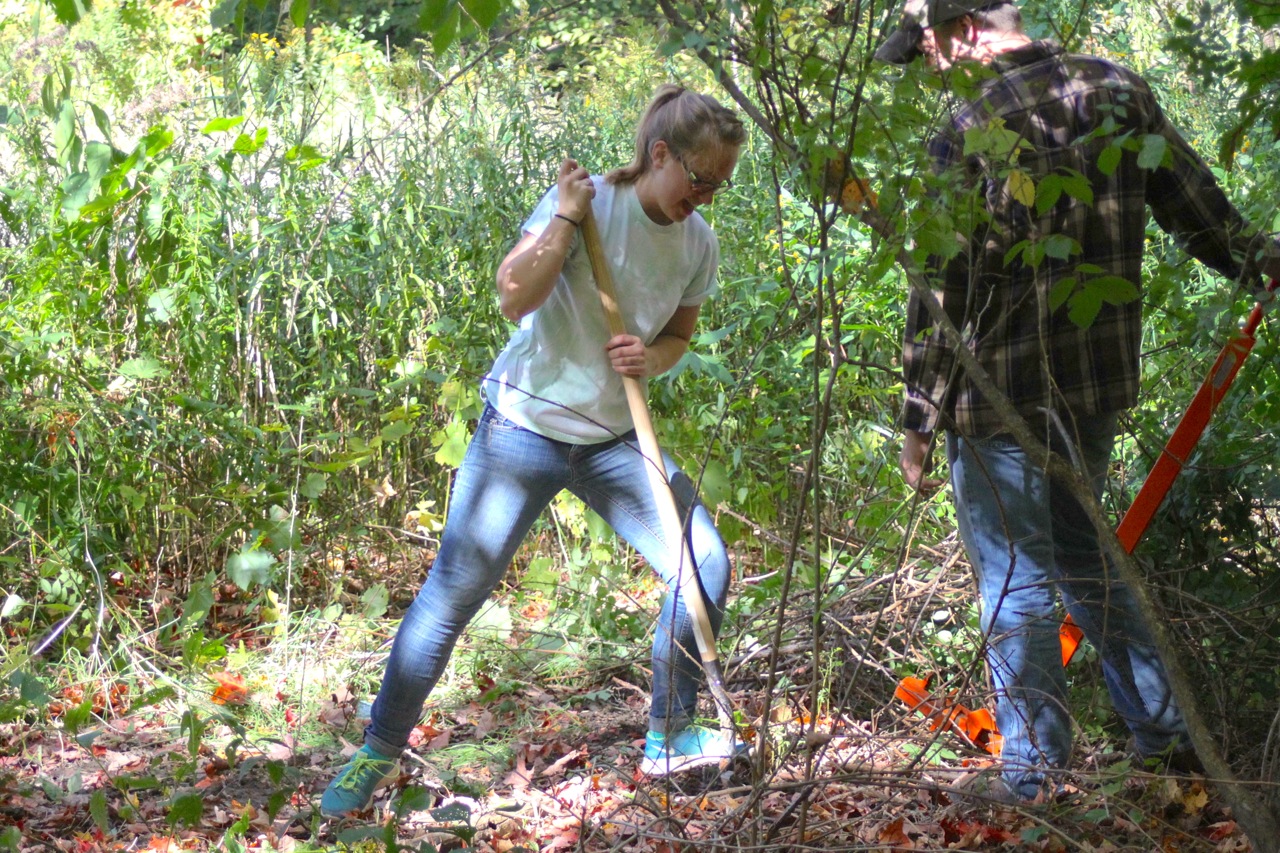
Tom Cermak, Pennsylvania Sea Grant coastal outreach specialist, helps Behrend students remove invasive bush honeysuckle from Wintergreen Gorge.

“This project not only provides valuable, hands on experiences for students, but it also protects and enhances the ecological integrity of a wonderful community asset,” said Tom Cermak, PASG coastal outreach specialist who is working with students to identify, track and remove invasives.

“We at Behrend are very excited to work with Sea Grant to eliminate invasive plant populations throughout Wintergreen Gorge. As these aggressive species are removed, they will be replaced with native plant communities, which will increase biodiversity and help keep the Wintergreen Gorge Ecosystem in balance, ” said Quinn.

You can help maintain the beauty of this popular hiking and biking trail by volunteering to remove plants at planned workdays this summer. Contact Ann Quinn at 898-6993 or abq1@psu.edu.

nps.gov bush honeysuckle1D0EC7E8-155D-451F-678FFC8BDF8B607F-large

Bush honeysuckle is a deciduous shrub that can grow up to 15 feet. This aggressive invader displaces many native plants, including wildflowers and dogwoods.

multiflora rose Penn State

Multiflora rose (above) steals space, nutrients, water, and sunlight from native plants and trees.

Turnbull Award winner relishes her time spent at Behrend

DSC_1245

By Steve Orbanek
Marketing Communications Specialist, Penn State Behrend

First impressions go a long way. Just ask Amyelia Payne.

Four years ago, while searching for colleges, the New Castle native toured Penn State Behrend. That’s all it took for her to make up her mind.

“We had this awesome tour guide, and right away, I knew Behrend was for me. I instantly fell in love with the campus,” the senior interdisciplinary business with engineering studies (IBE) and international business major recalls.

Payne’s experience that day would later influence her campus involvement as a student. When she looked into organizations to join, one club resonated with her.

“I loved Lion Ambassadors because a Lion Ambassador was the first person that I met when I came to campus,” Payne says. “I remember how that influenced me, and I wanted to have that same impact on students when they came to tour Behrend.”

Joining Lion Ambassadors was just the start of Payne’s influence and involvement. She joined Lambda Sigma and Beta Gamma Sigma, both national honor societies, and also became very active in Student Government Association (SGA). As a junior, she was SGA vice president before serving as president this past year.

Through SGA, Payne has left her mark. She’s helped spearhead discussions and preliminary plans to transform Erie Hall into a fitness and recreation center and Behrend’s SGA played a part in expanding Penn State’s smoking policy to include electronic and vapor cigarettes.

As SGA president, Payne also introduced an international seat on the organization’s board in response to the college’s growing international student population. This past fall, Penn State Behrend welcomed 186 international students, the largest such class ever at the college.

“We’ve seen such an influx of international students, and this was done to ensure that they had equal representation,” Payne says.

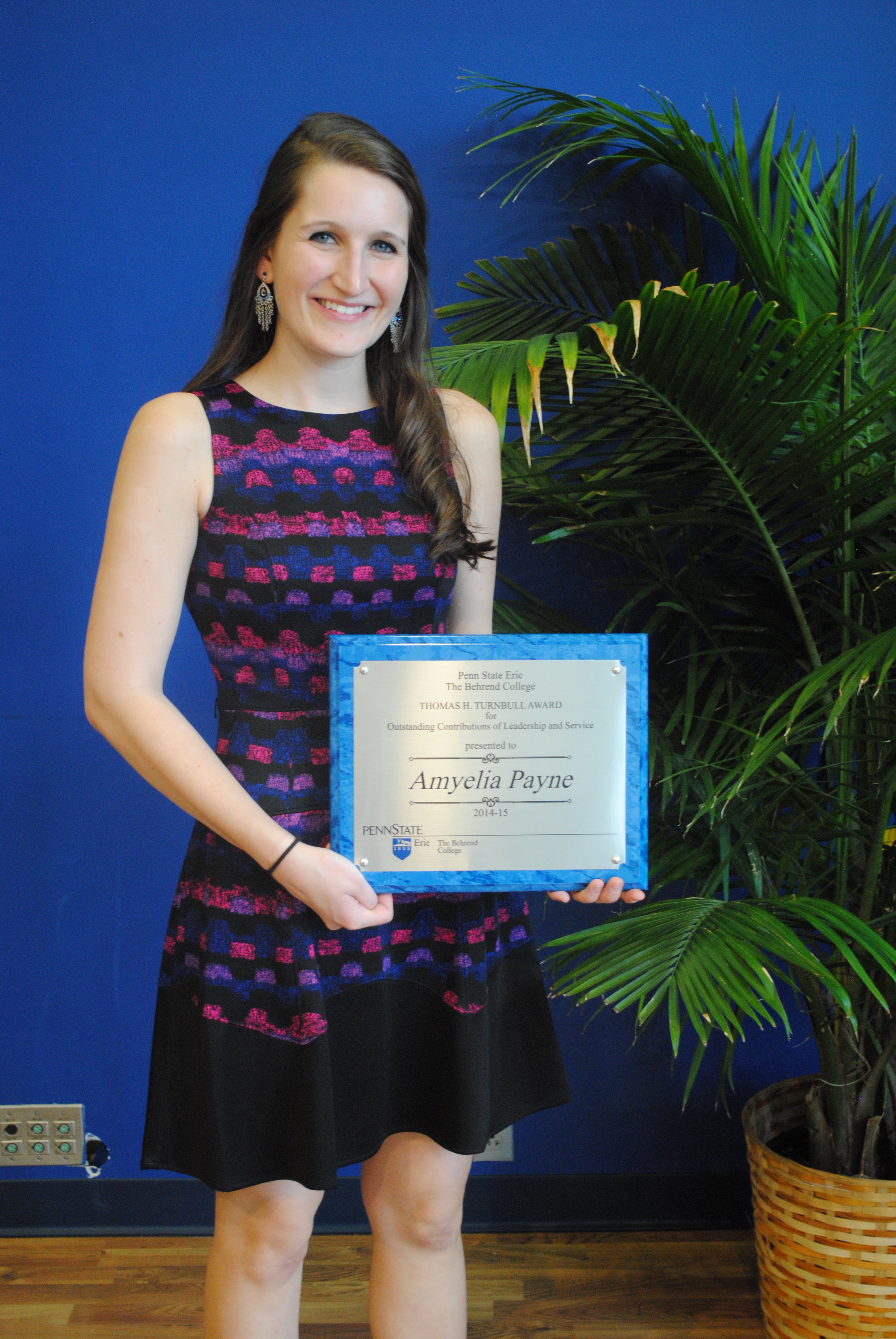
Payne’s involvement on campus was recognized in April at the 66th Honors and Awards Convocation where she was named the recipient of the Thomas H. Turnbull Award. The award recognizes a Penn State Behrend student who has contributed to the college community through outstanding qualities of character, scholarship, leadership and citizenship.

As it happens, when it came time for the naming of the Turnbull Award winner, Payne was already on stage handing out awards as part of her duties as SGA president.

“I had been standing up there for more than two hours smiling, and by the time they got to the final awards, my face hurt. I heard them say IBE and international business major and I thought, ‘Wait a minute; I’m the only one here with that double major,’” she recalls. “I was so shocked, but it was an incredible feeling to be recognized. I’ve given a lot to Behrend in four years, but I could never repay the experiences that it’s given to me.”

This week, Payne will graduate with her IBE degree and head to Cary, North Carolina, to intern with LORD Corporation this summer. She will study abroad in Barcelona this fall before graduating with her international business degree in December.

She says she will miss her time at Behrend, but she’s also hopeful and excited for the future.

“I’m not sad. There have been times over the past month when I’ve thought about it, but why be sad? It’s inevitable, so there’s no reason to dwell on it,” Payne says. “Everyone comes to college to get a degree and for their academics, but it’s what you do outside your degree that makes your experience unique. I’ve done all that I could, and I think I’m looking forward to that next stage of my life. ”

Left-hander Jack Herzing gives baseball team boost during sophomore season

Jack Herzing

By Steve Orbanek
Marketing Communications Specialist, Penn State Behrend

One by one, Jack Herzing sent them down. Between the left-hander’s strong fastball and biting curveball, Penn State Altoona hitters found themselves helpless at the plate.

When the April 6th game had finished, the Penn State Behrend pitcher had struck out 16 batters, tying the school record set in 2001 by Troy Williams.

His source of motivation that day came from an unexpected place — fear.

“In the back of my head, there was just this fear of getting rocked. It’s happened to me before, and it’s a very bad feeling when you’re up there getting hit around, and I was really motivated to get out there and help our team win,” Herzing said.

The Lions did win the game, defeating Penn State Altoona 4-1 in the AMCC contest. Herzing’s strong performance earned him recognition as Louisville Slugger National Player of the Week, but it was just a snapshot of what’s become a breakout sophomore season for the St. Marys native.

Overall, Herzing is 7-1 with a 2.82 ERA in 44 1/3 innings of work and leads the team with 58 strikeouts while averaging 11.69 strikeouts per game. His success has given a huge boost to the Lions, which own a 23-10-1 record and begin play in the AMCC Championship Tournament on Friday, but the seeds to Herzing’s 2015 breakout had been planted at the end of last year.

While he showed glimpses of his talent during his first year as a collegiate player, Herzing says he felt a need for improvement.

“After my freshman season, I really wasn’t pleased with how I performed,” the project and supply chain management major says. “The day after I came home (from college), I started a new lifting routine to get myself ready for the next season.”

The extra time in the gym has paid dividends for Herzing, who is penciled in to start the Lions’ first game   of the AMCC Championship Tournament against Mount Aloysius.

“Herz has been big time for us this spring,” says Behrend head coach Paul Benim. “Our assistant coach Jay Condit has done a tremendous job of helping Herz evolve, simplifying his process. Herz has really focused, stepped up and elevated his performance, especially after the team lost three senior pitchers from last year’s ECAC Championship team.”

Perhaps no one is more familiar with Herzing’s mentality on the mound than teammate Brian Bohman, who has caught every one of his games this season. As a catcher, Bohman is often charged with keeping Herzing calm, even when things turn sour.

“Jack is that bulldog out there,” Bohman, a sophomore history major, says. “He wants to go 110 miles all the time, but sometimes you have to slow him down, say a little joke and get on with it. We work really well together.”

Herzing credits Bohman with much of his success.

“They say it’s 50-50 catchers and pitchers, but it’s really 60-40 catchers, if not more,” he says. “Bohman has been so great this year. He studies the batters. He knows where we should throw it, and I just throw it where he wants me to. He deserves most of the credit.”

While he’s clearly very serious with regard to baseball, there is another side to Herzing, and Hunter Hux will attest to that. As the only left-handed pitchers on the team, Herzing and Hux immediately developed a bond, but it goes beyond baseball.

“We’re the two goofiest kids on the team. We’re always laughing and cracking jokes,” Hux says. “We saw this one story online called ‘17 Reasons That You and Your Best Friend Are Joey and Chandler,’ and we started crying laughing afterwards because it described us perfectly.”

Hux is one of Herzing’s greatest supporters, and he has high hopes for his friend’s future. Last year, former Behrend pitcher Chad Zurat signed a professional contract with the Colorado Rockies organization.

That leaves big shoes for any Behrend pitcher to fill, but Hux says Herzing could be the guy to do it.

“If anyone on this team has the potential to do that, it’s Jack,” Hux says. “If he just develops a third pitch, there is no ceiling for him. And if Jack decides he wants to do it, I think he will.”

Alumnus returns to inspire, encourage at Relay for Life

By Heather Cass
Publications & Design Coordinator, Penn State Behrend

Brooks Family

The Brooks family – Amy, Glenn, Haley, and Lindsay

Glenn Brooks ’86 never expected to be invited back to Penn State Behrend to speak to students.

“I changed my major several times and it took me awhile to determine where I was headed as an adult. And, let’s just say that I may have been working on my ‘social skills’ a little too much back then,” he said with a laugh.

But there are lots of surprises in life. Some good. Some not so good, like cancer.

“In September of 2011, I was diagnosed with Stage IV Head and Neck Cancer, originating in the ligual tonsil,” he said. “My treatment included chemotherapy, radiation, hydration therapy, tonsillectomy, a feeding tube, extended stays in the hospital, and nearly three months of not being able to eat, drink, or speak.”

Fortunately, the aggressive treatment plan worked. He’s been cancer-free for two years now and he says he is filled with gratitude and an internal drive to give back.

“Given the choice, I wouldn’t choose to get cancer, of course,” he said. “But it has inspired me to use my experience to help others. I genuinely believe that my calling is to seize as many opportunities as possible to reach out to others as they endure treatments and recovery, as well as to those that have been fighting for the cancer patient, too.”

That’s why he said “yes” when two Penn State Behrend students asked him to return to campus on April 10 to deliver messages of hope to hundreds of participants in the college’s Relay for Life, a 24-hour walk that is a fundraiser for the American Cancer Society. Brooks was the Opening Ceremony speaker.

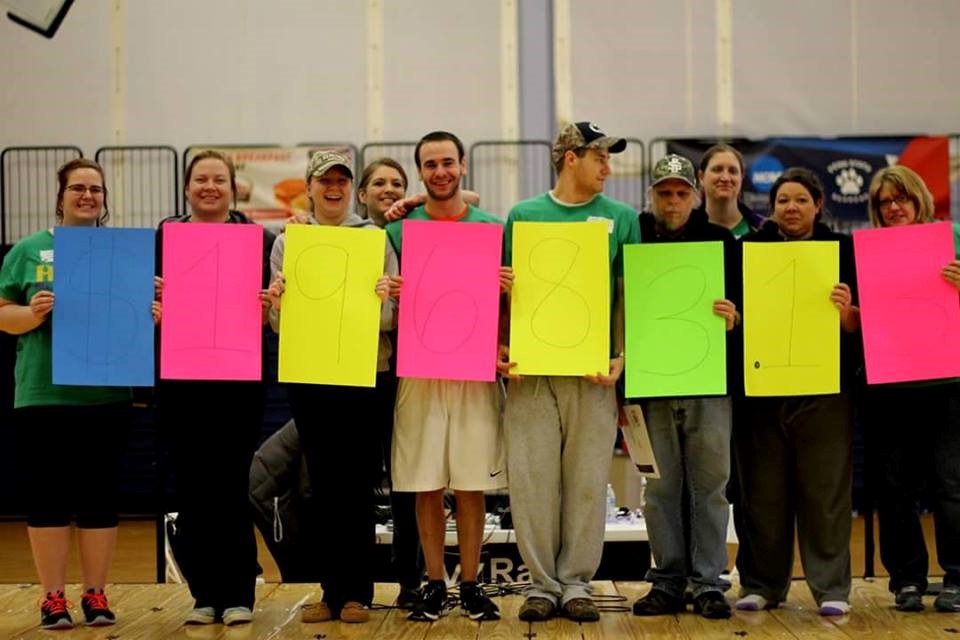
More than 250 participated in the Behrend Relay for Life with twenty-one teams who raised 19,683 for the American Cancer Society! The highest fundraising team was Behrend’s own Housing and Food Service Team Tie Dye who raised $3,817.

relay for life

Brooks, who participated in the Survivors Lap, was recently named a Global Hero of Hope by the American Cancer Society, one of only thirty-one such people in the world.

We talked with Brooks to learn more about his days at Behrend, his journey since, and how he reaches out to help others.

Why did you choose Behrend? Well, because initially I wanted to pursue Civil Engineering. But Calculus 162 said I wasn’t right for that career. In hindsight, I have to agree.

Degree earned: Management, with a Human Resources option.

Where do you work now? I’m the Manager of Organization Development for Student Transportation, Inc., the world’s third largest provider of school transportation services with more than 14,000 employees throughout the United States and Canada.

Family: Wife, Amy, and two daughters, Lindsay, 20, and Haley, 17, who is currently a Penn State Behrend student, but is soon transferring to the University of Hawaii, where she will be joining her fiancé who is serving in the U.S. Navy. They are getting married in June.

You speak regularly about your cancer fight, correct? I do. In the past couple of years, I’ve given more than fifty talks to various groups. I also lead a Cancer Support Network initiative at work and I’ve written several articles about cancer that have been published in various publications and magazines.

What do you say? My typical story describes my cancer journey, from diagnosis to current. I remind the audience that cancer is no longer a death sentence, due in part to the efforts of the American Cancer Society. I always, on behalf of all cancer survivors and their caregivers, thank those who are engaged in the fight against cancer. I encourage them to remain involved so that we can rid the world of cancer in hopes our children and grandchildren never have to hear that terrible diagnosis.

Why go so public? I know that some cancer patients wish to keep their experiences private, but I choose to be an activist for cancer research, recovery, and response. As a cancer survivor, I’ve been given a gift—authentic understanding. It’s something that doctors, nurses, and other health care professionals who haven’t had cancer, don’t have. I understand the financial, spiritual, practical, relational, philosophical, emotional, and physical changes that occur when a person has cancer because I’ve experienced it first-hand.

Do you find sharing to be rewarding or fulfilling in some way? I’ve met some rather incredible folks along the way. The energy and passion that I’ve felt is nothing short of amazing. I can tell you this with full confidence—we are loved. We are all loved by people that don’t even know us. Also, my involvement has given me the opportunity to give back and show appreciation for all the people—family, friends, coworkers, and perfect strangers—who were so good to my wife and my daughters when I was sick.

Your wife was recently diagnosed with cancer? Yes, in March of 2014, she was diagnosed with thyroid cancer. And, when someone tells you that if you have to pick a type of cancer, that’s a good one to get, don’t believe them. Any cancer is horrible.

Did you join in the Relay at Behrend? I did the Survivors Lap and also the Caregiver Lap. I did my best to thank every team member along the way, handing out high-fives all the way.

What is a Global Hero of Hope? I was submitted an application and was selected to represent the cancer survivors/caregivers internationally. There are only thirty-one Global Heroes of Hope in the world with seventeen countries represented. There are just four of us from the United States.

What do you want people with cancer to know? You are not alone. You can win the fight. And, love will beat cancer.

Can people contact you if they have questions or would like you to talk to a group? Sure, they can e-mail me at gabrooks@yahoo.com.