
By Heather Cass, Publications Manager, Penn State Behrend
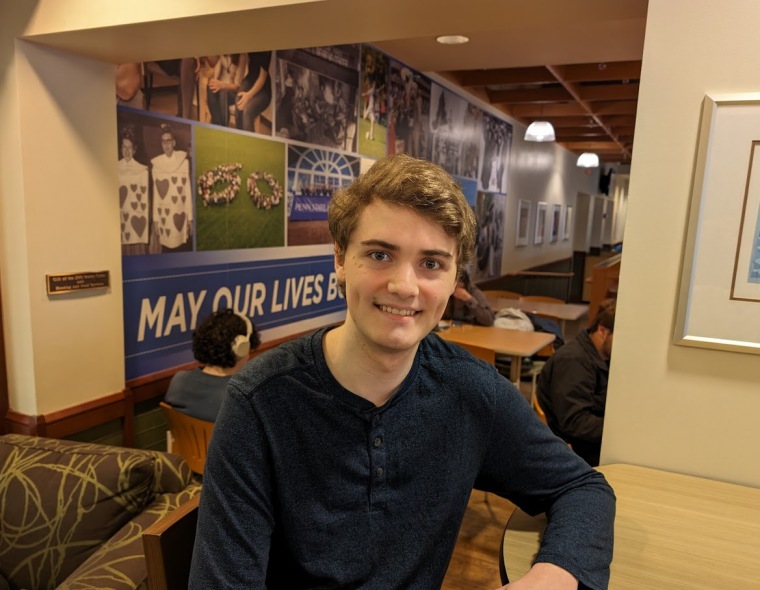
While at Penn State Behrend, Eric Oelhaf, a senior Political Science major, added something to his resume that few college students can claim: His work has been published in The Wall Street Journal.
In fact, he has had three pieces published in the WSJ’s “Future View” column, in which they invite undergraduate and graduate students to offer their opinion on current topics from Twitter’s rebranding to the future of the NFL to foreign policy to ChatGPT.
Oelhaf’s published essays address the topics of American support for aid to Ukraine; the U.S. border crisis, and why people don’t trust scientists anymore. He is in good company with students from such institutions as Brown University, Harvard University, and West Point Academy.
We talked with Oelhaf, a State College native, to learn more about why he wanted to contribute, how he got published, and what he has gained from the experience.
How did you learn about “Future Views”?
Dr. Maggie Shum, assistant professor of Political Science, mentioned it in a class that I took with her in the fall semester. Though it’s known to be a conservative publication, The Wall Street Journal said it was trying to provide a diversity of viewpoints in this feature.
Did you immediately contribute?
No. I looked at it as a national writing competition and decided that I was only going to contribute if I had something unique to say. I felt that would improve my odds of being selected. I was surprised that they printed the first one I submitted, which was the piece on the border crisis. The second one was the piece on why people don’t trust scientists.
Then you submitted one about aid for Ukraine?
Yes. That one was a strategic choice. I wanted to dispel myths that are prominent in conservative information spaces about the costs of sending aid to Ukraine. Of course, the reason to support Ukraine is that it’s the right thing to do. Russia has historically tried to eradicate the Ukrainian language and identity from existence since the times of the Russian Empire. And languages are a particularly important part of European political philosophy.
Does the newspaper edit the pieces?
The one on the border crisis is nearly identical to what I submitted, and those are really my thoughts on the matter. There was light editing on the Ukraine piece. But the trustworthiness of scientists’ piece was heavily edited. Looking back on that, I realize that was my fault.
How so?
I had tried to have a more in-depth discussion than what the 250-word-limit would allow, and I didn’t end up making a clear argument in what I originally submitted. The editor then rewrote some of it operating under the assumption that I was trying to critique the behavior of just the authority figures, which I wasn’t. It was a misunderstanding that I know now I could’ve prevented.
What has been the response to your work?
It’s interesting to read through the comments. I’ve learned that people will complain about anything unless your reasoning is airtight or in line with what they believe. I was called an elitist for providing context on the border crisis. Sometimes, readers will even complain that they are listening to college students, despite clicking on a column clearly labeled “Future View.”
What have you learned by reading the feedback?
It seems the current American news consumer is addicted to anger, and the media is more than happy to feed that addiction.
What other topics interest you?
I care most about what is happening in Ukraine and, as a result, I’m concerned about the current state of Congress. I’m also interested in artificial intelligence and the ways in which it’s being handled by our government.
What would people be surprised to know about your generation regarding politics?
My generation seems to care about efficacy to a greater degree than older ones. We want our politicians to be good at what they do. We don’t want them to continually take half measures on humanitarian crises cause by our allies, nor do we want them to spend six months trying to pass a budget.
What do you want to do after college?
I like foreign relations, so I may pursue a career in government in that field. I would certainly take a job in journalism, too, if I had the opportunity.
Oelhaf’s published pieces
- The New Border Immigration Problem
- Why We Don’t Trust Science Anymore
- The Case For and Against Aid to Ukraine
Did you know?
Penn State faculty, staff, and students have access to The New York Times and The Wall Street Journal at no cost through the Student News Readership Program. To take advantage of this program, you must register using your Penn State email. Learn more at Penn State’s Student Affairs website.
 BEHREND BLOG