Standout Seniors ’25: Meet : S. N. “Nic” Darrell (English)

Penn State Behrend’s Class of 2025 is ready to make its mark on the world. We’re proud of our students and all that they have learned and accomplished here at Behrend. Over the next several weeks, we will introduce you to a few of our remarkable seniors who have conducted valuable research, pioneered innovation, overcome challenges, and engaged in college life in a big way.

Today, we’d like you to meet: S.N. “Nic” Darrell:

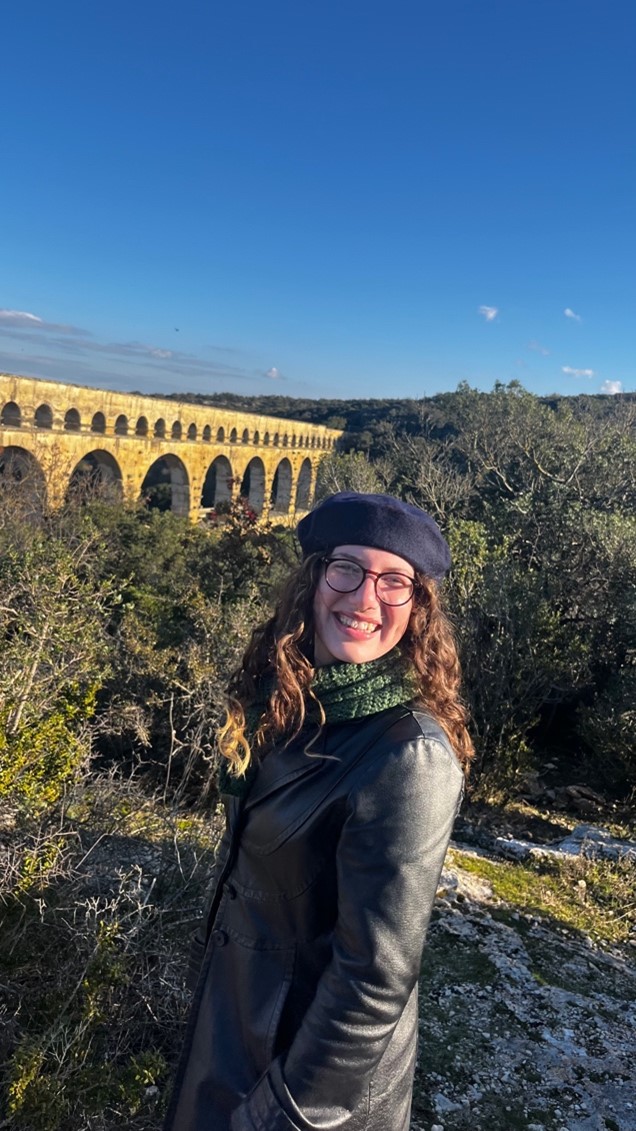
Darrell during a semester abroad in France at Pont du Gard, the largest ancient Roman aqueduct in Europe.

Major: English — Literature, Film, and Culture option

Minor: French and Francophone Studies

Hometown: Perkasie, Pennsylvania

Scholarships: Chancellor’s Scholarship

Why they chose Behrend:  It was far enough from home that it made me I feel I was branching out. It is also the only Penn State Commonwealth Campus with NCAA Water Polo.

Why they chose their major: I have always been involved and interested in languages and the arts. The English Literature, Film, and Culture option offered a diverse learning path that continues to interest me.

Proudest accomplishment at Behrend: I am most proud of the independence I gained while studying abroad for a semester in Montpellier, France. Living with a host family helped me to truly immerse myself in the French language and culture. I gained a global perspective on politics, sustainability, and life, and I can finally call myself multilingual.

Challenge accepted: Balancing work and play is always a challenge. I have had a job throughout my years at Behrend and each semester, I get burned out toward the end. I try to remember to take time for myself and to spend time in nature, with my dog, or with the people I love.

Clubs/activities: I’m a member of Greener Behrend and the French and Francophone clubs.

Awards: Association of Collegiate Water Polo Coaches (ACWPC) Water Polo All-Academic Team, President’s Freshman Award (4.0 in first semester at Behrend).

Captain ‘O Captain: I am the senior captain of the water polo team. I have been playing for nine years. I love the sport. It keeps me healthy and disciplined.

What you’d be surprised to know about them: Although people look at me and assume that I am a woman, I am non-binary and pansexual. Queer/gender studies have been a focus for me in my English classes. I am doing my senior thesis on Orlando by Virginia Woolf, which is a 1928 biographical fiction about a genderfluid aristocrat. LBGTQIA+ studies are underrepresented, and I want to bring light to these unique, queer ideas.

Highest priority for the coming years: I want to travel and understand cultures different from my own as much as possible. I know the best way to do that is to get paid while traveling, so I plan to find a career that accommodates this lifelong dream.

Love for art and nature: I am passionate about consuming and creating art, whether that is through dancing, painting, crocheting, writing, or making music. I also love nature and constantly seek out ways to preserve the Earth through vegetarianism, reducing waste, and giving back to the place we all call home.

Advice for first-year students: Someone told me that in the first month of school, I should say “yes” to any new opportunity that came my way. It was great advice as it allowed me to branch out and take advantage of the diverse student life at Behrend.

After graduation in May, Nic plans to pursue a job that allows them to see the world, perhaps teaching English abroad or being a flight attendant.

Hash-Tagging History: Alumna Shapes Social Media at Gettysburg Museums

By Heather Cass, Publications Manager, Penn State Behrend

Alanna Gillis ’24

While job hunting, Alanna Gillis ’24 stumbled across a position as a programs assistant at the Adams County Historical Society (ACHS) in Gettysburg. It seemed a good fit for Gillis, who earned a Creative Writing degree and minored in History at Penn State Behrend.

Though the organization eventually filled that position internally, they encouraged Gillis to interview for a part-time customer service position.

She was disappointed but figured she would interview for the experience.

“One very convincing interview and tour of the building—including their massive library and archives— later, I was working for ACHS as a visitor services associate in a part-time capacity,” she said. “Even though it wasn’t the job I hoped to land right out of college, it was still a job in my field that I felt confident I could do well.”

She did it so well that by September, she was promoted to part-time associate in the marketing department.

“They had been looking for someone to fill that position in marketing and had seen on my resume that I had experience with writing, graphic design, and running social media for the clubs I was in at Behrend,” she said.

Gillis was promoted again in just a few months. Today, she is the full-time social media and marketing coordinator at ACHS, where she creates and curates content for the organization’s social media pages, produces short- and long-form video projects, and contributes to marketing materials and publications.

We chatted with Gillis to learn more about her job, how Behrend helped her get there, what she’s learned so far, and what she’s looking forward to.

Tell us a little bit about the Adams County Historical Society.

The Adams County Historical Society is a nonprofit historical society that runs two museums in Gettysburg. ACHS focuses on preserving, protecting, and sharing the stories of Gettysburg and Adams County. Through our two museums, Gettysburg Beyond the Battle and The Shriver House Museum, we highlight the local history, reaching all the way back to the time of the dinosaurs.

How did your Behrend education help you obtain this role?  

Both of my areas of study were crucial. My History minor helped me get my foot in the door, but my Creative Writing degree allowed me move up and achieve the job I have now.

My job is mainly about communicating with the public, whether that be to our museum patrons, to our followers, or to our YouTube viewers. I needed to have a good grasp of how to best communicate with people through the written word—a skill I felt confident in because of my Creative Writing degree.

Having a good grasp of the English language, from word choice to register, helps me effectively draft both a fun TikTok script and a more formal press release, which is the flexibility that ACHS needed from someone in this position.

My Creative Writing degree has also allowed ACHS to start new projects they wanted to do but didn’t have the staff for, such as publishing firsthand accounts of the Battle of Gettysburg.

What are your primary duties in your current role?

I am responsible for our social media pages; I create and curate content for Facebook, Instagram, TikTok, and YouTube. I generate daily content for all these sites, which varies from photos with captions, to short form videos highlighting our museum, to video thumbnails, to longer videos aimed at teaching people the history of Adams County and Gettysburg.

Beyond that, I am also responsible for filming and editing our longform videos for YouTube. So far, I’ve worked on nearly forty videos with a combined view count of nearly 150,000 on the platform.

I also help with our publications. This includes civilian accounts of the Battle of Gettysburg, informational and promotional flyers, and a museum guide featuring many of the artifacts on display and in our archival collections, like those published by The Smithsonian.

What does a typical day look like for you?

My day starts with a 40-minute commute, but I don’t complain about it too much because it’s a beautiful drive through rural south-central Pennsylvania. It gives me time to center myself and prepare for the day ahead.

The first thing I do is check my email inbox and the inboxes of our various social media sites. If any messages came in overnight, I’ll respond or pass them along to the correct department.

From there, I usually spend the morning editing YouTube and TikTok videos. Depending on the length of the video, this can take anywhere from a few minutes to an hour or more.

After lunch, I work and draft social posts for the week. If I get all that done, I’ll spend time working on secondary assignments like publications.

When do you gather content?

Certain days of the week are reserved for filming content only; I’ll go out onto the Gettysburg Battlefield or into other parts of Adams County with our historian and film episodes for our YouTube channel. Usually, this is how I spend Fridays.

What has been your favorite project so far?

I’m really enjoying getting to put together the civilian accounts of the battle. This project is a perfect blend of my major and my minor, and it’s very rewarding to be able to work on a project where both are useful. Putting together these accounts has also allowed me to see a different type of publishing than I had when I worked on Lake Effect, Behrend’s literary journal.

And your favorite post so far?

The YouTube video “Tim’s Top 10 Defunct Gettysburg Attractions.” Tim Smith is our historian, and he and I spend a lot of time together filming our YouTube videos. I also often consult with him during research or when I’m fact-checking my written content. This was the first episode he and I worked on together, and it was also the first I’d shot and edited in this style. I managed to sneak in some jokes during the editing process, which made the project quite fun.

Have you done anything that turned out to be an unexpected success? 

A few YouTube videos have unexpectedly done well. We don’t typically get more than 3,000 views on our longer lecture videos, but “The Confederate Retreat” lecture has 28,000 views, significantly more than we anticipated.

An unexpected success that is more directly related to me and my work is that I started a book club for fans of Adams County history. Each month, ACHS staff selects a book, usually historical nonfiction, and I prepare a weekly discussion on each section. It’s a virtual book club, which means we have participants from all over the country. So far, we have over 110 members!

What would people be surprised to know about social media marketing? 

A lot of work goes into social media content management and marketing. It’s not as easy as just selecting an image, writing a quick caption, and hitting “post.” Often, images require editing or designs must be created. From there, captions must be drafted and edited to ensure that voice aligns with the company and the historical content is correct. The next step is tagging the correct people and inserting the corresponding ticket links, if necessary. After that, the post is good to go live. Then, it must be cross-posted to all the other platforms. All that work is for one single post, and ACHS usually posts a minimum of five times per week on each platform.

What are you looking forward to? Are there any big events or projects you’re excited about? 

This May, we are hosting the Gettysburg Film Festival: Victory in World War II. We will have guests ranging from historical filmmakers like Ken Burns to authors and screenwriters. I’m excited to help with this and make connections with people in the fields of both writing and history.

What have you learned the hard way? 

When I first started, I was hesitant to ask for help. For a short time, I tried to grin, bear it, and figure it out by myself.

When this resulted in content that I wasn’t happy with, I realized I had two choices: admit I couldn’t do something and ask for help or submit work that I wasn’t proud of.

I asked for help. I realized that if I wanted to succeed in this job and create work that I was happy to have my name associated with, I may need to reach out for guidance sometimes. It’s OK to not know it all.
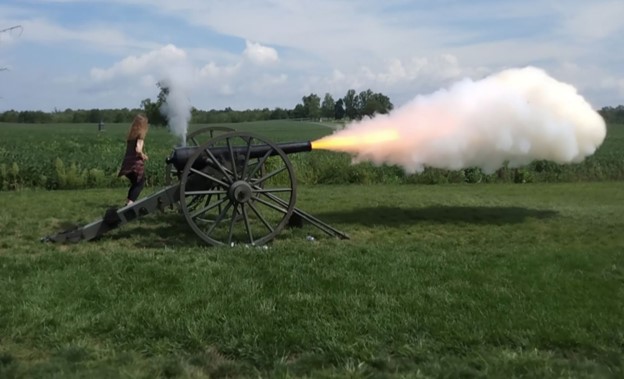
Gillis: “Every now and then, we get to work on fun events or participate in exciting demonstrations. Two examples that I can think of are when I had the chance to shoot a Civil War cannon (above) and when I participated in a day-long leadership tour of the Gettysburg battlefield (below).”  
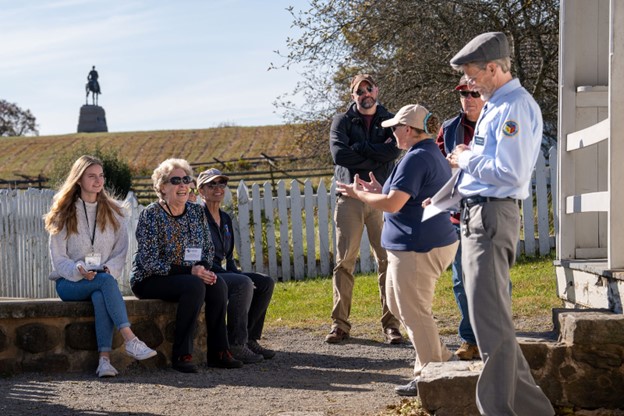
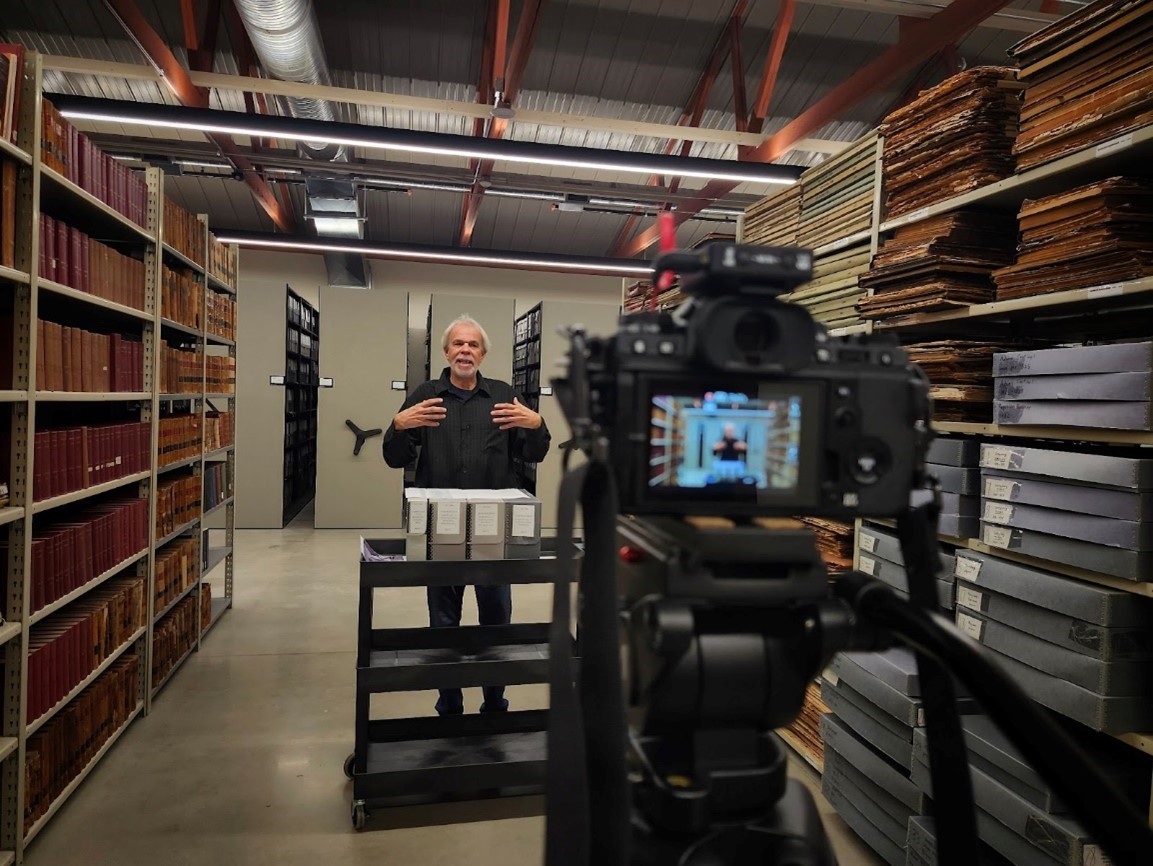
Behind-the-scenes of filming a YouTube video in the ACHS archives. 
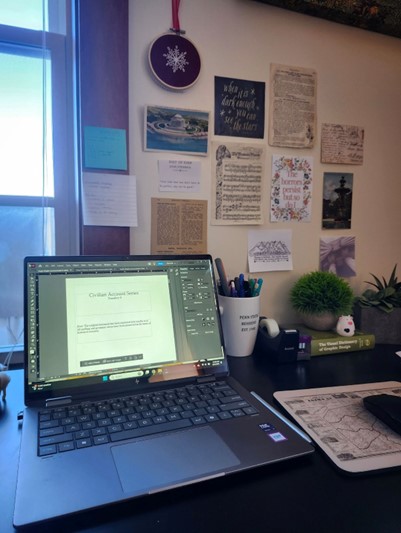
Gillis’ workspace. “I took this while editing a Civilian Account of the Battle of Gettysburg (with my Penn State Behrend mug in the background),” she said.

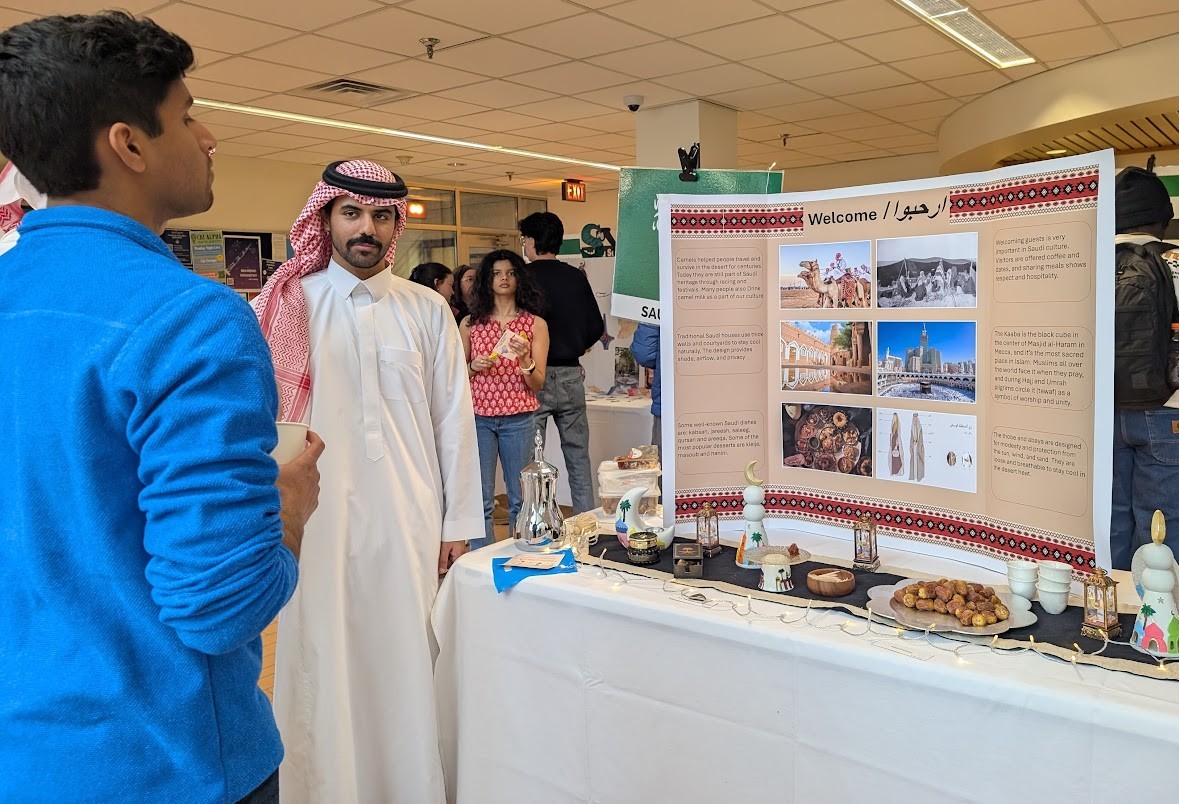
Found Treasure: Behrend family travel trunk discovered in consignment shop

By Heather Cass, Publications Manager, Penn State Behrend

This slideshow requires JavaScript.

Ernst and Mary Behrend, whose Glenhill farm property formed the core of Penn State Behrend in 1948, were avid world travelers.

“It was a very important part of their lives,” said Jane Ingold, reference librarian and archivist at the college’s Lilley Library. “We have many photos and postcards that they collected while on their frequent trips abroad. We even have some film of them visiting the locks at the Panama Canal.”

Thanks to the eagle eye of a Behrend food service staff member and the generosity of Steve Miller, associate director of Housing and Food Services, Ingold has another treasure to add to the Behrend collection: one of Ernst’s travel trunks.

“One of my employees mentioned that they saw an old steamer trunk that had ‘E. Behrend’ stamped on it on a photo posted on social media by One-Eighty Consignment and Thrift Shoppe in Albion,” Miller said. “I knew as soon as I saw it that it belonged in Behrend’s archives.”

When Miller drove to Albion to see the trunk, he was surprised at its condition.

“Normally, the leather handles on this type of steamer trunk deteriorate over time, but the handles on this trunk had not,” Miller said. “It appears to have been stored fairly well for some time.”

This slideshow requires JavaScript.

Behrend Blog talked with Miller, a history buff, to learn more about the trunk, which he purchased and donated to the Behrend archives.

Do you know where the trunk came from?

The best the store could gather was that the man who sent it to the store for consignment sale had received it from his wife’s uncle. Who that is or why he had the trunk is unknown.

How do you know it belonged to Ernst Behrend?

It has a brass identification plaque reading “E.R. Behrend Erie PA, U.S.A.” and “E.R. Behrend, Erie, PA” is written in white paint on the front.

Does it have any other identifying marks?

It has a shipping sticker from the American Express Railway Company (AERC). The AERC was formed in 1917 from an amalgamation of three express companies: First Express Company, Pony Express, and Wells Fargo Express. This was an effort to streamline shipping to aid in the war effort as the U.S. was involved in World War I at the time. The AERC was sold in 1929, so this dates the trunk to the 1917–1929-time frame.

It appears the trunk was shipped either to or from Newport, Rhode Island, which makes sense as the Behrend’s had a summer home there in 1913.

The sticker also has the abbreviation “N.Y.N.H. & H.” This is a reference to the New York, New Haven and Hartford Railroad. Service from this railroad ran from eastern New York state through Connecticut, Rhode Island, and Massachusetts. The shipping sticker places the value of the trunk at $300, which is approximately $4,800 in today’s dollars.

This slideshow requires JavaScript.

Were trunks commonly used by travelers then?

Steamer trunks or cabin trunks, which were named after their ability to be stored in the cabin of a steam ship, became popular in the 1880-1920 time period. They had a lower profile than typical shipping trunks to fit under berths in trains and steam ships. The trunks were typically identified with the name or initials of the owner. In addition, they carried notations to identify the contents of the trunk for appropriate storage. In the case of the Behrend trunk, a painted circle with “B” in the center.

You suspect this was one of many trunks the Behrends used?

Yes. Wealthy families typically traveled with many trunks to store their belongings for a long journey. The trunks were typically prepared by the house staff (maids, butlers, etc.) and shipped with a courier service to be placed in a steam liner berth or a train cabin.

Plans for the trunk

Ingold displayed the trunk with a few other Behrend family travel artifacts in the Glenhill Farmhouse during last month’s Parents, Families, and Alumni Weekend at Behrend. This summer, she plans to create a larger display about Ernst and Mary’s travels centered around the trunk that will be on display in the fall 2025 semester.

“It’s in remarkably good condition,” Ingold said. “But things were built to last back then.”

“Unissued Diplomas” Exhibition Urges Viewers To Bear Witness

By Heather Cass, Publications Manager, Penn State Behrend

This slideshow requires JavaScript.

Ivanna Obodzinska, 19, was the mother of twins and a Garden Design student at Polissia National University. She planned to be a landscape designer.

Serhii Molchanov, 19, was a student at the Ukrainian Leadership Academy who volunteered to fight for his country. While serving, he collected stories and photos for a book he hoped to write.

Oleksandra Borivska, 18, was an International Relations student at Vasyl Stus Donetsk National University. She dreamed of a diplomatic career, traveling the world, and seeing the Grand Canyon.

None of them achieved their goals. They were killed in Ukraine, including Obodzinska’s twins–victims of Russia’s invasion of Ukraine.

Obodzinska, Molchanov, and Borivska are three of forty Ukrainian students whose stories and photos are highlighted in “Unissued Diplomas,” an exhibition in Penn State Behrend’s Lilley Library that honors the memory of Ukrainian students who will never graduate.

The exhibition is one of dozens installed at institutions worldwide to remind people about the ongoing war and the price Ukrainians are paying daily in their fight for freedom. The exhibits were erected on February 24, the second anniversary of the invasion, which has resulted in the deaths of an estimated 70,000 Ukrainians to date.

While no one would wish a real-world trauma experience to affect their students, the course instructor of PSYCH 442: Trauma and Resiliency, Dr. Melanie Hetzel-Riggin, director of the School of Humanities and Social Sciences and a professor of psychology, saw “Unissued Diplomas” as an opportunity put lessons into practice.

Her class visited the exhibit last week.

This slideshow requires JavaScript.

“We talk a lot about how important it is for those who study trauma to bear witness to horrible events,” Hetzel-Riggin said. “Hearing and seeing the impact, elevating victim voices, and keeping space for those people affected by it is at the core of what trauma-informed work is.”

Hetzel-Riggin said the exhibit was particularly moving for Behrend students as they could see parts of  themselves in the Ukrainian students featured.

“The subjects of the exhibition were about the same age and might have had similar hobbies or majors or dreams and aspirations,” she said. “It brings the lessons from the course from abstract theory to affecting real people.”

Dr. Lena Surzhko-Harned, an associate teaching professor of political science, associate director of Behrend’s Public Policy Initiative, and a Ukrainian native, worked with Lilley Library to present the exhibition.

“The Russian full-scale invasion is also a war on Ukraine’s future,” Surzhko-Harned said. “The lives of the young Ukrainians, their future, their hopes and dreams were turned upside down on February 24, 2022. Many young people are losing their lives at the front lines and many more are dying as civilians targeted by artillery and drone strikes. With this exhibit, I hope we can honor this brave generation and remember to live our own lives to the fullest because your entire world can change in a moment.”

The “Unissued Diplomas” exhibition is located on the first floor of Lilley Library and is accessible during library hours. The exhibit will run through the end May.

Learn more at unissueddiplomas.org.