Infinite Lizards, Infinite Beauty

Math and art converge in Behrend’s growing “geometry gallery”

By Heather Cass, Publications Manager, Penn State Behrend

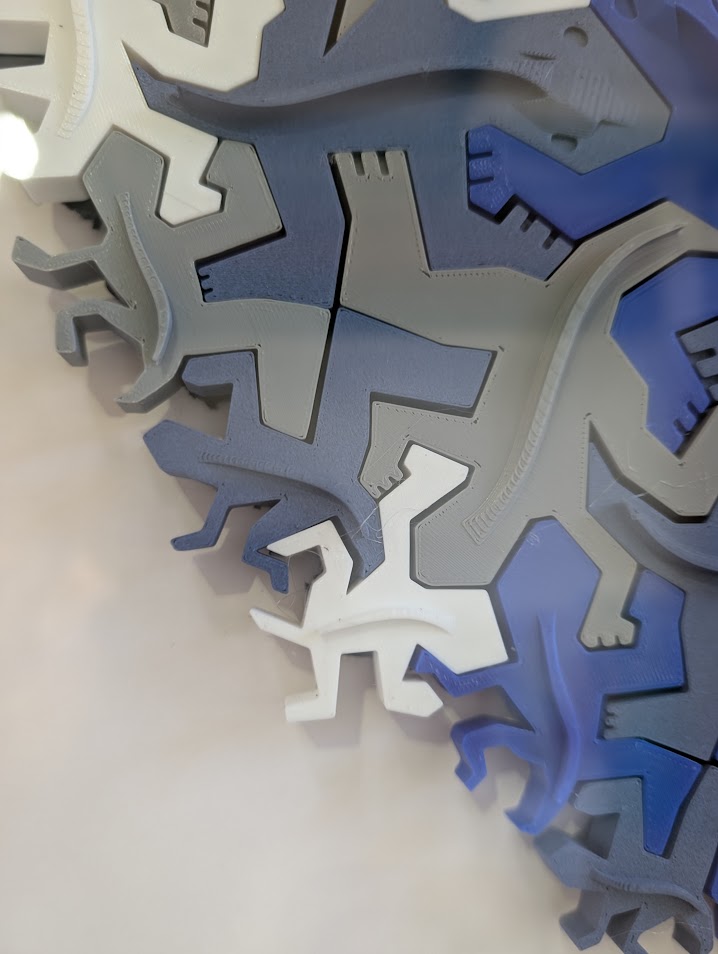
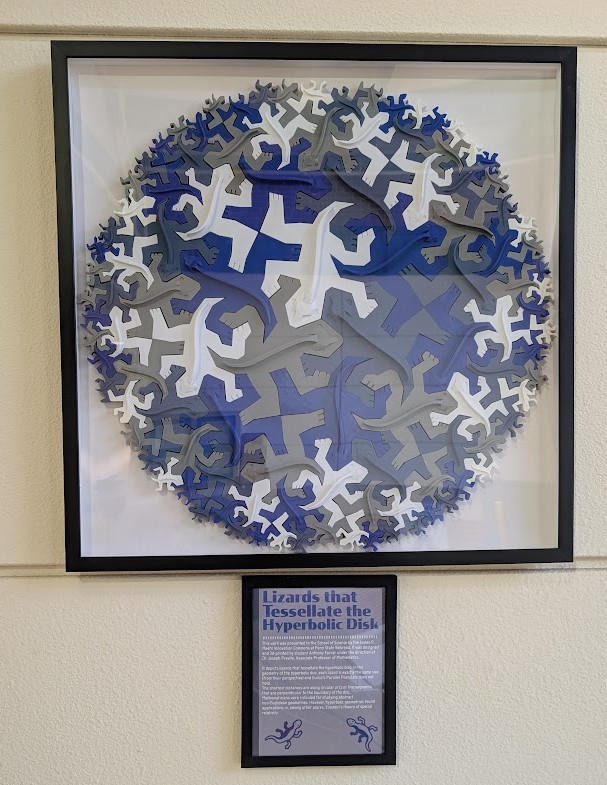
Math isn’t always numbers on a chalkboard. Sometimes it’s a work of art—a swirl of repeating lizards, 3-D printed in Penn State blue and white, then installed in a building where math, art, and science intersect. The lizards blend together in a hypnotic pattern, each appearing to shrink as it spirals toward infinity.  

The piece, Lizards that Tessellate the Hyperbolic Disk, was imagined by Dr. Joseph Previte, professor of mathematics, who wanted to capture the beauty of mathematics in a form anyone could see.

He took the design to the James R. Meehl Innovation Commons, the college’s open ideation lab, where engineering students Anthony Farrar and Quinlan Barnes transformed Previte’s concept into reality with 3-D-printed tiles and a sharp eye for symmetry.

The result is art born from math—or perhaps math revealed as art.

Dutch artist M.C. Escher showed the world that geometry could be beautiful with his mesmerizing tessellations and optical illusions, where patterns unfolded in ways both precise and poetic.

“For centuries, mathematicians questioned the value of studying this type of geometry, dismissed it as impractical and useless, with no relation to reality,” Previte said. “But it later proved essential to modern science, including helping Einstein describe how time and space work in his theory of relativity.”

While some mathematicians ridiculed the study of abstract math, others reveled in it. English mathematician G.H. Hardy argued that mathematics was a pure art form, divorced from practicality—something he took great pride in. Hardy’s theories later laid the groundwork for encryption, proving that beauty and utility often travel together.

That same tension—between abstraction and application, imagination and reality—now hangs on the wall at Behrend.  

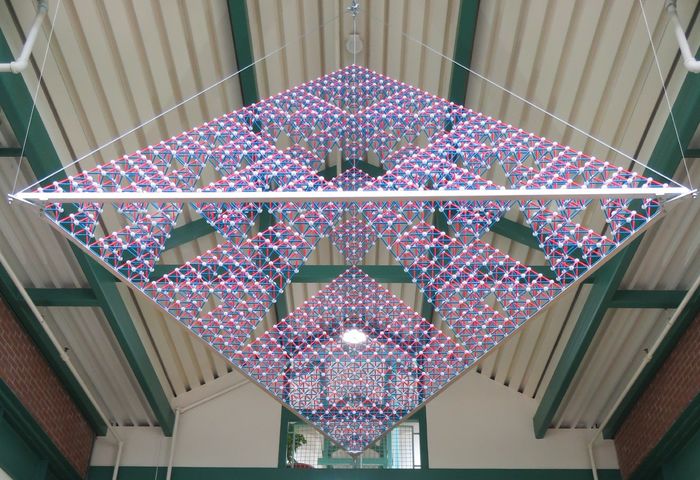
Lizards that Tessellate the Hyperbolic Disk joins an existing sculpture, Math in Flight, a stage-5 Sierpinski tetrahedron, a fractal shape featuring a pattern of infinite triangles, that hangs high above the entrance to Roche Hall in the Science Complex.  

Math Club students built the sculpture using Zometool construction parts. It consists of 2,050 white balls and 6,144 red-and-blue struts.

Previte has plans to continue adding to the mathematics art gallery.

“I’d like to do the Platonic solids next,” he said. “I am currently looking for a student in Innovation Commons to make that project a reality.”

Masterpieces, Meet the iPhone: Art History Gets a Makeover

By Heather Cass, Publications Manager, Penn State Behrend

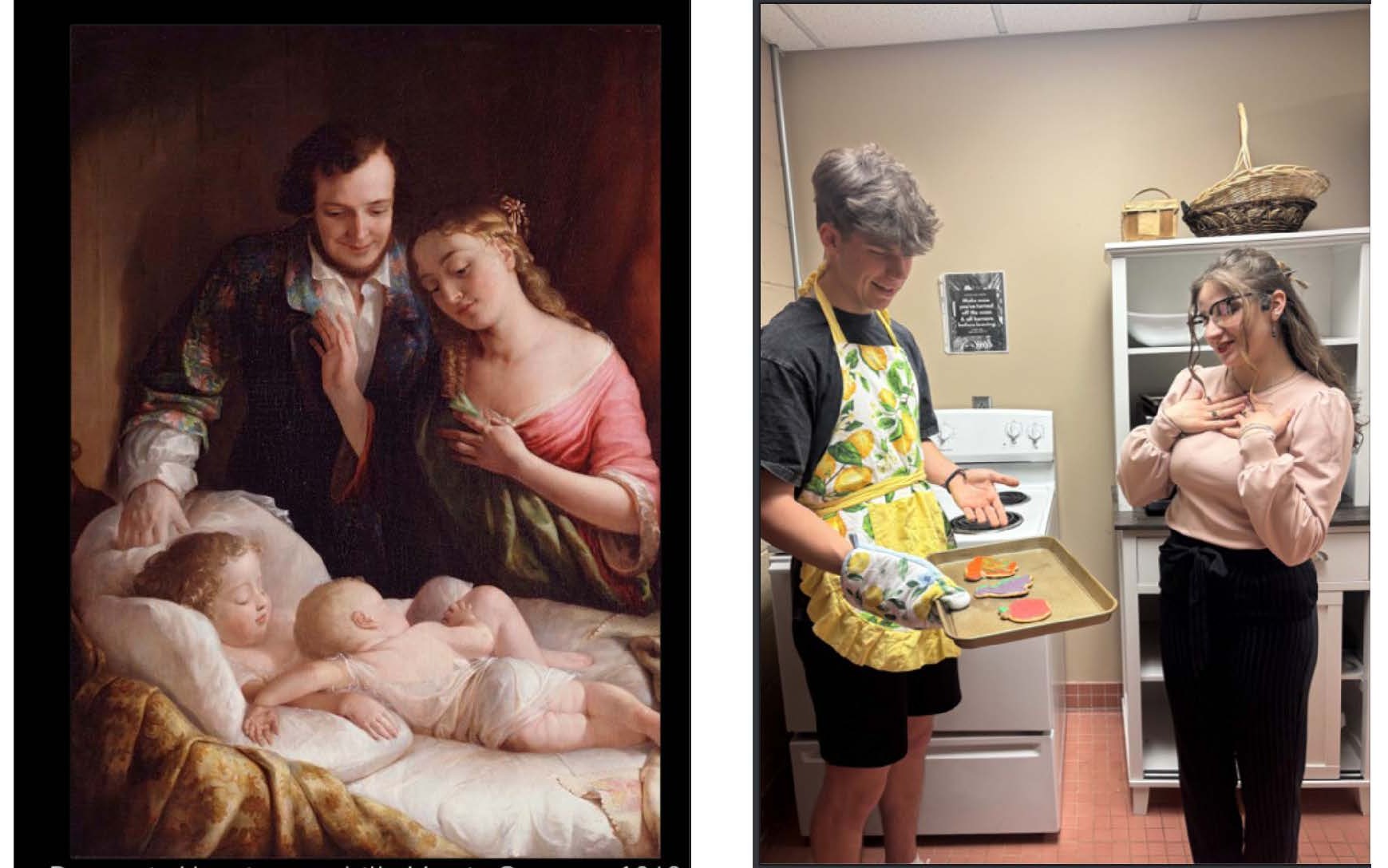
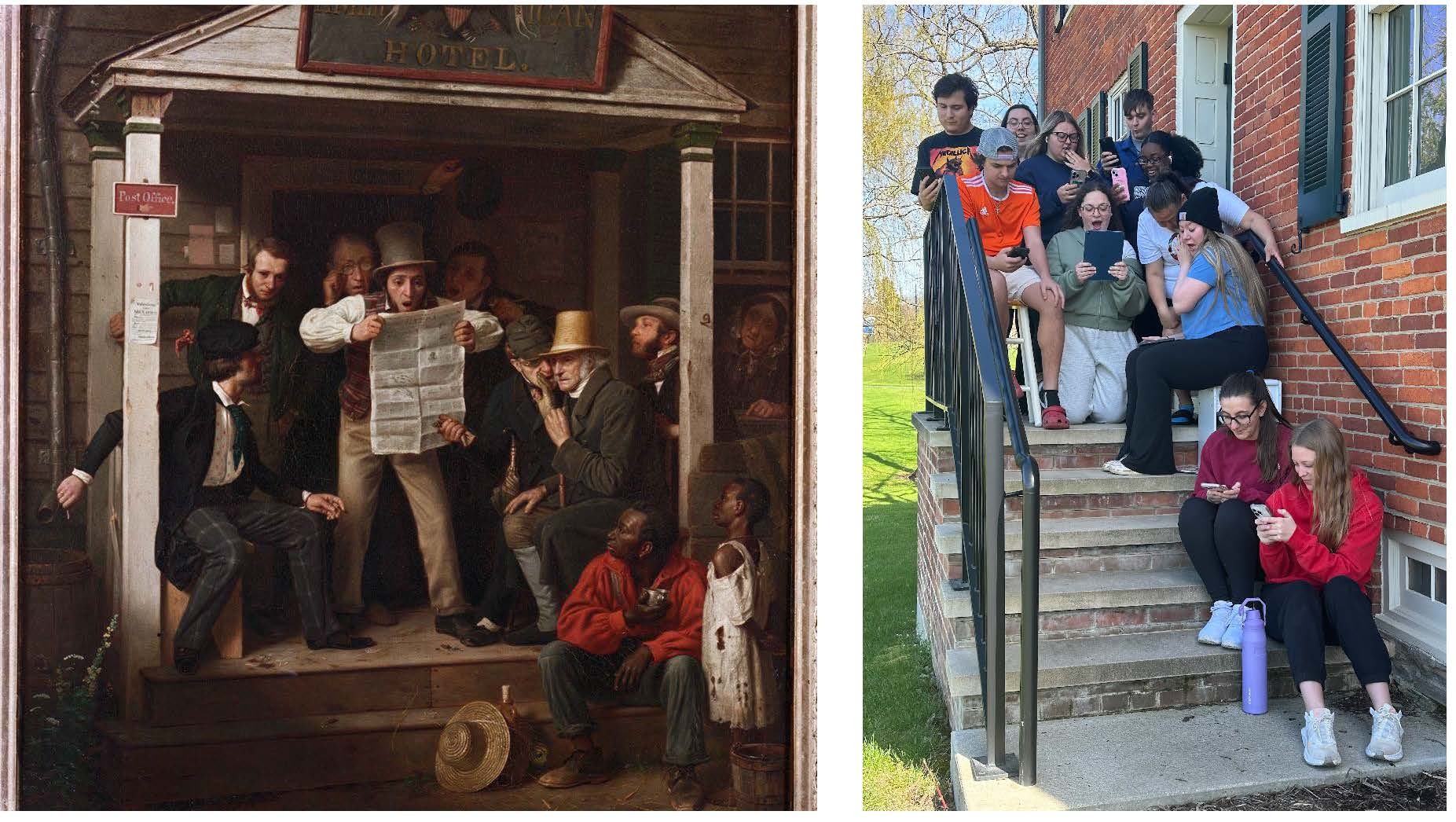
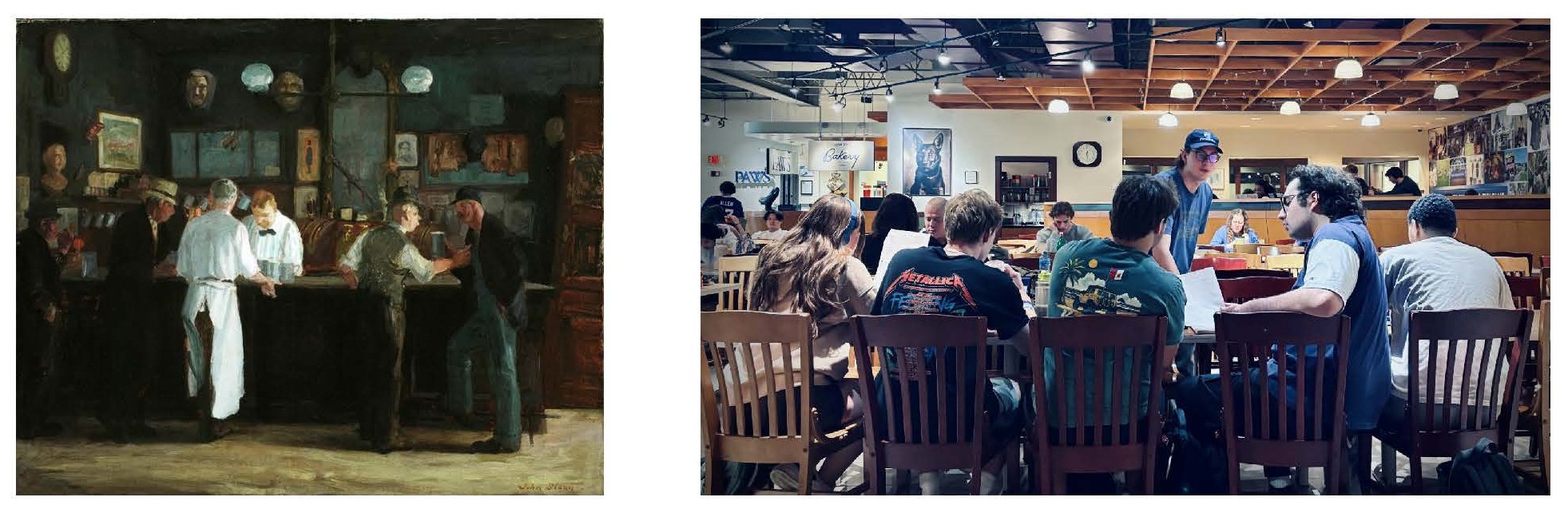
This spring, students in Dr. Matthew Levy’s AMST 307N: American Art and Society course at Penn State Behrend engaged in a unique interdisciplinary project that blended historical analysis with creative expression. As part of the course, students worked in groups to create tableaux vivants—or “living pictures”—that reenact and recontextualize iconic works of American art that were discussed in class.

Not only did students have to study the formal and thematic elements of a chosen painting, but they also had to consider its relevance to contemporary social and cultural issues.

“Working in groups, they researched their chosen work, gaining a deeper understanding of the social issues it represented,” said Levy, associate professor of art history, music, theatre, and visual arts.

Each group then reimagined their selected artwork for a 21st-century context, using modern props, settings, and interpretations to bridge the past and the present.

“They had to think carefully about props, poses, setting, framing, and more to bring the work of art into modern times,” Levy explained.

Here are several standout projects from the class, along with insights from Levy on what made each piece compelling.

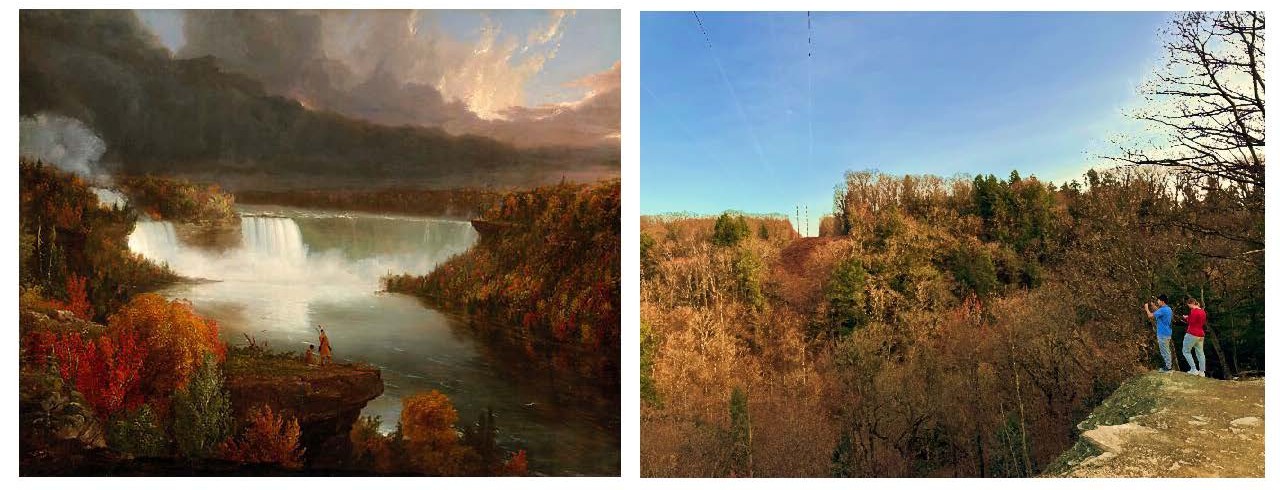
Distant View of Niagara Falls by Thomas Cole: “Where Cole’s view of Niagara Falls depicts the untouched majesty of the falls (represented both by the landscape and the presence of the Native Americans living at one with nature), the students depicted a domesticated and technologized landscape. Using the Wintergreen Gorge as their setting, they drew attention to the power lines, nature trail, and the use of phones to mediate our experience with nature.”

Domestic Happiness by Lilly Martin Spencer: “In the original painting, Spencer offers what was a progressive view of family life for the time, with both mother and father doting on their children. Our students instead depicted a “girl boss” showering praise on the domestic accomplishments of her stay-at-home husband. Notably, no children are present.”

War News from Mexico by Richard Caton Woodville. “Woodville’s painting depicts the latest in information technology—the penny press—which made journalism far more accessible than ever before. Our students depicted a scene in which everyone is responding to the news, not in the shared experience represented by Woodville, but each on their own through their phones and tablets.”

McSorley’s Bar by John Sloan: “Sloan’s painting depicts a scene of working-class sociability in a male-only bar. Our students represented a scene of co-ed sociability in Bruno’s Café on the campus of Penn State Behrend. Again, the presence of devices mediates human-to-human connection. Note how the student group considered the framing of the shot, mirroring the lights and memorabilia on the walls of the original.

Fun fact: McSorely’s Old Ale House is New York City’s oldest continuously operated saloon. The bar did not admit women until it was forced to do so in 1970.”

ABOUT THE COURSE

AMST 307N: American Art and Society covers the history of art in the English colonies and the United States from the seventeenth century to the present, examined through paintings, sculpture, buildings, prints and photographs, as well as exhibitions and national/world fairs.

The course is designed to meet two principal goals. The first is to increase students’ powers of visual analysis and help them build a critical vocabulary for discussing an art object’s medium, composition, style, and iconography. The second is to foster an understanding of the deep implication of the visual arts in their social and cultural contexts.

Hash-Tagging History: Alumna Shapes Social Media at Gettysburg Museums

By Heather Cass, Publications Manager, Penn State Behrend

Alanna Gillis ’24

While job hunting, Alanna Gillis ’24 stumbled across a position as a programs assistant at the Adams County Historical Society (ACHS) in Gettysburg. It seemed a good fit for Gillis, who earned a Creative Writing degree and minored in History at Penn State Behrend.

Though the organization eventually filled that position internally, they encouraged Gillis to interview for a part-time customer service position.

She was disappointed but figured she would interview for the experience.

“One very convincing interview and tour of the building—including their massive library and archives— later, I was working for ACHS as a visitor services associate in a part-time capacity,” she said. “Even though it wasn’t the job I hoped to land right out of college, it was still a job in my field that I felt confident I could do well.”

She did it so well that by September, she was promoted to part-time associate in the marketing department.

“They had been looking for someone to fill that position in marketing and had seen on my resume that I had experience with writing, graphic design, and running social media for the clubs I was in at Behrend,” she said.

Gillis was promoted again in just a few months. Today, she is the full-time social media and marketing coordinator at ACHS, where she creates and curates content for the organization’s social media pages, produces short- and long-form video projects, and contributes to marketing materials and publications.

We chatted with Gillis to learn more about her job, how Behrend helped her get there, what she’s learned so far, and what she’s looking forward to.

Tell us a little bit about the Adams County Historical Society.

The Adams County Historical Society is a nonprofit historical society that runs two museums in Gettysburg. ACHS focuses on preserving, protecting, and sharing the stories of Gettysburg and Adams County. Through our two museums, Gettysburg Beyond the Battle and The Shriver House Museum, we highlight the local history, reaching all the way back to the time of the dinosaurs.

How did your Behrend education help you obtain this role?  

Both of my areas of study were crucial. My History minor helped me get my foot in the door, but my Creative Writing degree allowed me move up and achieve the job I have now.

My job is mainly about communicating with the public, whether that be to our museum patrons, to our followers, or to our YouTube viewers. I needed to have a good grasp of how to best communicate with people through the written word—a skill I felt confident in because of my Creative Writing degree.

Having a good grasp of the English language, from word choice to register, helps me effectively draft both a fun TikTok script and a more formal press release, which is the flexibility that ACHS needed from someone in this position.

My Creative Writing degree has also allowed ACHS to start new projects they wanted to do but didn’t have the staff for, such as publishing firsthand accounts of the Battle of Gettysburg.

What are your primary duties in your current role?

I am responsible for our social media pages; I create and curate content for Facebook, Instagram, TikTok, and YouTube. I generate daily content for all these sites, which varies from photos with captions, to short form videos highlighting our museum, to video thumbnails, to longer videos aimed at teaching people the history of Adams County and Gettysburg.

Beyond that, I am also responsible for filming and editing our longform videos for YouTube. So far, I’ve worked on nearly forty videos with a combined view count of nearly 150,000 on the platform.

I also help with our publications. This includes civilian accounts of the Battle of Gettysburg, informational and promotional flyers, and a museum guide featuring many of the artifacts on display and in our archival collections, like those published by The Smithsonian.

What does a typical day look like for you?

My day starts with a 40-minute commute, but I don’t complain about it too much because it’s a beautiful drive through rural south-central Pennsylvania. It gives me time to center myself and prepare for the day ahead.

The first thing I do is check my email inbox and the inboxes of our various social media sites. If any messages came in overnight, I’ll respond or pass them along to the correct department.

From there, I usually spend the morning editing YouTube and TikTok videos. Depending on the length of the video, this can take anywhere from a few minutes to an hour or more.

After lunch, I work and draft social posts for the week. If I get all that done, I’ll spend time working on secondary assignments like publications.

When do you gather content?

Certain days of the week are reserved for filming content only; I’ll go out onto the Gettysburg Battlefield or into other parts of Adams County with our historian and film episodes for our YouTube channel. Usually, this is how I spend Fridays.

What has been your favorite project so far?

I’m really enjoying getting to put together the civilian accounts of the battle. This project is a perfect blend of my major and my minor, and it’s very rewarding to be able to work on a project where both are useful. Putting together these accounts has also allowed me to see a different type of publishing than I had when I worked on Lake Effect, Behrend’s literary journal.

And your favorite post so far?

The YouTube video “Tim’s Top 10 Defunct Gettysburg Attractions.” Tim Smith is our historian, and he and I spend a lot of time together filming our YouTube videos. I also often consult with him during research or when I’m fact-checking my written content. This was the first episode he and I worked on together, and it was also the first I’d shot and edited in this style. I managed to sneak in some jokes during the editing process, which made the project quite fun.

Have you done anything that turned out to be an unexpected success? 

A few YouTube videos have unexpectedly done well. We don’t typically get more than 3,000 views on our longer lecture videos, but “The Confederate Retreat” lecture has 28,000 views, significantly more than we anticipated.

An unexpected success that is more directly related to me and my work is that I started a book club for fans of Adams County history. Each month, ACHS staff selects a book, usually historical nonfiction, and I prepare a weekly discussion on each section. It’s a virtual book club, which means we have participants from all over the country. So far, we have over 110 members!

What would people be surprised to know about social media marketing? 

A lot of work goes into social media content management and marketing. It’s not as easy as just selecting an image, writing a quick caption, and hitting “post.” Often, images require editing or designs must be created. From there, captions must be drafted and edited to ensure that voice aligns with the company and the historical content is correct. The next step is tagging the correct people and inserting the corresponding ticket links, if necessary. After that, the post is good to go live. Then, it must be cross-posted to all the other platforms. All that work is for one single post, and ACHS usually posts a minimum of five times per week on each platform.

What are you looking forward to? Are there any big events or projects you’re excited about? 

This May, we are hosting the Gettysburg Film Festival: Victory in World War II. We will have guests ranging from historical filmmakers like Ken Burns to authors and screenwriters. I’m excited to help with this and make connections with people in the fields of both writing and history.

What have you learned the hard way? 

When I first started, I was hesitant to ask for help. For a short time, I tried to grin, bear it, and figure it out by myself.

When this resulted in content that I wasn’t happy with, I realized I had two choices: admit I couldn’t do something and ask for help or submit work that I wasn’t proud of.

I asked for help. I realized that if I wanted to succeed in this job and create work that I was happy to have my name associated with, I may need to reach out for guidance sometimes. It’s OK to not know it all.
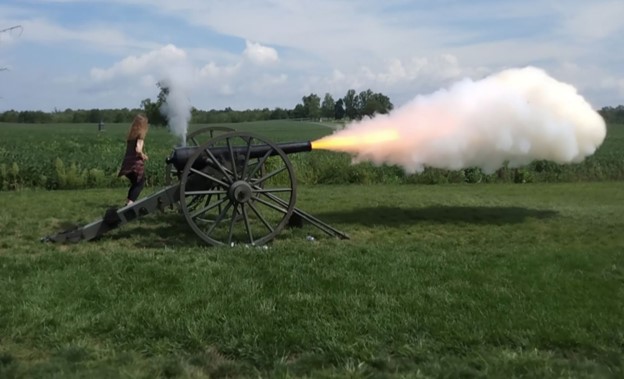
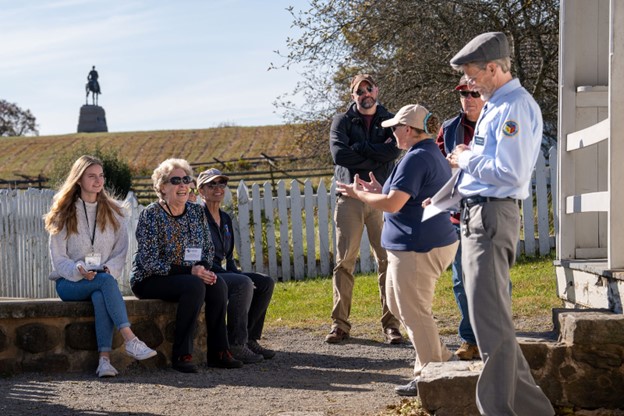
Gillis: “Every now and then, we get to work on fun events or participate in exciting demonstrations. Two examples that I can think of are when I had the chance to shoot a Civil War cannon (above) and when I participated in a day-long leadership tour of the Gettysburg battlefield (below).”  
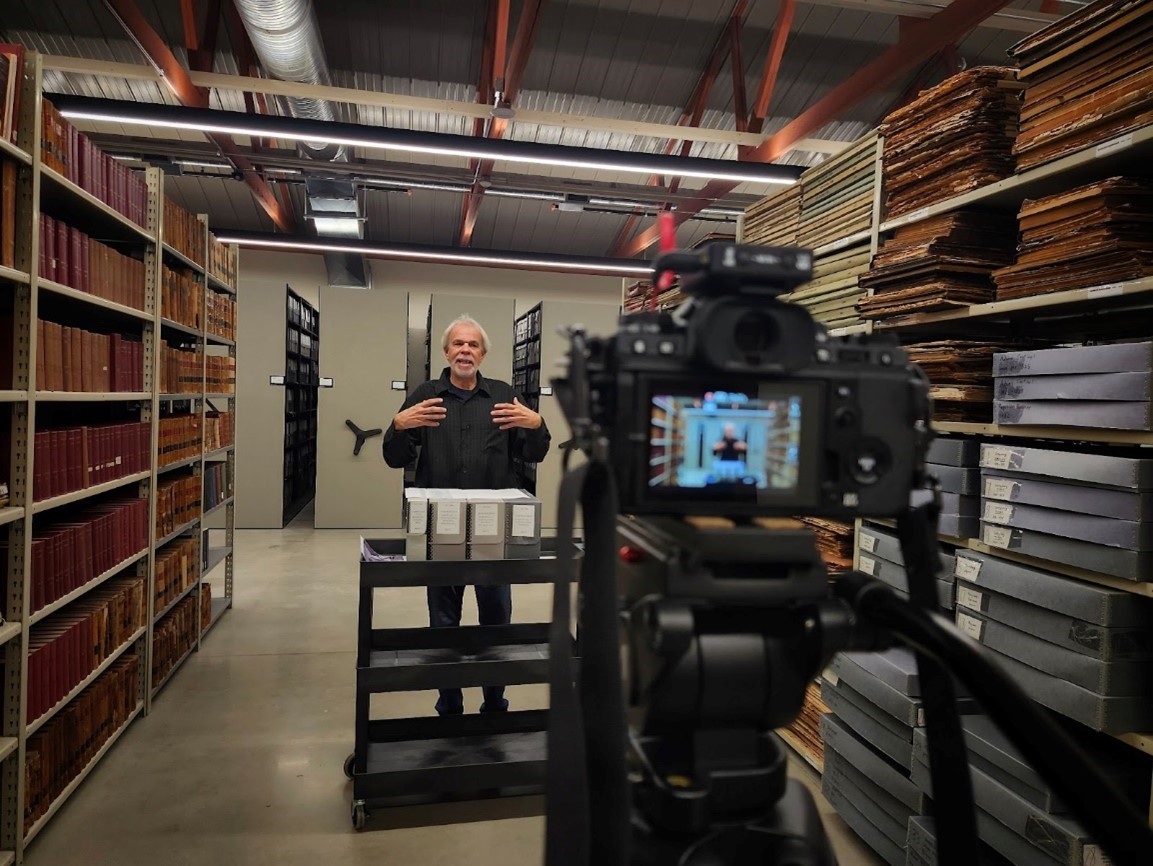
Behind-the-scenes of filming a YouTube video in the ACHS archives. 
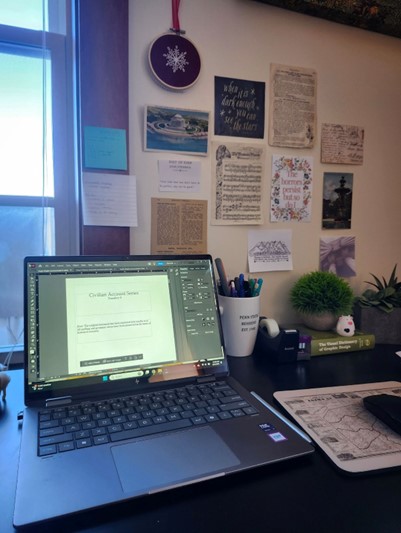
Gillis’ workspace. “I took this while editing a Civilian Account of the Battle of Gettysburg (with my Penn State Behrend mug in the background),” she said.

Found Treasure: Behrend family travel trunk discovered in consignment shop

By Heather Cass, Publications Manager, Penn State Behrend

This slideshow requires JavaScript.

Ernst and Mary Behrend, whose Glenhill farm property formed the core of Penn State Behrend in 1948, were avid world travelers.

“It was a very important part of their lives,” said Jane Ingold, reference librarian and archivist at the college’s Lilley Library. “We have many photos and postcards that they collected while on their frequent trips abroad. We even have some film of them visiting the locks at the Panama Canal.”

Thanks to the eagle eye of a Behrend food service staff member and the generosity of Steve Miller, associate director of Housing and Food Services, Ingold has another treasure to add to the Behrend collection: one of Ernst’s travel trunks.

“One of my employees mentioned that they saw an old steamer trunk that had ‘E. Behrend’ stamped on it on a photo posted on social media by One-Eighty Consignment and Thrift Shoppe in Albion,” Miller said. “I knew as soon as I saw it that it belonged in Behrend’s archives.”

When Miller drove to Albion to see the trunk, he was surprised at its condition.

“Normally, the leather handles on this type of steamer trunk deteriorate over time, but the handles on this trunk had not,” Miller said. “It appears to have been stored fairly well for some time.”

This slideshow requires JavaScript.

Behrend Blog talked with Miller, a history buff, to learn more about the trunk, which he purchased and donated to the Behrend archives.

Do you know where the trunk came from?

The best the store could gather was that the man who sent it to the store for consignment sale had received it from his wife’s uncle. Who that is or why he had the trunk is unknown.

How do you know it belonged to Ernst Behrend?

It has a brass identification plaque reading “E.R. Behrend Erie PA, U.S.A.” and “E.R. Behrend, Erie, PA” is written in white paint on the front.

Does it have any other identifying marks?

It has a shipping sticker from the American Express Railway Company (AERC). The AERC was formed in 1917 from an amalgamation of three express companies: First Express Company, Pony Express, and Wells Fargo Express. This was an effort to streamline shipping to aid in the war effort as the U.S. was involved in World War I at the time. The AERC was sold in 1929, so this dates the trunk to the 1917–1929-time frame.

It appears the trunk was shipped either to or from Newport, Rhode Island, which makes sense as the Behrend’s had a summer home there in 1913.

The sticker also has the abbreviation “N.Y.N.H. & H.” This is a reference to the New York, New Haven and Hartford Railroad. Service from this railroad ran from eastern New York state through Connecticut, Rhode Island, and Massachusetts. The shipping sticker places the value of the trunk at $300, which is approximately $4,800 in today’s dollars.

This slideshow requires JavaScript.

Were trunks commonly used by travelers then?

Steamer trunks or cabin trunks, which were named after their ability to be stored in the cabin of a steam ship, became popular in the 1880-1920 time period. They had a lower profile than typical shipping trunks to fit under berths in trains and steam ships. The trunks were typically identified with the name or initials of the owner. In addition, they carried notations to identify the contents of the trunk for appropriate storage. In the case of the Behrend trunk, a painted circle with “B” in the center.

You suspect this was one of many trunks the Behrends used?

Yes. Wealthy families typically traveled with many trunks to store their belongings for a long journey. The trunks were typically prepared by the house staff (maids, butlers, etc.) and shipped with a courier service to be placed in a steam liner berth or a train cabin.

Plans for the trunk

Ingold displayed the trunk with a few other Behrend family travel artifacts in the Glenhill Farmhouse during last month’s Parents, Families, and Alumni Weekend at Behrend. This summer, she plans to create a larger display about Ernst and Mary’s travels centered around the trunk that will be on display in the fall 2025 semester.

“It’s in remarkably good condition,” Ingold said. “But things were built to last back then.”

Behrend student wins essay contest; participates in Jewish history panel discussion

DSC_9473

By Steve Orbanek
Marketing Communications Specialist, Penn State Behrend

Danielle Ropp sat quietly toward the center of the table as her legs shook under the tablecloth, hidden from the audience seated in front. Her quiet demeanor, indicative of her anxiousness, would soon subside.

After all, every living thing thrives in its natural habitat, and that’s exactly where Ropp was once the panel discussion got underway.

“I’ve just always loved history. Whenever I hear an interesting fact, I commit it to memory,” said Ropp, a junior History major at Penn State Erie, The Behrend College.

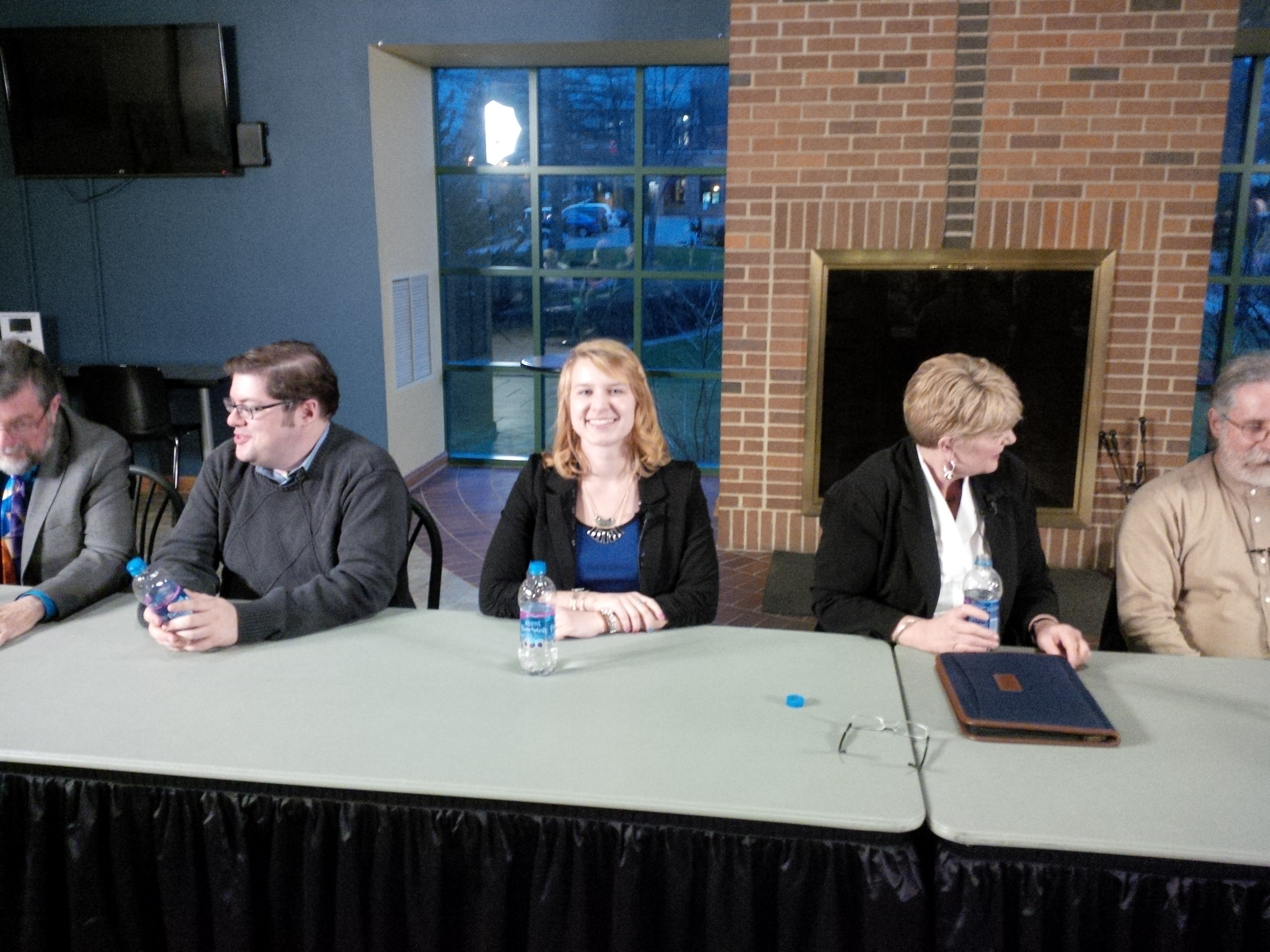
Ropp displayed the depth of her historical knowledge by participating in a panel discussion of the WQLN documentary Perspective: Jewish History, Parts I and II at Mercyhurst University in Erie on April 22.

The Folsom, California, native earned a spot on the panel as well as $500 after winning first place in WQLN and Mercyhurst University’s “Story of the Jews” college essay contest. The prompt for the contest was: “How has history shaped the modern perception of Jews?”

Other panel participants included: Dr. Joshua Ezra Burns, assistant professor of theology at Marquette University; Rabbi John Bush, Temple Anshe Hesed; Dr. Randall Howarth, professor of ancient history at Mercyhurst University; Dr. Olena Surzhko-Harned, assistant professor of political science at Mercyhurst University; and Dr. Robert von Thaden, Jr., associate professor of religious studies at Mercyhurst University. The panel was moderated by Kim Young, instructor in journalism at Penn State Behrend.

Ropp’s essay was titled “The Crucifixion Shaping Modern Jewish Perceptions,” and it discussed how Jewish individuals are still viewed negatively because of their perceived participation in the crucifixion. Ropp said her own perception was vividly changed through her research.

Ropp found edicts from past Popes that absolve blame for the crucifixion away from Jewish people, but she said that message has not permeated within the general public.

“The fundamental core of Christianity is that Jesus had to die. These people were blamed for this, but it wasn’t their fault,” Ropp said. “Today’s Jews are also different from the Jews back then. You cannot blame people for actions that happened 2,000 years ago.”

While Ropp thoroughly enjoyed writing the essay, she said she was surprised she won.

“This is definitely one of the biggest things I’ve ever accomplished,” Ropp said. “The fact that I won just makes me want to do it again.”

Given Ropp’s career aspirations, it’s likely the essay was just the beginning. Ropp plans to pursue a master’s degree in secondary education upon graduation in 2015 and then plans to attain a doctorate in history. Her ultimate goal is to spread her knowledge as a college professor.

“I can’t imagine myself doing anything but history,” Ropp said.

IMG_20140422_200526

Women in History Month: Meet Jane Ingold

By Steve Orbanek
Marketing Communications Specialist, Penn State Behrend

In recognition of Women’s History Month, we’d like to introduce you to just a few of the dynamic women in Penn State Behrend’s history.  Our college has a rich history of leadership and involvement by strong, forward thinking, and generous women. Each Monday in March, we’ll highlight a woman who has made, or is currently making, her mark on the college.

Today, we’d like you to meet Jane Ingold, a reference librarian in the John M. Lilley Library.

JanewithStudent

It’s not believed that any member of the Behrend family still lives in the Erie area, but Mary Behrend’s grandsons might beg to differ.

“The grandsons (Dick and Bill Sayre) have told me I’m an adopted Behrend,” Penn State Behrend reference librarian Jane Ingold said.

Given Ingold’s knowledge of the Behrend family history, it’s an appropriate remark.

Since 1999, she has worked as a librarian at the John M. Lilley Library. On a typical day, Ingold might be helping a student with a research project or reorganizing library materials, but there’s a good chance that she’ll be working in the archives, located on the bottom floor of the library.

The archives at Penn State Behrend are comprised of three permanent collections: the Behrend Family Collection, the Hammermill Paper Company Collection, and the Penn State Behrend Collection. Since 2006, Ingold has worked to organize and categorize the collections, and she’s become something of an expert when it comes to Behrend history.

Ingold has a great knowledge for every detail surrounding Behrend’s history, dating back to when Mary Behrend donated her family’s Glenhill Farm estate to Penn State in 1948.

Through the years, Ingold has received countless relics and souvenirs that somehow tie into the Behrend family, the college, or the Hammermill Paper Company, the company owned by Mary Behrend’s husband Ernst as well as his brothers, Otto and Bernard, and their father, Moritz.

Ingold has made a meticulous effort to carefully keep track of everything she’s found or been given since she first came to Behrend. She’s viewed as the historical expert on campus, and the archives even earned the Local History Award in July 2011 from the Erie County Historical Society.

Ingold said she has seen plenty of interesting artifacts in the archives, but there’s one particular item that stands out above the rest.

“It’s the letters that Mrs. Behrend wrote to her son Warren right before he died in a car accident in 1929.” Ingold said. “It made me cry.”

Because of her knowledge, Ingold has become a great resource, both to students and former Hammermill employees. Many of the Hammermill retirees recognize the importance of the archives, and they help to contribute and spread the word.

This is especially true of Harry Hahn, a 104-year-old Hammermill retiree. Hahn communicates frequently with Ingold, and he’s always doing what he can to help grow the archives.

“He’s one of the joys of my life,” Ingold said.

harryhahn100

In a newspaper story discussing his impending open-heart surgery at age 101, Hahn even encouraged former employees to donate materials to the archives.

For all the work that Ingold does with the archives, her main passion remains the Penn State Behrend students.

“My favorite part of the job is helping students. It’s like a treasure hunt when you’re looking for something for someone, and they’re always so grateful,” Ingold said.

This was true a few years back when a student came to Ingold in the eleventh hour for help with a program on Behrend’s history.  Ben Lane, the former director of admissions and author of Behrend Remembered, had been scheduled to make a presentation on Behrend’s history, but he had to cancel. Ingold quickly gathered up all the information she could and stepped in to replace Lane.

“It tickled me,” Ingold said. “It made me feel very helpful.”

Outreach1

In the future, Ingold said she would like to possibly update Lane’s book.

Considering her wealth of knowledge, that seems like a realistic goal.

About Jane Ingold

Birthplace: Cranesville, Pa.

Education: B.A. in English from Gannon University, M.S. in library and information science from the University of Texas at Austin

Family/pets: “I spend a lot of time being what Elizabeth Gilbert terms a “sparent” or spare parent to my nieces and their children. I have a brown tabby, Tye, who was adopted from a local shelter.”

Favorite thing about Behrend: “The resources we have to help students are great. We have access to almost anything in the world that a student would need.”

Advice for today’s students: “Having a librarian in your corner can make a big difference in your academic career. Befriend one.”

Favorite hobbies: “Reading (now there’s a surprise), organizing anything from papers to events, genealogy.”

Last book read:  Eleven Rings by Phil Jackson

Three books that everyone should read: The Art of Possibility by Rosamund and Benjamin Zander, The War of Art by Steven Pressfield, and Getting Things Done by David Allen

Why is it important that we preserve history?:  “This series that you and your colleagues are writing on Women of Behrend wouldn’t be possible if we hadn’t chosen to preserve our history.”

This slideshow requires JavaScript.