‘Understaffed, underfunded, and under attack’

Alumnus, deputy director of elections in Michigan, to speak at Penn State Behrend Monday

adam fracassi speaker
Adam Fracassi-Wier, deputy director of elections for the state of Michigan.

Adam Fracassi-Wier, deputy director of elections at the Michigan Bureau of Elections, will discuss the state of elections and election security when the Speaker Series returns to Penn State Behrend at 7:30 p.m. Monday, Oct. 21. His talk, “Facing the Storm: Resilience in Elections after 2020,” will be held in the Metzgar Center. The program is free and open to the public.

Fracassi-Wier graduated from Penn State Behrend in 2012 with Bachelor of Arts degrees in Political Science, International Studies, and English. He earned his law degree from Michigan State University College of Law in 2014. His career includes serving as Michigan’s assistant attorney general from 2015 to 2018, as an adjunct professor at Michigan State University College of Law, and currently as deputy director of elections at the Michigan Bureau of Elections.

Behrend Blog talked with Fracassi-Wier to learn more about what it’s like to work in elections and election law in an increasingly partisan environment.

What are your biggest challenges right now?

Election administrators across the country are understaffed, underfunded, and under attack. This is the biggest challenge. We have to manage elections and election administration in a hyper-partisan environment that fuels misinformation, all while ensuring the safety of ourselves, our staff, other election officials, and poll workers. I’ve had to add different facets to my job that I never thought I would have to add. For example, I’m no longer just an attorney – I’ve had to add communications and marketing into my daily responsibilities.

What does it feel like to oversee election integrity when so many are distrustful of our elections today?

This is a heavy burden, especially in this era where misinformation and distrust are rampant.  Being a nonpartisan civil servant who ensures elections are fair is critical, but it brings risks and requires constant communication and transparency. I take very seriously my responsibility to ensure that every eligible citizen can vote while balancing it against the necessary security checks in the system. It’s hard when something you have dedicated your life to is constantly under threat, and things that you have always done because the law requires it, now are the things making you a target.

How do you fight that disinformation and assure voters that Michigan’s elections are secure?

Transparency and communication are vital. We have had a lot of success going to folks directly with messaging. What I’ve seen in the last four years is that many people are interested in the system but don’t understand it. I have allocated and created new resources in the last several years that are focused on providing educational materials and clearly communicating what we’re doing in advance of doing it. Engaging with voters directly and providing them with accurate information is key to building trust.

I’ve also had a lot of success by coordinating with local officials (clerks, township supervisors, etc.) on the messaging. In many instances, voters will trust their local officials.

The key is just to be a constant source of truth. I’ve been able to build trust with both Democrats and Republicans, voters and elected officials, because I’m consistent in what I do, and the decisions I make are not based on politics.

You secured a $40M budget increase to improve election operations in Michigan. What were you focused on improving?

Voters in 2022 passed a constitutional amendment that dramatically changed elections in Michigan. They implemented early in-person voting, mandated that drop boxes be available in all jurisdictions, and required the state to pay for the return of all absent voter ballots. But this required significant funding for us and the local clerks. I was very fortunate to be able to obtain $40 million to fund the constitutional amendment and the subsequent legislation that passed, but it wasn’t enough to fully fund our office and the local clerks’ offices.

Michigan has more than 1,600 township, city, and county clerks who all have different election roles. We are one of, if not the, most decentralized systems in the country for running elections. More than 900 clerks’ offices are single-precinct jurisdictions that likely have only one staff member—themselves.  This is not enough to run elections. When I sought funding, I sought approximately $125 million for our office and the local clerks.  Everyone thought I was crazy for asking for that, but I had the numbers to back me up. I obtained $40 million, and we spent it almost immediately, with more than $30 million being allocated to clerks directly. With this money, we were able to fund thirty-five additional staff members at the Bureau of Elections, more than doubling our staff.

Since 2020, clerks have seen the number of ballots being returned by mail more than double. We went from approximately 25 percent voting by mail to approximately 55 percent. The funding allocation allowed us to buy new equipment for clerks to account for this increase and ease processing. This funding also allowed us to build a new pollbook to be used to better detect and prevent double voting during the early voting period, buy equipment for clerks to administer early voting, and fund poll workers for jurisdictions.

What do you wish people knew about the election and election security?

Trust your election administrators. Almost every single election administrator – regardless of party affiliation – administers the election the same. We all believe in upholding the integrity of the election while ensuring that voters can exercise their most fundamental right of casting a ballot. If you have questions about the process or want to know more, contact your election official. Start that dialogue with them in a respectful manner, and you will find that they will engage and help you to the best of their ability.

It’s also important to know that there are backups for everything.  Michigan uses paper ballots, as do many other states. Even if you don’t have a paper ballot, there are still backup records to do recounts and audits. All of these are done to verify the accuracy of the results.

After 2020, our office conducted more than 250 audits across the state. The Auditor General audited our office, and the Senate Oversight Committee, led by Republican Senator Ed McBroom, examined everything as well. The audits showed that while there are always improvements to be made, the system worked as it should. We have not seen and do not continue to see massive voter fraud like what is suggested by several candidates.

Is there a better way to handle elections in the U.S.?

Our system is very similar to systems across the world. There are positives and negatives with every system, but I think a “better” way is dependent on the eye of the beholder. What you’re seeing in several states are different methods of electing officeholders that are affecting the policies, starting with redistricting.

Several states—Michigan included—have an independent redistricting commission that draws lines in a nonpartisan manner. In Michigan, this has resulted in a more evenly split legislature. Right now, democrats control both chambers, but only by two seats in each house. If either chamber flips, it would likely only be a two-to-four seat majority for either party.  This results in less partisan bills passing in several states.

Additionally, other states have changed from a plurality-based approach to rank choice voting, where voters rank the candidates in order of preference to ensure that whoever wins obtains a majority of support rather than a plurality.  Alaska has a system where everyone runs together in the primary and the top four vote earners advance to the general election, regardless of party, to run in a rank choice election.

Athletics Day of Giving Raises Nearly $113,000

Women's soccer celebration pic

As the Behrend Athletics Day of Giving campaign comes to a close, we are excited to share that our sports teams have exceeded their goal, raising nearly $113,000!

Our student-athletes and their coaches will directly benefit from this support, which will help cover the growing costs of travel and meals. Proceeds also will be used to purchase new equipment, uniforms and warm-up gear.

Sincere thanks to all Behrend alumni, coaches, faculty, staff, family and friends who have contributed to this campaign. Your support will enable our student-athletes and coaches to focus on training, competing, studying and making Penn State Behrend proud of their efforts.

If you haven’t participated in the Day of Giving campaign, you can still support Behrend Athletics until 9 a.m. on Friday, Oct. 11, making a gift to one or more teams. Details are at https://give.psu.edu/penn-state-behrend-athletics.

Thank you again for your support of Behrend Athletics!

Blue Chair Chat Guest Offers Peek Behind the Curtain of Arena Operations

By Heather Cass, Publications Manager, Penn State Behrend

FBEventGraphic_BCChat_Letson1920x1005

Eileen Letson, vice president of finance at PPG Paints Arena in Pittsburgh, was the featured guest at the “Blue Chair Chat” discussion series presented by Penn State Behrend’s Women’s Engagement Council at McGarvey Commons on October 3.

Letson, a 1988 Behrend accounting graduate, talked about her career choice, shared her experience working for convention centers and arenas, offered plenty of sage advice, and dished on what it is like to work with some big performing artists (who shall remain nameless) with an audience of students, staff, faculty members, alumni, and community members who attended the free event.

The Blue Chair Chat series was designed by the Women’s Engagement Council to be a friendly conversation between women in a comfortable and cozy environment, so Letson was interviewed by her friend and former Behrend classmate, Barb Byers, a 1987 Communications graduate who is the director of content development for the University at Buffalo division of university advancement.

PXL_20241003_232001833

Letson talked about the financial side of arena operations, giving attendees a behind the curtain look at what happens to box office proceeds (it goes to the promoter), how the artist gets paid (that’s up to the promoter), how her office determines which events are successful (profit-and-loss statements), and the one thing arena staff hope no event promoter requests (confetti).

A few takeaways for students and recent grads from Letson’s talk:

Believe in yourself. Imposter syndrome is real, especially for young women, but trust your education. You have something to offer and important talents to bring to the table.

Pick a mentor you connect with. Find someone you admire or wish to emulate. Age, gender and position in the company doesn’t matter, choose someone you connect with that can help you grow.

Don’t be afraid to ask why. Rather than just learn a set of steps or procedures, ask questions to determine the “why” behind it. Understanding why you need to something a certain way will help you do it properly.

Join clubs and/or volunteer. Letson said one of the most important things current college students can do to gain leadership and life experience is to serve in a club or do volunteer work. “Whatever they ask you to do, do it well, and don’t complain,” she said. “It’s all a learning experience and doing the things nobody else wants to will earn you respect.”

Admit your mistakes.  If you make a mistake, own up to it, and fix it. Later, you can explore why it happened, what you learned from it, and how to prevent it from happening again.

For much more advice, insight, a few laughs, and a list of books Letson thinks you should read, watch the entire one-hour Blue Chair Chat.

Blue Chair Chat WECMembers of the Penn State Behrend Women’s Engagement Council with Eileen Letson ’88, center left, and Barb Byers ’87, center right. 

Dinner and a movie for free, every Friday

By Heather Cass, Publications Manager, Penn State Behrend

a group of people watching a lecturer present on screen

You could spend Friday night watching Netflix and binging episodes of your favorite comfort show or, you could expand your viewing horizons at Behrend’s weekly International Film Screening Series.

The series, sponsored by Behrend’s Digital Creations Club and BOLD-C (Behrend Open Lab for Digital Creations), will run on Fridays from 7 to 9 p.m. in Reed 117 through November 11.  Students, faculty, and staff can enjoy a different film every week and free pizza, too. (Student couples, take note: that’s a free date night!)

International film festivals are more than just celebrations of cinema—they are crucial spaces for artistic expression, cultural exchange, industry growth, and social advocacy. They help cultivate an appreciation for diverse forms of cinema, encouraging audiences to explore films beyond mainstream Hollywood productions.

Sean Martin, a junior Digital Media Arts and Technology major, student manager of BOLD-C, and president of the Digital Creations Club, spearheaded the effort to bring the semester-long series to Behrend. He chose the films from three different streaming services available to the Penn State community, taking care to find a wide variety.

“Students, faculty and staff should come and watch these films because they offer a completely unique and compelling look into a different culture, time, and story from an artistic perspective,” Martin said.

Screenshot 2024-10-09 at 13-47-45 Battleship Potemkin (1925)

Showing this Friday, October 11, is Battleship Potemkin, a film set “in the midst of the Russian Revolution of 1905 when the crew of the battleship Potemkin mutiny against the brutal, tyrannical regime of the vessel’s officers. The resulting street demonstration in Odessa brings on a police massacre.”

Several more films are planned this semester. Martin said that he is especially looking forward to L’Age D’or on October 25 and All About My Mother on November 1.

See the full lineup here.

Wellness Fest to be Held September 19

Penn State Behrend’s rich history of influential women begins with Mary Behrend, who in 1948 donated her Glenhill home to the University in memory of her late husband, Ernst, founder of Hammermill Paper Company.

Recognizing that legacy and the growing importance of engaging women in leadership roles, Behrend formed the Women’s Engagement Council (WEC) in 2020 to encourage women to become involved in the life of the college, serve as a resource for Behrend students, enhance the personal and professional goals of its members, and more.

The Council’s directors are committed to supporting and lifting women around, which is why they are spearheading a new event – Wellness Fest – to be held on Thursday, September 19, from 4:30 to 7:30 p.m. at Behrend’s McGarvey Commons.

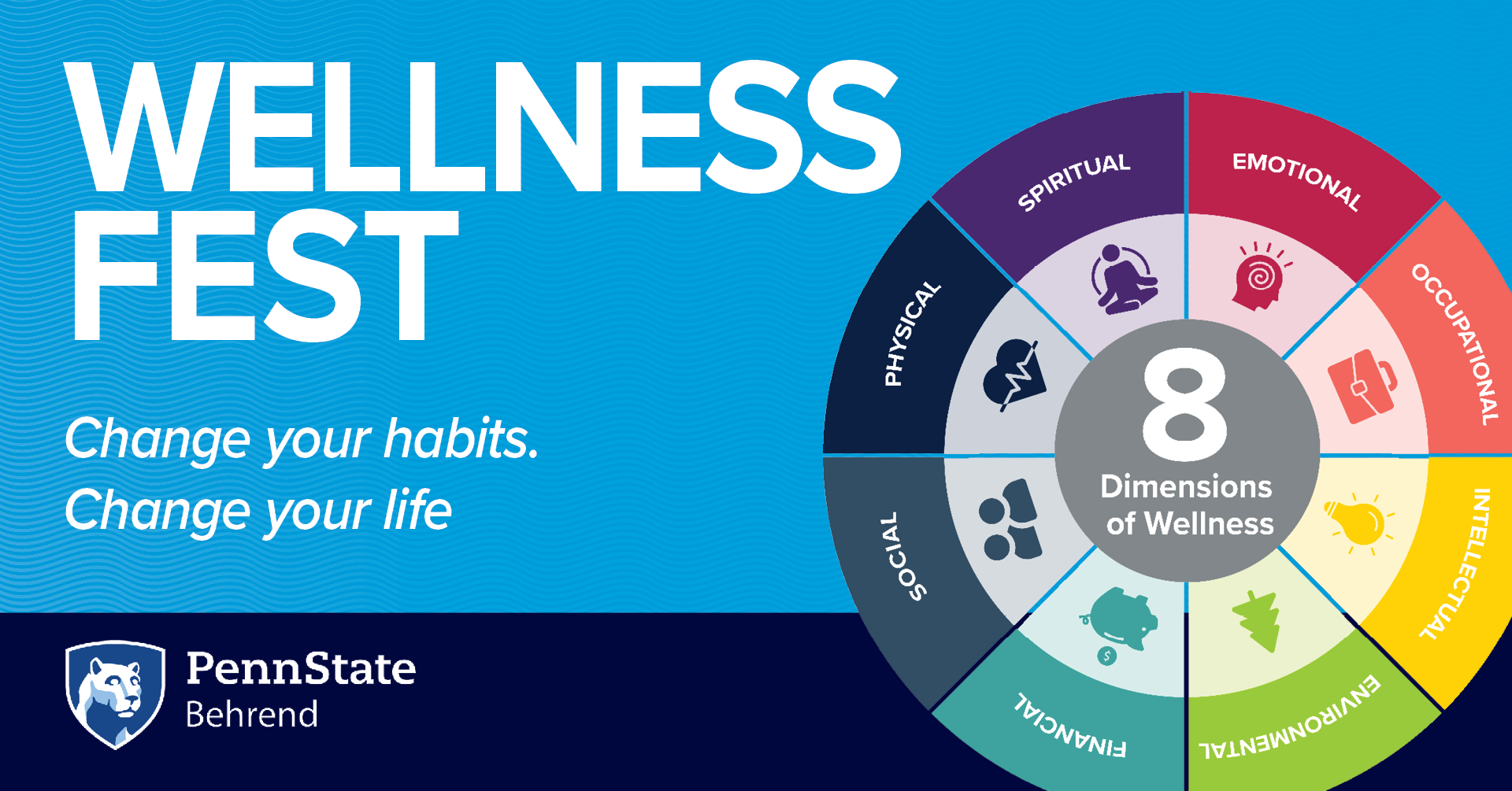
The event, which is free and open to the public, will address 8 Dimensions of Wellness: emotional, occupational, intellectual, environmental, financial, social, physical, and spiritual.

“It’s a great opportunity to see what resources are available from Penn State Behrend and in the Erie area to help you achieve whole-body well-being,” said Anne Eisert, chair of WEC’s Outreach Committee.  “With more than thirty organizations attending, there will be something for everyone.”

Wellness Fest is being held in partnership with Behrend Student Wellness Services and is part of Penn State’s Healthy Campus Initiative.

“Initially we were going to focus on mental health,” Eisert said. “But then we realized a person’s well-being is influenced by a lot of factors that contribute to mental health, so we decided to widen the focus for a whole-body approach.”

In addition to exhibitors and interactive stations, participants will be able to take part in free activities including yoga, sound meditation, animal interactions, and a group hike in Wintergreen Gorge.

For more information, visit WEC’s Facebook page.

From Student to Emmy Winner in Eight Years

Communications alumna wins award for her work at WQLN

KN_Emmy

Kristen (Bessetti) Nielsen ’16 stands out. From her colorful, creatively shorn hair and dozens of tattoos to her infectious, wide smile and obvious joy for life, she is a woman who enjoys being unconventional.

Case in point: She applied to Penn State Behrend on a whim as a 24-year-old mother of two, searching for a new beginning after leaving an abusive relationship. She arrived ready to explore.

“Just because I was an older student didn’t mean I had any idea what my future career path would be,” Nielsen said.

She soon found her niche and graduated in 2016 with a degree in Communication with a focus on Broadcast Journalism, and a Women’s Studies minor.

While still in school, she obtained an internship at WJET/WFXP and YourErie.com, a broadcast news outlet in Erie. After she graduated, the station offered her a job as an in-studio camera operator. She then moved into the newsroom as a news videographer before being promoted to multimedia journalist.

“I’m pretty sure I could have gotten the Guinness World Record for most tattooed news reporter,” she quipped.

After a three-year stint as the morning show producer, Nielsen moved to WQLN, Erie’s public broadcasting station, where she works as an assistant producer on Chronicles, an immersive docuseries that showcases the Lake Erie region’s past and present.

A year later, Nielsen and her team were in Cleveland, hoisting a golden Emmy statue from the Central Great Lakes Chapter of the National Academy of Television Arts & Sciences for their work on the three-part Chronicles: Bellwether episode exploring the political evolution of Erie.

Nielsen, who went from an unlikely college student to an Emmy award winner in just eight years, can scarcely believe it herself.

“When I was a student at Behrend, I never would have imagined accomplishing half the things I have to this point, and I’m still early in my career,” she said.  “Anything is possible when you really care about the work you do.”

Behrend Blog talked with Nielsen about her career trajectory, the advice she has for other Communication students, and why her husband is glad she made the jump from news to historical storytelling.

What is your role in the WQLN Chronicles series?

I am an assistant producer, but with a small crew, we all pitch in on a variety of tasks. Whether it’s operating a camera, setting up lights, writing scripts, animating lake monsters, monitoring audio, directing, or holding a boom mic, most of us have been credited with multiple roles in each episode. I also help a lot with marketing.

How many seasons are there, and are more to come?

We just wrapped up Season 2 with an episode on Strong Vincent. As it stands now, there will be one more season, which will finish next summer.

Ian Murray_Redlining BTS

What are some of the topics featured in the series?

The USS Wolverine, the nation’s first iron-hulled ship, which was built in Erie; rum running during prohibition; the Behrend family; the Hammermill Paper company; Lake Erie shipwrecks; Antarctic expeditionist Paul Siple, aka “the Father of wind chill”; military strategist John Boyd; Civil War hero Strong Vincent; composer Harry T. Burleigh, and much more!  You can find a full list and links to each episode at: wqln.org/shows/chronicles.

How do you decide what to feature?

The mission of the series is to focus on the lesser-known history of our region, so we look for things that have not been done over and over, like the War of 1812. We did do a two-part series on Daniel Dobbins, who does not get as much credit as he should for building the fleet for the Battle of Lake Erie.

What has been your favorite episode so far?

The three-part Bellwether episode, which won the Emmy, is the first project I put a lot of work into when I got to WQLN, so I call it my “baby.” Chronicles had a total of eighteen nominations across several categories. Seeing how all our work paid off has been really gratifying.

What are you working on now?

I’m working on an hour-long episode for Season 3 about journalist Ida Tarbell. She grew up in the Titusville region during the oil boom and went on to expose John D. Rockefeller’s corrupt practices in the oil industry. Her work led the Supreme Court to break up the oil monopolies.

What’s the hardest part of your job?

In news, we worked very fast, running from story to story, event to event, grabbing some b-roll and putting it all together as quickly as possible. Working on Chronicles is the exact opposite. I’m learning to dig deeper to tell a fuller story. I’m also learning a great deal about the equipment and techniques used in more film-oriented productions.

Why is this type of historical storytelling important?

First, it is important to not let the stories of those who came before us be forgotten. Second, understanding the history of the town you come from or live in makes life more interesting. When I walk downtown now, my mind is flooded with facts and images of what it once was. Compare that to when I was working in news and my husband made a rule that I couldn’t point out all the “murder” houses I would see along our journey. This new lens is much nicer.

Chronicles airs on WQLN on Thursdays at 8 p.m. Watch past episodes at wqln.org/shows/chronicles.

This slideshow requires JavaScript.

Retired faculty members add perspective to Behrend’s 75th anniversary celebration

By Robb Frederick, Associate Director, News & Information

Penn State Behrend

Behrend faculty, 1968-69

The yearlong celebration of Penn State Behrend’s 75th anniversary has been an opportunity to reflect on the growth of the college and the contributions of those who helped make Behrend what it is today.

With help from Rod Troester, associate professor emeritus of speech communication, we have collected stories and life lessons from retired faculty members who remember a very different Behrend. Here are some of their reflections:

“I never looked at my time at Behrend as ‘work.’ I felt comfortable slipping into my office in the evening or on weekends in my slippers, often bringing my dog, Ginger, with me for company.

bob-tauber-emeritus (Copy)

“I took advantage of the swimming pool and the ski slope behind the Otto Behrend Science building. I recall my daughter, Rebecca, then just a youngster, proudly coming over from the swimming pool to my office and informing me that she was able to swim two lengths of the pool. This entitled her to be on the forward deck of our sailboat.

“I loved teaching, and doing so at Behrend. I found it a joy to go to work each day.”

~ Robert Tauber, professor emeritus, education

**************************

“I remember traveling with Dean Baldwin and students to the College English AssociationGreg Morris (copy) conference in Pittsburgh, where we shared an elevator with John Updike. We also went to the Shakespeare Festival in Stratford, Ontario, where we saw Christopher Plummer perform the title role in ‘King Lear”; and to the PEN International conference in Toronto, where I had a conversation about melons with Arthur Miller in an open-air market.

“None of this would have happened without the help of the terrific Behrend community of faculty, staff and students.”

~ Greg Morris, professor emeritus, American literature and English

**************************

“I was hired in 1968. My husband, Ben Scott, taught in the Physics department. He was hired the same year I was and retired in 1988.Mary Chisholm (copy)

“I was a chemist. During my 36-year tenure at Behrend, I saw the college develop from a two-year feeder institution to University Park to a flourishing, four-year campus.

“I retired in 2004. I stay in touch with the chemists, and with a few other faculty members in the School of Science.”

~ Mary Chisholm, professor emerita, chemistry

**************************

“I was hired in 1970. That makes me second-generation Behrend Center faculty, but first-Dan Frankforter (copy)generation Behrend College faculty. I was part of the crowd of newbies hired that year to staff the four-year majors that were to make Behrend a baccalaureate-granting institution.


“There was little to work with at the time. Some of us joked that launching the college was like an old Mickey Rooney—Judy Garland movie: ‘Gee, kids, let’s put on a show in the barn.’ But Behrend provided a wonderful and unique opportunity for a career. In an age of academic retrenchment, Behrend bucked the trend and gave us a shot at a much more exciting and fulfilling project. It’s growing success is an achievement well worth celebrating.”

~ Dan Frankforter, professor emeritus, history

Standout Seniors: Meet Samhita Chitturi (Creative Writing)

Penn State Behrend’s Class of 2024 is ready to make its mark on the world!  We’re proud of our students and all that they have learned and accomplished here at Behrend. Over the next several weeks, we will introduce you to a few of our remarkable seniors who have engaged in college life in a big way, conducted valuable research, pioneered innovations, and overcome challenges during their time at Penn State Behrend.

Today, we’d like you to meet Samhita Chitturi.

Samita Chitturi

Major: Creative Writing

Minor: Crime, Law, and Psychology

On choosing Behrend: It chose me. In all of Penn State, the B.F.A. in Creative Writing is only offered here. And, thank God, it is! I love Behrend. It was the best decision I (n)ever made.

On choosing her major: I decided in eighth grade that I wanted to be a professional writer. Writing and storytelling are what I am most passionate about.

Her proudest accomplishment at Behrend: Being a Learning Resource Center tutor and earning the Outstanding Tutor in Humanities Award in Spring 2023. I love tutoring in both writing and math. I also tutor in French, ethics, chemistry, and other subjects. It’s a great way to meet people, to inspire them, and to be inspired by them. Not only do I get to help my peers, but I often learn new approaches to solving problems or out-of-the-box thinking. Anything that opens you up to new perspectives is always a worthwhile activity.

Campus involvement: I’m currently Features Editor at the Behrend Beacon. I started the “Created by Behrend Students” column to showcase students’ creative works, such as poetry, paintings, and more. I have also written the Local Eats pieces, interview articles, and Arts and Entertainment reviews. I’m also a School of Humanities and Social Sciences ambassador.

Awards and recognition: I have won four awards for my writing in the last two years: third place for the Fall 2022 Smith Fiction Award for my short story, “One Night in New York,” which is the second piece in my thesis collection; the SalisMania 2023 Best Romance Book Award for my debut novel, “When You Saved Me”; the Fall 2023 Farrell Nonfiction Award for my essay, “Two Angles on Arts and Ethics: An Exploration into What Determines Artistic Success”; and a 2024 LiFT Award in Contemporary Romance for “When You Saved Me.”

Her talents: I like to do a lot of different things, but I think the one thing I’m best at is daydreaming. It fuels my creativity, it helps me remain open to new perspectives, and it’s a coping mechanism when I need it.

Believe in yourself: Some think I’m pretentious, but what I am is confident. The only way people are going to recognize your value is if you recognize it. That said, just because I recognize my value, doesn’t mean I disvalue others. Everyone has talent, has an interesting personality, and is beautiful on the inside. You just have to look for those qualities sometimes.

Her definition of living a good life: Living it with autonomy and respecting others’ autonomy. I subscribe to Kantianism. I believe autonomy is the key to goodness.

Advice for first-year students: College (and life) is only as difficult as you make it. Rule No. 1 to reduce that difficulty? Communicate! It makes everything more efficient and effective. If you feel like you’re going to fail a class, talk to the professor and make a plan. If your roommate and you are having conflicts, discuss them respectfully and work out a solution. Whatever the problem is, I guarantee you there is a solution or a change in perspective waiting for you that will make everything OK.

Parting thoughts for new students: Take an ethics class with Dr. Joshua Shaw, professor of philosophy and bioethics; an algebra class with Dr. Dan Galiffa, associate professor of mathematics; and at least one English class with Dr. Sara Luttfring, associate professor of English. Taking a class with each of these three professors will help prepare you for the rest of your academic life.

After graduation in May, Samhita will attend the University of New Hampshire to earn an M.F.A. in writing. She plans to work toward a Ph D. and hopes to eventually become a professor at Behrend.

Standout Seniors: Meet Cameron Schmidt (Software Engineering)

Penn State Behrend’s Class of 2024 is ready to make its mark on the world!  We’re proud of our students and all that they have learned and accomplished here at Behrend. Over the next several weeks, we will introduce you to a few of our remarkable seniors who have engaged in college life in a big way, conducted valuable research, pioneered innovations, and overcome challenges during their time at Penn State Behrend.

Today, we’d like you to meet Cameron Schmidt.

Cameron Schmidt

Major: Software Engineering

Minors: Game Development, Computer Science

Hometown: North Ridgeville, Ohio

On choosing Behrend: I chose Behrend for two reasons. The first was because of the Software Engineering program. I wanted Software Engineering over Computer Science, so I needed to find a school that had a good Software Engineering program, and after touring Behrend, I found it here. The second reason: Penn State. I was born and raised in Ohio, but grew up a Penn Stater because of my dad, who is a Penn State alumnus. During my childhood, if I was out with my dad and he was wearing a Penn State shirt there was always a chance we’d hear a ” WE ARE” from across a room, or I’d hear my dad suddenly yell “WE ARE” at other strangers wearing Penn State stuff. Complete strangers who he had never met before, connected simply by the fact that they went to the same school. Having that sense of community growing up made me realize early on that Penn State was special.

On choosing his major: I initially chose Computer Science, before I even decided where I wanted to go to school, simply because I wanted to make software applications. As I learned about the differences between Software Engineering and Computer Science, I ended up choosing Software Engineering, because unlike Computer Science, it also focused on Software Development concepts like documentation, design and implementation, project management, computer hardware, and more.

Campus involvement: While I was at Behrend I was mainly involved with one organization, Alpha Phi Omega, which is a co-ed service fraternity. I joined APO my second semester, mainly to make friends but soon began taking leadership positions in the group. APO really helped me develop my leadership skills, which helped me later when I became a resident assistant, throughout the rest of college, and in life in general.

A seat at the council table: I was also involved with an organization at University Park called the Council of Commonwealth Student Governments, or CCSG. For about three semesters, I served as the Associate Director of Student Affairs. My favorite part about my time in CCSG were the committee meetings. They gave me experience facilitating discussion among people, which I really enjoy.

People might be surprised to learn: I spent two summers at University Park, taking classes and working. The first summer, I just worked as an RA and took a few classes. The second summer, I worked as an RA and a Research Assistant and took quite a few classes. I have a lot of great memories from my time there, and gained a lot of academic, RA, and life experience!

His definition of living a good life: A good life is a life that is filled with little stress, less problems, where you have financial stability, and are doing what makes you happy. I want to emphasize the last point: do what makes you happy, only you know what that is and only you know how to achieve it.

HIs passions: I am passionate about learning and not just in an academic sense. I like learning about people and where they come from, what they’re passionate about. I also like learning about subjects completely unrelated to my field.

Advice for first-year students: The most important thing I think first year students should know is that it’s ok to mess up. Learn from your mistakes instead of letting them consume you. In my first semester, I failed two classes, got a D in two, and late-dropped one. It was really hard, but I learned from what I did wrong and came back from it. Another big piece of advice is to surround yourself with good people who will support you when you’re down, people you can learn from, and people who will help you grow as a person. That person for me in my first year and now, is my friend Ben Coler. I hope everyone can find someone like that.

After his graduation in May, Cameron plans to find work as an engineer in the game development industry, with hopes of eventually transitioning to game design and/or game production.

Standout Seniors: Meet Nathan Murarik (Mathematics)

Penn State Behrend’s Class of 2024 is ready to make its mark on the world!  We’re proud of our students and all that they have learned and accomplished here at Behrend. Over the next several weeks, we will introduce you to a few of our remarkable seniors who have engaged in college life in a big way, conducted valuable research, pioneered innovations, and overcome challenges during their time at Penn State Behrend.

Today, we’d like you to meet Nathan Murarik.

NathanMurarik

Major: Mathematics, Pure Mathematics option

Minor: Computer Science

Associate Degree:  Information Sciences and Technology (Penn State DuBois):

Hometown: Karthaus, Pennsylvania

Scholarships: Penn State Provost Award; Evelyn W. Cronister Memorial Scholarship

On choosing Behrend: When I saw that Behrend was the only campus with a Software Engineering program, I had to join in on the fun! I later realized my passion was in Mathematics, but the uniqueness of the Software Engineering program is what brought me to Behrend.

On choosing his major: I’m always asking “why,” and mathematics unabashedly answers that question for me. It allows one to make educated conclusions, prove properties, and appreciate the complexity of the beauty around us. I find joy in learning how computers utilize mathematics to solve problems that a programmer or an engineer might face in their daily work.

Campus involvement: Gender and Sexual Equality Club – Multi-Cultural Council Representative; Math Club – Vice-President, President; Council of Commonwealth Student Governments – Information Technology Coordinator; 2023 Fall Concert Committee – Logistics Chair; Alternative Spring Break 2024

What makes him unique: I have a book filled with daily sayings authored by me. My favorite is,” Anyone could have chosen my path. The beauty is they didn’t.”

What you might be surprised to know about him: I was raised on a farm.

Words to live by: “Do not fear death, but rather the unlived life. You don’t have to live forever. You just have to live.” ― Natalie Babbitt

His highest priority for the coming years: Attaining a Ph.D. and paying down my student loans.

His passion: My biggest passion, outside of mathematics, is education. Every human being has the right to an unbiased education in pursuit of enlightenment or upward economic mobility. I despise those who fear knowledge but favor ad hominem arguments against the very literature that develops an open-mindset, critical thinking, and a healthy curiosity.

Advice for first-year students: Test the assumptions you’ve made about the world, its systems, and its people. I assure you that at some point, you will struggle with one of those assumptions and mature as a person.

After his graduation in December, Nathan plans to specialize in computational mathematics research at a university, industry stakeholder, or, in his words, “wherever the wind takes me.”