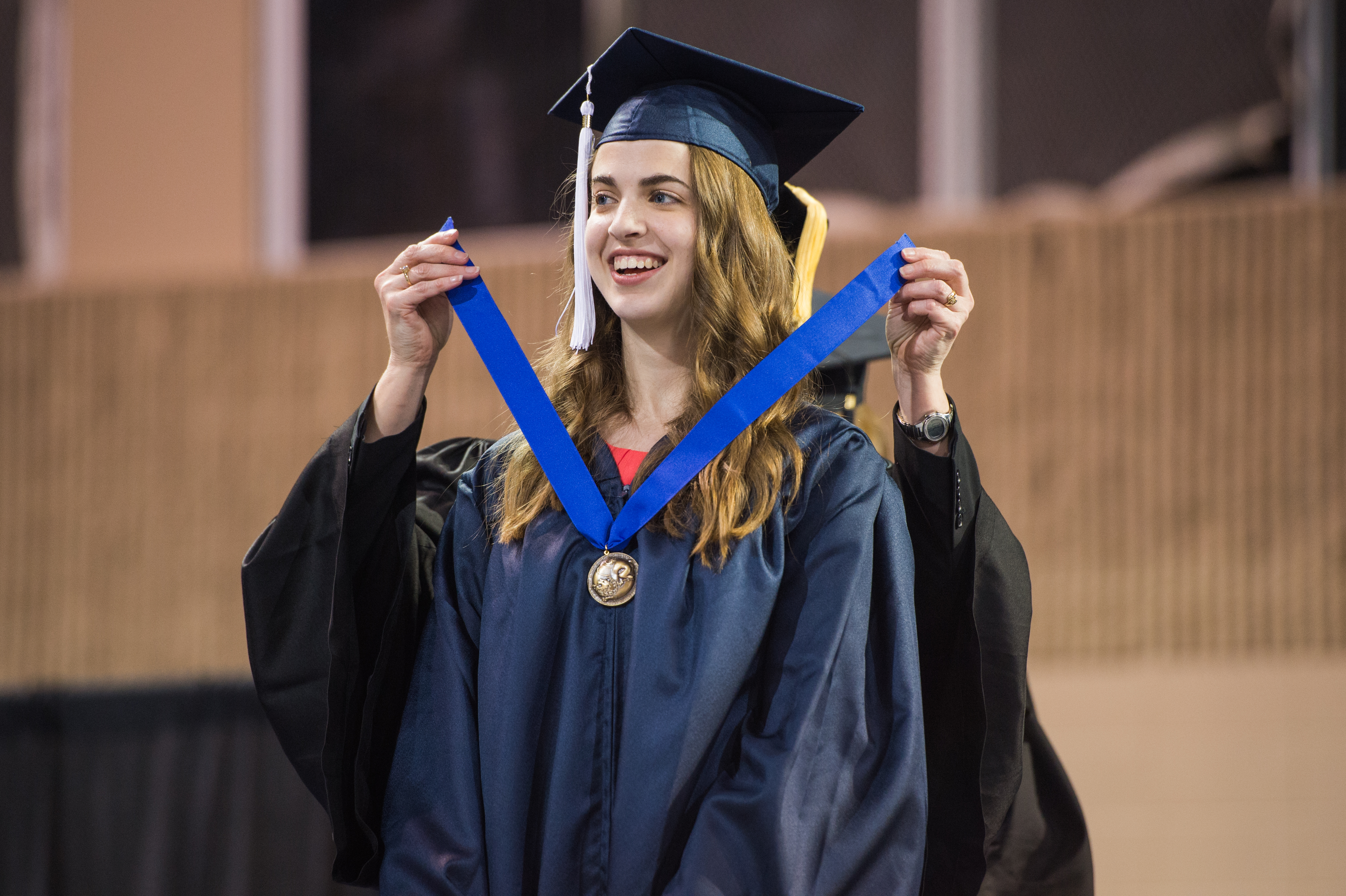
Young Erie authors publish one-week novels at College for Kids

DSC_0646

By Robb Frederick
Public Information Coordinator, Penn State Behrend

Once upon a time there was a boy named David. He liked to write. He came to a college called Penn State Behrend for a program called College for Kids. He was one of 1,283 kids in the program.

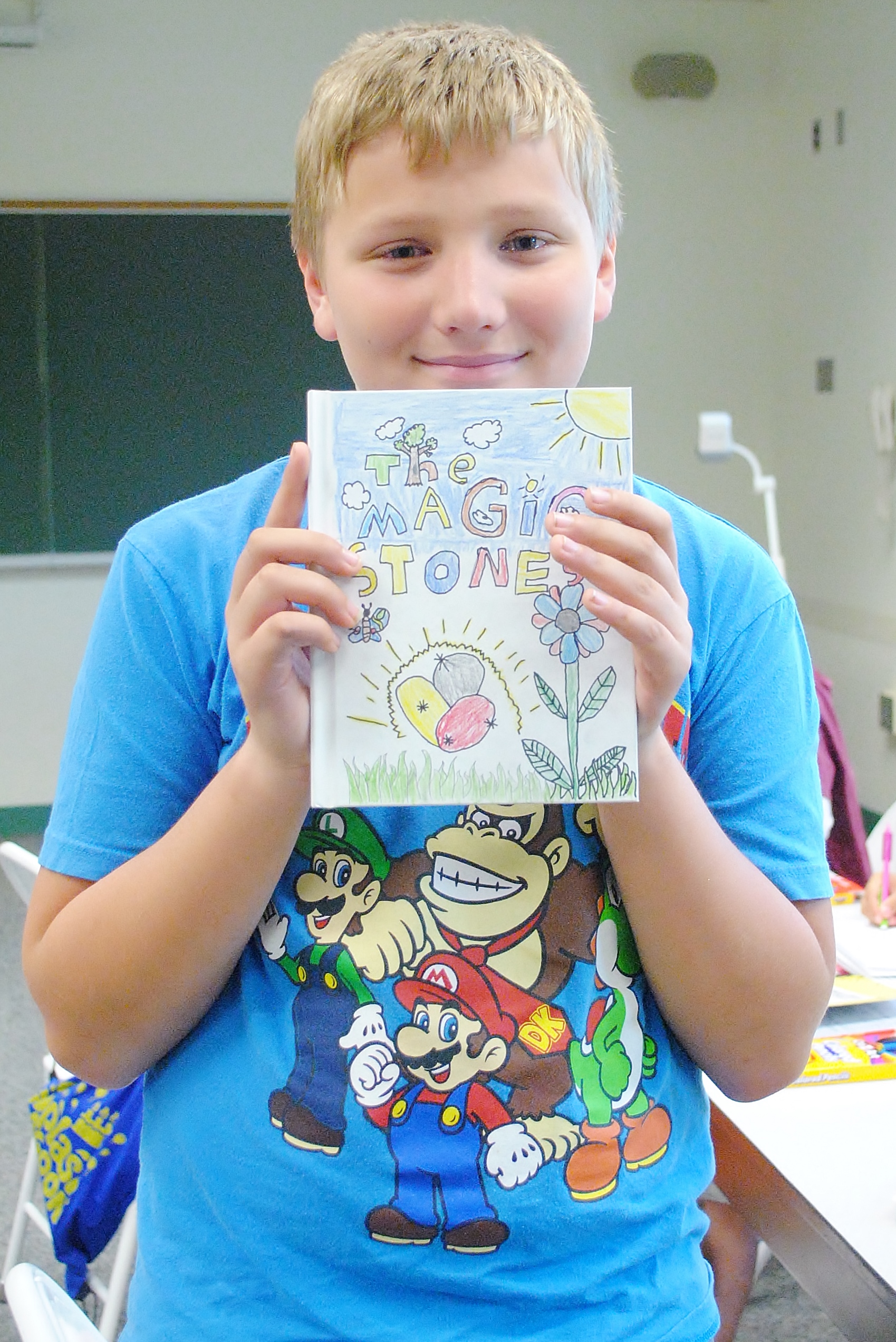
The kids had fun. They launched rockets and built robots and made stained-glass mosaics. David’s class was called “Author’s Club.” The kids in it made their very own hard-cover books. David’s book was “The Magic Stones,” by David Showers, age 10. He dedicated it to his Gramma.

His teacher, Ms. Lenze, helped him write it. She taught him about plot and character and conflict. She made him practice. One time, she gave the class the ending of a story and asked them to write what the characters did to get to that point. That was like a backward book.

Ms. Lenze played classical music while the kids wrote. Some kids sat at desks. Some sat on the floor, their legs folded crisscross applesauce. David sat next to Audi, whose book was called “Mark and Jasmine Meet an Alien.” The boy across from them wrote “Attack of the Changeos.” Whatever those are.

“They are so creative at this age,” Ms. Lenze said. “The stories they come up with are just so imaginative.”

David’s story was about a boy who found three magic stones. The red stone made the boy invisible. The gold stone helped him fly. The black stone granted all of his wishes. But not right away. That was in a later chapter.

“I just moved here like six months ago,” David said. “I read a lot of books. I think it’s cool that I’m making my own.”

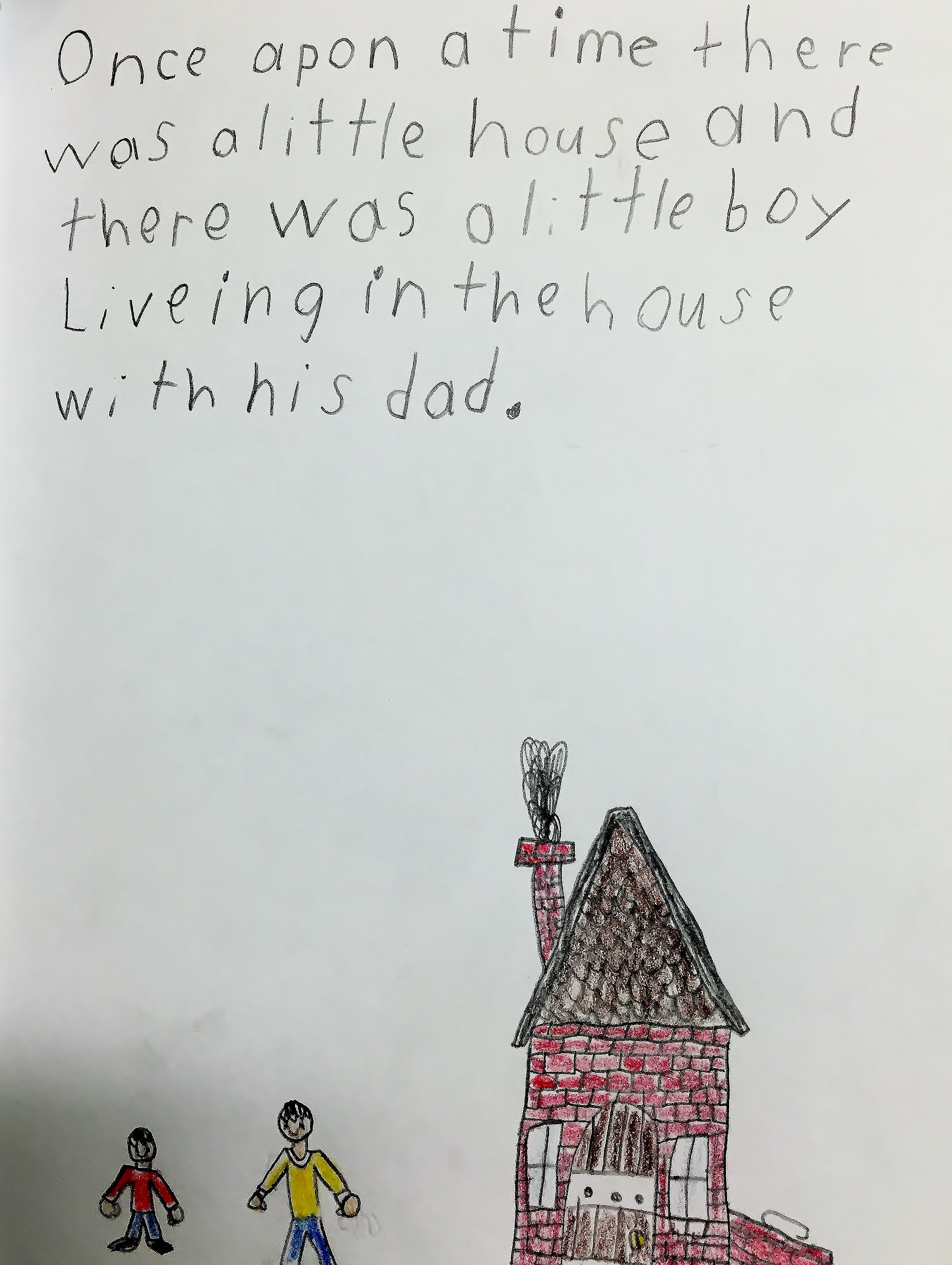
He wrote the first draft in a notebook. Then he copied the story into a blank book that Ms. Lenze gave him. He spent a lot of time on the drawings. Especially the first page, where he drew the boy and the boy’s dad and the big house they lived in. He drew all the bricks and shingles and even put smoke on the chimney.

IMG_2883

“I’m really good at drawing houses,” David said. He pointed to the front door, which looked like wood. “Isn’t that good?”

On the next page, the boy goes into the woods. He finds the magic stones. He starts to learn about their power.

Ms. Lenze said a good book should have some conflict. Like a fight. So David made his boy meet another boy – a friend, but not really – who also wanted the magic stones. That boy planned to do bad things with the power. So the boys wrestled, each of them grabbing at the stones, until the magic rocks dropped and broke.

And then?

Then it just ends. The last pages are blank. Ms. Lenze would call that a cliffhanger. David called it time-to-clean-up-for-lunch.

“That’s as far as I got,” he said. “I’ll have to write some more tomorrow, I guess.”

A Textbook Case of Win-Win: Student filmmakers, professors, textbook company team up to create educational videos

Papiya

Dr. Papiya Bhattacharjee

By Christine Palattella
Marketing Communications Specialist, Penn State Behrend

Associate professor of mathematics Dr. Papiya Bhattacharjee’s daily summer lectures have an audience of just one unblinking video camera, but the potential to reach millions of math students.

Bhattacharjee is one of four calculus teachers chosen by regional audition to act as talent in supplemental video content to be distributed by Erie-based Larson Texts. The video series is being produced using equipment provided by Greater Erie Arts Rental (GEAR), a new outreach services of the School of Humanities and Social Sciences, and with the assistance of Behrend students working as production interns for Larson.

“I think the videos are going to be extremely helpful for any student, but especially the visual learners,” says Bhattacharjee, who spends four hours each morning in the Kochel Center television studio, working aloud while illustrating her commentary in grease marker on a large pane of glass. (The glass will be flipped in post-production to make the pane readable.)

Years of teaching have left Bhattacharjee comfortable speaking in public. It’s the addition of technology that’s the challenge. “I need to remember to always look at the camera while speaking, move away from my writing so it can be seen clearly in the camera, and so on,” she says. “I am trying to have fun. All I have to remember is that the camera is my student, and I am tutoring my student.”

But this is no average student: The camera is an Epic-M Red Dragon Pro, the same model used to film Game of Thrones, The Hobbit, and Avenger: Age of Ultron. This camera is just one piece of equipment in GEAR’s inventory, which includes high-end cameras, lighting kits, and other hardware and software. The equipment is available to professional and student filmmakers and regional artists. GEAR’s equipment inventory, purchased using a $500,000 gift commitment from the Samuel P. Black Family Fund of the Erie Community Foundation, also includes lenses, tripods and stage legs; six-channel sound mixers; shotgun and wireless mics; Fresnal, LED, and HMI lighting systems; and Mac Pro, Adobe and DaVinci Resolve editing and rendering software.

Tim Larson ’87 is a partner in Grant Larson Productions, creator of the calculus video series. He anticipates filming 700 individual videos averaging seven minutes in length by the time the shoot wraps in August. Larson calls GEAR “a wonderful resource. It’s so nice to have this kind of equipment in Erie. On previous shoots we’ve had to rent cameras and equipment from Columbus and Buffalo, so this is an astounding benefit to us.”

An additional GEAR benefit is a ready-made film crew, since a rental discount is available to GEAR clients who hire Penn State Behrend students. “I feel so incredibly lucky to be able to work on this project,” says Erik Brown, a spring Communication graduate and one of six Behrend students and young alumni working for Grant Larson as paid production interns. “The great thing about working here is not only learning about the film industry itself, but also being exposed to high-quality equipment. We’re not using just a couple house lights and DSLR cameras, but industry-standard gear for lighting, sound recording, and cameras. I’ve always wanted to work in the film industry and, now, working on this shoot, I feel like I have a realistic chance of doing that.”

Erik Brown, left, Josh Lapping

Erik Brown, left, and Josh Lapping, (above) are two of six Behrend students and recent alumni working on the videos for Grant Larson Productions using equipment from the Greater Erie Arts Rental, or GEAR, a new outreach service of the School of Humanities and Social Sciences that provides professional and student filmmakers and regional artists access to high-end cameras, lighting kits, and other hardware and software. 

Josh Lapping, Ciara Smith

Penn State students, Josh Lapping, left, and Ciara Smith, work on a series of videos for Grant Larson Productions.

Shelby Dailey

Shelby Dailey, Penn State Behrend Communication major and intern for Grant Larson Productions.

Intern Shelby Dailey, pictured above, a Communication major starting her senior year at the college, appreciates that Grant Larson rotates its student workers. “We’re given the chance to experience all the moving parts of film, such as camera operating, producing, directing, and script supervising. I’ve learned things that textbooks can’t adequately prepare students for, such as (crew) dos and don’ts, set etiquette, and (the importance) of networking.”

“We want to offer an educational experience that is at the same time a close facsimile of what students will experience once they enter the professional environment of producing film and television,” says GEAR coordinator Michael Berlin, whose previous professional experiences include managing crew and equipment for New York City’s Fashion Week and the E! and Pop television networks and production management for ABC World News, CNBC, and ESPN. “The students working on these calculus videos are gaining technical know-how and a type of muscle memory that characterizes this industry, plus they are learning the responsibility that comes with arriving on-set day in and day out. They also are enjoying the benefit of getting paid for their hard work—believe me when I tell you that this type of arrangement is a very rare and very special as a teaching tool that is fair to all parties involved.”

For additional information about GEAR, email Michael Berlin at mbb21@psu.eduLarson Texts and Grant Larson Productions online.

Move over, Bill Nye. Penn State Behrend has its own ‘Science Guy’

By Steve Orbanek
Marketing Communications Specialist, Penn State Behrend

Joel Solomon (3)
Joel Solomon, a physics major, was the recipient of this year’s T. Reed Ferguson Award. The award recognizes a junior who has demonstrated scholarship, leadership and citizenship through academic and out-of-class involvement and gives promise of further achievement in the senior year.

For some kids, it’s Cartoon Network. For others, it’s Nickelodeon. For Joel Solomon, it was the Science channel?

“Growing up, I just always watched that channel,” says Solomon, who recently completed his junior year at Penn State Erie, The Behrend College. “I was fascinated by what humanity has been able to do over the years, and I knew that I wanted to be a part of that.”

Math and science resonated with Solomon, and that interest led the New Wilmington, Pa., native to Penn State Behrend. As he got older, he knew he wanted to pursue research in college, and he could think of no better destination than Behrend.

“Being able to get a great education at a small campus is great,” says Solomon, a physics major. “I was looking for a research-oriented institution, and Behrend is one of the few schools in the region that offers such opportunities. I know that with a degree from here, I can go anywhere that I choose.”

This past year, Solomon collaborated with Bruce Wittmershaus, associate professor of physics, on a research project titled, “Concentration Dependence of Coated Gold Nanoparticles for Metal Enhanced Fluorescence.” The project was recognized as the Best Poster Presentation this past April at the Sigma Xi Undergraduate Student Research and Creative Accomplishment Conference.

Undergraduate research has been a big part of his time at the college, but Solomon’s interests go beyond the academic realm. For the past three years, he’s been a goalie on the men’s soccer team. This past year, Solomon was inducted into Chi Alpha Sigma, a national society that honors collegiate student-athletes who excel in both the classroom and in athletic competition. The society recognizes student-athletes who received a varsity letter in their sport while maintaining a cumulative GPA of 3.4 or higher throughout their junior and/or senior years. Solomon is also a former AMCC All-Academic selection.

“I feel as if soccer complements my academics. Just being physically active helps me keep up with my coursework,” he says.

Solomon’s accomplishments on the field and in the classroom played a key role in his receiving the 2014-15 T. Reed Ferguson Award last April at the college’s 66th annual Honors and Awards Convocation. The award recognizes a junior who has demonstrated scholarship, leadership and citizenship through academic and out-of-class involvement and gives promise of further achievement in the senior year.

“I was very happy to receive the award, and it was nice to know my work is paying off,” Solomon says. “It just reassured me that I’m on the right path, but I know there’s more that I can do.”

Solomon will get the chance to fulfill that promise of further achievement this fall, continuing his undergraduate research as the recipient of a grant to explore the topic of “Enhancing the Photostability of Fluorophores Using Metal Enhanced Fluorescence.”

For the future, Solomon plans to attend graduate school and possibly work with optics. His ultimate goal, though, has its roots in the programs he watched on Science as a boy.

“My dream job is always going to be something with NASA. I have always been fascinated by all of NASA’s accomplishments,” he says, “so that’s the dream, and that’s what I’ll keep working toward.”

Kunming, China, native comes to Penn State Behrend to ‘claim’ an education

By Steve Orbanek
Marketing Communications Specialist, Penn State Behrend

(Wang, Arthur) Rose_Cologne_Keystone Award
Arthur Wang, a Kunming China, native, is shown holding the Rose Cologne Keystone Citizen Award, a University-wide award that he received this spring.

Yuanheng “Arthur” Wang arrived in the United States for the first time in 2006. His parents felt it was time for him to see the world, so the Kunming, China, native went to live with his uncle in Seattle.

He knew there would be only one way to adapt.

“I really struggled back then because I basically knew nothing about English. I realized then that I had to master this language to survive,” Wang says.

Now a junior at Penn State Erie, The Behrend College, Wang is doing more than surviving — he’s thriving.

He has made the Dean’s List every semester so far, has joined the Lambda Sigma National Honor Society, has served as the regional vice president of the Student Pennsylvania State Education Association and was recently accepted into the University’s Schreyer Honors College. His greatest accomplishment though, might be the work he is doing to help his fellow international students, he says.

Wang serves as a teaching assistant for Penn State Behrend’s English Language Learners program and holds office hours each week, tutoring students in college-level reading, writing, speaking and listening skills. The English language has resonated with him.

“I like English, and I like communication. They just make me excited,” Wang says.

In fact, he’s so enthused about the language that English has become his major. Now he’s using that excitement to assist others.

“I want to help those who are learning English, but in order to do that, I have to master the language myself,” Wang says. “I use English and Chinese interchangeably, which we call ‘code-switching.’ I want to encourage those around me to realize and appreciate the beauty of language.”

Wang’s efforts were recognized this spring when he was honored with two awards: Behrend’s Irvin H. Kochel Award and the University-wide Rose Cologne Keystone Citizen Award. The Kochel Award is presented annually to an outstanding student who demonstrates character, scholarship, leadership and citizenship through efforts that positively influence students and the college community. The Cologne Award recognizes students for service and volunteerism to their campus and local communities.

After graduation, Wang plans to pursue a master’s degree in education or instructional communication and would eventually like to be a professor of language and literacy education. He’s not afraid to challenge stereotypical notions along the way.

“I wish to challenge the stereotype that Asian students or international students are not able to major in English or the humanities. I want to challenge the stereotype that says all international students are going to major in business, engineering or the sciences,” he says.

Guiding him along the way is a principle he picked up from a speech titled “Claiming an Education,” given by poet Adrienne Rich at the 1977 convocation of Douglass College in New Jersey.

“I’m not here to accept or receive an education. I’m here to claim an education. I want to claim all of the resources here available to me,” Wang says. “This term inspires me because it really confirms my dedication and informs my direction.”

He’s hoping other students are willing to follow his footsteps in claiming their education.

“College is all about choice,” he says. “If you want to be happy, if you want to be a success, then you make that choice and do it. Once you make that choice, no one can take it away from you.”

For adult student, degree is ‘one of those lifetime badges you get’

By Robb Frederick
Public Information Coordinator, Penn State Behrend

Michael Linhart (3) (682x1024)Michael Linhart took his time getting to Erie Insurance Arena, where he received a bachelor’s degree in general arts and sciences. He crossed the stage in May, 24 years after he first enrolled at Penn State Erie, The Behrend College.

“It’s hard to describe how that felt,” Linhart, 42, said. “To be honest, I just tried to soak it all in.”

The Fairview resident first arrived at Penn State Behrend in 1991. The Kochel and Burke centers had not yet been built. Ohio and Almy halls were still woodlots.

Linhart had trouble adjusting to college life. After three semesters, his GPA had flat-lined at 1.5.

“I wasn’t ready for college,” he said. “I didn’t have the focus or the determination to stay with it. I needed to grow up.”

So he left. He worked the cash register at a grocery store and helped manage a Taco Bell. He watched his friends go on to better things.

“All my friends were getting these great 9-to-5 jobs,” he said. “They were getting married, having kids, and I was stuck, still living hand-to-mouth.”

In 1998, after five years away, he came back to campus. He tried to be more active: He joined the Zeta Beta Tau fraternity and the Returning Adult Student Organization. He volunteered as an orientation leader.

“He had a renewed sense of what he needed to do to be successful here,” said Biddy Brooks, director of the Office of Adult Learner Services. “He was committed to putting in the work. So it was hard to see him leave again.”

After two years of study, Linhart was offered an internship at a property management company. He worked as a leasing consultant, matching renters to apartments in a 132-unit complex. When his boss offered him a full-time position – good pay, and a path up the organizational ladder – he accepted, leaving college for a second time.

Before long, however, the work bored him. He joined the U.S. Navy Reserve, training as an aviation supply worker. He completed basic training on Sept. 5, 2001.

Six days later, the nation went to war.

“I ended up in the Persian Gulf, on the USS Theodore Roosevelt, thinking, ‘Yeah, this was a great plan,’” Linhart said.

When his tour ended, he returned to Erie, wanting to be close to family again. He met a woman and had two children. He’d raise them on his own, tending bar and working as a massage therapist.

He married again in 2012. When his new wife, Amy, encouraged him to complete his degree, Linhart once more found himself in Biddy Brooks’ office.

“He just persevered,” Brooks said. “He was so positive and outgoing, and always willing to talk with other adult students. He wanted to help them through situations he’d already had to work through.”

He kept his own doubts to himself. “I was a lot more apprehensive, coming back that third time,” Linhart said. “I was like, ‘What am I doing here?’ But I stayed with it. I saw it as one of those lifetime badges you get: the ‘turn 40 and go back to college’ badge.”

It worked. He earned his final credits and was honored as the college’s top adult learner. The day of his last exam, he lingered on campus.

“This school has given me so much,” he said. “So many friends, so many experiences, so many nuggets of wisdom I can take with me anywhere. I just walked around and took it all in one more time.”

Before the commencement ceremony, he drove to the cemetery where his grandparents are buried. He placed an invitation in a zip-lock bag and tucked it between their headstones. Then he went home and taped a message to the top of his mortarboard: “I MADE IT.”

College packing 101

DSC_0209

By Heather Cass
Publications & Design Coordinator, Penn State Behrend

Ah…’tis the season for first-year students to clear the shelves at Bed, Bath & Beyond and Target in preparation for the big move to college. It’s a daunting and, at times, overwhelming task to pack up your life and move into a much smaller (and usually shared) living space.

Don’t stress, we are here to help! (By the way, that’s true not just for packing advice, but for any problem you encounter while you’re here. Never be afraid to ask for help!)

Keys to success

The keys to packing for college are the same things that will help you be successful once you get here:

  1. Do the research.
  2. Make a plan.
  3. Keep track of what you need to get done.
  4. Do not procrastinate.

What to bring

Now, the good news: We’ve done the research for you on what to bring.

Here’s the official list from Penn State’s Housing and Food Services Department:

  • Address book, stamps, stationery
  • Alarm clock
  • Backpack
  • Baskets for toiletries and storage
  • Bed Linen: sheets (extra-long twin), mattress pad (extra-long twin), bedspread/blanket, and pillow
  • Bike and bike lock
  • Cleaning supplies (cleaner, paper towels)
  • Clothing (bathrobe)
  • Computer, printer, and cables
  • Desk items (lamp, pens/pencils/highlighters, calendar, calculator, tape, scissors, stapler, paperclips)
  • Fan (portable)
  • Financial items (checking/savings account, credit/debit card, health insurance card, Social Security card, driver’s license or photo ID)
  • First Aid items (band aids, cotton balls, cotton swabs, cold/cough medicine, first-aid kit, aspirin)
  • Food items (can opener, bottled beverages, coffee maker with automatic shutoff, one set of silverware/plates/bowls/glasses, condiments, napkins, snacks, dish detergent/ towel)
  • Games (cards, board games)
  • Hangers
  • Laundry basket/bag, detergent, iron
  • Padlocks (desk, laptop, and bike)
  • Room decorations (note that posters/photos must be hung with plastic tack)
  • Sewing kit/safety pins
  • Snow shovel/snow brush to store in your car
  • Stereo system (CD player, radio, mini disc player, headphones, CDs, etc.)
  • Television
  • Toiletry Items
  • Towels
  • Umbrella
  • Vacuum Cleaner (although vacuums are available in each residence area, it is suggested that you bring a small one with you, such as a “stick” vacuum, if your room is carpeted)
  • VCR or DVD player (with cables)

Especially for Behrend bound students

There are some additional things you should add to your shopping list if you’re bound for Behrend. We asked current Behrend students, recent alumni, and staff and faculty members what they would add to the list. Here’s what they had to say:

  • Bring winter clothes/brush/gear with you. Last year, a good majority of people were caught surprised by a foot of snow the week before Thanksgiving break. — Zachary McCauley
  • A scientific calculator. — Robert Durbin
  • A flashlight. — Amanda VanBuskirk
  • Swiffer, dust rag, dish soap, and a sponge. — Megan Dunlap
  • Yaktrax (traction cleats designed that pull on over your shoes) give you better traction on ice. — Lauren Minner
  • A sleeping bag for staying in friends’ rooms. — Alysha Simmons
  • A boot mat to put wet footwear on and something to clean the floor with, such as a Swiffer. — Savannah Martin
  • Desk lamp. — Megan Dunlap
  • A small wash bin to do dishes. It’s easier than trying to do them in the sink. — Ashlyn Kelly
  • A warm scarf to cover your face in winter as you walk around campus, good winter boots, a sturdy umbrella, and rain boots, too. — Valeri Maye
  • Bring a pair of old shoes or boots that you can get dirty during walks in the gorge. — Jackie Gowen
  • A boot dryer. —Amanda Hall (Editor’s note: Oooh, good one, Amanda. Very smart investment!)
  • Extension cords and multi-plug outlet adapters. — Carol Brandon

Women in Engineering: Meet Sara Bell ’12

By Heather Cass
Publications & Design Coordinator, Penn State Behrend

sara bell

When people find out that Sara Bell ’12 is a mechanical engineer, they usually say something like, “Oh, well, good for you!”

Bell said she doesn’t perceive the response to be patronizing; rather she thinks it reflects a general lack of understand about the field of engineering.

“They usually have no idea what being an engineer entails or what I actually do, so I think that’s why they say it,” Bell, who works at Eriez (formerly Eriez Magnetics) in Erie, said. “Sometimes they ask me about my job, but it’s often based on things they’ve seen about engineers on TV, and they ask if I work on a big team or make big machines and equipment. They seem disappointed when I tell them ‘no.’”

Bell works with detection systems, helping design conveyor systems and reject systems and working with metal detector heads. She says her job may not be as glamorous as that of a NASA engineer, but it’s no less important or rewarding.

“The world needs engineers for everything, even for things that don’t seem ‘cool,’” she said. “I really enjoy seeing my designs and ideas come to life.”

Born with an engineer’s mind

Bell says she has always had an aptitude for math and science. As an Erie-area native, she participated in some of Penn State Behrend’s outreach programs, including Math Options for Girls and the FIRST robotics league in her senior year.

“Robotics had the largest impact,” she said. “That’s where I saw how cool it was to see something come together and work.”

A friend suggested that Bell look into a career in engineering.

“I wanted to do something where I could learn and use my brain,” she said. “I chose mechanical engineering because it is a catch-all engineering field. I thought it would be a really versatile degree that would allow me to do a variety of things but still hone in on something specific down the road if I wanted to.”

She’s been a mechanical engineer at Eriez for two and a half years, though she’s worked there longer, having interned there for several semesters before graduating,” she said.

Encouraging future generations

Bell has returned to Behrend to volunteer at Women in Engineering Day for the past two years.

“I always feel the need to encourage more women to pursue any STEM-related career they are interested in,” she said. “I think you’re seeing more women in engineering because they have opportunities to explore and learn about these types of careers before they even reach college.”

Bell is quick to point out that education never really ends for engineers.

“I sometimes say that I didn’t earn my degree for engineering; I earned it for learning,” she said. “As an engineering student, you learn how to learn. With that knowledge, you can do pretty much anything you want to in life.”

Meet Dr. Bernd Hacker, Visiting Scholar from Germany

By Heather Cass
Publications & Design Coordinator, Penn State Behrend

IMG_5879

Dr. Bernd Hacker

Penn State Behrend welcomes the opportunity to host foreign scholars who enrich our community’s intellectual and research endeavors, international connections, and global perspectives.

Dr. Bernd Hacker, a professor from the University of Applied Sciences in Rosenheim, Germany, a partner school of Penn State Behrend, has been a visiting scholar in the Black School of Business since January.

With Hacker’s experience at Behrend drawing to a close in August, we sat down to talk with him about his time at the college, how students in Germany and the United States compare, and the 5-year-old quadruplets (two sets of identical twins!) he and his wife are raising.

How did you end up at Penn State Behrend?

In February of 2014, Penn State Behrend and the University of Applied Sciences in Rosenheim signed a memorandum of understanding, agreeing to collaborate in various areas including student and faculty exchange programs and joint research projects and educational programs. I was the first to enroll in the faculty exchange program.

What courses did you teach?

In the spring semester, I taught ACCTG 305: Financial Statements and Management Decisions and I’m currently teaching a summer course, ACCTG 211: Financial and Managerial Accounting.

Are accounting principles/lessons the same in the United States as Germany?   

Yes, accounting principles don’t change. However, the teaching structure and system here are different from what I know.

How so?

In Germany, we don’t have midterms, quizzes, or graded homework assignments. We have a full semester of teaching followed by one big exam or project at the end of the class. American students are tested and graded much more.

So which system do you think is best?

I think a combination of both systems might be ideal. There is value to the system as it is here for students in their first year or two of college who might need more guidance and feedback.  As students move toward graduation, though, I think it’s important to transition them to a more self-directed system in which they have to come up with a plan for self-assessment, manage their time, and succeed without a lot of feedback or guidance along the way. I plan to take some of what I learned here about exams, testing, and quizzes to Rosenheim and try it in some of my classes with younger students.

In what ways is Behrend like your university?

They are similar in size with Rosenheim having about 5,500 students (Behrend has about 4,350 students). We have similar schools within our university and, like Behrend, we have very strong business, engineering, and plastics programs.

What is the biggest different between the universities?

We don’t charge tuition. In Germany, there are some private universities that charge tuition, but not many.

So everyone in Germany can go to college for free?

Yes, and no. It’s free, but not everyone can go. Admission is strictly merit based. There are only a certain amount of slots to fill in the programs at the universities and if you’re not good enough to earn a spot, you don’t get in. Some programs are more competitive than others, but in general, you have to have very good grades to go to university.

In Germany, students are separated at about age 10 or 11 and put on different tracks. Gymnasium is for academically-inclined students headed for college. Realschule is a middle level education for average or higher white-collar jobs. Hauptschule is for trades and blue-color jobs. It is possible to switch tracks, but not common.   More about the German School system here.

How do students in Germany and the United States compare?

They are very much alike. They care about what they learn. They are concerned about their grades. They like to have fun on the weekends.  I learned that students are not that different around the world.

Did anything surprise you?

I couldn’t buy a car without a United States driver’s license, so we rented one. Also, the winter was much colder and snowier here than in Germany. This children enjoyed the snow though.

You and your wife have quadruplets?

Yes, they are going to be six years old soon. Two boys and two girls, two sets of identical twins.

That must’ve been shocking news?

Yes. The doctor kept finding more in there whenever we went back. (Laughs)

Did your family travel to the U.S. with you?

Yes. My wife is a lawyer and she took a sabbatical to bring the children and come with me. She’s really enjoyed the extra time with the children. They love the beaches at Presque Isle.  They also attended preschool from January to May, which was a great international experience for them.

Have you always wanted to be a professor?

Yes. I taught while earning my Ph.D. and I enjoyed it. I worked in the banking industry for five years and at Seimens (the largest engineering company in Europe) prior to teaching though. In Germany, in the applied sciences college, professors are required to have five years of industry experience before becoming a professor.

How have students benefitted from the agreement between the universities so far?

Right from the start, we were able to arrange internships for Behrend students in Germany. The first intern went to Germany in May of 2014. This summer, three students are interning in Munich, Berlin, and Rosenheim. It’s a great opportunity for Behrend students to gain international experiences in multinational companies.

Have there been any student exchanges yet?

We’re currently working together on making it viable. There are several departments in Rosenheim that match Behrend’s four schools. We, too, have a School of Business and a School of Engineering. We also have a School of Business and Engineering, so I see a lot of opportunities for Behrend students to go to Germany and our students to attend Behrend. I am confident the partnership will benefit both schools, and I’m looking forward to greeting the first Behrend students at the University of Applied Sciences in Rosenheim.

Any advice for students interested in studying in Germany? Do they need to learn German?

No, you can definitely get along speaking English in Germany. Most Germans can speak, or at least understand, English. I would advise students to plan as early as possible if they want to study abroad. There are financial considerations (travel and accommodations). They should also keep some of their electives open. Students can earn 12 to 15 credits while in Germany, but they may need to be credits from their available electives.

Where can students get more information about the German exchange program?

Contact Ruth Pflueger, director of the Learning Resource Center, at (814) 898-6418 or rcp1@psu.edu.

Creating the Penn State Behrend Performance Band was one of Miranda’s many highlights

Print

SONY DSC
One of Craig Miranda’s favorite moments from this past academic year was creating the Penn State Behrend Performance Band, which performed a series of concerts on campus by the spring semester’s end.

By Steve Orbanek
Marketing Communications Specialist, Penn State Behrend

Editor’s note: Far from Home is an occasional series in which we document a year in the life of international students at Penn State Erie, The Behrend College.

When Craig Miranda arrived at Penn State Erie, The Behrend College, he had one goal.

“Even though I’m just a freshman, I want to start big. I want to make an impact,” the first-year computer science major said at the beginning of the academic year.

Miranda did more than start big. He finished big.

Through the course of the academic year, he excelled in the classroom, joined numerous campus organizations, started his own club, joined the tennis team and even presented a project at the Clinton Global Initiative University’s 2015 meeting, held this past March in Miami.

It’s not how Miranda expected his first year to go when he set foot on campus last August.

“I came here thinking that I would be more secluded. I thought I would just focus on getting my work done to get through, but it turned out to be the opposite,” he says.

Miranda credits the friends he made at Behrend with helping him get involved. Being so far away from home can be challenge, but he’s begun to build a strong support system at the college through the friends he has made.

“Friends are what help me to keep going,” he says. “They give me an escape to get away from whatever I’m feeling, whether it’s homesickness or something else.”

Together with his friends, Miranda created the Penn State Behrend Performance Band student organization as an outlet for anyone who enjoys singing or performing live music. By the end of the semester, the band had 12 members and had performed six concerts.

“We want to reach diverse groups of people, who come from different cultures and might have different tastes in music,” Miranda says of the student organization. “One of the songs we performed this year was an original written by two of our members, and it included both English and Chinese lyrics.”

An emphasis on musical diversity is a reason why Miranda, currently president of the club, has already begun the process of having the Penn State Behrend Performance Band brought under the college’s Multi-Cultural Council (MCC) banner. As the group grows, he envisions it being used even more to promote diversity on campus.

Miranda’s work with the band, coupled with his other accomplishments, made for a busy year, but he says he has no plans to slow down over the summer. Now back home in Kuwait, he reports that he’s already thinking about returning to Behrend in the fall, with plans to do “do something a lot bigger.”

This slideshow requires JavaScript.

Bittersweet Commencement

By Heather Cass
Publications & Design Coordinator, Penn State Behrend

Earlier this week, I was looking through the photos taken at Commencement and began jotting down the image numbers of students I recognized from having interviewed in the past.

“Oh, that’s a really nice one of Maddie. I’m going to have to send that one to her.  Awww..there’s George. And Vee. And Brian. And look at this one of Katie & Cody. Oh, I love it!  Wait, Nico graduated? And Megan and Paul, too?”

And there go half of my go-to student sources. Dang.

As a writer in the Office of Marketing Communication at Behrend, I work this gig like a newspaper beat, cultivating relationships with people in each school, making contact with the movers-and-shakers, and keeping tabs on standout students.

But, eventually, they all leave.

*sigh*

Such is the nature of the beast in academia. Student turnover is inevitable (and, if we’re being honest, preferable for everyone involved, I’m sure). It’s our job to educate them and send them out into the world.

But it’s bittersweet to see them go. Not just because I lose valuable student sources, but because we lose charismatic, interesting, enthusiastic, and remarkable members of our Penn State Behrend family.

  • Brian established the Waste Not program with his friend and former classmate, Stephen, turning what was waste into food for the hungry.
  • Vee was a very successful president of the LEB and a visible member of the Arts Administration program.
  • George was a hands-on, charismatic Marketing student who gamely posed in a hot, humid water park for a School of Business cover shoot.
  • Katie drove (and worked on) the School of Engineer’s thrice-winning Supermileage Car. Cody was a vital member of the Supermileage team, too.
  • Maddie helped the women’s soccer team to four championships while earning an Interdisciplinary Business with Engineering Studies degree and doing an internship in Germany.
  • Megan was the cheerleading coach and a founding member of Phi Sigma Rho, a new engineering sorority on campus.
  • Danielle was an outstanding tutor. She even has an award to prove it.

I could go on…and on…and on…and on. We have a lot of really great students at Behrend.  And I’ve been here long enough to know that there will be more to replace those who graduate.

While I’m going to miss the students that I got to know in the Class of 2015, I can’t wait to see where they go and what they do. Rest assured, you’ll probably hear about them in the future. I write alumni stories, too, you know.

(So, students…I mean, ’15 alums, go out there and do something I’m going to want to write about!).