Penn State Behrend’s class of 2022 is ready to make its mark on the world! We’re proud of our students and the things they’ve accomplished and learned while here at Behrend. Over the next couple of months, we’ll be introducing you to a few of our remarkable seniors who have overcome challenges, pioneered new technology, participated in important research projects, and left an impression at Penn State Behrend.
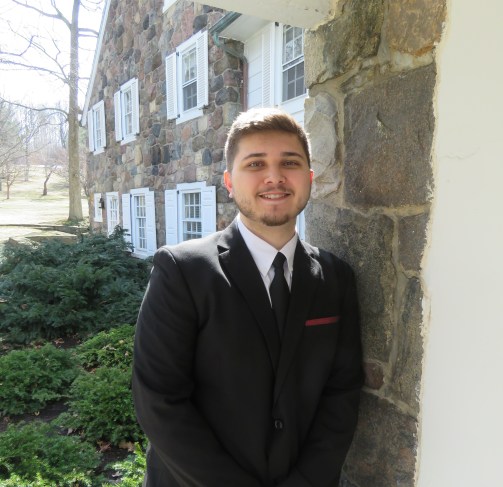
Today, we’d like you to meet Matt Mathias:
Major: Communication with a certificate in Public Relations
Hometown: Jamestown, Pennsylvania
Scholarships: I have received the Joseph and Isabel Prischak Trustee Scholarship and the Irvin Kochel Leadership Scholarship.
Why he chose Behrend: It was an hour from home and offered a wide variety of majors. I was unsure of what I wanted to do in college, so I liked having a lot of options. Also, who can deny the pedigree of a Penn State degree?
On choosing his major and changing plans: I changed my major a few times before deciding on Communication. It fits my skillset well and I have been able to continue with camera and video work that I’ve always enjoyed.
Proudest accomplishment at Behrend: My proudest accomplishment at Behrend has been making the Dean’s List in back-to-back semesters in 2021. The start of my college career was rough. I hit a wall early on when I was unsure what direction to pursue. I was unmotivated and struggled mentally, and then COVID happened and that didn’t help. In the end, support at home and here at Behrend helped me get back on my feet, and I’m incredibly proud of where I am now.
Awards and recognition: Myron Jones Broadcasting Award.
Campus Involvement: I’ve written for the Behrend Beacon since the spring of 2021 and am currently the sports editor. I also am involved in BVZ Radio.
On leadership: During the summer of 2018, I was selected to attend the Penn State Summer Leadership Conference at University Park. It was one of the best learning experiences I’ve had at Penn State.
On conversation and music: I can talk to anyone. I think this may stem from the fact that I played piano for a local church from the time I was 12 years old. I was constantly surrounded by adults and expected to hold conversations with them at a young age. It helped me become confident in my speaking abilities and taught me how to make friends and how to listen to and learn from other people. I developed compassion and empathy for others that I think has served me well as a communicator.
What you’d be surprised to know about him: I worked as a page for the Pennsylvania State Senate in Harrisburg in 2011 and 2012. I am highly interested in government and how state and national government functions, not necessarily the politics behind it all, but everything else that goes into it.
Passion for service: I love helping people. It gives me a sense of accomplishment and validates the work that I do. Not only that, but I learn a lot about myself when helping others. I’m always trying to grow and be the best version of myself.
Advice for first-year students: It’s OK to not to know what you’re going to do for the rest of your life. I’m graduating in a few months, and I still have no idea where life might take me. Just have confidence in yourself and listen to your gut. Never doubt that the hard work you put in will pay off.
Parting thoughts: I’m thankful for all the Behrend faculty members who have guided me throughout my college career as well as the advisers who paved the way for me. I’m excited for the next chapter of my life.
Matt will graduate in June and plans to find a job in media production or in the communications/public relations field.
By Heather Cass, Publications Manager, Penn State Behrend
Why did the amphibian cross the road? To lay eggs on the other side.
The area around Penn State Behrend’s Advanced Manufacturing and Innovation Center (AMIC) in Knowledge Park is an amphibian’s paradise. Woods give way to marshy areas and small ponds, some tucked safely behind trees and shrubs, providing the perfect habitat for frogs, salamanders, and newts that live in woods but breed in water.
Each spring, a parade of amphibians crosses Technology Drive and the AMIC parking lot to reach the ponds where they can lay their eggs. Many don’t make it, falling victim to vehicle traffic or plunging through the grates that cover road drainage tubes. Motorists passing by may not notice, but the faculty members and students in Behrend’s Biology program who study spotted salamanders do.
“Frankly, we’ve seen too many road-killed amphibians and egg-laden females stuck in the drains to not try to do something about it,” said Dr. Lynne Beaty, assistant professor of biology. “They’re not alone, though, as many wood frogs, red-spotted newts, and spring peepers also face those same hazards to reach breeding ponds in the spring.”
Beaty reached out to the college’s Maintenance and Operations (M&O) department with two solutions to mitigate the problem. One was to install “amphibian migration route” signs to encourage drivers to pay attention to amphibians on the asphalt. The second solution involves placing a mesh covering over the drains in the area to prevent small amphibians from falling through on their way to their breeding sites.
The signs, which were designed by senior Biology student Phoebe Will, are now installed, and a team of engineering students is working with M&O to create the mesh coverings for the drains.
“Our Maintenance and Operations group is always willing to help the college achieve its academic and research missions, especially when that involves protecting wildlife,” said Randy Geering, senior director of operations.
So, if you regularly travel Technology Drive, please go slow and keep an eye out for wildlife!
Penn State Behrend’s class of 2022 is ready to make its mark on the world! We’re proud of our students and the things they’ve accomplished and learned while here at Behrend. Over the next couple of months, we’ll be introducing you to a few of our remarkable seniors who have overcome challenges, pioneered new technology, participated in important research projects, and left an impression at Penn State Behrend.
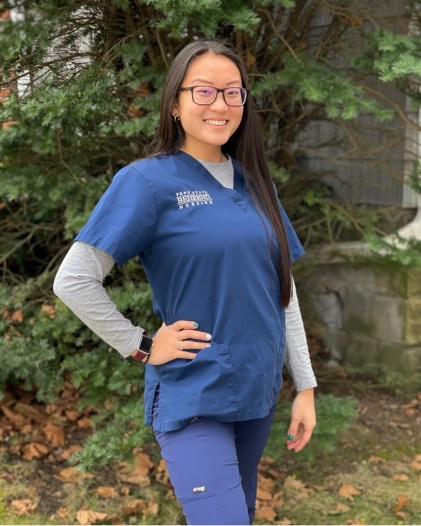
Today, we’d like you to meet Brianna Scanga:
Major: Nursing
Hometown: Vandergrift, Pennsylvania
Scholarships: Dr. and Mrs. Arthur W. Phillips Scholarship for Schreyer Scholars; Council of Fellows Leadership Scholarship; Audrey Herbert Sweny Scholarship for Nursing; Behrend Academic Excellence Award; and Irvin Kochel Lion Ambassador Fund.
On choosing Behrend: It was one of the most beautiful campuses I have ever seen. Also, it was far enough, but not too far from home and I liked the professor–to-student ratio. I got to know my professors well and they got to know me, too. I felt like I was part of a family here.
On choosing her major: From personal experience, I’ve seen the impact that nurses have in people’s lives. It inspired me to want to be like them. I have always enjoyed taking care of children, and I believe being a pediatric nurse is what I was destined to do.
Proudest accomplishment at Behrend: Maintaining a GPA above 3.9 while also taking on multiple leadership positions, participating in a variety of clubs, and working on and off campus.
Campus involvement: I was a member of Behrend Benefitting THON for 2 years and traveled to THON at University Park. I have been a Lion Ambassador since my first year and serve as Treasurer for the group. I’m a member of Alpha Sigma Alpha Sorority, the Behrend Honors Program and Schreyers Honors College, and the Student Nurses Association of Pennsylvania. I have been a tutor with the Learning Resource Center and a Resident Assistant for three years. This year, I was finally able to participate in Welcome Week as a guide. It was so much fun!
Awards and recognitions: President’s Freshman Award for maintaining a 4.0 GPA my first year at Behrend and the Irvin H. Kochel Award for outstanding involvement, and I’ve been on the Dean’s List every semester.
What makes her unique: I was adopted from China when I was nine months old and brought to the United States. I am forever grateful for my parents, family, and friends who I have loved growing up, and I wouldn’t change my life for anything. I was given such a great life, and I have learned to never take what I have for granted. I have not been back to China since, but I do wish to visit my hometown when the pandemic is over.
Sunny side up: I am pretty good at staying positive and keeping morale up when things go bad. I always try to see the good in people and in situations.
Her definition of the good life: Living a life without regret. Try new things. Do things that scare you and do not let fear get in the way of your dreams.
Advice for first-year students: Join as many clubs as you can and attend lots of social events on campus. I loved attending the Lion Entertainment Board (LEB) events and the Lion Ambassador’s Midnight Bingo. I made some of my best friends in college this way.
Brianna has accepted a position at UPMC Children’s Hospital of Pittsburgh in the Pediatric ICU (PICU) after her graduation in May. She also plans to go back to graduate school to become a pediatric nurse practitioner.
By Heather Cass, Publications Manger at Penn State Behrend
Do you speak French? You could learn how at Penn State Behrend, where you’ll find courses in French, German, and Spanish, as well as a class on Italian culture. Behrend’s academic offerings in global languages include a minor in Spanish and a German Studies certificate.
You can learn much more about Behrend’s language offerings during the college’s celebration of National Foreign Language Week, Monday, February 28, to Thursday, March 3.
The week’s events will include a variety of Zoom presentations on language and culture topics, making it easy to pop in from wherever you are on or off campus. See the complete schedule and get Zoom links here.
The line-up will even feature in-person events that involve food. Yum!
Monday, February 28, from noon to 1:00 p.m., you can sample food from different countries at World Catering Day in McGarvey Commons.
Wednesday, March 2, from 11:00 a.m. to noon, you can Join the Global Ambassadors in Bruno’s Café for a free taste of French cuisine and a chance to win delicious macarons.
The Behrend Blog chatted with Dr. Laurie Urraro, assistant teaching professor of Spanish, to learn more about the event and why everyone should consider learning a foreign language.
How many languages do you speak?
I am a native English speaker who is also fluent in Spanish. I speak some Portuguese and can read some French. I also understand a little Italian.
What language should students learn?
It depends on the field one enters, of course, but any foreign language is useful and will help you stand out in a job interview!
We know that it’s easiest to learn a second language as a child, but how about as a college student? College students’ minds are still developing, too, so it is not too late to learn! In fact, I would encourage anyone at any age to try to pick up another language. Just because it’s “easier” at a young age doesn’t mean it’s impossible at an older age.
Why should a student learn another language?
Here are just a few great reasons:
It will boost your resume. No matter what field you go into, learning a foreign language will be an “added bonus” that makes you a more attractive employee.
In an increasingly global world, being bilingual makes you more versatile. It also makes you more mobile as it’s easier for you to travel and explore new places.
It helps your English. Many languages are derived from Latin (French, Spanish, Italian), including many words in English. English is a Germanic tongue. Learning a foreign language will boost your vocabulary by familiarizing you with words that have common equivalents in other languages.
It makes you smarter. Research has shown that being bilingual improves cognitive skills unrelated to language.
It increases your cultural IQ. Studying a foreign language exposes the learner to diverse customs, ideas, and perspectives. Of course, you can still learn about other cultures without speaking the native tongue, but language learning allows for a more immersive experience.
It can increase your brain power: Learning a foreign language can improve your multitasking, attention, and problem-solving skills. It can also help improve your memory, which comes in handy when trying to remember the names of new contacts or clients.
By Heather Cass, Publications Manager, Penn State Behrend
The weeks between Thanksgiving and the end of the semester are notoriously rough for almost everyone on a college campus. Professors kick it into high gear to cover remaining material before final exams. Students scramble to stay on top of their work and study for finals. Staff and administrators work feverishly to plan for the start of the new semester that will follow break.
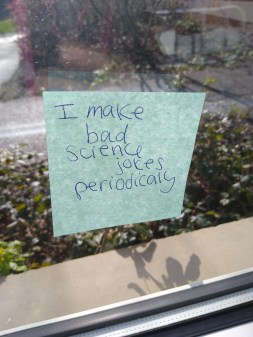
Penn State Behrend’s School of Science Ambassadors are no strangers to the tense atmosphere in those few weeks, so they decided to toss a little sodium hydride into the water with a bunch of eye-catching colorful sticky notes plastered on the glass walls in the breezeway between the Otto Behrend building and the Science Complex.
“At our first Science Ambassadors meeting this year, we discussed doing something fun to brighten up the science buildings,” said Lauren Barmore, a senior Biology major, who helped spearhead the project. “There was a group of four of us who put the wall up the Friday before Thanksgiving break. We wanted it to be a surprise for the students when they returned.”
The students who wrote the initial notes—Barmore, Taylor Romania, Briona Bargerstock, and Jacob Kessler—penned notes that reflect the material taught in the School of Science.
“We wanted to put our own spin on it,” Barmore said. “A lot of our professors put jokes and memes into their learning materials, so we were sort of influenced by them.”
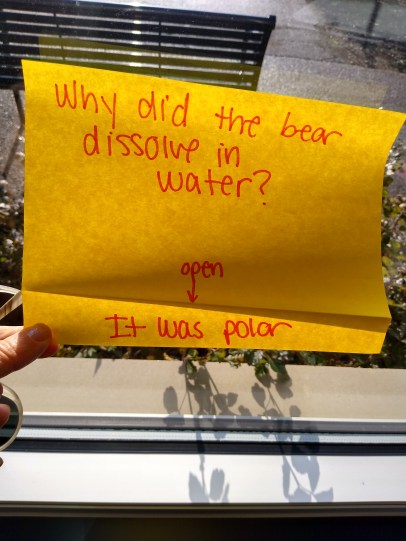
The messages on the notes range from inspirational to encouraging to laugh-out-loud funny. Most contain math or science references guaranteed to make readers chuckle:
Or groan:
Or, if they are non-science majors, scratch their heads.:
A similar display of sticky notes can be found in the stairwell in the Reed Union Building. That project began several years ago and continues. thanks to the college’s Random Acts of Kindness (RAK) club.
It’s a popular campus feature and one that Barmore has used.
“I always loved taking notes from the RAK stairwell and giving them to my friends before exams or if they were having a rough day, or needed a laugh,” she said. “I’ve found that the smallest acts of empathy or service can have a big effect on people. We wanted to bring some of that color and joy to our side of campus.”
The notes are meant to be shared and to multiply: A container of sticky notes and pens hangs in the middle of the display, inviting anyone to share a note or joke or drawing. Take what you need. Leave what you want to say.
“We hope people enjoy reading them as much as we did writing them,” Barmore said.
There’s so much more to Penn State Behrend’s faculty and staff members than what you see them doing on campus. In this occasional series, we take a look at some of the interesting, unconventional, and inspiring things that members of our Behrend community do in their free time.
By Heather Cass Publications Manager, Office of Strategic Communications, Penn State Behrend
Two of the most frightening things known to humans – advanced math and tarantulas – are some of Dr. Dan Galiffa’s favorite things. The associate professor of mathematics owns thirteen tarantulas and says the highly venomous spiders make great pets.
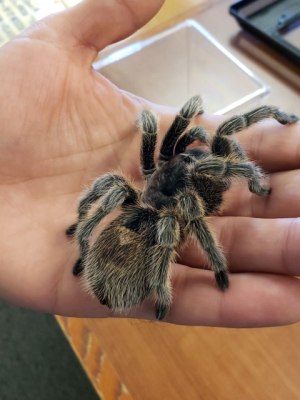
“They are one of cleanest and most fascinating animals,” Galiffa said, as his Honduran curlyhair “Curly” (Tliltocatl albopilosus), a thirteen-year-old tarantula about the size of his palm, slowly walks over and around his hand. “Each spider has a unique personality.”
Dr. Dan Galiffa with two of his pet tarantulas
Rosalinda, a Chilean rose, was his first tarantula. Galiffa acquired her eight years ago and liked her so much that he has since gathered twelve more tarantulas, for a total of thirteen spiders of twelve different species, including greenbottle blue, Venezuelan sun tiger, Costa Rican zebra, Chilean copper, Mexican red knee, Arizona blonde, Brazilian salmon pink, Columbian giant red leg, and Mexican red rump.
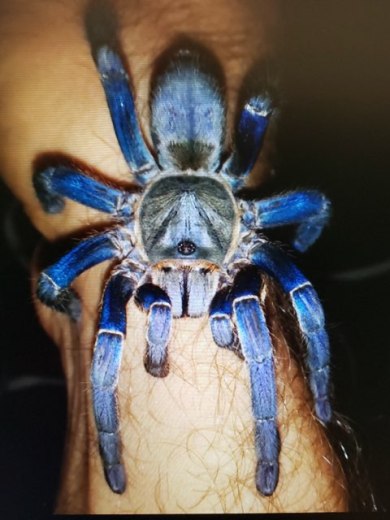
One of his most beautiful and exotic is Blue, a cobalt blue tarantula native to Myanmar and Thailand. As with most things in nature, the vibrant color is a warning.
“They’re high venomous, extremely fast-moving, and one of the most defensive species of tarantula,” he said. “Many people who own them don’t handle them.”
Galiffa does and said she is a calm and “sweet” spider. That said, he is always respectful of the spider’s space and temperament. No stranger to deep research, Galiffa has done his homework.
“I spend a lot of time learning about them, reading whatever I can find, including some scientific articles and papers that can be pretty specific,” he said. “But I actually did a lot of my mathematical research work in epidemiology, so I’m familiar with the biological science.”
There is much work to do in tarantula taxonomy. “Scientists are still learning a lot of basic things about them,” he said. “The classifications are still not solid.” He estimates there are more than 1,000 species of tarantulas and new discoveries lead to changes in taxonomy. “There are about 45,000 known spider species, in general,” he said.
We talked with Galiffa and Curly (though she was pretty quiet) to learn more about tarantulas and how they can sometimes serve as teaching aids.
What types of courses do you teach at Behrend?
The entire calculus sequence, differential equations, linear algebra, and other advanced math classes.
What is appealing to you about tarantulas?
They make really great pets. They are clean, quiet, easy to care for and they all have their own personalities. It is an exciting challenge to try and understand a species that is so far removed from humans. They communicate with their actions and behaviors.
Why do you think people are so afraid of spiders?
I think spiders get a bad rap. Anytime someone has an odd welt, and it has a visible hole, they call it a spider bite. I always ask the question, “Did you see the spider bite you?” I’ve never had anyone say yes. More than likely, the injury was inflicted by a different insect. Spiders rarely bite unless they are directly threatened.
Where did you get your tarantulas?
I bought them at pet stores, online, and at exotic animal expos. A couple of them are rescues from people couldn’t care for them anymore.
What do they eat?
Worms, crickets, roaches. Basically, they eat anything alive that is smaller than they are. They only eat a few times a month.
You handle all of your tarantulas. Does each species feel different?
Oh, yes. The bristles can be soft, hard, very long, short, thick, or thin. Additionally, some tarantulas are much faster than others. Blue’s speed would blow you away. She could be on the other side of my office in seconds. The same is true of the Sun Tiger.
Are they venomous?
Yes, every one of them is venomous, but they are not aggressive. The venom is not all bad. It is used in some medicines, and it’s not lethal to humans.
What would happen if you got bit?
I have held my tarantulas thousands of times and have never been bitten. If someone were to get bitten, it would probably because they were careless in handling the spider. In any event, there are two types of bites, dry and wet. A dry bite is a puncture wound from fangs. A wet bite is when the tarantula actually uses their venom. They rarely do that. They don’t even use venom when catching their prey unless it is absolutely necessary. A dry bite would be handled like any normal puncture wound with some antibiotic cream and a bandage. A wet bite should probably be seen by a doctor but, again, it’s rare and the venom is not lethal.
How long do they live?
Twenty to forty years with females living longer than males. I have eleven females and two males. When the males mature, they seek out females for mating and will die shortly after, so if a keeper has a male, it’s best to send him to a breeder after he matures. I will have to do this with both of my males, and I’ll be very sad when that time comes. By the way, females can produce egg sacs with over 1,000 eggs!
You’ve used your tarantulas as teaching aids before in Behrend’s K-12 outreach programs. What do you teach with them?
There are many things we can teach with spiders – web strength and construction, genetics, population dynamics, gait analysis, and blood flow, which is quite fascinating in tarantulas since their blood flows through their entire body. They don’t have veins like humans do.
How can you use them to teach math modeling?
We can model them as predators and as prey. We can also study the genetic probability of obtaining certain variations of a given species using probabilistic models. For example, there are three forms of Chilean rose tarantulas – the gray, red, and pink color forms. My spider, Rosalinda, is gray form and Charlotte is a red form. The students in my workshops do a basic version of this very type of modeling and then get to see the differences in the color forms in my actual tarantulas.
Do you have any other pets?
I also have Madagascar hissing cockroaches and a skinny pig (hairless guinea pig) named Hamilton. I previously had two skinny pigs—Perry and Ty—who played games and did tricks.
What do you want people know about tarantulas beyond what we have covered above?
Here are some interesting facts:
Tarantulas do have eight eyes, but scientists are not sure how well they see.
Tarantulas have bristles, not hair. Only mammals have hair. The bristles give them a lot of information. So, yes, “spider senses” are a real thing, not just something made up for the Spider-Man comics.
Tarantulas use their senses to assess everything that’s happening around them and they have amazing perception despite the fact that they cannot smell and have no ears.
At the end of each of the tarantulas eight legs are two retractable claws, similar to those in a cat. They use these for mobility.
In addition to their eight legs, they possess two pedipalps or additional appendages that are located at the front of their bodies.
Since tarantulas are arthropods, they have to molt in order to grow. When a tarantula molts, it can often change color and grow exceedingly large.
Tarantulas can spin webs. The webs are not like commonly seen ones used to catch prey but are used to line their burrows and keep them safe, for example, spinning a trip “wire” near their home to sense prey and potential predators.
Tarantulas are opportunistic predators, which means they wait for the prey to come near their home, then attack it with extreme speed and accuracy.
Tarantulas have a wide variety of coloration and patterns. They are quite stunning when viewed in the right light.
By Heather Cass Publications Manager, Office of Strategic Communications, Penn State Behrend
Plastics recycling class opens eyes, options for high school students
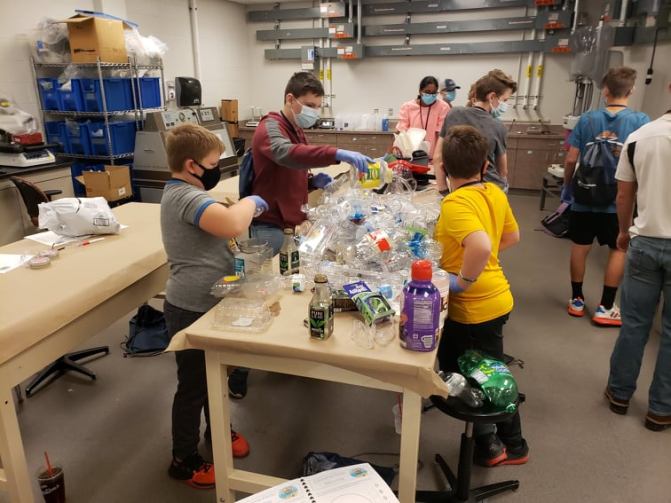
When you toss your 2-liter soda bottle or yogurt container in the recycling bin, you may not think about where it ends up or how it might be recycled, but ten Erie-area students, recent “graduates” of Penn State Behrend’s Recycling Bootcamp, sure do.
The students, ages 14-18, saved their home plastic waste for a week before the all-day bootcamp event in August in Burke Center. It was led by Plastics Engineering Technology (PLET) faculty members—Dr. Alicyn Rhoades, associate professor of engineering; Dr. Gamini Mendis, assistant professor of engineering; Anne Gohn, assistant research professor; and Dr. Xiaoshi Zhang, engineering researcher. Several Behrend PLET students helped throughout the day, as well.
The students started the day identifying the different types or families of plastics they collected. They then counted the number of pieces in each family and calculated the weight fractions of each type of material, which is critical for cost-effective recycling.
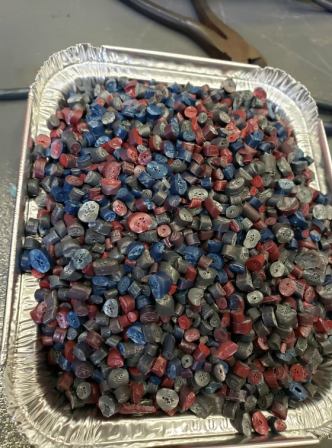
“Students shredded their high-density polyethylene (recycling code #2) materials, extruded to pelletized form, and injection-molded test samples and plastic building bricks,” Gohn said. “Samples were tensile- and impact-tested at various levels of recycling content. The students then stretched and impact-tested the samples to analyze changes in material properties.”
The work they put into recycling their plastic waste opened their eyes to the challenges involved in the process.
“They were surprised by how much recycling affects the strength of plastic material and how complicated the process can be,” Gohn said.
Comments from student participants reflect the value of outreach efforts and learning in a hands-on environment. Several students said they were now “excited about plastics” and at least one is considering a career in plastics engineering. That’s just what organizers of the event hoped would be the result.
The bootcamp was funded through a $500,000 National Science Foundation Faculty Early Career Development (CAREER) Program grant awarded to Rhoades. The CAREER program is designed to support early-career faculty members who serve as academic role models in research and education.
By Heather Cass Publications Manager, Office of Strategic Communications, Penn State Behrend
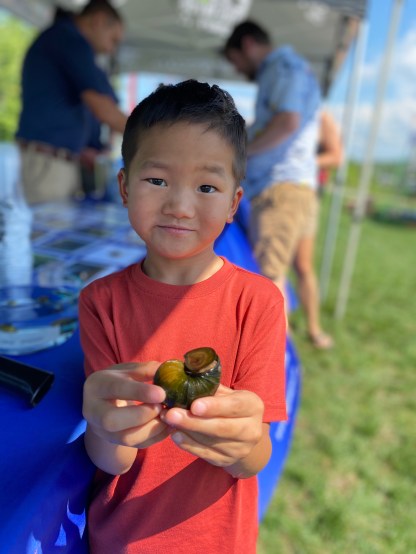
On a sunny August Saturday, a half dozen fans are lined up in front of the Mysterysnail Speedway, a four-foot plastic box with plexiglass dividers creating race lanes for a field of ten large snails. They place their “bets” and cheer for their chosen snail, each marked with a race number on its shell.
This slideshow requires JavaScript.
As the oversized gastropod invaders make their way to the finish line, Dr. Lynne Beaty, assistant professor of biology at Penn State Behrend, explains why we don’t want them in our waterways.
“Mysterysnails are so named because females produce young, fully developed snails that ’mysteriously‘ appear. They’re a group of invasive species that originate in Asia but have found their way to Lake Erie,” Beaty said. “They compete with native species, alter nutrient ratios, and transmit parasites to wildlife.”
Aquatic invasive species (AIS) are non-native plants, animals, or pathogens that harm the environment, the economy, and human and animal health. They are one of the greatest threats to biodiversity and native communities of other species, and they can spread easily through unwitting human assistance and connected waterways.
Beaty and two other Biology faculty members, Dr. Adam Simpson and Dr. Sam Nutile, have been working with Kristen McAuley, lecturer in marketing, and Sara Stahlman, extension leader for Pennsylvania Sea Grant, to raise awareness about invasive snails (and other species) in the waters around the Erie region. Last summer, the team came up with a novel idea to reach adults: craft beer.
“Good beer needs high-quality, clean water and invasive species threaten our freshwater supply,” Beaty said. “So we thought a collaboration with Erie Brewing Company in Behrend’s Knowledge Park was a great way to promote AIS awareness because controlling invasive species can help improve water quality. We were thinking too that this might be an excellent way to reach adult audiences who are more likely to accidentally transfer AIS when they move boats to different water bodies.”
The group met with Erie Brewing’s brewmaster, Tate Warren, who was on board with creating a ‘draft series’ of special AIS-themed brews for invasive species awareness.
The first, Mysterysnail Ale, “an amber ale loaded with flavors of bread, biscuit, and caramel malt,” debuted at a launch party, complete with the aforementioned mysterysnail racing, at Erie Brewing. Visitors had the opportunity to try a new brew and also learn about many AIS at tables manned by Behrend School of Science faculty members and staff members from Sea Grant, a research, education, and outreach program administered by Behrend.
The event was well-attended, and the Mysterysnail Ale was well-received. It currently has a 3.6-star review (out of five) on Untapped.com, a website where beer lovers rate and review brews.
Three more brews are planned in the AIS series: a Round Goby Rye, a Zebra Mussel Malt, and a Hazy Hydrilla. Each beer will launch with an event to raise awareness of the AIS the brew is meant to thwart.
In addition, for each of the beers, a promotional poster will be developed that will highlight the beer, the flavor, and the facts about the highlighted species. QR codes on the posters, which will be displayed at Erie Brewing and other locations on the Lake Erie Ale Trail, will lead users to even more information about the featured AIS.
Mysterysnail Ale is currently on tap at Erie Brewing and other participating Ale Trail breweries, including Lavery Brewing, Arundel Cellars and Brewing, Twisted Elk Brewing, Brewerie at Union Station, Nostrovia, and Erie Ale Works. For more information about aquatic invasive species, visit seagrant.psu.edu.
By Heather Cass Publications Manager, Office of Strategic Communications, Penn State Behrend
Dr. Joel Hunt, associate teaching professor of music and digital media, arts, and technology, and students, Alison Huffman, and Adam Boaks.
People of faith believe that things, even bad things, happen for a reason. Alison Huffman, a senior Computer Engineering major, recalls the injury that ended her college soccer career at Behrend through that lens.
“You know if I hadn’t torn my ACL (anterior cruciate ligament), I wouldn’t have had the time to get so involved in music, so in some ways it was a gift,” Huffman said.
Huffman and a fellow student, Adam Boaks, a senior Biology major, recently released their first album, For Your Glory, at the request of The Cross, an Erie church that Huffman and Boaks attend.
The pair wrote and performed the songs, all taken from the Bible’s Book of Psalms. They also played all of the instruments and handled vocals, as well. When it came time to mix it all together, they enlisted the aid of Dr. Joel Hunt, associate teaching professor of music and digital media, arts, and technology.
Huffman, who is also working on a Music Technology minor, was even able to earn college credit for the project. Though the minor is offered at University Park, she was able to fulfill the course requirements taking classes with Hunt at Behrend. That included INART 258A Fundamentals of Digital Audio and a variety of independent studies.
“When we were trying to find an independent study topic for Alison, I learned about the album she was making with Adam,” Hunt said. “We thought it would be a great way to dig deeper into music production.”
After the album was mixed, Huffman and Boaks handed it off to a distributor for final mastering and to set the levels required by Apple, Spotify, and other platforms. The album was released this summer and is available on any major music streaming platform by searching for “The Cross Worship” and For Your Glory.
Huffman and Boaks will be performing live at an album release party tomorrow – Friday, September 10 – at 7:00 p.m. at the stage at Perry Square in downtown Erie.
Can’t make it Friday? Catch them at 1:00 p.m. at Saturday’s West Bayfront Porchfest. They’ll be performing at 627 Myrtle Street.
There’s so much more to Penn State Behrend’s faculty and staff members than what you see them doing on campus. In this occasional series, we take a look at some of the interesting, unconventional, and inspiring things that members of our Behrend community do in their free time.
By Heather Cass Publications Manager, Office of Strategic Communications, Penn State Behrend
After just a few minutes of chatting with Dr. Courtney Nagle, associate professor of mathematics, one thing becomes clear: She’s a team player. As chair of the Secondary Education in Mathematics program, Nagle is also quick to share any credit for accomplishments with her colleagues.
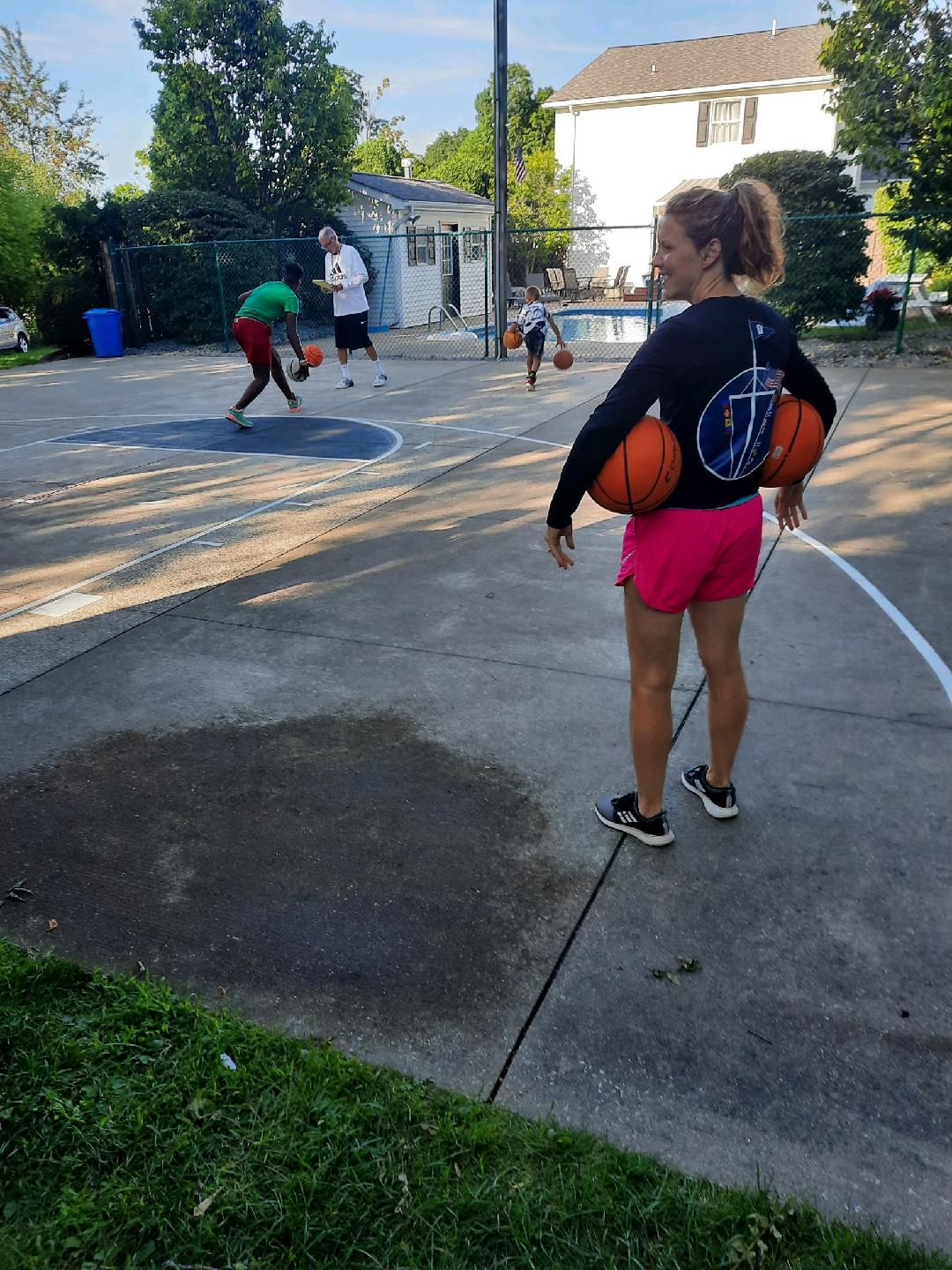
Nagle can trace those team skills back not only to her schooling, but to a blacktopped basketball court behind her childhood home. It was there that Nagle and her older sister learned some of the most important lessons in life –resilience, teamwork, selflessness, and how to win and lose gracefully — from time spent on the court with their father, Terry Thompson.
For more than fifty years, Thompson has coached basketball in one form or another at the elementary school through college levels. In 1998, as the assistant coach of the girls’ basketball team at Girard High School, he helped lead his team, including his two daughters, to the state championship.
Today, he is still coaching – offering summer-long basketball skills camp on his backyard court for free to any area youth who want to attend. He has an assist from his basketball-loving daughter, Nagle, who enjoys teaching on the court as much as in the classroom.
Behrend Blog talked with Nagle to learn more about her “secret life” as a basketball coach.
What are some of your father’s career highlights as a basketball coach?
The largest number of years were spent coaching high school boys, including stints as the head varsity coach for Fairview and Girard as well as teams south of the Erie area. He was an assistant coach for the Girard girls’ basketball team during the years my sister and I played in the late 1990s. He even spent a few years as an assistant men’s basketball coach at Penn State Behrend in the early 1990s.
Was it hard being coached by your dad in high school?
At times, yes. He pushed me, and we spent a lot of extra time practicing. That wasn’t always easy. However, he was really good at leaving the games on the court. I often hear about parent coaches who rehash games and go over mistakes around the dinner table. We never did that. We left it all on the court.
He has a court in his backyard?
Yes. We moved to that house in Girard when I was 14, and that’s when they had the court put in. We grew up playing games on it. Kids in the community still use it regularly. It’s almost like a community playground.
Tell us about the Sunday clinics and how they got started.
The Girard community has always embraced basketball with many kids attending summer skills camps and summer-long clinics. Three years ago, when my son, Jack, and niece, Ainsley, were 5, my dad decided to start doing free clinics in his backyard. It was a way for him to get his grandchildren interested in playing basketball, but he also just enjoys working with young people on the fundamentals of the game. That is his favorite aspect of coaching.
Most of the kids who attend are from the surrounding community, including some of the children of my former teammates and classmates who still live in the Erie area. It’s fun to see the next generation start in the same way we did – playing on the same court we did.
After an hour of basketball drills and skills, my parents open their pool for an hour to anyone who wants to stay and swim. The kids love that part of the night!
What is your role on the court?
I’m in an assistant coach role. I do some of the drill demonstrations and work with the kids as we go through the various drills. I also help my dad get the word out about the clinics with social media posts and such.
What do you enjoy about the clinics?
I love watching kids learn the game and improve week after week. It’s such a fun and laid-back environment and the kids who attend are so excited to be there. We have a wide range of ages and abilities, but they all work together.
On a more personal note, seeing my older son learn from my dad on the same court I grew up playing on is pretty special. My 2-year-old, Benny, isn’t quite ready to play, but he joins in on the occasional drill.
My sister lives in Grove City, but usually drives up for the clinics, bringing her kids. My mom prepares the pool area and keeps the freezer stocked with popsicles for the kids to enjoy after playing.
Do you still play basketball yourself?
I hadn’t played much in the last ten years or so, but now that my son is starting to play, I am getting back into it. It’s mostly just family pick-up games. And, yes, my 79-year-old father still plays.










 BEHREND BLOG