Major Decisions

By JoLayne Green, Contributing writer, Penn State Behrend

Graduate found confidence, voice when she landed in the right program for her

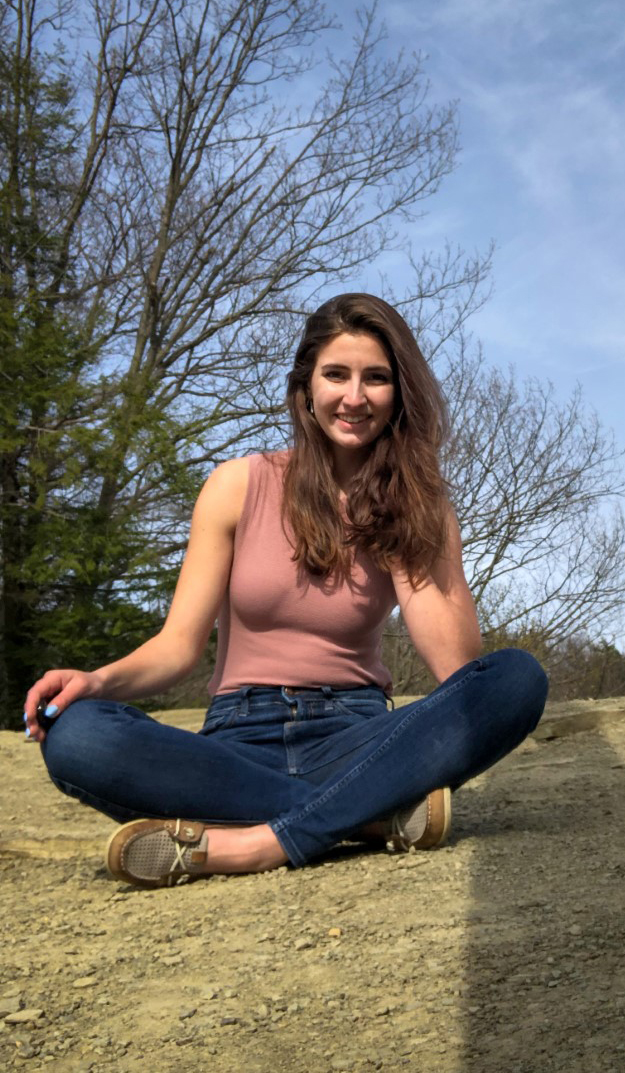
When Gabi Watson switched her major to English at Penn State Behrend, she finally found her path—and her voice. It just took a little courage for her to follow a passion that was there all along.

“I did every other possible major,” Watson said, with a chuckle.

An Erie native who graduated last semester, Watson started in Forensic Biology at University Park. She learned that a STEM (science, technology, engineering and math) field wasn’t truly what she wanted. Her college journey led her to Behrend and included stops in the Division of Undergraduate Studies and the Political Science program.

“I finally realized I belonged in liberal arts,” she said. “I fell in love with the English program and the teachers in it.”

She also felt at home at Behrend.

“I love how close-knit the campus is and how beautiful Behrend is,” she said. “I got all four seasons here in my hometown where I got a great education and had a close relationship with teachers.”

Before landing in the English department, Watson did a little soul searching.

“I grew up reading. I knew I loved English, but I didn’t know if I loved literature,” she said. “I thought choosing English would mean I would just be reading a lot of poetry.”

Then Watson discovered how diverse a degree in English is.

“I didn’t know how many options there were in writing. I felt I was floating around in the English department until I took Writing for the Web,” she said. “I found out you can have a great career in something you are passionate about.”

While she concentrated on professional writing, it was creative writing classes that helped her find her own voice.

“I learned a lot about expressing emotion and how to transcribe my thoughts into words,” she said.

Watson’s budding confidence carried into extracurricular activities. Describing herself as an introvert, she was a junior before becoming involved in activities at Behrend such as the Lion Entertainment Board and an Alternative Spring Break service trip.

She grew from observer to participant to executive director of the Lion Entertainment Board, helping to advance the club from four members to more than thirty while developing event planning skills.

Watson credits her advisor, Dr. Massimo Verzella, associate professor of English, as well staff members in the Office of Student Leadership and Involvement (SLI) with putting her on a path to success.

“Dr. Verzella changed the trajectory of what I wanted to do in my life,” she said. “He educated me on possibilities I didn’t know existed. I don’t think I’d be as social or as well-rounded as I am now without his support and that of SLI staff members.”

In turn, she began mentoring other students.

“I learned I like leading a team and helping people find their passion, and wanted to help other students figure out what they were good at,” she said.

Watson’s success in leadership was recognized beyond campus when she was chosen to receive the 2023 ATHENA Young Professional Award, celebrating emerging women leaders in Erie.

Watson, who graduated in December 2023, envisions a career that involves writing, generating social media content, travel, event planning, and possibly work in diversity, equity, and inclusion. First, she is going to Walt Disney World for a six-month stint in the Disney College Program in Florida.

After that? Who knows, but she knows she won’t be a silent observer.

“You can be an introvert and still be a leader,” she said. “I never thought I could, but with the right support, I’ve been able to find my voice in writing and in leadership. Wherever I end up next, I know Behrend has given me a solid foundation to build on.”

Captured History

Former math professor’s hobby produced one of Behrend’s greatest gifts

By Heather Cass, Publications Manager, Penn State Behrend

B.p. single

Though he taught generations of college students during his thirty-seven years as a mathematics professor at Behrend, Norman B. “Bill” Patterson, above, established a legacy that goes far beyond linear algebra, differential equations, and statistics. When he retired in 1990, he left a trove of photos documenting life at Behrend with intimacy and affection.

The camera he used to record much of it–a $129 model he saved all year to buy from Erie’s Boston Store in 1954–is in the archives at Lilley Library along with hundreds of his photos, a true gift to the college.

“If a picture paints a thousand words, Bill’s photos are surely the most expensive materials in the Behrend Archives,” said Jane Ingold, reference and instruction librarian and archivist at Behrend. “My ability to answer the many calls for photos for anniversary exhibits and stories like this one would be severely limited without them.”

In honor of Behrend’s 75th anniversary, a sampling of Patterson’s work is on exhibit in Kochel Center. “Behrend Begins: The Campus Photography of Norman B. Patterson” highlights some of his most evocative photos from the 1950s through the early 1970s.

The exhibit provides a fascinating look into the past, offering a visual record of how Behrend has grown and changed over time.

Signs

At 98 years old, Patterson, who resides in an Erie area senior facility, is happy to talk about photography and Behrend with visitors. When asked what type of camera he liked to shoot with, he quipped, “anything I could get ahold of,” adding, “Some things you are just interested in from Day One and I liked taking pictures.”

Patterson’s introduction to photography was in 1938 when his older brother brought a camera, and he became immediately fascinated with it. Much happened for Patterson in the next 15 years, including receiving an undergraduate degree in chemistry, serving a stint in the Army in World War II, and returning to graduate school to earn a mathematics degree courtesy of the GI Bill.

When he was offered a mathematics teaching position at the five-year-old Behrend Center in Erie, a place he had never been, he took the job.  “I said, ‘Well, I have nothing in mind at the moment, so why not?’” Patterson recalled.

When he arrived, no science buildings yet existed. The library was in what is now the Studio Theatre, and Turnbull Hall had been converted from a horse barn for the Behrend family into academic space. On his first day, the original Erie Hall opened.

He quickly fell for the campus and the city. “I liked Behrend, and I love Erie,” he said. “We have it all here.”

As was customary in higher education then, faculty members were heavily involved in the life of the campus and its students. There were few administrators and staff members. It was faculty members who helped with student clubs, activities, and events.

“I was up there at the college for events and things three, four nights a week,” he said. “And if you saw me, my camera would be right next to me. I took it with me everywhere I went.”

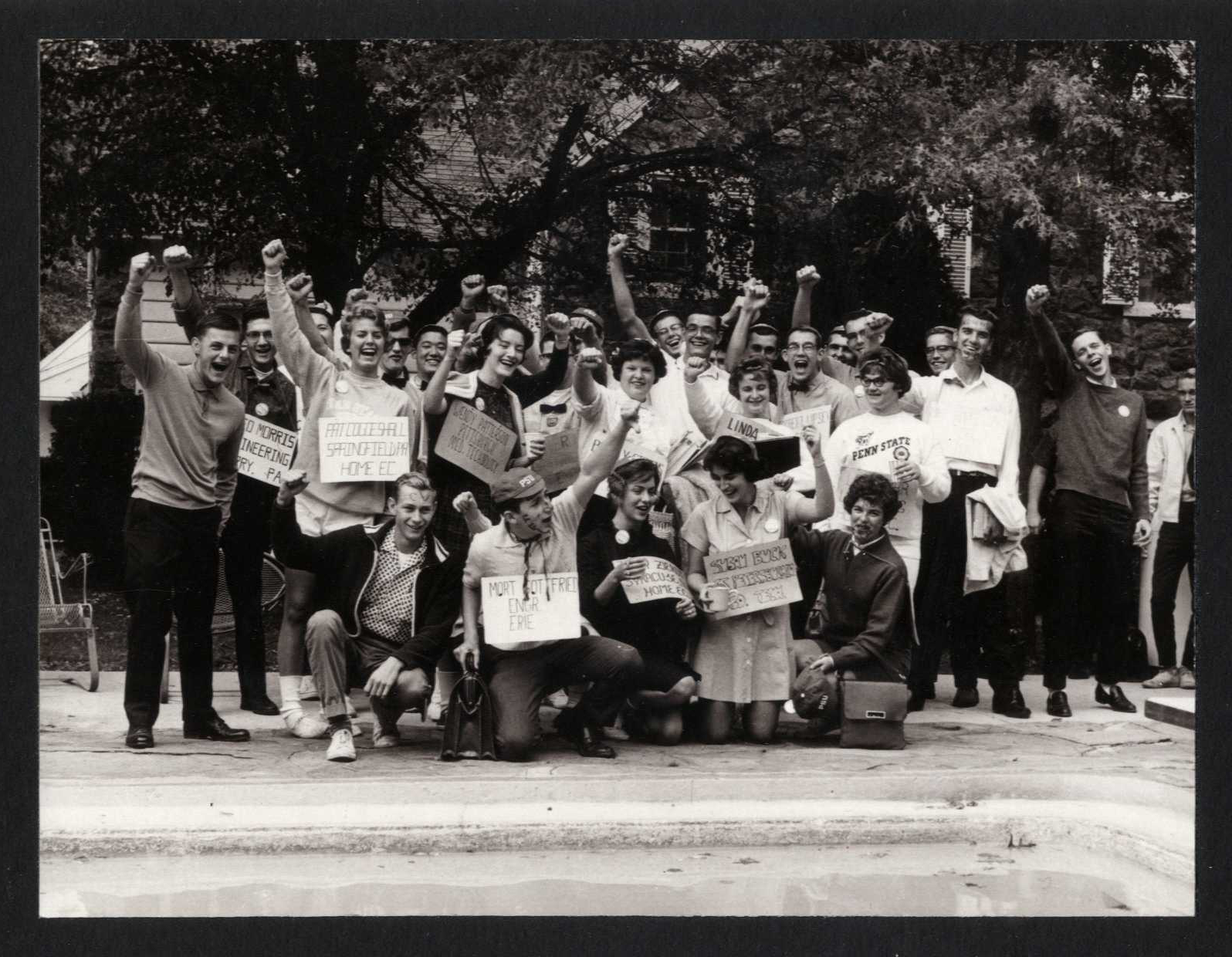
And he recorded history as it happened – one Winter Snowball dance, Hanging of the Greens, and Student Work Day at a time.  He also photographed the daily college life that so fascinates today – the “lunch ladies” making food in the Glenhill Farmhouse kitchen, students cannonballing into the pool and skiing down the hill behind today’s Science Complex, and the female students who lived on the second floor of the farmhouse, with bunkbeds stacked in each room.

4GirlsSleepingInBunkbeds

When night fell, he developed the photos.  “I didn’t have a darkroom, so I just had to wait until it got dark,” he said.

Later, he added a home darkroom in a corner of his basement. His son, Bob Patterson, a lecturer in accounting at Behrend, said that when he and his two sisters were growing up, they knew better than to flip on the basement lights without asking and risk ruining their dad’s work.

By the time Patterson retired, he had witnessed—and captured in photos—the remarkable growth of Penn State Behrend over nearly four decades. And, yet, he has a fondness for the earlier, leaner years.

“The lack of resources in the 1950s meant that you had to make do with what you had,” he said. “We didn’t have people to do the auxiliary, non-teaching work, so the faculty were much more involved in student activities and things.”

And, of course, Patterson, who was never without his camera, was there to document it all, and in retirement, he continued to enjoy photography, even mastering photo editing software programs.

“When dad retired, he got a computer,” Bob Patterson said. “I went over to help him set it up and he was the best student I ever taught. It wasn’t long before he was editing and restoring photos and turning them into 3-D images.”

To further cement Patterson’s legacy at Behrend, a third generation of his family now works at the college: Granddaughter Katie Patterson, Bob’s daughter, who serves as an admissions counselor.

Here are just few of Patterson’s photos:

This slideshow requires JavaScript.

Behrend student says semester-long experience in France was life-changing

By Heather Cass, Publications Manager

Office of Strategic Communication, Penn State Behrend

SD2

One thing Sophia DiPlacido knew for sure when she started at Penn State Behrend is that she wanted to leave — for at least a semester.

“I have always wanted to study abroad,” said DiPlacido, a junior dual majoring in Marketing and Psychology. “I was slightly worried about language barriers, though, so I looked at countries with residents who spoke English as a first or second language.”

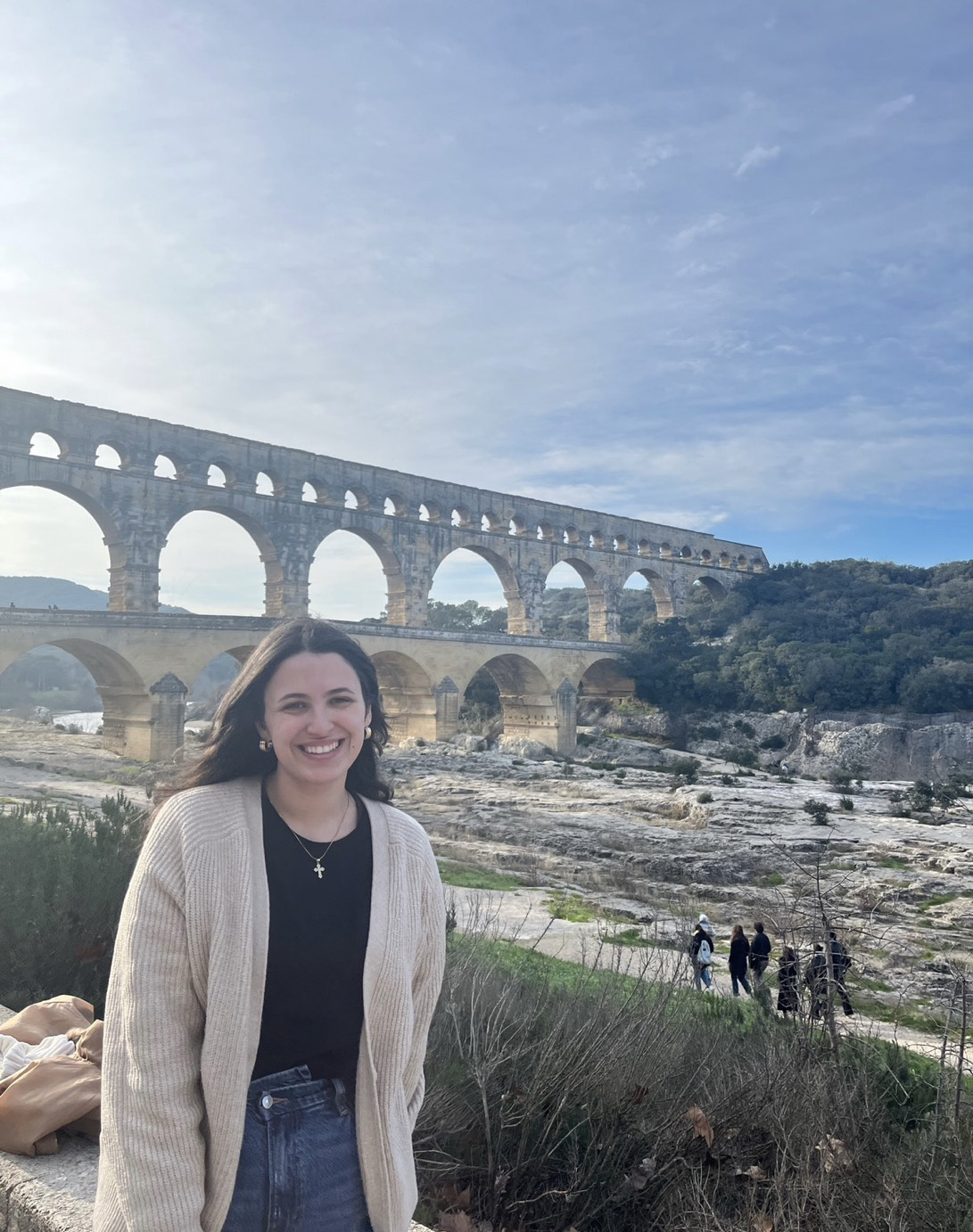
She ultimately chose France and set off in January to spend the spring 2023 semester in Aix-en-Provence, known as “Little Paris.” She lived with a host family in a home with three other students who were also studying abroad from other U.S. universities.

“My host mother had done a study abroad experience, so she wanted to help others have that opportunity,” DiPlacido said.

She took five classes–International Business, French, History of Christianity, Wine Marketing, and Drawing and Painting–at the Institute for American Universities, where DiPlacido said curriculum is king.

“Extracurricular activities are not a thing in European universities,” she said. “College in France is actually closer to what I had been told in high school that college would be like, which is to say that instructors would not be very accessible, the classes would be mostly lectures, and your grade was made up of a few exams.”

While her college experience was quite different from the experience at Behrend, DiPlacido said she quickly felt at home in France.

“I easily adjusted,” she said. “The geography reminded me of California, and the people were very welcoming, which is not what you sometimes hear about the French. I expected to encounter some resistance because I didn’t speak their language, but everyone was nice about it.”

She didn’t have classes on Fridays, so she was able to explore several nearby countries as travel throughout western Europe is relatively easy and inexpensive. Among her many adventures: visiting the Eiffel Tower in Paris; skydiving in Switzerland; scuba diving in Marseille; making pasta in a cooking class in Venice; and seeing the Cliffs of Moher in Ireland. She also visited Budapest, Brussels, London, Madrid, Nice, and Prague as well as cities in Germany and Luxembourg.

DiPlacido said that all that travel helped her develop important life skills.

“I didn’t have a strong sense of direction,” she said, “but I developed it getting around on my own. It gave me a lot of self-confidence.”

DiPlacido said she would recommend a study abroad experience to students in any major but cautions that it takes work to prepare for it, even with guidance from Behrend’s Learning Resource Center, the campus experts on global programs.

“You have to be proactive and get your visa and passport and stay on top of what needs to be done when,” she said. “But in that responsibility is personal growth. Studying abroad was the most amazing thing I have ever done. You come back a whole different person with an entirely new perspective on the world.”

This slideshow requires JavaScript.

STUDY ABROAD BASICS

Does it have to be a full semester?

No, at Behrend, the international study experience can be as short as ten days or as long as a full academic year, depending on the type of program a student selects. International study programs are happening throughout the year—during fall and spring semesters, at semester breaks, and over the summer.

Do you need to speak a second language?

No, but you do have to be a strong student, academically, to be eligible for international study. The minimum grade point average is a 2.5, and many programs require a 3.0. Prerequisites vary by program.

How much does it cost?

Cost varies depending on the program and location a student chooses, but you can expect to pay tuition, travel expenses, and for meals and personal expenses while abroad.

Scholarship funds are available for those who qualify. DiPlacido received funding from Penn State Behrend’s Study Abroad program and the University’s Schreyer Honors College, and she won a competitive Gilman Scholarship, which is administered by the U.S. Department of State.

How can a student learn more?

Attend a Study Abroad Information Session. Meetings are held weekly at Behrend throughout the semester. A list of upcoming sessions is available at behrend.psu.edu/studyabroad, where students can also learn about the different types of programs; explore upcoming opportunities; and find out about the application process and deadlines, as well as financial aid and scholarships.

‘Kosovo precedent’ complicated invasion of Ukraine, visiting scholar says

 By Robb Frederick, Associate Director of News and Information,

Penn State Behrend

When Russia invaded Ukraine, President Vladimir Putin invoked the “Kosovo precedent,” a 78-day NATO air campaign over the former Yugoslavia. The attacks, launched on March 24, 1999, and led by the United States, forced Serbian leader Slobodan Milosevic to withdraw from Kosovo, where more than 10,000 Kosovar Albanians had been killed.

NATO had acted without approval from the U.N. Security Council, where Russia, a longtime Serbian ally, could have vetoed any resolution. The member nations argued that the international community was obligated to intervene and end a humanitarian crisis.

Russia had a different perspective.

“Russia’s view was that NATO had attacked a sovereign country and taken its territory,” said Jiří Nykodým, a postgraduate researcher at Masaryk University in Brno, in the Czech Republic. “Then, when it suited them, they argued the opposite – that Kosovo set a precedent for interventions that do not involve the U.N. Security Council. Russia used that as a justification when they annexed Crimea, and again when they invaded Ukraine.”

Nykodým studied the Kosovo precedent during a five-month visit to Penn State Behrend, where he served as a visiting scholar. He came to the college to work with Lena Surzhko Harned, an associate teaching professor of political science and an expert on Ukraine and the politics of the post-Soviet space.

“Her insight was very unique,” he said. “She recommended several books, including texts that were written in Cyrillic.”

Jiri Nykodym

Jiří Nykodým

A paper written by the pair was published by the European Consortium of Political Research.

As they examined the Kosovo precedent, Nykodým and Surzhko Harned looked closely at how it intersects with a diplomatic principle known as “responsibility to protect.” That policy, adopted at the 2005 United Nations World Summit, gives the international community the right to intervene when a state fails to keep its residents safe. The measure was a direct response to the war in Kosovo and massacres in Rwanda and Srebrenica.

“When you combine the Kosovo precedent and the responsibility to protect, you see there are limits to international law,” Surzhko Harned said. “Russia has used the Kosovo precedent to obstruct and undermine the law. Basically, they say to the west, ‘You broke the rules first.’”

Russia has blocked efforts to enforce the responsibility to protect, vetoing U.N. resolutions meant to address state failures in Syria, Zimbabwe, Myanmar, Venezuela and Yemen. At the same time, Putin used the measure to justify military incursions into Georgia, Kazakhstan and Ukraine, where he perceived a threat to Russian-speaking minority communities, alleging a genocide for which there was no evidence.

“Putin has been careful not to explicitly invoke the responsibility to protect,” Nykodým said. “He uses the same language, however. It allows him to operate in a grey zone, selectively applying aspects of international law that support his goals.”

The war in Ukraine raises the stakes for the international community, which will have to reassess its commitment to the responsibility to protect other nations, Nykodým said.

“The war makes this more relevant,” he said. “We are seeing the effects of the Kosovo precedent in real time, and at the cost of Ukraine’s sovereignty.”

Psst: Office gossip can be costly, Behrend researchers find

By Robb Frederick, Associate Director of News and Information,

Penn State Behrend

canstockphoto110465852 (002)

Workplace gossip often targets the boss. She’s in over her head. He’s overextended. There’s trouble at home, supposedly.

When the boss is the one spreading gossip, sharing private insight about a team member’s performance or personal life, that can lead to a far more damaging dynamic – a behavior researchers refer to as moral disengagement.

“Leaders set the tone for an organization,” said Joongseo Kim, an assistant professor of management at Penn State Behrend’s Black School of Business. “When a leader participates in gossiping behavior, other employees pick up on that right away. They are less likely to feel shame or guilt when they gossip. They think, ‘Even the leaders are doing this. It’s acceptable in this organization.’”

Kim runs the Raimy Behavioral Lab at Penn State Behrend. He studies business ethics and workplace deviance. This spring, working with Madison Dambach, a senior in the Black School of Business, and Yun Kim at Oklahoma State University, he began a study of gossip contagion in the workplace.

“Gossip can be fun,” he said. “It’s sharing a thing that began as a secret, and that makes it a social-bonding mechanism.”

Positive gossip – sharing the news of a colleague’s promotion, for example – can increase a team’s sense of organizational identity, according to a 2022 study by the National Institutes of Health. That type of water-cooler talk can boost efficiency and employee retention.

“It’s all about intent,” Kim said. “If you gossip to motivate a person, or to elevate the reputation of a person, that’s a positive thing. If what you are saying is purposefully hurtful, however, and if you’re saying it to sideline or neutralize a colleague, that can do real damage.”

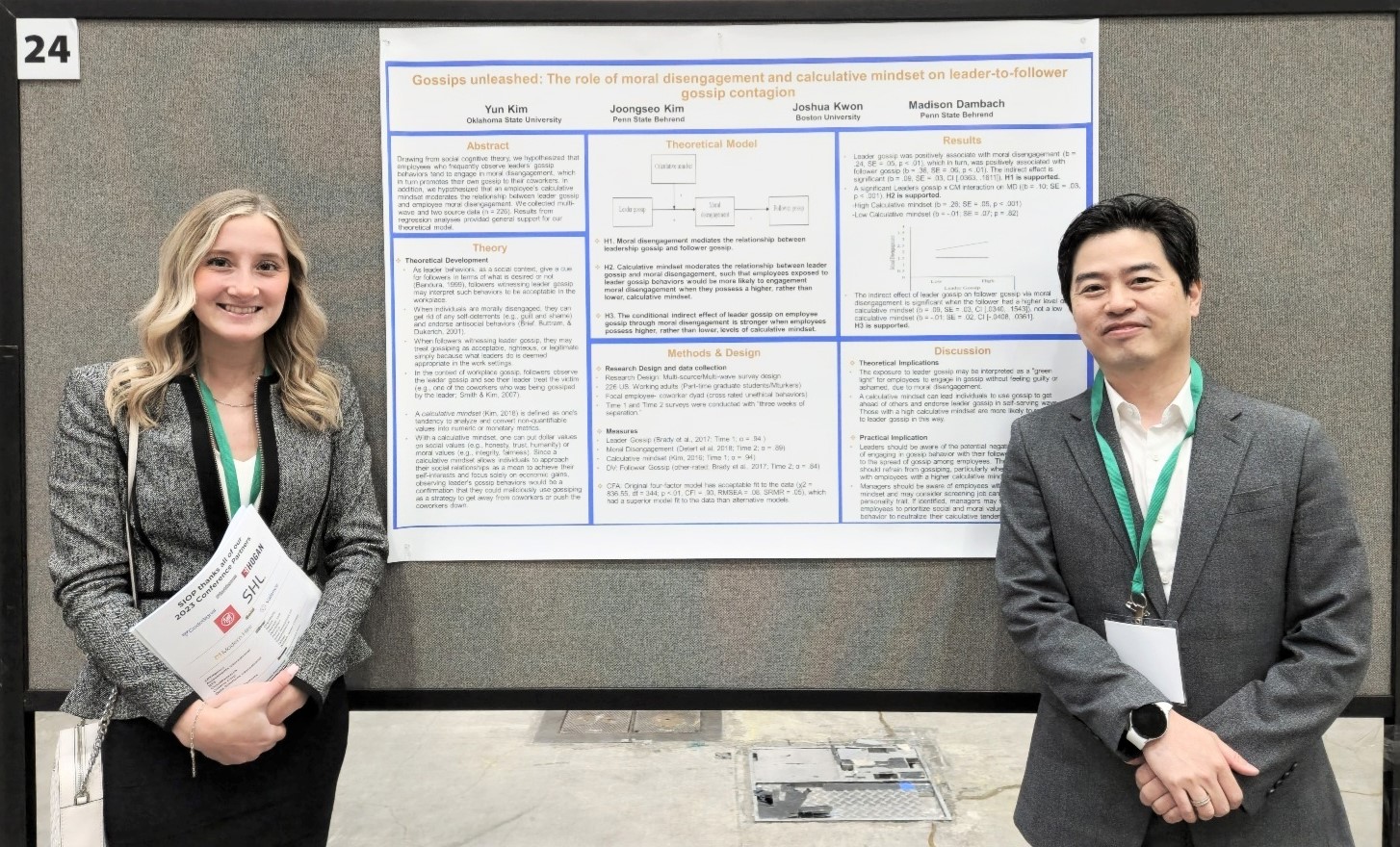
An employee with a calculative mindset – someone who approaches social relationships as a means of achieving another goal, such as financial gain – is more likely to gossip when a supervisor participates in the behavior, said Dambach, who presented the study at the Society for Industrial and Organizational Psychology conference in Boston.

“People with a higher calculative mindset see gossip as an opportunity,” Dambach said. “It’s a way to undercut a competitor or cast doubt on their abilities or their commitment to the organization. Some people will use that to their advantage, especially if the supervisor is listening.”

When a boss gossips, that’s viewed as a green light for others in the organization to behave the same way, Dambach said. Over time, that can affect employee productivity.

“Managers should pay more attention to that,” she said. “if they feed into gossip, their employees will do the same, without any sense of guilt or shame. That weakens the cohesiveness of the group. It leads to resentment. Ultimately, it can lead to the failure of the business.”

Madison Dambach and Joongseo Kim in Boston

Senior student Madison Dambach, left, and Joongseo Kim, assistant professor of management at Behrend’s Black School of Business.

Standout Seniors ’23: Max Myers (Mechanical Engineering)  

Penn State Behrend’s Class of 2023 is ready to make its mark on the world!  We’re proud of our students and all that they have learned and accomplished here at Behrend. Over the last several weeks, we have introduced you to a few of our remarkable seniors who have overcome challenges, pioneered new technologies, participated in important research projects, and made their mark at Penn State Behrend.

max myers

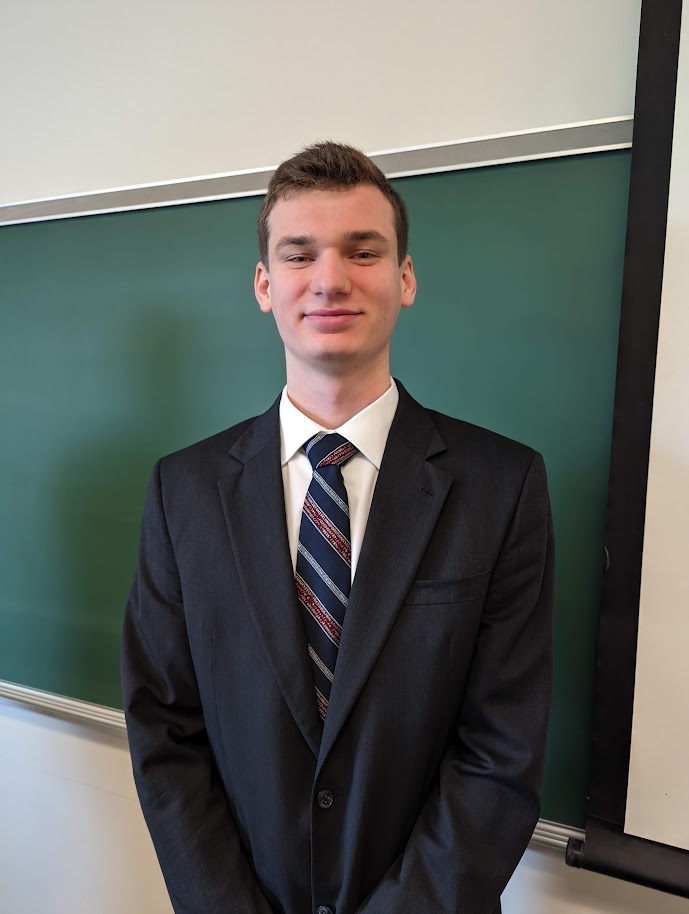
Today, we’d like you to meet Max Myers.

Major: Mechanical Engineering

Minors: Math, French and Francophone Studies

Hometown: Erie, Pennsylvania

Scholarships: Behrend Excellence Award

On choosing Behrend: Behrend is a great school. The class sizes are small, so you get to know your professors well. Getting started with extracurriculars, research, or other campus opportunities is easier because you aren’t competing with thousands of other students. Also, Behrend is close to home, so I saved money by commuting.

On choosing his major: I wanted to go into some form of engineering or science. Mechanical engineering is very broad. You can go into a lot of different sectors – corporate, government or academic – and fields within those sectors after finishing the degree.

Awards and recognition: President’s Freshman Award, Dean’s List, First-Place Engineering Research Award at the Sigma Xi Undergraduate Research and Creative Accomplishment Conference.

Proudest accomplishment at Behrend: Graduating with two minors, my Schreyer Honors thesis, three internships, and an internship project all coming to an end as I start a new chapter is extremely gratifying.

Campus involvement: I was part of the French and Francophone Club. I also worked as a tutor at the Learning Resource Center for about three years and was a lifeguard at Junker Center for a year.

What you might be surprised to know about him: I can ride a unicycle.

Words he lives by: “It is no bad thing to celebrate a simple life,” JRR Tolkien. It is really easy to get caught up in your education or your career and start chasing pursuits that are not totally your own. It is also easy to stop pursuing something you love because of what others think. I think living a good life is living a simple life, where you do things you care about no matter how big or small they seem. Everyone has a different path.

Highest priority in coming years: I want to travel globally and continue to learn. I think I will be to go to graduate school within a decade.

Advice for first-year students: Study hard. Respond to your emails. Make sure to keep your professors updated via email. Make sure the email is sent and not stuck in the drafts folder. Don’t be afraid to reach out for help—Tutoring is free, and the tutors are wicked smart and patient.

Max plans to serve as a nuclear naval officer through the Nuclear Propulsion Candidate Program.

Standout Seniors ’23: Meet Savanna Carr (Industrial Engineering)

Penn State Behrend’s Class of 2023 is ready to make its mark on the world! We’re proud of our students and all that they have learned and accomplished here at Behrend. Over the next several weeks, we’ll introduce you to a few of our remarkable seniors who have overcome challenges, pioneered new technologies, participated in important research projects, and made their mark at Penn State Behrend.

Today, we’d like you to meet Savanna Carr.

Savanna Carr IE copy

Major: Industrial Engineering

Hometown: Accident, Maryland

On choosing Behrend: I originally wanted to be an aerospace engineer, and the only university that offers aerospace engineering in Pennsylvania is Penn State. I ran cross-country and track in high school and after talking to the head cross-country coach, Coach Greg Cooper, I decided to start at Behrend and transfer to University Park after two years. After my first semester, I knew I wasn’t going anywhere. I knew Behrend was where I was going to be the most successful.

On choosing her major: When I decided to stay at Behrend, I changed my major to Mechanical Engineering. I’ve always loved the methods and process of manufacturing but not always the design part of engineering. During the pandemic, I did some soul-searching and realized that Industrial Engineering was a better fit for me. I switched my major again, and it’s one of the best decisions I’ve ever made.

Her proudest accomplishment at Behrend: There have been a lot of things I am proud of during my time at Behrend, but if I were to pick one, I would say that it is how much I have grown as a person. My freshman year, all I could think of was running fast and making it to nationals. While I’d still love to do that, I’ve realized that there is more to college than that. I took a semester off to do a co-op at Rand Machine where I helped grow their new Program Management department. I’ve never been the best student, but once I started taking major classes, I started making the Dean’s List. Though it has not been easy, Behrend has helped me grow tremendously and I am proud of the person I am today.

Campus involvement: I am a member of the cross-country and track teams as well as Phi Sigma Rho, an engineering sorority.

Awards: I’ve been the AMCC cross-country runner of the year four times, an academic all-American, and the 2019-2020 Behrend Athlete of the Year, and I received the 2020 Herb Lauffer Leadership and Scholarship Award.

What makes her unique: I’m determined. My coach told me that when he needs a relay to do well or someone to score points in an event, he’ll put me in it because he knows I’ll get the job done.

What you might be surprised to know about her: I love to downhill and water ski.

She’s writing her own story: I’ve always felt pressure to be the best in the classroom, the fastest person on the team, and involved in everything. During college, I realized that while I could have everything, I wasn’t able to achieve everything. And it took me a while to realize that it is okay. I define what makes me successful, and I define what is a good life. So, I try to wake up every day grateful for the opportunities I have been given and to be a better person than I was yesterday.

Improvement is her passion. I am passionate about improvement, from the manufacturing process to personal goals. It’s amazing what someone can accomplish when they put their mind to it.

Advice for first-year students: Something I’ve come to realize is that when you set a goal to climb a mountain, you only spend a fraction of the time at the summit compared to the long trek up. Enjoy the climb.

Parting thanks: I’d like to thank everyone who has helped me through the journey, especially my parents, Jay and Johnna, who I am so blessed to have supporting me, and Coach Greg Cooper who talked me into coming to Behrend.

After her graduation in December, Savannah plans to find work as an industrial engineer.

Standout Seniors ’23: Meet Olivia Hodgson (Environmental Science)  

Penn State Behrend’s Class of 2023 is ready to make its mark on the world! We’re proud of our students and all that they have learned and accomplished here at Behrend. Over the next several weeks, we’ll introduce you to a few of our remarkable seniors who have overcome challenges, pioneered new technologies, participated in important research projects, and made their mark at Penn State Behrend.

Today, we’d like you to meet Olivia Hodgson.  

SS23OliviaHodgson

Major: Environmental Science

Minors: Biology and Chemistry

Hometown: Centre Hall, Pennsylvania

On choosing Behrend: When I first visited Behrend, I knew this was the place for me. Behrend is a small school that offers so many opportunities. It has allowed me to grow socially, academically, and professionally.

On choosing her major: I chose to major in Environmental Science because, when I was in high school, I read Rachel Carson’s Silent Spring. I wanted to combine my interests in biology and chemistry to study chemical pollution in the environment.

Her proudest accomplishment at Behrend: My undergraduate research and presenting my findings at the annual Society of Environmental Toxicology and Chemistry North America conference.

Campus involvement: Behrend Alternative Break, Behrend Honors Student Association, Greener Behrend, and the Schreyer Scholars Program.

Awards and recognitions: Undergraduate 2021 Jerry Covert Student Research Award, Cavano Leadership Award, Most Outstanding Student Organization Officer Award, Penn State Behrend Academic Excellence Award.

What you’d be surprised to know about her: In another life, I would be a K-12 science teacher.

Her passions: Science and science education. I want to foster curiosity and be a mentor to other aspiring scientists.

Advice for first-year students: It is important to balance hard work with fun. It’s obviously important to prioritize your studies, but make sure you spend time with your friends, get outside, take up a hobby, and just step away from your work for a few hours.

After her graduation in May, Olivia will begin a research assistantship at Penn State University Park and begin working toward a master’s degree in Ecology.

Standout Seniors ’23: Ben Fahrney (Mechanical Engineering)  

Penn State Behrend’s Class of 2023 is ready to make its mark on the world!-  We’re proud of our students and all that they have learned and accomplished here at Behrend. Over the next several weeks, we’ll introduce you to a few of our remarkable seniors who have overcome challenges, pioneered new technologies, participated in important research projects, and made their mark at Penn State Behrend.

Today, we’d like you to meet Ben Fahrney.   

ben fahrney3 cropped

Major: Mechanical Engineering Major

Hometown: Lititz, Pennsylvania

Scholarships: Provost Scholarship as well as scholarships from the foundry industry

On choosing Behrend: I chose attend Penn State Behrend for its excellent integration of the business and engineering schools. I chose to stay at Behrend because of the professors. During my first year, one of my professors sat down with me for almost four hours to talk about what I wanted to get out of my experience there. This kind of personal interaction with professors is common at Behrend and exactly the reason I loved it here.

On choosing his major: Like most engineers, I have always loved learning how things work but, at Behrend, I really fell in love with the process. Seeing a project that you have been working on for months–and sometimes years–slowly come together is a truly rewarding experience and one I hope to continue pursuing in my professional career.

Proudest accomplishment at Behrend: One of my proudest accomplishments was completing an almost three-year-long research project (concerning the integration of additive manufacturing into the Pennsylvania investment casting industry to spur economic growth) and presenting my findings at various competitions, at major trade expos, and at several campus presentations. Working on a huge project like that and then presenting in front of more than 200 industry professionals is not where I would have seen my Behrend career going, but it has been an amazing experience.

Campus involvement: I have been on the executive board for the Materials and Manufacturing Group for all four of my years here at Behrend. I am also involved in the Rack ‘em Pool Club and Disc Golf Club and have been a Welcome Week volunteer twice. I have also worked in Innovation Commons, the college’s open ideation, product development, and prototyping center, for three years.

Awards and recognitions: I have been on the Dean’s List several times, won both first and second place in the engineering division at our annual Sigma Xi research competition, been the recipient of several metal casting scholarships from the foundry educational foundation (FEF), and won the Larry Blum Intern Scholarship, which allowed me to speak at the 68th annual technical conference for the Investment Casting Institute.

What makes him unique: When I first came to Behrend, I had almost no experience in the metal casting industry. I barely knew what the industry was. Since starting formal academic research during my first semester, I have become a highly regarded student in the field.  After four short years, I have had internships, competed in competitions, and spoken at conferences in the industry. I am an active member of the Foundry Educational Foundation, the Association for Iron and Steel Technology, and the Investment Casting Institute and frequently travel to their conferences and expos.

Top priority: I am excited to begin pursuing my professional career. I’m also looking forward to setting some roots down near my family and begin serving my community as a volunteer firefighter again.

Eager to help: I am most passionate about helping people in any way that I can. I enjoy talking with new and prospective students, making them feel welcome, and giving them the advice and guidance that was so helpful to me when I first came to Behrend.

Advice for first-year students: The best advice that I have for new students is to talk to people. Bugging my professors, people at job fairs, and even the maintenance staff at Behrend has afforded me more opportunities than I can count.

After his graduation in May, Ben has accepted a position as a systems integration and testing engineer in the rotary mission systems division of Lockheed Martin in New Jersey.

This slideshow requires JavaScript.


Standout Seniors ’23: Meet Joseph Previte Jr. (Polymer Engineering and Science)  

Penn State Behrend’s Class of 2023 is ready to make its mark on the world! We’re proud of our students and all that they have learned and accomplished here at Behrend. Over the next several weeks, we’ll introduce you to a few of our remarkable seniors who have overcome challenges, pioneered new technologies, participated in important research projects, and made their mark at Penn State Behrend.

Today, we’d like you to meet Joseph Previte Jr.

JosepfPrevite

Major: Polymer Engineering and Science (PES)

Hometown: Erie, Pennsylvania

Scholarships: I am a Penn State Schreyer Scholar.

Why Behrend? I chose Behrend because it was close to home and offered the degree that I was interested in.

On choosing his major: I chose the PES major because I love chemistry, and this new major is very chemistry-focused.

A trailblazer: My proudest accomplishment at Behrend is being one of the first two students to graduate from the brand-new PES major.

Campus involvement: I was a member of the Behrend Plastics club during my junior and senior years.

Awards: I have been on the Dean’s list since Fall 2020.

What makes him unique: I really love airplanes, and I flew a plane before I drove a car.

People might be surprised to know: For most of my college career, I was in a class of just two students, since my major is brand new to Penn State Behrend.

Top priority: To earn a doctorate in Polymer Science and Engineering with a focus on aerospace composites. I would love to work for an aircraft company like Boeing or Lockheed Martin designing commercial or military aircraft.

His passions: I am passionate about airplanes and my career, but also about my faith, family, and friends. I also love physical activities such as skiing and weightlifting.

After his graduation in May, Joseph will work at Parker LORD Corporation for the summer in research and development. In the fall, he will begin graduate school at the University of Southern Mississippi.