Tube Time Well Spent

Faculty and staff recommend television worth watching over winter break

canstockphoto73643710

By Heather Cass, publications manager, Penn State Behrend

If you ask Penn State Behrend faculty and staff members what television shows or movies they’d recommend students enjoy over break, they’ll often suggest books instead. (You can take the professor out of the classroom, but…). If you press them, though, they may admit to occasionally indulging in a few flicks or bingeing on a streaming series, whether it’s something with an educational aspect to it or something that’s just plain fun to watch.

Here are the shows/movies that Penn State Behrend faculty and staff members recommend relaxing with over your well-earned holiday break. Please note: These suggestions are for adults; some shows may not be appropriate for younger audiences.  

Dr. Laurie Urraro, assistant teaching professor of Spanish

I recommend students watch the series Cobra Kai, a martial arts comedy-drama on Netflix, because we could all use a little more physical activity and inspiration in our lives right now.

I have to add a prerequisite, though: You must first watch the original Karate Kid movies (I and II)  so you can appreciate the series, which is based on the 1980s-era movies and features the main characters from the films. 

Dr. Robert Speel, associate professor of political science

Here are my recommended shows, all on Netflix, but some may be found elsewhere, too.

Occupied. This is a Norwegian political thriller that involves climate change and Russian subterfuge.

Learn something about European politics from this series, which includes all the elements of any political drama – sex, violence, and assassinations – mixed with efforts to save the environment.

Kim’s Convenience. Laugh while learning how everyone fits into a multicultural city in Canada in this funny sitcom about a Korean-Canadian family who owns a convenience store in Toronto.

Bodyguard. Learn a little bit about British politics and the civil service while trying to solve a mystery in this political thriller centered around the bodyguard of an ambitious government minister.

Evil Genius – This is a true crime documentary about the most famous criminal case to take place in Erie in the last quarter century. It tells the odd tale of a bank robbery heist that ended in the death of a pizza deliveryman who died when a collar bomb exploded around his neck.

Dr. Melanie Hetzel-Riggin, professor of psychology

I’m a big sci-fi fan, so I recommend any of the Star Trek movies or series, as well as Farscape and Babylon 5.

Not only are all of these shows incredibly entertaining, but they also provide us an opportunity to examine the social issues we discuss in psychology, sociology, political science, and anthropology in a way that allows us to escape the constraints of real life.

There are significant ethical dilemmas, interpersonal conflict, issues related to discrimination and oppression, and more. It also allows us to see the strengths and weaknesses of different ways of approaching life and various moral and religious compasses. Also, there are transporters!

Tracy Halmi, associate teaching professor of chemistry

Breaking Bad is an older television series about a chemistry teacher with cancer who resorts to cooking meth to make as much money for his family as he can before he dies. The show features plenty of chemistry and science, but also a lot of drug use, swearing, and violence, so it’s definitely not appropriate for younger audiences!

I’d also suggest HBO’s miniseries Chernobyl, a great docudrama that is available on Amazon Prime.

Two great movies that I’d recommend: Radioactive, a movie on Amazon Prime, is about the famous scientist, Marie Curie, and it delves into her life and the aftermath of her discoveries. Hidden Figures is a 2016 movie about three brilliant  African-American women at NASA who helped put John Glenn on the moon, though their efforts went largely unnoticed, hence the title of the movie.

Angela Davis, reference instructional librarian at Lilley Library

I find nature documentaries soothing, so I’d suggest students watch the Our Planet series. It’s actually on YouTube right now as Netflix allowed it to be placed there so educators could access it for free during the pandemic.

The series focuses on how climate change affects various species in every habitat on Earth. Those who enjoy animals or are interested in climate change and the environment would enjoy the series, which isn’t too science heavy.

Dr. Jay Amicangelo, professor of chemistry

My wife and I have been enjoying a related set of historical fiction series over the last few months. These miniseries, available on a few premium streaming services such as Starz, Hulu, and YouTube, each portray drama related to the monarchy of England during the time period from about the mid-1400s to the early-1500s. 

I’d suggest watching them in the following chronological order:  

  • The White Queen – This series is mainly about Catherine Woodville, who was the wife of Edward IV.
  • The White Princess – This series is centered around Elizabeth of York, who was the wife of Henry VII
  • The Spanish Princess – This series is mainly about Catherine of Aragon, who was the first wife of Henry VIII

Riki Hay, regional global education coordinator, International Student Services

During Behrend’s recent International Education Week programming, we did a “daily digest” which, among many things, included some recommendations from the experts on ways to learn interculturally.

Here are some TED talks they recommended that students may want to check out while they are on break:

You can find a whole collection of  TED talks (and more) on the topic of diversity at ted.com.


Building stronger student athletes

By Heather Cass, publications manager, Penn State Behrend

chris viscuso2
Chris Viscuso, coordinator of strength

Earth, Wind & Fire is just one of the many tools Chris Viscuso, the college’s new coordinator of strength training, uses to motivate his student-athletes.

“I try to make it fun and keep things lively and upbeat,” he said. “I make them listen to my music, which drives them nuts. They tease me about it, and I’ll say, ‘Hey, this group is in the Rock & Roll Hall of Fame. If you can tell me who it is, you can cut your workout short.’”

Rare is the 20ish-age college student who gets to skip out of strength training early.

Like any good coach or fitness guru, Viscuso takes an approach that mixes pleasure with pain, walking  a line between the two. He looks the part of a bodybuilder—he’s bald, bearded, muscled, and tattooed. He’s often grinning, but with just enough seriousness to convey without words that if you slack off, he’s going to call you on it.

Throughout December, an Elf on the Shelf perched on the bleachers in Erie Hall, where additional fitness equipment is set up for students. Viscuso’s elf didn’t move very much, but every day the holiday mischief-maker posted a new workout.

“Sometimes, he was a kind elf and it would be an easy workout,” Viscuso said. “Other times, he was an angry elf in a bad mood, and he’d make students do 150 body squats, run a half mile, and crank out some push-ups and pull-ups.”

Back to Behrend

Viscuso joined Behrend’s Athletics staff in September of 2020. It was a homecoming for the 1992 History graduate who had played basketball for the Behrend Lions. He has bragging rights as the first player to score a basket in the newly renovated Erie Hall when it reopened in 1992.

Nearly twenty years later, Viscuso is back in Erie Hall, though the building will soon be replaced by a new fitness and recreation center. It’s bittersweet for Viscuso, since he has made a lot of memories in Erie Hall.

He has several more months to imprint that facility on the college’s student-athletes, though, and he’s making the most of it.

“I’m the only ‘coach’ on staff who works with all 300 of our student-athletes,” he said. “And, I get to work with them year-round, not just when they are in season.”

One could argue that good athletes are built in the off-season.

“If you get stronger, you’re going to be a faster runner, a more explosive basketball player, a better soccer player,” he said. “There is not a sport you can play that you can’t play better with a stronger body.”

Hard? Yes. Complicated? No.

Like his musical taste, Viscuso is old-school when it comes to building stronger bodies. He likes the classic moves.

“The biggest mistake people make when it comes to strength training is making it too complicated,” he said. “Fads come and go in fitness, but the basics never really change. I’m going with meat-and-potatoes workouts – lunges, plyometrics, squats, sprints, pushups, etc. We use the weight room, but we also just add weight doing movement-based workouts.”

He likes to work unilaterally. “We do a lot of one-legged squats and one-arm dumbbell exercises, things like that,” Viscuso said.  It’s important for almost all athletes, but especially those who do a lot of pivoting on the playing field, like those in basketball, soccer, and tennis.

He’s also big on flexibility, another thing that benefits every athlete. “If your heels are coming off the ground when we are doing squats, everybody thinks of hips and sometimes it is that, but it can also be tight Achille’s tendons; all of these parts are in play.”

That’s why Fridays are for yoga, but if student-athletes think they are going to find inner peace, Viscuso sets them straight pretty quickly. “It’s actually more stretching and more of workout than they expect,” he said.

You might call Viscuso’s approach intense, and he’s perfectly OK with that. It’s one of his three ingredients to success. “Intensity, effort, and enthusiasm are key,” he said. “It’s hard to stop a determined man or woman.”

chris viscuso1

Viscuso Vitals

Before Behrend: Assistant basketball coach at Brescia University in Owensboro, Kentucky, then at Gannon University in Erie for fourteen years. At Gannon, he also served as the director of performance enhancement for the men’s basketball team, too.

On one measure of athletes: “I ask them to do 40 unbroken pushups and 10 pullups on their own; it’s not a huge challenge, but it tells me where they are, physically. Then we have a starting point.”

On pandemic-era training: “With no sports happening right now, it’s been a great time for strength training. Our philosophy has been, let’s just work on getting stronger, then.”

On a long winter break: “I told the student-athletes, ‘I’ve spent months working on you. Don’t you go home and let it all go. Do the workouts I post on Instagram (a private page for student-athletes).’ I’ll know if they didn’t.”

On Behrend student-athletes: “As a whole, our athletes have impressive GPAs, unheard of in sports-scholarship-level schools. Personally, I have found them to be hungry for information; they love feedback. In general, they are just good kids—smart, hardworking, respectful.”

A Winter To-Do List for Career Success

 By Heather Cass, publications manager, Penn State Behrend

canstockphoto6204341 (1)

With the Spring 2021 semester starting a week later than normal, Penn State Berend students have the luxury of an extra-long holiday rest.

Just kidding, students. You’ve heard the phrase, “No rest for the weary,” and that definitely applies to college students, particularly, juniors and seniors. You have some recommended winter work to prepare for your future.

None of these “assignments” are difficult or required, or will be graded, but if you complete these tasks suggested by Christina Moreschi, career counselor in Behrend’s Academic and Career Planning Center, you will be setting yourself up for future career success.

Here are suggestions for making the most of your extra time over winter break:

  1. Log into Nittany Lion Careers (NLC), Penn State’s job and internship search platform. Once you log in, take a few minutes to fill in the required information under “My Account,” so you will be ready for Penn State Behrend’s Virtual Spring 2021 Career and Internship Fair, which will take place on the NLC platform Wednesday, February 24.
  2. Create/update your resume. Check out the ACPC’s samples and suggestions for help.
  3. Create/update your LinkedIn profile. Watch LinkedIn Like A Pro to learn how to leverage your profile and make LinkedIn work for you.
  4. Practice interviewing by scheduling a mock interview session with an ACPC career counselor via Zoom. A mock interview is one of the best ways to refine your interviewing skills, and the counselors are available during the extended winter break to help you!
  5. Build/check-in with your network virtually. Consider sending a card or email to reconnect with friends and former colleagues and let them know what you are doing. The main idea is to have an annual check-in with people who might be helpful to you, personally or professionally, in developing your plan for the future.

Broaden your holiday tune horizons

By Heather Cass, Publications Manager, Penn State Behrend

canstockphoto2812679

In this tumultuous year when nothing is normal, we can take comfort in one thing that hasn’t changed: Christmas carols. Everyone has their favorites and most of us have more than a few.

We asked the music experts on campus to share with us their favorite holiday tunes and also to suggest some new songs/artists or albums to expand our holiday music playlist.

Here’s what they had to say:

Emily Cassano, assistant teaching professor of theatre, music, and arts

My all-time favorite Christmas tune is “Have Yourself a Merry Little Christmas” because I love the musical Meet Me in St. Louis. I don’t necessarily have a favorite version; there are a lot of great renditions.

For more modern music, I typically turn on any of the Pentatonix Christmas Albums, and their song “White Winter Hymnal” is a favorite of mine.

In November, the three Fates from Hadestown (last year’s Tony Award Winner for Best Musical) released a Christmas album called If the Fates Allow.  It’s really great, and very non-traditional, like Hadestown itself.  One of the three Fates is played by an Erie native and Penn State alumnus Mike Karns’ wife, Kay Trinidad.

Gabrielle Dietrich, director of choral ensembles and associate teaching professor of music

I have to admit my holiday music tastes are eclectic, and also more modern in their conception.

I really enjoy Dar Williams’ “The Christians and the Pagans,” the Goo Dolls’ “Better Days,” and Ingrid Michaelson and Sara Bareilles’ “Winter Song.”

As for classics, I have a real soft spot for “You’re a Mean One, Mr. Grinch” because what says “Happy Holidays” better than some good old-fashioned insult comedy!

Gary Viebranz, teaching professor of music

The first classic that comes to my mind is an oldie, but a goodie: “Mary’s Boy Child” by Harry Belafonte. In a most traditional sense, I love “Lo, How a Rose E’er Blooming,” especially the rendition by the King’s Singers.

For some nostalgia, I grew up with the Harry Simeone Chorale recording “Sing We Now of Christmas” and still listen to it. My silly side likes “All I Want for Christmas is My Two Front Teeth” by Spike Jones and his City Slickers, and I appreciate “You’re a Mean One, Mr. Grinch” from the original soundtrack of the animation, which is sung by Thurl Ravenscroft, the voice of Kellogg’s Tony the Tiger. Heeeeee’s Grrrrreat!

If you want to expand your horizons, I’d encourage you try some instrumental collections. My favorites include “A Canadian Brass Christmas” and the Philadelphia Orchestra’s “A Christmas Festival,” which is an amazing album recorded in 1964.

Retiring Physics Professor Reveals Meaning of Life (Kinda)

By Heather Cass, Publications Manager, Penn State Behrend

Jonathan Hall (5)
Jonathan Hall, associate teaching professor of physics at Penn State Behrend

Jonathan Hall, associate teaching professor of physics, began his career in a remote area of Borneo where the only “technology” he had access to was in the form of painted plywood chalk boards and a hand-cranked, mimeograph-like machine. He taught in a language he had learned just three months earlier.

This month, he will finish his career in education from home, where he has been teaching dozens of Penn State Behrend students remotely using online videoconferencing software and a host of other high-tech tools that would’ve been inconceivable at the start of his career three decades ago.

Yet, Hall, who has been teaching at Behrend for thirty-two years, says not much has changed.

“Though the technology available today for education is very different, the key ingredient for student success has not changed; the desire to learn is the most important part,” Hall said.

Sometimes that desire can be stamped out quickly in physics class, a subject many students find intimidating. Hall learned to build students’ confidence first.

“In my general education physics course, I found that if I started with a topic, such as color and light, that students enjoyed, their confidence in their ability to learn physics enabled them to achieve greater success in the course,” he said. “We still did the more challenging topics, but students did better when I would ease them into it later in the course.”

Over the course of his teaching career, Hall said he has learned as much as he has taught, and we couldn’t let him retire without collecting some of his wisdom on topics big and small.

What brought you to Behrend?  

A 1988 Mazda hatchback. And a job teaching at a college!

What types of classes have you taught over the years?  

Physics, Astronomy, Civic and Community Engagement.

Which classes have been your favorites and why?

Of course, I enjoyed teaching physics, but the advantage of teaching astronomy is that it’s not called what it actually is, which is “the physics of the universe.” Because it doesn’t include the word “physics,” students relax, and enjoy learning… physics!

What I enjoyed about Civic and Community Engagement is that it was team-taught with faculty from other disciplines, including communication, psychology, and sustainability. It was truly inter-disciplinary, which was great, and I learned a lot from my colleagues. With the service projects, students were able to put into practice what they learned in their majors.

What do you remember most about your first year of teaching?

I had been a high school teacher for five years before coming to Behrend. I enjoyed getting to know students in my classes from teaching them 180 school days, but when I started teaching college, I didn’t miss at all the “supervisory” duties of a high school teacher such as monitoring homerooms, study halls, etc. At the college level, I could focus on teaching students, not monitoring them. Also, though I wasn’t any smarter or more qualified than I had been before, the respect people (especially the parents of students) give college faculty compared to high school faculty was eye-opening.

What have you learned the hard way?

I started my career as a Peace Corps volunteer, and it truly was the toughest job I’ve ever loved. I had twenty-five class preps every week in a language that I had only started learning three months before. Speaking a foreign language is not one of my strengths. During the first three months, I wondered if I had made a mistake; about a third of the volunteers in my training group quit during this time. But I toughed it out. Things got better, and I enjoyed my second year so much that I extended my assignment and served three years. In order to survive those early months, one thing I learned to do was to listen intently; to pay attention to and catch both the verbal and non-verbal cues; to listen to everything the person was saying, not just the words.  That skill has carried over to make me a better teacher and I hope more understanding of others. 

What would people be surprised to know about you?

How our children go out of their way to keep my wife, Katherine, and me informed of world and national events. Our daughter, Maria, was a Peace Corps volunteer in Madagascar when a coup overthrew the democratically elected government there. At the same time, our daughter, Liz, who is a Marine, was in Iraq.  Liz has also been deployed to Afghanistan (twice), South Korea, Chad, Australia, and Germany, and is presently at the U.S. Embassy in Baghdad. Our son, David, lives in Portland and kept us up to date on the fires and protests in Oregon. Someday, we hope to be less well-informed.

What have you enjoyed most in your career?

I have always enjoyed teaching young people and helping them to achieve their potential, and that has not changed during my career.

Do you have a different perspective on the profession now?

When people ask me what I teach, I tell them I teach young people, not a subject.  As teachers, we have the task of preparing our students for the future; content knowledge is often a  means by which we teach more important lessons about life.

What will you miss the most?

I have been fortunate in my life and career to work for organizations with a noble purpose, whether the Peace Corps, or Penn State University, whose mission as a land grant institution is teaching, research, and service. Working with everyone at Behrend who share in striving for the common good is what I will miss the most.

What’s the secret of life?

Since, in Malaysia, I was a “guru,” I’ll recommend as a starting point in your quest — the “Galaxy Song” from Monty Python’s “The Meaning of Life.”  (Please note that I didn’t say I was a good guru…)

Any other parting wisdom for us?

In Asian culture, keeping harmonious relationships within the community is often the top priority.  In America, we emphasize individualism.  I think that in a healthy community, there is a balance of both; freedom of individual expression, along with concern for others.

This slideshow requires JavaScript.

Recreating history: One tiny soldier at a time

By Heather Cass
Publications Manager, Office of Strategic Communications, Penn State Behrend

Today, when most of us in the United States are focused on the pandemic and political warfare, Jerry App, a junior History major, need only walk down his basement stairs to escape current affairs and lose himself in the drama of 1500s Italy.

Jerry App
Jerry App, junior History major at Penn State Behrend

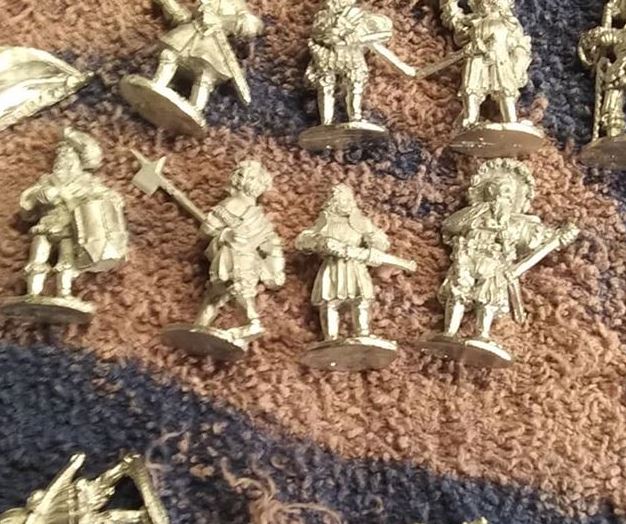
App is a kriegsmodelle enthusiast. He paints tiny figures and scenery and then stages elaborate and historically accurate battle scenes in miniature. Lately, he’s been working on the Italian Wars, depicting battles between the Holy Roman Empire and France for control of Italy.

He has plenty to work with. Between 1494 to 1559, the Italian peninsula became the main battleground for European supremacy. Everybody wanted a piece of Italy’s “boot,” which was economically advanced but politically divided among several states, making it an attractive target.

“I’ve had to do a lot of research before I could actually begin building and painting the models, but it’s worth the effort,” App said.

Delving deep into history is a labor of love for App who can trace his fascination with the past to a classic fantasy game he played as a child.

“My dad taught me to play Dungeons and Dragons when I turned 10,” he said. “I got really interested in the medieval ages, specifically the realistic and historical sides to fantasy tropes. We bought some old pewter Grenadier models and painted them together. Later, I discovered a game called Warhammer Fantasy, and that is what really kicked off my interest in miniature painting and wargaming.”

It’s a pastime that he and his father still share today, and one that is particularly suited for a pandemic.

It’s been a great hobby to have during the lockdown,” App said. “Earlier this year, I was home from college and my parents were off work for a while, too, which gave us a lot of time to catch up on painting and playing. A typical wargame takes an hour or two to play out, so we had plenty of time to play. You could start a wargame on Sunday and play it all week.”

We caught up with App to learn more about his hobby, his personal history, and how both influenced his academic and career choices.

Your dad introduced you to both fantasy gaming (Dungeons and Dragons) and modeling?  

Yes. He started modeling when he was a kid, putting together World War II kits. He actually still has some of those kits, and he’s assembled a few WWII models recently. He was inspired by our recent visit to Gettysburg, and he recently bought some Civil War models. So, we’ve been working on those, too.

What do you enjoy about Kriegsmodelle?

I enjoy being able to take gray, flat plastic sprues (generic figures) and turn them into fully built and painted pieces. It’s very calming and helps me relieve stress after a long day. When I build and paint models, my mind is completely focused on what I am doing at that moment. It’s almost like meditation.

Metal unpainted 1
Unpainted sprues.

Where do you buy the figures?

It depends on the genre. Historical models can be difficult to find, depending on the period. For example, you can easily find Napoleonic or Late Imperial Romans, but you’ll really have to scrounge for Wars of Lombardy or Russian Civil War. I’d recommend Perry Miniatures or Warlord Games. Science fiction and fantasy models are easier to find, and you can find them on Ebay or Amazon for a decent price. Local stores or hobby shops that carry models are especially nice to work with, if you have one nearby.

The figures arrive in need of a paint job?

Yes, that’s the best part! I try to sit down for an hour or two every day to work on a squad of models. It can take a while to paint them up (a few hours per model), but I paint them in groups which speeds up the process a lot; this is referred to as “batch painting.”

How many models have you done?

I have around 2,250 models, but only about 1,000 of them are painted with 100 still needing assembly. My dad has a comparable amount. We work on the models in our basement, which is affectionately named the “Nerd Bunker” by friends and family. I’ve been painting for ten years this month.

What are you working on now?

The Italian Wars, as well as some medieval levies (militia units raised by conscription), a couple of Warhammer 40,000 armies and the Civil War models my dad picked up.  It’s a lot of different projects, but I’m never without something new to paint.

You also study German?

Yes, I’m working toward a certificate in German. My grandmother, Omi, is from southern Prussia, and she inspired me to take up German. I’m hoping I will become proficient enough to be able to speak with her in Deutsche.

What are your career goals?

Originally, I wanted to become a civil servant and work for a government agency. However, I’ve also looked into museum work and law school. Right now, I’m considering using my degree as a launch pad into Naval Officer Candidate School. I’m not committed to one plan yet, but I’m starting to narrow it down.

What advice do you have for those who might want to try modeling?  

I’m the Vice President for the Behrend Game Club, and I’m also the club’s strategy committee head. If any students are interested in pursuing the kriegsmodelle hobby, join the club on Behrend Sync and get involved. I’m happy to answer any questions and share resources to help another start their own collection.

This slideshow requires JavaScript.

Penn State announces Peace Corps Prep certificate program

By Heather Cass
Publications Manager, Office of Strategic Communications, Penn State Behrend

Did you know that the Peace Corps, the international volunteer service organization, would not have come into being without college students?

“During the 1960 presidential election, John F. Kennedy made a late-night stop at the campus of the University of Michigan,” said Jonathan Hall, associate teaching professor of physics at Penn State Behrend. “He made an off-hand remark inquiring whether the college students there would be willing to serve in a developing country. It would have been a forgotten campaign speech, except that the students organized and sent a petition with hundreds of signatures asking for the opportunity to serve others and their country.”

Hall served after his undergraduate years, and his time in the corps remains a transformative life experience, so much so that forty years later, he regularly encourages Behrend students to consider joining, helps raise awareness of the organization on campus, and staffs a recruiting table at Behrend’s twice-yearly Career and Internship Fair.

“The Peace Corps is a great opportunity to learn about another culture, to develop one’s talents, and to be of service to people in a developing nation,” Hall said. “An example of the impact possible is Alejando Toledo, the former President of Peru, who said ‘I am one of sixteen brothers and sisters. Born in extreme, extreme poverty… I’m the first president of indigenous descent who had been democratically elected in 500 years in South America. To a large extent thanks to the Peace Corps.’”

“While none of my former students in Malaysia became a president,” Hall said, “I did help the children of subsistence farmers and fishermen become teachers and nurses who in turn contributed to education and health care in places where it was scarce.”

Hall is proof that the Peace Corps stays with you. A few years ago, he even returned to Borneo to catch up with some of his former students.

That’s why he’s excited about a new partnership between the Peace Corp and Penn State to offer a preparatory program for students interested in volunteering.

Peace Corps Prep is a certificate program for undergraduate students of any major. Students who participate in the program gain skills and experiences that make them attractive candidates for the corps or any form of international or service work. The inaugural cohort will begin this fall semester.

Accepted students will build their coursework around one of six strategic competencies that the Peace Corps seeks in its volunteers. The program requires students to complete a set number of field hours in their chosen competency area, take globally minded classes, show language competency, and engage in career-related activities.

Interested students are required to complete an online interest form by October 16, 2020 to be considered for the inaugural cohort. Program requirements, application information, and more can be found at https://studentsaffairs.psu.edu/career/peace-corps-prep.

While the certificate program does not guarantee acceptance in the Peace Corps, it will help to provide participants with a competitive advantage.

ABOUT THE PEACE CORPS

Peace Corps mission: to promote world peace and friendship by fulfilling three goals:

  • To help the people of interested countries in meeting their need for trained men and women.
  • To help promote a better understanding of Americans on the part of the peoples served.
  • To help promote a better understanding of other peoples on the part of Americans.

Volunteers serve for twenty-seven months in areas such as health, education, environment, agriculture, community economic development, and youth in development.

Jonathan Hall and Wan Musa
Jonathan Hall, associate teaching professor of physics at Penn State Behrend, and a former colleague, Wan Musa, who taught with Hall in North Borneo forty years ago. Wan Musa

Secret Lives of Staff: Meet Steven Miller, history buff

There’s so much more to Penn State Behrend’s faculty and staff members than what you see them doing on campus. In this occasional series, we take a look at some of the interesting, unconventional, and inspiring things that members of our Behrend community do in their free time.

By Heather Cass
Publications Manager, Office of Strategic Communications, Penn State Behrend

Some people make it a goal to visit every state or capitol, but Steven Miller ’06, associate director of Housing and Food Services at Penn State Behrend, is a World War II reenactor and Penn State Behrend history alumnus who is working on a more unique challenge: He has a goal of visiting the private residences of every U.S. president. He’s already been to twenty.

“Visiting presidential homes offers an insight into the private life of individuals who had a profound impact on the formation and development of our country,” Miller said. “The homes and grounds themselves show a progression of architecture and lifestyle through history, from the vast agricultural farmlands of the Founding Fathers to the urban presidents of today.”

It all started with a trip to President Dwight D. Eisenhower’s home in Gettysburg, a stop on Miller’s itinerary while visiting Gettysburg National Military Park.

“It evolved into an annual summer trip with my brother, a challenge to visit the private residences of past presidents, with the goal of visiting all forty-five of them,” Miller said.

We chatted with Miller to learn more about his adventures and the homes he’s been most impressed with.

Are presidents’ residences public?

Yes, most presidential private residences belong to the National Park Service and are open to the public for tours. Information on their locations and visiting information can be found on the National Park website at nps.gov/findapark.

Do you plan vacations around visiting presidential homes?

I typically plan our itinerary around visiting both presidential sites and museums. Some of the most extensive collections of historical military artifacts are in museums located at the service academies, such as West Point or the United States Naval Academy, and often I will add these into our itineraries. Thirteen presidents have homes in New York, Ohio or Virginia, so from here where we live, creating a travel itinerary that takes you by a president’s home is fairly easy. One of the things we enjoy on these visits is eating at local establishments as much as possible; we try to avoid chain restaurants.

Who is your favorite (or most admired) president and why?

My favorite modern president was Franklin Delano Roosevelt (FDR). He was elected at the height of the Great Depression, and through various public programs, he got the country back on its feet. He then led the nation through four years of World War II and was the only president elected to four terms in office. He also founded the March of Dimes with the goal of finding a vaccine for polio.

What are some of the more famous homes you’ve seen so far?

Mount Vernon, George Washington’s home; Monticello, Thomas Jefferson’s home; Montpelier, James Monroe’s home; and Springwood, FDR’s home.

Have any the homes surprised you in any way?

It is impressive to see how some of these homes are incredibly preserved with original furnishings and furniture.

What does history mean to you? Why is it important to study and learn about history?

I am always searching for a connection to the past, and visiting historical sites, whether presidential homes or museums, let us see the tangible items that create those links. Visiting these homes is like stepping into the past. It’s amazing to think about walking in the footsteps of some of the most influential people in our country’s history.

This slideshow requires JavaScript.

Resilience Pays Off for Engineering Students

Plans change but summer learning experiences continue

By Heather Cass, Publications Manager, Penn State Behrend

When the COVID-19 pandemic arrived in the United States, it disrupted not only the last few weeks of the academic semester for Penn State Behrend students, but also summer plans, too. With activity across the country and most of the world at a standstill, job offers, internships, and research opportunities were suddenly vanishing or being put on hold.

Even in a time as tumultuous as this, though, persistence and ingenuity pay off, and many Behrend students have been able to find ways to continue learning and getting hands-on experience from home this summer.

Caralyn Harben

Caralyn Harben, intern at Northrop Grumman

Caralyn Harben, a junior majoring in Software Engineering, had been looking forward to spending her summer in sunny California working at Northrop Grumman’s Redondo Beach location before the coronavirus conspired to keep her at home.

While she laments the location change, she is thankful to still have the opportunity to support the company’s Space Systems division as a software engineering intern. 

“I was lucky that Northrop Grumman decided to continue their internship program with many of us, including me, working remotely,” Harben said. “They shipped my work computer and additional hardware to me.”

In addition to her internship duties, Harben is an active member of the company’s intern council where she helps plan various virtual social events to keep her peers connected.

“I’m having a lot of fun with the work and the council, and it’s been a blast learning more about the company as a whole,” she said.

Micahel Magnotti

Michael Magnotti, paid research assistant

Industrial Engineering sophomore Michael Magnotti wants to get as much hands-on experience as he can before he graduates from Behrend. “Research is all about learning and I love to learn,” said Magnotti, who is also a Schreyer Honors scholar.

So when he learned about a summer research opportunity with Dr. Faisal Aqlan, associate professor of industrial engineering, and Carol Putman, assistant teaching professor of management, Magnotti teamed up with two other classmates, Samantha Melnik and Cameron Butts, to work on the project that focuses on applying an abstract concept to everyday business processes.

“Our team is working on developing a concept relationship map and an implementation plan for Industry 4.0 in manufacturing and the service industry,” Magnotti said. “First, we identified the main pillars of Industry 4.0 and how they are relate to one other and then we developed a visual representation of this relationship and created a simulation model for a small-scale implementation of Industry 4.0.”

It’s a paid position, which Magnotti said he appreciates in light of the time it requires, and it’s one that was easily adapted to an at-home work format. The Penn State Behrend Undergraduate Student Summer Remote Research Fellowship he received requires the research work be completed with software and tools that are free and available to the public on the Internet.

“You would think a virtual research experience like this would be mostly writing, but we have many different physical deliverables as well as simulation programs that allow us to be more physically creative instead of solely reading and writing every day,” Magnotti said. “The experience is incredibly exciting, even with the reading and writing, and I am so grateful to Penn State Behrend for giving students opportunities throughout these uncertain and stressful times.”

Rebecca Grey

Rebecca Grey, intern turned researcher

Rebecca Grey, a senior Mechanical Engineering major, had a summer internship lined up, but it was rescinded due to the pandemic.

“When my internship was canceled, I figured that I would probably spend my summer doing research since I am a member of the Schreyer Honors College and was beginning to transition research into work for my honors thesis,” Grey said.

But then, Dr. Charlotte de Vries, assistant professor of mechanical engineering, told her about the Multi-Campus Research Experience for Undergraduates (MCREU) organized by University Park.

Grey had worked with de Vries on a research project investigating the use of 3D printers to produce accessibility aids to support aging in place. Aging in place is an initiative largely centered on improving home accessibility to allow older adults to live in their homes longer. 

Grey submitted a last-minute application and was accepted as the program was approved to go fully virtual for the summer. 

“I am still doing research with Dr. de Vries and was also given another mentor for the MCREU program, Swapnil Sinha, who is a Ph.D. candidate in mechanical engineering at University Park,” Grey said. “My research has now transitioned from what is being printed on a 3D printer to focusing on improving the overall usability of the physical 3D printer.”

To that end, Grey is working on developing guidelines for 3D printers governed by the principles of universal design, a concept that focuses on product and building design that is accessible and user-friendly for individuals of varying ages and physical abilities 

Grey said the project is going well and she has benefitted from having a second mentor.  

“I am reviewing a lot of literature, analyzing various aspects of 3D printers that cause issues, looking for areas of improvement, and designing a survey for future use to gain more perspective on usability issues that others have dealt with,” she said. “In a remote research environment, it has been great working with a professor I know and have previously conducted research with. Having an additional mentor as well has been helpful in bringing a new perspective to my project and extra tips on conducting effective research.” 

Behrend’s Youth Outreach Wants to Send You on a Wild GooseChase this Summer

By Heather Cass, 

Publications Manager, Penn State Behrend

goosechase

With many camps and activities canceled this summer, it can be challenging to keep the kids entertained, but Penn State Behrend’s Youth Education Outreach program came up with a fun and family-friendly idea: an all-ages digital scavenger hunt utilizing a free smartphone application called GooseChase.

Just download the application and join the “Behrend Summer Fun” game to get a list of weekly tasks. Behrend will add new “missions” every week until the end of August.

The missions might be indoors or out and will include things like photo challenges, family games, hands-on activities, STEAM (science, technology, engineering, art, and math) challenges, and more. Trying new things will be encouraged!

This week’s missions are themed around the Fourth of July. A few sample tasks (each worth 100 points): Take a photo of yourself dressed in red, white, and blue; build something using only red, white, and blue LEGOS; take a photo with an American flag; design and enjoy a home-made slip-n-slide, and more.

“The tasks are designed to get kids out and about having fun while also sneaking in some educational activities and lessons,” said Melanie Ford, director of Youth Education Outreach at Penn State Behrend.

Need more incentive? Prizes will be awarded to the top three players and other randomly-drawn players, too.

Download the GooseChase application at your favorite app store and search for “Behrend Summer Fun” or use the code: JW9WLZ to join the game.

For more information and the latest news on the “Behrend Summer Fun” scavenger hunt, follow Behrend’s Youth Education Outreach program on Facebook at https://www.facebook.com/PSBOutreach/.