By Heather Cass, Publications Manager, Penn State Behrend
You could spend Friday night watching Netflix and binging episodes of your favorite comfort show or, you could expand your viewing horizons at Behrend’s weekly International Film Screening Series.
The series, sponsored by Behrend’s Digital Creations Club and BOLD-C (Behrend Open Lab for Digital Creations), will run on Fridays from 7 to 9 p.m. in Reed 117 through November 11. Students, faculty, and staff can enjoy a different film every week and free pizza, too. (Student couples, take note: that’s a free date night!)
International film festivals are more than just celebrations of cinema—they are crucial spaces for artistic expression, cultural exchange, industry growth, and social advocacy. They help cultivate an appreciation for diverse forms of cinema, encouraging audiences to explore films beyond mainstream Hollywood productions.
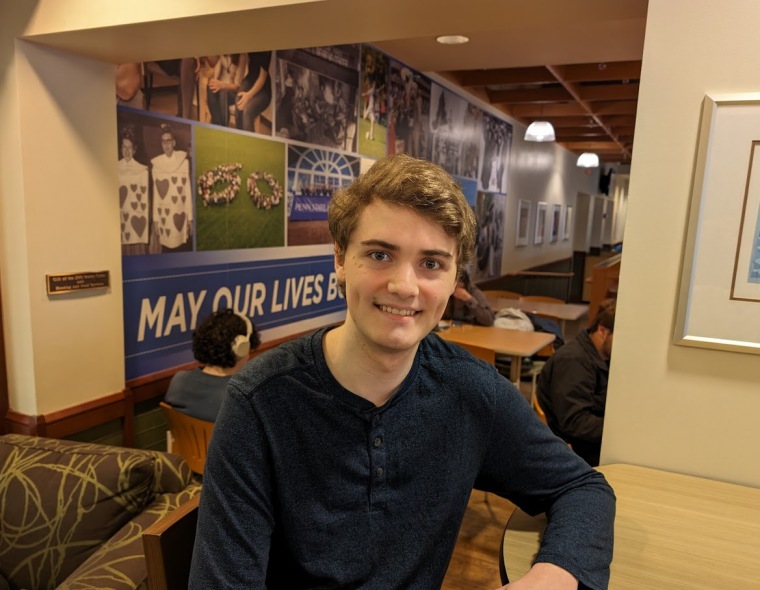
Sean Martin, a junior Digital Media Arts and Technology major, student manager of BOLD-C, and president of the Digital Creations Club, spearheaded the effort to bring the semester-long series to Behrend. He chose the films from three different streaming services available to the Penn State community, taking care to find a wide variety.
“Students, faculty and staff should come and watch these films because they offer a completely unique and compelling look into a different culture, time, and story from an artistic perspective,” Martin said.
Showing this Friday, October 11, is Battleship Potemkin, a film set “in the midst of the Russian Revolution of 1905 when the crew of the battleship Potemkin mutiny against the brutal, tyrannical regime of the vessel’s officers. The resulting street demonstration in Odessa brings on a police massacre.”
Several more films are planned this semester. Martin said that he is especially looking forward to L’Age D’or on October 25 and All About My Mother on November 1.
The yearlong celebration of Penn State Behrend’s 75th anniversary has been an opportunity to reflect on the growth of the college and the contributions of those who helped make Behrend what it is today.
With help from Rod Troester, associate professor emeritus of speech communication, we have collected stories and life lessons from retired faculty members who remember a very different Behrend. Here are some of their reflections:
“I never looked at my time at Behrend as ‘work.’ I felt comfortable slipping into my office in the evening or on weekends in my slippers, often bringing my dog, Ginger, with me for company.
“I took advantage of the swimming pool and the ski slope behind the Otto Behrend Science building. I recall my daughter, Rebecca, then just a youngster, proudly coming over from the swimming pool to my office and informing me that she was able to swim two lengths of the pool. This entitled her to be on the forward deck of our sailboat.
“I loved teaching, and doing so at Behrend. I found it a joy to go to work each day.”
~ Robert Tauber, professor emeritus, education
**************************
“I remember traveling with Dean Baldwin and students to the College English Association conference in Pittsburgh, where we shared an elevator with John Updike. We also went to the Shakespeare Festival in Stratford, Ontario, where we saw Christopher Plummer perform the title role in ‘King Lear”; and to the PEN International conference in Toronto, where I had a conversation about melons with Arthur Miller in an open-air market.
“None of this would have happened without the help of the terrific Behrend community of faculty, staff and students.”
~ Greg Morris, professor emeritus, American literature and English
**************************
“I was hired in 1968. My husband, Ben Scott, taught in the Physics department. He was hired the same year I was and retired in 1988.
“I was a chemist. During my 36-year tenure at Behrend, I saw the college develop from a two-year feeder institution to University Park to a flourishing, four-year campus.
“I retired in 2004. I stay in touch with the chemists, and with a few other faculty members in the School of Science.”
~ Mary Chisholm, professor emerita, chemistry
**************************
“I was hired in 1970. That makes me second-generation Behrend Center faculty, but first-generation Behrend College faculty. I was part of the crowd of newbies hired that year to staff the four-year majors that were to make Behrend a baccalaureate-granting institution.
“There was little to work with at the time. Some of us joked that launching the college was like an old Mickey Rooney—Judy Garland movie: ‘Gee, kids, let’s put on a show in the barn.’ But Behrend provided a wonderful and unique opportunity for a career. In an age of academic retrenchment, Behrend bucked the trend and gave us a shot at a much more exciting and fulfilling project. It’s growing success is an achievement well worth celebrating.”
By Heather Cass, Publications Manager, Penn State Behrend
Dr. Gary Viebranz, professor of music and director of instrumental ensembles, at Penn State Behrend.
Music is as close to time travel as humans can get. Hearing a particular song can transport you to your early childhood dancing in the kitchen with your mom, to your first solo drive after getting your license, to your high school prom, to the day you buried a loved one.
“Music is a visceral thing that can actually cause changes to our body chemistry,” said Dr. Gary Viebranz, professor of music and director of instrumental ensembles, which includes jazz, concert, and pep bands. “It can make us happy or provide an outlet for pain or grief. Some songs are forever burned into our memories. I can remember songs that I played when I was seven years old.”
And, yes, he has been making music since he was a child. Viebranz got his first instrument—a paper-headed drum set—for his fourth birthday. By six years old, he was playing the trumpet.
“It came somewhat naturally to me, and I practiced a lot because I enjoyed it, so work ethic was easy for me to find,” he said.
Fortunately, he had parents who encouraged his musical inclinations as he grew up in Strongsville, Ohio.
He knew early on that he wanted to be a music teacher. For several years after college, he taught music at the high school level in the Cleveland area. A return to graduate school opened his eyes to the possibility of teaching college students.
“Crazy as it can be at times, teaching at the collegiate level is much calmer and more predictable than public high school,” he said.
He joined Behrend in July 1999 and will retire in June, after his twenty-fifth year. We sat down with Viebranz to learn more about music education, his career, and his post-retirement plans.
Can anyone learn to play an instrument?
Yes, but it takes more persistence than some people want to put into it. It’s never too late, though.
How many instruments can you play today, and what is your favorite?
Tuba, baritone, trombone, and bass guitar. Tuba is my first love and my go-to.
Is there an instrument you want to learn in retirement?
There are things I’d like to play around with, like my theremin, which is an electronic instrument that you don’t actually touch, and I’d like to get back to playing bass guitar again.
Not everyone who participates in a band wants to be a musician, so why do you think students make time for it?
The point of music education isn’t to have a career in music. It’s to spawn creative thinking and to make something abstract into something you can hear and feel. Also, it can serve a lot of purposes in a person’s life. It can be a way to escape or grieve or relax or find joy or relieve stress.
What is your most memorable teaching moment?
To be honest, it wasn’t a positive one, but I think it’s worth sharing. In a general education music class, I shared something interesting that was outside the curriculum of the class and said, “That won’t be on the test, though,” and a student asked, “Then why are you wasting our time?” I was shocked by the idea this student had that because something wouldn’t be on the exam, it wasn’t important or worth knowing.
What other changes have you noticed in teaching for twenty-five years?
It’s become harder to find inroads into students’ mindsets, to widen the focus and have them entertain the idea that there is not always a single solution or result, but that there can be many ways to achieve an expected result.
One of your most popular classes was about the Beatles. What did you cover?
We studied everything from pre-Beatles to Beatlemania and on though the group’s breakup. They recorded thirteen commercial albums, which made it easy to set up the course by covering one album each week through the semester.
Music at Noon, which you also directed, is one of the college’s most enduring musical traditions. How did you get involved?
The program had been going on for ten years when I came to Behrend. Several years later, I said I would do it for a year, and here we are. It’s been going strong for thirty-four years. I have been involved for seventeen of them. And, yes, it will continue after me.
Are there any Music at Noon performances that stick out in your memory?
In their own way, they have all been memorable. You have to live each concert in the moment. One of the unique things about the program is that it draws an all-ages audience, from Erie City elementary school children to college students to older community members.
What would people be surprised to find on your Spotify playlist?
Well, you might be surprised to know that I don’t have Spotify. That said, I have eclectic musical tastes. I’m open to listening to anything, and I don’t worry about labels. Of course, I enjoy the music of my youth, things that were popular in the mid- to late-1980s, the most.
What will you miss most about Behrend?
The people: Many students, staff, and faculty members become like family.
Dr. Gary Viebranz, professor of music and director of instrumental ensembles, conducting his final Concert Band performance at Penn State Behrend in April 2024.
VITAL STATS AND PARTING THOUGHTS
Family: Wife, Mari; Daughters, Sofia, 26, and Elizabeth, 23.
First concert: “My older sister took me to see John Denver at the Blossom Music Center in Cuyahoga Falls, Ohio, when I was young.”
Perfect song: “I don’t know that perfection exists because it’s an arbitrary measure. Perfect presents itself in the moment when the right song comes on at the right time.”
A song he will always sing along with: “’Jar of Hearts’ by Christina Perri. I love to blast it in the car and harmonize along.”
Non-music hobbies: “I love to bike, kayak, and travel.”
Retirement plans: “My wife is still working, and she loves her job, so I’ll be in Erie for the foreseeable future. There are some passions I’d like to revive, like singing, bowling, and fishing.”
By Heather Cass, Publications Manager, Penn State Behrend
Eric Oelhaf, Penn State Behrend Political Science major.
While at Penn State Behrend, Eric Oelhaf, a senior Political Science major, added something to his resume that few college students can claim: His work has been published in The Wall Street Journal.
In fact, he has had three pieces published in the WSJ’s “Future View” column, in which they invite undergraduate and graduate students to offer their opinion on current topics from Twitter’s rebranding to the future of the NFL to foreign policy to ChatGPT.
We talked with Oelhaf, a State College native, to learn more about why he wanted to contribute, how he got published, and what he has gained from the experience.
How did you learn about “Future Views”?
Dr. Maggie Shum, assistant professor of Political Science, mentioned it in a class that I took with her in the fall semester. Though it’s known to be a conservative publication, The Wall Street Journal said it was trying to provide a diversity of viewpoints in this feature.
Did you immediately contribute?
No. I looked at it as a national writing competition and decided that I was only going to contribute if I had something unique to say. I felt that would improve my odds of being selected. I was surprised that they printed the first one I submitted, which was the piece on the border crisis. The second one was the piece on why people don’t trust scientists.
Then you submitted one about aid for Ukraine?
Yes. That one was a strategic choice. I wanted to dispel myths that are prominent in conservative information spaces about the costs of sending aid to Ukraine. Of course, the reason to support Ukraine is that it’s the right thing to do. Russia has historically tried to eradicate the Ukrainian language and identity from existence since the times of the Russian Empire. And languages are a particularly important part of European political philosophy.
Does the newspaper edit the pieces?
The one on the border crisis is nearly identical to what I submitted, and those are really my thoughts on the matter. There was light editing on the Ukraine piece. But the trustworthiness of scientists’ piece was heavily edited. Looking back on that, I realize that was my fault.
How so?
I had tried to have a more in-depth discussion than what the 250-word-limit would allow, and I didn’t end up making a clear argument in what I originally submitted. The editor then rewrote some of it operating under the assumption that I was trying to critique the behavior of just the authority figures, which I wasn’t. It was a misunderstanding that I know now I could’ve prevented.
What has been the response to your work?
It’s interesting to read through the comments. I’ve learned that people will complain about anything unless your reasoning is airtight or in line with what they believe. I was called an elitist for providing context on the border crisis. Sometimes, readers will even complain that they are listening to college students, despite clicking on a column clearly labeled “Future View.”
What have you learned by reading the feedback?
It seems the current American news consumer is addicted to anger, and the media is more than happy to feed that addiction.
What other topics interest you?
I care most about what is happening in Ukraine and, as a result, I’m concerned about the current state of Congress. I’m also interested in artificial intelligence and the ways in which it’s being handled by our government.
What would people be surprised to know about your generation regarding politics?
My generation seems to care about efficacy to a greater degree than older ones. We want our politicians to be good at what they do. We don’t want them to continually take half measures on humanitarian crises cause by our allies, nor do we want them to spend six months trying to pass a budget.
What do you want to do after college?
I like foreign relations, so I may pursue a career in government in that field. I would certainly take a job in journalism, too, if I had the opportunity.
Penn State faculty, staff, and students have access to The New York Times and The Wall Street Journal at no cost through the Student News Readership Program. To take advantage of this program, you must register using your Penn State email. Learn more at Penn State’s Student Affairs website.
Behrend is home to a wide variety of frogs and toads, but have you ever wondered where they go in winter?
They don’t migrate or hibernate; they brumate.
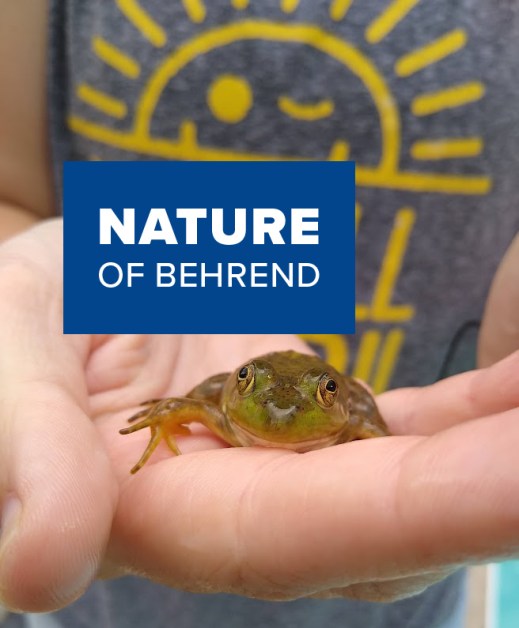
Brumation is to amphibians what hibernation is to mammals. When temperatures drop and the days get shorter, amphibians seek out a warm, safe hiding place where their metabolism slows to the bare minimum, and they rest until spring.
“Amphibians brumate differently depending on the species,” said Dr. Lynne Beaty, assistant professor of biology. “Some, like pickerel frogs and bullfrogs, brumate underwater; some, like American toads, brumate on land underground below the frost line; and some, like spring peepers, gray treefrogs, and wood frogs, brumate in the freezing zone.”
If “the freezing zone” sounds like a frigid place to spend the winter at Behrend, be assured that it is. Not only is it cold, but it’s very cool in a nature-is-so-amazing way.
“All frog species that overwinter in the freezing zone exhibit some degree of freeze tolerance—that is, up to sixty percent of the frog can freeze solid and survive. They just thaw out when warmer temperatures arrive,” Beaty said.
“This is primarily due to the action of cryoprotective compounds (i.e., antifreeze) that prevent vital parts from freezing completely,” Beaty said. “Many of these organisms also have an inherent ability to resist structural damage when ice crystals form in the body, and their cells are particularly hardy in the face of massive dehydration that occurs during the freezing process.”
Of all the frogs that do this, the wood frog can handle freezing temperatures the best, which is why they have the northernmost range of all frog species in North America.
“Wood frogs, which we have on campus, are the real ‘super freezers,’” Beaty said. “Watch this cool video to see why.”
________________________________________________
NATURE OF BEHREND is an ongoing series highlighting Behrend’s unique environment, beautiful campus, and outdoor learning opportunities. New items are posted every Monday on the college’s Facebook and Instagram pages.
Do you have question about something you’ve seen outdoors at Behrend — trees, plants, animals, insects, paths, artifacts, etc.? Email hjc13@psu.edu and we may cover it in a “Nature of Behrend” post, story, or video.
By JoLayne Green, Contributing writer, Penn State Behrend
Graduate found confidence, voice when she landed in the right program for her
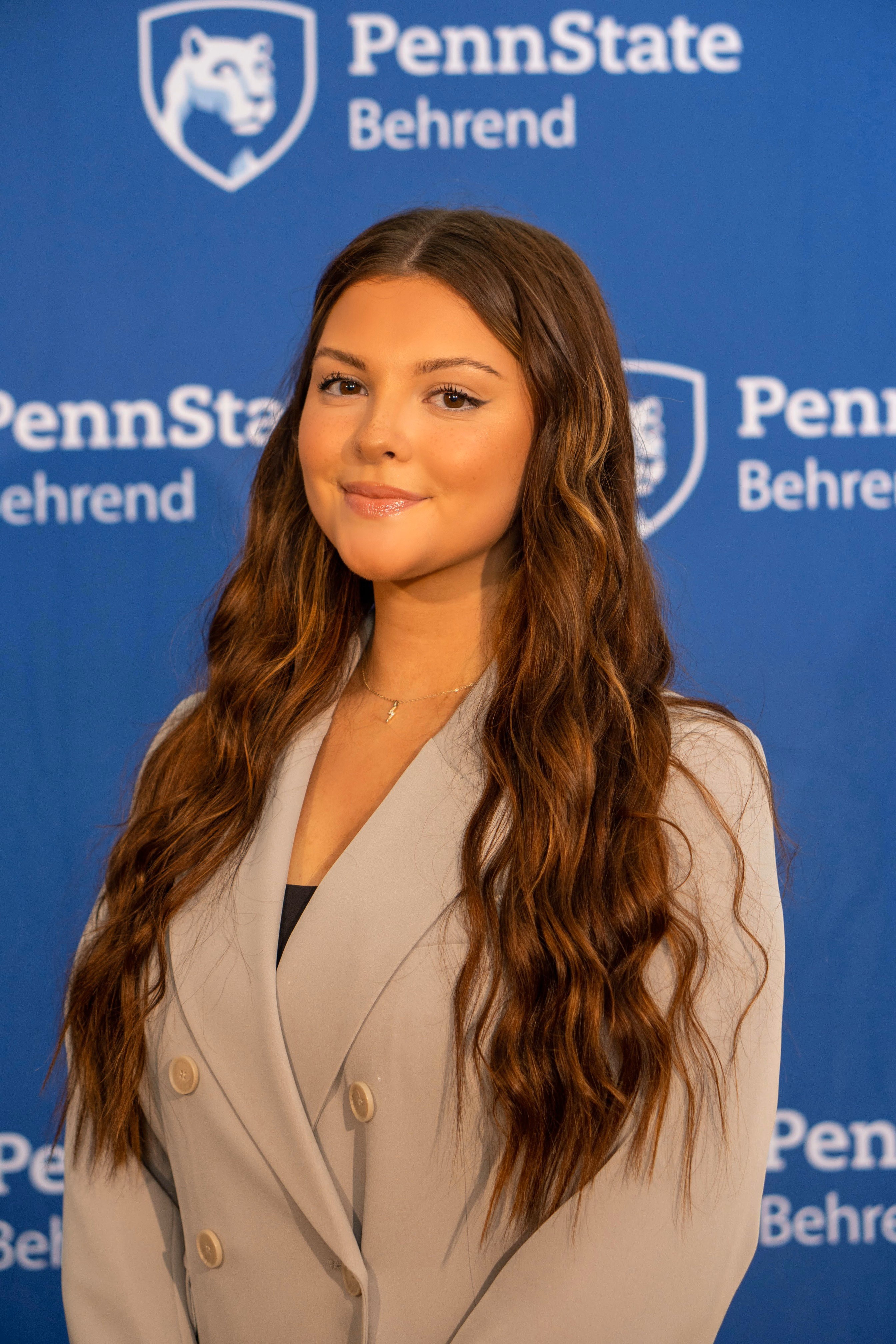
When Gabi Watson switched her major to English at Penn State Behrend, she finally found her path—and her voice. It just took a little courage for her to follow a passion that was there all along.
“I did every other possible major,” Watson said, with a chuckle.
An Erie native who graduated last semester, Watson started in Forensic Biology at University Park. She learned that a STEM (science, technology, engineering and math) field wasn’t truly what she wanted. Her college journey led her to Behrend and included stops in the Division of Undergraduate Studies and the Political Science program.
“I finally realized I belonged in liberal arts,” she said. “I fell in love with the English program and the teachers in it.”
“I love how close-knit the campus is and how beautiful Behrend is,” she said. “I got all four seasons here in my hometown where I got a great education and had a close relationship with teachers.”
Before landing in the English department, Watson did a little soul searching.
“I grew up reading. I knew I loved English, but I didn’t know if I loved literature,” she said. “I thought choosing English would mean I would just be reading a lot of poetry.”
Then Watson discovered how diverse a degree in English is.
“I didn’t know how many options there were in writing. I felt I was floating around in the English department until I took Writing for the Web,” she said. “I found out you can have a great career in something you are passionate about.”
While she concentrated on professional writing, it was creative writing classes that helped her find her own voice.
“I learned a lot about expressing emotion and how to transcribe my thoughts into words,” she said.
Watson’s budding confidence carried into extracurricular activities. Describing herself as an introvert, she was a junior before becoming involved in activities at Behrend such as the Lion Entertainment Board and an Alternative Spring Break service trip.
She grew from observer to participant to executive director of the Lion Entertainment Board, helping to advance the club from four members to more than thirty while developing event planning skills.
Watson credits her advisor, Dr. Massimo Verzella, associate professor of English, as well staff members in the Office of Student Leadership and Involvement (SLI) with putting her on a path to success.
“Dr. Verzella changed the trajectory of what I wanted to do in my life,” she said. “He educated me on possibilities I didn’t know existed. I don’t think I’d be as social or as well-rounded as I am now without his support and that of SLI staff members.”
In turn, she began mentoring other students.
“I learned I like leading a team and helping people find their passion, and wanted to help other students figure out what they were good at,” she said.
Watson’s success in leadership was recognized beyond campus when she was chosen to receive the 2023 ATHENA Young Professional Award, celebrating emerging women leaders in Erie.
Watson, who graduated in December 2023, envisions a career that involves writing, generating social media content, travel, event planning, and possibly work in diversity, equity, and inclusion. First, she is going to Walt Disney World for a six-month stint in the Disney College Program in Florida.
After that? Who knows, but she knows she won’t be a silent observer.
“You can be an introvert and still be a leader,” she said. “I never thought I could, but with the right support, I’ve been able to find my voice in writing and in leadership. Wherever I end up next, I know Behrend has given me a solid foundation to build on.”
Office of Strategic Communication, Penn State Behrend
One thing Sophia DiPlacido knew for sure when she started at Penn State Behrend is that she wanted to leave — for at least a semester.
“I have always wanted to study abroad,” said DiPlacido, a junior dual majoring in Marketing and Psychology. “I was slightly worried about language barriers, though, so I looked at countries with residents who spoke English as a first or second language.”
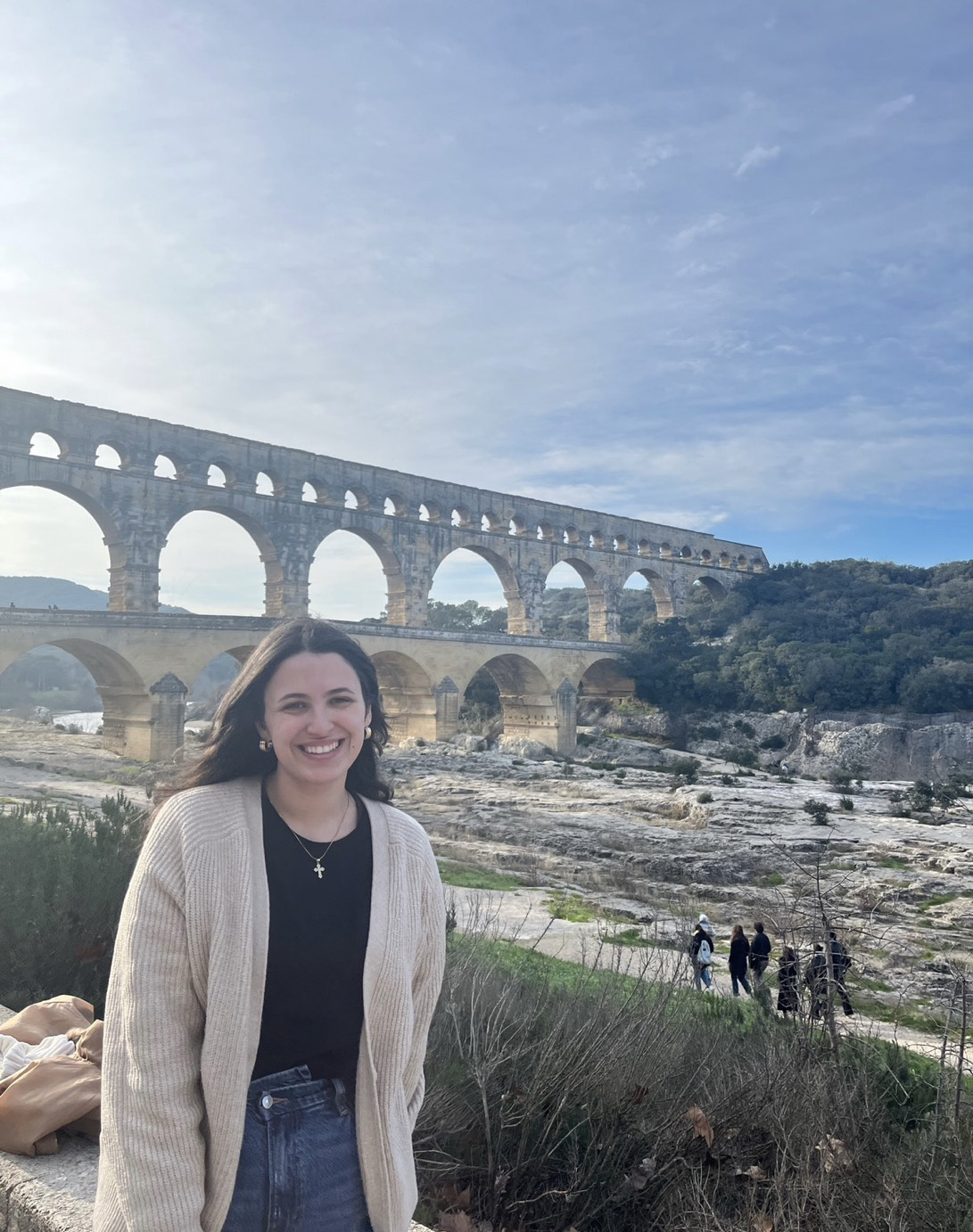
She ultimately chose France and set off in January to spend the spring 2023 semester in Aix-en-Provence, known as “Little Paris.” She lived with a host family in a home with three other students who were also studying abroad from other U.S. universities.
“My host mother had done a study abroad experience, so she wanted to help others have that opportunity,” DiPlacido said.
She took five classes–International Business, French, History of Christianity, Wine Marketing, and Drawing and Painting–at the Institute for American Universities, where DiPlacido said curriculum is king.
“Extracurricular activities are not a thing in European universities,” she said. “College in France is actually closer to what I had been told in high school that college would be like, which is to say that instructors would not be very accessible, the classes would be mostly lectures, and your grade was made up of a few exams.”
While her college experience was quite different from the experience at Behrend, DiPlacido said she quickly felt at home in France.
“I easily adjusted,” she said. “The geography reminded me of California, and the people were very welcoming, which is not what you sometimes hear about the French. I expected to encounter some resistance because I didn’t speak their language, but everyone was nice about it.”
She didn’t have classes on Fridays, so she was able to explore several nearby countries as travel throughout western Europe is relatively easy and inexpensive. Among her many adventures: visiting the Eiffel Tower in Paris; skydiving in Switzerland; scuba diving in Marseille; making pasta in a cooking class in Venice; and seeing the Cliffs of Moher in Ireland. She also visited Budapest, Brussels, London, Madrid, Nice, and Prague as well as cities in Germany and Luxembourg.
DiPlacido said that all that travel helped her develop important life skills.
“I didn’t have a strong sense of direction,” she said, “but I developed it getting around on my own. It gave me a lot of self-confidence.”
DiPlacido said she would recommend a study abroad experience to students in any major but cautions that it takes work to prepare for it, even with guidance from Behrend’s Learning Resource Center, the campus experts on global programs.
“You have to be proactive and get your visa and passport and stay on top of what needs to be done when,” she said. “But in that responsibility is personal growth. Studying abroad was the most amazing thing I have ever done. You come back a whole different person with an entirely new perspective on the world.”
This slideshow requires JavaScript.
STUDY ABROAD BASICS
Does it have to be a full semester?
No, at Behrend, the international study experience can be as short as ten days or as long as a full academic year, depending on the type of program a student selects. International study programs are happening throughout the year—during fall and spring semesters, at semester breaks, and over the summer.
Do you need to speak a second language?
No, but you do have to be a strong student, academically, to be eligible for international study. The minimum grade point average is a 2.5, and many programs require a 3.0. Prerequisites vary by program.
How much does it cost?
Cost varies depending on the program and location a student chooses, but you can expect to pay tuition, travel expenses, and for meals and personal expenses while abroad.
Scholarship funds are available for those who qualify. DiPlacido received funding from Penn State Behrend’s Study Abroad program and the University’s Schreyer Honors College, and she won a competitive Gilman Scholarship, which is administered by the U.S. Department of State.
How can a student learn more?
Attend a Study Abroad Information Session. Meetings are held weekly at Behrend throughout the semester. A list of upcoming sessions is available at behrend.psu.edu/studyabroad, where students can also learn about the different types of programs; explore upcoming opportunities; and find out about the application process and deadlines, as well as financial aid and scholarships.
Penn State Behrend’s Class of 2023 is ready to make its mark on the world! We’re proud of our students and the things they’ve accomplished and learned while here at Behrend. Over the next several weeks, we’ll be introducing you to a few of our remarkable seniors who have overcome challenges, pioneered new technology, participated in important research projects, and left an impression at Penn State Behrend.
Today, we’d like you to meet Chase Schultz.
Major: Mechanical Engineering
Hometown: Edinboro, Pennsylvania
Scholarships: Erie Insurance Open Doors Scholarship; Moyer Trustee Scholarship; Arloween Zurn Todd Leadership Scholarship; Jim and Lynn Levinson Memorial Scholarship for Penn State Behrend’s Educational Partnership Program; ASM International Northwestern Pennsylvania Chapter Scholarship; and Ryan E. Knoll Open Doors Scholarship
On choosing his major: Mechanical Engineering is very broad, and I knew I would have a lot of opportunities in many different industries.
Proudest accomplishment at Behrend: Participating in the Steel Founders’ Society of America (SFSA) Cast in Steel competition twice, creating a sword and a spear. These two projects were done through the Materials and Manufacturing Group (MMG) club. We handled all aspects of creating a new Celtic Leaf sword and an African spear point, exploiting the casting manufacturing process from design conception to performance.
Campus involvement: I’m the president of the Outdoors Club and treasurer of the Materials and Manufacturing Group.
His definition of living a good life: Working hard, playing hard, and loving even harder.
Passion project: In 2017, a friend and I started a brand called flowdaddyfishing. We have an Instagram page to promote hunting, fishing, and making the most of every day.
Advice for first-year students: Get your priorities straight and go after what you want. Make friends who are smarter than you are. Find some healthy hobbies. Work hard and accept that college, and any career path, is going to be difficult. Without the struggle, there will be no reward.
Have job, will travel: I’m looking forward to my job at ExxonMobil. I will have the opportunity to travel domestically and internationally to both inland and offshore well site locations on a rotational schedule.
Chase has accepted a position as a well operations supervisor with ExxonMobil following his graduation in May.
Penn State Behrend’s class of 2023 is ready to make its mark on the world! We’re proud of our students and all that they have learned and accomplished here at Behrend. Over the next several weeks, we’ll introduce you to a few of our remarkable seniors who have overcome challenges, pioneered new technologies, participated in important research projects, and made their mark at Penn State Behrend.
Today, we’d like you to meet Carly Evans:
Major: Marketing
Minor: Communication Arts and Mass Media
Hometown: Pittsburgh, Pennsylvania
On choosing Behrend: I chose Behrend because of the Black School of Business and the Penn State network of resources. Also, I like that you are not just a number here and are able to build strong connections with professors and staff.
On choosing her major: I chose Marketing because it’s versatile. From content creation and social media marketing to analytics and search engine optimization, there is something for everyone. I have always enjoyed the creative aspects of marketing and how a career in the field can look different each day.
Campus involvement: I am a member of Alpha Sigma Alpha sorority. I have held several leadership positions in our chapter over the years.
Her definition of living a good life: Being somewhere warm and sunny, surrounded by my family and friends and my cat, Daisy. I think that living a fulfilling life is prioritizing self-care but giving that same energy back to the important people in your life. Making a difference in the lives of others starts with you.
Her passions: In my free time, you can find me on the golf course, creating art, or seeking out a new coffee spot. I’m a pretty go-with-the-flow person, so I’m always down to try something new.
Advice for first-year students: Use your resources and don’t be afraid to ask for help. College can be overwhelming at times. Keeping an organized planner has helped me keep track of my schedules, class assignments, and extracurriculars. Also, get involved. Being a part of a club or organization can greatly develop your leadership and problem-solving skills and your confidence.
Office of Strategic Communication, Penn State Behrend
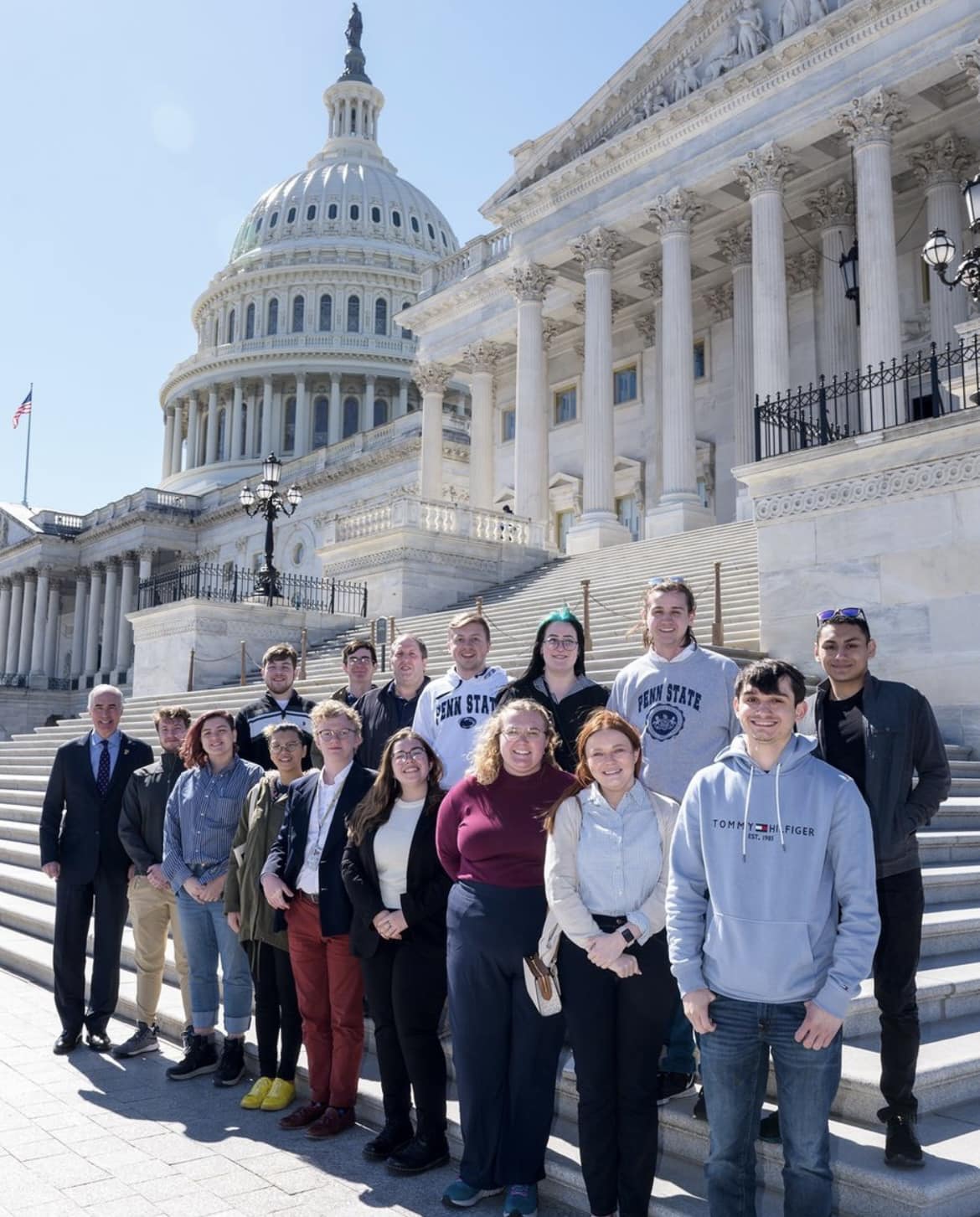
Penn State Behrend students with U.S. Senator Bob Casey Jr. at the Capitol Building in Washinton, D.C.
Political Science class gets a first-hand look at how U.S. government works
It’s one thing to study the U.S. government and how it operates in Washington, D.C. It’s another to experience it, walking the same halls that senators and congresspersons do, sitting in the same courtrooms where federal judges preside, and meeting with foreign ambassadors and lobbyists.
“After being taught in the classroom, actually seeing the historical locations in person gave me a whole new perspective,” said Justin Lopez-Beltran, a second-year student dual majoring in Political Science and Economics.
More than a dozen Penn State Behrend students enrolled in Dr. Robert Speel’s PLSC 177N Politics and Government of Washington, D.C., spent their spring break in our nation’s capital where they squeezed a lot into one week.
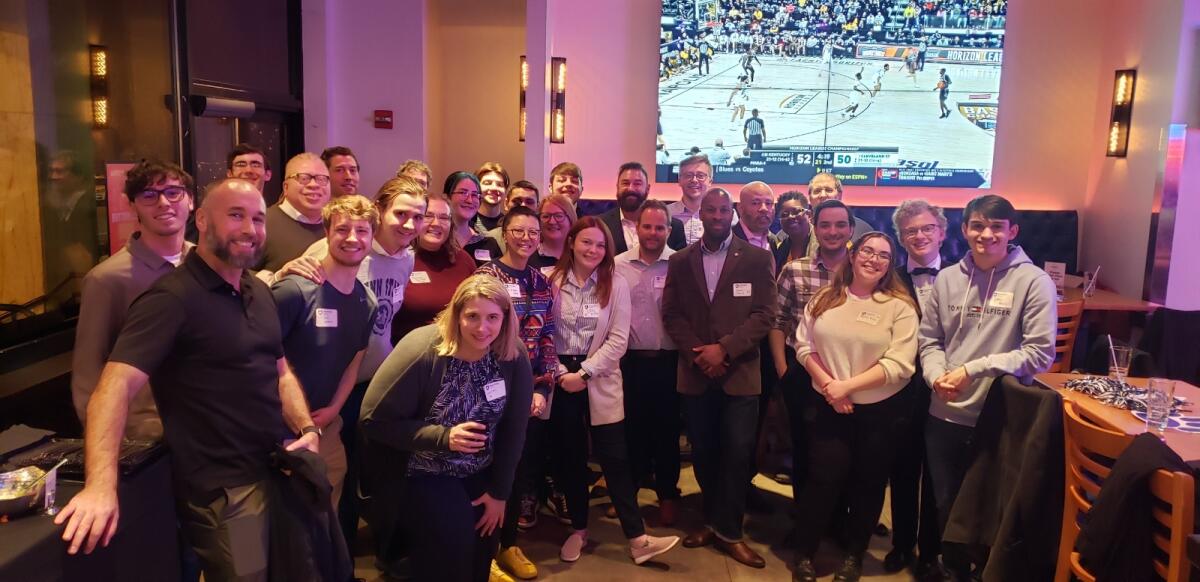
The group met with members of Congress and leaders of federal government agencies; received briefings from foreign embassies and international organizations; participated in seminars led by interest groups, political party officials, and consultants; and toured government offices and facilities. They visited monuments, memorials, museums, and Arlington National Cemetery, and met with many Penn State Behrend alumni who live and work in D.C.
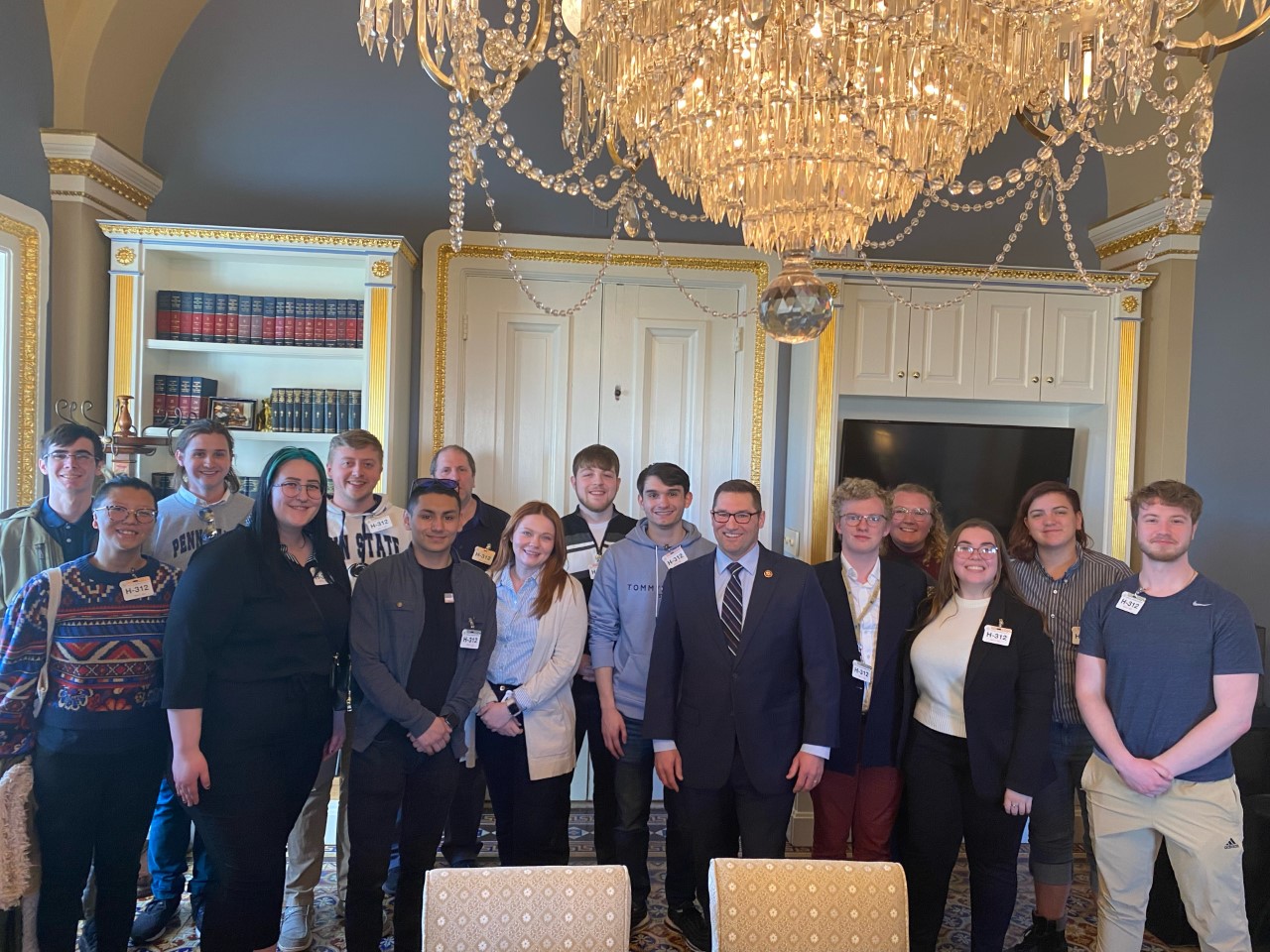
Among the alumni in D.C. is U.S. Representative Guy Reschenthaler (R-Pa.), a 2004 Political Science graduate, who serves on the House Rules Committee and invited the students to sit in on a committee meeting.
Penn State Behrend students with U.S. Representative Guy Reschenthaler (R-Pa.), a 2004 Political Science graduate (center in striped tie) in Washinton, D.C.
“This is not something the average person can do,” said Casey Mitolo, a fourth-year Political Science major. “He even gave a shout out to the class and Dr. Speel during the meeting. It was special.”
“My favorite part was visiting Capitol Hill and seeing all the politicians you admire and even some you might disagree with,” Lopez-Beltran said. “After taking multiple political science courses, it was fascinating to see politicians we have discussed and even argued about in the classroom.”
Classmate Nicklas Richar, a second-year Political Science major, agreed. “It was really cool to be inside the Capitol building and to see all the senators and representatives I’ve watched on TV and realize that they are real people doing an actual job.”
Mason Milliard, a third-year Political Science major, said he especially enjoyed meeting with Behrend alumnae Yuri Unno, director for international trade policy for Toyota, and Elizabeth Buck, deputy assistant director of the U.S. Marshals Service. “It was also really interesting to watch votes from the Senate and House galleries and sit in for a lecture at the Supreme Court,” he said.
Mitolo was surprised by the number of Behrend alumni in the capital. “It was extremely eye-opening to see all the doors that a Behrend Political Science degree can open,” he said. “We met alumni who work as political consultants, representatives, union leaders, and much more.”
The students interviewed for this story all agreed that the experience solidified their career choices.
“It was one of the most fascinating experiences of my life,” Richar said. “Every single place that we visited had a rich history and important part in how our government functions. It really inspired me to continue in my career path, and I learned that the potential for jobs in this field is endless.”
“This trip 100 percent solidified my career decision,” Lopez-Beltran said. “I learned that there are countless opportunities in D.C. and a wide variety of options from campaign work to legislative work to lobbying.”
This slideshow requires JavaScript.
4 Takeaways
Things are not always what they seem: “I learned that, occasionally, lobbyists are the ones who have to rein in the legislators,” Milliard said. “It was surprising to hear that, from a lobbyist’s perspective, they sometimes must remind politicians that the ideas they are pushing are unrealistic. This contradicted a belief I had that politicians were the ones who had to curtail persistent ‘radical’ lobbyists.”
It’s more complicated than it seems. “I learned how many outside influences affect how lawmakers make legislation,” Richar said. “We learn in class about the types of legislation they create but not always about the work that goes into it or what causes lawmakers to think the way they do. Now, after meeting them, I have a much better understanding.”
Prepare for a workout. “The trip was exhausting!” Mitolo said. “We walked more than ten miles one day, according to my Apple watch. But it was totally worth it.”
D.C. runs on youth. “One of the staff members that I spoke to privately made a joke about how the government is really run by a bunch of 20-year-olds, and it made me laugh because it was clear that there was an element of truth to it,” Lopez-Beltran said. “They were the ones rushing around delivering mail, moving legislation, setting up tours, and more.”
Penn State Behrend students meet with some Behrend alumni who live and work in Washington, D.C.




 conference in Pittsburgh, where we shared an elevator with John Updike. We also went to the Shakespeare Festival in Stratford, Ontario, where we saw Christopher Plummer perform the title role in ‘King Lear”; and to the PEN International conference in Toronto, where I had a conversation about melons with Arthur Miller in an open-air market.
 generation Behrend College faculty. I was part of the crowd of newbies hired that year to staff the four-year majors that were to make Behrend a baccalaureate-granting institution.





 BEHREND BLOG