When You Give an Engineer a Problem….

By Heather Cass
Publications Manager, Office of Strategic Communications,  Penn State Behrend

Plastics recycling - Valerie Zivkovich and Olivia Dubin - horiz.jpg

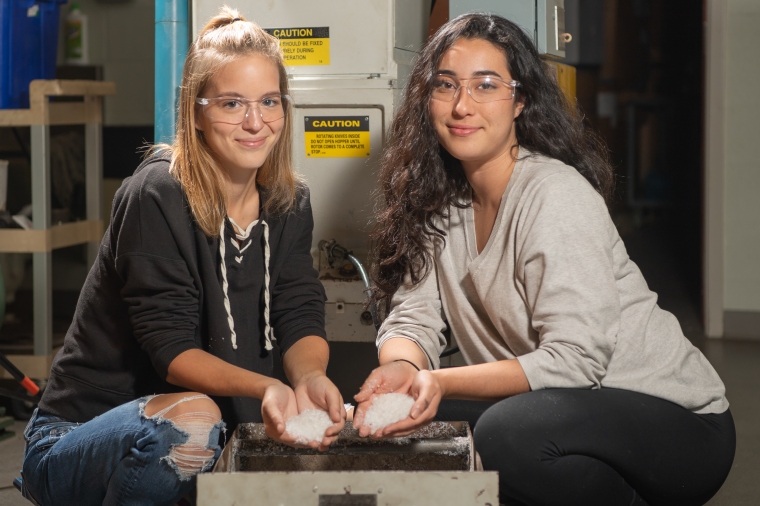
Valerie Zivkovich and Olivia Dubin, seniors majoring in Plastics Engineering Technology.

Engineers are problem solvers by nature. So it should come as no surprise that when faced with a recycling conundrum, students in Penn State Behrend’s School of Engineering saw an opportunity.

The quandary

China, which is the largest consumer of recycled material from the United States, has significantly reduced the amount and types of material it will accept and introduced strong restrictions on contamination, i.e. trash mixed in with recyclables.

This has forced a wave of changes in the U.S. recycling industry.

“Waste Management has had to adjust the way it recycles materials to ensure those materials pass through numerous quality checks and has also found it necessary to pass on increased costs to customers, including Behrend,” said Randall Geering, senior director of business and operations. “The impact of these changes is being felt everywhere, not just on our campus.”

The bottom line: Recycling is becoming harder and more expensive for consumers and businesses to do and unprofitable for material recovery facilities.

It is not hard to see how this could lead to complete breakdown in the recycling system.

Seeds of change

Recycling and the waste generated by landscaping containers is what led Valerie Zivkovich, a senior from Gibsonia, Pennsylvania, to the Plastics Engineering Technology (PLET) program at Penn State Behrend.

“I worked at a vegetable farm in high school, and we were constantly throwing out plastic containers that the plants were in,” Zivkovich said. “We couldn’t reuse them because of potential contaminants in the soil, and I understood that, but I thought there had to be a better way. I wanted to develop a better plastic for agricultural use.”

Zivkovich and her capstone project partner, fellow PLET senior Olivia Dubin, had heard the uproar from the Penn State Behrend community about the prospect of no longer recycling and realized the campus could recycle its own plastic bottles.

At a campus-wide meeting with Waste Management officials, Zivkovich and Dubin presented a proposal to collect, clean, and pelletize bottles into raw material that could then be used to create new products.

“Basically, we’ll collect plastic bottles—primarily PET (polyethylene terephthalate) and PP (polypropylene) such as pop bottles, Starbucks cups, etc.—then grind them up into tiny pellets and use or resell them to a vendor,” Zivkovich said.

They worked on their initial plan with Jason Williams, assistant teaching professor of engineering.

“I think this could work because we already have most of the equipment and skills in our plastics department,” Williams said. “We are unique in that we have both a plastics factory and a research facility. This combination of resources makes Behrend a great place to test something like this.”

Waste Management agreed and awarded the students a $3,000 Think Green grant to help get the program going.

“The recycling industry is changing, and it’s going to take projects like this one to help identify different markets for material,” said Erika Deyarmin-Young, public affairs coordinator at Waste Management.

Williams is excited about the possibilities.

“I think this initiative is a valuable teaching tool and a demonstration of how engineers can make things better,” he said. “It will also give us tools we can use to study ways to handle post-consumer waste. I think there is a lot of research opportunity in developing automatic sorting technology and material handling of plastics.”

“As PLET majors, we learn about the impact and importance of recycling,” Dubin said. “We are excited to have come up with a solution that our whole campus could be involved in.”

It takes a village

The first step, Zivkovich said, is spreading the word about what can and can’t be recycled and the importance of rinsing containers before tossing them into the recycling bin.

“There definitely needs to be a campus-wide education campaign,” she said. “We need to teach others how to recycle properly with information sessions, posters, and clear signage on the collection containers.”

“We want students to get involved with every aspect of the recycling process,” Dubin said.

Other priorities include finding more funding and securing workspace. “We need a new grinder and that’s $45,000,” Zivkovich said. “We’re applying for grants to find that funding. As for lab space, we think the Merwin building in Knowledge Park would be ideal.”

Another important part of the equation: volunteers from all four schools.

“We don’t want this to be a project only for PLET or engineering students,” Williams said. “This is an opportunity for students across the college to get involved with these recycling efforts.”

Zivkovich plans to reach out to the college’s sustainability program and Greener Behrend club for help securing volunteers to sort and collect plastics.

“Whatever major you are in, you’ll deal with recycling somewhere—at home, at work, in your community,” Zivkovich said. “This effects all of us whether you work in the industry or not.”

Students learn about the business of fun

By Heather Cass
Publications Manager, Office of Strategic Communications,  Penn State Behrend

cedar point 4

On Friday, September 21, fourteen students from MGT471W Strategic Planning and Business Policy traveled to “the roller coaster capital of the world”— Cedar Point Amusement Park in Sandusky, Ohio. However, they were not there just to buckle themselves into the park’s seventeen roller coasters. This trip was all (er, mostly) business.

Amusement parks aren’t simply fun and games; they are for-profit businesses. This is something that Chris Harben, assistant teaching professor of management, is quite familiar with because he works as an emergency medical technician at Cedar Point each summer.

Harben arranged the trip so students could get a close-up look at how the business of fun is done.

Students were welcomed to the park by Missy Smith, director of finance for Cedar Point, and then experienced four hours of presentations, tours, and conversations with Cedar Point management, including Smith, Joanne Mueller, the vice president of human resources, Karen Michelson, vice president marketing, and Jason McClure, general manager, who spent the entire afternoon with the group.

“Students were surprised at the extent of the information the leadership team members shared with them,” Harben said. “Topics included staffing challenges for the park, their international hiring program, marketing strategies, financial forecasting and budgeting, park competitive positioning and strategy, growth plans, and much more.”

Students received a behind-the-scenes tour of the park, which included the corporate headquarters of Cedar Fair, the parent company of Cedar Point, and even saw “Screamsters” getting their make-up and costumes on in preparation for Cedar Point’s “Haunt at Halloweekends” event taking place that evening. They also enjoyed a meal at one of the park’s newest restaurant offerings, Melt.

After all the lessons were done, students were able to cut loose and enjoy the park for a few hours.

The students who attended were: Grace Baumiller, Kylie Cosgrove, Emily Demmick, Michael Funera, Rayna Hollarn, Kyler Luchkiw, Margo Mccullough, Chi Hou Ng, Jeffrey Smith, Madison Start, Nathan Steis, Ryan Terrabasso, and Sean Wither.

This slideshow requires JavaScript.


United Way Internship Offers Communication Major Experience, Career Confidence

By Heather Cass
Publications Manager, Office of Strategic Communications,  Penn State Behrend

United Way

Carlie Bright, far right, a senior communication major, did a summer internship at United Way of Erie County.  Also in the photo are, from left, Jana Ranus of Wegmans, Donald Snyder of Curtze Food Service, and Lisa Fischer, United Way campaign accounts manager. The three women were awarding Synder, a United Way donor, with a “prize surprise” Wegmans shopping spree.

Carlie Bright, who was born and raised in Erie, thought she knew her hometown. Then she did a summer internship at United Way of Erie County.

“I developed a whole new understanding for the community I grew up in,” Bright said. “It was very eye-opening for me. There are a lot more people struggling than I ever knew.”

Bright, a senior communication major at Penn State Behrend, worked as a marketing and communications intern for the nonprofit agency, which serves as a coalition of charitable organizations. Bright won a stipend from Behrend’s Academic and Career Planning Center, which made the three-credit experience free for her.

“Unpaid internships, like the one that I did at United Way, can be difficult for students to manage, so the stipend really helped,” she said.

Bright worked three days a week from May to August and said every day was different.

“There was no typical day because nonprofit communications departments are usually run by a few people who are faced with a wide variety and number of tasks,” she said. “But no matter what I had on my plate on a given day, I was almost always involved with website updates, scheduling social media posts, and clipping or collecting any media mentions United Way had received.”

She got to try her hand at designing flyers and creating content for electronic newsletters. She also assisted in the planning and preparation of many community events, including National Night Out, an anti-violence community initiative that took place in twenty locations on one night.

“Many of the events and activities that I was involved with were moving and inspiring,” Bright said.

The experience was also enlightening.

“Overall, the internship tied in very well with my career goals and objectives, as well as with my degree and coursework,” Bright said. “I was able to see firsthand how communications and marketing tie into every department in any business or organization. I also learned that communications professionals wear a lot of hats. Personally, I loved constantly having so many things to do.”

Silver Celebrated: Professor honored for decades of work on journal Freshwater Science

By Heather Cass
Publications Manager, Office of Strategic Communications,  Penn State Behrend

Pam Silver (21) smaller

Dr. Pam Silver, interim associate dean for academic affairs and distinguished professor of biology, was in graduate school when she submitted her first paper to what was then the journal of the North American Benthological Society (now the journal Freshwater Science).

“It came back covered in red ink,” Silver said. “The founding editor of the journal, Rosemary Mackay, worked with me and taught me how to write.”

It’s a favor that Silver went on to pay forward for twenty-one years, serving in various roles at the journal, including editor-in-chief for the last thirteen years, until her retirement from the journal this spring.

“Pam worked tirelessly to improve and grow the journal while unselfishly working in the trenches with authors to improve their manuscripts,” said Jack Feminella, professor and associate dean of academic affairs at Auburn University, and Charles Hawkins, professor in the department of Watershed Sciences at Utah State University, in their nomination of Silver for the Society for Freshwater Science’s Distinguished Service Award. “Over her tenure as editor-in-chief, Pam has been a role model and mentor to many young authors and new appointees to the Editorial Board. Aside from her incredible work ethic, Pam’s ability to work effectively with all kinds of personalities is perhaps her greatest strength.”

These attributes did not go unnoticed at Penn State Behrend, where last year Silver was tapped to serve as interim associate dean for academic affairs. It was a promotion that ultimately led her to give up her work at the journal.

“My head needs to be here at Penn State Behrend,” Silver said.

Before she left the journal, however, they honored her with a Distinguished Service Award at the group’s fall conference in Detroit.

Though Silver prefers to avoid the spotlight, we did get her to sit down for a Q&A about the award, her years at the journal, and why the sleep deprivation was all worth it.

Why are scientific journals important?

It’s a way to disseminate information in a way that ensures its validity. Is the work scientifically valid? Can the findings be trusted? If it is in Freshwater Science, it’s been peer-reviewed. Now, what you can know depends on the tools and techniques that are currently available. And, so, in that way, journals can be historically valuable, too. They contain the history of how that knowledge evolved over time. It’s also a way of creating a network of people, a community, that share information. Sharing that information can inspire more curiosity, which leads to more science. It’s like scaffolding. Scientists just keep building on top of earlier work. Every paper published is resting on a pyramid of other papers.

Tell us about the journal for Freshwater Science. Who reads it? How is it distributed? Who submits articles?

It’s a professional journal for ecologists, biologists, and environmental scientists who both read it and submit to it. The Society for Freshwater Science co-publishes the journal with the University of Chicago Press quarterly. To my knowledge, it’s the only major scientific journal in the field of freshwater science that is still society-published. Most other journals have been sold to commercial publishers. There is both a print and an online version that is available to SFS’s 1,500 members.

Are all submitted papers published?

Definitely not. Articles are fully peer-reviewed. The editorial board rejects about 60 to 65 percent of submissions.

How did you get involved with the journal?

The journal was founded when I was in graduate school and I submitted a paper. The editor bled red ink all over it, but she taught me how to make it better. I actually thought, ‘I want her job.’ I applied to be a member of the editorial board (they review the science in the papers) and was accepted in 1997. In 2002, they asked me to be a co-editor. When Dave Rosenberg, the journal’s second editor-in-chief retired in 2005, they asked me to take the job.

This was in addition to your full-time job as a biology professor at Behrend?

Yes. It was like having another full-time job. I probably worked an additional forty hours a week editing articles and working with the writers.

What would people be surprised to know about editing a scientific journal?

The amount of work that it requires. Each article involved about twenty hours of time, and we published about 100 articles a year, so that’s about 2,000 hours annually. By the time an issue published, I will have read and edited every page at least four times.

Were you responsible for reviewing the science, too?

No. The editorial board did all the science. I did the wordsmithing and double-checked the science.

The people who nominated you for the award said you did that very well.

Yes, I know that the journal got a reputation as a place to teach students how to write and edit. When I announced I was retiring, I heard from dozens of contributors who said, ‘How can you retire? We need you!’ I think I was a good editor. I was honest, but made every effort to be kind and I tried hard to keep our interactions informal. The authors may not have liked all the changes I made to their paper, but they usually agreed that I made it better.

What is the most frequent problem you encountered when editing?

Organization. If a paper was hard to understand, it was usually because of paragraph, sentence, or word order and inconsistency in how the authors were referring to things.

What are three things scientists (or anyone) could do to improve their writing?

  1. Use precise and concise language.
  2. Use the active voice.
  3. Use forward moving sentences.
  4. Think of the audience. If you can’t explain it to a non-scientist, you need to work on your communication skills.

One of the things you’re credited with is diversifying the organization as well as the membership.

I made a real effort to increase international diversity and bring more women onto the editorial board. I also tried to include more young scientists. Everyone has something to bring to the table and the publication benefited from having a variety of perspectives.

Why was it important to include young scientists?

For the same reason that I love to teach first-year students. They’re young and excited and full of energy and they still want to save the world. You can help mentor them to direct that energy to things that are important.

Did you enjoy editing?

I did. The biggest benefit of editing the journal was learning about so many different and interesting things in freshwater science. In any issue, I might be editing an article about the sex life of a water bug and another about microplastics in the Chicago River and another about molecular biology. Every paper was an intellectual challenge for me, and it made all the work and sleep deprivation worth it.

What’s next for you?

Well, I have plenty of work to do as the interim associate dean for academic affairs, and I’m hoping to find time to write about my own road salt research work. I’m still teaching a little, too. I have an Urban Ecology class in the spring semester that I’m very excited about. It’s going to be a fun challenge.

Harambee Dinner Brings Campus Community Together

By Heather Cass
Publications Manager, Office of Strategic Communications,  Penn State Behrend

dinner2

Flavors, customs, and tastes may differ from country to country, but food is a universal language of human beings. Sharing a meal, whether an elaborate holiday feast or a simple dinner, can unite and create community among people.

For thirty-two years, Penn State Behrend’s Multi-Cultural Council, a student club comprising of cultural student organizations, sets the table for connection among the campus community at the club’s annual Harambee dinner.

This year’s dinner is scheduled for October 4 from 5:30 to 7:30 p.m. in McGarvey Commons.

“Harambee is a word in Swahili that means ‘Let’s pull together’ and originated in the country of Kenya as a slogan for national unity,” said Andy Herrera, Director of Educational Equity and Diversity Programs and adviser for MCC. “We use this event as a way of uniting our campus community and celebrating the diversity of cultures here at Behrend.”

The annual event offers students, faculty and staff members a chance to get to know one another while enjoying an international buffet dinner and an evening of entertainment. This year’s guest speaker is Shinjini Das, a young entrepreneur, industrial engineer, global millennial influencer, and media personality. She is the founder and CEO of The Das Media Group, a boutique digital strategy consulting firm, and has been recognized for her global efforts to empower women.

The event will also feature a cultural performance with a professional touring group performing Afro-Brazilian music and the Brazilian dance art of capoeira.

“It’s really nice to see the diversity of students and community members who attend the event every year,” Herrera said. “Some students from MCC wear traditional dress from their various cultures, and group members emcee the event and speak about the importance and meaning of Harambee.”

The timing of the event is deliberate, Herrera said.

“Harambee is held in early fall every year to set a tone of cultural awareness and appreciation for the year. Like the name of the dinner suggests, it’s meant to pull us all together.”

This slideshow requires JavaScript.

If you wish to attend Harmabee, RSVP at the Multi-Cultural Council’s Behrendsync page. (NOTE: If link is not live, it will be soon!)


Students Save a Seat for Women in History

Lilley Library art exhibit invites remarkable women to the table

By Heather Cass
Publications Manager, Office of Strategic Communications,  Penn State Behrend

IMG_1464

“For most of history, Anonymous was a woman.”

This quote by author Virginia Woolf sums up the invisibility of women in the collective history of the world. Overshadowed by the accomplishments of men, few females have made it into the history books. And, yet, women have made their presence known in every aspect of human existence from art to banking to the military to the board room and beyond.

In 1979, feminist artist Judy Chicago gave thirty-nine women a seat at the table in her masterwork “The Dinner Party,” a giant sculpture that imagines famous women from myth and history engaged in conversation.

The installation art, which took more than five years to produce, is composed of thirty-nine ornate place settings on a triangular table with thirteen plates on each side. An additional 999 women’s names are written in gold on the floor. The piece toured the world, gaining an audience of millions; it is now on permanent display at the Brooklyn Museum.

Closer to home, you’ll find another dinner party happening in the John M. Lilley Library.

Students in last spring’s WMNST 106 Representations of Women in Literature, Art, and Culture taught by Dr. Sarah Whitney, assistant teaching professor of English and women’s studies, painted plates to honor a women from a wide variety of backgrounds. The students’ work is on display in the gallery space near the entrance to the library.

“For this project, students researched a woman of their choice who made significant contributions,” Whitney said. “They designed and painted on china as Judy Chicago did, using color and shape creatively to demonstrate the chosen figure’s importance. Students also wrote a reflection paper exploring their figure’s historical, and personal, impact on the artist.”

Some of the plates honor women you might expect, such as Supreme Court Justice Ruth Bader Ginsburg, author Maya Angelou, and women’s rights activist Susan B. Anthony.

Others are more surprising.

Molly Boniger, a junior English major, chose to honor Soviet sniper Lyudmila Pavlichenko.

“The purpose of ‘The Dinner Party’ was to recognize women who history had forgotten and I wanted someone who was unconventional, even by today’s standards,” Boniger said. “Pavlichenko has an incredible story. She is a young woman from a Ukrainian village who became the Soviet Union’s greatest sniper during World War II. She showed that woman can be hard and strong, and they don’t have to be the delicate, soft things that society would prefer we be.”

Boniger is an aspiring screenwriter who took WMNST 106 to learn what she suspected she was missing.

“The class was amazing,” Boniger said. “I could not believe the amount of exposure I received and just how much women’s contributions to art and culture have been excluded from the narrative we’ve all been taught.”

Whitney was pleased with the range of women and topics that students picked.

“The plates reflect a diversity of choices, which is wonderful,” Whitney said. “I especially enjoyed learning about new women from our international students whose choices spanned the globe. Furthermore, some students chose mythical or fictional figures, such as Shakti, which were also quite enlightening.”

Among the women represented are: Coco Chanel, Cleopatra, Julie Andrews, Lynsey Addario, Ellen DeGeneres, Chihiro Ogino, Miley Cyrus, Emma Watson, Pasang Lhamu, Athena, Amy Winehouse, Billie Jean King, Marilyn Monroe, Amelia Earhart, Helen Keller, and Janis Joplin.

Not all of the plates honor people.

Junior biology major Caitlin Kent, chose to celebrate the essence of womanhood and give a nod to her future career as an obstetrician/gynecologist.

“I painted a uterus as the center of the universe to represent a feminine divine force or a female creator,” Kent said. “All life stems from women. On my plate, one ovary is painted as the sun and one as the Earth to center the uterus as the birthplace of the universe.”

The plates are simple porcelain and students used a china paint, just like Judy Chicago, to adorn them.

“Using hands-on materials to make historical events come alive is a key part of my teaching practice in general,” Whitney said. “I think using manipulatives is particularly important in studying ‘Dinner Party’ both because it is a visceral, intense piece, and because Chicago was intentional about using traditional women’s art practices, like china painting and embroidery, to honor forgotten female artists. By doing it, you sort of experience Chicago’s process.”

Kent and Boniger gave the project, and the entire course, high marks.

“I think WMNST 106 is a class that all people can benefit from,” Boniger said. “These women’s histories are all of our histories. The class covers such a range of subjects, I can guarantee that any student taking it will learn something new, and enjoy doing so. It’s about time we start bringing women into the conversation and including them in the history they have helped create.”

“My Dinner Party” will be on exhibit in the Lilley Library until October 26. Whitney would like to acknowledge the help of the Lilley librarians, and Scott Rispin, assistant teaching professor of art, who helped to assemble the display.

This slideshow requires JavaScript.


Alumnus honored for lifelong mayfly work

By Heather Cass
Publications Manager, Office of Strategic Communications,  Penn State Behrend

OLYMPUS DIGITAL CAMERA

Dr. Peter Grant ’75

As a child growing up on the bluffs overlooking Lake Erie’s Presque Isle Bay, Dr. Peter Grant ’75 delighted in chasing fireflies, plucking cicada exoskeletons from trees, and capturing mayflies that would cling to his family’s Front Street home each summer.

“I remember waking up and seeing that there had been a mayfly hatch the night before and rushing outside to catch them,” he said. “They’re pretty slow, so they were easy to get.”

Little did he know then that those ancient winged insects would become his life’s work.

Grant, who attended Erie’s Cathedral Prep and then Penn State Behrend, where he earned an undergraduate degree in biology, was recently honored for that work with a Lifetime Achievement Award from the Committee of the International Conference on Ephemeroptera. Mayflies belong to the order Ephemeroptera.

“I was very surprised,” he said. “I still don’t believe it.”

Currently the dean of the College of Arts and Sciences and a professor of biology at Southwestern Oklahoma State University, Grant has studied mayflies for nearly four decades. He has compiled an annual bibliography on the insect for the North American Benthological Society (now the Society for Freshwater Science) for twenty-seven years and he founded and served as the editor of The Mayfly Newsletter for twenty-six years.

Over the years, he has provided many producers and authors from news organizations and publications, such as the BBC, National Geographic and The New York Times, with information about mayflies.

peter grant - mayfly 1

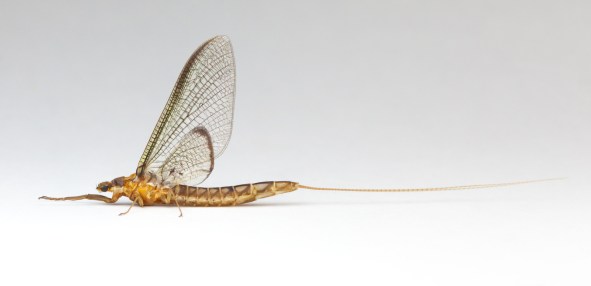
An adult mayfly

Getting his feet wet in Walnut Creek

Grant’s education and career has taken him from Pennsylvania to Texas to Florida to South Carolina to Oklahoma, but he still keeps in touch with the Behrend professor who encouraged his first research work. Dr. Ed Masteller, emeritus professor of biology, recruited Grant to participate in a summer research project in Walnut Creek in the summer after his first year at Behrend.

“I mostly did water chemistry work,” he said. “Later, when I was in graduate school in Texas, I actually began to study the mayfly lifecycle.”

Mayflies are part of an ancient group of insects called the Palaeoptera, which includes dragonflies and damselflies. The gossamer-winged, short-lived mayfly has never really held a candle to its zippy, flashy “cousins.”

But they stand out for a few reasons.

“Mayflies are the oldest known winged insect,” Grant said. “The ancestry goes back about 300 million years, further than any currently living group of insects.”

Despite the longevity and variety (there are more than 3,000 species of mayflies), the insect has a brief adult life. Few live more than a day or two as flying insects.

“They don’t even have any functional mouth parts or a digestive system,” Grant said. “They exist in their adult form simply to reproduce.”

Water babies

A mayfly spends the majority of its life, up to a year or more, in its immature nymph stage as an aquatic freshwater insect. They can be found at the bottom of nearly any freshwater source—creeks, rivers, lakes—in still or running water. Turn over a few rocks in the water, and you are likely to find a mayfly on one of them.

They play an important role in the aquatic food chain. The nymphs eat decomposing matter and algae in the water and serve as a food source for more than 200 species of animals, insects, and carnivorous plants.

“The nymphs recycle organically rich material back into the food chain by consuming it and turning it into mayfly tissue, which their predators then eat,” Grant said.

peter grant - mayfly nymph

Mayfly nymph

Canaries in the coalmine

Mayflies typically hatch in mass, particularly the large mayflies that inhabit Lake Erie, which means swarms of them appear literally overnight and cover the sides of building near the waterfront.

There is good reason for this group hatch: They have an extremely short amount of time to meet up, reproduce, and lay eggs. If they hatched over a series of days, those late to the party would never have the chance to pass on their genes.

While not everyone welcomes the influx of flying insects to their community, they are a welcome sight for ecologists and those who care about clean water.

“Anything living in the water is challenged by pollution,” Grant said. “And nymphs are thin skinned, so it’s easy for them to absorb pollutants.”

Grant is quick to qualify that statement, however.

“There are a lot of factors that go into how big the summer hatch is and some species are hardier than others, so you can’t directly equate a big or a small hatch to water quality, but it’s a factor, for sure.”

Still hard at work

Grant continues to balance his academic responsibilities with his research work. He’s currently involved in a long-term project cataloging the mayflies of Oklahoma as well as a study looking at the population size of endangered species of mayflies and caddisflies (another group of aquatic insect) in the state.

“When people think of Oklahoma, they tend to think of flat, dusty land, but it’s one of the most ecologically diverse states in the country,” he said. “We have twelve ecological regions and tons of streams.”

Grant could not be happier with his lot in life.

“I’ve wanted to be a scientist since I was a kid,” he said. “Being a college professor gave me the flexibility to both teach and learn.”

Class Reunion, Borneo style: Faculty member returns to his Peace Corps roots

Jonathan Hall

Guest post by Jonathan Hall, associate teaching professor of physics

Penn State Behrend

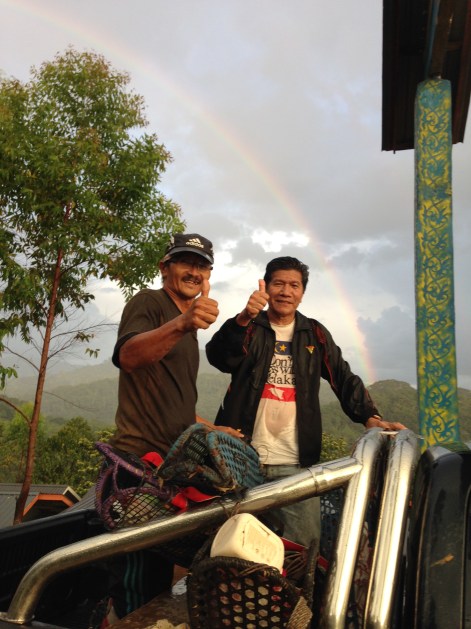
Forty years ago, I was a Peace Corps volunteer in Malaysia, teaching students in the only secondary school in the district of Sipitang, Sabah (formerly known as North Borneo). This summer, I returned to visit my former students and fellow teachers. I brought along my daughter, Liz Hall, who was a student at Behrend in 2003-04 before attending the U.S. Naval Academy.

Our trip started with a fourteen-hour flight from the United States to China, and then to Kota Kinabalu (“KK”), the capital of Sabah. We arrived late in the evening, and checked into the hotel. When the receptionist found out that I had been a teacher in Sipitang, which was near her hometown of Beaufort, it resulted in all of the staff wanting to have their picture taken with the “guru from Sipitang.” It was a warm welcome back to Sabah.

After a recovery day on the beaches of the South China Sea, we headed to a downtown hotel for a reunion dinner with some of my former students who live and work in KK.

It was Ramadan, a month-long religious observation during which Muslims fast each day from dawn to sunset, so we joined them for their evening meal when they broke the day’s fast. It was a buffet offering a wide variety of dishes, from curries to satay, which was an excellent introduction to Malaysian cuisine for Liz.

After eating, we went around the table, telling our stories from the past forty years. A friendly competition emerged regarding the number of grandchildren each person at the table had. The person with the most had seven.
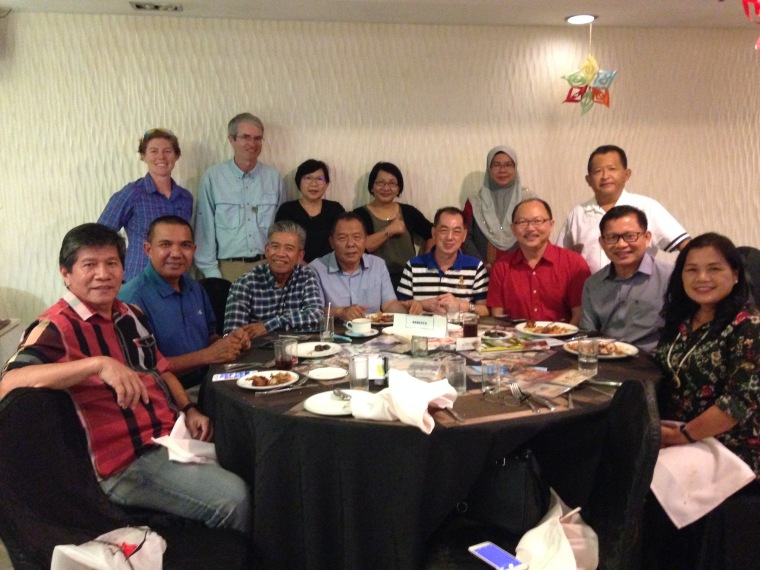
 

Class reunion

First, a little history

Malaysia was formed from a collection of colonies in the early 1960s. In order to develop as a nation, expanding education from the few to the many was the number one priority of the government.

To accomplish this, Malaysia “imported” teachers from other countries to teach, especially topics such as math and science, in rural areas. This is how Peace Corps volunteers came to be in Malaysia from the early 1960s until the early 1980s, helping until Malaysia was able to train enough of their own teachers.

As is common in other nations in Asia, your academic success, and your future career, is largely determined by the results of national standardized exams. The exams are given at the end of Form 3 and Form 5 (ninth and eleventh grade). Math is a mandatory pass. If you fail the math exam, that is the end of your education.

The parents of many of my students were subsistence farmers or fishermen, but they knew that education was the key to a brighter future for their children. Unfortunately, because they lived in a remote area, many of my students did not have teachers who were qualified in math during their early years in school. We had a year or two to catch up through practice in class, daily homework, and extra classes after school and on Saturdays when necessary.

At the reunion dinner, several of my students said that they came to high school unprepared in math, but learned and became proficient enough at it to pass their exams, which enabled them to move on to careers in teaching, nursing, banking, business and law. It was very gratifying to hear that.

I don’t think that I did anything special or was a particularly good teacher as I’d just graduated from college, but it was enough for me to volunteer to be present where I was needed. In that place and time, it was critical to have a qualified teacher who was willing and able to help them prepare for their exams.

Mountain climbing with former student

On day three, Liz and I went to Mount Kinabalu to meet up with my former student, Daring Laban.

When I taught Daring, he lived in a remote village, Long Pa Sia, close to the Indonesian border. Students from his village traveled five days on foot through the rain forest to attend secondary school, where they lived in a dormitory.

mt kinabalu climbers

Liz, myself, and Daring

Today, Daring is the manager of Sabah State Parks. Sabah Parks administers several state and national parks, including Kinabalu Park, a UNESCO World Heritage Center, and the Danum Valley Conservation Area, a mostly undisturbed rainforest that is the home of orangutans, Sumatran rhinoceros, pygmy elephants, and more. Sabah Parks host 1.3 million visitors a year, playing a major role in tourism, the second largest sector of the state economy. While much of the rainforest has been lost over the past forty years, ecotourism has replaced timber as a mainstay of the economy and is helping to preserve the remaining rain forest.

On Mount Kinabalu, we traveled through four climate zones as we climbed—lowland dipterocarp rain forest, montane forest, cloud forest, and sub-apline vegetation—before reaching bare rock and the peak at 13,400 feet.
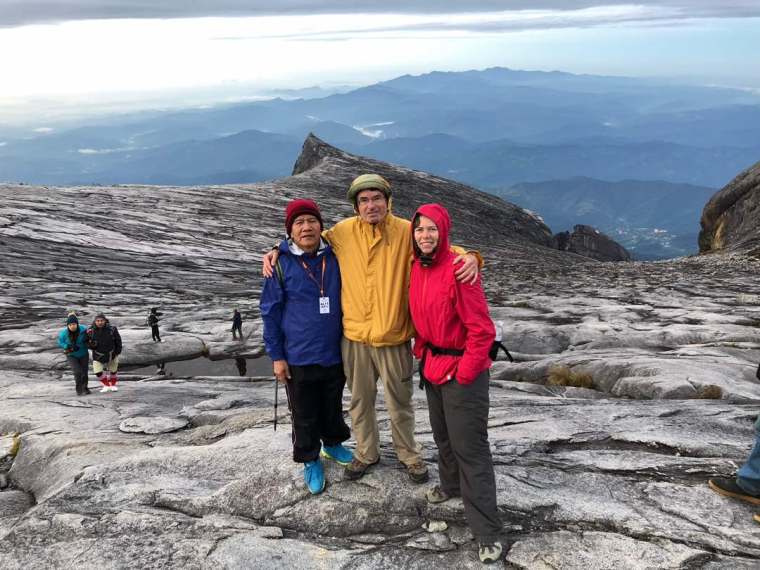
Daring Jon Liz Mt KinabaluDaring, me, and Liz on Mt. Kinabalu

Liz & Daring climbing

Climbing Mt. Kinabalu

Mt Kinabalu peak

Mt. Kinabalu peak

The park was formed to preserve its great biodiversity, including some of the world’s largest pitcher plants, and the Rafflesia, said to be the world’s largest flower. During the 8.5-kilometer hike, we climbed 2 kilometers in altitude.

In June 2015, there was an earthquake at the mountain. Rockslides killed eighteen climbers; most of those killed were students visiting from Singapore. The trail was closed for six months for repairs. The violence of the earthquake was still very evident, with large areas of newly exposed white granite where the rockslides occurred instead of dark, weathered rock seen elsewhere.

rock slide Mt K

Rockslide damage on Mt. Kinabalu

We celebrated a successful climb by stopping at an open-air restaurant specializing in wild boar, which are hunted in the oil palm plantations.

Visiting Long Pa Sia

After hiking, it was on to the interior village of Long Pa Sia. Back then, it was a 50-mile trek. Now, it is accessible by four-wheel drive vehicles over a logging road.

The village is named by the native Lun Dayeh people1. Long = mouth, Pa = river, and Sia = red. In traditional Borneo, the river was the lifeblood of the community and was used for transportation, water, food, and bathing.

We spent a day hunting and fishing with another of my former students, Lukas. Lukas retired from banking in the city to hunt, a traditional way of life in the interior. We caught several small fish in the river. Lukas and his hunting dogs brought back a barking deer.
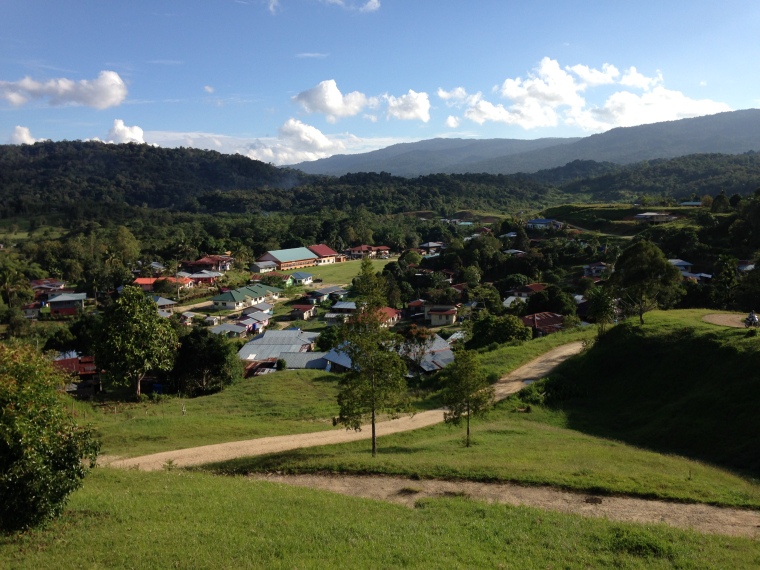
Long Pa Sia

The village of Long Pa Sia

Liz at Pa Sia river

Liz at the Pa Sia river

Lukas & Daring after hunt

Lukas and Daring after hunting

Many changes, but friends remain

Sipitang was my home far away from home when I was in the Peace Corps. All of the towns and cities in Sabah have grown and developed so much over the last forty years, that they were nearly unrecognizable to me. (In Long Pa Sia, which was known very being remote, there is now excellent cell phone reception!) Sipitang was no exception.

In Sipitang, changes included a hospital, paved roads, enough cars to have traffic jams, new schools, factories and industries, and many more people. Gone is the old open-air fish market where fishermen off-loaded from small praus their catch of prawns, squid, fish, and rays. Also gone is the fruit and vegetable market where farmers brought baskets of bananas, durians, rambutans, and other tropical fruits. Now there are two supermarkets instead.

Taking a walk down memory lane, I showed Liz the school where I taught.

Next it was on to a “Hari Raya” dinner, celebrating the end of Ramadan. The dinner was hosted by Ramawi, another former student. Ramawi’s family happens to include Wan Musa, a fellow science teacher. We worked closely together forty years ago and became dear friends. I attended Wan Musa’s wedding, where I was the Malay equivalent of his best man, which included having the groom’s face and mine smeared with rice flour.

It was great to see him again, however briefly.
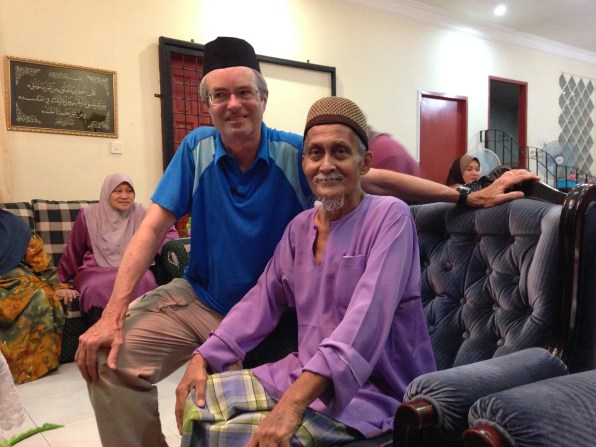
Jonathan & Wan Musa

Me and Wan Musa

Weddings, coffee, and longhouses

Speaking of weddings, the next day we traveled to Sarawak, the other Malaysian state on Borneo, crossing the Lawas River by ferry to attend a Lun Dayeh wedding.

Ishak Liz Lawas river ferry

Ishak and Liz at the Lawas river ferry

After a Christian wedding ceremony, there was a reception for the entire community, which included traditional songs and dance, and the giving of baskets of gifts by the bride to members of both families.

Lun Dayeh wedding

Lun Dayeh wedding in Sarawak

The next day, was a road trip to Tenom, to drink the locally grown coffee and visit the Sabah Murut Cultural Center. Built as a traditional longhouse, but on a much larger scale, the center includes displays of traditional dress, baskets, musical instruments (gongs), and other aspects of the culture and history of the local native people.

On the way back, we stopped at two longhouses—a traditional wooden longhouse and a new one made with modern materials. Regardless of the building materials, the basic design is the same. Longhouses are an elevated building in which each family has an “apartment” consisting of a living room, bedroom, and kitchen. All of the apartments open onto a verandah, which runs the length of the longhouse and serves as a common area.

Sipitang Longhouse

At a longhouse

canstockphoto7243483

Stock photo of a typical Borneo longhouse

Math teacher turned voice coach?

After visiting Sarawak, we returned to KK to prepare for our 3 a.m. flight home the next day. But, before leaving, we met up with other former students for the most sumptuous Chinese dinner I’ve ever had.

In my three years in Sabah, I taught one English class. Being a math/science teacher, and learning TESL (Teaching English as a Second Language) on the fly, I decided to incorporate singing in the lessons. Albert, one of my former students who was at dinner that night, was in my English class and said that I inspired him to become a pretty decent karaoke singer. (As a teacher, you plant a seed and…)

Durian McFlurrys

What has changed in Sabah over the past forty years? Every town has a KFC. Also, there are McDonald’s restaurants and they serve Durian McFlurrys. This is a flavor that would not go over big in the United States.

McDonalds durian

While many Asians love the taste of durian, as do I, others have been known to object to the scent of durian. One writer described durian as “eating a delicious raspberry sorbet in a revolting public lavatory.”

Durian smells so bad, that it is banned in many public places. Upscale hotels charge large cleaning fees if it is brought into a guest room.

no durians

Final reflections

In Malaysia, one is struck by the hospitality of people. It is part of a way of life, of forming relationships with others, and strengthening those relationships is valuable and important to them. My students thanked me for teaching them. I thanked them for welcoming me into their lives.

While I taught students science, math, geography, and English, they taught me something of great value that I have kept close to my heart. The students in my class came from a wide variety of diverse backgrounds, with different cultures, languages, and religions, but they were all classmates together. They worked and learned together and respected one other.

In the classes I taught, I never witnessed anyone being left out or excluded because of differences. The class was only successful if every student was, so students helped each other.

Forty years later, that has not changed. It is normal and natural for Muslims celebrating the end of Ramadan to invite Christian and Chinese classmates to their home to share a meal. They don’t let their differences divide them, they respect and celebrate those differences2. This was particularly striking to me now because in our current times, there are some who openly advocate that if people are different, they should be kept separate.

The native people of central Borneo; the Lun Dayeh (also known as Lun Bawang), Kelabit and Sa’ban, are involved in the Heart of Borneo Project, dedicated to the conservation of the remaining rain forest in central Borneo. Preserving the environment impacts the preservation of traditions, languages, culture, and a way of life for the people there. Their slogan is: “Serurum. Selawe. Meruked.” This translates from Lun Dayeh as: “Friends. One way (united). Forever.”

Thanks and terima kasih3to the students of Sipitang for teaching this “guru” the most important of lessons.

NOTES:

1. Though we live on opposite sides of the globe, the Lun Dayeh people have a history of friendship with Americans. Before World War II, American missionaries with the Borneo Evangelical Mission lived in Lun Dayeh communities. When Borneo was occupied early in WWII, these missionaries and their families were executed. Later in the war, two American bombers crashed in the interior. Surviving crew members were found by the Lun Dayeh, who recognized them as Americans. The Lun Dayeh leaders, then made the decision to shelter, protect, and defend the American crewmen, at the risk of their own lives and communities. The Americans were guided to a location where British special forces established a small airfield to return the crewman to safety. For the full story, read The Airmen and the Headhunters by Judith M. Heimann, or watch the PBS Secrets of the Dead episode of the same name as the book title.

2. If you like holidays, Malaysia is the place to be. You can celebrate Muslim, Christian, Chinese, Hindu, Buddhist, national and harvest festival holidays!

3. While terima kasih is how you say thank you in Malay, I prefer it’s literal meaning, which is “receive love.” The response, sama sama, means “the same to you”!


A Capella Engagement at Tone-Acious Concert

By Heather Cass
Publications Manager, Office of Strategic Communications,  Penn State Behrend

According to the program handed out before the Tone-Acious concert in late April, the student a capella group was going to sing seven songs.

But after performing those songs for the nearly-full audience in Reed 117, instead of taking a bow, members of the group lowered a viewing screen on the stage and announced a surprise final song.

As they launched into God Only Knows by The Beach Boys, a slideshow of images from the last year of Tone-Acious’ concerts and activities played on the screen. The audience laughed and smiled at club members hamming it up for the camera.

Then, it got weird. Literally. The slideshow contained the words: “And now things get strange…” What followed were a series of photos of a little boy and girl, then a slightly older boy and girl, then a teenage boy and girl.

Eventually it dawned on the confused audience that it was the same boy and girl. Yet, they didn’t seem to be members of Tone-Acious.

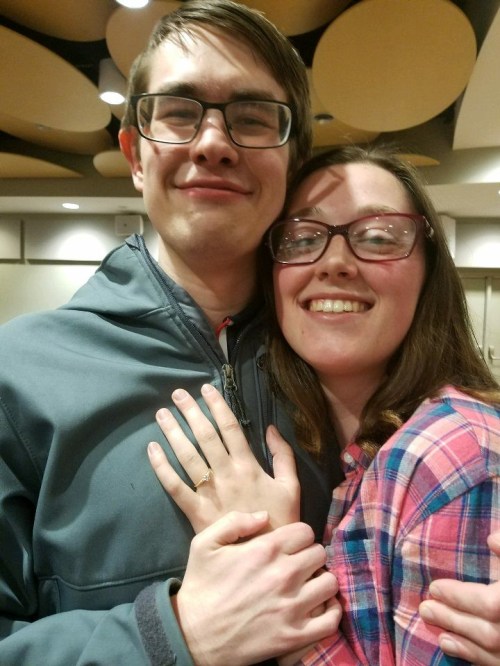
It all made sense a few moments later when the adult version of the boy in the photos pulled the adult version of the girl in the photos onto the stage and dropped to one knee.

She said yes.

Well, sort of.

“I was so surprised that I could only nod with tears running down my face,” said Lexie Gee, the bride-to-be.

20180426_214237

Gee met her future husband, Christian Olson, a mechanical engineering technology major at Penn State Behrend, in preschool. By middle school, the Warren-Pennsylvania, natives were a couple. They’ve been dating for nearly six years.


Olson arranged the surprise engagement with Tone-Acious member Ashley Meyer.

“I wanted to do something music-related and showy, but I was lacking in the number of musically-talented friends to help me, so I talked to Ashley about involving Tone-Acious.”

God Only Knows is a song we both loved from our high school choir days,” Olson said. “So that’s the song I asked them to sing for us.”

Gee had no idea Olson was planning to propose. “When the pictures of us came up on the screen, I was caught off guard.”

Her family, including her sister, who is a Penn State Behrend student and was in the audience that evening, was not. Gee’s father supplied the ring.

“It’s a beautifully engraved ring that had been my mother’s when my father proposed to her, so it’s very special to me,” Gee said. “My family is ecstatic about our engagement. They’ve known for months and were having trouble keeping it from me.”

Olson and Gee are planning a July 13, 2019, wedding in their hometown of Warren.

acapella engagement


Curiosity leads to opportunity for nursing student

By Heather Cass
Publications Manager, Office of Strategic Communications,  Penn State Behrend

IMG_0815.JPG

Efua Crentsil, senior nursing major

Has your curiosity ever led you down a rabbit hole? It starts with reading something online and then you have a question, so you open another browser window and Google it. Next thing you know, you’ve lost forty-five minutes of your life researching how almonds grow (on trees!) or how spiders survive winter in northern states (in eggs!).

An inquisitive mind is an asset for students when it’s channeled toward topics in their field of study. A need to know more can lead to opportunity.

It did for Efua Crentsil, a senior nursing major, whose interest in a class project spilled into independent summer research work, which led to an invitation to present her work at two different industry events.

Crentsil, a native of Ghana, began researching whether nurses preferred to work with nurse practitioners or with physicians and what impact that had on their job satisfaction for her NURS 200W Principles of Nursing Research and Evidence-Based Practice class. The project piqued her interest and she continued working on it after the class was over.

“I wanted to know more and look deeper at the subject,” she said. “Dr. Alison Walsh (assistant teaching professor of nursing) had been asking if any nursing students wanted to develop a research project, so I told her I’d be interested.”

Walsh says Crentsil exceeded expectations. “She took her evidence-based class project and continued to develop it into a systematic review—Job Satisfaction in Registered Nurses: The Effect of Working with Nurse Practitioners Compared to Physicians.”

While Crentsil did not receive academic credit for her research work, she was rewarded with an invitation to present her work at the Annual Scientific Sessions of the Eastern Nursing Research Society in New Jersey.

IMG_0814

That invitation, in turn, led to a second opportunity to speak at UPMC Hamot Hospital’s Research Symposium in Erie where Crentsil won the Student Award for her work, which came with a $250 education scholarship.

IMG_0764

Crentsil said she used existing data from four online databases to do her research work, but that next she would like to collect her own research data.

“I did informal polling and observation while I did an internship at The Cleveland Clinic this summer, but I primarily relied on existing data,” she said.

Crentsil said her research showed an 80/20 percent split with the majority of nurses reporting higher job satisfaction working with nurse practitioners than with physicians.

“This was mostly due to communication,” she said. “Nurses felt that nurse practitioners listened to them more and gave them more independence and respect. Those who reported higher satisfaction in working with physicians said they preferred doctors because they tended to be straight to the point, more confident, and more knowledgeable than nurse practitioners.”

Crentsil has reason to be interested in nurse practitioners and research: She sees both as potential career paths.

“I wanted to be a nurse practitioner, but now I’m considering being a nursing researcher because if institutions can see why they should make changes, they’re more likely to do so,” she said. “The research has to be done first.”

Crentsil, who graduates on Friday with a bachelor’s of science degree in nursing and a minor in women’s studies, is currently considering several job offers. She plans to stay in the United States for a few years and return to graduate school after she gains nursing experience.

Crentsil is a recipient of the Jack Kent Cooke Foundation scholarship, the Penn State Behrend Chancellor Scholarship, and a Special International Grant-in-Aid (SIGIA). “I am so thankful,” she said. “I truly would not be here if not for this financial support.”