What if your classroom wasn’t just a classroom, but a creative agency with real clients, real deadlines, and real impact?
That’s the idea behind COMM 481: Advanced Multimedia Production, a new course taught by Tom Deau, lecturer in media and communication. Students in the course don’t just learn production skills — they use those skills to help community partners.
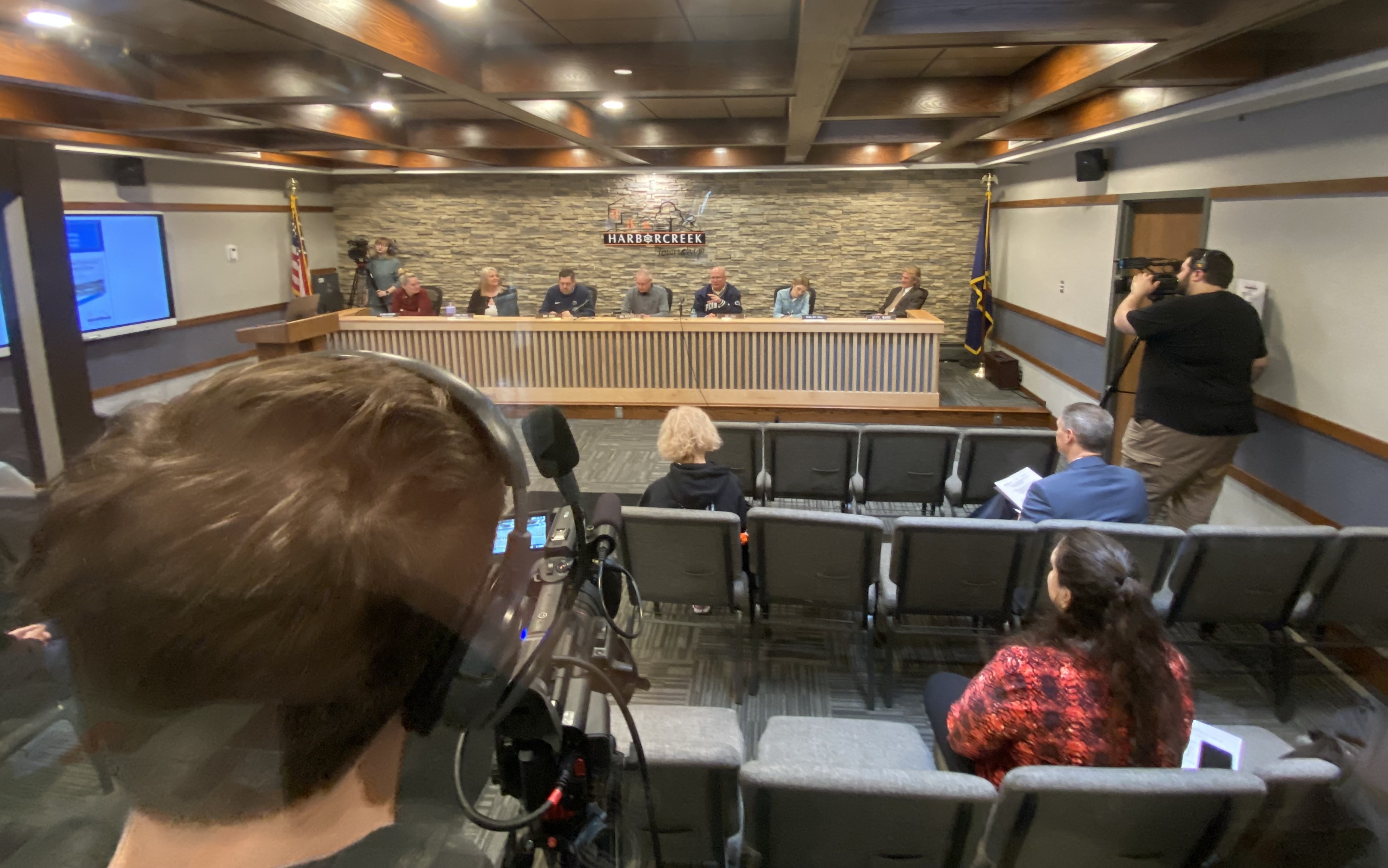
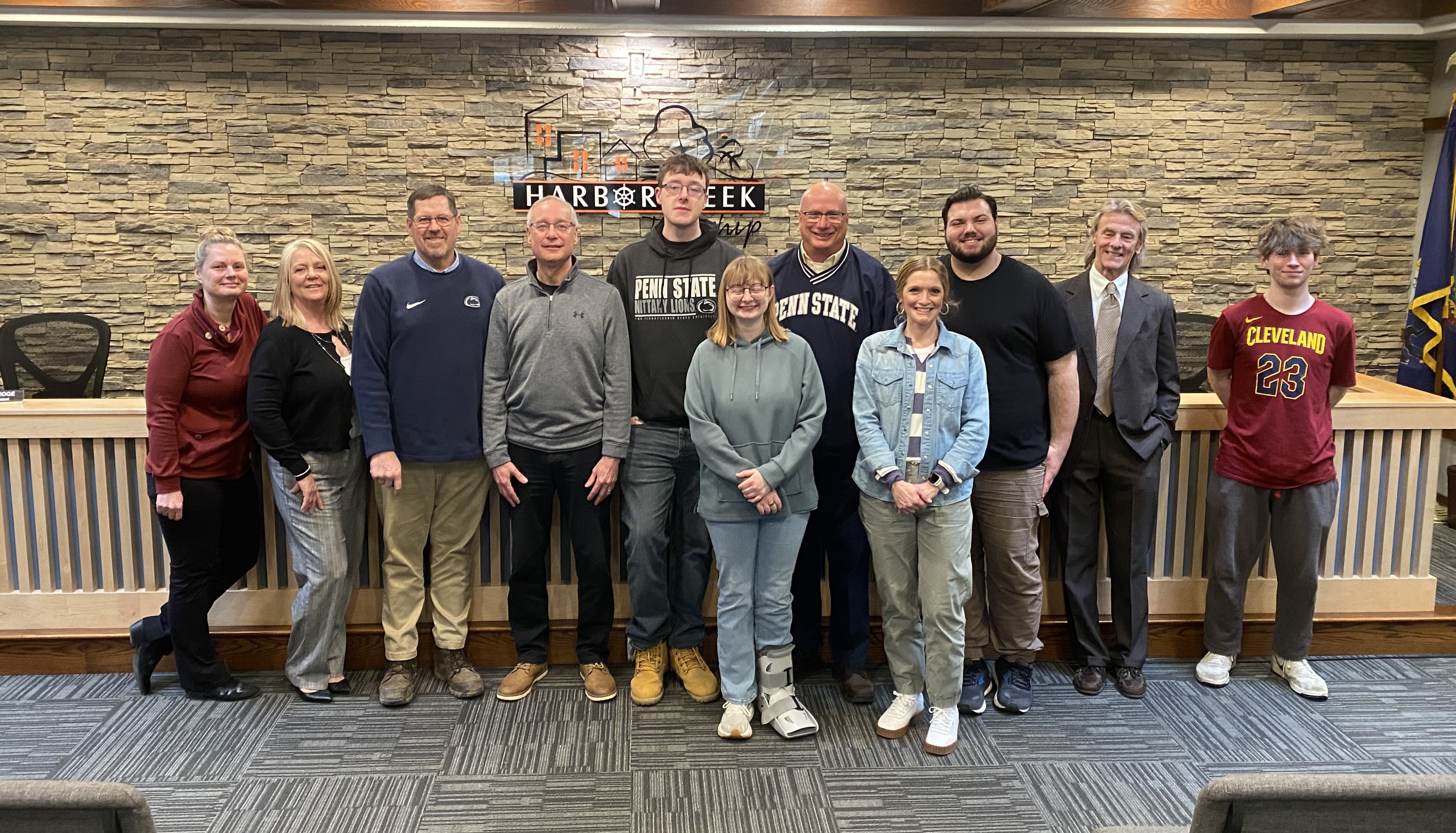
After connecting with Harborcreek Township Supervisor Dean Pepicello, students recently launched a live-streaming initiative for the township’s bi-monthly public meetings, giving community members easier access to local government. The first stream went live on March 4. The next is scheduled for March 18, at 5 p.m. The live streams can be viewed on the Wintergreen Media YouTube channel.
The township streaming project is just one of several new initiatives this semester. Deau’s students also are producing a promotional video for HARVEST 912, a nonprofit that supports individuals who are experiencing homelessness. Other projects include employee profile videos for the School of Humanities and Social Sciences, “Day in the Life” features for social media, and a promotional video for the “Empower Her Summit,” a Junior Achievement of Western PA event that will be held on campus later this month.
These experiences embody the college’s Open Lab model of learning, in which students and faculty members partner with business, industry, and community organizations to design new products, develop new services, or solve specific business challenges. The projects benefit the community, but they help students, too: By applying the fundamentals they learn in class, students gain résumé-building, real-world experience.
By Heather Cass, Publications Manager, Penn State Behrend
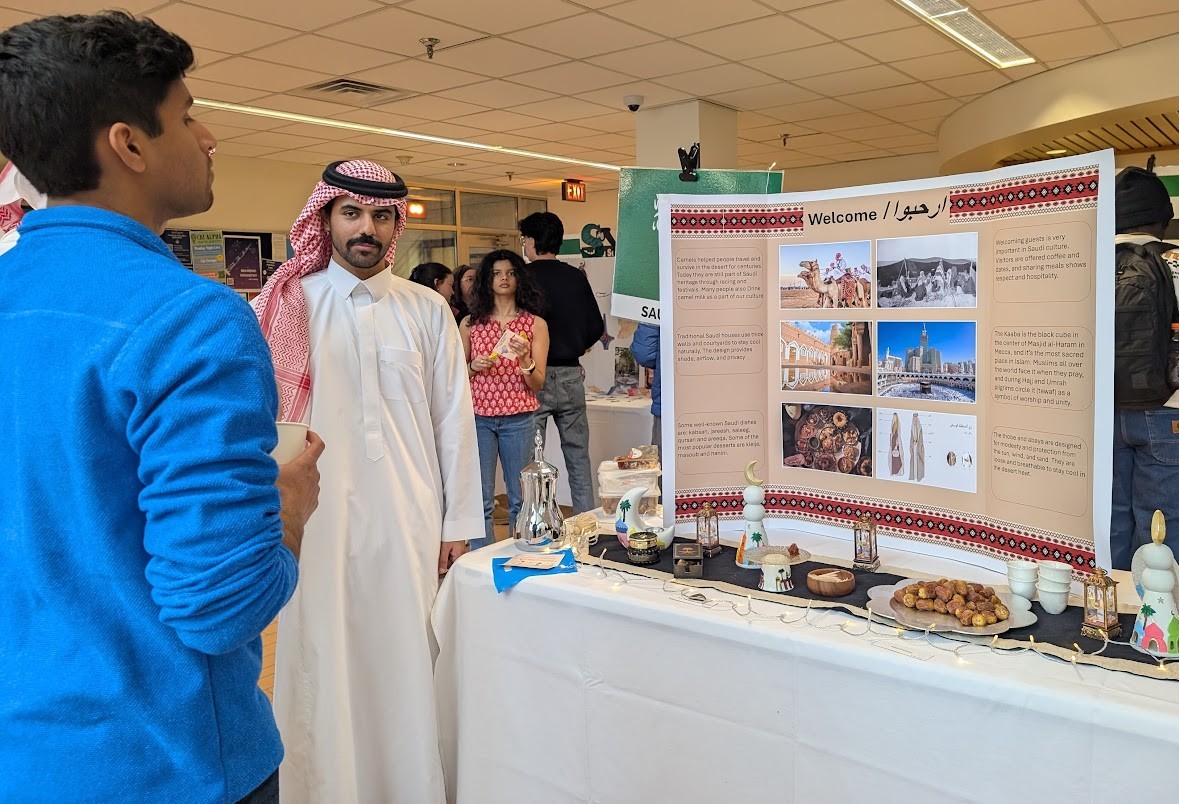
One of the first things I learned at the Penn State Behrend Culture Fair is that hospitality is serious business in Saudi Arabia — and I experienced it almost immediately. In Saudi culture, welcoming guests isn’t just a polite gesture; it’s a point of pride, often described as part of the very “DNA” of the country. Visitors are traditionally greeted with Arabic coffee and dates, a pairing that symbolizes warmth, generosity, and respect.
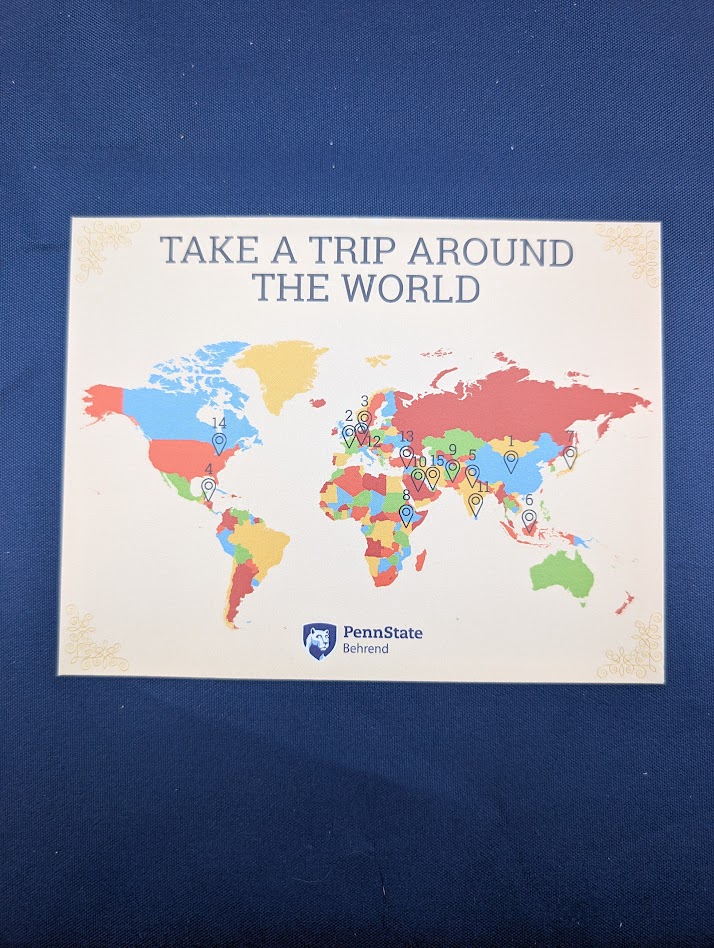
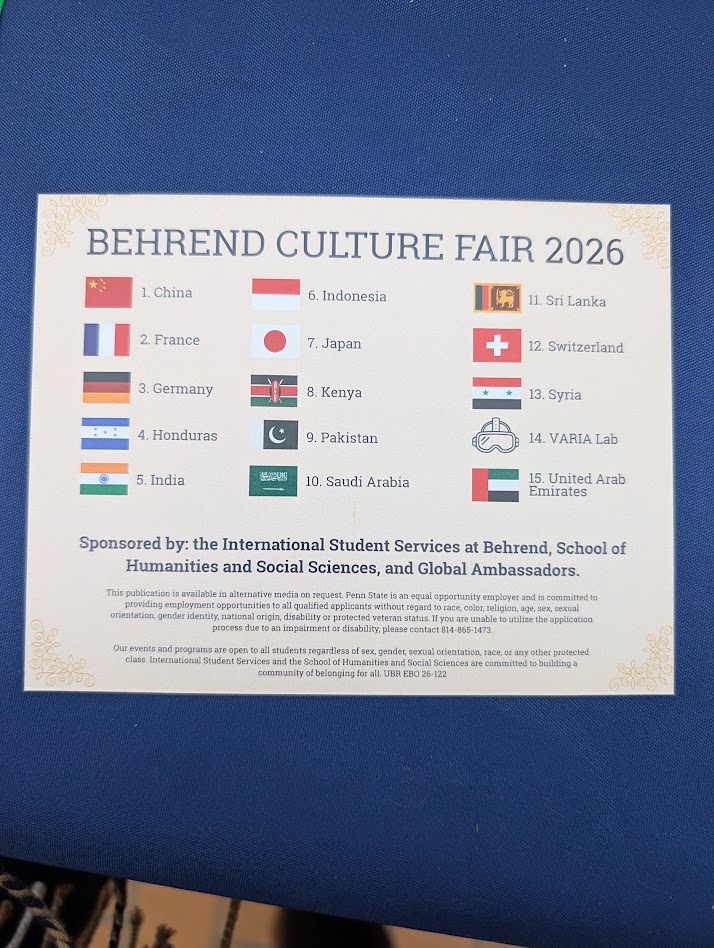
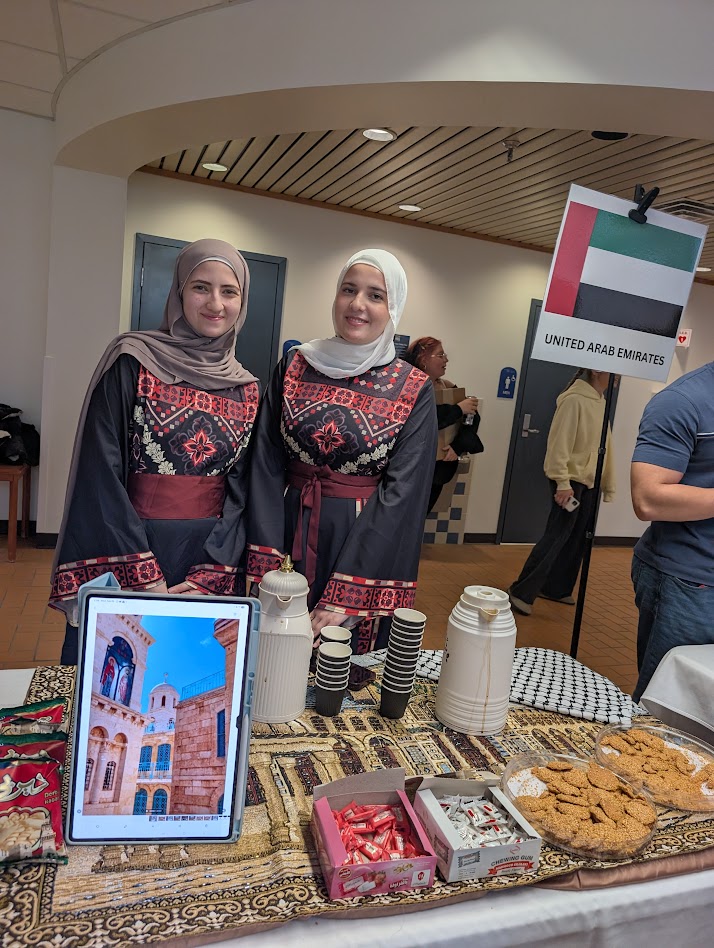
So, when I approached the Saudi Arabia table, one of fourteen, at yesterday’s Culture Fair, I barely had time to take in the display before students dressed in traditional white thobes and red‑and‑white head coverings welcomed me with that same spirit of hospitality. They offered Gahwa, a spiced Arabic coffee infused with cardamom, cloves, and saffron, along with soft, caramel‑like Medjool and Khalas dates, a staple of Gulf welcome traditions. It was a delicious introduction to the afternoon and a perfect reminder of how meaningful cultural traditions can feel when shared person to person.
Here are five more interesting things I learned while I “took a trip around the world” in McGarvey Commons — happily gathering international snacks and fascinating facts along the way:
Sri Lanka: Tea isn’t just a drink; it’s an identity. Sri Lankans take it seriously. It’s the country’s top export, and Lipton Tea traces its roots back there.
Mecca: The Kaaba — the black cube at the center of Masjid al‑Haram — is the most sacred site in Islam, and Muslims around the world face it during prayer.
Germany:Neuschwanstein Castle, tucked into the Bavarian Alps, inspired Disney’s Sleeping Beauty Castle. King Ludwig II really earned that “Fairy‑tale King” nickname.
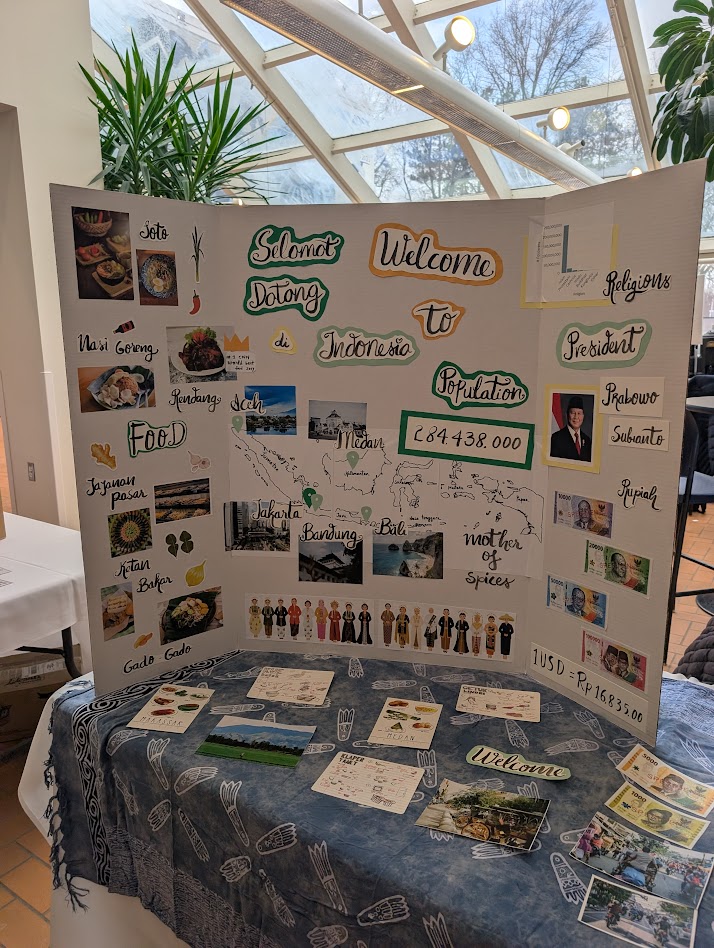
Indonesia: This stunningly beautiful country is called the “Mother of Spices,” thanks to volcanic soil that produces nutmeg, cloves, pepper, and more.
These were just a few of the stories and facts our students, faculty, and staff shared — each one a reminder of how much of the world is already right here with us on campus.
Events like the Culture Fair show that learning doesn’t only happen in classrooms. It happens in conversations, in shared traditions, in the foods we taste, and in the stories we exchange. Behrend is fortunate to be a campus where so many cultures meet, teach, and celebrate together.
I left McGarvey Commons with a full stomach, a handful of new rabbit holes to dive into on Google, and the distinct feeling that I’d only scratched the surface. That’s kind of the point — and exactly why events like this matter.
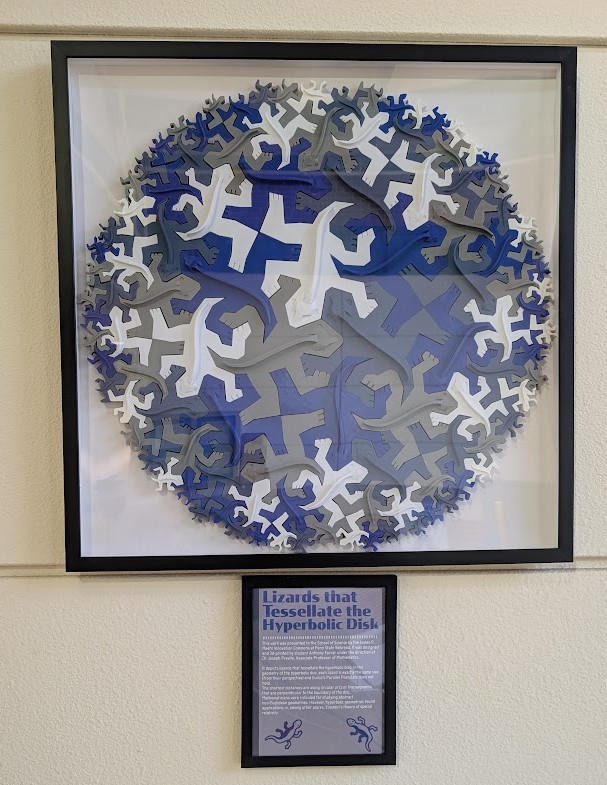
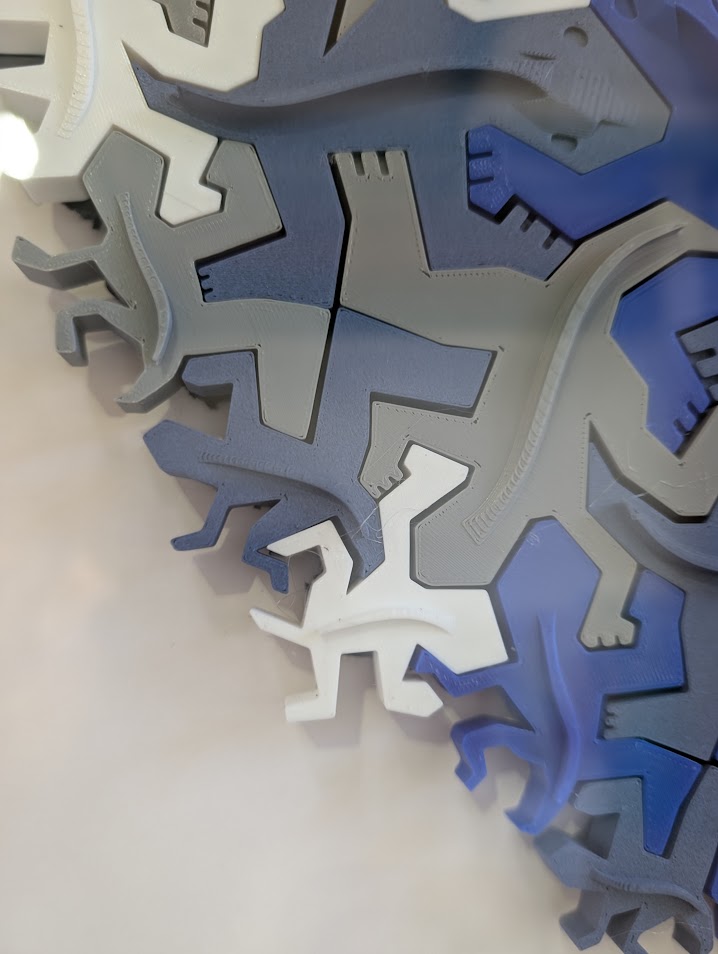
Math isn’t always numbers on a chalkboard. Sometimes it’s a work of art—a swirl of repeating lizards, 3-D printed in Penn State blue and white, then installed in a building where math, art, and science intersect. The lizards blend together in a hypnotic pattern, each appearing to shrink as it spirals toward infinity.
The piece, Lizards thatTessellate the Hyperbolic Disk, was imagined by Dr. Joseph Previte, professor of mathematics, who wanted to capture the beauty of mathematics in a form anyone could see.
He took the design to the James R. Meehl Innovation Commons, the college’s open ideation lab, where engineering students Anthony Farrar and Quinlan Barnes transformed Previte’s concept into reality with 3-D-printed tiles and a sharp eye for symmetry.
The result is art born from math—or perhaps math revealed as art.
Dutch artist M.C. Escher showed the world that geometry could be beautiful with his mesmerizing tessellations and optical illusions, where patterns unfolded in ways both precise and poetic.
“For centuries, mathematicians questioned the value of studying this type of geometry, dismissed it as impractical and useless, with no relation to reality,” Previte said. “But it later proved essential to modern science, including helping Einstein describe how time and space work in his theory of relativity.”
While some mathematicians ridiculed the study of abstract math, others reveled in it. English mathematician G.H. Hardy argued that mathematics was a pure art form, divorced from practicality—something he took great pride in. Hardy’s theories later laid the groundwork for encryption, proving that beauty and utility often travel together.
That same tension—between abstraction and application, imagination and reality—now hangs on the wall at Behrend.
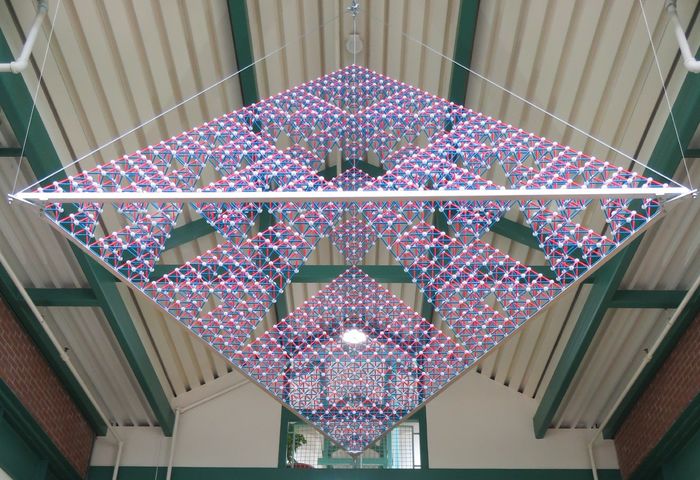
Lizards that Tessellate the Hyperbolic Disk joins an existing sculpture, Math in Flight, a stage-5 Sierpinski tetrahedron, a fractal shape featuring a pattern of infinite triangles, that hangs high above the entrance to Roche Hall in the Science Complex.
Math Club students built the sculpture using Zometool construction parts. It consists of 2,050 white balls and 6,144 red-and-blue struts.
Previte has plans to continue adding to the mathematics art gallery.
“I’d like to do the Platonic solids next,” he said. “I am currently looking for a student in Innovation Commons to make that project a reality.”
Their mistake is understandable. In just three years, Orange, an immersive administrator in the college’s Virtual/Augmented Reality (VAR) Lab, has left his mark on campus—literally. From 3D scanning equipment and building video game consoles in the VAR Lab to creating 360-degree virtual tours for industry partners, Orange’s work can be seen all over Behrend.
“He oversees several of the undergraduate employees in the lab, working with them across a half dozen or more projects, helping them to achieve their own goals,” said Dr. Chris Shelton, associate professor of psychology and director of the VAR Lab. “He goes out of his way to learn and help others who are trying new techniques in the lab, while also improving the atmosphere with his positive attitude and calm demeanor.”
Orange is also collaborating with Jane Ingold, reference and instruction librarian and Behrend’s archivist, to digitally preserve college artifacts as part of his Schreyer Honors College thesis project.
“He is so engaged and is a real champion of Behrend history through the preservation work that he’s doing,” Ingold said. “This spring, he did 3D scans of Ernst Behrend’s old steamer trunk, the bust of Moritz Behrend’s head, and Bruno’s headstone.”
Behrend Blog caught up with Orange before he returned home to New Bethlehem for the summer.
How did you get involved in the VAR Lab? I met another student, Marcus Jacobs (a ’22 Business Economics and International Business grad), who worked there, and he roped me in. I was interested in what they were doing in the lab. Now I do a lot of the project managing. I joke that I’m Marcus 2.0.
What are some projects you’ve worked on? Most recently, I helped create a 360-degree virtual tour for Snap-tite, an Erie company, and I’m working on the Echoes of HistERIE project—scanning historical sites and artifacts like the Presque Isle Lighthouse. If something ever happens to these places, at least we’d still have them digitally.
We heard you built a turntable to help scan people in 3D? Yes! It’s hard to do 360-degree scans of people while lugging around the camera and cables, so it’s easier if the person rotates on a platform while the camera stays put. You can buy turntables like this, but my true gumption is being frugal—so I wanted to build one. My dad and I used the motor from a pig roaster, since it offers a slow, strong spin. It turned out great.
You also created an augmented reality sandbox. Tell us about that. It’s an interactive display that lets users shape and manipulate 3D topographic maps in real time. A 3D camera senses the shape of the sand, and a projector overlays a topographic map onto it. You can build mountains and valleys right in front of you. Again, you can buy these, but we made ours out of plywood and an old projector.
And the VARcade? That’s an arcade machine I built from an old kitchen cabinet. It runs classic games and also gives students a platform to test new games they create in computer science or game design classes.
You sound like an engineer. Why did you choose DIGIT? DIGIT is the best of both worlds. I get to work with emerging technology but in a more creative or artsy way. I like 3D modeling, photography, making movies, and videogames. I’m also minoring in game development.
What are some practical uses for VR and 3D images? A lot of people think VR is just for video games, but it has serious real-world uses—training simulations, for instance, where it’s safer to make mistakes. It’s also great for exposure therapy for phobias and PTSD. And 3D tours can give people a sense of what a place looks and feels like without needing to physically go there.
What motivates you? My faith—especially Jeremiah 29:11: “I know the plans I have for you, declares the Lord, plans to prosper you and not to harm you, plans to give you hope and a future.”
What are you looking forward to when you return in August? My Schreyer thesis project, which is a continuation of the work I do in the lab. I’ll be using different scanners on various artifacts to find the most efficient methods for digital preservation. And I’m excited to see what else comes my way in the VAR Lab. I’m up for anything.
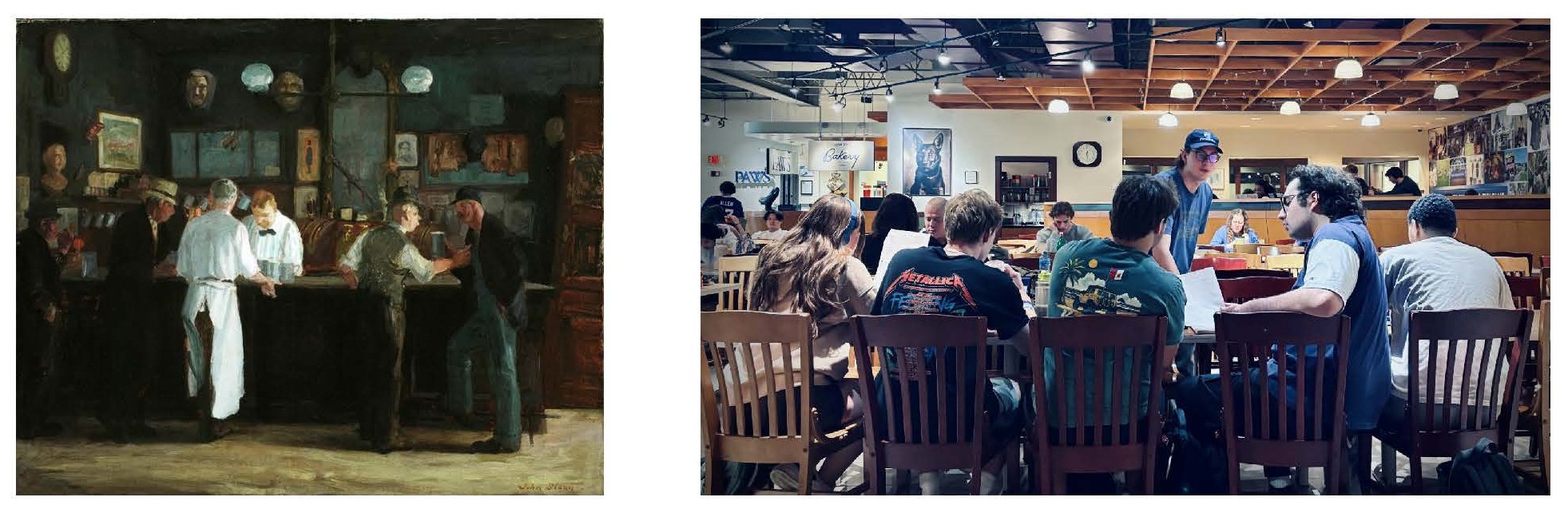
This spring, students in Dr. Matthew Levy’s AMST 307N: American Art and Society course at Penn State Behrend engaged in a unique interdisciplinary project that blended historical analysis with creative expression. As part of the course, students worked in groups to create tableaux vivants—or “living pictures”—that reenact and recontextualize iconic works of American art that were discussed in class.
Not only did students have to study the formal and thematic elements of a chosen painting, but they also had to consider its relevance to contemporary social and cultural issues.
“Working in groups, they researched their chosen work, gaining a deeper understanding of the social issues it represented,” said Levy, associate professor of art history, music, theatre, and visual arts.
Each group then reimagined their selected artwork for a 21st-century context, using modern props, settings, and interpretations to bridge the past and the present.
“They had to think carefully about props, poses, setting, framing, and more to bring the work of art into modern times,” Levy explained.
Here are several standout projects from the class, along with insights from Levy on what made each piece compelling.
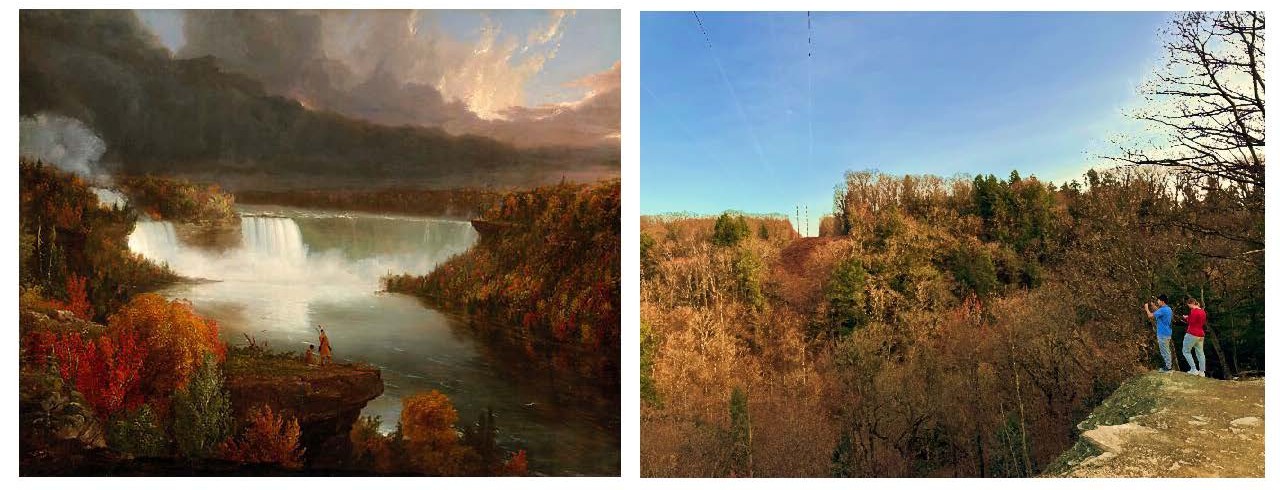
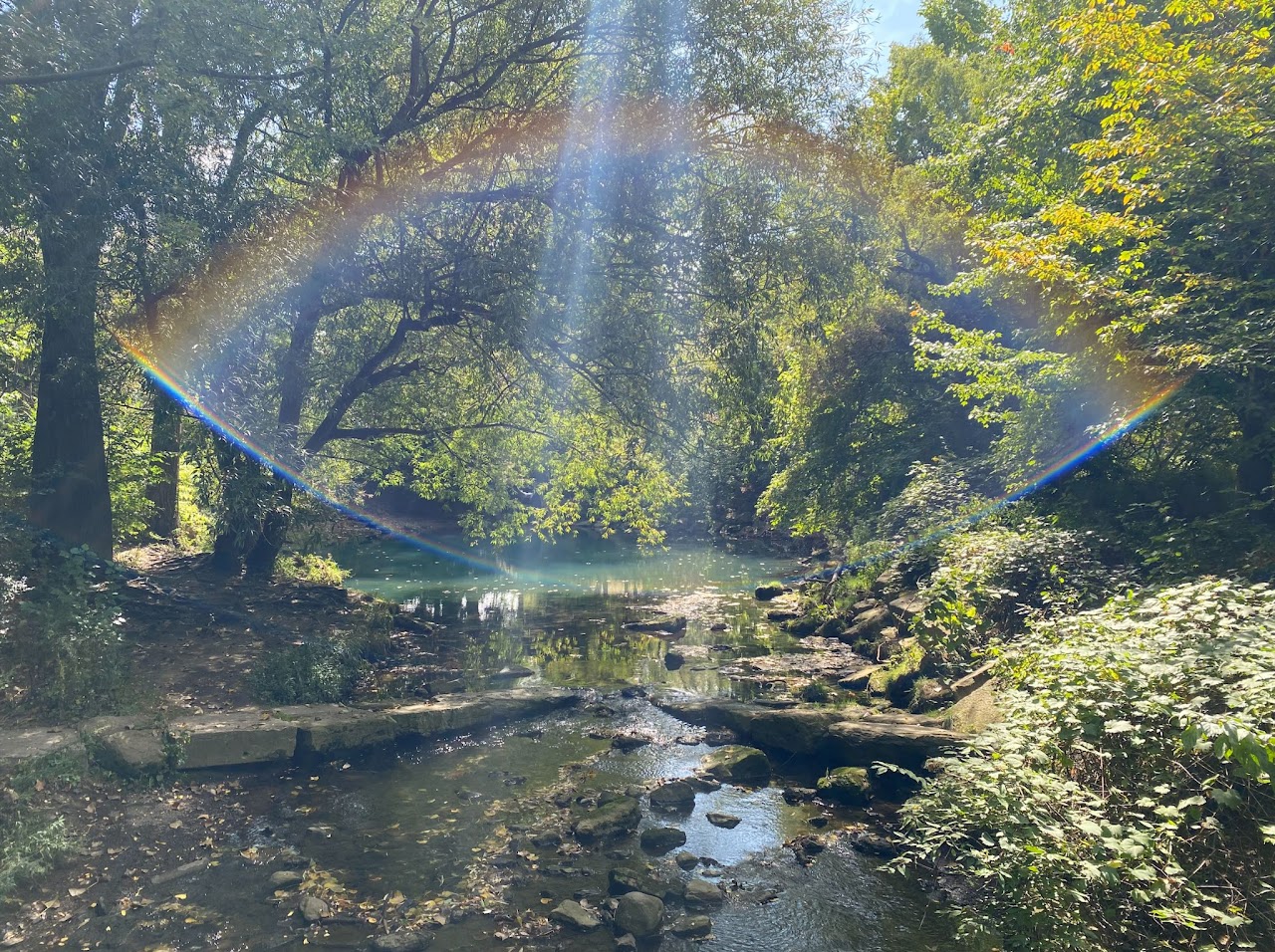
Distant View of Niagara Falls by Thomas Cole: “Where Cole’s view of Niagara Falls depicts the untouched majesty of the falls (represented both by the landscape and the presence of the Native Americans living at one with nature), the students depicted a domesticated and technologized landscape. Using the Wintergreen Gorge as their setting, they drew attention to the power lines, nature trail, and the use of phones to mediate our experience with nature.”
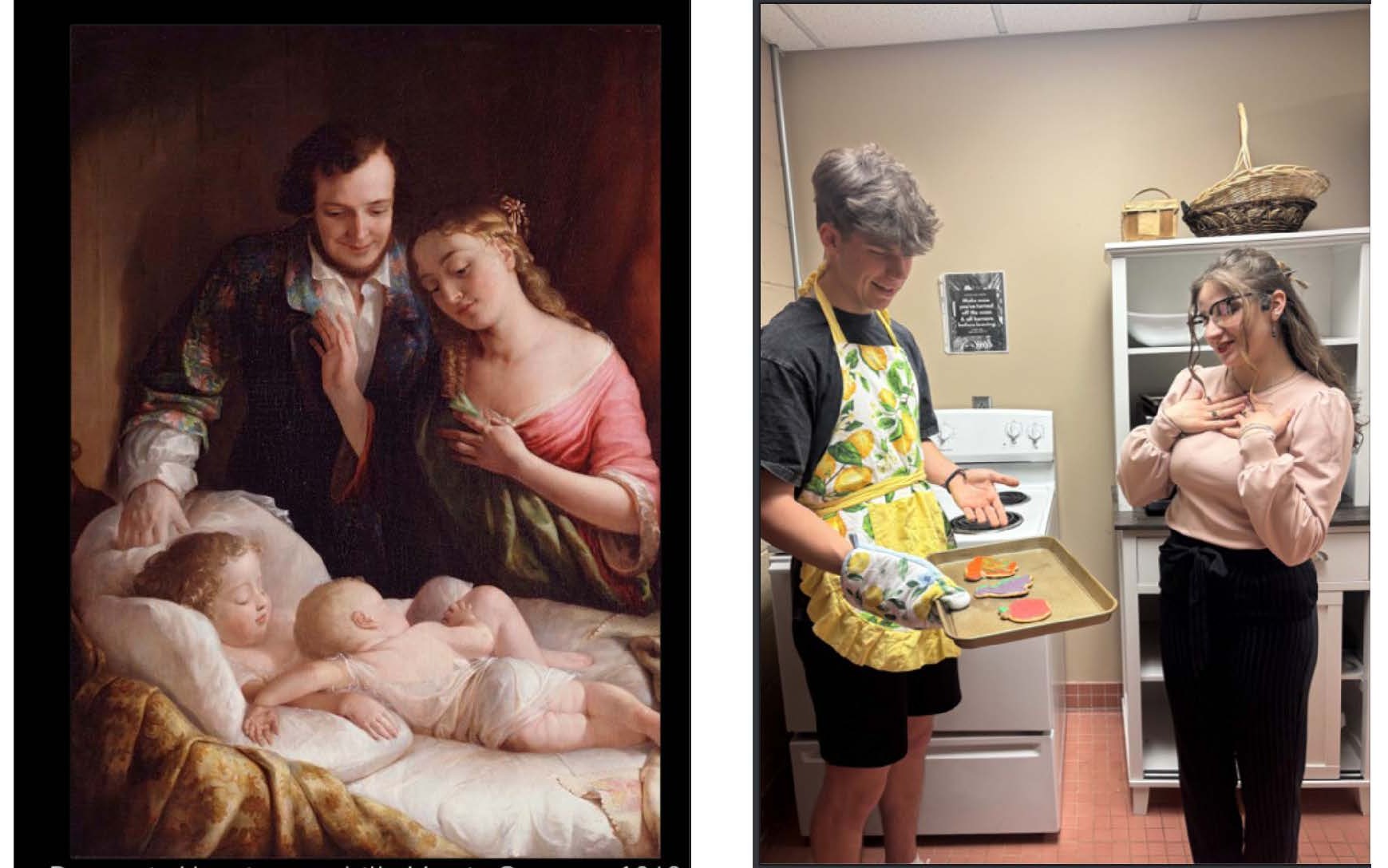
Domestic Happiness by Lilly Martin Spencer: “In the original painting, Spencer offers what was a progressive view of family life for the time, with both mother and father doting on their children. Our students instead depicted a “girl boss” showering praise on the domestic accomplishments of her stay-at-home husband. Notably, no children are present.”
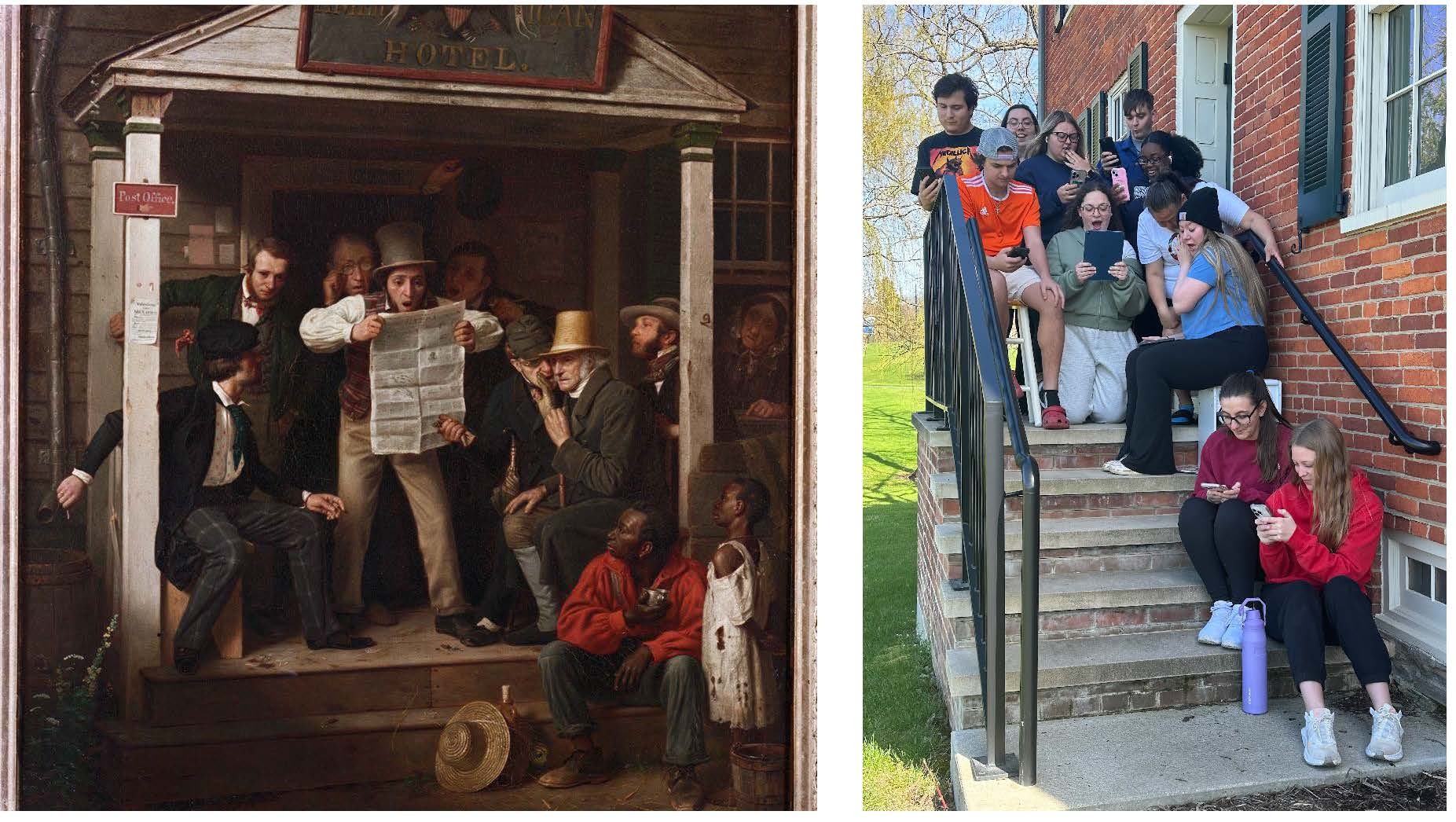
War News from Mexico by Richard Caton Woodville. “Woodville’s painting depicts the latest in information technology—the penny press—which made journalism far more accessible than ever before. Our students depicted a scene in which everyone is responding to the news, not in the shared experience represented by Woodville, but each on their own through their phones and tablets.”
McSorley’s Bar by John Sloan: “Sloan’s painting depicts a scene of working-class sociability in a male-only bar. Our students represented a scene of co-ed sociability in Bruno’s Café on the campus of Penn State Behrend. Again, the presence of devices mediates human-to-human connection. Note how the student group considered the framing of the shot, mirroring the lights and memorabilia on the walls of the original.
Fun fact:McSorely’s Old Ale House is New York City’s oldest continuously operated saloon. The bar did not admit women until it was forced to do so in 1970.”
ABOUT THE COURSE
AMST 307N: American Art and Society covers the history of art in the English colonies and the United States from the seventeenth century to the present, examined through paintings, sculpture, buildings, prints and photographs, as well as exhibitions and national/world fairs.
The course is designed to meet two principal goals. The first is to increase students’ powers of visual analysis and help them build a critical vocabulary for discussing an art object’s medium, composition, style, and iconography. The second is to foster an understanding of the deep implication of the visual arts in their social and cultural contexts.
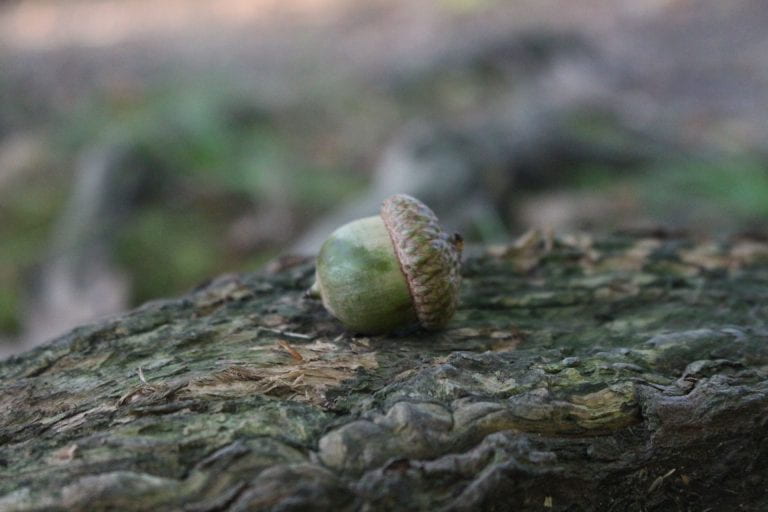
Students in Photo 202: Fundamentals of Professional Photography recently completed a photo essay project based on “The Land Ethic,” an essay written by Aldo Leopold in 1949 that argues for a deeper connection between humans and the natural world.
Leopold suggests that humans need to expand their concept of ethics beyond just people and animals to include the land—soil, water, plants, and more. The “land” is not something we own, but something we are a part of, and we should treat it with care and respect. Leopold proposes that we should think of ourselves as caretakers, responsible for maintaining balance and harmony with nature.
Urban park. CREDIT: Chelsea Quijas
Tommy Hartung, assistant professor of digital media, arts, and technology, instructed students in the class to choose an area and create a series of five 360-degree panoramic images that document the landscape and the biome it contains.
“The site they chose could be anywhere from urban to complete wilderness,” Hartung said. “Students were also required to take notes documenting the ecosystem and use their notes to draft a 500-word essay to go with the images.”
A second part of the assignment involved time-lapse photography.
“The element of time and motion related to photography has allowed humans to see systems develop by compacting time into short motion clips,” Hartung said. “It allows a focus that the human experience may overlook about the location.”
Dobbin’s Landing in Erie. CREDIT: Evan Gerdes
The students’ essays are impressive and thought-provoking. See for yourself at the links below:
By Robb Frederick, Associate Director of News and Information,
Penn State Behrend
Workplace gossip often targets the boss. She’s in over her head. He’s overextended. There’s trouble at home, supposedly.
When the boss is the one spreading gossip, sharing private insight about a team member’s performance or personal life, that can lead to a far more damaging dynamic – a behavior researchers refer to as moral disengagement.
“Leaders set the tone for an organization,” said Joongseo Kim, an assistant professor of management at Penn State Behrend’s Black School of Business. “When a leader participates in gossiping behavior, other employees pick up on that right away. They are less likely to feel shame or guilt when they gossip. They think, ‘Even the leaders are doing this. It’s acceptable in this organization.’”
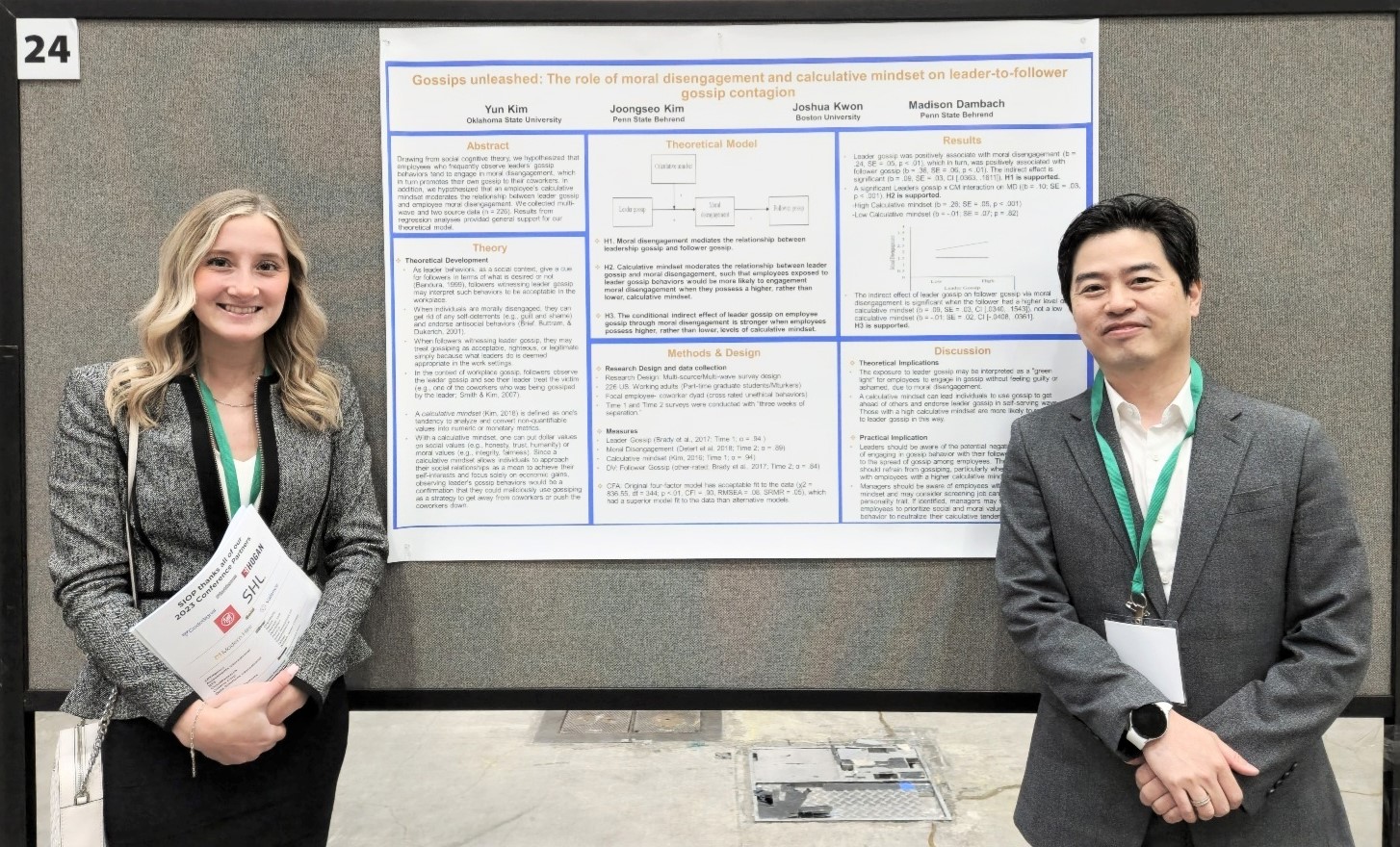
Kim runs the Raimy Behavioral Lab at Penn State Behrend. He studies business ethics and workplace deviance. This spring, working with Madison Dambach, a senior in the Black School of Business, and Yun Kim at Oklahoma State University, he began a study of gossip contagion in the workplace.
“Gossip can be fun,” he said. “It’s sharing a thing that began as a secret, and that makes it a social-bonding mechanism.”
Positive gossip – sharing the news of a colleague’s promotion, for example – can increase a team’s sense of organizational identity, according to a 2022 study by the National Institutes of Health. That type of water-cooler talk can boost efficiency and employee retention.
“It’s all about intent,” Kim said. “If you gossip to motivate a person, or to elevate the reputation of a person, that’s a positive thing. If what you are saying is purposefully hurtful, however, and if you’re saying it to sideline or neutralize a colleague, that can do real damage.”
An employee with a calculative mindset – someone who approaches social relationships as a means of achieving another goal, such as financial gain – is more likely to gossip when a supervisor participates in the behavior, said Dambach, who presented the study at the Society for Industrial and Organizational Psychology conference in Boston.
“People with a higher calculative mindset see gossip as an opportunity,” Dambach said. “It’s a way to undercut a competitor or cast doubt on their abilities or their commitment to the organization. Some people will use that to their advantage, especially if the supervisor is listening.”
When a boss gossips, that’s viewed as a green light for others in the organization to behave the same way, Dambach said. Over time, that can affect employee productivity.
“Managers should pay more attention to that,” she said. “if they feed into gossip, their employees will do the same, without any sense of guilt or shame. That weakens the cohesiveness of the group. It leads to resentment. Ultimately, it can lead to the failure of the business.”
Senior student Madison Dambach, left, and Joongseo Kim, assistant professor of management at Behrend’s Black School of Business.
Office of Strategic Communication, Penn State Behrend
After a three-year hiatus, Penn State Behrend’s Black School of Business reintroduced its annual spring trip for students in March. More than forty Behrend business students, including Finance majors studying through World Campus, traveled to Pittsburgh for two days of company visits and networking opportunities.
The group toured Schneider Downs, an accounting, tax, and business advisory firm, and the investment banking firm of BNY Mellon together, and major-specific breakout sessions were also offered. For example, Marketing majors toured the marketing agency, Brunner; Finance and Business Economics majors visited Waldron Private Wealth, and Accounting and Management Information Systems majors went to the accounting, tax, and advisory firm of BDO. Company visits included tours, presentations on the business and industry, and time for questions.
One notable session was held at the Pittsburgh Penguins office where Marketing and Project and Supply Chain majors got a firsthand look at how a top sports franchise operates, from ticket and retail sales to social media and game-day operations.
The students also had the opportunity to interact and network with Black School of Business alumni at a gathering at the Rivers Club in downtown Pittsburgh.
Students who participated in the spring trip described it as a valuable and enlightening experience.
“It’s a great chance to meet alumni and both establish and strengthen relationships so that when it comes time to search for a job, you have a robust network to contact,” Tristan Leopold, a junior Finance major, said.
“The trip provides an opportunity to see businesses through an insider’s eyes and gives you the chance to form connections and hone networking skills. It is well worth the cost and time to attend,” Anita Laughner, a junior World Campus Finance major, said.
“I liked hearing advice from employees about entering the business workforce. I also enjoyed networking with Behrend alumni. It was a fun experience,” Ella Cuccaro, a junior Project and Supply Chain Management major, said.
“I would definitely recommend this trip to any student who wants to broaden their contact list, meet young professionals, and learn what will be expected of them in their first years on the job. It provided a lot of insight into what it will be like day-to-day,” Keara Mollenauer, a senior dual majoring in Accounting and Management Information Systems, said.
“It was a great networking experience that provides students with the opportunity to get their foot in the door for prospective job opportunities. It was very well organized and thought out. If you’re a business student, this trip is a must,” Zane Lewis, a first-year student dual majoring in Accounting and Finance, said.
Plans are already underway for the spring 2024 trip with the destination city to be announced in the fall.
By Heather Cass, Publications Manager, Penn State Behrend
Why did the amphibian cross the road? To lay eggs on the other side.
The area around Penn State Behrend’s Advanced Manufacturing and Innovation Center (AMIC) in Knowledge Park is an amphibian’s paradise. Woods give way to marshy areas and small ponds, some tucked safely behind trees and shrubs, providing the perfect habitat for frogs, salamanders, and newts that live in woods but breed in water.
Each spring, a parade of amphibians crosses Technology Drive and the AMIC parking lot to reach the ponds where they can lay their eggs. Many don’t make it, falling victim to vehicle traffic or plunging through the grates that cover road drainage tubes. Motorists passing by may not notice, but the faculty members and students in Behrend’s Biology program who study spotted salamanders do.
“Frankly, we’ve seen too many road-killed amphibians and egg-laden females stuck in the drains to not try to do something about it,” said Dr. Lynne Beaty, assistant professor of biology. “They’re not alone, though, as many wood frogs, red-spotted newts, and spring peepers also face those same hazards to reach breeding ponds in the spring.”
Beaty reached out to the college’s Maintenance and Operations (M&O) department with two solutions to mitigate the problem. One was to install “amphibian migration route” signs to encourage drivers to pay attention to amphibians on the asphalt. The second solution involves placing a mesh covering over the drains in the area to prevent small amphibians from falling through on their way to their breeding sites.
The signs, which were designed by senior Biology student Phoebe Will, are now installed, and a team of engineering students is working with M&O to create the mesh coverings for the drains.
“Our Maintenance and Operations group is always willing to help the college achieve its academic and research missions, especially when that involves protecting wildlife,” said Randy Geering, senior director of operations.
So, if you regularly travel Technology Drive, please go slow and keep an eye out for wildlife!
By Heather Cass, Publications Manager, Penn State Behrend
The weeks between Thanksgiving and the end of the semester are notoriously rough for almost everyone on a college campus. Professors kick it into high gear to cover remaining material before final exams. Students scramble to stay on top of their work and study for finals. Staff and administrators work feverishly to plan for the start of the new semester that will follow break.
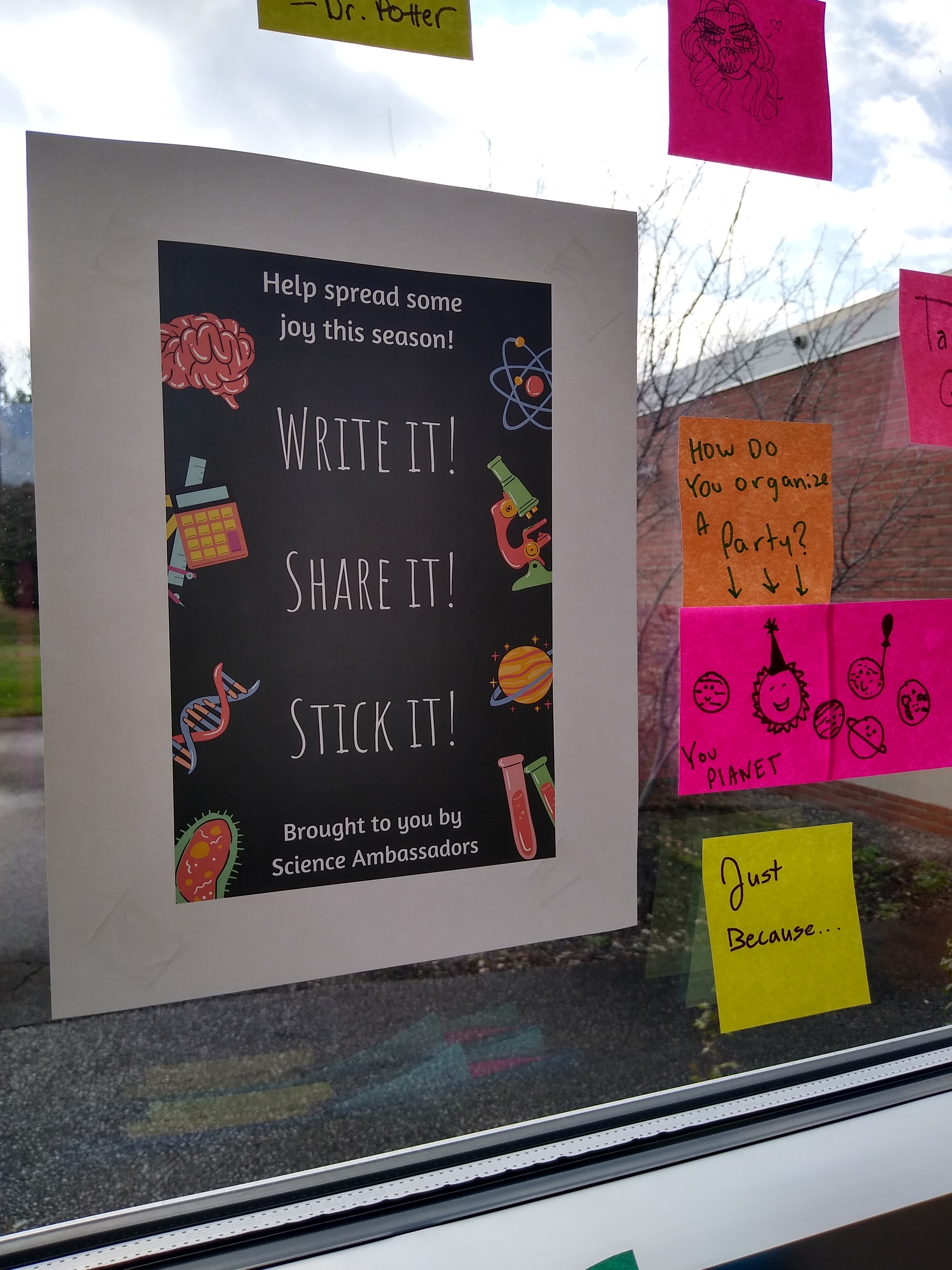
Penn State Behrend’s School of Science Ambassadors are no strangers to the tense atmosphere in those few weeks, so they decided to toss a little sodium hydride into the water with a bunch of eye-catching colorful sticky notes plastered on the glass walls in the breezeway between the Otto Behrend building and the Science Complex.
“At our first Science Ambassadors meeting this year, we discussed doing something fun to brighten up the science buildings,” said Lauren Barmore, a senior Biology major, who helped spearhead the project. “There was a group of four of us who put the wall up the Friday before Thanksgiving break. We wanted it to be a surprise for the students when they returned.”
The students who wrote the initial notes—Barmore, Taylor Romania, Briona Bargerstock, and Jacob Kessler—penned notes that reflect the material taught in the School of Science.
“We wanted to put our own spin on it,” Barmore said. “A lot of our professors put jokes and memes into their learning materials, so we were sort of influenced by them.”
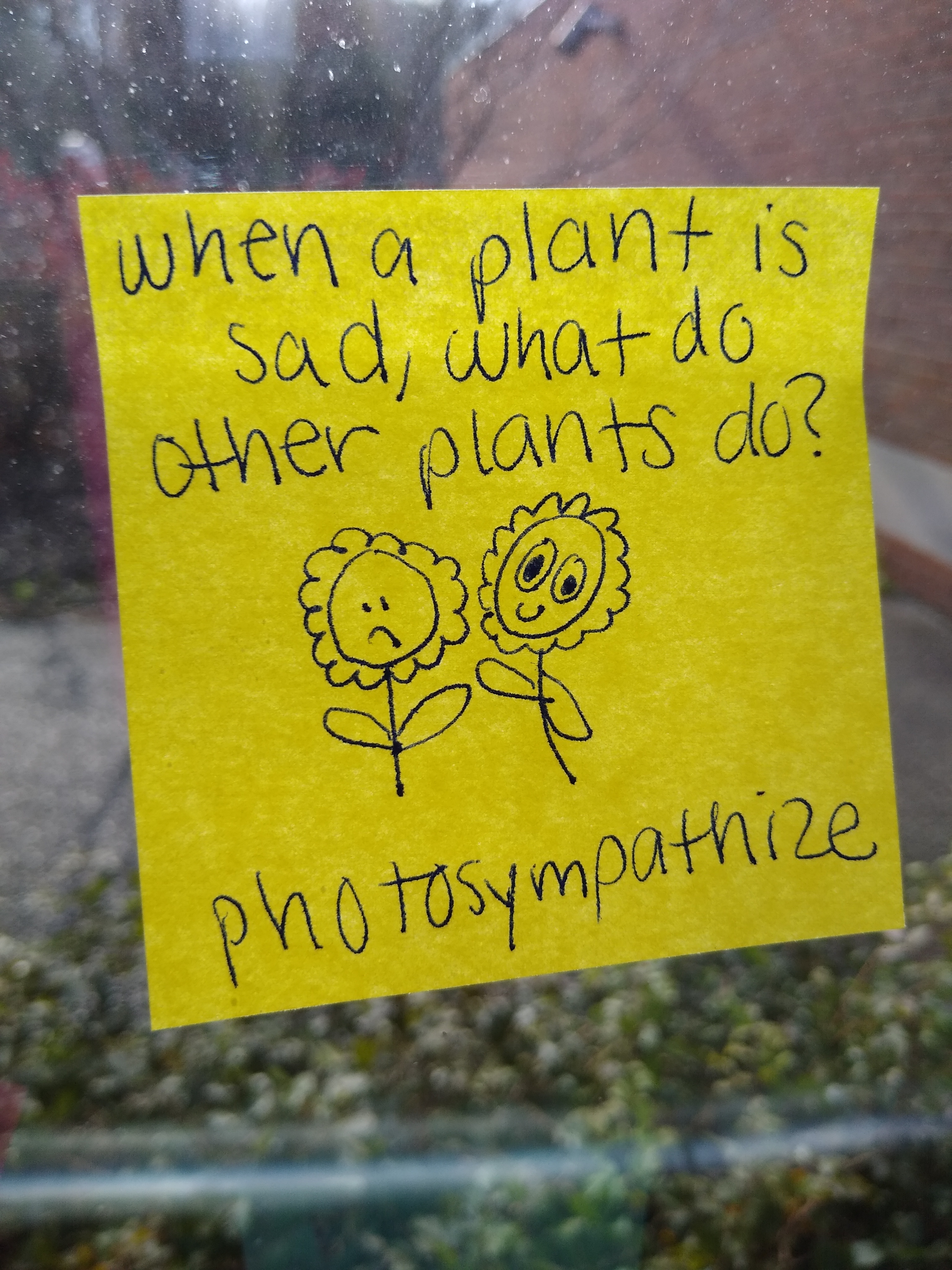
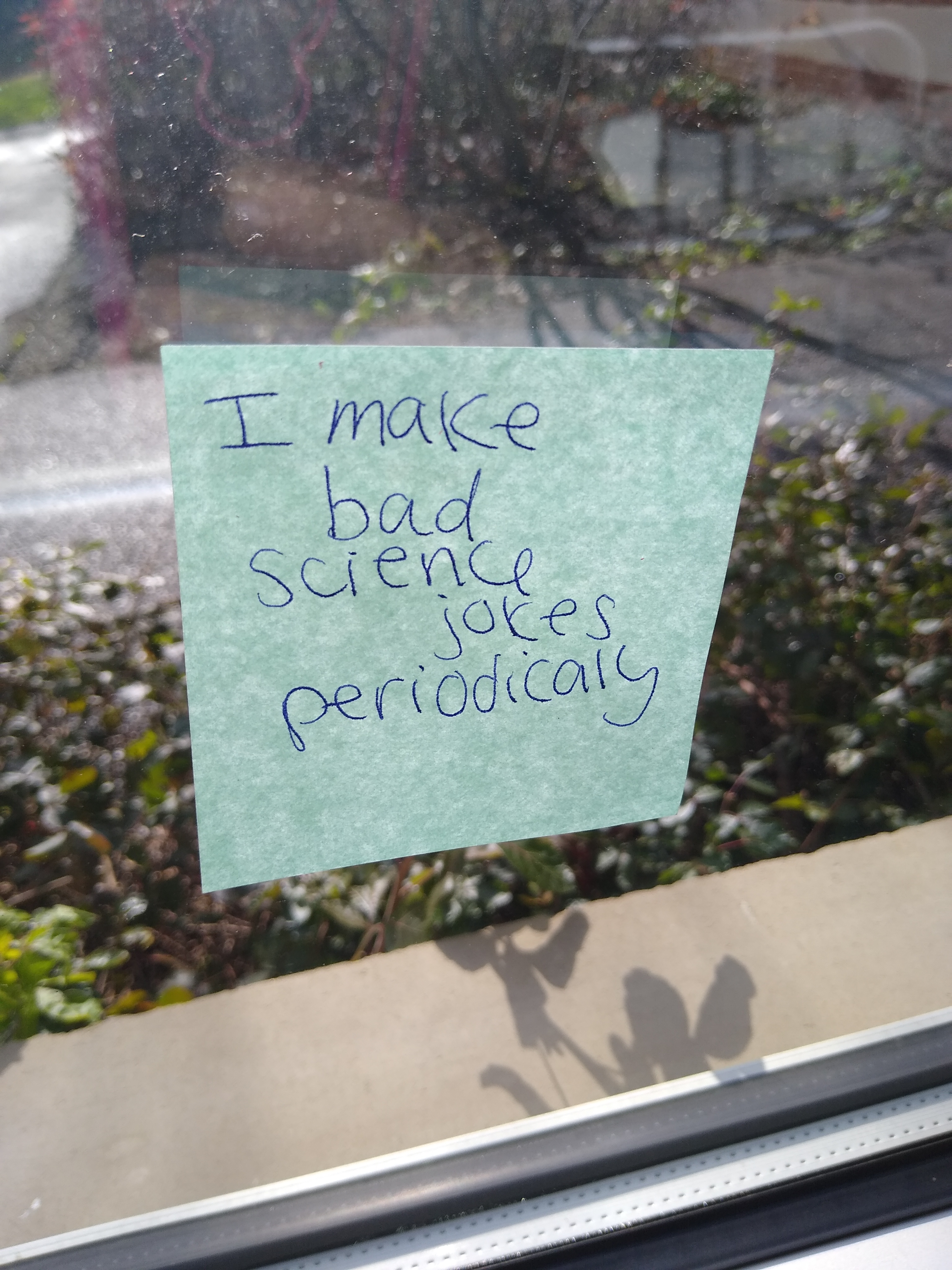
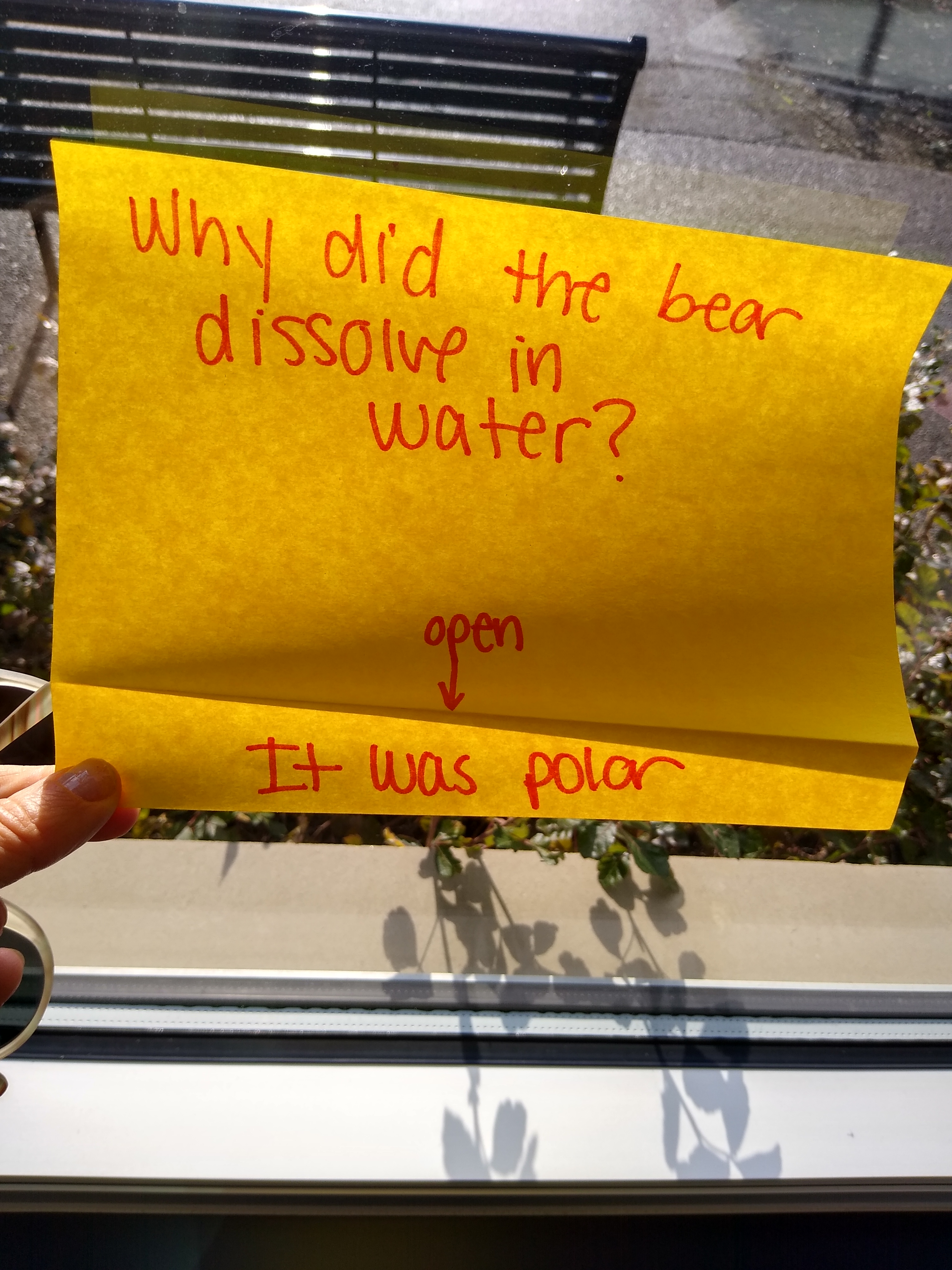
The messages on the notes range from inspirational to encouraging to laugh-out-loud funny. Most contain math or science references guaranteed to make readers chuckle:
Or groan:
Or, if they are non-science majors, scratch their heads.:
A similar display of sticky notes can be found in the stairwell in the Reed Union Building. That project began several years ago and continues. thanks to the college’s Random Acts of Kindness (RAK) club.
It’s a popular campus feature and one that Barmore has used.
“I always loved taking notes from the RAK stairwell and giving them to my friends before exams or if they were having a rough day, or needed a laugh,” she said. “I’ve found that the smallest acts of empathy or service can have a big effect on people. We wanted to bring some of that color and joy to our side of campus.”
The notes are meant to be shared and to multiply: A container of sticky notes and pens hangs in the middle of the display, inviting anyone to share a note or joke or drawing. Take what you need. Leave what you want to say.
“We hope people enjoy reading them as much as we did writing them,” Barmore said.





 BEHREND BLOG