
By Heather Cass
Publications & Design Coordinator, Penn State Behrend
Divide three hours, four minutes and thirty seconds by 26.2 and you’ll get the pace of the fastest mathematics professor at Penn State Behrend.
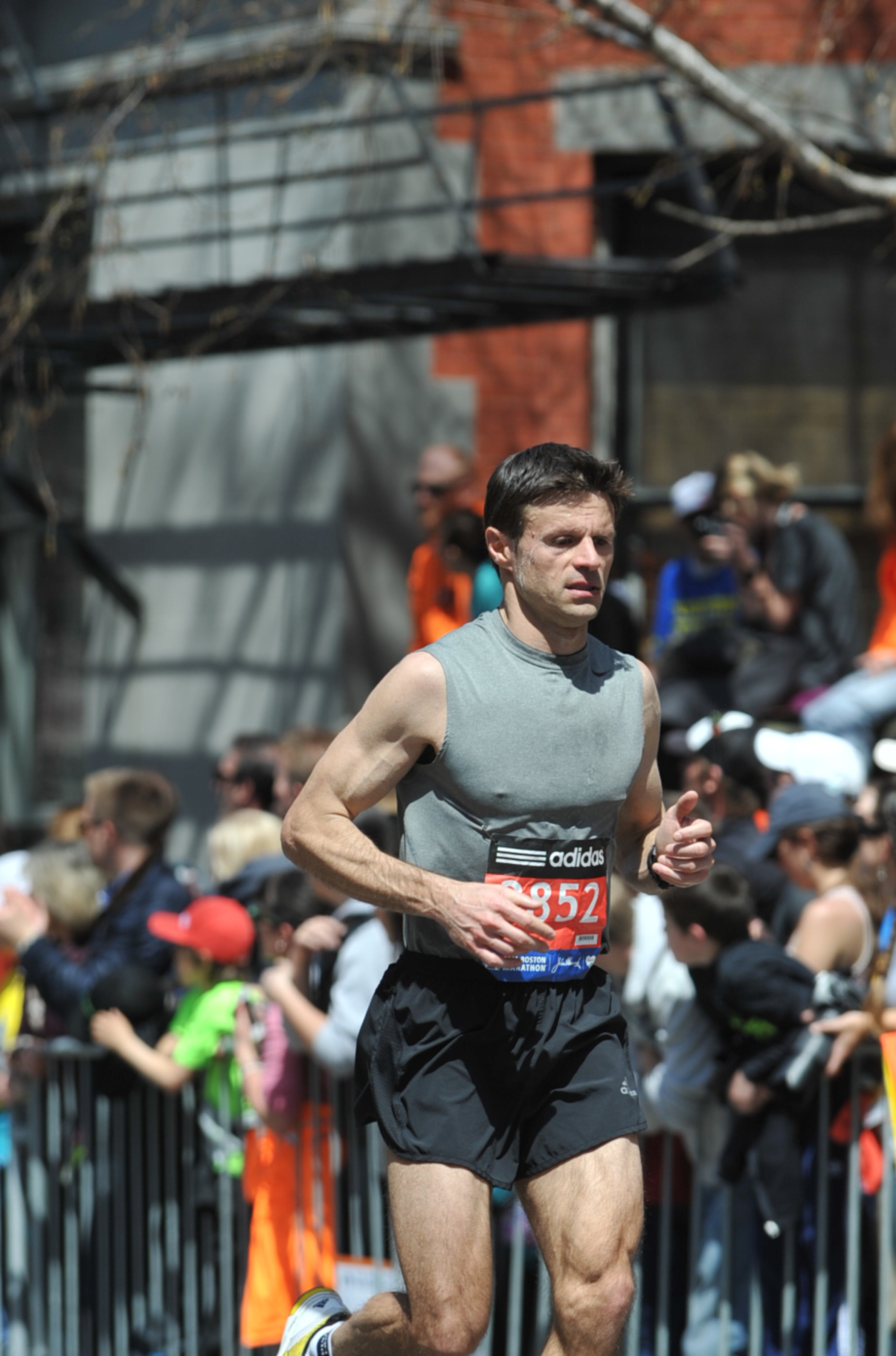
Dr. Antonio Mastroberardino, assistant professor of mathematics, completed the 2014 Boston Marathon last Monday with an impressive average 7.02 minute per mile pace.
But, that wasn’t even his best! Mastroberardino, 39, qualified for the 2014 Boston marathon at the Rochester marathon in September of 2012 with a finish time of 2:58:34, a full 12 minutes under the 3:10 qualifying time he needed.
We caught up with Mastroberardino (which wasn’t easy…he’s quite fast, you know) and talked him into answering a few question about his race through bean town.
What was your finish time at Boston?
3:04:30. The Erie Times-News had an incorrect time of 3:06:24.
Were you happy with that?
I was pleased with the result.
Have you run Boston before?
No, this was my 3rd marathon. Rochester 2012 was my first. Erie 2013 was my second. I hit the proverbial wall in Erie and ran a disappointing 3:14:07.
What was it like to be/run Boston in this emotional year?
It was an amazing day for the city of Boston. From the start in Hopkinton to the finish in Back Bay and through all of the towns in between, the atmosphere was electric. The most amazing part was turning onto Boylston St. with the finish line in sight and having a roaring crowd carry you to the end.
Was your family there?
No, but my mom mentioned that my aunt in Italy was very happy for me.
Were you worried about anything happening?
No, not at all.
What is going through your mind as you run a marathon? What do you think about?
The first thing to do is to establish the right pace in the first 5-6 miles. People often go out too fast, and this could cost you several minutes in the end if you have to slow down to a walking pace in the last part of the race. This happened to me in Erie in 2013. For the miles in between, a friend of mine with a lot of experience told me: You need to be bored at mile 15; otherwise, you are working too hard and are in danger of hitting the wall later in the race.
What is your strategy for dealing with the tough miles (a mantra, doing math problems to distract yourself, etc.)?
The last 5-6 miles require total concentration. At that point, your legs are crying for you to stop, but you have to simply fight the strong desire to give in to your body’s demand of slowing down. In a race like Boston, the crowd support definitely makes a difference.
Where do you train?
This winter, I trained everywhere. I used the treadmill at my apartment complex, the treadmill and the indoor track at LECOM, the treadmill and the indoor track at Junker, the Behrend outdoor track, Veteran’s Stadium, Mercyhurst soccer field, the streets around the Gannon campus, Presque Isle trail, and various other places whenever I traveled out of town.
How many days/miles a week do you run?
I started from 30/week back in December and got up to the low 50’s during the last week of March.
Where is your favorite place to run locally?
I like running at Presque Isle, although I don’t go there that often to run. I actually prefer to ride the bike if I go to the peninsula.
Do you train alone or with friends?
I train alone.
Do you listen to music?
No music. Just the sound of nature.
Favorite running shoes?
I choose shoes that fit the best. I wore Adidas for this marathon and had a pair of Saucony before that. I purchased both pairs from Achille’s Running Shop in Erie.
Why do you enjoy running marathons?
It is a great challenge not only to complete one but also to train for one. And I guess I enjoy the challenge.
What would people be surprised to learn about you?
I played football in high school and in college. In college I played Sprint Football—a varsity sport with a weight limit that has ranged from 150 lbs. in the early years of the league to the current limit of 175 lbs. There are currently eight teams in the Collegiate Sprint Football League, including the Army and Navy teams.
What do you like to do (besides run) in your free time?
I play the violin, although I am not very good. I play in a community orchestra called YADO (Young Artist Debut Orchestra) conducted by Frank Collura. We have a performance in December and one in May every year.
Next race? What are you training for now?
I will run a half marathon in Buffalo at the end of May.
Any other memories from Boston you want to share?
As we walked from the Athletes’ village to the start (just over a kilometer) in Hopkinton, a man standing outside his home was offering everyone donuts, beer, and cigarettes. I passed on the offer.

 BEHREND BLOG