Secret Lives of Faculty: Dr. Pam Silver

By Heather Cass

Publications & Design Coordinator, Penn State Behrend

There’s much more to Penn State Behrend’s faculty and staff members than what you see on campus. In this occasional series, we’ll take a look at some of the interesting, unconventional, and inspiring things that members of our Behrend community do in their free time.

Bemis Point 2

NAME: Dr. Pam Silver

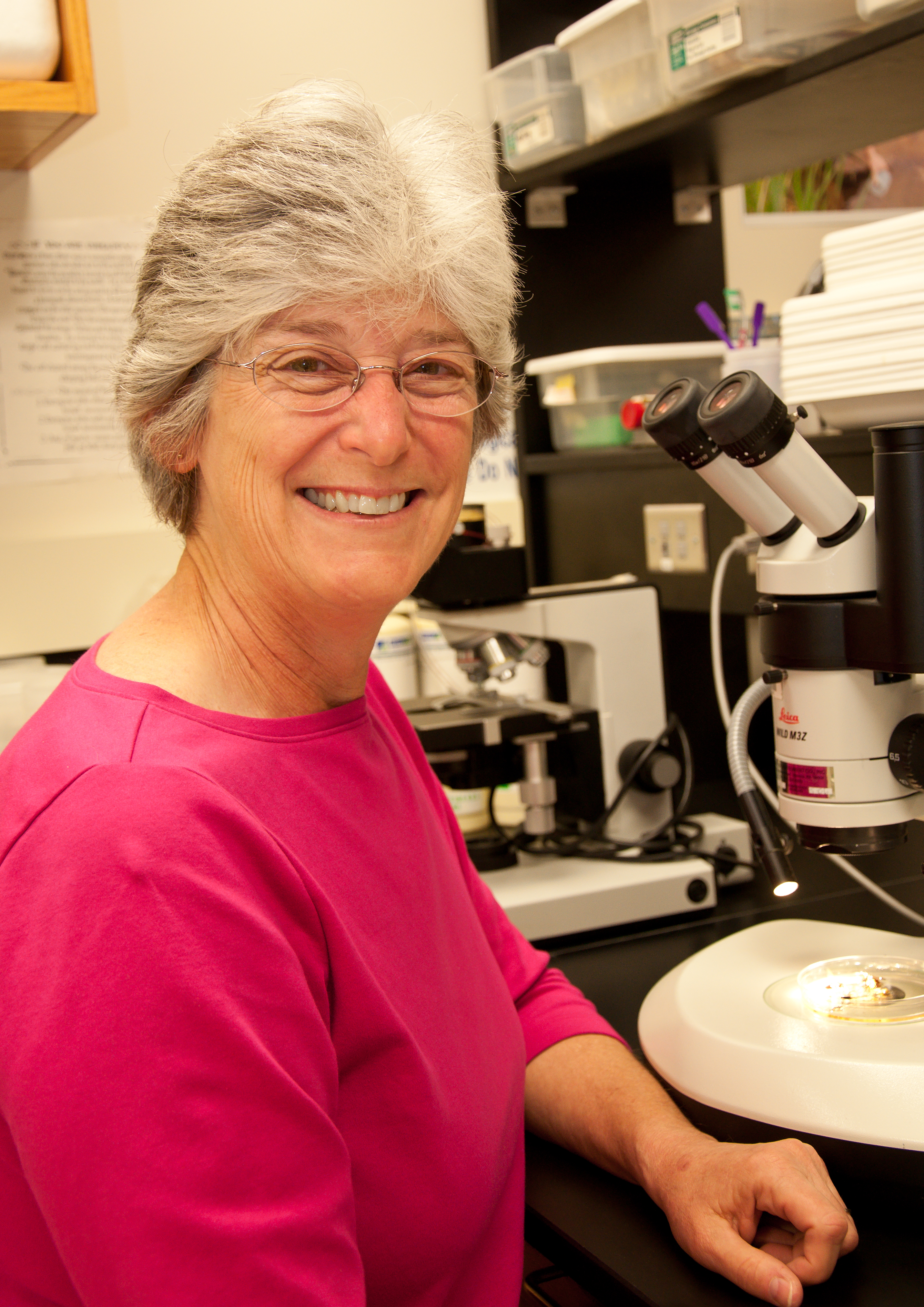
DAY JOB: Distinguished professor of biology, Penn State Behrend

SIDE GIG: Pipe Major, 96th Highlanders Pipes & Drums Corp

If Dr. Pam Silver’s childhood had a soundtrack, it would be the humming drone and romantic skirl of the bagpipes.

“My earliest memories are of following my mother around the yard as she walked back and forth playing bagpipes,” she said.

It wasn’t long before Silver was squeezing her own set of pipes under her tiny arm.

“I started taking lessons when I was 7 and got my first pipes when I was 9,” Silver said. “I’ve been playing ever since.”

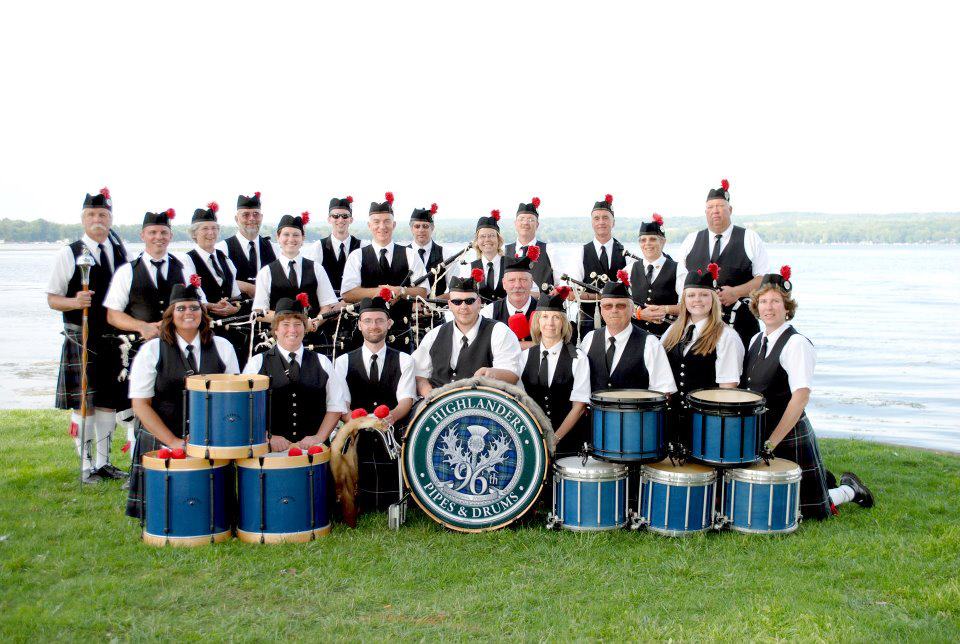
Today, she is the Pipe Major of the 96th Highlanders Pipes & Drums, a pipe and drum corps that represents Jamestown and Chautauqua County, New York, at parades, festivals, and special events throughout the year.

96th Highlanders 2011 Color shot

Silver said her favorite music to play on the pipes is a trio of songs: Mrs. Joy Cairns, Rebecca’s Air, and Shoshanna’s LullabyEach of the songs is a tribute to women—wives, mothers, daughters.

“To me, that set is just one giant love song,” she said.

Speaking of love songs, Silver’s husband, Doug Clark, shares her passion for music. He is the drum sergeant in the 96th Highlanders (that’s how they met). He runs a large Celtic festival every August in Mayville, New York. To coin a trite, but wholly appropriate phrase, they make beautiful music together.

In addition to her performances and practices with the 96th Highlanders, Silver offers bagpipe lessons and takes on the occasional private gig, playing at weddings, parties, funerals, and, once, a bat mitzvah.

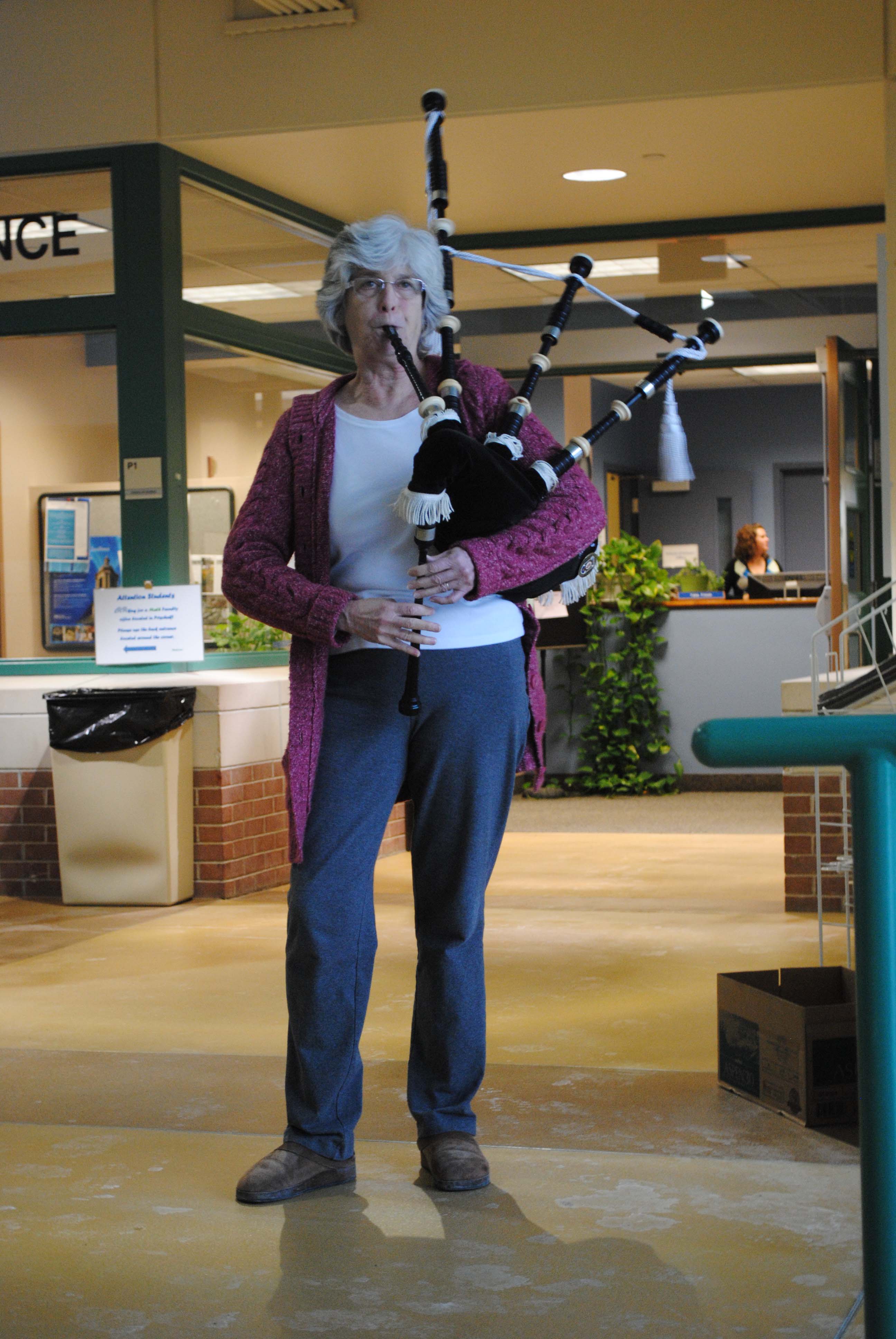
She’s also been known to liven things up in the School of Science with impromptu performances.

“When it’s been a long week, or when the students have been working really hard, I like to bring in my pipes and play a little,” she said. “It lifts spirits and makes a lot of noise.”


DSC_0271

ON THE CREATIVITY OF SCIENTISTS:

“People sometimes think science is about memorizing facts, but it’s really about discovering facts and wringing answers out of nature,” she said. “When you have a scientific question, it takes a lot of creativity to find the answer to it.”

FROM BLOOD TO BIO:

“I worked as a medical technologist at a blood bank in Florida for ten years while I raised my sons. When they got older, I decided to go back to grad school to be an ecologist, but I never could learn to like the Florida heat. I grew up in rural New Jersey, so I was happy to move back to the Northeast to work at Penn State Behrend.”

ON TEACHING:

“If we want to save the world, or at least slow the destruction of our ecosystem, we have to communicate effectively with non-scientists. Scientists tend to be introspective and many of them struggle to explain things to those outside their field. I’m really good at explaining things, so the most useful place for me to be to help fix our ecosystem is in the classroom. By teaching students to respect and appreciate our natural resources and insisting they take action to preserve it, I can have a much larger impact than I could if I worked only in the lab or in the field.”

ON ECOLOGY (AND HER SPECIALTY – AQUATIC ECOLOGY):

“I love ecology because it pulls everything together. I get to talk about all kinds of subjects from history to politics to engineering because it all influences our ecosystem. Also, I really love to play in the water.”

WHAT SHE WANTS THE WORLD TO KNOW:

“Water is our most precious natural resource, and it should never be wasted or deliberately contaminated. Drinkable water is not abundant and is, in fact, one of our most scarce natural resources. People don’t realize that yet, but they will. And it will happen in our lifetime. Every living thing needs clean water. We can’t survive without it.”

ON EDITING FRESHWATER SCIENCE:

Silver is Editor-in-Chief of Freshwater Science, a highly-rated international scientific journal that has doubled in size and tripled in submissions since Silver took over in 2005.

“It’s a ton of work,” she said. “I spend probably sixteen hours on every paper in that journal. But, it’s really satisfying work. I like making sure the science is well-written and understandable. And I’ve amassed a huge network of scientific colleagues from across the world. I have learned something from each of them.”

A DISTINGUISHING HONOR:

Silver was recently named a University distinguished professor, an honor bestowed on fewer than 120 faculty members University-wide. She was nominated by Dr. Martin Kociolek, director of the School of Science.

“I’m still not sure if I’m worthy of the title, but there are people who I have tremendous respect for who think that I am, so I guess I can trust their opinion,” she said with a laugh.

Pam Silver 2010 JF

SILVER STATS:

Time at Behrend: 22 years

Favorite aquatic insect: Midges. “They are very interesting and ecologically important to the health of a lake.”

Hobby No. 2: Making small, decorative quilts. “I created one as a memorial to a famous aquatic ecologist and donated to the Society of Freshwater Science for their annual auction to benefit graduate students and it fetched a donation of $2,600!”

Hobby No. 3: Gardening. “It’s therapeutic to have your hands in the soil.”

Favorite TV show: Madam Secretary.

Favorite sweet treat: Coffee-flavored ice cream.

Dream vacation: Hiking in the Swiss Alps. “I’ve done it before, but I’d like to go back.”

Book she’d recommend everyone read: Lord of the Rings. “I inherited the book from my grandfather and didn’t think I’d like it, but I reread it every year.”

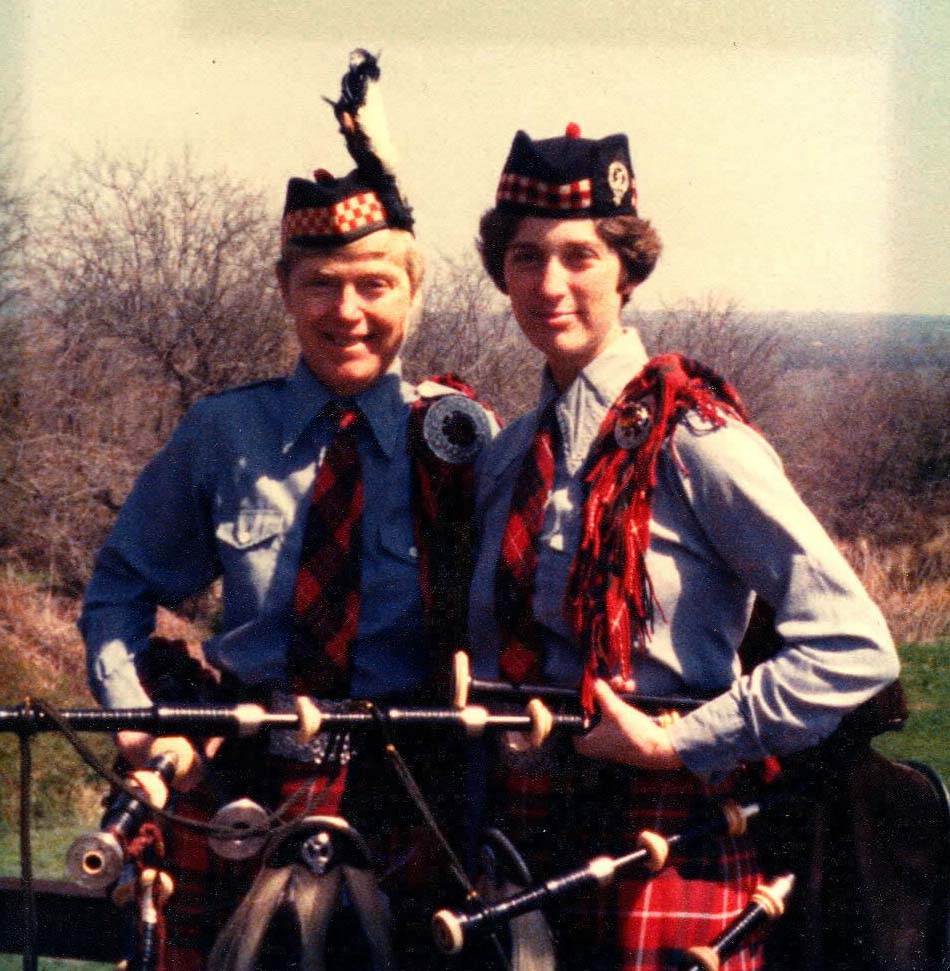
Person she admires most: Her mother. “We drive to New Jersey once a month to visit her. She is 85 and still plays the bagpipes. We play together every chance we get.”

Edith and Pam Silver 1975 cROPPED

Dr. Silver, right, and her mother, Edith


Recommended gift ideas from faculty members

By Steve Orbanek
Marketing Communications Specialist, Penn State Behrend
In need of some last-minute holiday gift ideas for the young ones in your life? How about something that’s fun and educational at the same time?

We asked Penn State Behrend faculty members to give us a few suggestions.

1378_star_wars_lightsaber_thumb_wrestling

School of Science

Ideas provided by Tracy Halmi, senior lecturer in chemistry

  • Science of the Month Club. Inspire the next generation of scientists by having hands-on science delivered to your door each month! For just $24.99 a month, you get everything you need to conduct exciting experiments.
  • Sunlight, Skyscrapers, and Soda Pop: The Wherever-You-Look Science Book. This fun book helps children learn the science behind simple, everyday activities. $9.95
  • Yahn Planetarium Gift Certificates. Have you heard? Penn State Behrend now has its very own planetarium. Help someone see worlds beyond their reach by purchasing a gift certificate, available in any denomination. For more information, contact planetarium director Jim Gavio (jvg10@psu.edu or 814-898-7268).
  • Star Wars Lightsaber Thumb Wrestling. Unless you’ve been living under a rock, you know that a new Star Wars film is hitting theaters next year. Celebrate by picking up this fun game. May the thumb be with you… $12.99

monopoly_number9_pack

School of Business

Ideas provided by Eric Robbins, lecturer in finance

  • Board games. Life and Monopoly are two timeless classics. The fast-paced, rummy-like game Five Crowns is another great option. $9.99 to $24.99
  • Go Venture. This is a series of business simulation and financial literacy computer games that are good for kids of all ages. $495
  • Kano. This is the perfect gift for those with really innovative minds. Kano provides a kit kids can use to build their own computers, in a form similar to LEGOs, then play games on what they just built. $149.99

3c074cea-6f2b-4ccd-99a4-71ca3959b845

School of Humanities and Social Science

Ideas provided by Dr. Tom Noyes, associate professor of English and creative writing

  • Books! Some gift ideas never get old, and that’s the case here. In particular, Tom suggests using NPR’s Book Concierge app to find the perfect book for those on your shopping list.
  • Art supply sets. Participation in the visual arts helps children develop an imagination and sharpen their eye for detail. $13.99 and up

article_post_width_pokemon-omega-ruby-alpha-sapphire-main-169-us

School of Engineering

Ideas provided by Dr. Matthew White, assistant professor of game development

  • Amiibos. Action figures + video games = tons of fun. $12.99
  • Pokémon. The more things change, the more they stay the same. Pokémon video games have been one of the hottest-selling video games for years, and that’s true in 2014 as well. Pokémon Omega Ruby and Pokémon Alpha Sapphire qualify as two of the most popular games this season. $39.99
  • Xbox One. It’s one of the top game systems in the world, and for a limited time, it can be had at a lower price ($349) than normal.

Yahn Planetarium at Penn State Behrend will be open this weekend

IMG_0540 editedUp for some traveling this holiday weekend? How about a trip to the moon?

The Yahn Planetarium at Penn State Behrend, a newly-renovated 55-seat astronomy theater that opened earlier this month, will be open on Saturday. The planetarium, housed in the college’s School of Science Complex, will offer two public shows at 1:00 p.m. and 2:30 p.m.

The 1:00 p.m. show, “Back to the Moon for Good,” follows teams as they race toward the moon and compete to win a $30 million Google Lunar XPRIZE. Penn State’s Lunar Lion Team is featured in the program, which is narrated by Tim Allen.

The 2:30 p.m. show, “The Sky Above Mr. Rogers’ Neighborhood,” is an introductory and interactive show recommended for ages 2 and up. The show follows X the Owl as he tries to save the moon from being taken out of the sky by Lady Elaine.

“If you want to get out and do something a little different this holiday weekend, the planetarium is a great fit,” says Jim Gavio, director of the Yahn Planetarium. “It’s very family oriented, and there are plenty of educational takeaways from both shows.”

Admission to the planetarium is $5 for adults and $3 for children ages 12 and under. For more information, visit behrend.psu.edu/yahnplanetarium or call 814-898-7268.


Behrend Reacts: What are you thankful for?

BehrendReactslogolarge

By Nicole Krahe
Marketing Communication Student Assistant, Penn State Behrend

Studies have shown that being grateful has a significant impact on lives; it reduces stress levels and can even increase our life expectancy. In honor of the upcoming holiday, we asked Behrend students, faculty, and staff:  What are you most thankful for?


026

Casey LaBuda, sophomore, Nursing, from Pittsburgh: “My mom. I always call her in the middle of the night when I’m having a breakdown about nursing.”


Nancy Study

Dr. Nancy Study, lecturer in engineering: “In answer to the question about what I’m thankful for this year, I would say it’s the same things I’m thankful for every day: my family and friends, and the privilege of having a job I enjoy. Of course I’m also thankful for the creature comforts in my life like a nice house to live in, an all-wheel drive vehicle to get around in the snow, a steady supply of caffeine via coffee and Twining’s English Breakfast Tea, and sturdy snow boots, but I’ve learned over the years that material things and money mean very little if you don’t have your loved ones and/or spend 40+ hours a week in a job that makes you miserable.”


027

Morgan Corle, first-year student, Communication, from Avella: “I’m thankful for all the people that I’ve met here and become close with.”


Dorothy Kurylo

Dorothy Kurylo, campus coordinator for nursing programs and lecturer in nursing: “I am thankful especially for my family and friends. I am also thankful to be a faculty member of Penn State Erie, The Behrend College. As a newcomer to Erie, I have become very thankful for my boots and my snowbrush. Wishing everyone a Happy Thanksgiving!”


028

Amy Neal, first-year student, Division of Undergraduate Studies, from Erie: “The cold, so I’m able to appreciate the weather when it’s warm!”


029

Mallory Carson, first-year student, Political Science, from Erie: “I’m thankful for black lipstick.”


Kristen Comstock Headshot

Kristen Comstock, assistant director of alumni relations: “I am thankful to work for my lovely alma mater. Every day I get to interact with many of our fantastic 35,000 alumni. Plus working at Behrend means I get to enjoy, more often than most alumni, the delicious Bruno’s chicken wraps! And I cannot forget I am grateful for friends, family, health, happiness, and shoes!”


Mary-Ellen Madigan

Dr. Mary-Ellen Madigan, senior director of enrollment management: “I am thankful for my kids—now grown.  They both have good jobs and live independently.  Along with them, I am thankful for my three beautiful and fun granddaughters.  I’m especially thankful that they live nearby and I get to spend time with them.”


Don Birx's first Behrend portrait. Taken May 2010 by John Fontecchio

Dr. Don Birx, Chancellor:

“Thankful – Yes; for being in Erie and especially at Behrend.

Yes it is cold,

but I have found hearts here are warm and friendships deep.

Yes there is lots of snow,

but it makes the days so much brighter – with a glint from the winter sun.

Sunsets are stunning, the hills full of grapes,

and the land slopes down to a great and beautiful lake.

Thankful – Yes, and for so much more……for all of you.”


Dawn Blasko (2)

Dr. Dawn Blasko, interim associate dean for academic affairs and associate professor of psychology:

“What am I thankful for this year?  Like everyone else I’ve seen today I’m supposed to be thankful that three feet of snow did not fall on Erie today, but went north instead. But, to be honest, a little part of me is disappointed. I’m invigorated by this crazy cold, slap in the face, start to winter. I had to buy new warmer clothes-even find some gloves and boots. My office is always freezing, so my family bought me an alpaca sweater-no wonder alpacas can hang out in the Andes-much better than polar fleece.

The first snow to me is always exciting. I know it sounds crazy to you snow haters, but to me growing up in the Poconos, the first snow was pure gold. It opened up a wealth of new fun activities. Best of all, was the ultimate prize- THE SNOW DAY!

Even though we don’t have snow days at Behrend, (I guess we’re too tough for that), as a kid I clearly remember being snowed in with the whole family for days at a time. Mom, in her fox-furred hood, riding the toboggan, and Dad wobbly on his snow shoes walking the yard to measuring the snow in the deepest drift with his yard stick. There was no work, and no school. Time stopped, we pitched in to shovel the driveway then we were off into the untouched whiteness.  A soft fluffy blanket of white erasing all the ugly reality underneath.

Kids made trails around the neighborhood as we called all our friends out to play. We built snow forts to defend our territories and stored up snowballs for battle. We dug out the sleds from the basements and garages and went sleigh riding down the middle of the street. We held toboggan races—that were our own Olympic games.  Then there were the accidents, tremendous rolling crashes into banks of snow and sometimes into each other.

Who could forget the feeling of dragging yourself home, bruised, exhausted and soaking wet with numb feet and hands? We’d have some warm soup, put on dry gloves and go out again until the lack of light and parents calling us for supper ended the fun. The perfect snow was short-lived, in a few days the plow trucks and cinders would ruin our hill, school and work would start again, and we would be back to the usual routine.

This might be a long winter, and by February, if not before, even us diehard northerners will be tired of it. But, In the meantime, if the snow is just right, break the routine and make a new memory. The yard behind my office in Glenhill Farmhouse sure looks like some prime territory to defend.”


Behrend Reacts is a regular Thursday feature at the Behrend Blog that tries to get the campus pulse on a current topic, whether it’s serious or trivial. If you have a question to suggest for Behrend Reacts, please email Nicole Krahe at ndk5089@psu.edu.

Like Us: facebook.com/pennstatebehrend

Follow Us: Instagram.com/psbehrend

Tweet Us: twitter.com/psbehrend

Watch Us: youtube.com/pennstatebehrend1

Behrend Reacts: How should we react to the Ebola Epidemic?

BehrendReactslogolarge

By Nicole Krahe
Marketing Communication Student Assistant, Penn State Behrend


The Ebola epidemic currently sweeping through West African countries has proven to be the most devastating single outbreak of the disease in history.  Medical professionals say that the virus is unlikely to spread in countries with more advanced medical systems such as the United States, but authorities are still taking precautionary measures such as special training for health care workers and airport screenings.

With all of the current hype in the media, sometimes it is hard to decipher fact from fiction. We asked Behrend students how they think we should react to the Ebola epidemic.


147

Trey Loomis, sophomore, Mechanical Engineering, from Warren: “I’d say that people are overreacting.  We’ve been able to contain it so far and have dealt with similar things before. I don’t think that we should ban travel.”

148

Melissa Gess, first-year student, Chemical Engineering, from Pittsburgh: “I think the general population should be calmer about the situation. We are a wealthier country and should be able to handle it.”

149

Katelyn Pegher, junior, Psychology, from Dubois: “I feel like America has done a good job of containing it, or at least it seems like we have. I’m not concerned.”

151

Alex Herzing, sophomore, Interdisciplinary Business with Engineering Studies, from Saint Mary’s: “I don’t think we should be worried. Our medical system can handle it.”

153

Josh Holbert, first-year student, Mechanical Engineering, from Pittsburgh: “I don’t think we have much to worry about. I think that it’s mostly media hype. There have only been a few cases in the U.S and we seem to be containing it well.”

150

Trisha Hall, sophomore, Psychology, from Ohio: “I don’t think we should be too concerned. I do think the cases in the United States could have been prevented, but I’m sure our medical system will be able to control the virus.”

152

Will Cole, junior, Interdisciplinary Business with Engineering Studies, from Russel: “Given how great our country is and the amount of research done, it’s probably not that big of a deal. I think it’s just another thing for the media to exploit.”

154

Daniel Gross, first-year student, Biomedical Engineering, from Erie: “I don’t think that people should be panicking, running wild in the streets. It is something we should take seriously though.”


Behrend Reacts is a regular Thursday feature at the Behrend Blog that tries to get the campus pulse on a current topic, whether it’s serious or trivial. If you have a question to suggest for Behrend Reacts, please email Nicole Krahe at ndk5089@psu.edu.

Like Us: facebook.com/pennstatebehrend

Follow Us: Instagram.com/psbehrend

Tweet Us: twitter.com/psbehrend

Watch Us: youtube.com/pennstatebehrend1

Behrend’s rain gardens enjoy successful summer growth period

Jonathan and Bridget Thompson

By Steve Orbanek
Marketing Communications Specialist, Penn State Behrend

You’ve probably heard of rain gardens, but do you know what they are?

At Penn State Behrend, they are a significant part of the college’s best management practices for storm water efforts.

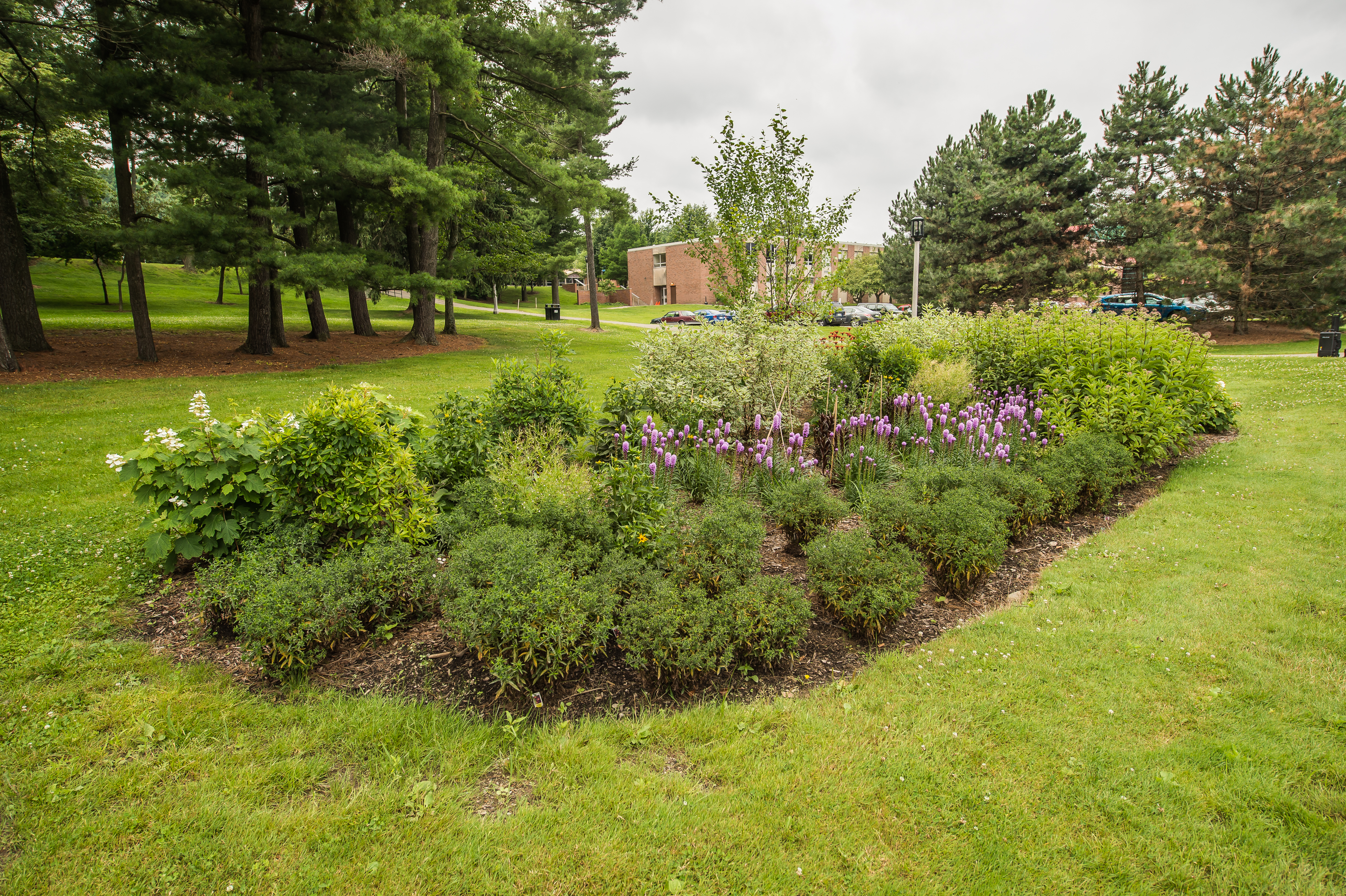
The college’s two rain gardens — one between Fasenmyer and Hammermill buildings, and one to the east of Nick, near College Drive — sit lower than the surrounding lawn and act as basins to catch and slowly absorb rain water, helping reduce potential flooding during storms and filtering pollutants from storm water runoff that would otherwise enter Four Mile Creek and, eventually, Lake Erie. Storm water runoff is considered one of the nation’s main sources of water pollution.

The rain gardens were planted in 2012 with a $36,495 Growing Greener grant from the Department of Environmental Protection awarded to Ann Quinn, lecturer in biology.

According to Quinn, the gardens have been cut back for the fall, but they grew well this past season. She attributed the successful growth in part to the compost, which is mixture of food waste from Dobbins Dining Hall and leaf matter from the wooded areas on campus, added to the gardens.

The gardens do more than just help with storm water runoff. They are also butterfly way stations and certified pollinator gardens. When choosing what to plant in the garden, Quinn said students researched native plants that fit the three zones — wet, moist, and dry — of a rain garden and also filled the criteria for pollinator and butterfly certifications.

Plants in the college’s rain gardens that are tolerant of standing water include cardinal flower, New England aster, several varieties of Joe Pye weed, swamp milkweed, and cinnamon fern.

Some plants in the garden thrive in areas that hold several inches of water during and immediately after a rain event, but is otherwise dry. Plants in these areas need to be draught tolerant, but also handle water well, too. Plants in the garden that fall into this category include black-eyed Susan, false sunflower, kobold, and summer sweet.

Quinn said that every plant in the garden grew beyond expectations.

“The Joe Pye weed spread well, and there are plans to transplant some of it to other wetland areas on campus,” she said. “The milkweed was a beautiful addition and a very important plant to include for Monarch butterflies, who migrate to the Erie area annually.”

If you missed the gardens this summer, don’t worry, they’ll be abloom again in the spring. And the bees and butterflies will be there to greet you!

Until then, here are some photos to enjoy:

This slideshow requires JavaScript.


Behrend Reacts: Who is your favorite professor?

BehrendReactslogolargeBy Nicole Krahe
Marketing Communication Student Assistant, Penn State Behrend

Author William A. Ward once said; “The mediocre teacher tells. The good teacher explains. The superior teacher demonstrates. The great teacher inspires.”

With so many dedicated professors on our campus, we asked Behrend students, who is their favorite and why?

Samantha

Samantha Raible, senior, Biology, from Pittsburgh: “I would have to say my favorite professor is Dr. Pam Silver, Professor of Biology. She was tough but always took the time to help students. She made things interesting enough to keep us awake at an 8:00 A.M class.”

Cat

Cat Hensley, first-year student, Geography, from Michigan: “Dr. Michael Naber, lecturer in geosciences. He’s easygoing, funny, and has Harry Potter glasses.”

Cassie

Cassie Peters, sophomore, Veterinary and Biomedical Sciences, from Erie: “I would say Ms. Luciana Aronne,  lecturer in chemistry. She is supportive, motivational and keeps class interesting.”

Ronnie

Ronnie Cox, sophomore, Physics, from Erie: “My favorite professor would have to be Mr. Adam Combs, lecturer in mathematics. He is not going to take it easy on you but will take the time to go over things you don’t understand.”

Lindsey

Lindsey Chase, first-year student, Kinesiology, from Randolph, N.Y: “Mr. Scott Rispin, lecturer in art. He makes things fun and interesting, and is very personable. You can tell he cares about his students.”

Pat

Pat Kress, sophomore, Finance, from Erie: “I would say my management professor, Dr. Ryan Vogel, assistant professor of management. He is enthusiastic and relates concepts to college students well. He makes an 8:00 A.M class bearable.”

matthew

Matthew Moreau, senior, Biology, from Massachusetts: “Dr. Michael Campbell, a professor of biology. He engages you and makes things interesting. If you pay attention in class, it’s really rewarding.”

Katie

Katie Powers, first-year student, Biology, from Clearfield: “I would say Mr. Scott Simpson, lecturer in chemistry. He’s young and you can tell he’s excited about teaching. He also does experiments every day which is really cool.”

Mary

Mary Bradley, first-year student, Division of Undergraduate Studies, from Erie: “My favorite professor is Dr. Angela Rood, lecturer in psychology.  She breaks the class down to make it easier to understand and does activities every day to keep things fun and interesting.”

Behrend Reacts is a regular Thursday feature at the Behrend Blog that tries to get the campus pulse on a current topic, whether it’s serious or trivial. If you have a question to suggest for Behrend Reacts, please email Nicole Krahe at ndk5089@psu.edu.

Like Us: facebook.com/pennstatebehrend

Follow Us: Instagram.com/psbehrend

Tweet Us: twitter.com/psbehrend

Watch Us: youtube.com/pennstatebehrend1

Behrend Reacts: What makes you stand out?

BehrendReactslogolarge

By Nicole Krahe
Marketing Communication Student Assistant, Penn State Behrend


Junker Center was teeming with anticipation yesterday as over a thousand Behrend students flooded the athletic facility in hopes of meeting future employers.

Amidst the fervor and preparation, we asked Behrend students: What makes you stand out?


Joshua Fox

Joshua Fox, senior, Mechanical Engineering, from Port Allegany: “I’m part of a Physics three plus two program, which means I’ll be earning a degree in Physics as well as Mechanical Engineering.”

What companies are you interested in speaking with today? “Domtar and Keystone Powdered Metal Company.”


MIchael Diana

Michael Diana, senior, Mechanical Engineering, from Zelienople: “I’ve been working since I was 14 years old, so probably my experience and work ethic.”

What companies are you interested in speaking with today? “Keystone Powdered Metal Company and Cummins, Inc.”


Mia chies

Mia Chies, sophomore, Electrical Engineering, from Zelienople: “I think I stand out because I am a woman in engineering and there are few of us.”

What companies are you interested in speaking with today? “Aerotech and LORD Corporation.”


 Benn Baxter

Benn Baxter, senior, Mechanical Engineering, from Port Allegany “I’ve been a contractor for about five years, I think it gives me a little more experience than others might have.”

What companies are you interested in speaking with today? “LORD Corporation and John Deere.”


 Kayla Cochran

Kayla Cochran, senior, Psychology, from Meadville: “I’ve been really involved on campus. I’m a part of the Pennsylvania Aggression Reduction Center (P.A.R.C) where I work with Dr. Charisse Nixon, to train people in the community to become mentors for school-age children.”

What companies are you interested in speaking with today? “The Pennsylvania Department of Corrections, the Perseus House, and the Barber National Institute.”


Mitchell MIles

Mitchell Miles, sophomore, Mechanical Engineering, from Erie: “My experience with software programs and the relationships I have with some of the business representatives.”

What companies are you interested in speaking with today? “GE and LORD Corporation.”


Ryan Koch

Ryan Koch, sophomore, Project and Supply Chain Management and Management Information Systems, from Pittsburgh: “My commitment and experience. Also, I’ve job shadowed at a few of the companies.”

What companies are you interested in speaking with today? “UPMC, U.S. Steel and Northrop Grumman.”


 Bret Henchar

Daniel Grim, senior, Software Engineering, from Greenville: “I’ve had three prior internships in the field and I’ve done a lot of research.”

What companies are you interested in speaking with today? “U.S. Steel and Erie Insurance.”


Daniel Grim

Bret Henchar, senior, Software Engineering, from Zelienople: “I have experience with the software some of the companies use.”

What companies are you interested in speaking with today? “Northrop Grumman and Progressive Corporation.”


Andrew Link

Andrew Link, senior, Mechanical Engineering, from Erie: “My prior experience and the amount of research I’ve done on the companies I’m planning to talk to.”

What companies are you interested in speaking with today? “Aerotech, Parker Aerospace, and US Endoscopy.”


Behrend Reacts is a regular Thursday feature at the Behrend Blog that tries to get the campus pulse on a current topic, whether it’s serious or trivial. If you have a question to suggest for Behrend Reacts, please email Nicole Krahe at ndk5089@psu.edu.

Like Us: facebook.com/pennstatebehrend

Follow Us: Instagram.com/psbehrend

Tweet Us: twitter.com/psbehrend

Watch Us: youtube.com/pennstatebehrend1

The predator above us (Wings over Behrend)

By Christine Palattella
Marketing Communications Specialist, Penn State Behrend

Red-Tailed Hawk cropped

Photo by Andy Colwell ’11 COMM

The secret to optimizing your Behrend bird watching experience? Have a great photographer with you, and hope that he or she owns a lens the size of a dinner plate.

I was lucky to be in the company of Andy Colwell ’11 COMM two Saturdays ago when a pair of large raptors started circling high above Junker Center. Andy used his Nikon Nikkor 400mm f/2.8 manual telephoto lens to capture this image of a red-tailed hawk, Buteo jamaicensis.

Any lens with its own handle is a serious piece of business, but Andy’s also has an interesting provenance: Before finding its way to him, the Nikkor spent twenty years on the sidelines at Beaver Stadium, shooting Nittany Lion football games. Andy learned the patience and finesse needed to coax crisp images from his mega-manual lens while earning his two undergraduate photography degrees, in visual journalism and in art photography.

As for Buteo jamaicensis, they are year-round residents of the region and common sight over campus. Assistant Professor of Biology Dr. John Steffen told me that the males are indistinguishable from the females, to humans at least. Red-tails themselves clearly have it worked out, because they are monogamous and somewhat infamous in the bird world for their elaborate mating display: After a series of aerial swoops and dives, the pair will rest in a tree. The male will stoop down in front of the female, and if she’s into him, she rolls over so that their cloacas can meet. They’ll build a stick nest in the crotch of a tree to incubate their clutch of two or three eggs; Steffen says it’s not unusual for these nests to reach four feet in diameter. He added that in many places, red-tails are the top-dog predator; their diet of songbirds, small mammals, reptiles, and amphibians keeps the population of smaller vertebrates regulated.

Learn more about the red tailed-hawk and hear its call here (it will be a familiar sound to you if you’ve been at Behrend for a while).

Learn more about photographer Andy Colwell (below) and see more of his work here.

Behrend faculty and staff recommended reading – Part II

By Heather Cass
Publications & Design Coordinator,
Penn State Behrend

382400_3947653647143_2114840972_n

Did you get through all those titles I gave you last week? No? Slacker! (Just kidding, of course). Break out your to-read list because I’ve got some more suggestions for you straight from lips, er, keyboards of the book-loving faculty and staff members at Penn State Behrend.

Without further ado, recommended summer reading part two:

Black Like Me by John Howard Griffin is one of the shortest and most powerful books I’ve ever read.  It was published fifty years ago, and I read it as a teenager and reread it five years ago.  It is nonfiction and tells how the author, through medication and dye, transformed himself into a black man to experience what it was like to be black in the south in the 1950s. It’s hard to believe how recent this history is.” — Dr. Eric Corty, associate director of the School of Humanities and Social Sciences and professor of psychology

“I’ll second Black Like Me. I read it several years ago and it really sticks with you. I use Ann Fadiman’s The Spirit Catches You and You Fall Down in class, and every time I read it I’m stuck by how well she captures both the culture clash of the new Hmong refugee and the western medical model’s failing. For fun, I’m reading the Outlander series by Diana Gabaldon. It consists of eight historical novels written about the Scottish Jacobite upraising and those who eventually immigrated to America. I’ve heard there is a TV series about it being filmed in Scotland now.” — Dr. Dawn Blasko, interim associate dean for Academic Affairs and associate professor of psychology

I recommend House of Breath , Come, The Restorer and Arcadio, all by William Goyen, who is considered in Europe to be one of the greatest writers America has ever produced. Ironically, he’s little known here. All his stories and novels are wonderful, but the books recommended are, in my opinion, his best three novels. The House of Breath was his first novel and Arcadio was his last (published posthumously). Enjoy. — George Looney, professor of English and creative writing

I would recommend The Moon is a Harsh Mistress by Robert A. Heinlein. Not only is he one of the best science fiction writers ever and not only did he receive his fourth Hugo Award for this novel, but this book is really imaginative and captivating. Heinlein depicts an entire society on the moon (and its rebellion against Earth) several years before we had even step foot there. This novel is science fiction at its best. — Dr. Amy Carney, assistant professor of history

I found The Presidents Club by Nancy Gibbs and Michael Duffy to be inspiring. It’s about how current and former presidents have cooperated through time to accomplish great things.  For fiction, I recommend Behind the Beautiful Forevers by Katherine Boo. It’s a great story about “life, death, and hope in the Mumbai undercity.” — Dr. Greg Filbeck, professor of finance

I’ll recommend One Summer: America in 1927 by Bill Bryson. Bryson is a classic storyteller known for his bestsellers such as A Walk in the Woods and A Really Short History of Nearly Everything, but One Summer is the book we all should have all read in some high school or college history class. It consists of juicy and amazingly true stories of Charles Lindbergh, Babe Ruth, Henry Ford, Calvin Coolidge (who seems to have been the worst President ever), and many others of that era. It’s fun and kind of makes you feel intellectually thin for not knowing more history. — Dr. Darren Williams, professor of physics and astronomy

I recently discovered that British author Mary Stewart (The Crystal Cave, among many others) died this year at age 97. Her suspense and romance novels featured independent females in exotic locales and they enthralled me as a teenager. I’ve been picking them up at yard sales for years and want to re-read them this summer. She also wrote several Arthurian novels that were very popular. — Jane Ingold, associate librarian at Lilley Library

I just finished Delivering Happiness a Path to Profits, Passion, and Purpose by Tony Hsieh who is the CEO of Zappos. I had heard that Zappos was a tremendous company, and I like inspirational books. It was good for me to read something out of my field, too. It caused me to do a lot thinking outside of the (shoe) box. — Ann Quinn, lecturer in biology

Mr. Spaceman by Pulitzer Prize winning author Robert Olen Butler is an intensely clever, funny, and poignant book.  The prose is spare and lovely.  The plot weaves historical events from the flight of the Kitty Hawk through the Vietnam War into a larger, compelling story about Desi, the spaceman of the title, his wife, Edna Bradshaw, their cat, and a bus of twelve people he abducts. — Ruth Pflueger, director of the Learning Resource Center and lecturer in English

The Atomic Chef by Steven Casey contains true stories of human error and things that go really wrong and why, from switching embryos to getting locked in an ATM room. I actually use this as a textbook in my upper-level human factors psychology classes. The Zen of Zombie Better Living Through the Undead by Scott Kenemore is a fun and easy read. It is kind of like Don’t Sweat the Small Stuff but from a zombie’s point of view. The Sword of Truth is the first in a large fantasy series by Terry Goodkind. And, finally, 1408 by Stephen King is an interesting, shorter horror-type story. They made it into a movie a few years ago, but it didn’t do the book justice. — Dr. Heather Lum, research associate in psychology