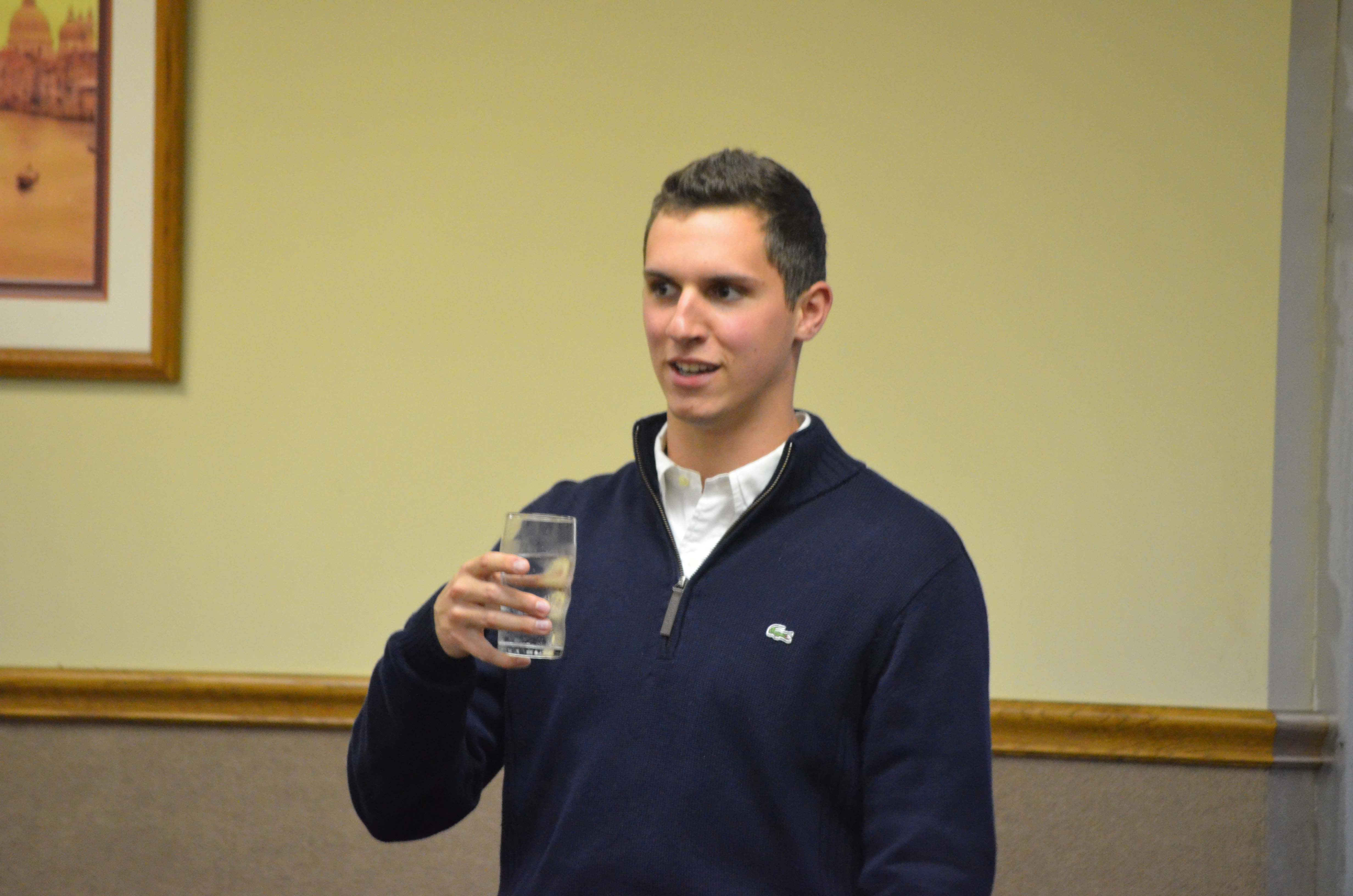
On a rainy Tuesday evening in late April, twenty-five Penn State Behrend students gathered at Nunzi’s Place to test techniques they had learned in CAS 100 Effective Speech. They dressed up for the occasion. The women wore dresses and cardigans. The men wore business casual attire. A few even wore ties. They sat at banquet tables arranged in a horseshoe formation around a podium.
To the left, at a small table discretely tucked in the corner, Dr. Miriam McMullen-Pastrick, lecturer in speech communication, took notes.
No pressure there, right?
But, pressure is sort of the point at the Toasters’ Banquet—an end-of-class tradition for students in McMullen-Pastrick’s classes.
“I want to put them in situations they might actually have to face when they are making post-graduate contributions to the world,” she said. “In their future, they may have to give opening remarks at an event, or introduce a VIP at a corporate banquet, or debate funding cuts at their child’s school board meeting. These are real situations they are likely to face at some point in their lives. The banquet gives them a chance to practice.”
Each class organizes their own banquet, collecting money from classmates for dinner, creating and printing programs, and voting on which classmates should receive awards — some serious and some not-so-serious.
On that rainy Tuesday that Section 005 had their banquet, Andy Peterson, a junior Physics major, gave opening remarks. Brian Ristau, a freshman Engineering major, introduced Jacob Roth, a sophomore Earth and Mineral Science major, who gave an informative speech. Zach Reese, a junior Mechanical Engineering major offered a toast.
And, so it went, with all twenty-five students taking at least one turn at the podium, offering a variety of entertaining, informative, and persuasive speeches, debates, toasts, and introductions until Guiliana Latella, a sophomore Nursing student, gave the closing remarks.
Between all the speeches and presentations, they enjoyed a small feast—pizza, pasta, meatballs, antipasto, and dessert—during which they were encouraged by McMullen-Pastrick to work on their dinner conversation skills.
Throughout the evening, the students laughed, joked, and listened attentively to one another. But, as McMullen-Pastrick might remind you, part of being a good speaker is being a respectful and intense listener. “They learn by listening to each other with focus and purpose,” she said.
McMullen-Pastrick typically teaches three sections of CAS 100 each semester and attends a banquet for each. In the Spring 2014 semester, she attended her 175th banquet.
“Teaching public speaking is my passion because it has such a major impact on the educational insights and personal confidence of the students,” she said. “It changes them optimally, for the better, for life.”
By Steve Orbanek Marketing Communications Specialist, Penn State Behrend
Margaret Eimers regularly reminds her children that a person is not defined by his or her past mistakes.
She would know. She’s proved it.
More than twenty years ago, Eimers dropped out of high school during her sophomore year after she failed a class and became fed up with school.
Now, in a few days, the Erie native is about to walk in her first commencement ceremony. She will graduate with a 3.94 grade point average and bachelor’s degree in Psychology from Penn State Erie, The Behrend College. How’s that for juxtaposition?
When it comes to Eimers, graduation is the icing on the cake.
Throughout her time at the college, Eimers has been president of the Penn State Behrend Circle of Omicron Delta Kappa National Leadership Honor Society, vice president of the Society of Undergraduate Economists, and a member of Psi Chi International Psychology Honor Society, Phi Kappa Phi National Honor Society, and the National Society of Leadership and Success. She has also served as an ambassador for adult student open houses and a career counseling intern at the Academic and Career Planning Center.
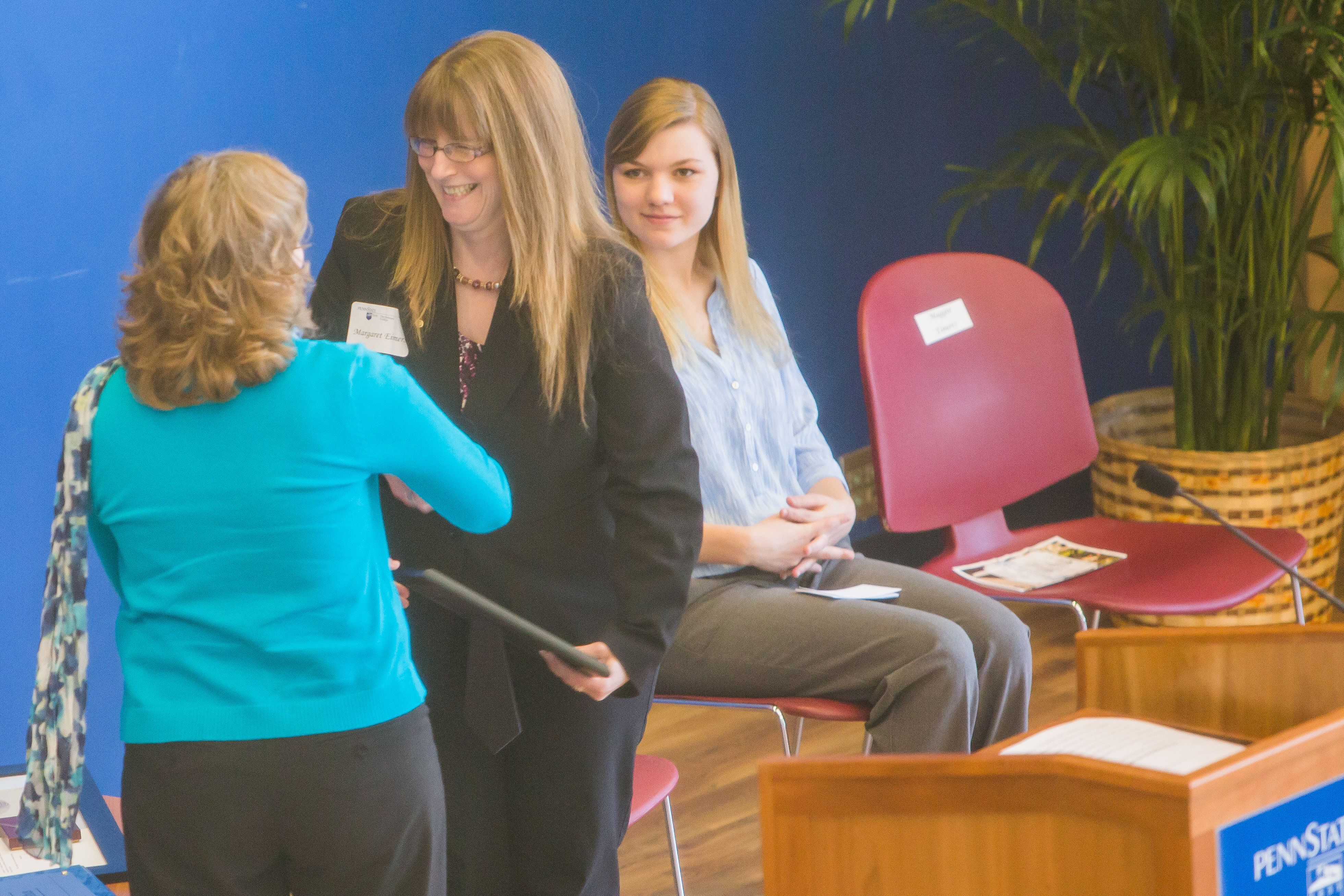
Eimers was recognized for all of her collegiate accomplishments on April 27 when she was awarded a Ralph Dorn Hetzel Memorial Award at the Sixty-fifth Annual Honors and Awards Convocation at Penn State Behrend. The award is named after Penn State’s tenth president and recognizes a combination of high scholastic achievement with good citizenship, and participation and leadership in student activities.
While Eimers may not have had a high school diploma, she always had a thirst for knowledge and cognition. Prior to enrolling at Penn State Behrend, she worked for eleven years as a crossing guard and estimated that she read at least fifty books annually during her downtime while directing traffic. Eventually, Eimers was asked to stop reading during her shifts, which led her to consider college.
“I said, ‘Why am I doing this when I really could be learning?’” said Eimers, who earned her GED after dropping out of school.
Eimers decided to apply to college, and Penn State Behrend was at the top of her list as she was aware of the value that a Penn State degree carries. Unfortunately, her application was initially denied.
“I went through the appeals process to become a student here,” Eimers said. “After I wrote an essay and was accepted, I then began as a provisional student.”
Eimers started as an Accounting major, a subject she had previously studied at a business school in Pittsburgh.
Accounting worked initially for Eimers, but something was missing.
“I can do accounting, and I do like it, but what I do is build relationships; what I do is help people,” Eimers said.
That drive led Eimers to change her major to Psychology with the goal of one day becoming an academic counselor.
Upon graduation, Eimers will work for the summer in the Academic and Career Planning Center. She’s looking forward to spending more time with her husband, Greg, as well as her children, David and Rebekah, who she said have been extremely supportive during her time as a Penn State Behrend student.
Eimers’ story as an adult student is far from over though.
In the fall, she begins work on a master of arts in counseling from Edinboro University. It’s just the latest stop in her academic journey.
“I like to call this my very happy mid-life crisis,” Eimers said. “I feel as if I have exceeded my expectations. Life is a moving target though, so now I’ll create new expectations. “
By Steve Orbanek Marketing Communications Specialist, Penn State Behrend
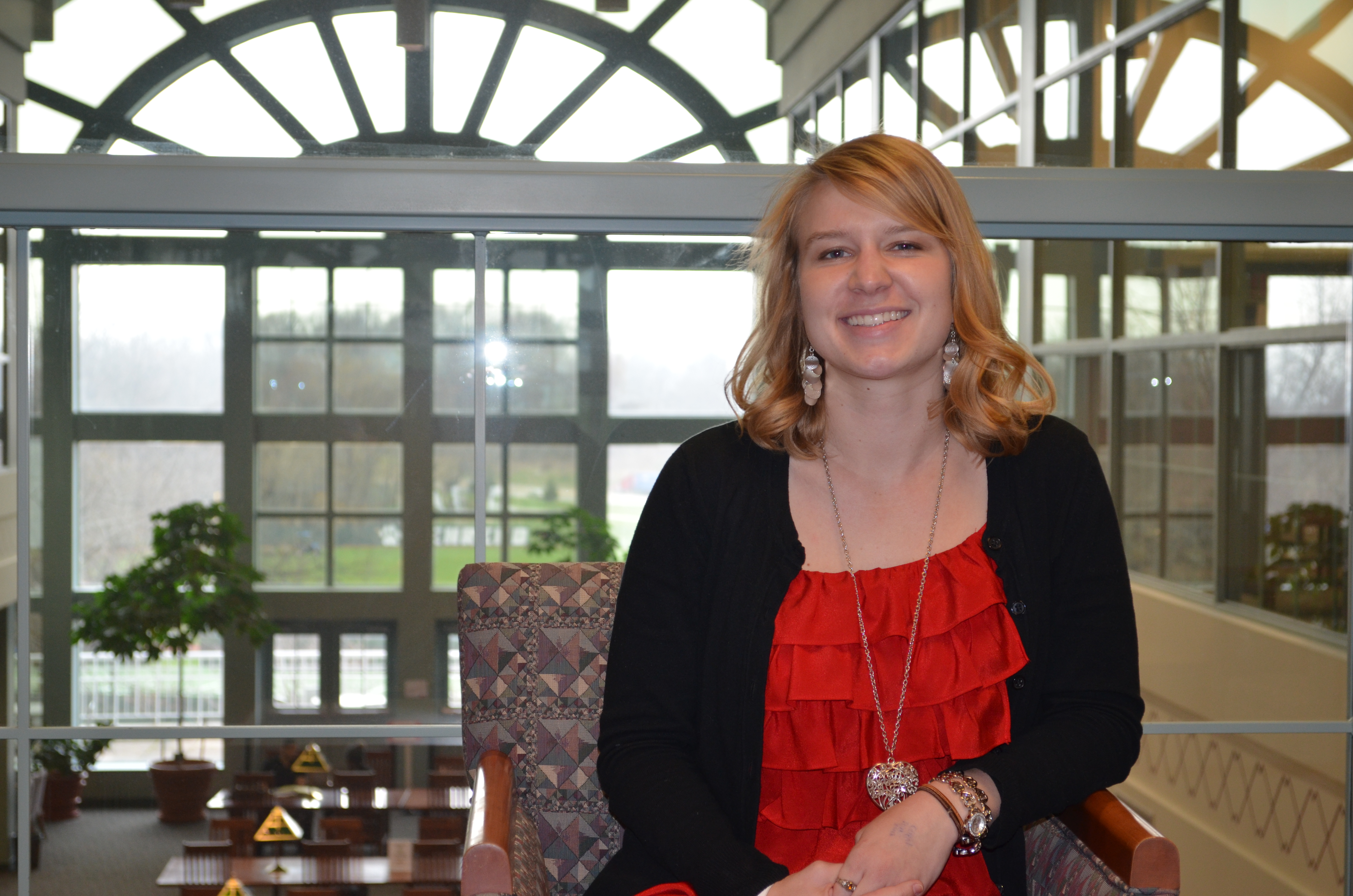
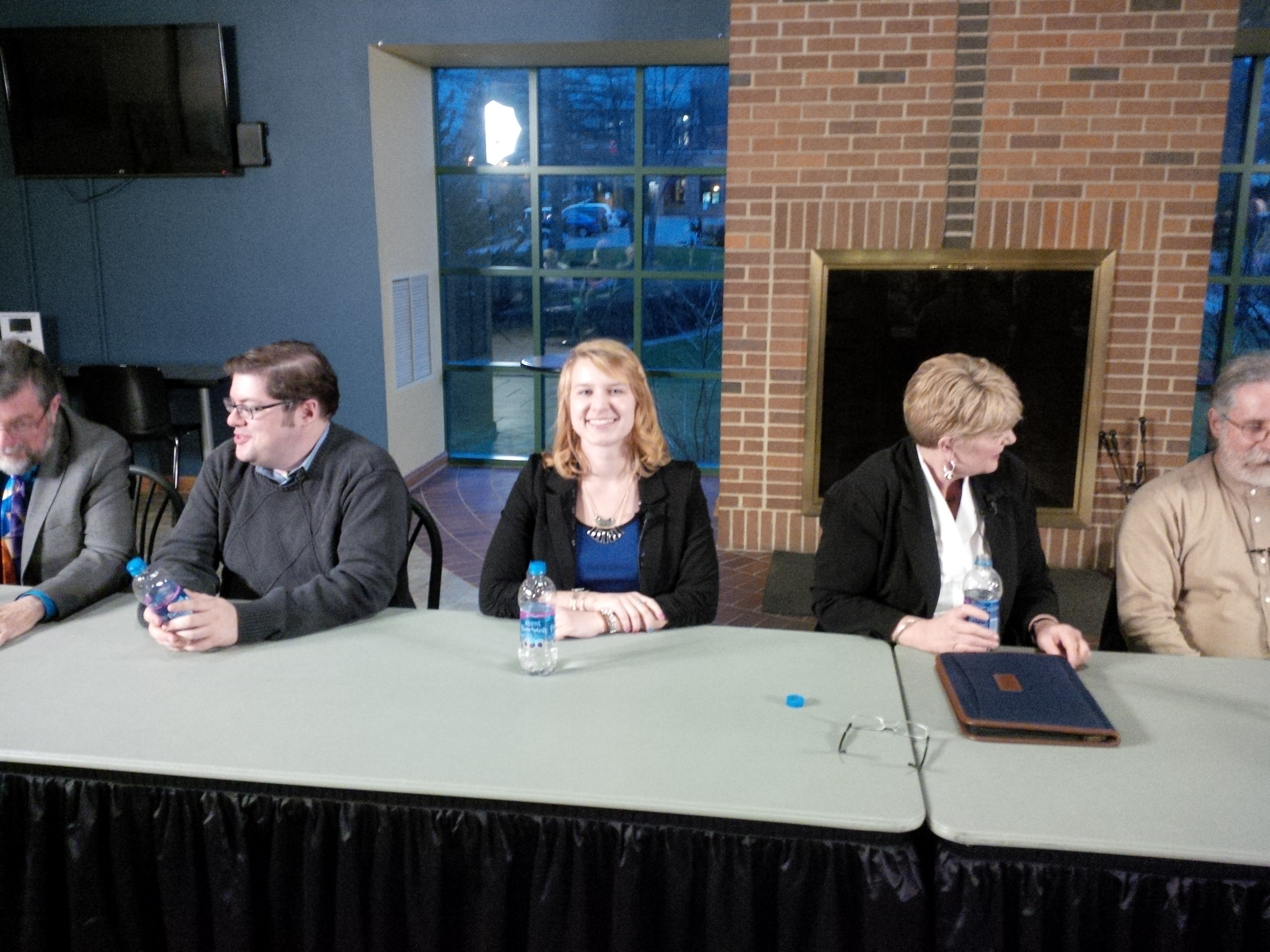
Danielle Ropp sat quietly toward the center of the table as her legs shook under the tablecloth, hidden from the audience seated in front. Her quiet demeanor, indicative of her anxiousness, would soon subside.
After all, every living thing thrives in its natural habitat, and that’s exactly where Ropp was once the panel discussion got underway.
“I’ve just always loved history. Whenever I hear an interesting fact, I commit it to memory,” said Ropp, a junior History major at Penn State Erie, The Behrend College.
Ropp displayed the depth of her historical knowledge by participating in a panel discussion of the WQLN documentary Perspective: Jewish History, Parts I and II at Mercyhurst University in Erie on April 22.
The Folsom, California, native earned a spot on the panel as well as $500 after winning first place in WQLN and Mercyhurst University’s “Story of the Jews” college essay contest. The prompt for the contest was: “How has history shaped the modern perception of Jews?”
Other panel participants included: Dr. Joshua Ezra Burns, assistant professor of theology at Marquette University; Rabbi John Bush, Temple Anshe Hesed; Dr. Randall Howarth, professor of ancient history at Mercyhurst University; Dr. Olena Surzhko-Harned, assistant professor of political science at Mercyhurst University; and Dr. Robert von Thaden, Jr., associate professor of religious studies at Mercyhurst University. The panel was moderated by Kim Young, instructor in journalism at Penn State Behrend.
Ropp’s essay was titled “The Crucifixion Shaping Modern Jewish Perceptions,” and it discussed how Jewish individuals are still viewed negatively because of their perceived participation in the crucifixion. Ropp said her own perception was vividly changed through her research.
Ropp found edicts from past Popes that absolve blame for the crucifixion away from Jewish people, but she said that message has not permeated within the general public.
“The fundamental core of Christianity is that Jesus had to die. These people were blamed for this, but it wasn’t their fault,” Ropp said. “Today’s Jews are also different from the Jews back then. You cannot blame people for actions that happened 2,000 years ago.”
While Ropp thoroughly enjoyed writing the essay, she said she was surprised she won.
“This is definitely one of the biggest things I’ve ever accomplished,” Ropp said. “The fact that I won just makes me want to do it again.”
Given Ropp’s career aspirations, it’s likely the essay was just the beginning. Ropp plans to pursue a master’s degree in secondary education upon graduation in 2015 and then plans to attain a doctorate in history. Her ultimate goal is to spread her knowledge as a college professor.
“I can’t imagine myself doing anything but history,” Ropp said.
By Steve Orbanek Marketing Communications Specialist, Penn State Behrend
There seems to be one in every family: one person who differs from the rest of the clan.
Jessa holds that distinction in the Boarts family, but she wouldn’t have it any other way.
“On multiple occasions, my mom has asked me where I came from,” Boarts says.
A first-year Psychology major at Penn State Erie, The Behrend College, Boarts is somewhat of a fanatic when it comes to choir. On a typical day, the Erie native can be found humming choir songs, listening to choir CDs in her car, or practicing the tunes she performs as part of the Chamber Singers and Concert Choir at Penn State Behrend.
Music and singing have come naturally to Boarts even though no one in her family has ever had any experience with it.
“It’s just easier for me to express my emotions through music,” says Boarts.
Boarts is one of twenty-five students who will be performing Sunday, April 27, during “Wayfaring Stranger,” the spring concert from Penn State Behrend’s Chamber Singers and Concert Choir. The concert is the latest stop in what has been long musical career for Boarts at Penn State Behrend.
In eighth grade, she joined the Young People’s Chorus of Erie, which was in its first year of existence. YPC Erie is a youth outreach organization of the School of Humanities and Social Sciences at Penn State Behrend and northwestern Pennsylvania’s only comprehensive youth choral program.
Boarts had longed to join a choir ever since her first exposure as an elementary school student, and YPC Erie was the perfect fit.
“It was kind of like a second family. I liked the togetherness that we all shared,” she says.
Over the next five years, Boarts performed in a slew of concerts as a member of YPC. She formed many relationships along the way, and her passion for choir music continued to grow.
Of all the relationships Boarts forged, perhaps none was more significant than the bond she developed with Dr. Gabrielle Dietrich. Dietrich joined Penn State Behrend in 2012 as the college’s director of choral ensembles and serves as YPC’s artistic director as part of her position.
The two immediately hit it off.
“Jessa is really special,” Dietrich says. “She’s not only a wonderful singer, but she’s one of those people who shows up every week and has a great attitude, a great spirit, and is willing to try everything.”
As Boarts began to look at colleges during her senior year of high school, she says it became apparent that Penn State Behrend would be an ideal choice. Not only did the college have the Psychology major that she sought, but it would also allow her an opportunity to continue to grow musically with Dietrich as part of the college’s Chamber Singers and Concert Choir.
“I was really interested in how she brought the music out in YPC, and I wanted to be able to continue that in the Behrend Choir,” Boarts says.
Dietrich was more than a little enthused when she heard the news.
“I was thrilled to hear she was staying because she’s the kind of kid you want in your choir. She’s not only the type of girl who brings good with her, she’s the type of girl who spreads good,” Dietrich says.
Boarts does more than spread good. She’s constantly trying to encourage her friends and other students on campus to enroll in either the Chamber Singers or Concert Choir class.
She subscribes to the idea that everyone has the ability to sing, which comes from Hungarian composer Zoltán Kodály and is a big part of Dietrich’s teachings. It’s the reason she believes everyone should consider joining the choir.
“Anyone can sing, it’s just a matter of will someone join a choir and portray different types of music,” Boarts says.
Many different types of music will be portrayed by Boarts and the rest of the Penn State Behrend Chamber Singers and Choir Orchestra during Sunday’s “Wayfaring Stranger” concert. The concert will include works from American composers Aaron Copland, Cecil Effinger, and Kirke Mechem; African-American spirituals; a folk song from Northern Thailand; and music of the French Renaissance.
For Boarts, the concert is the culmination of months of practice and hard work. It’s a long road to get to the point of being ready to perform, but Boarts says it’s always worth it.
“My life would be pretty boring without choir,” Boarts says. “Something would definitely be missing.”
In recognition of Women’s History Month, we’d like to introduce you to just a few of the dynamic women in Penn State Behrend’s history. Our college has a rich history of leadership and involvement by strong, forward thinking, and generous women. Each Monday in March, we’ll highlight a woman who has made, or is currently making, her mark on the college.
Today, we’d like you to meet Dr. Diana Hume George, Professor Emerita of English and Women’s Studies.
Diana Hume George at JFK International Airport. Photo by John Edwards.
I caught up with her by email to ask her about the importance of women’s studies, why she doesn’t (yes, you read that right!) miss teaching at Behrend, and what she’s been doing lately.
You taught women’s studies at Penn State Behrend. Why is it important for college students to learn about this subject?
Yes, I taught women’s studies and I worked for years on founding what became the women’s studies program at Behrend—I’m so glad it’s still going.
As much progress as women have made in this country and around the world, there’s nothing like genuine equity yet. Women can still be owned, enslaved, beaten, and maimed in many places, including in some parts of this country—and control of women’s bodies is still a primary political aim. Sometimes I am heartened by all the advances—no one’s surprised by women in the so-called professions any more, as doctors or professors or politicians or talking heads on TV, and that progress is genuine. But it’s just as true that in many cultures and countries, there’s still a war against women’s equality that is violent and terrifying.
Without women’s studies, younger women would be even more likely to backslide, to lose touch with all that has gone before, and to become re-enculturated in ways that disable and disenfranchise them—I see it every day. The lack of a feminist awareness among young women scares me deeply and daily and a lot.
What do you miss about teaching at Behrend?
I don’t miss teaching at Behrend, because I took the best of it with me. I’m still in contact with a bunch of my previous students over the years—one became among the best friends of my life, another student-turned-friend I meet up with at the Cleveland Film Festival every year. I visit one in Baltimore regularly, another is getting ready to run the Boston Marathon and makes me great beach-glass earrings, and yet another sends me his wonderful poems. And there’s another fellow writer, and another is a magazine editor—come to think of it, I’m in touch with someone from every generation of my career there.
I also stay in touch with department colleagues—I met up with John Champagne and Sharon Dale in Rome last year and stayed at John’s place in Perugia, and I see George Looney because along with Phil Terman at Clarion, we run the Chautauqua Writers’ Festival together, which is how I also run into Greg Morris as well as newer colleagues like Kim Todd and Tom Noyes. Other writer colleagues from long ago, names current people might not even remember, like Melissa Bender and Ann Pancake, are part of my life, too. And after leaving Behrend, I got to know a couple of colleagues that I never had time to know when I was working constantly—I love and miss Toby Cunningham, whom I barely knew at Behrend, but once we were gone, we ended up in a writers’ group together and my partner John Edwards published his wonderful book.
My son Bernie is back at Behrend finishing up his degree—so put it all together and it’s like I never left.
What have you been working on since leaving Behrend?
Since I left Behrend, I’ve been teaching creative nonfiction in an MFA program at Goucher College in Baltimore. I’ve also been to several colleges and universities as a visiting writer, teaching for a few weeks or even a semester, at places such as Davidson in North Carolina, UNC/Wilmington, and Ohio University.
What do you enjoy about teaching in the MFA program at Goucher College?
I live in Pennsylvania, and work online, going to Baltimore a couple of times a year. I mentor writers who always wanted to write a book. Our program is geared toward helping them write voice-driven narrative—some have been professional journalists all their lives and they haven’t yet gotten to write long-form. It’s great fun and I get to learn as much as I teach, because whatever they’re writing a book about, I’m reading that book as they write it. And we also get doctors and psychologists and professors, as well as people who want to write about their own lives, so I edit memoirs on trauma and on travel, and sometimes that can be the same book.
You mentioned in our email exchanges that you have been traveling. Please tell us more.
I have the privilege of shaping my life so that I can do my favorite thing, which is to travel with my friends or my partner, John Edwards. I wrote one travel book and I’m always writing the next one. I try to go to Italy for about a month every other year. Lately I’ve been alternating Italy with the Yucatan peninsula, from which I’m just back right now. I stay on Isla Mujares, an undeveloped island right off Cancun, where I first went with a fellow writer on a retreat back when I was at Behrend. I got hooked on those Caribbean breezes in January.
What are your other interests?
Even more than travel and writing, I want to read. I don’t get to read enough. That’s my goal, lots of good books, the kind where you can throw yourself down on a bed and get lost in an imaginary world.
And I love long-form drama on TV, where a lot of the best storytelling takes place, both comic and tragic—Deadwood, The Sopranos, and Breaking Bad were almost as important to me as literature.
You wrote and edited books on the American poet Anne Sexton. Does her work still resonate with you? How has your relationship with her work changed?
I wrote or edited three books about Anne Sexton, and she was a wondrous enough poet that I never got weary of her writing—but I did get battle fatigue about her psyche. She was a joyful and delightful person, witty, wicked smart, and ironic, but she was also bipolar, and being in the presence of that kind of mind can yank you around. My friend and the co-editor with me of Sexton’s Selected Poems, Diane Wood Middlebrook, lived inside Sexton’s head for a decade, and she said it was nearly too much.
I was attracted to her sense of joy, and I still admire her willingness to also say the depth of her pain—but she couldn’t live, in the end, and I can. So although my affection for her poetry remains, and I think she was tremendously important, and deserves to endure, I am a bit distant from her now.
But if you’re lucky, your old literary loves from early in your life stay with you in some sense throughout, they get internalized and are part of who you are, and all of my early loves became part of me—Sexton and Adrienne Rich and William Blake and Freud.
If someone is unfamiliar with your writing, what might be a good introductory work? Personal essays I wrote, such as “Wounded Chevy at Wounded Knee” or “The Last of the Raccoon,” still represent my work.
Diana Hume George will do a public reading at Clarion University of Pennsylvania on April 17, 2014. The second edition of her book The Lonely Other: A Woman Watching America will be released in April, with several new essays.
Forget Furby and Tickle-Me Elmo. Those “hot” holiday toys rarely stand the test of time. For most kids, interest in these trendy, flashy toys fizzles before the garbage truck carries off the boxes.
We asked a few Penn State Behrend faculty and staff members who oversee outreach programs for younger students to tell us what they wish parents/caregivers would give to the kids on their list.
Here are their top choices:
School of Science
Ideas provided by Tracy Halmi, senior lecturer in chemistry
Legos. Check out legoeducation.us where you’ll find lots of great information and shop by grade level.
Snap Circuits. These make a great gift and they are available in a variety of sets so you can find one that will fit your budget.
Science kits. There are no shortage of fun science kits available for kids today (spa science, sci-fi slime, crystal-growing kit, butterfly kit). Look for them in craft and book stores.
Classic toys: You can never go wrong with toys that have spanned decades, such as silly putty, Slinkies, and Spirograph.
School of Business
Ideas provided by Erica Jackson, Director of the Center for Financial and Consumer Outreach
Games that allow kids to play as grownups. Teach kids how to budget their money by giving games like The Game of Life and Monopoly. These games teach children how to live within their means, receive a paycheck, work investment deals, and pay their bills.
Toy ATM. Toy ATMs, like the one manufactured by The Hammacher Schlemmer Institute $40, accepts real coins and bills and displays accurate, up-to-date account information on the screen. Kids even get their own ATM card and PIN number.
Piggy bank or a safe. If the child on your list has outgrown cutesy banks, look for a mini safe or vault that opens only by secret code or your child’s voice, which makes saving money more fun and easier to do around little siblings looking to share the wealth.
K’nex
School of Engineering
Ideas provided by Melanie Ford, lecturer in computer science and software engineering
K’nex. One step up from Legos, K’nex are slightly more sophisticated building toys. The roller coaster and simple machines kits teach students basic engineering and physics principles.
Origami kits/books. Origami, the art of Japanese paper folding, teaches students spatial skills.
Logic puzzles/games. These types of games and puzzles teach problem solving skills — a key concept for all engineers! The Perplexes Maze Games are a favorite among kids. Mindware.com has many more great ideas.
GoldieBlox. Part construction set, part story book, the creator of GoldieBlox (a young female engineer herself) aims to tap into girls’ strong verbal skills, while giving young inventors the tools they need to build and create amazing things.
Lego Mindstorms. Classic building bricks + robotics = one cool egineering lesson (but don’t tell the kids they are learning, they just think it’s cool.)
School of Humanities and Social Sciences
Ideas provided by Dr. Thomas Noyes, associate professor of English and creative writing; Kim Todd, assistant professor of English and creative writing
Art supply sets. Participation in the visual arts helps children develop an imagination and sharpen their eye for detail.
Award-winning books. Any book is a great gift, but quality children’s fiction books, such as Newbery Award Winners, are an especially good choice.
Nature journal. The Nature Connection, An Outdoor Workbook for Kids and Families (by Claire Walker Leslie) is a nature journal full of activities and prompts for each month. Parents can guide younger kids through it on a walk or a hike; older kids can just put it in their backpacks and do the activities themselves when they feel like it.
Students in Dr. Glenn Kumhera’s 406W Research in Medieval Sources class used the research work they completed this semester to create a board game, titled Gesta miserororum or “Deeds of the Ill-fated,” to teach players about eleventh-century Europe.
They unveiled the game last night and invited faculty members, friends, and administrators to Reed 114 to play a game or two.
The students not only produced the board and developed the game concept, but they created more than 600 individual cards, too.
Who knew learning about ancient history could be so much fun?