Ode to Resilience on National Love-a-Tree Day

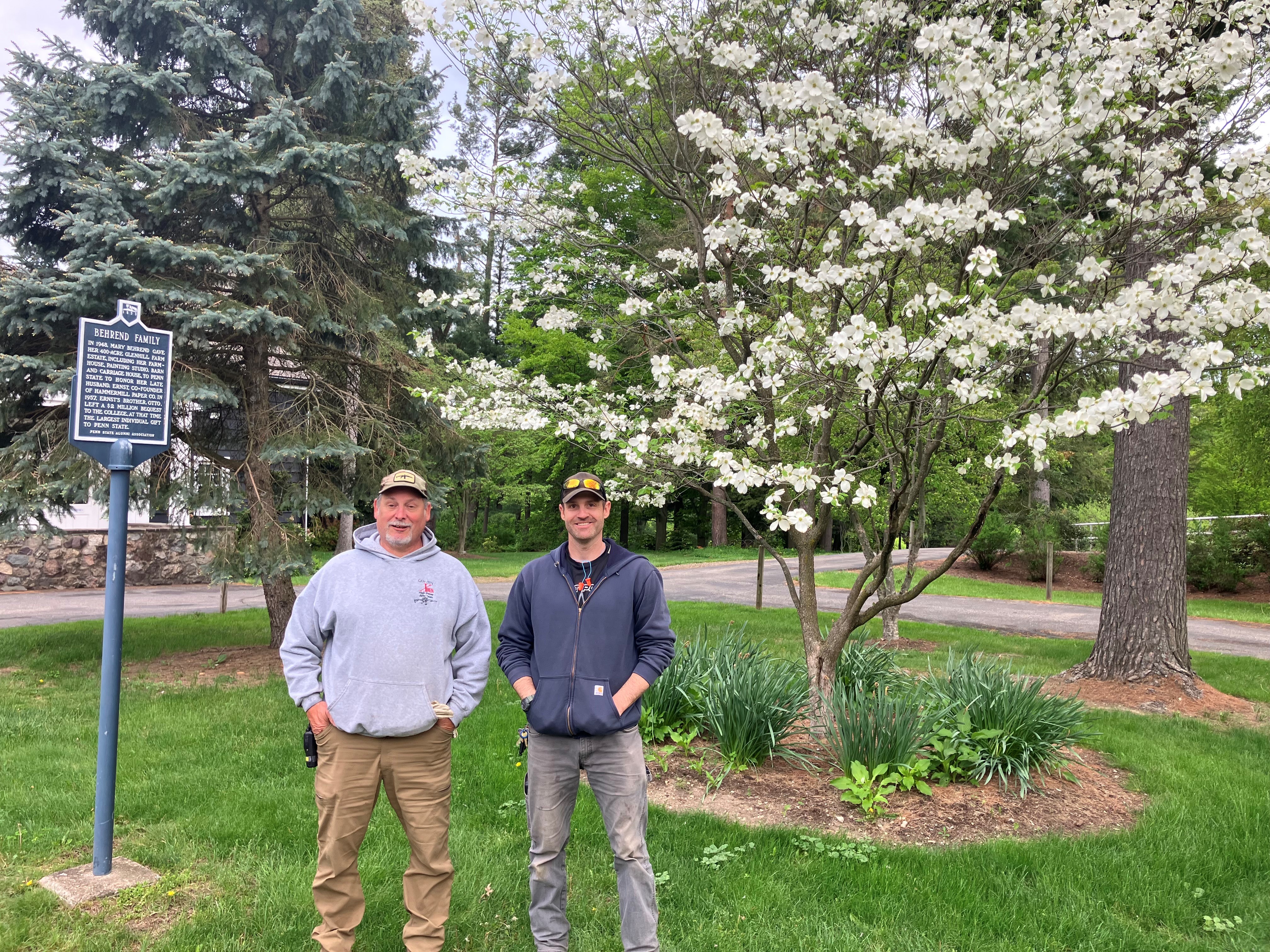
John Troncone, left, and Brooks Travis in front of a flowering dogwood that Troncone has transplanted four times in twenty years.

By Heather Cass, Publications Manager, Penn State Behrend

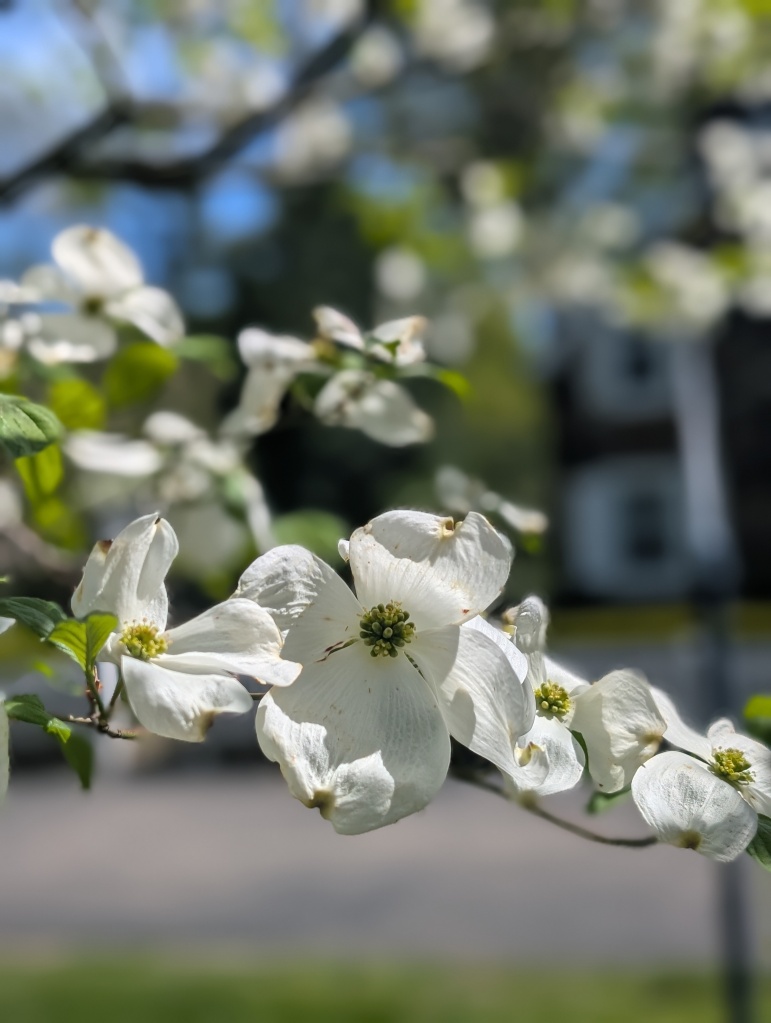
“Bloom where you are planted” is a metaphorical phrase encouraging individuals to make the best of their current circumstances. A real-life example of this sentiment can be found at Penn State Behrend, where a flowering dogwood tree is thriving even after having been transplanted four times.

The tree, Cornus florida, was first planted two decades ago near Lilley Library by groundskeepers John Troncone and Patricia Blackhurst, who is now retired.

“Patty and I planted it along the east side of the library, but it was too wet, and the tree was struggling there,” Troncone said.

They chose to move it next to the old Erie Hall, where the dogwood grew until a fire at Dobbins Dining Hall in March of 2010 forced another move.

“Housing and Food Services had to set up a temporary kitchen in Erie Hall that required us to remove the tree,” Troncone said.

He and Blackhurst dug a third hole for the growing tree, south of the Glenhill swimming pool.  Again, the tree grew and flowered until, a dozen years later, Troncone was once again facing the dogwood that had to go to make room for the Glenhill Gardens project.

He and his new groundskeeping partner, Brooks Travis, had to decide whether to destroy the tree or attempt yet another transplant.

“The timing was good,” Troncone said. “The tree was in the dormant stage at that point, and the weather was dry enough to give it a try.”

Troncone, Travis, and Jack Crowley, a student worker, spent three days carefully digging the tree out, wrapping its roots in burlap and tying them into a root ball for transplant. However, moving the 20-foot tree would be no easy feat.

“Then we got lucky,” Troncone said. “The contractor for the pool project had a track loader and offered to help us move it.”

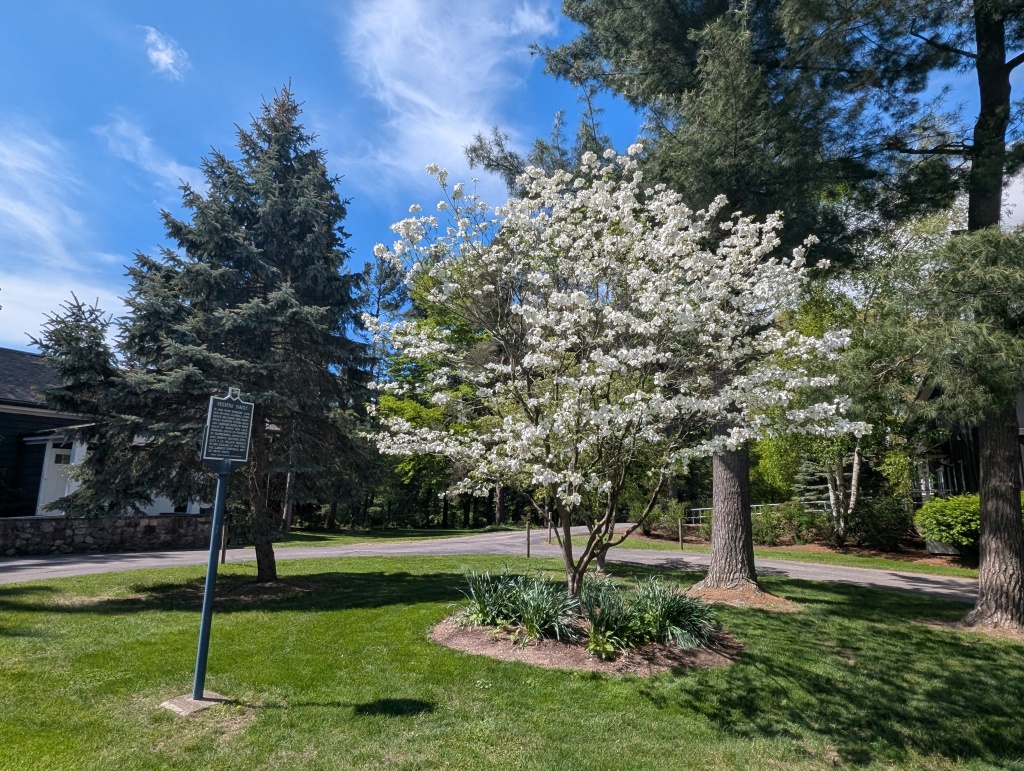
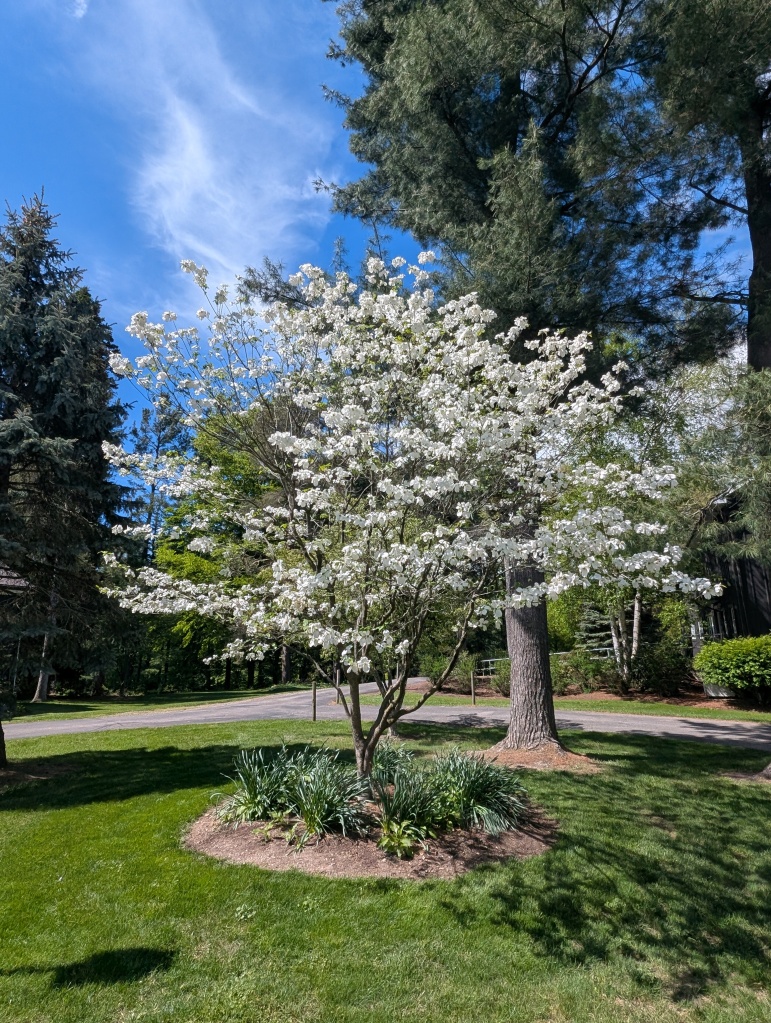
Troncone and Travis found the perfect spot for the tree in a grassy circle surrounded by the college’s original, historical buildings—Glenhill Farmhouse, Mary Behrend’s Studio, and the Turnbull Building.

It’s space fitting of a tree that has born witness to so many important moments and changes on campus.

It’s currently in full bloom, a gratifying sight for the caretakers who watch over it.

“Brooks and I are pleased with the tree’s condition to date,” Troncone said.  “I’m glad we were able to save it. Hopefully, that will be the last time we have to move it.”

A few interesting facts about flowering dogwood

  • The large, showy “petals” are actually modified leaves called bracts, not true petals.
  • Native Americans used dogwood bark to make scarlet dyes and medicinal teas. 
  • In some cultures, the dogwood is a symbol of rebirth and resurrection. (Fitting for the subject of this blog post!)
  • The “fruit” of the dogwood is a drupe, similar to a plum, with a hard seed inside.
  • Dogwood wood is hard and strong, making it suitable for tool handles, charcoal, and other items.
  • The name dogwood is thought to be a variation of the Old English word “dagwood,” meaning a skewer or dagger. The hard wood of the tree was used to make these tools.
  • Another theory regarding the origin of the name dogwood suggests it could have been named for its berries, called “dogberries,” which might have been considered less desirable or “fit for a dog.”
  • Dogwoods have been used medicinally for generations; the bark is rich in tannins, so ground bark or leaves are used to treat pain, fevers, backaches, dizziness, weakness, excessive sweating, uterine bleeding, and incontinence.
Nature of Behrend: Summer Beds Begin in Late Winter

By JoLayne Green
Contributing writer

annuals3
Mother Nature can put on spectacular displays all on her own, but others take human help. Behrend’s hardworking grounds crew plant and tend to a whole bunch of flower beds that bring bursts of color to Behrend’s beautiful campus each year.

About this time of year, Keven Engle, grounds and landscape supervisor, and members of Behrend’s landscaping crew work on cultivating areas for annual flower beds that will brighten campus from mid-to-late May until mid-October – or however long Mother Nature will allow. Annual flowers were introduced to campus in about 2017, Engle said.

The planning process for summer color begins in mid-to-late winter — well before signs of spring emerge — when Engle chooses the plants, flowers and locations. He concentrates on key areas on campus that get the most traffic volume.

“Every place would look nicer with flowers, but we focus on a few for financial and labor reasons,” Engle said.

Selecting areas with water close by, or that the water truck can get to easily, also is key. The crew amends the soil as much as possible and adds moisture to help keep the water molecules in the soil longer for the plantings to take root.

“It’s hard to have flops with flowers, but I would say some plantings were less successful because of site conditions,” Engle said. For example, an area near Aquarius Drive would not allow flowers to thrive, and beds have been lost to disease before.

Once locations are chosen, Engle and the staff determine which plants will do best in each space and compile an order from local nurseries. Last year, they ordered fifty-two hanging baskets and 147 flats of flowers.

Hardy annuals with a variety of colors that don’t require a lot of attention are the goal. Reliable picks are begonias, petunias, pansies, marigolds and potato vines.

Of course, Penn State blue and white selections might be ideal, but that can be tricky because there are no truly blue flowers, only purple ones that can appear blue to different people, Engle said. Sky blue and purple petunias get the job done, though.

Throughout the season, the crew tills and adds compost, fertilizer and soil additives to the beds. The plantings require a lot of water at the start of the season and during the heat of summer when they often need daily watering.

It is worthwhile work.

“We enjoy planting and having the annuals on campus. They add a much-needed splash of color to the grounds,” Engle said.

NATURE OF BEHREND is an ongoing series highlighting Behrend’s unique environment, beautiful campus, and outdoor learning opportunities.

Do you have question about something you’ve seen outdoors— trees, plants, animals, insects, paths, artifacts, etc.? Email hjc13@psu.edu and we may cover it in a “Nature of Behrend” post, story, or video.

Nature of Behrend: Freezing Frogs

The fascinating science of frogs in winter

frogs in winter

Behrend is home to a wide variety of frogs and toads, but have you ever wondered where they go in winter?

They don’t migrate or hibernate; they brumate.

Brumation is to amphibians what hibernation is to mammals. When temperatures drop and the days get shorter, amphibians seek out a warm, safe hiding place where their metabolism slows to the bare minimum, and they rest until spring.

“Amphibians brumate differently depending on the species,” said Dr. Lynne Beaty, assistant professor of biology.  “Some, like pickerel frogs and bullfrogs, brumate underwater; some, like American toads, brumate on land underground below the frost line; and some, like spring peepers, gray treefrogs, and wood frogs, brumate in the freezing zone.”

If “the freezing zone” sounds like a frigid place to spend the winter at Behrend, be assured that it is. Not only is it cold, but it’s very cool in a nature-is-so-amazing way.

“All frog species that overwinter in the freezing zone exhibit some degree of freeze tolerance—that is, up to sixty percent of the frog can freeze solid and survive. They just thaw out when warmer temperatures arrive,” Beaty said.

“This is primarily due to the action of cryoprotective compounds (i.e., antifreeze) that prevent vital parts from freezing completely,” Beaty said. “Many of these organisms also have an inherent ability to resist structural damage when ice crystals form in the body, and their cells are particularly hardy in the face of massive dehydration that occurs during the freezing process.”

Of all the frogs that do this, the wood frog can handle freezing temperatures the best, which is why they have the northernmost range of all frog species in North America.

“Wood frogs, which we have on campus, are the real ‘super freezers,’” Beaty said. “Watch this cool video to see why.”

________________________________________________

NATURE OF BEHREND is an ongoing series highlighting Behrend’s unique environment, beautiful campus, and outdoor learning opportunities. New items are posted every Monday on the college’s Facebook and Instagram pages. 

Do you have question about something you’ve seen outdoors at Behrend — trees, plants, animals, insects, paths, artifacts, etc.? Email hjc13@psu.edu and we may cover it in a “Nature of Behrend” post, story, or video.