
Infinite Lizards, Infinite Beauty

Math and art converge in Behrend’s growing “geometry gallery”

By Heather Cass, Publications Manager, Penn State Behrend
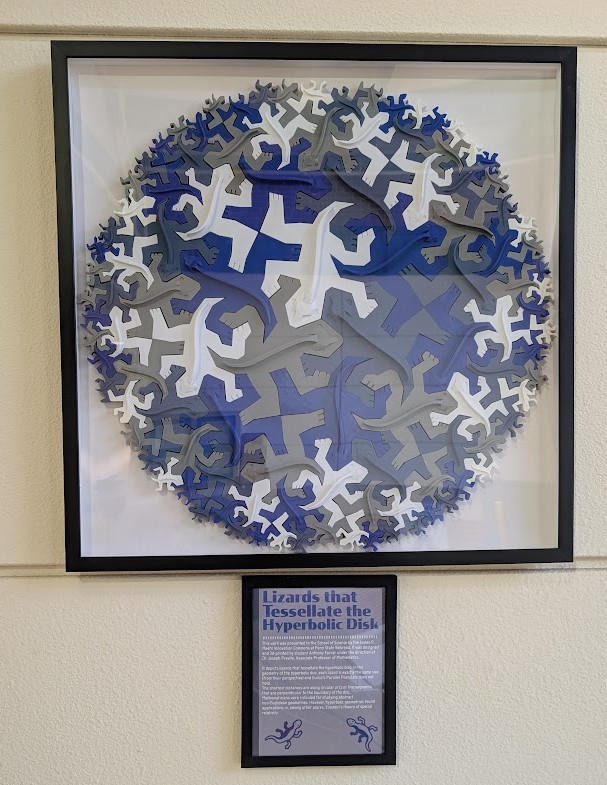
Math isn’t always numbers on a chalkboard. Sometimes it’s a work of art—a swirl of repeating lizards, 3-D printed in Penn State blue and white, then installed in a building where math, art, and science intersect. The lizards blend together in a hypnotic pattern, each appearing to shrink as it spirals toward infinity.  

The piece, Lizards that Tessellate the Hyperbolic Disk, was imagined by Dr. Joseph Previte, professor of mathematics, who wanted to capture the beauty of mathematics in a form anyone could see.

He took the design to the James R. Meehl Innovation Commons, the college’s open ideation lab, where engineering students Anthony Farrar and Quinlan Barnes transformed Previte’s concept into reality with 3-D-printed tiles and a sharp eye for symmetry.

The result is art born from math—or perhaps math revealed as art.
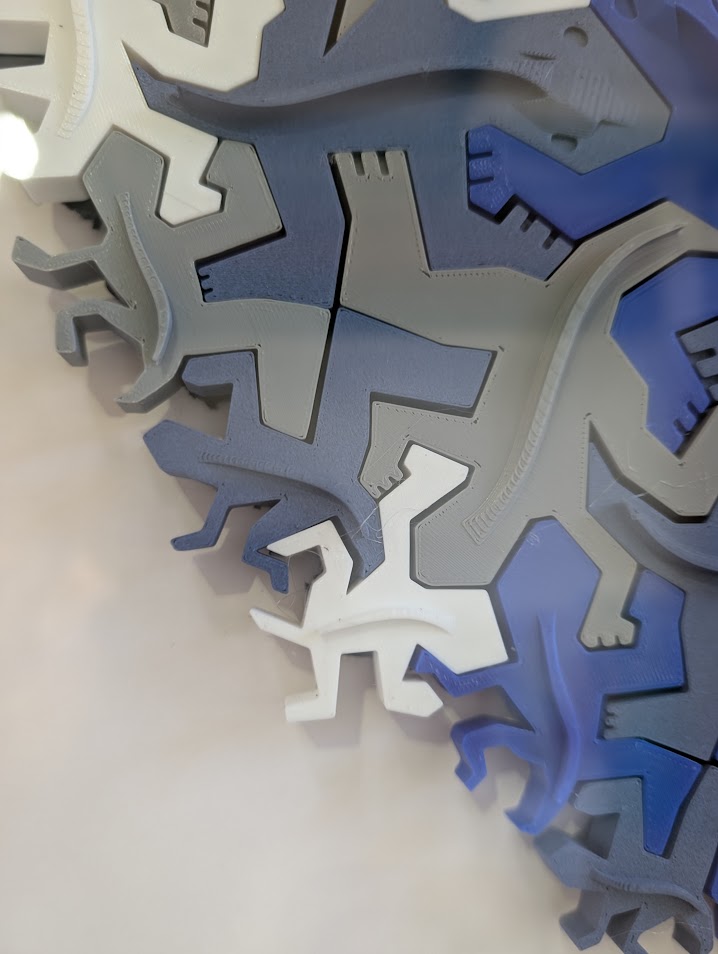
Dutch artist M.C. Escher showed the world that geometry could be beautiful with his mesmerizing tessellations and optical illusions, where patterns unfolded in ways both precise and poetic.

“For centuries, mathematicians questioned the value of studying this type of geometry, dismissed it as impractical and useless, with no relation to reality,” Previte said. “But it later proved essential to modern science, including helping Einstein describe how time and space work in his theory of relativity.”

While some mathematicians ridiculed the study of abstract math, others reveled in it. English mathematician G.H. Hardy argued that mathematics was a pure art form, divorced from practicality—something he took great pride in. Hardy’s theories later laid the groundwork for encryption, proving that beauty and utility often travel together.

That same tension—between abstraction and application, imagination and reality—now hangs on the wall at Behrend.  

Lizards that Tessellate the Hyperbolic Disk joins an existing sculpture, Math in Flight, a stage-5 Sierpinski tetrahedron, a fractal shape featuring a pattern of infinite triangles, that hangs high above the entrance to Roche Hall in the Science Complex.  
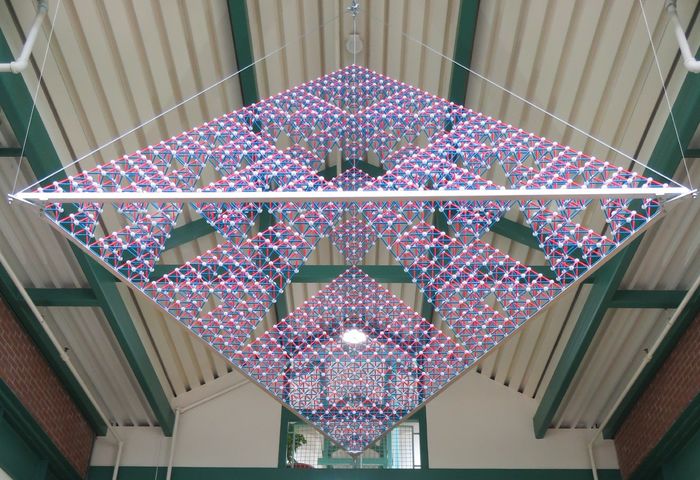
Math Club students built the sculpture using Zometool construction parts. It consists of 2,050 white balls and 6,144 red-and-blue struts.

Previte has plans to continue adding to the mathematics art gallery.

“I’d like to do the Platonic solids next,” he said. “I am currently looking for a student in Innovation Commons to make that project a reality.”
Standout Seniors: Meet Michael Gibilterra (Plastics Engineering Technology)

Penn State Behrend’s class of 2022 is ready to make its mark on the world!  We’re proud of our students and the things they’ve accomplished and learned while here at Behrend. Over the next several weeks, we’ll be introducing you to a few of our remarkable seniors who have overcome challenges, pioneered new technology, participated in important research projects, and left an impression at Penn State Behrend.

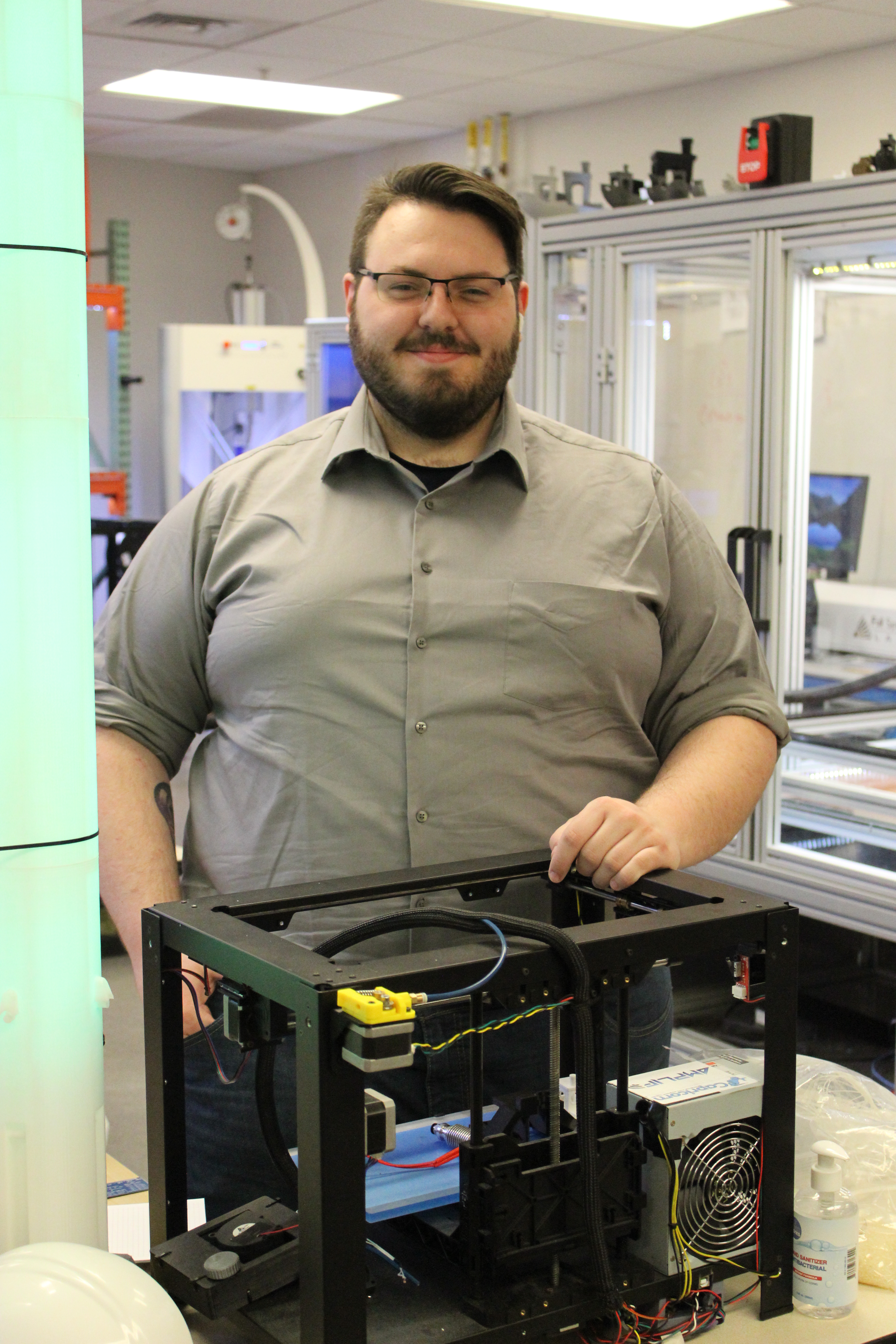
Today, we’d like you to meet Michael Gibilterra

gibliterra2

Major: Plastics Engineering Technology

Hometown: Hershey, Pennsylvania

Scholarships: The Joseph and Isabel Prischak Trustee Scholarship.

On choosing his major: Originally, I came to Behrend for Computer Engineering. But, after getting involved with Innovation Commons (see below), I realized I wanted to do more with 3D printing. In doing that work, I learned that I didn’t have a strong knowledge of what happens to plastics when printing. After talking to some of faculty members, especially Jason Williams, assistant teaching professor of engineering, I switched to Plastics Engineering Technology.

About Innovation Commons: It is an open ideation, product development, and prototyping center staffed by students who help guide innovators and entrepreneurs through the early stages of development. It is open to all entrepreneurs and innovators throughout Erie County and the surrounding region, including students, who are looking for support to organize, collaborate, compose, and construct their ideas.

Proudest accomplishment at Behrend: Becoming the first student volunteer at Innovation Commons.  This is where my entrepreneurial spirit grew and where I learned about starting my own company. I’m incredibly thankful for the opportunities Innovation Commons has created for students.

Campus involvement: I was a member of Alpha Phi Omega, a service fraternity. I also helped to revive the Entrepreneurship Club and served as president. The club brought in guest speakers, including a variety of entrepreneurs and/or those who support them, and we helped with Penn State Behrend’s Global Entrepreneurship Week activities.

What makes him unique: I can become very focused on a topic, which has been a “superpower” that helps me tackle big problems and led to my ability to develop new products, machines, or designs in a relatively short amount of time.

People would be surprised to know:  That I have autism and it’s one of my biggest strengths. While it has certainly had its hindrances, it has helped me significantly in my professional life and has enabled me to approach problems in a different light.

A printing passion: I have an obsession with 3D printing. It started back in high school when I built my first 3D printer using motors from some CD drives, a microcontroller kit, zip ties, cardboard, and the cheapest 3D doodler pen I could find at the time. I really enjoyed writing the code and then getting to see my creation print. I went on to build myself a 3D printer farm selling 3D printed parts and developing new 3D printers that each solve a different problem.

Advice for first-year students: Don’t be afraid to ask questions to get a deeper understanding. I’ve learned so much by just asking why or how something happens. Also, your professors want you to succeed. Don’t be afraid to ask them for help.

Michael is working to launch his own company, Additive Manufacturing System — a 3D printer manufacturing company that focuses on producing 3D printers, materials, and software for engineering applications in sectors such as aerospace, automotive, and medical.