Hash-Tagging History: Alumna Shapes Social Media at Gettysburg Museums

By Heather Cass, Publications Manager, Penn State Behrend

Alanna Gillis ’24

While job hunting, Alanna Gillis ’24 stumbled across a position as a programs assistant at the Adams County Historical Society (ACHS) in Gettysburg. It seemed a good fit for Gillis, who earned a Creative Writing degree and minored in History at Penn State Behrend.

Though the organization eventually filled that position internally, they encouraged Gillis to interview for a part-time customer service position.

She was disappointed but figured she would interview for the experience.

“One very convincing interview and tour of the building—including their massive library and archives— later, I was working for ACHS as a visitor services associate in a part-time capacity,” she said. “Even though it wasn’t the job I hoped to land right out of college, it was still a job in my field that I felt confident I could do well.”

She did it so well that by September, she was promoted to part-time associate in the marketing department.

“They had been looking for someone to fill that position in marketing and had seen on my resume that I had experience with writing, graphic design, and running social media for the clubs I was in at Behrend,” she said.

Gillis was promoted again in just a few months. Today, she is the full-time social media and marketing coordinator at ACHS, where she creates and curates content for the organization’s social media pages, produces short- and long-form video projects, and contributes to marketing materials and publications.

We chatted with Gillis to learn more about her job, how Behrend helped her get there, what she’s learned so far, and what she’s looking forward to.

Tell us a little bit about the Adams County Historical Society.

The Adams County Historical Society is a nonprofit historical society that runs two museums in Gettysburg. ACHS focuses on preserving, protecting, and sharing the stories of Gettysburg and Adams County. Through our two museums, Gettysburg Beyond the Battle and The Shriver House Museum, we highlight the local history, reaching all the way back to the time of the dinosaurs.

How did your Behrend education help you obtain this role?  

Both of my areas of study were crucial. My History minor helped me get my foot in the door, but my Creative Writing degree allowed me move up and achieve the job I have now.

My job is mainly about communicating with the public, whether that be to our museum patrons, to our followers, or to our YouTube viewers. I needed to have a good grasp of how to best communicate with people through the written word—a skill I felt confident in because of my Creative Writing degree.

Having a good grasp of the English language, from word choice to register, helps me effectively draft both a fun TikTok script and a more formal press release, which is the flexibility that ACHS needed from someone in this position.

My Creative Writing degree has also allowed ACHS to start new projects they wanted to do but didn’t have the staff for, such as publishing firsthand accounts of the Battle of Gettysburg.

What are your primary duties in your current role?

I am responsible for our social media pages; I create and curate content for Facebook, Instagram, TikTok, and YouTube. I generate daily content for all these sites, which varies from photos with captions, to short form videos highlighting our museum, to video thumbnails, to longer videos aimed at teaching people the history of Adams County and Gettysburg.

Beyond that, I am also responsible for filming and editing our longform videos for YouTube. So far, I’ve worked on nearly forty videos with a combined view count of nearly 150,000 on the platform.

I also help with our publications. This includes civilian accounts of the Battle of Gettysburg, informational and promotional flyers, and a museum guide featuring many of the artifacts on display and in our archival collections, like those published by The Smithsonian.

What does a typical day look like for you?

My day starts with a 40-minute commute, but I don’t complain about it too much because it’s a beautiful drive through rural south-central Pennsylvania. It gives me time to center myself and prepare for the day ahead.

The first thing I do is check my email inbox and the inboxes of our various social media sites. If any messages came in overnight, I’ll respond or pass them along to the correct department.

From there, I usually spend the morning editing YouTube and TikTok videos. Depending on the length of the video, this can take anywhere from a few minutes to an hour or more.

After lunch, I work and draft social posts for the week. If I get all that done, I’ll spend time working on secondary assignments like publications.

When do you gather content?

Certain days of the week are reserved for filming content only; I’ll go out onto the Gettysburg Battlefield or into other parts of Adams County with our historian and film episodes for our YouTube channel. Usually, this is how I spend Fridays.

What has been your favorite project so far?

I’m really enjoying getting to put together the civilian accounts of the battle. This project is a perfect blend of my major and my minor, and it’s very rewarding to be able to work on a project where both are useful. Putting together these accounts has also allowed me to see a different type of publishing than I had when I worked on Lake Effect, Behrend’s literary journal.

And your favorite post so far?

The YouTube video “Tim’s Top 10 Defunct Gettysburg Attractions.” Tim Smith is our historian, and he and I spend a lot of time together filming our YouTube videos. I also often consult with him during research or when I’m fact-checking my written content. This was the first episode he and I worked on together, and it was also the first I’d shot and edited in this style. I managed to sneak in some jokes during the editing process, which made the project quite fun.

Have you done anything that turned out to be an unexpected success? 

A few YouTube videos have unexpectedly done well. We don’t typically get more than 3,000 views on our longer lecture videos, but “The Confederate Retreat” lecture has 28,000 views, significantly more than we anticipated.

An unexpected success that is more directly related to me and my work is that I started a book club for fans of Adams County history. Each month, ACHS staff selects a book, usually historical nonfiction, and I prepare a weekly discussion on each section. It’s a virtual book club, which means we have participants from all over the country. So far, we have over 110 members!

What would people be surprised to know about social media marketing? 

A lot of work goes into social media content management and marketing. It’s not as easy as just selecting an image, writing a quick caption, and hitting “post.” Often, images require editing or designs must be created. From there, captions must be drafted and edited to ensure that voice aligns with the company and the historical content is correct. The next step is tagging the correct people and inserting the corresponding ticket links, if necessary. After that, the post is good to go live. Then, it must be cross-posted to all the other platforms. All that work is for one single post, and ACHS usually posts a minimum of five times per week on each platform.

What are you looking forward to? Are there any big events or projects you’re excited about? 

This May, we are hosting the Gettysburg Film Festival: Victory in World War II. We will have guests ranging from historical filmmakers like Ken Burns to authors and screenwriters. I’m excited to help with this and make connections with people in the fields of both writing and history.

What have you learned the hard way? 

When I first started, I was hesitant to ask for help. For a short time, I tried to grin, bear it, and figure it out by myself.

When this resulted in content that I wasn’t happy with, I realized I had two choices: admit I couldn’t do something and ask for help or submit work that I wasn’t proud of.

I asked for help. I realized that if I wanted to succeed in this job and create work that I was happy to have my name associated with, I may need to reach out for guidance sometimes. It’s OK to not know it all.
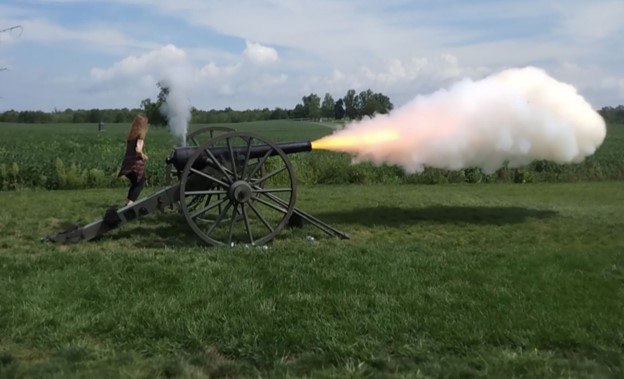
Gillis: “Every now and then, we get to work on fun events or participate in exciting demonstrations. Two examples that I can think of are when I had the chance to shoot a Civil War cannon (above) and when I participated in a day-long leadership tour of the Gettysburg battlefield (below).”  
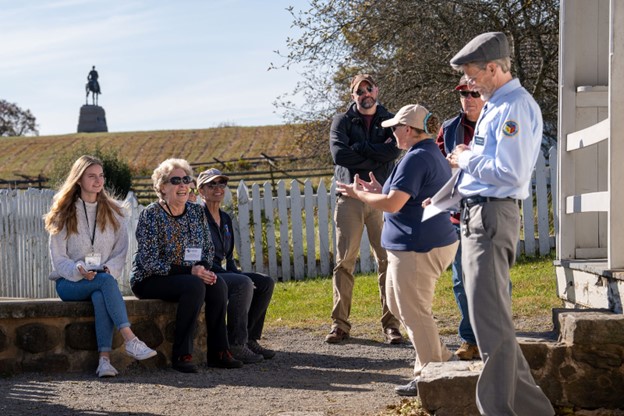
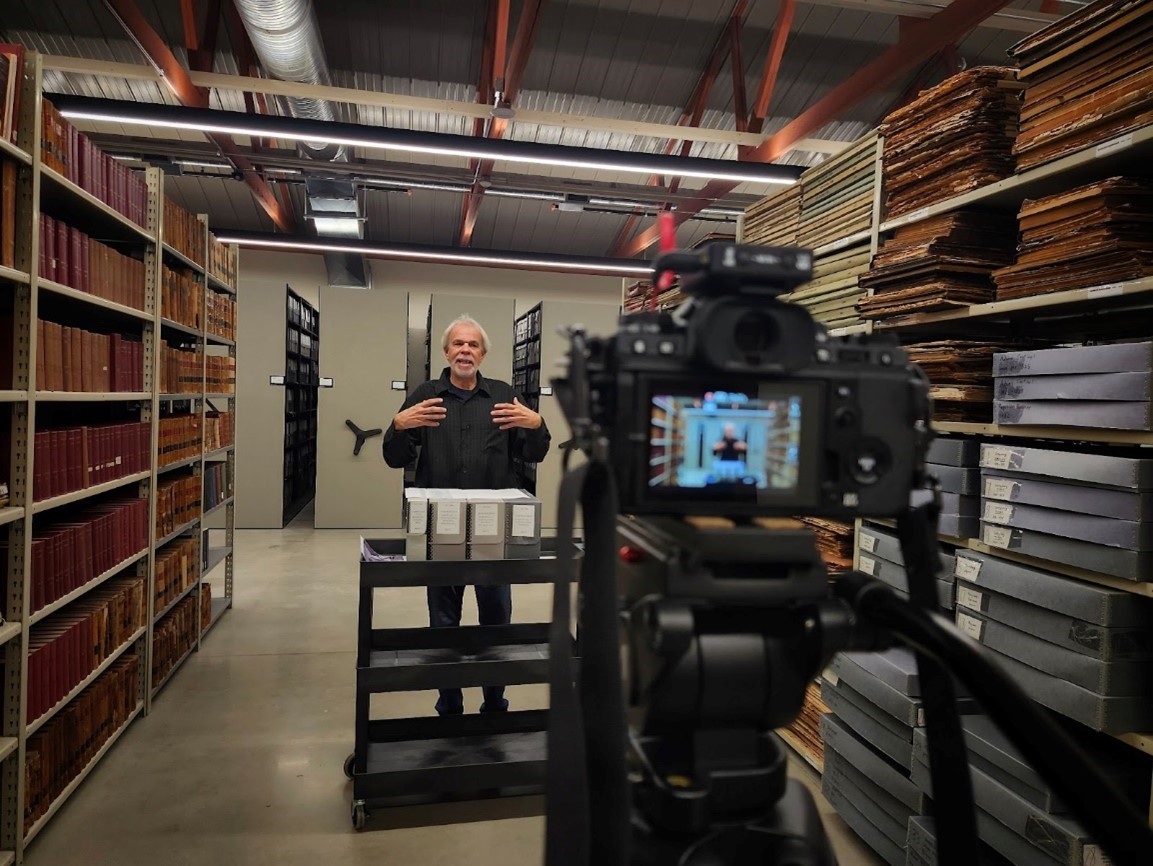
Behind-the-scenes of filming a YouTube video in the ACHS archives. 
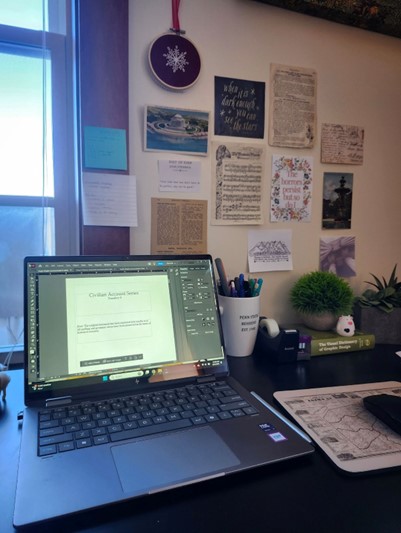
Gillis’ workspace. “I took this while editing a Civilian Account of the Battle of Gettysburg (with my Penn State Behrend mug in the background),” she said.
Found Treasure: Behrend family travel trunk discovered in consignment shop

By Heather Cass, Publications Manager, Penn State Behrend

This slideshow requires JavaScript.

Ernst and Mary Behrend, whose Glenhill farm property formed the core of Penn State Behrend in 1948, were avid world travelers.

“It was a very important part of their lives,” said Jane Ingold, reference librarian and archivist at the college’s Lilley Library. “We have many photos and postcards that they collected while on their frequent trips abroad. We even have some film of them visiting the locks at the Panama Canal.”

Thanks to the eagle eye of a Behrend food service staff member and the generosity of Steve Miller, associate director of Housing and Food Services, Ingold has another treasure to add to the Behrend collection: one of Ernst’s travel trunks.

“One of my employees mentioned that they saw an old steamer trunk that had ‘E. Behrend’ stamped on it on a photo posted on social media by One-Eighty Consignment and Thrift Shoppe in Albion,” Miller said. “I knew as soon as I saw it that it belonged in Behrend’s archives.”

When Miller drove to Albion to see the trunk, he was surprised at its condition.

“Normally, the leather handles on this type of steamer trunk deteriorate over time, but the handles on this trunk had not,” Miller said. “It appears to have been stored fairly well for some time.”

This slideshow requires JavaScript.

Behrend Blog talked with Miller, a history buff, to learn more about the trunk, which he purchased and donated to the Behrend archives.

Do you know where the trunk came from?

The best the store could gather was that the man who sent it to the store for consignment sale had received it from his wife’s uncle. Who that is or why he had the trunk is unknown.

How do you know it belonged to Ernst Behrend?

It has a brass identification plaque reading “E.R. Behrend Erie PA, U.S.A.” and “E.R. Behrend, Erie, PA” is written in white paint on the front.

Does it have any other identifying marks?

It has a shipping sticker from the American Express Railway Company (AERC). The AERC was formed in 1917 from an amalgamation of three express companies: First Express Company, Pony Express, and Wells Fargo Express. This was an effort to streamline shipping to aid in the war effort as the U.S. was involved in World War I at the time. The AERC was sold in 1929, so this dates the trunk to the 1917–1929-time frame.

It appears the trunk was shipped either to or from Newport, Rhode Island, which makes sense as the Behrend’s had a summer home there in 1913.

The sticker also has the abbreviation “N.Y.N.H. & H.” This is a reference to the New York, New Haven and Hartford Railroad. Service from this railroad ran from eastern New York state through Connecticut, Rhode Island, and Massachusetts. The shipping sticker places the value of the trunk at $300, which is approximately $4,800 in today’s dollars.

This slideshow requires JavaScript.

Were trunks commonly used by travelers then?

Steamer trunks or cabin trunks, which were named after their ability to be stored in the cabin of a steam ship, became popular in the 1880-1920 time period. They had a lower profile than typical shipping trunks to fit under berths in trains and steam ships. The trunks were typically identified with the name or initials of the owner. In addition, they carried notations to identify the contents of the trunk for appropriate storage. In the case of the Behrend trunk, a painted circle with “B” in the center.

You suspect this was one of many trunks the Behrends used?

Yes. Wealthy families typically traveled with many trunks to store their belongings for a long journey. The trunks were typically prepared by the house staff (maids, butlers, etc.) and shipped with a courier service to be placed in a steam liner berth or a train cabin.

Plans for the trunk

Ingold displayed the trunk with a few other Behrend family travel artifacts in the Glenhill Farmhouse during last month’s Parents, Families, and Alumni Weekend at Behrend. This summer, she plans to create a larger display about Ernst and Mary’s travels centered around the trunk that will be on display in the fall 2025 semester.

“It’s in remarkably good condition,” Ingold said. “But things were built to last back then.”

“Unissued Diplomas” Exhibition Urges Viewers To Bear Witness

By Heather Cass, Publications Manager, Penn State Behrend

This slideshow requires JavaScript.

Ivanna Obodzinska, 19, was the mother of twins and a Garden Design student at Polissia National University. She planned to be a landscape designer.

Serhii Molchanov, 19, was a student at the Ukrainian Leadership Academy who volunteered to fight for his country. While serving, he collected stories and photos for a book he hoped to write.

Oleksandra Borivska, 18, was an International Relations student at Vasyl Stus Donetsk National University. She dreamed of a diplomatic career, traveling the world, and seeing the Grand Canyon.

None of them achieved their goals. They were killed in Ukraine, including Obodzinska’s twins–victims of Russia’s invasion of Ukraine.

Obodzinska, Molchanov, and Borivska are three of forty Ukrainian students whose stories and photos are highlighted in “Unissued Diplomas,” an exhibition in Penn State Behrend’s Lilley Library that honors the memory of Ukrainian students who will never graduate.

The exhibition is one of dozens installed at institutions worldwide to remind people about the ongoing war and the price Ukrainians are paying daily in their fight for freedom. The exhibits were erected on February 24, the second anniversary of the invasion, which has resulted in the deaths of an estimated 70,000 Ukrainians to date.

While no one would wish a real-world trauma experience to affect their students, the course instructor of PSYCH 442: Trauma and Resiliency, Dr. Melanie Hetzel-Riggin, director of the School of Humanities and Social Sciences and a professor of psychology, saw “Unissued Diplomas” as an opportunity put lessons into practice.

Her class visited the exhibit last week.

This slideshow requires JavaScript.

“We talk a lot about how important it is for those who study trauma to bear witness to horrible events,” Hetzel-Riggin said. “Hearing and seeing the impact, elevating victim voices, and keeping space for those people affected by it is at the core of what trauma-informed work is.”

Hetzel-Riggin said the exhibit was particularly moving for Behrend students as they could see parts of  themselves in the Ukrainian students featured.

“The subjects of the exhibition were about the same age and might have had similar hobbies or majors or dreams and aspirations,” she said. “It brings the lessons from the course from abstract theory to affecting real people.”

Dr. Lena Surzhko-Harned, an associate teaching professor of political science, associate director of Behrend’s Public Policy Initiative, and a Ukrainian native, worked with Lilley Library to present the exhibition.

“The Russian full-scale invasion is also a war on Ukraine’s future,” Surzhko-Harned said. “The lives of the young Ukrainians, their future, their hopes and dreams were turned upside down on February 24, 2022. Many young people are losing their lives at the front lines and many more are dying as civilians targeted by artillery and drone strikes. With this exhibit, I hope we can honor this brave generation and remember to live our own lives to the fullest because your entire world can change in a moment.”

The “Unissued Diplomas” exhibition is located on the first floor of Lilley Library and is accessible during library hours. The exhibit will run through the end May.

Learn more at unissueddiplomas.org.

Captured History

Former math professor’s hobby produced one of Behrend’s greatest gifts

By Heather Cass, Publications Manager, Penn State Behrend

B.p. single

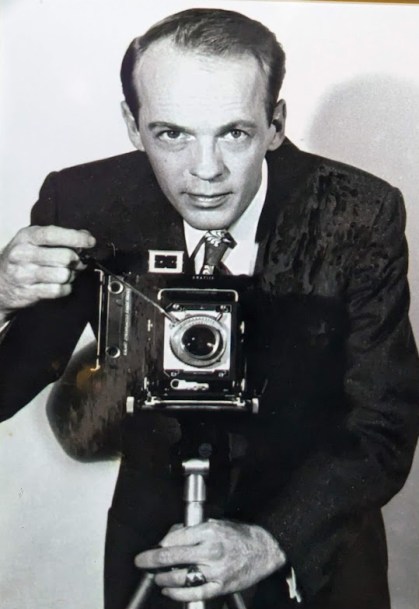
Though he taught generations of college students during his thirty-seven years as a mathematics professor at Behrend, Norman B. “Bill” Patterson, above, established a legacy that goes far beyond linear algebra, differential equations, and statistics. When he retired in 1990, he left a trove of photos documenting life at Behrend with intimacy and affection.

The camera he used to record much of it–a $129 model he saved all year to buy from Erie’s Boston Store in 1954–is in the archives at Lilley Library along with hundreds of his photos, a true gift to the college.

“If a picture paints a thousand words, Bill’s photos are surely the most expensive materials in the Behrend Archives,” said Jane Ingold, reference and instruction librarian and archivist at Behrend. “My ability to answer the many calls for photos for anniversary exhibits and stories like this one would be severely limited without them.”

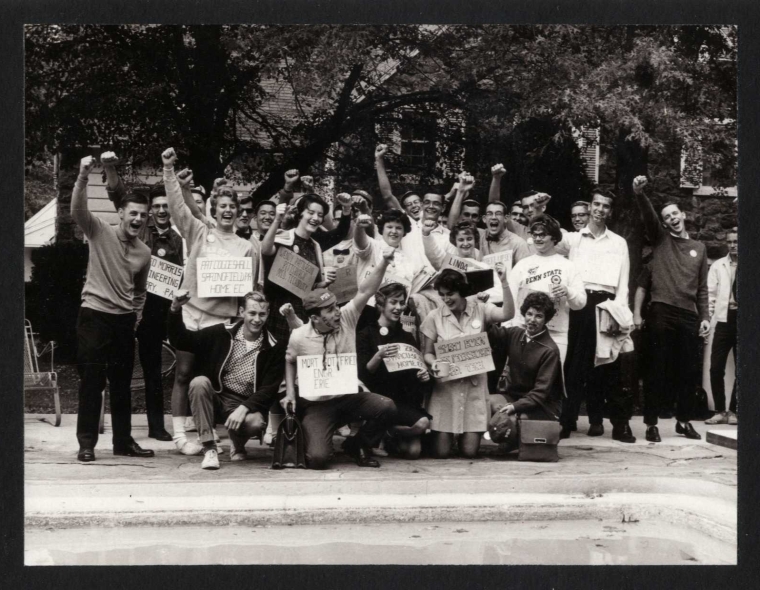
In honor of Behrend’s 75th anniversary, a sampling of Patterson’s work is on exhibit in Kochel Center. “Behrend Begins: The Campus Photography of Norman B. Patterson” highlights some of his most evocative photos from the 1950s through the early 1970s.

The exhibit provides a fascinating look into the past, offering a visual record of how Behrend has grown and changed over time.

Signs

At 98 years old, Patterson, who resides in an Erie area senior facility, is happy to talk about photography and Behrend with visitors. When asked what type of camera he liked to shoot with, he quipped, “anything I could get ahold of,” adding, “Some things you are just interested in from Day One and I liked taking pictures.”

Patterson’s introduction to photography was in 1938 when his older brother brought a camera, and he became immediately fascinated with it. Much happened for Patterson in the next 15 years, including receiving an undergraduate degree in chemistry, serving a stint in the Army in World War II, and returning to graduate school to earn a mathematics degree courtesy of the GI Bill.

When he was offered a mathematics teaching position at the five-year-old Behrend Center in Erie, a place he had never been, he took the job.  “I said, ‘Well, I have nothing in mind at the moment, so why not?’” Patterson recalled.

When he arrived, no science buildings yet existed. The library was in what is now the Studio Theatre, and Turnbull Hall had been converted from a horse barn for the Behrend family into academic space. On his first day, the original Erie Hall opened.

He quickly fell for the campus and the city. “I liked Behrend, and I love Erie,” he said. “We have it all here.”

As was customary in higher education then, faculty members were heavily involved in the life of the campus and its students. There were few administrators and staff members. It was faculty members who helped with student clubs, activities, and events.

“I was up there at the college for events and things three, four nights a week,” he said. “And if you saw me, my camera would be right next to me. I took it with me everywhere I went.”

And he recorded history as it happened – one Winter Snowball dance, Hanging of the Greens, and Student Work Day at a time.  He also photographed the daily college life that so fascinates today – the “lunch ladies” making food in the Glenhill Farmhouse kitchen, students cannonballing into the pool and skiing down the hill behind today’s Science Complex, and the female students who lived on the second floor of the farmhouse, with bunkbeds stacked in each room.

4GirlsSleepingInBunkbeds

When night fell, he developed the photos.  “I didn’t have a darkroom, so I just had to wait until it got dark,” he said.

Later, he added a home darkroom in a corner of his basement. His son, Bob Patterson, a lecturer in accounting at Behrend, said that when he and his two sisters were growing up, they knew better than to flip on the basement lights without asking and risk ruining their dad’s work.

By the time Patterson retired, he had witnessed—and captured in photos—the remarkable growth of Penn State Behrend over nearly four decades. And, yet, he has a fondness for the earlier, leaner years.

“The lack of resources in the 1950s meant that you had to make do with what you had,” he said. “We didn’t have people to do the auxiliary, non-teaching work, so the faculty were much more involved in student activities and things.”

And, of course, Patterson, who was never without his camera, was there to document it all, and in retirement, he continued to enjoy photography, even mastering photo editing software programs.

“When dad retired, he got a computer,” Bob Patterson said. “I went over to help him set it up and he was the best student I ever taught. It wasn’t long before he was editing and restoring photos and turning them into 3-D images.”

To further cement Patterson’s legacy at Behrend, a third generation of his family now works at the college: Granddaughter Katie Patterson, Bob’s daughter, who serves as an admissions counselor.

Here are just few of Patterson’s photos:

This slideshow requires JavaScript.

Wilson Picnic Grove: Tribute to Love and Kindness

By Heather Cass, Publications Manager, Penn State Behrend

Before Penn State Behrend became a college, it was a country estate owned by Hammermill Paper Company founder, Ernst Behrend, and his wife, Mary (pictured above). The two built Glenhill farmhouse—and many of the outbuildings that remain today—as  a fresh-air reprieve from life on the East Lake Road mill property, which could be, well, odiferous. (In those days, factory owners often lived on the plant property or next door.)

At the “farm,” the Behrends and their children, Warren and Harriet, kept goats and chickens, raised German shepherds (including the renowned Bruno, for whom the café in Reed Building is named), rode horses along the bridle path into Wintergreen Gorge, and picnicked in a wooded spot near Trout Run.

This slideshow requires JavaScript.

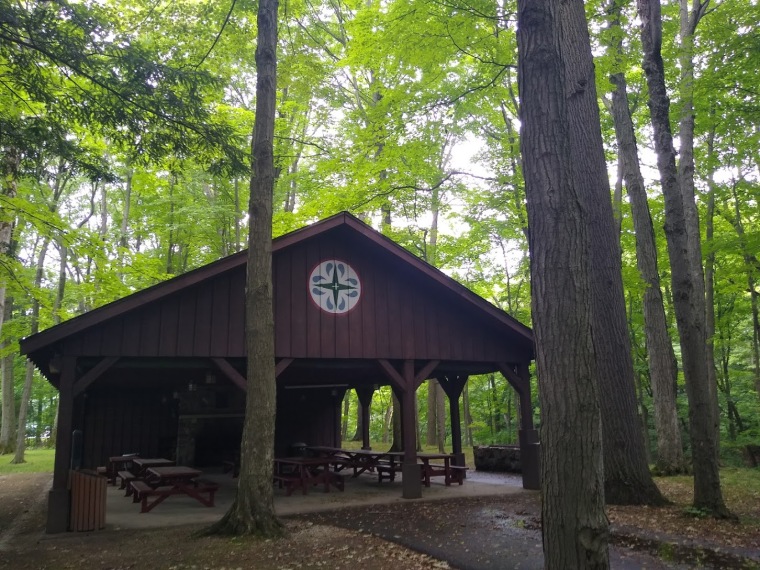
Years after Mary Behrend donated her property to Penn State to establish Penn State Behrend, a longtime Hammermill employee, Norman W. Wilson, who recalled fondly many picnics with Ernst and Mary, donated the funds to build – you guessed it –Wilson Picnic Grove, a rustic shelter with a wood-burning fireplace tucked in the shade of tall trees and overlooking a tributary of Fourmile Creek.

Wilson donated the shelter in memory of his wife, Flora Nick Wilson, who had died two years earlier in 1969. Like many couples, they met at work. Flora was a private secretary for Ernst Behrend, and Norman was a young man Ernst had taken under his wing.

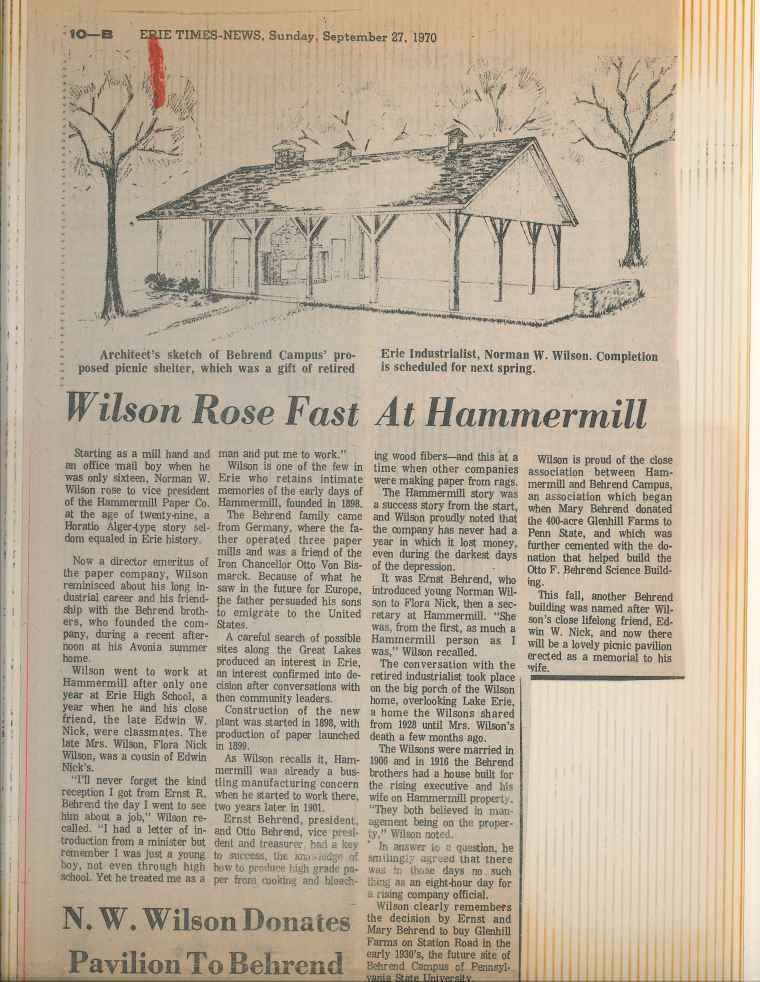
Norman had started his career at Hammermill as a millhand and office mailboy at the age of sixteen after having attended just a year of high school at East High in Erie. By twenty-nine, he was vice president of the company, a feat that a September 1970 Erie Times-News article called “a Horatio Alger-type story seldom equaled in Erie history.”

Wilson News story

In that 1970 article, Wilson was quoted as saying, “I’ll never forget the kind reception I got from Ernst R. Behrend the day I went to see him about a job. I had a letter of introduction from a minister, but remember that I was just a young boy, not even through high school. Yet he treated me as a man and put me to work.”

Wilson spent his entire career working for Hammermill, and after Mary donated Glenhill Farm to Penn State, he became involved in the college, as well, serving on the Behrend Campus Advisory Board.

Members of the board conceived of the idea of a picnic shelter, wanting to encourage use of one of the most beautiful spots on campus. But recognizing the greater need for athletic and academic facilities at the growing college, they felt they couldn’t ask the University for funds to take on a recreational project.

That’s when Wilson stepped up and asked to build the pavilion as a memorial to his late wife who had loved the outdoors.

The Flora Nick Wilson Grove and Pavilion was dedicated on November 9, 1971, to the “enjoyment of the students, faculty, and friends of the Behrend Campus.” Photos from the dedication show snow covering the ground around the shelter, which was filled with wooden folding chairs and guests, including Norman Wilson who spoke warmly about his former boss, his wife, and his hopes for the future.

This slideshow requires JavaScript.

“I could not feel comfortable about participating in this ceremony without expressing my respect and affection for Mr. Ernst R. Behrend, after whom this campus is named,” Wilson said  at the dedication. “It was he who gave me my first job at Hammermill. It was he who introduced me to his lovely private secretary, who was destined to become my Guiding Star, for always.”

“Mrs. Wilson loved the outdoors. She contrived impromptu picnics on the shortest conceivable notice. She rarely missed the early morning breakfast rides, or late moonlight supper rides on the Arizona ranch we liked best. She loved to motor, and to take her turn at the wheel. In her youth, she played basketball, fenced, golfed, and skated. She ran a tight house (and that included me!) She shopped, was a marvelous cook, and gave a great party. She liked people and they liked her.”

“Now, may I record my pride in everything about the Behrend Campus, including the students, the faculty, the advisory board, the director and the tremendous progress that has been made already. It is my fervent hope that the students, faculty, and friends will indeed find enjoyment in the frequent use of this memorial, and that the fellowship and goodwill for which this campus has become noted, will be enhanced thereby.”

Norman W. Wilson died July 5, 1979 at 94, but his generosity and spirit lives on at Behrend in the quaint shelter along Trout Run. He’d love it if you’d picnic there soon. It’s beautiful in any season.

Wilson Picnic Grove in 2021

Special thanks to Jane Ingold, instructional librarian and archivist at Penn State Behrend, who provided the background photos and articles for this story. Ingold has spent many years documenting the college’s history, assembling a treasure trove of memorabilia and recollections in Lilley Library.

Recreating history: One tiny soldier at a time

By Heather Cass
Publications Manager, Office of Strategic Communications, Penn State Behrend

Today, when most of us in the United States are focused on the pandemic and political warfare, Jerry App, a junior History major, need only walk down his basement stairs to escape current affairs and lose himself in the drama of 1500s Italy.

Jerry App
Jerry App, junior History major at Penn State Behrend

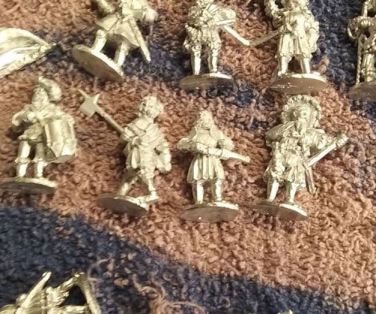
App is a kriegsmodelle enthusiast. He paints tiny figures and scenery and then stages elaborate and historically accurate battle scenes in miniature. Lately, he’s been working on the Italian Wars, depicting battles between the Holy Roman Empire and France for control of Italy.

He has plenty to work with. Between 1494 to 1559, the Italian peninsula became the main battleground for European supremacy. Everybody wanted a piece of Italy’s “boot,” which was economically advanced but politically divided among several states, making it an attractive target.

“I’ve had to do a lot of research before I could actually begin building and painting the models, but it’s worth the effort,” App said.

Delving deep into history is a labor of love for App who can trace his fascination with the past to a classic fantasy game he played as a child.

“My dad taught me to play Dungeons and Dragons when I turned 10,” he said. “I got really interested in the medieval ages, specifically the realistic and historical sides to fantasy tropes. We bought some old pewter Grenadier models and painted them together. Later, I discovered a game called Warhammer Fantasy, and that is what really kicked off my interest in miniature painting and wargaming.”

It’s a pastime that he and his father still share today, and one that is particularly suited for a pandemic.

It’s been a great hobby to have during the lockdown,” App said. “Earlier this year, I was home from college and my parents were off work for a while, too, which gave us a lot of time to catch up on painting and playing. A typical wargame takes an hour or two to play out, so we had plenty of time to play. You could start a wargame on Sunday and play it all week.”

We caught up with App to learn more about his hobby, his personal history, and how both influenced his academic and career choices.

Your dad introduced you to both fantasy gaming (Dungeons and Dragons) and modeling?  

Yes. He started modeling when he was a kid, putting together World War II kits. He actually still has some of those kits, and he’s assembled a few WWII models recently. He was inspired by our recent visit to Gettysburg, and he recently bought some Civil War models. So, we’ve been working on those, too.

What do you enjoy about Kriegsmodelle?

I enjoy being able to take gray, flat plastic sprues (generic figures) and turn them into fully built and painted pieces. It’s very calming and helps me relieve stress after a long day. When I build and paint models, my mind is completely focused on what I am doing at that moment. It’s almost like meditation.

Metal unpainted 1
Unpainted sprues.

Where do you buy the figures?

It depends on the genre. Historical models can be difficult to find, depending on the period. For example, you can easily find Napoleonic or Late Imperial Romans, but you’ll really have to scrounge for Wars of Lombardy or Russian Civil War. I’d recommend Perry Miniatures or Warlord Games. Science fiction and fantasy models are easier to find, and you can find them on Ebay or Amazon for a decent price. Local stores or hobby shops that carry models are especially nice to work with, if you have one nearby.

The figures arrive in need of a paint job?

Yes, that’s the best part! I try to sit down for an hour or two every day to work on a squad of models. It can take a while to paint them up (a few hours per model), but I paint them in groups which speeds up the process a lot; this is referred to as “batch painting.”

How many models have you done?

I have around 2,250 models, but only about 1,000 of them are painted with 100 still needing assembly. My dad has a comparable amount. We work on the models in our basement, which is affectionately named the “Nerd Bunker” by friends and family. I’ve been painting for ten years this month.

What are you working on now?

The Italian Wars, as well as some medieval levies (militia units raised by conscription), a couple of Warhammer 40,000 armies and the Civil War models my dad picked up.  It’s a lot of different projects, but I’m never without something new to paint.

You also study German?

Yes, I’m working toward a certificate in German. My grandmother, Omi, is from southern Prussia, and she inspired me to take up German. I’m hoping I will become proficient enough to be able to speak with her in Deutsche.

What are your career goals?

Originally, I wanted to become a civil servant and work for a government agency. However, I’ve also looked into museum work and law school. Right now, I’m considering using my degree as a launch pad into Naval Officer Candidate School. I’m not committed to one plan yet, but I’m starting to narrow it down.

What advice do you have for those who might want to try modeling?  

I’m the Vice President for the Behrend Game Club, and I’m also the club’s strategy committee head. If any students are interested in pursuing the kriegsmodelle hobby, join the club on Behrend Sync and get involved. I’m happy to answer any questions and share resources to help another start their own collection.

This slideshow requires JavaScript.

Secret Lives of Staff: Meet Steven Miller, history buff

There’s so much more to Penn State Behrend’s faculty and staff members than what you see them doing on campus. In this occasional series, we take a look at some of the interesting, unconventional, and inspiring things that members of our Behrend community do in their free time.

By Heather Cass
Publications Manager, Office of Strategic Communications, Penn State Behrend

Some people make it a goal to visit every state or capitol, but Steven Miller ’06, associate director of Housing and Food Services at Penn State Behrend, is a World War II reenactor and Penn State Behrend history alumnus who is working on a more unique challenge: He has a goal of visiting the private residences of every U.S. president. He’s already been to twenty.

“Visiting presidential homes offers an insight into the private life of individuals who had a profound impact on the formation and development of our country,” Miller said. “The homes and grounds themselves show a progression of architecture and lifestyle through history, from the vast agricultural farmlands of the Founding Fathers to the urban presidents of today.”

It all started with a trip to President Dwight D. Eisenhower’s home in Gettysburg, a stop on Miller’s itinerary while visiting Gettysburg National Military Park.

“It evolved into an annual summer trip with my brother, a challenge to visit the private residences of past presidents, with the goal of visiting all forty-five of them,” Miller said.

We chatted with Miller to learn more about his adventures and the homes he’s been most impressed with.

Are presidents’ residences public?

Yes, most presidential private residences belong to the National Park Service and are open to the public for tours. Information on their locations and visiting information can be found on the National Park website at nps.gov/findapark.

Do you plan vacations around visiting presidential homes?

I typically plan our itinerary around visiting both presidential sites and museums. Some of the most extensive collections of historical military artifacts are in museums located at the service academies, such as West Point or the United States Naval Academy, and often I will add these into our itineraries. Thirteen presidents have homes in New York, Ohio or Virginia, so from here where we live, creating a travel itinerary that takes you by a president’s home is fairly easy. One of the things we enjoy on these visits is eating at local establishments as much as possible; we try to avoid chain restaurants.

Who is your favorite (or most admired) president and why?

My favorite modern president was Franklin Delano Roosevelt (FDR). He was elected at the height of the Great Depression, and through various public programs, he got the country back on its feet. He then led the nation through four years of World War II and was the only president elected to four terms in office. He also founded the March of Dimes with the goal of finding a vaccine for polio.

What are some of the more famous homes you’ve seen so far?

Mount Vernon, George Washington’s home; Monticello, Thomas Jefferson’s home; Montpelier, James Monroe’s home; and Springwood, FDR’s home.

Have any the homes surprised you in any way?

It is impressive to see how some of these homes are incredibly preserved with original furnishings and furniture.

What does history mean to you? Why is it important to study and learn about history?

I am always searching for a connection to the past, and visiting historical sites, whether presidential homes or museums, let us see the tangible items that create those links. Visiting these homes is like stepping into the past. It’s amazing to think about walking in the footsteps of some of the most influential people in our country’s history.

This slideshow requires JavaScript.

Take Notes: History is Happening

By Heather Cass

Publications Manager, Penn State Behrend

When Penn State Behrend faculty members were asked to record video messages that could be shared with students and the wider Behrend community on social media, Dr. Joe Beilein, associate professor of history, took the opportunity to remind us that the COVID-19 crisis will be a monumental moment in world history.

“We are living through a significant time in history right now,” Beilein said. “These days and months will be written about, taught, and reflected on decades from now.”

It’s a valuable reminder that someday the fear, inconvenience, aggravation, and disruption that we are living with will be history and that you may want to take some time during this pandemic to document what’s happening.

“Documenting what you’re thinking, doing, and feeling would be a treasure trove for future historians, as well as social scientists, especially psychologists and sociologists,” said Dr. Amy Carney, associate professor of history.

Penn State Behrend’s history professors strongly encourage others to take the time to record these monumental moments as they happen. Here are a few ways to do that.

  • Handwritten journaling is one of the most basic and accessible forms of recording history.
  • Start a blog. You can start an online blog in minutes on WordPress.com. You can share it with others or make it private and keep it for yourself.
  • Start a vlog. A vlog is a video blog (hence vlog). You can record an entry regularly and upload to YouTube. Again, you can make these private or share them.
  • Record snippets. If you don’t have a lot of time or inclination to write, download the 1 Second Video application for your smartphone and record a one-second video or photo memory every day. When you’re done, you can “mash” your seconds into a video that is just a few minutes long.
  • Download a smartphone diary app. There are several smartphone apps to aid you in daily journal keeping. Explore them to find one that works best for you.
  • Record an oral history. Record your own thoughts using the voice recorder on your phone. You might also consider including family members, too. By the way, this might be a great time to do a phone interview and oral history with elderly relatives who may be eager for interaction.

What should you record? Just document your daily experiences living in this era. Even the most mundane details about how you are living through this time will be interesting to look back on some day.

“Historians are able to find value in just about every piece of documentation or evidence we come across,” Carney said.

“It’s the absence of records that drives us nuts much more so than the quality of what the record describes,” Beilein added. “Who knows what will be important to human beings in fifty years anyway? So, the best way to get a picture of what is going on in a collective sense is through the honest observation and recording of whatever it is that a person thinks is significant.”

Need help getting started? Wright State University in Dayton, Ohio, offers great writing prompts that will inspire you to record your thoughts and experiences before this pandemic becomes a distant memory.

Submit your memories

The Penn State University Libraries’ University Archives is documenting this significant and unique period for preservation and future research use. Its official curatorial program, the Penn State COVID-19 Experience Project, invites Penn State students, staff, faculty and alumni to document and share their personal experiences for submission toward a new special collection for the University Archives. Participants are encouraged to submit written journals or diaries, photo essays, video or audio recordings, zines or any other creative means of documentation. Learn more about the project and how you can contribute here.


Behrend’s Story in 70 Pieces

By Heather Cass, Publications Manager, Penn State Behrend

70 pieces 3

What do a dog’s gravestone, a jar of grapes, and golf tees have to do with Penn State Behrend? Find out in the Lilley Library where you can see a new exhibit, History in 70 Pieces, honoring Behrend’s 70th birthday.

Curated by the Jane Ingold, reference and instructional librarian and archivist, the exhibit explores highlights of the past seven decades in the college’s history through a collection of objects, photos, and memorabilia. There are things you might expect to see, such as a student handbook circa 1950, a freshman “dink” (beanie hat worn by first-year students in the late 1940s), and Behrend’s first yearbook, The Cub.

There are surprising items in the display as well, including never-before-seen archival items and objects that are representative of significant moments in the college’s history.

A Starbucks coffee cup may seem an odd thing to find on display, but it represents a social movement sparked by the death of first-year student Alyssa Josephine O’Neil who, before dying unexpectedly from an epileptic seizure, told her mom she wanted to get a pumpkin spice latte from Starbucks. After her funeral, her parents unwittingly started a national pay-it-forward campaign by purchasing forty of the drinks and asking the barista to mark the cups with #AJO and give them to the next people who ordered them. Soon, people across the country were buying free lattes for strangers in honor of Alyssa.

“I really wanted to include some newer items, like the #AJO cup, because history is happening every day,” Ingold said. “I also tried to represent as many communities at Behrend as I possibly could, including our international student population, staff members, and other sometimes overlooked groups.”

The exhibit has sparked interest from library visitors, most of whom take time to peer through the glass and absorb a little history.

The item that generates the most attention?

“Definitely Bruno’s headstone,” Ingold said, gesturing to the slab of concrete marked with the birth and death dates of Harriet Behrend’s beloved German shepherd, which is believed to be buried near Wilson Picnic Grove on campus. Harriet is the daughter of Mary Behrend, who donated her family’s Glenhill Farm estate to Penn State in 1948 to establish what became known as Behrend Center. “Everybody loves Bruno,” she said.

The exhibit has inspired some visitors to learn more.

“I’ve had a couple of students ask to borrow Ben Lane’s Book, Behrend Remembered, after seeing a copy of it in the exhibit,” Ingold said. “Many have commented on the exhibit or asked questions.”

If you still have questions, maybe about those golf tees and the bottled grapes, stop by the library to find out how these items are intertwined with Behrend’s history. Handouts explaining each of the seventy pieces in the exhibit are available to take with you and a binder on the table dives deeper into some of the items.

History in 70 Pieces can be found across from the checkout desk in Lilley Library and will be on display through June.

This slideshow requires JavaScript.

Students Save a Seat for Women in History

Lilley Library art exhibit invites remarkable women to the table

By Heather Cass
Publications Manager, Office of Strategic Communications,  Penn State Behrend

IMG_1464

“For most of history, Anonymous was a woman.”

This quote by author Virginia Woolf sums up the invisibility of women in the collective history of the world. Overshadowed by the accomplishments of men, few females have made it into the history books. And, yet, women have made their presence known in every aspect of human existence from art to banking to the military to the board room and beyond.

In 1979, feminist artist Judy Chicago gave thirty-nine women a seat at the table in her masterwork “The Dinner Party,” a giant sculpture that imagines famous women from myth and history engaged in conversation.

The installation art, which took more than five years to produce, is composed of thirty-nine ornate place settings on a triangular table with thirteen plates on each side. An additional 999 women’s names are written in gold on the floor. The piece toured the world, gaining an audience of millions; it is now on permanent display at the Brooklyn Museum.

Closer to home, you’ll find another dinner party happening in the John M. Lilley Library.

Students in last spring’s WMNST 106 Representations of Women in Literature, Art, and Culture taught by Dr. Sarah Whitney, assistant teaching professor of English and women’s studies, painted plates to honor a women from a wide variety of backgrounds. The students’ work is on display in the gallery space near the entrance to the library.

“For this project, students researched a woman of their choice who made significant contributions,” Whitney said. “They designed and painted on china as Judy Chicago did, using color and shape creatively to demonstrate the chosen figure’s importance. Students also wrote a reflection paper exploring their figure’s historical, and personal, impact on the artist.”

Some of the plates honor women you might expect, such as Supreme Court Justice Ruth Bader Ginsburg, author Maya Angelou, and women’s rights activist Susan B. Anthony.

Others are more surprising.

Molly Boniger, a junior English major, chose to honor Soviet sniper Lyudmila Pavlichenko.

“The purpose of ‘The Dinner Party’ was to recognize women who history had forgotten and I wanted someone who was unconventional, even by today’s standards,” Boniger said. “Pavlichenko has an incredible story. She is a young woman from a Ukrainian village who became the Soviet Union’s greatest sniper during World War II. She showed that woman can be hard and strong, and they don’t have to be the delicate, soft things that society would prefer we be.”

Boniger is an aspiring screenwriter who took WMNST 106 to learn what she suspected she was missing.

“The class was amazing,” Boniger said. “I could not believe the amount of exposure I received and just how much women’s contributions to art and culture have been excluded from the narrative we’ve all been taught.”

Whitney was pleased with the range of women and topics that students picked.

“The plates reflect a diversity of choices, which is wonderful,” Whitney said. “I especially enjoyed learning about new women from our international students whose choices spanned the globe. Furthermore, some students chose mythical or fictional figures, such as Shakti, which were also quite enlightening.”

Among the women represented are: Coco Chanel, Cleopatra, Julie Andrews, Lynsey Addario, Ellen DeGeneres, Chihiro Ogino, Miley Cyrus, Emma Watson, Pasang Lhamu, Athena, Amy Winehouse, Billie Jean King, Marilyn Monroe, Amelia Earhart, Helen Keller, and Janis Joplin.

Not all of the plates honor people.

Junior biology major Caitlin Kent, chose to celebrate the essence of womanhood and give a nod to her future career as an obstetrician/gynecologist.

“I painted a uterus as the center of the universe to represent a feminine divine force or a female creator,” Kent said. “All life stems from women. On my plate, one ovary is painted as the sun and one as the Earth to center the uterus as the birthplace of the universe.”

The plates are simple porcelain and students used a china paint, just like Judy Chicago, to adorn them.

“Using hands-on materials to make historical events come alive is a key part of my teaching practice in general,” Whitney said. “I think using manipulatives is particularly important in studying ‘Dinner Party’ both because it is a visceral, intense piece, and because Chicago was intentional about using traditional women’s art practices, like china painting and embroidery, to honor forgotten female artists. By doing it, you sort of experience Chicago’s process.”

Kent and Boniger gave the project, and the entire course, high marks.

“I think WMNST 106 is a class that all people can benefit from,” Boniger said. “These women’s histories are all of our histories. The class covers such a range of subjects, I can guarantee that any student taking it will learn something new, and enjoy doing so. It’s about time we start bringing women into the conversation and including them in the history they have helped create.”

“My Dinner Party” will be on exhibit in the Lilley Library until October 26. Whitney would like to acknowledge the help of the Lilley librarians, and Scott Rispin, assistant teaching professor of art, who helped to assemble the display.

This slideshow requires JavaScript.