Retired faculty members add perspective to Behrend’s 75th anniversary celebration

By Robb Frederick, Associate Director, News & Information

Penn State Behrend

Behrend faculty, 1968-69

The yearlong celebration of Penn State Behrend’s 75th anniversary has been an opportunity to reflect on the growth of the college and the contributions of those who helped make Behrend what it is today.

With help from Rod Troester, associate professor emeritus of speech communication, we have collected stories and life lessons from retired faculty members who remember a very different Behrend. Here are some of their reflections:

“I never looked at my time at Behrend as ‘work.’ I felt comfortable slipping into my office in the evening or on weekends in my slippers, often bringing my dog, Ginger, with me for company.

bob-tauber-emeritus (Copy)

“I took advantage of the swimming pool and the ski slope behind the Otto Behrend Science building. I recall my daughter, Rebecca, then just a youngster, proudly coming over from the swimming pool to my office and informing me that she was able to swim two lengths of the pool. This entitled her to be on the forward deck of our sailboat.

“I loved teaching, and doing so at Behrend. I found it a joy to go to work each day.”

~ Robert Tauber, professor emeritus, education

**************************

“I remember traveling with Dean Baldwin and students to the College English AssociationGreg Morris (copy) conference in Pittsburgh, where we shared an elevator with John Updike. We also went to the Shakespeare Festival in Stratford, Ontario, where we saw Christopher Plummer perform the title role in ‘King Lear”; and to the PEN International conference in Toronto, where I had a conversation about melons with Arthur Miller in an open-air market.

“None of this would have happened without the help of the terrific Behrend community of faculty, staff and students.”

~ Greg Morris, professor emeritus, American literature and English

**************************

“I was hired in 1968. My husband, Ben Scott, taught in the Physics department. He was hired the same year I was and retired in 1988.Mary Chisholm (copy)

“I was a chemist. During my 36-year tenure at Behrend, I saw the college develop from a two-year feeder institution to University Park to a flourishing, four-year campus.

“I retired in 2004. I stay in touch with the chemists, and with a few other faculty members in the School of Science.”

~ Mary Chisholm, professor emerita, chemistry

**************************

“I was hired in 1970. That makes me second-generation Behrend Center faculty, but first-Dan Frankforter (copy)generation Behrend College faculty. I was part of the crowd of newbies hired that year to staff the four-year majors that were to make Behrend a baccalaureate-granting institution.

“There was little to work with at the time. Some of us joked that launching the college was like an old Mickey Rooney—Judy Garland movie: ‘Gee, kids, let’s put on a show in the barn.’ But Behrend provided a wonderful and unique opportunity for a career. In an age of academic retrenchment, Behrend bucked the trend and gave us a shot at a much more exciting and fulfilling project. It’s growing success is an achievement well worth celebrating.”

~ Dan Frankforter, professor emeritus, history

The Music Man Takes a Bow: After 25 years, Dr. Gary Viebranz, will retire in June

By Heather Cass, Publications Manager, Penn State Behrend

PXL_20240416_235733498
Dr. Gary Viebranz, professor of music and director of instrumental ensembles, at Penn State Behrend.

Music is as close to time travel as humans can get. Hearing a particular song can transport you to your early childhood dancing in the kitchen with your mom, to your first solo drive after getting your license, to your high school prom, to the day you buried a loved one.

“Music is a visceral thing that can actually cause changes to our body chemistry,” said Dr. Gary Viebranz, professor of music and director of instrumental ensembles, which includes jazz, concert, and pep bands. “It can make us happy or provide an outlet for pain or grief. Some songs are forever burned into our memories. I can remember songs that I played when I was seven years old.”

And, yes, he has been making music since he was a child. Viebranz got his first instrument—a paper-headed drum set—for his fourth birthday. By six years old, he was playing the trumpet.

“It came somewhat naturally to me, and I practiced a lot because I enjoyed it, so work ethic was easy for me to find,” he said.

Fortunately, he had parents who encouraged his musical inclinations as he grew up in Strongsville, Ohio.

He knew early on that he wanted to be a music teacher. For several years after college, he taught music at the high school level in the Cleveland area. A return to graduate school opened his eyes to the possibility of teaching college students.

“Crazy as it can be at times, teaching at the collegiate level is much calmer and more predictable than public high school,” he said.

He joined Behrend in July 1999 and will retire in June, after his twenty-fifth year. We sat down with Viebranz to learn more about music education, his career, and his post-retirement plans.

Can anyone learn to play an instrument?

Yes, but it takes more persistence than some people want to put into it. It’s never too late, though.

How many instruments can you play today, and what is your favorite?

Tuba, baritone, trombone, and bass guitar. Tuba is my first love and my go-to.

Is there an instrument you want to learn in retirement?

There are things I’d like to play around with, like my theremin, which is an electronic instrument that you don’t actually touch, and I’d like to get back to playing bass guitar again.

Not everyone who participates in a band wants to be a musician, so why do you think students make time for it?

The point of music education isn’t to have a career in music. It’s to spawn creative thinking and to make something abstract into something you can hear and feel. Also, it can serve a lot of purposes in a person’s life. It can be a way to escape or grieve or relax or find joy or relieve stress.

What is your most memorable teaching moment?

To be honest, it wasn’t a positive one, but I think it’s worth sharing. In a general education music class, I shared something interesting that was outside the curriculum of the class and said, “That won’t be on the test, though,” and a student asked, “Then why are you wasting our time?” I was shocked by the idea this student had that because something wouldn’t be on the exam, it wasn’t important or worth knowing.

What other changes have you noticed in teaching for twenty-five years?

It’s become harder to find inroads into students’ mindsets, to widen the focus and have them entertain the idea that there is not always a single solution or result, but that there can be many ways to achieve an expected result.

One of your most popular classes was about the Beatles. What did you cover?

We studied everything from pre-Beatles to Beatlemania and on though the group’s breakup. They recorded thirteen commercial albums, which made it easy to set up the course by covering one album each week through the semester.

Music at Noon, which you also directed, is one of the college’s most enduring musical traditions. How did you get involved?

The program had been going on for ten years when I came to Behrend. Several years later, I said I would do it for a year, and here we are. It’s been going strong for thirty-four years. I have been involved for seventeen of them.  And, yes, it will continue after me.

Are there any Music at Noon performances that stick out in your memory?

In their own way, they have all been memorable. You have to live each concert in the moment. One of the unique things about the program is that it draws an all-ages audience, from Erie City elementary school children to college students to older community members.

What would people be surprised to find on your Spotify playlist?

Well, you might be surprised to know that I don’t have Spotify. That said, I have eclectic musical tastes. I’m open to listening to anything, and I don’t worry about labels. Of course, I enjoy the music of my youth, things that were popular in the mid- to late-1980s, the most.

What will you miss most about Behrend?

The people: Many students, staff, and faculty members become like family.

PXL_20240417_000812930
Dr. Gary Viebranz, professor of music and director of instrumental ensembles, conducting his final Concert Band performance at Penn State Behrend in April 2024.

VITAL STATS AND PARTING THOUGHTS

Family: Wife, Mari; Daughters, Sofia, 26, and Elizabeth, 23.

First concert: “My older sister took me to see John Denver at the Blossom Music Center in Cuyahoga Falls, Ohio, when I was young.”

Perfect song: “I don’t know that perfection exists because it’s an arbitrary measure. Perfect presents itself in the moment when the right song comes on at the right time.”

A song he will always sing along with: “’Jar of Hearts’ by Christina Perri. I love to blast it in the car and harmonize along.”

Non-music hobbies: “I love to bike, kayak, and travel.”

Retirement plans: “My wife is still working, and she loves her job, so I’ll be in Erie for the foreseeable future. There are some passions I’d like to revive, like singing, bowling, and fishing.”

PXL_20240417_000904316

Psst: Office gossip can be costly, Behrend researchers find

By Robb Frederick, Associate Director of News and Information,

Penn State Behrend

canstockphoto110465852 (002)

Workplace gossip often targets the boss. She’s in over her head. He’s overextended. There’s trouble at home, supposedly.

When the boss is the one spreading gossip, sharing private insight about a team member’s performance or personal life, that can lead to a far more damaging dynamic – a behavior researchers refer to as moral disengagement.

“Leaders set the tone for an organization,” said Joongseo Kim, an assistant professor of management at Penn State Behrend’s Black School of Business. “When a leader participates in gossiping behavior, other employees pick up on that right away. They are less likely to feel shame or guilt when they gossip. They think, ‘Even the leaders are doing this. It’s acceptable in this organization.’”

Kim runs the Raimy Behavioral Lab at Penn State Behrend. He studies business ethics and workplace deviance. This spring, working with Madison Dambach, a senior in the Black School of Business, and Yun Kim at Oklahoma State University, he began a study of gossip contagion in the workplace.

“Gossip can be fun,” he said. “It’s sharing a thing that began as a secret, and that makes it a social-bonding mechanism.”

Positive gossip – sharing the news of a colleague’s promotion, for example – can increase a team’s sense of organizational identity, according to a 2022 study by the National Institutes of Health. That type of water-cooler talk can boost efficiency and employee retention.

“It’s all about intent,” Kim said. “If you gossip to motivate a person, or to elevate the reputation of a person, that’s a positive thing. If what you are saying is purposefully hurtful, however, and if you’re saying it to sideline or neutralize a colleague, that can do real damage.”

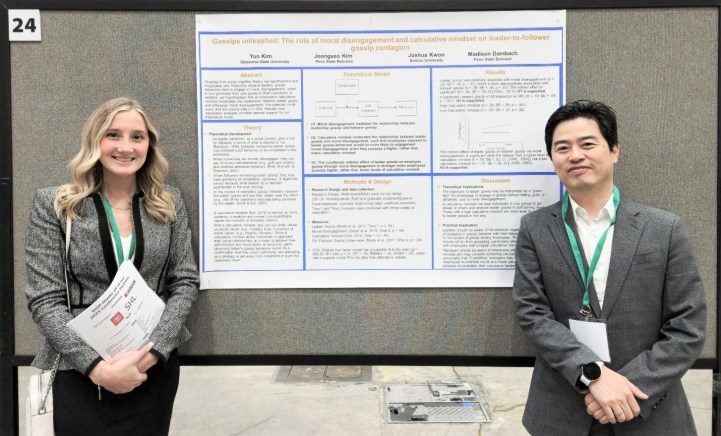
An employee with a calculative mindset – someone who approaches social relationships as a means of achieving another goal, such as financial gain – is more likely to gossip when a supervisor participates in the behavior, said Dambach, who presented the study at the Society for Industrial and Organizational Psychology conference in Boston.

“People with a higher calculative mindset see gossip as an opportunity,” Dambach said. “It’s a way to undercut a competitor or cast doubt on their abilities or their commitment to the organization. Some people will use that to their advantage, especially if the supervisor is listening.”

When a boss gossips, that’s viewed as a green light for others in the organization to behave the same way, Dambach said. Over time, that can affect employee productivity.

“Managers should pay more attention to that,” she said. “if they feed into gossip, their employees will do the same, without any sense of guilt or shame. That weakens the cohesiveness of the group. It leads to resentment. Ultimately, it can lead to the failure of the business.”

Madison Dambach and Joongseo Kim in Boston

Senior student Madison Dambach, left, and Joongseo Kim, assistant professor of management at Behrend’s Black School of Business.

Raise a Toast to Lake Erie: Faculty members partner with brewery and PA Sea Grant to raise awareness of aquatic invasive species

By Heather Cass
Publications Manager, Office of Strategic Communications, Penn State Behrend

On a sunny August Saturday, a half dozen fans are lined up in front of the Mysterysnail Speedway, a four-foot plastic box with plexiglass dividers creating race lanes for a field of ten large snails. They place their “bets” and cheer for their chosen snail, each marked with a race number on its shell.

This slideshow requires JavaScript.

As the oversized gastropod invaders make their way to the finish line, Dr. Lynne Beaty, assistant professor of biology at Penn State Behrend, explains why we don’t want them in our waterways.

“Mysterysnails are so named because females produce young, fully developed snails that ’mysteriously‘ appear. They’re a group of invasive species that originate in Asia but have found their way to Lake Erie,” Beaty said. “They compete with native species, alter nutrient ratios, and transmit parasites to wildlife.”

IMG_2579

Aquatic invasive species (AIS) are non-native plants, animals, or pathogens that harm the environment, the economy, and human and animal health. They are one of the greatest threats to biodiversity and native communities of other species, and they can spread easily through unwitting human assistance and connected waterways.

Beaty and two other Biology faculty members, Dr. Adam Simpson and Dr. Sam Nutile, have been working with Kristen McAuley, lecturer in marketing, and Sara Stahlman, extension leader for Pennsylvania Sea Grant, to raise awareness about invasive snails (and other species) in the waters around the Erie region. Last summer, the team came up with a novel idea to reach adults: craft beer.

“Good beer needs high-quality, clean water and invasive species threaten our freshwater supply,” Beaty said. “So we thought a collaboration with Erie Brewing Company in Behrend’s Knowledge Park was a great way to promote AIS awareness because controlling invasive species can help improve water quality. We were thinking too that this might be an excellent way to reach adult audiences who are more likely to accidentally transfer AIS when they move boats to different water bodies.”

The group met with Erie Brewing’s brewmaster, Tate Warren, who was on board with creating a ‘draft series’ of special AIS-themed brews for invasive species awareness.

thumbnail

The first, Mysterysnail Ale, “an amber ale loaded with flavors of bread, biscuit, and caramel malt,” debuted at a launch party, complete with the aforementioned mysterysnail racing, at Erie Brewing. Visitors had the opportunity to try a new brew and also learn about many AIS at tables manned by Behrend School of Science faculty members and staff members from Sea Grant, a research, education, and outreach program administered by Behrend.

The event was well-attended, and the Mysterysnail Ale was well-received. It currently has a 3.6-star review (out of five) on Untapped.com, a website where beer lovers rate and review brews.

Three more brews are planned in the AIS series: a Round Goby Rye, a Zebra Mussel Malt, and a Hazy Hydrilla. Each beer will launch with an event to raise awareness of the AIS the brew is meant to thwart.

In addition, for each of the beers, a promotional poster will be developed that will highlight the beer, the flavor, and the facts about the highlighted species. QR codes on the posters, which will be displayed at Erie Brewing  and other locations on the Lake Erie Ale Trail, will lead users to even more information about the featured AIS.

Mysterysnail Ale is currently on tap at Erie Brewing and other participating Ale Trail breweries, including Lavery Brewing, Arundel Cellars and Brewing, Twisted Elk Brewing, Brewerie at Union Station, Nostrovia, and Erie Ale Works. For more information about aquatic invasive species, visit seagrant.psu.edu.

This slideshow requires JavaScript.

Retiring Physics Professor Reveals Meaning of Life (Kinda)

By Heather Cass, Publications Manager, Penn State Behrend

Jonathan Hall (5)
Jonathan Hall, associate teaching professor of physics at Penn State Behrend

Jonathan Hall, associate teaching professor of physics, began his career in a remote area of Borneo where the only “technology” he had access to was in the form of painted plywood chalk boards and a hand-cranked, mimeograph-like machine. He taught in a language he had learned just three months earlier.

This month, he will finish his career in education from home, where he has been teaching dozens of Penn State Behrend students remotely using online videoconferencing software and a host of other high-tech tools that would’ve been inconceivable at the start of his career three decades ago.

Yet, Hall, who has been teaching at Behrend for thirty-two years, says not much has changed.

“Though the technology available today for education is very different, the key ingredient for student success has not changed; the desire to learn is the most important part,” Hall said.

Sometimes that desire can be stamped out quickly in physics class, a subject many students find intimidating. Hall learned to build students’ confidence first.

“In my general education physics course, I found that if I started with a topic, such as color and light, that students enjoyed, their confidence in their ability to learn physics enabled them to achieve greater success in the course,” he said. “We still did the more challenging topics, but students did better when I would ease them into it later in the course.”

Over the course of his teaching career, Hall said he has learned as much as he has taught, and we couldn’t let him retire without collecting some of his wisdom on topics big and small.

What brought you to Behrend?  

A 1988 Mazda hatchback. And a job teaching at a college!

What types of classes have you taught over the years?  

Physics, Astronomy, Civic and Community Engagement.

Which classes have been your favorites and why?

Of course, I enjoyed teaching physics, but the advantage of teaching astronomy is that it’s not called what it actually is, which is “the physics of the universe.” Because it doesn’t include the word “physics,” students relax, and enjoy learning… physics!

What I enjoyed about Civic and Community Engagement is that it was team-taught with faculty from other disciplines, including communication, psychology, and sustainability. It was truly inter-disciplinary, which was great, and I learned a lot from my colleagues. With the service projects, students were able to put into practice what they learned in their majors.

What do you remember most about your first year of teaching?

I had been a high school teacher for five years before coming to Behrend. I enjoyed getting to know students in my classes from teaching them 180 school days, but when I started teaching college, I didn’t miss at all the “supervisory” duties of a high school teacher such as monitoring homerooms, study halls, etc. At the college level, I could focus on teaching students, not monitoring them. Also, though I wasn’t any smarter or more qualified than I had been before, the respect people (especially the parents of students) give college faculty compared to high school faculty was eye-opening.

What have you learned the hard way?

I started my career as a Peace Corps volunteer, and it truly was the toughest job I’ve ever loved. I had twenty-five class preps every week in a language that I had only started learning three months before. Speaking a foreign language is not one of my strengths. During the first three months, I wondered if I had made a mistake; about a third of the volunteers in my training group quit during this time. But I toughed it out. Things got better, and I enjoyed my second year so much that I extended my assignment and served three years. In order to survive those early months, one thing I learned to do was to listen intently; to pay attention to and catch both the verbal and non-verbal cues; to listen to everything the person was saying, not just the words.  That skill has carried over to make me a better teacher and I hope more understanding of others. 

What would people be surprised to know about you?

How our children go out of their way to keep my wife, Katherine, and me informed of world and national events. Our daughter, Maria, was a Peace Corps volunteer in Madagascar when a coup overthrew the democratically elected government there. At the same time, our daughter, Liz, who is a Marine, was in Iraq.  Liz has also been deployed to Afghanistan (twice), South Korea, Chad, Australia, and Germany, and is presently at the U.S. Embassy in Baghdad. Our son, David, lives in Portland and kept us up to date on the fires and protests in Oregon. Someday, we hope to be less well-informed.

What have you enjoyed most in your career?

I have always enjoyed teaching young people and helping them to achieve their potential, and that has not changed during my career.

Do you have a different perspective on the profession now?

When people ask me what I teach, I tell them I teach young people, not a subject.  As teachers, we have the task of preparing our students for the future; content knowledge is often a  means by which we teach more important lessons about life.

What will you miss the most?

I have been fortunate in my life and career to work for organizations with a noble purpose, whether the Peace Corps, or Penn State University, whose mission as a land grant institution is teaching, research, and service. Working with everyone at Behrend who share in striving for the common good is what I will miss the most.

What’s the secret of life?

Since, in Malaysia, I was a “guru,” I’ll recommend as a starting point in your quest — the “Galaxy Song” from Monty Python’s “The Meaning of Life.”  (Please note that I didn’t say I was a good guru…)

Any other parting wisdom for us?

In Asian culture, keeping harmonious relationships within the community is often the top priority.  In America, we emphasize individualism.  I think that in a healthy community, there is a balance of both; freedom of individual expression, along with concern for others.

This slideshow requires JavaScript.

Distinguished Professor’s Secret to Success Career: Adaptability

By Heather Cass

Publications Manager, Penn State Behrend

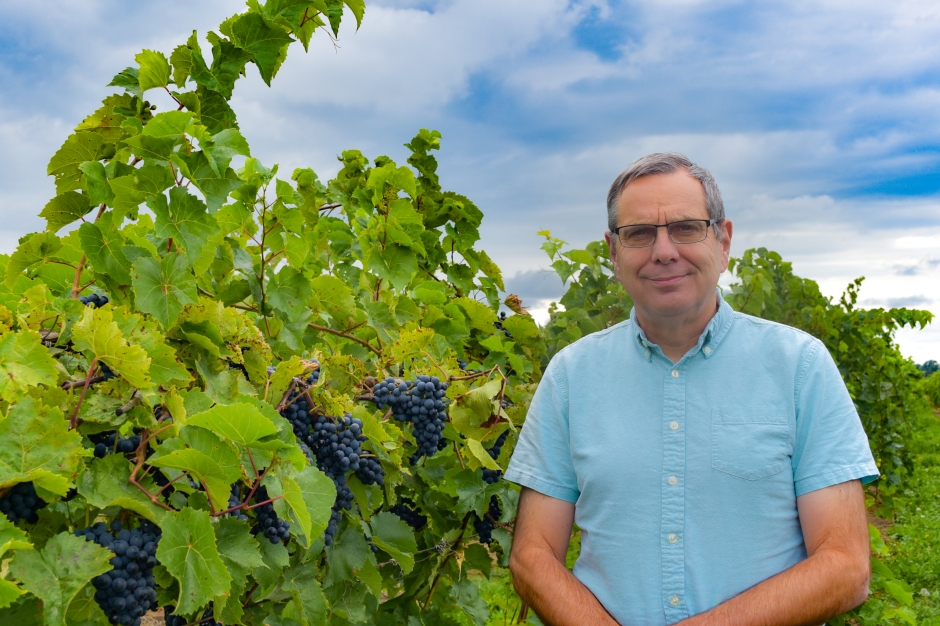
As a professor of biology and director of the Lake Erie Regional Grape Research and Extension Center (LERGREC), Dr. Michael Campbell already has a few impressive titles, but Penn State recently added another highly significant word to his academic title–distinguished.

The designation of distinguished professor recognizes outstanding academic contributions to the University and service to students. Campbell joins two other Behrend faculty members in holding the title: Dr. John Gamble, distinguished professor of political science and international law, and George Looney, distinguished professor of English and creative writing. The title serves as the sign of an educator, like Campbell, who has spent decades going above and beyond.

We recently talked with Campbell, who started at Behrend in 1994, to learn more about his career, what makes a great professor, and how he balances his research work, teaching, and running LERGREC.

Though he doesn’t point it out, it’s clear that the secret to Campbell’s success is his ability to adapt to changing conditions, much like his favored research subjects, plants, are known to grow toward the light or send down deeper roots to find the nutrients they need to keep growing.

Have you always wanted to be a professor?

Actually, no. I thought I would work in the plant science industry, but my intention when I finished graduate school was to work for a company or develop my own industry.

What did you do before Behrend?

I worked for the U.S. Forest Service as a geneticist, then for the United States Department of Agriculture as a physiologist.

What do you enjoy about teaching?

That has changed a bit over the years. At first, it was great just to see students learn and discover new material and ideas in the classroom. But, over the years, my outlook on it has become more holistic; it’s not only about teaching specific subjects but helping students develop a career path as well.

What is the most important quality for a professor to possess?

The desire to work and to help others. It is critical for a professor to enjoy the subject matter they are a specialist in, but to be a teacher at a place like Behrend, you need to also find joy in helping students find their way; it’s a big part of what we do here.

What have you had to learn the hard way?

Teaching is a moving target. Each class has a group personality and there is no one-size-fits-all to presenting the material. Each semester is a bit different.

How do you balance research, teaching, and running the grape-station research lab?

At times, I feel like a short order cook; trying to make the entrée finish at the same time as the side dish. It has been a challenge to find the time to work on projects and to dedicate time to students working on their own projects. That said, the balance is about what I expected, and I think being active in research helps me as a teacher, particularly with upper-division class material.

This semester, you had to quickly transition your classes to remote learning. How did that go?

It was definitely a challenge, especially because we had to adapt so quickly. Ultimately, though, I think this experience has been beneficial. It has given me some new approaches to teaching that I probably would not have pursued.

What research project at LERGREC are you excited about right now?

My research work involves regulating sprouting in potatoes and I’m still working on that, but I can see an overlap with connecting that work to controlling growth in grapes. It is a bit high risk, but, hey, why not? As the climate becomes more erratic, grape growers may benefit from preventing premature growth during warm winter weather. Connecting what we have learned about regulating growth in stored potatoes to controlling grape growth in the vineyard is a new and exciting avenue for research.

What’s the most important thing a professor can do for a student?

Be a good mentor. A professor’s role is to guide a student and show them the way. Success is up to the student.

What advice do you have for professors in the first years of their career?

Enjoy what you do. Keep chugging away. True success is an accumulation of small accomplishments built over time.


The Art of Science: Student/faculty artwork enhances science building

By Heather Cass, Publications Manager at Penn State Behrend

Science and the arts might seem to be very different disciplines, but the scientific method and the creative process are quite similar; inquiry is at the heart of each.

“People sometimes think science is about memorizing facts, but it’s really about making discoveries and wringing answers out of nature,” said Dr. Pam Silver, associate dean for academic affairs and distinguished professor of biology. “When you have a scientific question, it takes a lot of creativity to find the answer to it.”

Scientists are, by nature, creative individuals and the School of Science has recently added two works of art that visibly illustrate that.

Ties that bind

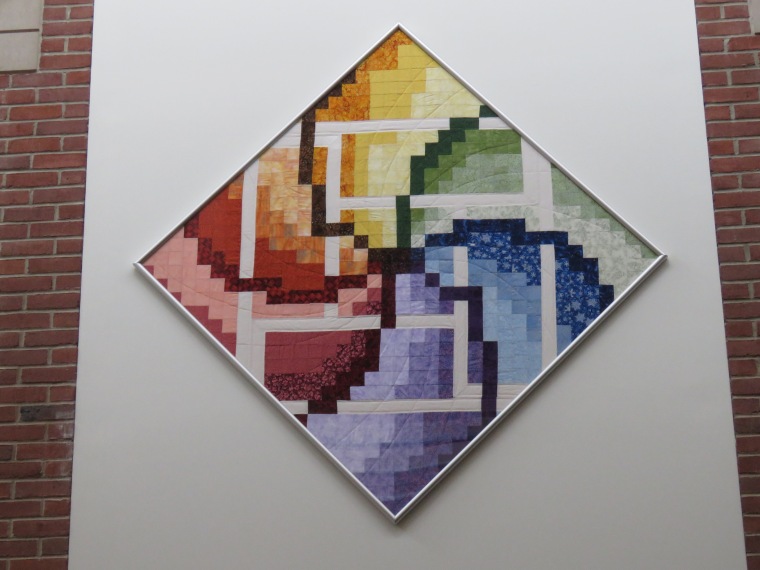
A colorful quilt, titled “A Way of Knowing,” was created by Silver and hangs in Hammermill Hall. Each color in the quilt represents a scientific discipline taught at Behrend—biology, chemistry, environmental science, nursing, physics, and mathematics and mathematics education. A spiral in the quilt represents the net movement of scientific discovery from observation to hypothesis to testing to understanding.

Furthermore, the underlying geometric design “symbolizes that the building blocks of science are not individual disciplines, but rather the discoveries to be made by merging diverse ideas, points of view, and approaches to form a strong and unified way of knowing with the goals of wisdom and the power to enact that wisdom,” Silver said.

briefs - artwork - quilt (1)

“A Way of Knowing,” by Dr. Pam Silver, associate dean for academic affairs and distinguished professor of biology, hangs near the stairwell in Hammermill Hall. 

Math in flight

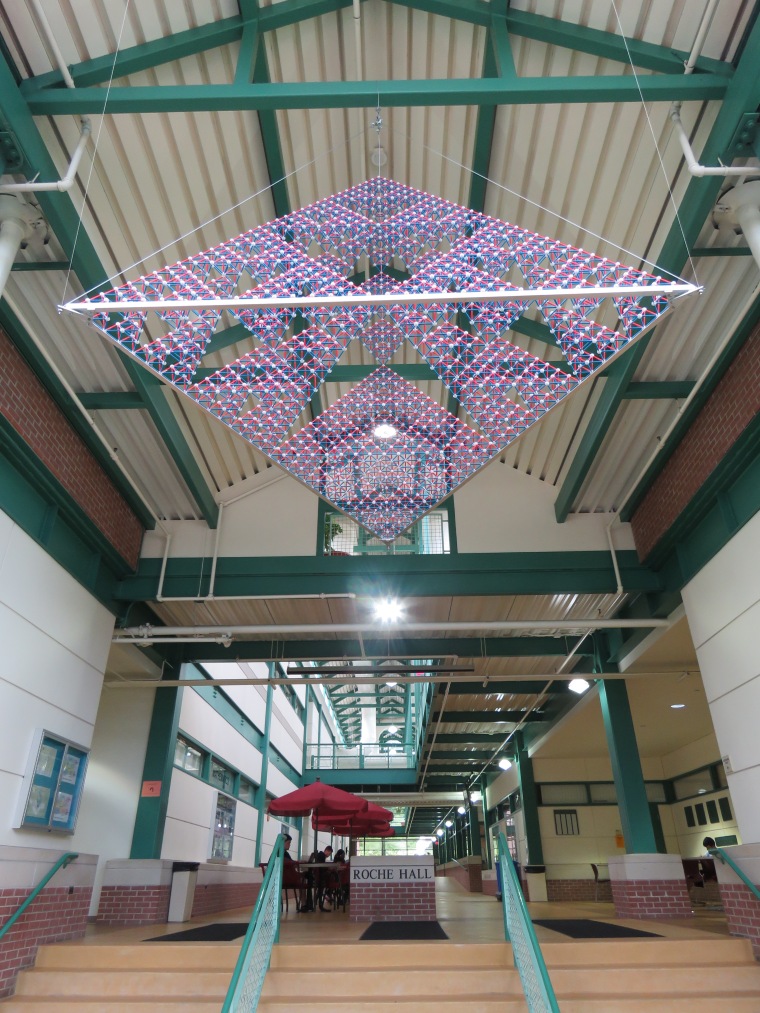
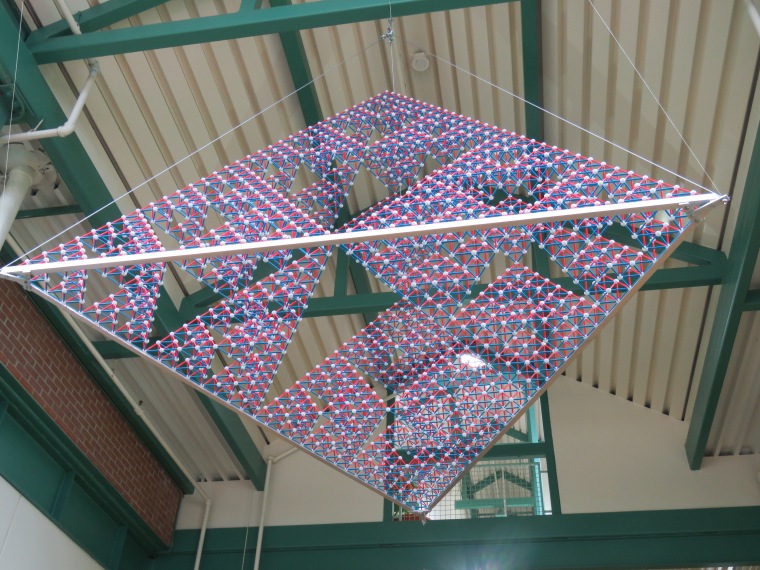
High overhead at the entrance of Roche Hall, is another work of art—a stage-5 Sierpinski tetrahedron that models a fractal with infinite triangles—created by the School of Science Math Club under the direction of club president Thomas Galvin  and Dr. Joe Previte, associate professor of mathematics.

“A fractal is a self-similar structure with recurring patterns at progressively smaller scales,” Previte said. “Fractals are useful in modeling natural structures such as plants, coastlines, or snowflakes.”

Some natural objects appear to be completely random in shape, but there is an underlying pattern that determines how these shapes are formed and what they will look like, according to Previte. Mathematics can help us to better understand the shapes of natural objects, which has applications in medicine, biology, geology, and meteorology.

Students built the fractal using Zometool construction parts. It consists of 2,050 white balls and 6,144 red and blue struts. Learn more about fractals at www.mathigon.org/world/Fractals

briefs - artwork - fractals (1)

A stage-5 Sierpinski tetrahedron created by the School of Science Math Club hangs above the entrance to Roche Hall. 

briefs - artwork - fractals (2)


Behrend Faculty Members Collaborate on Book about Technological Innovation

Heather Lum's book

Three faculty members from Penn State Behrend’s School of Humanities and Social Sciences contributed to a new book about the ways scientific research and technological innovation shape society, politics and culture.

Dr. Heather Lum, assistant professor of psychology, conceived of and was associate editor of the book, “Critical Issues Impacting Science, Technology, Society (STS), and Our Future.” She also wrote the preface, which references RFI implants, robotic exoskeletons and the 153 hours of television the average American watches every month.

“It is clear that we are fundamentally altering what is important to us as well as how we interact with each other,” Lum writes. “For centuries, face-to-face communication was the only way to interact and learn about each other and the world. But now we can talk to each other over the phone or online and gain access to any information we want.”

The book, which was published by IGI Global, assesses the impact of artificial intelligence, automated vehicles, Blockchain and wearable technology, among other topics. Dr. Ahmed Yousof, assistant teaching professor of game studies, co-wrote a chapter about digital game-based learning. Dr. Lisa Jo Elliott, assistant teaching professor of psychology, contributed a chapter about the digital divide – the disconnect between those who regularly use technology and those who do not.

To learn more about the book, visit the IGI Global website.

Secret Lives of Faculty – Elizabeth Fogle, Roller Derby athlete

There’s so much more to Penn State Behrend’s faculty and staff members than what you see on campus. In this occasional series, we take a look at some of the interesting, unconventional, and inspiring things that members of our Behrend community do in their free time.

By Heather Cass
Publications Manager, Office of Strategic Communications,  
Penn State Behrend

fogle - don't crop credit

Elizabeth Fogle, center. Photo credit: Raymond F. Durkin, http://www.DurmaxPhoto.com

PowerTower. Meanhatten. Big Red. Stitches. Miss United Skates. Lord of the Rink. Lady Liberty. Rusty Razor Blades. Jammin’ & Rammin’. Blockingjay.

Skater nicknames, which are typically creative puns that many skaters see as an opportunity to adopt an on-track persona, are only half the fun in the sport of roller derby. The names are what initially hooked Elizabeth Fogle, associate teaching professor of English, on the sport.

“I saw the movie Whip It in 2010 and became obsessed with coming up with derby names for fun,” Fogle said.

Of course, the English professor in Fogle would enjoy the wordplay, but she went all in on roller derby after learning there was a team in Erie.

“When a friend and I found out about Eerie Roller Girls, we went and observed a few practices and the rest is history,” Fogle said.

Though she had not been on roller skates since middle school, Fogle dug up some wheels, laced up and joined the team. She has been skating with the Eerie Roller Girls, part of the Women’s Flat Track Derby Association (WFTDA), for seven years now.

We caught up with Fogle to find out more about roller derby, what she loves about the sport, and the story behind her skater name.

What is roller derby?

It’s sort of a mash up of a bunch of sports—hockey, rugby, NASCAR, and demolition derby—only there are no cars, balls, or pucks and it’s all executed on roller skates. Roller derby is all about helping our jammer (usually our fastest skaters) do laps and keeping the other team’s jammer from getting through. There are three positions on the team—pivot, blocker, and jammer. You can learn more about the rules and technique behind the sport at the WFTDA’s web page.

What’s the goal? How do you win?

From the WFTDA website: “The skaters wearing a helmet cover with a star on it are the jammers. After making it through the pack of blockers once, the jammer begins scoring points for each opposing blocker she passes legally and in bounds. She can also score points on opponents who are in the penalty box and can get a fifth point if she laps the opposing jammer. Blockers are trying to stop the opposing team’s jammer while helping their own jammer get through.”

What is your position on the team?

I mostly block. I’ve been jamming a little more this season and I enjoy it, but I’m really more at home blocking and keeping everyone together. I like blocking. It’s not just about big hits, but also about empowering your teammates and communicating strategy in real time. We play defense and offense simultaneously.

What’s your nickname?

I go by “Strong Female Protagonist.” It makes people laugh because it’s both specific and generic. My teammates call me Fogle or “Tag” for short.

What do you enjoy about the sport?

I love how demanding it is. It’s also scary and I try to do something every day that scares me a little bit. I’m not an adrenaline junkie, but I really like to challenge myself, physically, mentally, and creatively. Roller derby gives me that. Also, there’s always something new to learn—footwork, strategy, etc.

What does it give you?

It gives me an outlet where I can just be a person moving through space with a goal. So often women are discouraged from contact sports or using their bodies in physical, athletic ways. Roller derby provides a safe place for women to be tough and brutal, as well as confident and unapologetic. It’s also a community. My teammates are my friends.

Is it only women?

On our team, yes. Men play roller derby, too, but it definitely attracts more female players. We have some male referees and coaches, though.

Why do you think it appeals to women?

It’s a place where things like size and age don’t matter very much. At 5 foot 3 inches and 44 years old, I can be just as effective as someone who is 6 foot tall and half my age. I just have to figure out the best way to use my particular body and skill set to achieve a goal—be that a block, a brace, a screen, or even points.

What is the roller derby season and where do you skate?

Our season runs from late spring to early fall, but we practice nine months out of the year at Presque Isle Skating and Event Center in Erie. Our home games, or bouts, are at the Bayfront Convention Center. We’re just wrapping up this year’s season, but you can like/follow Eerie Roller Girls on Facebook, Twitter, and Instagram to keep up with the team.

What do people say when you tell them this is your hobby?

The usually ask if it’s like the old roller derby that used to be on television. I clarify that we are not scripted, there are established rules, we play on a flat track (not a banked), and throwing elbows is not legal.

Do you have any other hobbies?

I lift weights and do cross-fit training, which I enjoy almost as much as roller derby. I also like to knit and read when I have the time.

What do you enjoy about teaching English at Behrend?

I love winning over science majors and teaching them how to express themselves thoughtfully and purposely. For many of them, writing is a challenge. I really enjoy demystifying it for them and empowering them to be better, more rounded scientists. I also enjoy teaching graphic novels. I love hybrid forms that engage readers in new and interesting ways. All human beings are storytellers, so I think it’s important to study the variety of ways we tell stories.

Ready for some fun? What would your roller derby name be? Try this online roller derby name generator from Buzzfeed.

This slideshow requires JavaScript.


Silver Celebrated: Professor honored for decades of work on journal Freshwater Science

By Heather Cass
Publications Manager, Office of Strategic Communications,  Penn State Behrend

Pam Silver (21) smaller

Dr. Pam Silver, interim associate dean for academic affairs and distinguished professor of biology, was in graduate school when she submitted her first paper to what was then the journal of the North American Benthological Society (now the journal Freshwater Science).

“It came back covered in red ink,” Silver said. “The founding editor of the journal, Rosemary Mackay, worked with me and taught me how to write.”

It’s a favor that Silver went on to pay forward for twenty-one years, serving in various roles at the journal, including editor-in-chief for the last thirteen years, until her retirement from the journal this spring.

“Pam worked tirelessly to improve and grow the journal while unselfishly working in the trenches with authors to improve their manuscripts,” said Jack Feminella, professor and associate dean of academic affairs at Auburn University, and Charles Hawkins, professor in the department of Watershed Sciences at Utah State University, in their nomination of Silver for the Society for Freshwater Science’s Distinguished Service Award. “Over her tenure as editor-in-chief, Pam has been a role model and mentor to many young authors and new appointees to the Editorial Board. Aside from her incredible work ethic, Pam’s ability to work effectively with all kinds of personalities is perhaps her greatest strength.”

These attributes did not go unnoticed at Penn State Behrend, where last year Silver was tapped to serve as interim associate dean for academic affairs. It was a promotion that ultimately led her to give up her work at the journal.

“My head needs to be here at Penn State Behrend,” Silver said.

Before she left the journal, however, they honored her with a Distinguished Service Award at the group’s fall conference in Detroit.

Though Silver prefers to avoid the spotlight, we did get her to sit down for a Q&A about the award, her years at the journal, and why the sleep deprivation was all worth it.

Why are scientific journals important?

It’s a way to disseminate information in a way that ensures its validity. Is the work scientifically valid? Can the findings be trusted? If it is in Freshwater Science, it’s been peer-reviewed. Now, what you can know depends on the tools and techniques that are currently available. And, so, in that way, journals can be historically valuable, too. They contain the history of how that knowledge evolved over time. It’s also a way of creating a network of people, a community, that share information. Sharing that information can inspire more curiosity, which leads to more science. It’s like scaffolding. Scientists just keep building on top of earlier work. Every paper published is resting on a pyramid of other papers.

Tell us about the journal for Freshwater Science. Who reads it? How is it distributed? Who submits articles?

It’s a professional journal for ecologists, biologists, and environmental scientists who both read it and submit to it. The Society for Freshwater Science co-publishes the journal with the University of Chicago Press quarterly. To my knowledge, it’s the only major scientific journal in the field of freshwater science that is still society-published. Most other journals have been sold to commercial publishers. There is both a print and an online version that is available to SFS’s 1,500 members.

Are all submitted papers published?

Definitely not. Articles are fully peer-reviewed. The editorial board rejects about 60 to 65 percent of submissions.

How did you get involved with the journal?

The journal was founded when I was in graduate school and I submitted a paper. The editor bled red ink all over it, but she taught me how to make it better. I actually thought, ‘I want her job.’ I applied to be a member of the editorial board (they review the science in the papers) and was accepted in 1997. In 2002, they asked me to be a co-editor. When Dave Rosenberg, the journal’s second editor-in-chief retired in 2005, they asked me to take the job.

This was in addition to your full-time job as a biology professor at Behrend?

Yes. It was like having another full-time job. I probably worked an additional forty hours a week editing articles and working with the writers.

What would people be surprised to know about editing a scientific journal?

The amount of work that it requires. Each article involved about twenty hours of time, and we published about 100 articles a year, so that’s about 2,000 hours annually. By the time an issue published, I will have read and edited every page at least four times.

Were you responsible for reviewing the science, too?

No. The editorial board did all the science. I did the wordsmithing and double-checked the science.

The people who nominated you for the award said you did that very well.

Yes, I know that the journal got a reputation as a place to teach students how to write and edit. When I announced I was retiring, I heard from dozens of contributors who said, ‘How can you retire? We need you!’ I think I was a good editor. I was honest, but made every effort to be kind and I tried hard to keep our interactions informal. The authors may not have liked all the changes I made to their paper, but they usually agreed that I made it better.

What is the most frequent problem you encountered when editing?

Organization. If a paper was hard to understand, it was usually because of paragraph, sentence, or word order and inconsistency in how the authors were referring to things.

What are three things scientists (or anyone) could do to improve their writing?

  1. Use precise and concise language.
  2. Use the active voice.
  3. Use forward moving sentences.
  4. Think of the audience. If you can’t explain it to a non-scientist, you need to work on your communication skills.

One of the things you’re credited with is diversifying the organization as well as the membership.

I made a real effort to increase international diversity and bring more women onto the editorial board. I also tried to include more young scientists. Everyone has something to bring to the table and the publication benefited from having a variety of perspectives.

Why was it important to include young scientists?

For the same reason that I love to teach first-year students. They’re young and excited and full of energy and they still want to save the world. You can help mentor them to direct that energy to things that are important.

Did you enjoy editing?

I did. The biggest benefit of editing the journal was learning about so many different and interesting things in freshwater science. In any issue, I might be editing an article about the sex life of a water bug and another about microplastics in the Chicago River and another about molecular biology. Every paper was an intellectual challenge for me, and it made all the work and sleep deprivation worth it.

What’s next for you?

Well, I have plenty of work to do as the interim associate dean for academic affairs, and I’m hoping to find time to write about my own road salt research work. I’m still teaching a little, too. I have an Urban Ecology class in the spring semester that I’m very excited about. It’s going to be a fun challenge.