‘Understaffed, underfunded, and under attack’

Alumnus, deputy director of elections in Michigan, to speak at Penn State Behrend Monday

adam fracassi speaker
Adam Fracassi-Wier, deputy director of elections for the state of Michigan.

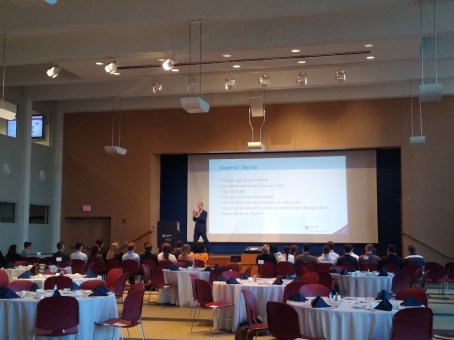
Adam Fracassi-Wier, deputy director of elections at the Michigan Bureau of Elections, will discuss the state of elections and election security when the Speaker Series returns to Penn State Behrend at 7:30 p.m. Monday, Oct. 21. His talk, “Facing the Storm: Resilience in Elections after 2020,” will be held in the Metzgar Center. The program is free and open to the public.

Fracassi-Wier graduated from Penn State Behrend in 2012 with Bachelor of Arts degrees in Political Science, International Studies, and English. He earned his law degree from Michigan State University College of Law in 2014. His career includes serving as Michigan’s assistant attorney general from 2015 to 2018, as an adjunct professor at Michigan State University College of Law, and currently as deputy director of elections at the Michigan Bureau of Elections.

Behrend Blog talked with Fracassi-Wier to learn more about what it’s like to work in elections and election law in an increasingly partisan environment.

What are your biggest challenges right now?

Election administrators across the country are understaffed, underfunded, and under attack. This is the biggest challenge. We have to manage elections and election administration in a hyper-partisan environment that fuels misinformation, all while ensuring the safety of ourselves, our staff, other election officials, and poll workers. I’ve had to add different facets to my job that I never thought I would have to add. For example, I’m no longer just an attorney – I’ve had to add communications and marketing into my daily responsibilities.

What does it feel like to oversee election integrity when so many are distrustful of our elections today?

This is a heavy burden, especially in this era where misinformation and distrust are rampant.  Being a nonpartisan civil servant who ensures elections are fair is critical, but it brings risks and requires constant communication and transparency. I take very seriously my responsibility to ensure that every eligible citizen can vote while balancing it against the necessary security checks in the system. It’s hard when something you have dedicated your life to is constantly under threat, and things that you have always done because the law requires it, now are the things making you a target.

How do you fight that disinformation and assure voters that Michigan’s elections are secure?

Transparency and communication are vital. We have had a lot of success going to folks directly with messaging. What I’ve seen in the last four years is that many people are interested in the system but don’t understand it. I have allocated and created new resources in the last several years that are focused on providing educational materials and clearly communicating what we’re doing in advance of doing it. Engaging with voters directly and providing them with accurate information is key to building trust.

I’ve also had a lot of success by coordinating with local officials (clerks, township supervisors, etc.) on the messaging. In many instances, voters will trust their local officials.

The key is just to be a constant source of truth. I’ve been able to build trust with both Democrats and Republicans, voters and elected officials, because I’m consistent in what I do, and the decisions I make are not based on politics.

You secured a $40M budget increase to improve election operations in Michigan. What were you focused on improving?

Voters in 2022 passed a constitutional amendment that dramatically changed elections in Michigan. They implemented early in-person voting, mandated that drop boxes be available in all jurisdictions, and required the state to pay for the return of all absent voter ballots. But this required significant funding for us and the local clerks. I was very fortunate to be able to obtain $40 million to fund the constitutional amendment and the subsequent legislation that passed, but it wasn’t enough to fully fund our office and the local clerks’ offices.

Michigan has more than 1,600 township, city, and county clerks who all have different election roles. We are one of, if not the, most decentralized systems in the country for running elections. More than 900 clerks’ offices are single-precinct jurisdictions that likely have only one staff member—themselves.  This is not enough to run elections. When I sought funding, I sought approximately $125 million for our office and the local clerks.  Everyone thought I was crazy for asking for that, but I had the numbers to back me up. I obtained $40 million, and we spent it almost immediately, with more than $30 million being allocated to clerks directly. With this money, we were able to fund thirty-five additional staff members at the Bureau of Elections, more than doubling our staff.

Since 2020, clerks have seen the number of ballots being returned by mail more than double. We went from approximately 25 percent voting by mail to approximately 55 percent. The funding allocation allowed us to buy new equipment for clerks to account for this increase and ease processing. This funding also allowed us to build a new pollbook to be used to better detect and prevent double voting during the early voting period, buy equipment for clerks to administer early voting, and fund poll workers for jurisdictions.

What do you wish people knew about the election and election security?

Trust your election administrators. Almost every single election administrator – regardless of party affiliation – administers the election the same. We all believe in upholding the integrity of the election while ensuring that voters can exercise their most fundamental right of casting a ballot. If you have questions about the process or want to know more, contact your election official. Start that dialogue with them in a respectful manner, and you will find that they will engage and help you to the best of their ability.

It’s also important to know that there are backups for everything.  Michigan uses paper ballots, as do many other states. Even if you don’t have a paper ballot, there are still backup records to do recounts and audits. All of these are done to verify the accuracy of the results.

After 2020, our office conducted more than 250 audits across the state. The Auditor General audited our office, and the Senate Oversight Committee, led by Republican Senator Ed McBroom, examined everything as well. The audits showed that while there are always improvements to be made, the system worked as it should. We have not seen and do not continue to see massive voter fraud like what is suggested by several candidates.

Is there a better way to handle elections in the U.S.?

Our system is very similar to systems across the world. There are positives and negatives with every system, but I think a “better” way is dependent on the eye of the beholder. What you’re seeing in several states are different methods of electing officeholders that are affecting the policies, starting with redistricting.

Several states—Michigan included—have an independent redistricting commission that draws lines in a nonpartisan manner. In Michigan, this has resulted in a more evenly split legislature. Right now, democrats control both chambers, but only by two seats in each house. If either chamber flips, it would likely only be a two-to-four seat majority for either party.  This results in less partisan bills passing in several states.

Additionally, other states have changed from a plurality-based approach to rank choice voting, where voters rank the candidates in order of preference to ensure that whoever wins obtains a majority of support rather than a plurality.  Alaska has a system where everyone runs together in the primary and the top four vote earners advance to the general election, regardless of party, to run in a rank choice election.

Blue Chair Chat Guest Offers Peek Behind the Curtain of Arena Operations

By Heather Cass, Publications Manager, Penn State Behrend

FBEventGraphic_BCChat_Letson1920x1005

Eileen Letson, vice president of finance at PPG Paints Arena in Pittsburgh, was the featured guest at the “Blue Chair Chat” discussion series presented by Penn State Behrend’s Women’s Engagement Council at McGarvey Commons on October 3.

Letson, a 1988 Behrend accounting graduate, talked about her career choice, shared her experience working for convention centers and arenas, offered plenty of sage advice, and dished on what it is like to work with some big performing artists (who shall remain nameless) with an audience of students, staff, faculty members, alumni, and community members who attended the free event.

The Blue Chair Chat series was designed by the Women’s Engagement Council to be a friendly conversation between women in a comfortable and cozy environment, so Letson was interviewed by her friend and former Behrend classmate, Barb Byers, a 1987 Communications graduate who is the director of content development for the University at Buffalo division of university advancement.

PXL_20241003_232001833

Letson talked about the financial side of arena operations, giving attendees a behind the curtain look at what happens to box office proceeds (it goes to the promoter), how the artist gets paid (that’s up to the promoter), how her office determines which events are successful (profit-and-loss statements), and the one thing arena staff hope no event promoter requests (confetti).

A few takeaways for students and recent grads from Letson’s talk:

Believe in yourself. Imposter syndrome is real, especially for young women, but trust your education. You have something to offer and important talents to bring to the table.

Pick a mentor you connect with. Find someone you admire or wish to emulate. Age, gender and position in the company doesn’t matter, choose someone you connect with that can help you grow.

Don’t be afraid to ask why. Rather than just learn a set of steps or procedures, ask questions to determine the “why” behind it. Understanding why you need to something a certain way will help you do it properly.

Join clubs and/or volunteer. Letson said one of the most important things current college students can do to gain leadership and life experience is to serve in a club or do volunteer work. “Whatever they ask you to do, do it well, and don’t complain,” she said. “It’s all a learning experience and doing the things nobody else wants to will earn you respect.”

Admit your mistakes.  If you make a mistake, own up to it, and fix it. Later, you can explore why it happened, what you learned from it, and how to prevent it from happening again.

For much more advice, insight, a few laughs, and a list of books Letson thinks you should read, watch the entire one-hour Blue Chair Chat.

Blue Chair Chat WECMembers of the Penn State Behrend Women’s Engagement Council with Eileen Letson ’88, center left, and Barb Byers ’87, center right. 

Dinner and a movie for free, every Friday

By Heather Cass, Publications Manager, Penn State Behrend

a group of people watching a lecturer present on screen

You could spend Friday night watching Netflix and binging episodes of your favorite comfort show or, you could expand your viewing horizons at Behrend’s weekly International Film Screening Series.

The series, sponsored by Behrend’s Digital Creations Club and BOLD-C (Behrend Open Lab for Digital Creations), will run on Fridays from 7 to 9 p.m. in Reed 117 through November 11.  Students, faculty, and staff can enjoy a different film every week and free pizza, too. (Student couples, take note: that’s a free date night!)

International film festivals are more than just celebrations of cinema—they are crucial spaces for artistic expression, cultural exchange, industry growth, and social advocacy. They help cultivate an appreciation for diverse forms of cinema, encouraging audiences to explore films beyond mainstream Hollywood productions.

Sean Martin, a junior Digital Media Arts and Technology major, student manager of BOLD-C, and president of the Digital Creations Club, spearheaded the effort to bring the semester-long series to Behrend. He chose the films from three different streaming services available to the Penn State community, taking care to find a wide variety.

“Students, faculty and staff should come and watch these films because they offer a completely unique and compelling look into a different culture, time, and story from an artistic perspective,” Martin said.

Screenshot 2024-10-09 at 13-47-45 Battleship Potemkin (1925)

Showing this Friday, October 11, is Battleship Potemkin, a film set “in the midst of the Russian Revolution of 1905 when the crew of the battleship Potemkin mutiny against the brutal, tyrannical regime of the vessel’s officers. The resulting street demonstration in Odessa brings on a police massacre.”

Several more films are planned this semester. Martin said that he is especially looking forward to L’Age D’or on October 25 and All About My Mother on November 1.

See the full lineup here.

Horror Story: Writing YA in a Time of Book Bans

By Heather Cass, Publications Manager, Penn State Behrend

speaking curtain fixed

Young Adult author Tiffany D. Jackson, above, visited Behrend to discuss her craft and the challenges of publishing in a tumultuous time.

In the 1970s and 80s, kids didn’t have tablets or computers, but nearly everybody had a Magic Slate, which was a cardboard drawing toy with a black waxed background, a drawing stylus, and a plastic film overlay that you lifted to “wipe” the waxed surface—the slate—clean.

It was in playing with a Magic Slate that four-year-old Tiffany D. Jackson, today a New York Times-bestselling and award-winning author of Young Adult (YA) novels, discovered the magic of writing.

“I realized that if I put letters together, I could make words, and I knew that words put together made a story,” Jackson said in a recent appearance at Penn State Behrend, where she shared her writing journey in a public presentation and in small-group sessions, including a Q&A with eighth-grade students from the City of Erie’s Eagle’s Nest Leadership Academy.

As a young black girl attending a predominately white high school in Montrose, New York, Jackson said that writing was a form of escapism for her. When she felt alone, she would dive into another world, spinning stories involving characters who looked like her, her friends, and her family.

She was fifteen when she completed her first book, written entirely in earth science class.

“I hated that class, and I spent all my time in it writing, just channeling my teenage angst into a book,” she said. “I got a ‘D’ in the class, which is something my mother enjoys telling people when she brings that handwritten book out.”

As a young reader, Jackson loved thrillers, especially horror. “I went right from R.L. Stine (author of the popular Goosebumps books for kids) to Stephen King,” she said.

As a writer, she specializes in the same genre that captivated her. Jackson’s novels–which include Monday’s Not Coming, Allegedly, Let Me Hear a Rhyme, Grown, White Smoke, Santa in the City, The Weight of Blood, and Blackout (co-author)–combine the realism of social issues with elements of thriller, horror, and supernatural genres.

She draws ideas from real-life news stories, imagining them in a different setting, with a unique cast of characters, or from a distinctive perspective. Her second book, Monday’s Not Coming, was inspired by a news story about a mother who had killed and buried her five children. Jackson found herself wondering about the best friend of the oldest child, a teen.

“What would it be like to be the best friend of a missing/murdered girl? Suddenly, your best friend is just gone,” she said.

Jackson’s latest published novel, The Weight of Blood, is a retelling of King’s Carrie set at a school’s first integrated prom. The storyline was inspired by a Georgia high school that held its first integrated prom in 2014.

Racism, inequality, and social issues figure heavily into Jackson’s novels because they figure heavily into teenagers’ lives.

“People grossly underestimate what kids can understand and handle,” she said.

Enter nervous adults who feel the need to shelter them.

“Almost my entire catalog is banned in some states,” Jackson said. “It hurts me to think that my words are so heinous that they’d want to hide them from young people who need them most. In most cases, the book banners are literally opposing facts.”

What book banners describe as “protecting kids,” Jackson asserts, is setting kids up to fail.

“Reading stories, putting yourself in another person’s mind and world, creates empathy. Empathy leads to compassion, which leads to action, which leads to change,” she said. “Don’t we want our kids to know and do better?”

Jackson encourages teens to challenge book ban efforts.

“I tell kids to make adults sweat,” she said. “Go to school board meetings, go to library council meetings, and speak up. Hold adults accountable for the decisions they are making that are detrimental to your future.”

In Brief

Education: A bachelor’s degree in film and television from Howard University and a master’s degree in media studies from The New School.

Career: Jackson worked for a decade in the television industry for National Geographic, BET, and BBC America before becoming a full-time writer seven years ago.

First book: Allegedly, which Jackson wrote when she was 30. HarperCollins published it five years later.

Challenges, big and small: Jackson said she faced scrutiny as a black woman writing horror, and the “soft” racism of publishers who told her, “Black kids don’t read.” Of those experiences, she said, “I had to do a lot of proving people wrong. Fortunately, that is one of my favorite activities.”

What you’d be surprised to know about her: To this day, Jackson has taken only one creative writing course. She learned to write by reading. “Writers are readers,” she said.

Not just for teens: Jackson’s books have a huge adult following. “I think sometimes that my books answer questions they had when they were young,” she said. “They can finally get some answers for their inner child.”

She’s a plotter: Jackson plans her book plots in advance and has an outline.

But she doesn’t always start at the beginning: “I usually start with whatever scene pops into my head,” she said. “Then the novel blooms out from that scene.”

She’s not messing around on her smartphone: Jackson does a lot of writing on her phone. “My notes app is crazy,” she said. “People will see me engrossed in my phone and think I’m looking at social media, but I’m writing scenes, chapters, dialogue. When I was working in television, I would write on sets, in between meetings, whenever I had a few minutes.”

Her cure for writer’s block: “Put yourself in your character’s shoes,” she said. “Watch something they would watch or listen to music they would like or go do something they would do.”

Advice for young writers: “Start now. Write now. Tell your stories and publish them on Wattpad or any other self-publishing format,” she said.

Advice for writers who feel invisible: “Write a book so good that they can’t ignore you,” Jackson said.

Website: writeinbk.com

This slideshow requires JavaScript.

While at Penn State Behrend, author Tiffany D. Jackson, far left, met with several groups, including holding a Question-and-Answer session with eighth-grade students from the City of Erie’s Eagle’s Nest Leadership Academy. The students all went home with some of Jackson’s books, courtesy of Books for Kids and Behrend’s Women’s Engagement Council.

Business Etiquette Still Matters in 2023

fork be with you1

By Hope Robbins

Contributing Writer

If you want to stand out in the corporate world, brush up on your business etiquette.

“It will be the skill that sets people apart in the professional world,” said Eric Robbins, associate teaching professor of finance and associate director of corporate outreach and research for Penn State Behrend’s Black School of Business. “The people who will rise to the surface are those with good soft skills for virtual meetings, email communications, and in-person interactions.”

That’s why, Robbins, with help from Phil Stuczynski, assistant teaching professor of finance, and Carol Peterson, co-curricular programs coordinator, put together “Make the Fork Be With You,” a business etiquette dinner that included a presentation on the importance of professional etiquette and communication.

Speakers at the event were George Emanuele, senior director of Global Investments for BNY Mellon, and Ann Scott, community outreach manager for Erie Insurance. Thirty Behrend students attended as well as sixteen alumni who were invited to network with the students.

According to Emanuele, it isn’t a question of whether or not you need business etiquette; it’s something that should innately encompass 100 percent of your job. He stressed the importance of many daily factors in business etiquette, such as the “sundown rule,” (that is, responding to emails within 24 hours).

Scott also talked about the maintenance of etiquette and how unprincipled table manners can distract from the subject of a company dinner. Everything that you do (for example, writing emails, wearing professional attire, and behaving appropriately at networking events and business lunches) is a representation of your employer.

If you don’t raise yourself to meet that professional bar, metaphorically speaking, Emanuele stated, “You’ll be stuck in a back-office position, and you will never see a front-end client.” For anyone seeking to rise in the ranks of the company they are a part of, this poses a professional risk and should be a call to action.

fork be with you 3

Why is the concept of behaving respectfully and engagingly in a professional environment becoming harder for the younger generation to understand? Scott said she thinks it is a byproduct of emerging from COVID-19.

“A lot of people haven’t been able to utilize their interpersonal skills in person,” Scott said, which inspires “a lack of confidence among the younger generation.” Making a phone call, for example, may seem more intimidating than sending an email or communicating online.

One of Scott’s pet peeves is seeing people at networking events gathered in groups with others they already know rather than fulfilling the purpose of being there: networking, or as she calls it, “making new friends!”

Emanuele and Robbins both say that business etiquette is becoming a lost art and there is a contentious device (literally) behind the decline in professionalism: cell phones. According to Robbins, a new generation of employees has become accustomed to “short bursts of unprofessional communication that are typed rather than spoken” via texting and online posting. This has led to a decline in professional phrasing, creating a causal conversation style that is less than business appropriate.

Another reason business etiquette skills may be less common today? Scott said it might be a lack of practice with in-person communication, a byproduct of COVID. And along with becoming accustomed to more casual conversation, our sense of personal presentation has adjusted into a more comfortable routine.

fork be with you2

While there are many nuances to business etiquette, Scott summed it up with a single rule to thumb: “The basics of etiquette is to make other people feel comfortable and confident.” The only way to succeed in this is to make yourself comfortable and confident in any professional situation.

Hope Robbins is a junior majoring in Digital Multimedia Design at Penn State World Campus.

10 takeaways from “Make the Fork Be With You”

  • Do not overshare or make the conversation all about you.
    • Find common ground when networking – vacations, hobbies, etc. Have a list of conversation starters.
  • Introduce and include others in conversation.
  • Stay positive – Do not complain or talk about co-workers.
  • Follow the lead of your host (in choosing your meal based on price, whether or not to order an alcoholic drink, and where you’re seated).
  • If seated, introduce yourself to everyone at the table.
  • Look for ways to give, help, share in a conversation.
  • Demonstrate good table manners – Avoid ordering “messy” foods, eating too quickly, and putting your napkin on your chair if you leave it.
  • Respect everyone, including the staff serving you.
  • Follow up after the event, reference something specific from your conversation.

Parlez-vous Français?

 By Heather Cass, Publications Manger at Penn State Behrend

foreign language1

Do you speak French? You could learn how at Penn State Behrend, where you’ll find courses in French, German, and Spanish, as well as a class on Italian culture. Behrend’s academic offerings in global languages include a minor in Spanish and a German Studies certificate.

You can learn much more about Behrend’s language offerings during the college’s celebration of National Foreign Language Week, Monday, February 28, to Thursday, March 3.

The week’s events will include a variety of Zoom presentations on language and culture topics, making it easy to pop in from wherever you are on or off campus. See the complete schedule and get Zoom links here.

The line-up will even feature in-person events that involve food. Yum!

  • Monday, February 28, from noon to 1:00 p.m., you can sample food from different countries at World Catering Day in McGarvey Commons.
  • Wednesday, March 2, from 11:00 a.m. to noon, you can Join the Global Ambassadors in Bruno’s Café for a free taste of French cuisine and a chance to win delicious macarons.

The Behrend Blog chatted with Dr. Laurie Urraro, assistant teaching professor of Spanish, to learn more about the event and why everyone should consider learning a foreign language.

How many languages do you speak?

I am a native English speaker who is also fluent in Spanish. I speak some Portuguese and can read some French. I also understand a little Italian.

What language should students learn?

It depends on the field one enters, of course, but any foreign language is useful and will help you stand out in a job interview!

We know that it’s easiest to learn a second language as a child, but how about as a college student? College students’ minds are still developing, too, so it is not too late to learn! In fact, I would encourage anyone at any age to try to pick up another language. Just because it’s “easier” at a young age doesn’t mean it’s impossible at an older age.

Why should a student learn another language?

Here are just a few great reasons:

  • It will boost your resume. No matter what field you go into, learning a foreign language will be an “added bonus” that makes you a more attractive employee.
  • In an increasingly global world, being bilingual makes you more versatile. It also makes you more mobile as it’s easier for you to travel and explore new places.
  • It helps your English. Many languages are derived from Latin (French, Spanish, Italian), including many words in English. English is a Germanic tongue. Learning a foreign language will boost your vocabulary by familiarizing you with words that have common equivalents in other languages.
  • It makes you smarter. Research has shown that being bilingual improves cognitive skills unrelated to language.
  • It increases your cultural IQ. Studying a foreign language exposes the learner to diverse customs, ideas, and perspectives. Of course, you can still learn about other cultures without speaking the native tongue, but language learning allows for a more immersive experience.
  • It can increase your brain power: Learning a foreign language can improve your multitasking, attention, and problem-solving skills. It can also help improve your memory, which comes in handy when trying to remember the names of new contacts or clients.

Learn more about Foreign Languages Week at Behrend here.

Harambee Dinner Brings Campus Community Together

By Heather Cass
Publications Manager, Office of Strategic Communications,  Penn State Behrend

dinner2

Flavors, customs, and tastes may differ from country to country, but food is a universal language of human beings. Sharing a meal, whether an elaborate holiday feast or a simple dinner, can unite and create community among people.

For thirty-two years, Penn State Behrend’s Multi-Cultural Council, a student club comprising of cultural student organizations, sets the table for connection among the campus community at the club’s annual Harambee dinner.

This year’s dinner is scheduled for October 4 from 5:30 to 7:30 p.m. in McGarvey Commons.

“Harambee is a word in Swahili that means ‘Let’s pull together’ and originated in the country of Kenya as a slogan for national unity,” said Andy Herrera, Director of Educational Equity and Diversity Programs and adviser for MCC. “We use this event as a way of uniting our campus community and celebrating the diversity of cultures here at Behrend.”

The annual event offers students, faculty and staff members a chance to get to know one another while enjoying an international buffet dinner and an evening of entertainment. This year’s guest speaker is Shinjini Das, a young entrepreneur, industrial engineer, global millennial influencer, and media personality. She is the founder and CEO of The Das Media Group, a boutique digital strategy consulting firm, and has been recognized for her global efforts to empower women.

The event will also feature a cultural performance with a professional touring group performing Afro-Brazilian music and the Brazilian dance art of capoeira.

“It’s really nice to see the diversity of students and community members who attend the event every year,” Herrera said. “Some students from MCC wear traditional dress from their various cultures, and group members emcee the event and speak about the importance and meaning of Harambee.”

The timing of the event is deliberate, Herrera said.

“Harambee is held in early fall every year to set a tone of cultural awareness and appreciation for the year. Like the name of the dinner suggests, it’s meant to pull us all together.”

This slideshow requires JavaScript.

If you wish to attend Harmabee, RSVP at the Multi-Cultural Council’s Behrendsync page. (NOTE: If link is not live, it will be soon!)


Students Save a Seat for Women in History

Lilley Library art exhibit invites remarkable women to the table

By Heather Cass
Publications Manager, Office of Strategic Communications,  Penn State Behrend

IMG_1464

“For most of history, Anonymous was a woman.”

This quote by author Virginia Woolf sums up the invisibility of women in the collective history of the world. Overshadowed by the accomplishments of men, few females have made it into the history books. And, yet, women have made their presence known in every aspect of human existence from art to banking to the military to the board room and beyond.

In 1979, feminist artist Judy Chicago gave thirty-nine women a seat at the table in her masterwork “The Dinner Party,” a giant sculpture that imagines famous women from myth and history engaged in conversation.

The installation art, which took more than five years to produce, is composed of thirty-nine ornate place settings on a triangular table with thirteen plates on each side. An additional 999 women’s names are written in gold on the floor. The piece toured the world, gaining an audience of millions; it is now on permanent display at the Brooklyn Museum.

Closer to home, you’ll find another dinner party happening in the John M. Lilley Library.

Students in last spring’s WMNST 106 Representations of Women in Literature, Art, and Culture taught by Dr. Sarah Whitney, assistant teaching professor of English and women’s studies, painted plates to honor a women from a wide variety of backgrounds. The students’ work is on display in the gallery space near the entrance to the library.

“For this project, students researched a woman of their choice who made significant contributions,” Whitney said. “They designed and painted on china as Judy Chicago did, using color and shape creatively to demonstrate the chosen figure’s importance. Students also wrote a reflection paper exploring their figure’s historical, and personal, impact on the artist.”

Some of the plates honor women you might expect, such as Supreme Court Justice Ruth Bader Ginsburg, author Maya Angelou, and women’s rights activist Susan B. Anthony.

Others are more surprising.

Molly Boniger, a junior English major, chose to honor Soviet sniper Lyudmila Pavlichenko.

“The purpose of ‘The Dinner Party’ was to recognize women who history had forgotten and I wanted someone who was unconventional, even by today’s standards,” Boniger said. “Pavlichenko has an incredible story. She is a young woman from a Ukrainian village who became the Soviet Union’s greatest sniper during World War II. She showed that woman can be hard and strong, and they don’t have to be the delicate, soft things that society would prefer we be.”

Boniger is an aspiring screenwriter who took WMNST 106 to learn what she suspected she was missing.

“The class was amazing,” Boniger said. “I could not believe the amount of exposure I received and just how much women’s contributions to art and culture have been excluded from the narrative we’ve all been taught.”

Whitney was pleased with the range of women and topics that students picked.

“The plates reflect a diversity of choices, which is wonderful,” Whitney said. “I especially enjoyed learning about new women from our international students whose choices spanned the globe. Furthermore, some students chose mythical or fictional figures, such as Shakti, which were also quite enlightening.”

Among the women represented are: Coco Chanel, Cleopatra, Julie Andrews, Lynsey Addario, Ellen DeGeneres, Chihiro Ogino, Miley Cyrus, Emma Watson, Pasang Lhamu, Athena, Amy Winehouse, Billie Jean King, Marilyn Monroe, Amelia Earhart, Helen Keller, and Janis Joplin.

Not all of the plates honor people.

Junior biology major Caitlin Kent, chose to celebrate the essence of womanhood and give a nod to her future career as an obstetrician/gynecologist.

“I painted a uterus as the center of the universe to represent a feminine divine force or a female creator,” Kent said. “All life stems from women. On my plate, one ovary is painted as the sun and one as the Earth to center the uterus as the birthplace of the universe.”

The plates are simple porcelain and students used a china paint, just like Judy Chicago, to adorn them.

“Using hands-on materials to make historical events come alive is a key part of my teaching practice in general,” Whitney said. “I think using manipulatives is particularly important in studying ‘Dinner Party’ both because it is a visceral, intense piece, and because Chicago was intentional about using traditional women’s art practices, like china painting and embroidery, to honor forgotten female artists. By doing it, you sort of experience Chicago’s process.”

Kent and Boniger gave the project, and the entire course, high marks.

“I think WMNST 106 is a class that all people can benefit from,” Boniger said. “These women’s histories are all of our histories. The class covers such a range of subjects, I can guarantee that any student taking it will learn something new, and enjoy doing so. It’s about time we start bringing women into the conversation and including them in the history they have helped create.”

“My Dinner Party” will be on exhibit in the Lilley Library until October 26. Whitney would like to acknowledge the help of the Lilley librarians, and Scott Rispin, assistant teaching professor of art, who helped to assemble the display.

This slideshow requires JavaScript.


Inflatable obstacle race coming to Junker pool

By Heather Cass
Publications Manager, Penn State Behrend

SwimJitsuIsComingErie (002)

Obstacle races are all the rage lately, including inflatable obstacle races, but Penn State Behrend Athletics is taking it one step further and hosting an inflatable obstacle course race in the pool!

The event—called SwimJitsu—is open to swimmers of any age, including adults. The $20 advance registration price gets you two-hours of swimming/sliding/jumping fun.

From the race organizer:

SwimJitsu participants, also known as ‘swimjas,’ aim to complete entertaining obstacles such as balancing across beams, swimming through trenches, and cannonballing off the top of Mt. Swimja. Once participants conquer the course and the three sacred traits of speed, agility, and wisdom, they can claim the title of Grand Master Swimja.”

Penn State Behrend’s event will be held on Sunday, October 8. Participants can register for one of three two-hour sessions: 9:00-11:00 a.m.; 11:30-1:30 p.m.; or 2:30-4:30 p.m.

Swimjas are separated into age groups and they get two hours to attempt unlimited runs on the course. Awards will be given at the end of each session for the best times per age group. There will also be four ninja-themed swimming games for competitors to practice their newfound abilities.

Penn State Behrend Athletics and Behrend Swimming and Diving are hosting the event, which has never been presented in the Erie area before.

“We’re excited to bring SwimJitsu to our facility as a fun activity for the Erie community to enjoy,” said Jen Wallace, head swimming and diving coach.

Visit SwimJitsu.com to register or to learn more about the event!


Athletics to host cool 5K fun run (ice cream is involved!)

Ice Cream Run TV

By Heather Cass

Publications & Design Coordinator, Penn State Behrend

Some people run for fun. Some people run for fitness. Some people run to spend time with friends.

What would you run for?

How about free Berkey Creamery ice cream (and a cool T-shirt, too)?

Ah…now there’s a tempting reason and sweet reward for running (or walking) the Penn State Behrend Athletics first Ice Cream Run on Friday, August 28 at 6:30 p.m.

Not up for 3.1 miles? There’s also a Family Fun 1-Mile Walk.

The races start and finish in the Junker Center parking lot, near the new soccer complex. The course is on all paved paths through campus and Coach Greg Cooper (cross-country and track) was merciful when he designed the course as it goes up first, then is mostly flat or downhill. Course map here (also posted below).

Race registration is $25 and includes a long-sleeve shirt and free Berkey’s Creamery ice cream when you finish the race. Register here (online registration only). By the way, this is a family-friendly event – there’s a $5 discount for every additional family member you register.

Four legged friends are even welcome to run with you, too, but they must be leashed and under control at all times.

This is a fun run, so there will not be a timer or awards.

All proceeds benefit Behrend Athletics! For more information call 814-898-6240.

5k Course1