What if your classroom wasn’t just a classroom, but a creative agency with real clients, real deadlines, and real impact?
That’s the idea behind COMM 481: Advanced Multimedia Production, a new course taught by Tom Deau, lecturer in media and communication. Students in the course don’t just learn production skills — they use those skills to help community partners.
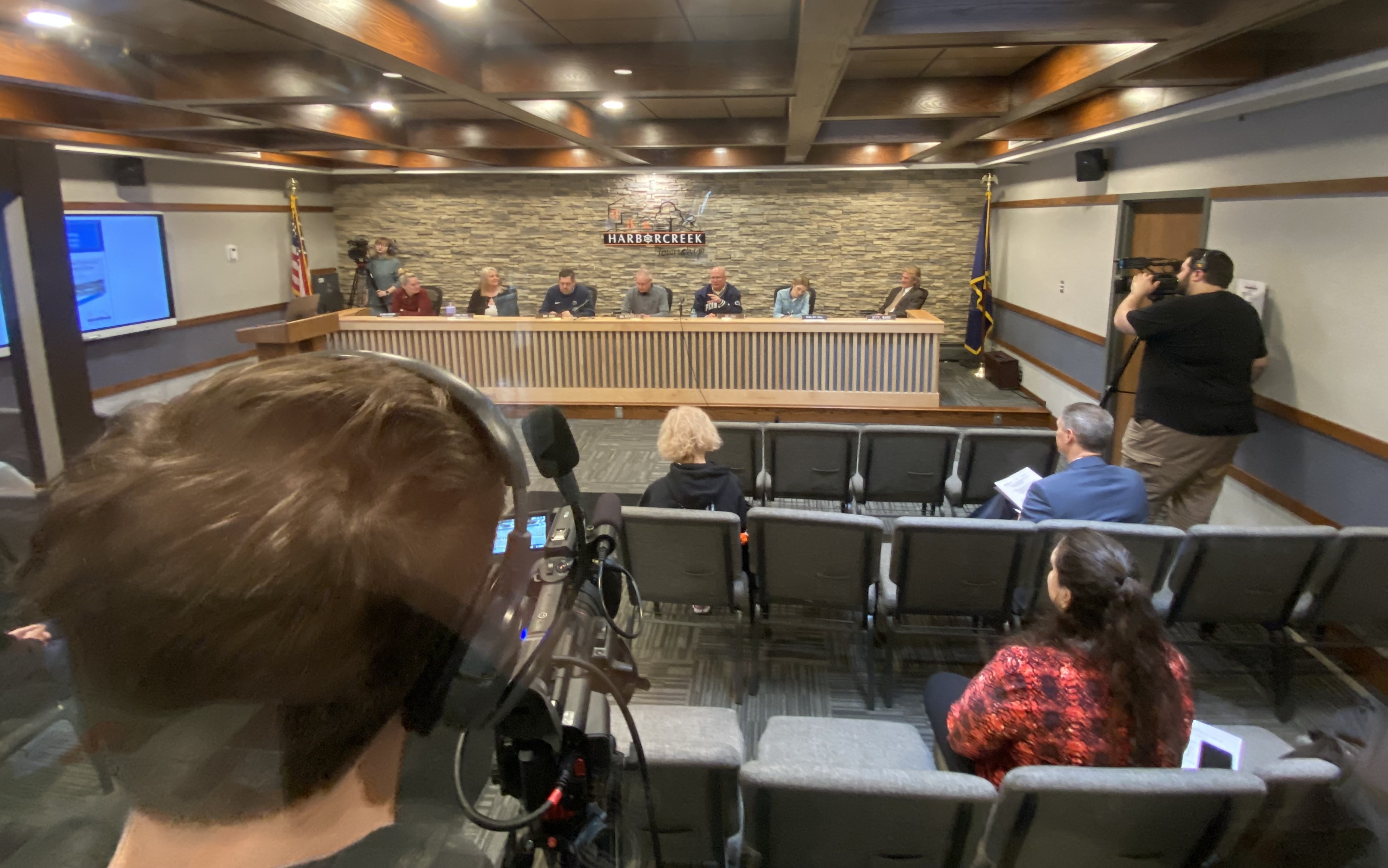
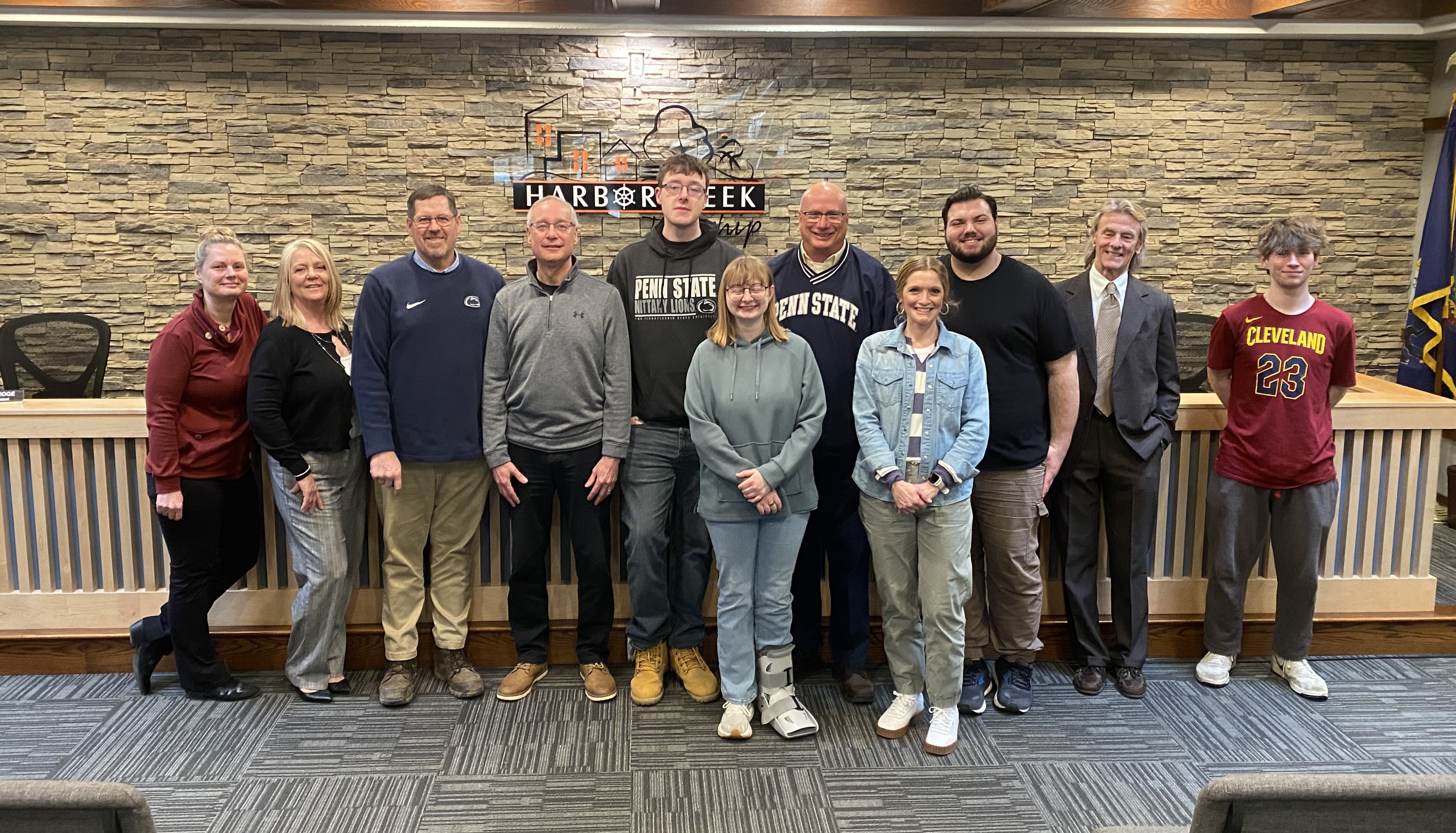
After connecting with Harborcreek Township Supervisor Dean Pepicello, students recently launched a live-streaming initiative for the township’s bi-monthly public meetings, giving community members easier access to local government. The first stream went live on March 4. The next is scheduled for March 18, at 5 p.m. The live streams can be viewed on the Wintergreen Media YouTube channel.
The township streaming project is just one of several new initiatives this semester. Deau’s students also are producing a promotional video for HARVEST 912, a nonprofit that supports individuals who are experiencing homelessness. Other projects include employee profile videos for the School of Humanities and Social Sciences, “Day in the Life” features for social media, and a promotional video for the “Empower Her Summit,” a Junior Achievement of Western PA event that will be held on campus later this month.
These experiences embody the college’s Open Lab model of learning, in which students and faculty members partner with business, industry, and community organizations to design new products, develop new services, or solve specific business challenges. The projects benefit the community, but they help students, too: By applying the fundamentals they learn in class, students gain résumé-building, real-world experience.
By Heather Cass, Publications Manager, Penn State Behrend
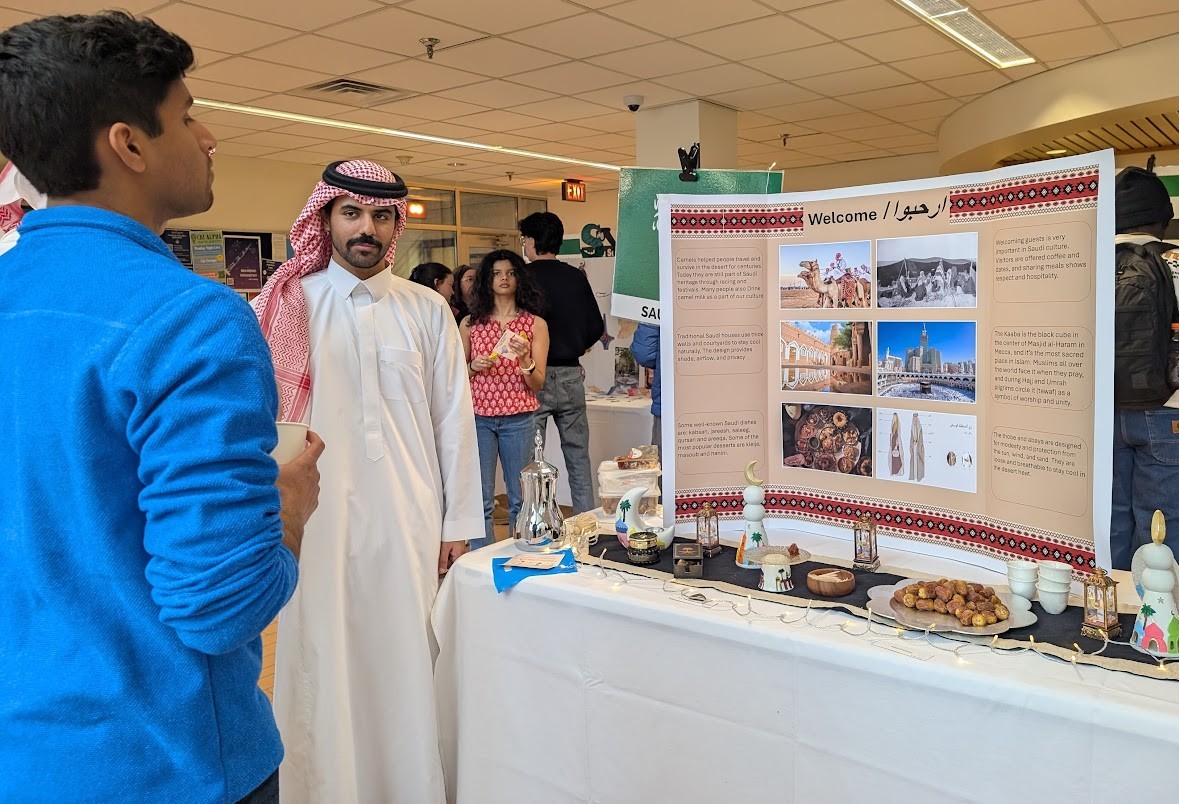
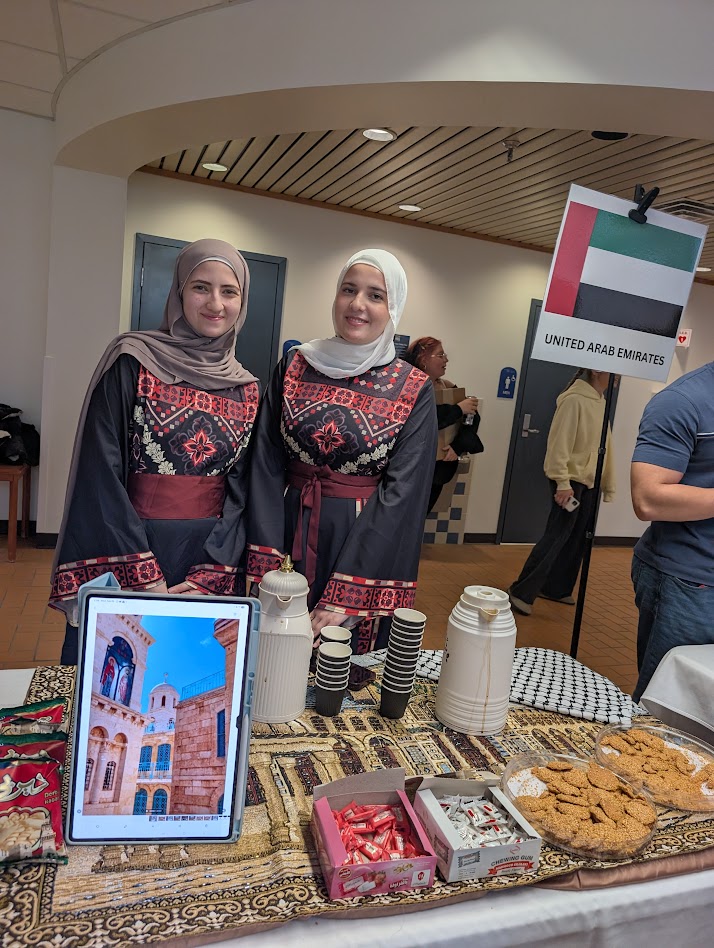
One of the first things I learned at the Penn State Behrend Culture Fair is that hospitality is serious business in Saudi Arabia — and I experienced it almost immediately. In Saudi culture, welcoming guests isn’t just a polite gesture; it’s a point of pride, often described as part of the very “DNA” of the country. Visitors are traditionally greeted with Arabic coffee and dates, a pairing that symbolizes warmth, generosity, and respect.
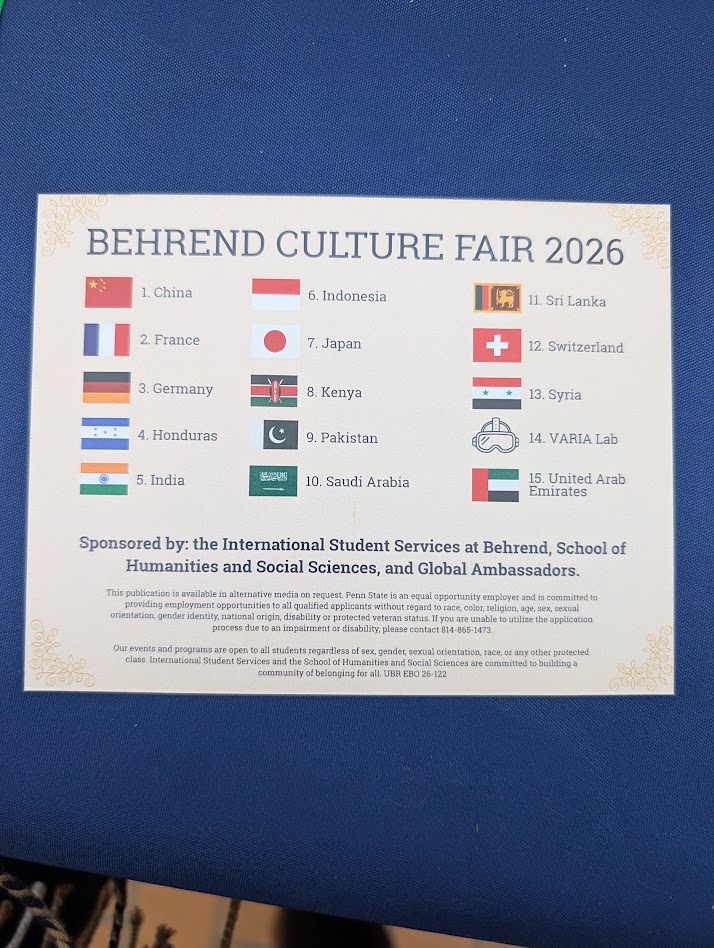
So, when I approached the Saudi Arabia table, one of fourteen, at yesterday’s Culture Fair, I barely had time to take in the display before students dressed in traditional white thobes and red‑and‑white head coverings welcomed me with that same spirit of hospitality. They offered Gahwa, a spiced Arabic coffee infused with cardamom, cloves, and saffron, along with soft, caramel‑like Medjool and Khalas dates, a staple of Gulf welcome traditions. It was a delicious introduction to the afternoon and a perfect reminder of how meaningful cultural traditions can feel when shared person to person.
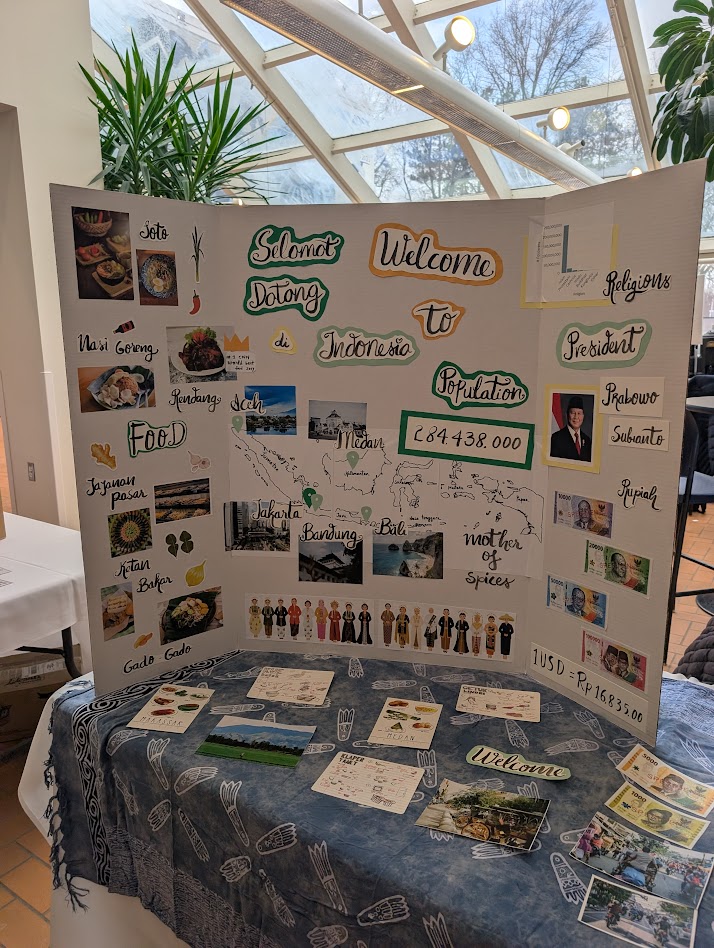
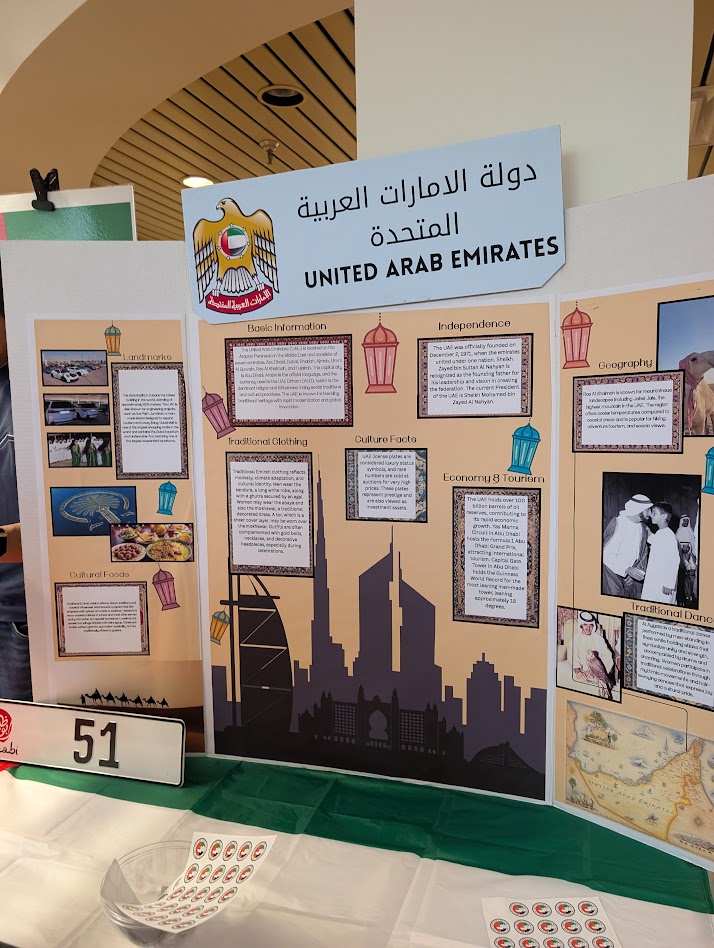
Here are five more interesting things I learned while I “took a trip around the world” in McGarvey Commons — happily gathering international snacks and fascinating facts along the way:
Sri Lanka: Tea isn’t just a drink; it’s an identity. Sri Lankans take it seriously. It’s the country’s top export, and Lipton Tea traces its roots back there.
Mecca: The Kaaba — the black cube at the center of Masjid al‑Haram — is the most sacred site in Islam, and Muslims around the world face it during prayer.
Germany:Neuschwanstein Castle, tucked into the Bavarian Alps, inspired Disney’s Sleeping Beauty Castle. King Ludwig II really earned that “Fairy‑tale King” nickname.
Indonesia: This stunningly beautiful country is called the “Mother of Spices,” thanks to volcanic soil that produces nutmeg, cloves, pepper, and more.
These were just a few of the stories and facts our students, faculty, and staff shared — each one a reminder of how much of the world is already right here with us on campus.
Events like the Culture Fair show that learning doesn’t only happen in classrooms. It happens in conversations, in shared traditions, in the foods we taste, and in the stories we exchange. Behrend is fortunate to be a campus where so many cultures meet, teach, and celebrate together.
I left McGarvey Commons with a full stomach, a handful of new rabbit holes to dive into on Google, and the distinct feeling that I’d only scratched the surface. That’s kind of the point — and exactly why events like this matter.
The School of Engineering’s annual Fasenmeyer Design Conference is a big day for senior engineering student, the culmination of a two-semester capstone project. Faculty, industry sponsors, family, and friends fill the presentation rooms. Students wear suits and aim to impress.
So, when one team’s project literally fell apart outside the classroom minutes before their presentation, you can imagine the panic it induced. The project, months of work, lay in pieces.
Then Chris and Andy Bartlett arrived.
With tools in hand, Penn State Behrend’s resident machinists and problem-solvers dropped to their knees beside the students.
“It was like a NASCAR pit crew in the hallway,” Chris recalls with a laugh.
They got it working. The students presented. The project succeeded.
It’s exactly the kind of moment Chris and Andy relish and show up for—even when they don’t have to.
“They don’t have to come in over the weekends to machine parts for the Society of Automotive Engineers (SAE) club’s competition car the week before our competition,” said Hunter Kamensky, a senior Mechanical Engineering Technology major and a member of the club’s executive board. “They didn’t have to become Environmental Health and Safety coordinators of the SAE/Robotics Lab to ensure our safety, and they didn’t have to come to the SAE club’s car-testing day at Lake Erie Speedway to show their support, but they did. They care about students.”
Chris has been at Behrend for five years; Andy, his uncle, for three. Combined, they bring sixty years of tool-and-die industry experience to the School of Engineering.
They also bring a willingness to show up, say yes, and help students turn drawings into reality.
We sat down with Chris and Andy to talk about their work, why manufacturing matters, and what they hope students learn from them.
For someone unfamiliar with machining, how would you describe what you do here day-to-day?
Chris: We make things the engineering students and faculty design.
Andy: We try to help them succeed by giving them the best approaches and let them know when something is not feasible. 3D printing is cool, but it’s fictitious. You can design and build parts with a 3D printer that won’t hold up in the real world.
What kinds of projects do you most often help with? Do any stand out as especially challenging?
Chris: We help with research projects, molds for the Plastics Engineering Technology program, welding, fabrication, capstone projects, and student clubs. We’re big supporters of the clubs because students learn a lot tinkering and working on side projects.
Andy: One of the most challenging projects we work on every year is the Cast in Steel capstone project, where students design and build functional replicas of traditionally forged items using modern steel casting. It’s reverse engineering. You basically have to work backward to create the piece. It’s technical, hands-on, and really fun.
When a student brings you a design that isn’t quite manufacturable, how do you handle it?
Chris: We can usually tell just by looking at plans what will work and what won’t. We mark it up, make suggestions, and show them the empirical data on what they are trying to do and why they need to revise.
Andy: Students do challenge us sometimes. We allow them to think it through or even try it, unless it’s going to be catastrophic. Failure teaches more than success.
The difference for us, having worked years in industry, is that we know manufacturing is inherently challenging. But in the shop, where they’re making a profit, everything has to be perfect. Failure is not something they embrace. The education environment is quite the opposite—we let them think through a bad idea. Then they really understand it.
What do engineering students learn in the shop that they can’t learn in a classroom?
Andy: In manufacturing, you learn that there are things that can be perfect in theory but impractical in real life. Tolerancing is a concept that clicks in the machine shop. The weight of materials and size of parts matter. Plastic is light, steel is very heavy. The physical reality matters.
Chris: Before they get to the machine shop, they’re working on fundamentals and hypotheticals. It’s all theoretical in the classroom, but when they see it, they really get it.
Andy: We have a dozen MET students, mostly seniors, who work with us on a weekly basis now. We wish we could get them in the shop in their first year. It would aid everything they’re learning in the classroom.
Can you share a memorable moment working with students?
Chris: That hallway moment with the senior design team—the NASCAR pit crew moment—that’s one.
Andy: Attending the SAE vehicle club’s training sessions at Lake Erie Speedway. We were testing on the track, doing modifications right there. We try to teach students to stay calm, even when things fall apart—because they will. You can’t be in a panic and do good engineering work.
How does your industry experience influence how you teach and support students?
Andy: At 22, young people tend to think they know everything, but I tell them when they get their first job, try to find a guy who is 50 or 55 and learn as much as you can from him. Those guys have real-world experience. You can learn a lot from them.
We also tell them to work on their interpersonal and teamwork skills, and we just try to instill the reality that manufacturing is hard work, and they will have mundane days. That’s just life.
Chris: We also encourage internships. That real-world experience is invaluable. They’re getting an excellent education at Penn State Behrend, but that physical contact with manufacturing matters.
Safety regulations limit the students’ access to the shop. How have you tried to help maintain hands-on opportunities?
Andy: We started to think about ways that we could legally allow students to work in the shop and have been making some headway. There’s a danger factor. We have limitations we have to work with. There’s a lot of training involved.
We’re very involved in America’s Cutting Edge (ACE), which offers hands-on CNC training at Behrend for students over sixteen. It’s ideal for those who are interested in exploring engineering, manufacturing, or hands-on technical careers.
Chris: ACE gave us the ability to get mechanical engineers on the floor for a forty-hour boot camp. They construct an air engine. In total, we’ve had about sixty students take part in the boot camps.
Andy: We also offer support for the METAL program—a four-day hands-on training experience in casting and forging. The goal of these programs is to get young people involved in manufacturing. The next round of skilled manufacturing workers are being developed here.
There are camps scheduled for spring break and right after the semester ends, in May.
What’s the most rewarding part of your job?
Chris: Working with students. Teaching them what I love to do.
Andy: I love it when a student has that lightbulb moment. When they think…“Now that thing I learned in class a year ago makes sense.”
We also love that Behrend emphasizes hands-on experiences. We hear back from friends in the field that Behrend students stand out on the manufacturing floors. One told us: “If I go into a shop and I see a student or young employee who is really sharp, I ask where they go to school—it’s almost always Behrend.”
What do you hope students carry with them from their time working with you?
Andy: We talk about life a lot. We tell them: The most stressful jobs make the most money. What is your life worth to you? How important is that money? Consider if you want to walk that walk.
Chris: We want them to understand that this is real. This is how things are made. This is how you solve problems. And we want them to know they can do it.
Andy: Manufacturing is such a noble thing. Man is meant to make things.
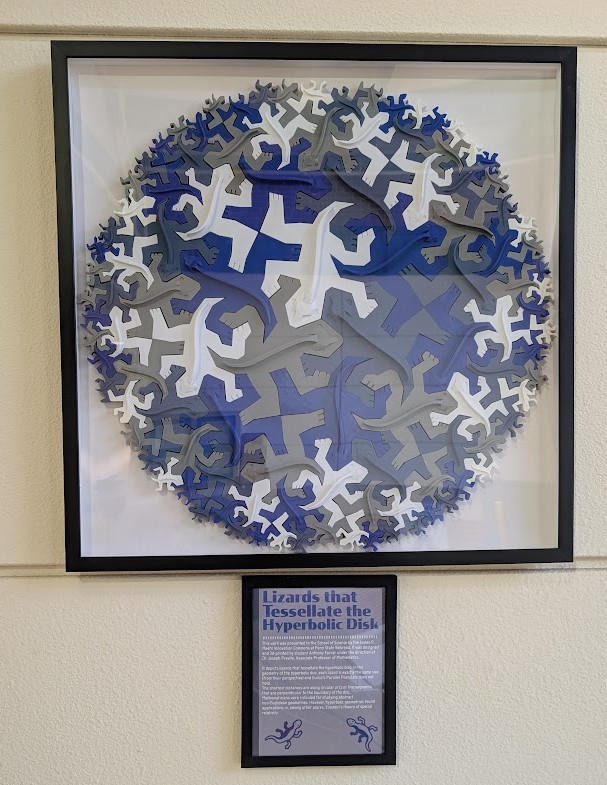
Math isn’t always numbers on a chalkboard. Sometimes it’s a work of art—a swirl of repeating lizards, 3-D printed in Penn State blue and white, then installed in a building where math, art, and science intersect. The lizards blend together in a hypnotic pattern, each appearing to shrink as it spirals toward infinity.
The piece, Lizards thatTessellate the Hyperbolic Disk, was imagined by Dr. Joseph Previte, professor of mathematics, who wanted to capture the beauty of mathematics in a form anyone could see.
He took the design to the James R. Meehl Innovation Commons, the college’s open ideation lab, where engineering students Anthony Farrar and Quinlan Barnes transformed Previte’s concept into reality with 3-D-printed tiles and a sharp eye for symmetry.
The result is art born from math—or perhaps math revealed as art.
Dutch artist M.C. Escher showed the world that geometry could be beautiful with his mesmerizing tessellations and optical illusions, where patterns unfolded in ways both precise and poetic.
“For centuries, mathematicians questioned the value of studying this type of geometry, dismissed it as impractical and useless, with no relation to reality,” Previte said. “But it later proved essential to modern science, including helping Einstein describe how time and space work in his theory of relativity.”
While some mathematicians ridiculed the study of abstract math, others reveled in it. English mathematician G.H. Hardy argued that mathematics was a pure art form, divorced from practicality—something he took great pride in. Hardy’s theories later laid the groundwork for encryption, proving that beauty and utility often travel together.
That same tension—between abstraction and application, imagination and reality—now hangs on the wall at Behrend.
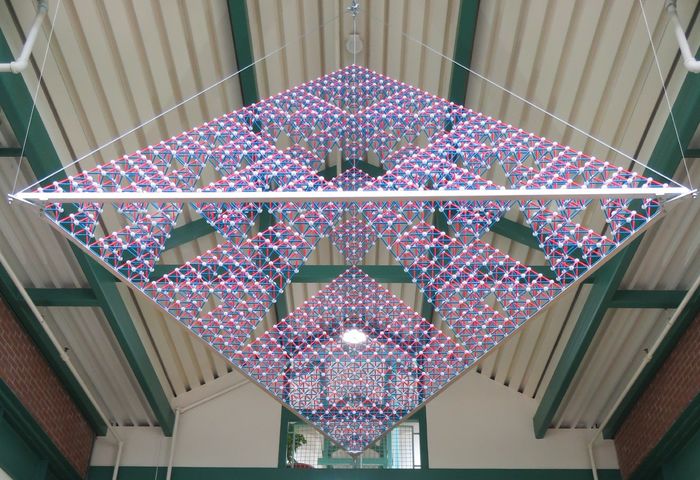
Lizards that Tessellate the Hyperbolic Disk joins an existing sculpture, Math in Flight, a stage-5 Sierpinski tetrahedron, a fractal shape featuring a pattern of infinite triangles, that hangs high above the entrance to Roche Hall in the Science Complex.
Math Club students built the sculpture using Zometool construction parts. It consists of 2,050 white balls and 6,144 red-and-blue struts.
Previte has plans to continue adding to the mathematics art gallery.
“I’d like to do the Platonic solids next,” he said. “I am currently looking for a student in Innovation Commons to make that project a reality.”
By Heather Cass, Publications Manager, Penn State Behrend
When’s the last time you really looked at a tree? Not through a windshield or a window and not while scrolling past a picture on social media but standing right in front of it. The 2025 Erie County Tree Scavenger Hunt invites you to do just that.
The hunt—a free, self-guided activity created by the Penn State Master Gardeners of Erie County—is your invitation to step outside, slow down, and discover eighteen remarkable trees growing in the region.
“We want to encourage people to get out of their houses and cars and explore Erie County,” said Lisa Rand, coordinator of the project. “When you’re standing in front of a tree, you notice things you can’t get from a website or a drive-by. You can study its shape, feel the texture of its bark, and catch the scent of its leaves or needles.”
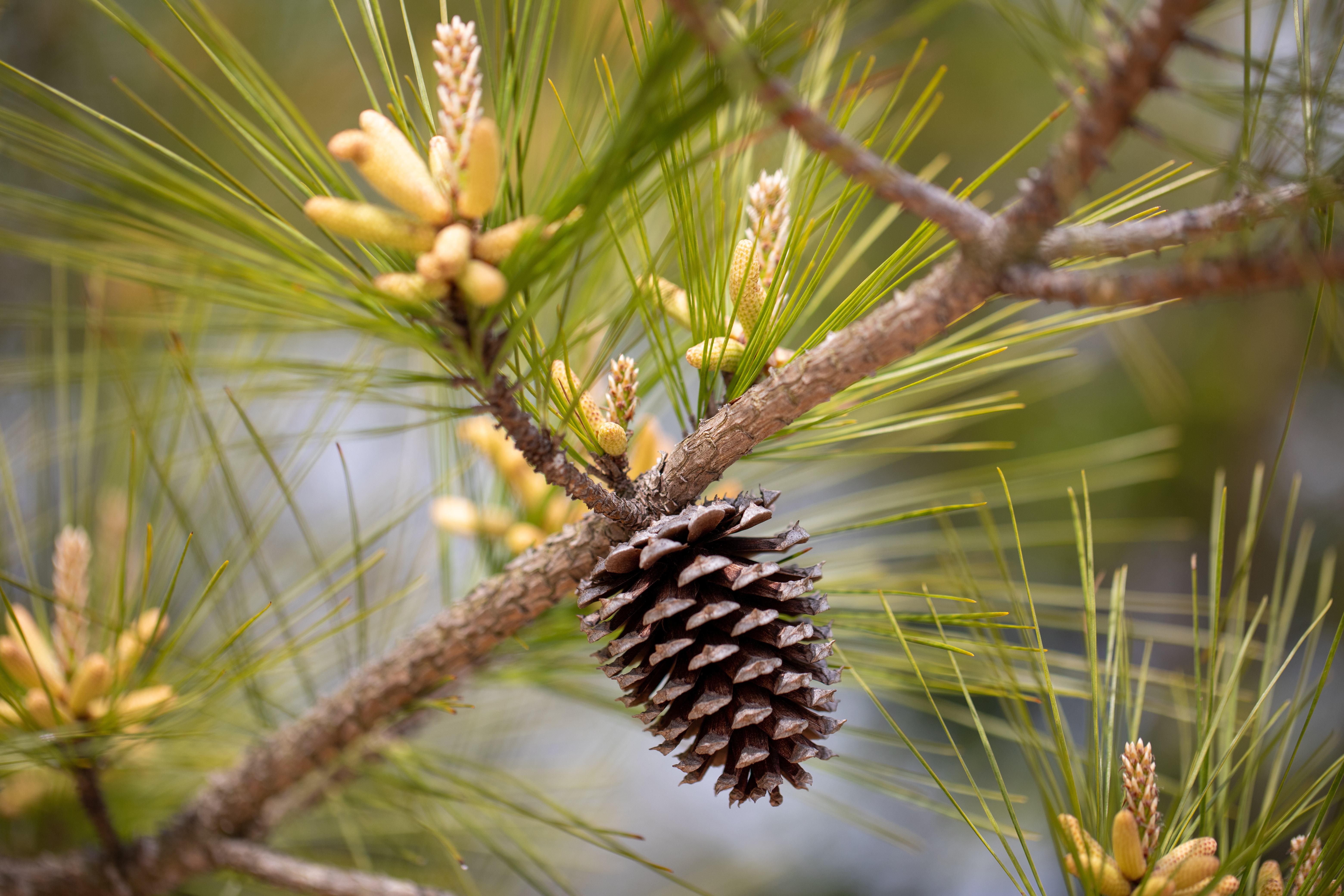
This year’s hunt focuses on conifers (cone-bearing trees) with eighteen “remarkable” specimens to find. All are located on public land or in places that welcome visitors, like Penn State Behrend, which is an official arboretum and home to more than 200 unique tree species.
What makes a tree remarkable?
“They’re all special for some reason—be it form, location, or historical significance,” Rand said. “The guide explains why each tree is significant.”
The scavenger hunt runs through October 1 and is open to anyone curious enough to lace up their shoes and start exploring. It’s part outdoor challenge, part botany lesson, and part treasure hunt—all rolled into one.
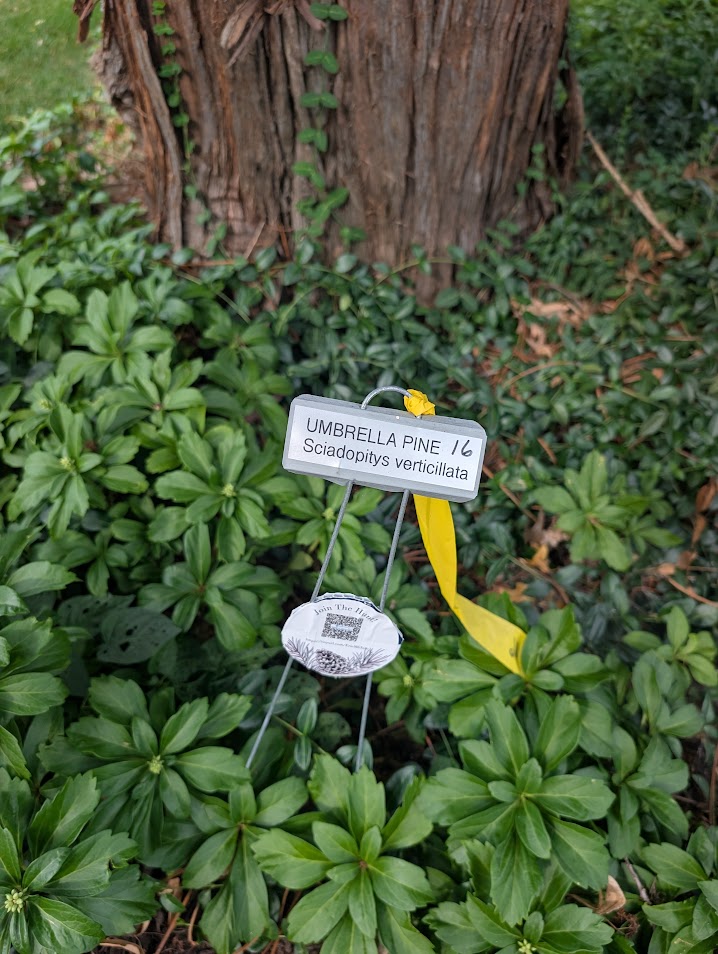
How to Play Use the digital Tree Hunt Guide, filled with clues to locate specially tagged trees across the county. At each stop, you’ll find a metal ID tag with a number. Find at least ten trees, log their numbers using the yellow links in the guide, and you’ll be entered in a prize drawing to win—what else?—a live tree.
It’s an easy, low-pressure way to spend time outdoors, learn about native trees, and maybe even discover a new favorite park or trail.
One past participant told Rand she and her mother found every tree in a previous hunt and couldn’t wait to do it again.
“It’s something they could enjoy doing together,” Rand said.
Note to college students: This also makes a fun—and free—date idea, and a nice break from hitting the books. Hint: One of the trees is right here at Behrend.
Their mistake is understandable. In just three years, Orange, an immersive administrator in the college’s Virtual/Augmented Reality (VAR) Lab, has left his mark on campus—literally. From 3D scanning equipment and building video game consoles in the VAR Lab to creating 360-degree virtual tours for industry partners, Orange’s work can be seen all over Behrend.
“He oversees several of the undergraduate employees in the lab, working with them across a half dozen or more projects, helping them to achieve their own goals,” said Dr. Chris Shelton, associate professor of psychology and director of the VAR Lab. “He goes out of his way to learn and help others who are trying new techniques in the lab, while also improving the atmosphere with his positive attitude and calm demeanor.”
Orange is also collaborating with Jane Ingold, reference and instruction librarian and Behrend’s archivist, to digitally preserve college artifacts as part of his Schreyer Honors College thesis project.
“He is so engaged and is a real champion of Behrend history through the preservation work that he’s doing,” Ingold said. “This spring, he did 3D scans of Ernst Behrend’s old steamer trunk, the bust of Moritz Behrend’s head, and Bruno’s headstone.”
Behrend Blog caught up with Orange before he returned home to New Bethlehem for the summer.
How did you get involved in the VAR Lab? I met another student, Marcus Jacobs (a ’22 Business Economics and International Business grad), who worked there, and he roped me in. I was interested in what they were doing in the lab. Now I do a lot of the project managing. I joke that I’m Marcus 2.0.
What are some projects you’ve worked on? Most recently, I helped create a 360-degree virtual tour for Snap-tite, an Erie company, and I’m working on the Echoes of HistERIE project—scanning historical sites and artifacts like the Presque Isle Lighthouse. If something ever happens to these places, at least we’d still have them digitally.
We heard you built a turntable to help scan people in 3D? Yes! It’s hard to do 360-degree scans of people while lugging around the camera and cables, so it’s easier if the person rotates on a platform while the camera stays put. You can buy turntables like this, but my true gumption is being frugal—so I wanted to build one. My dad and I used the motor from a pig roaster, since it offers a slow, strong spin. It turned out great.
You also created an augmented reality sandbox. Tell us about that. It’s an interactive display that lets users shape and manipulate 3D topographic maps in real time. A 3D camera senses the shape of the sand, and a projector overlays a topographic map onto it. You can build mountains and valleys right in front of you. Again, you can buy these, but we made ours out of plywood and an old projector.
And the VARcade? That’s an arcade machine I built from an old kitchen cabinet. It runs classic games and also gives students a platform to test new games they create in computer science or game design classes.
You sound like an engineer. Why did you choose DIGIT? DIGIT is the best of both worlds. I get to work with emerging technology but in a more creative or artsy way. I like 3D modeling, photography, making movies, and videogames. I’m also minoring in game development.
What are some practical uses for VR and 3D images? A lot of people think VR is just for video games, but it has serious real-world uses—training simulations, for instance, where it’s safer to make mistakes. It’s also great for exposure therapy for phobias and PTSD. And 3D tours can give people a sense of what a place looks and feels like without needing to physically go there.
What motivates you? My faith—especially Jeremiah 29:11: “I know the plans I have for you, declares the Lord, plans to prosper you and not to harm you, plans to give you hope and a future.”
What are you looking forward to when you return in August? My Schreyer thesis project, which is a continuation of the work I do in the lab. I’ll be using different scanners on various artifacts to find the most efficient methods for digital preservation. And I’m excited to see what else comes my way in the VAR Lab. I’m up for anything.
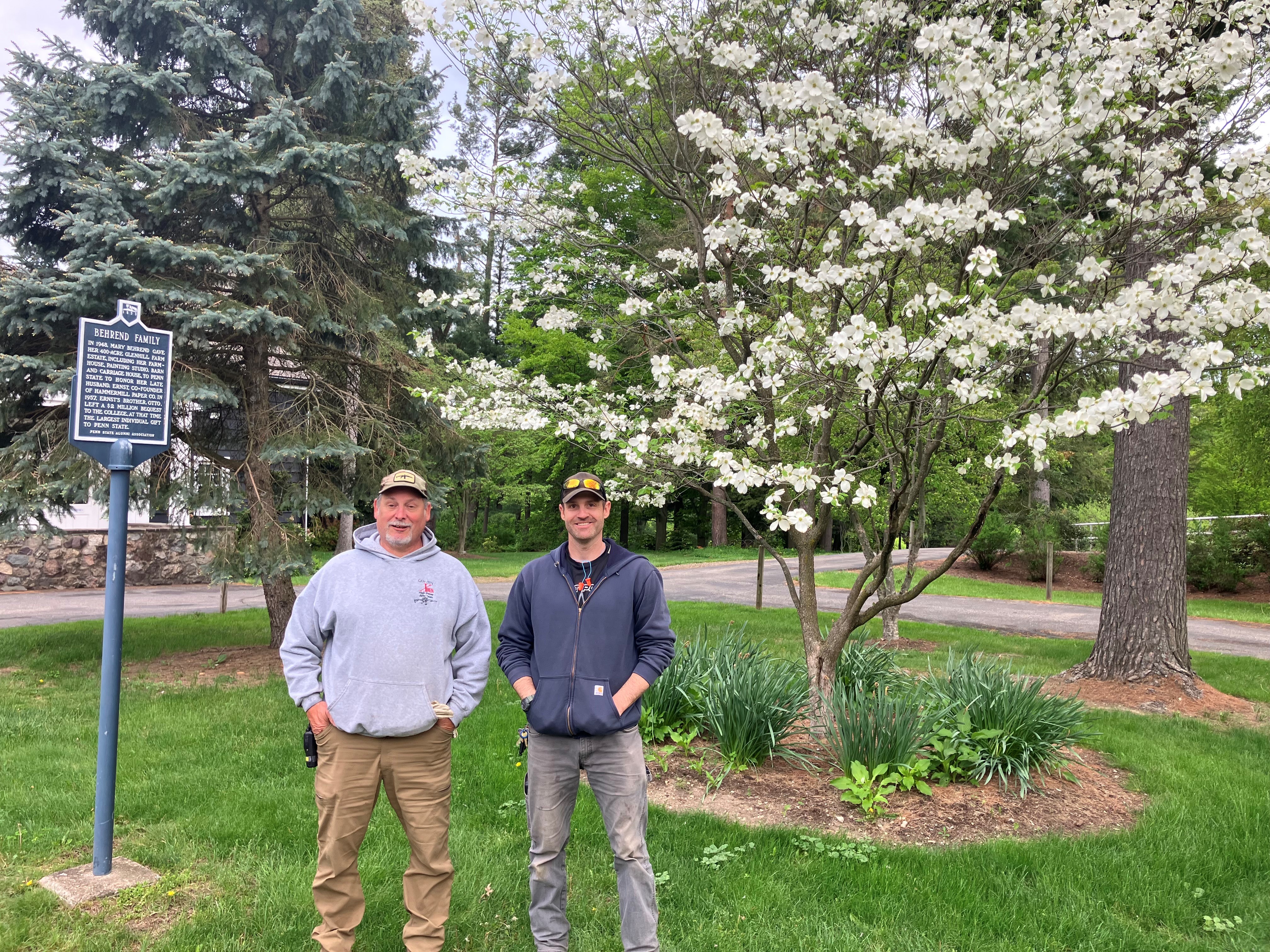
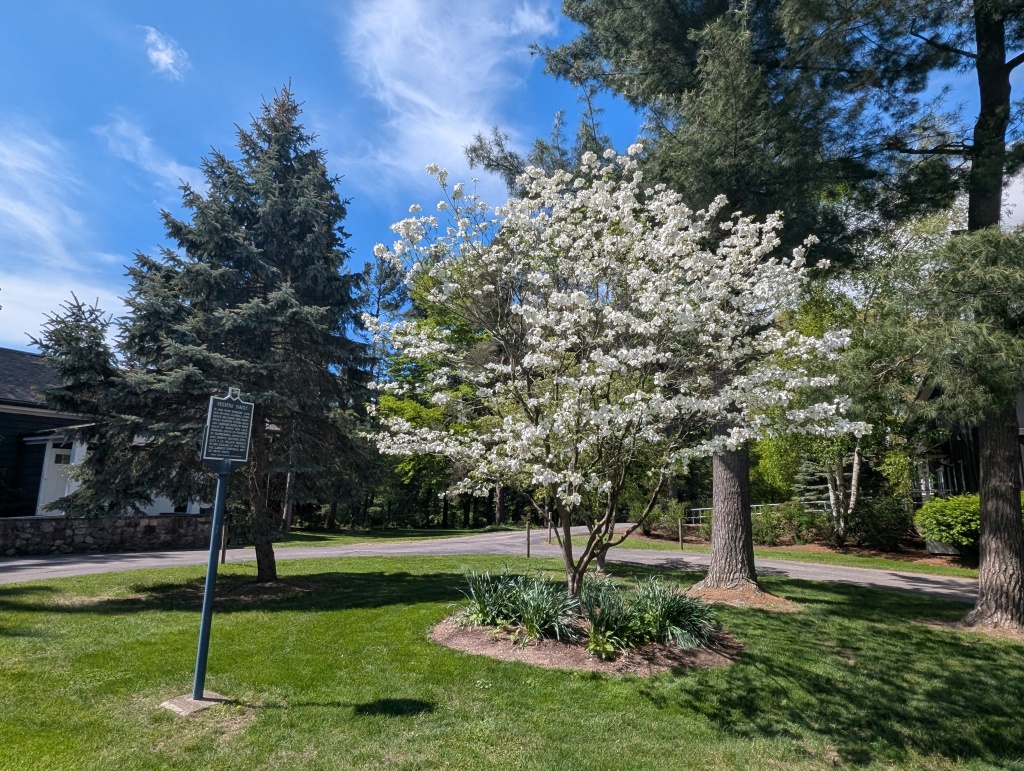
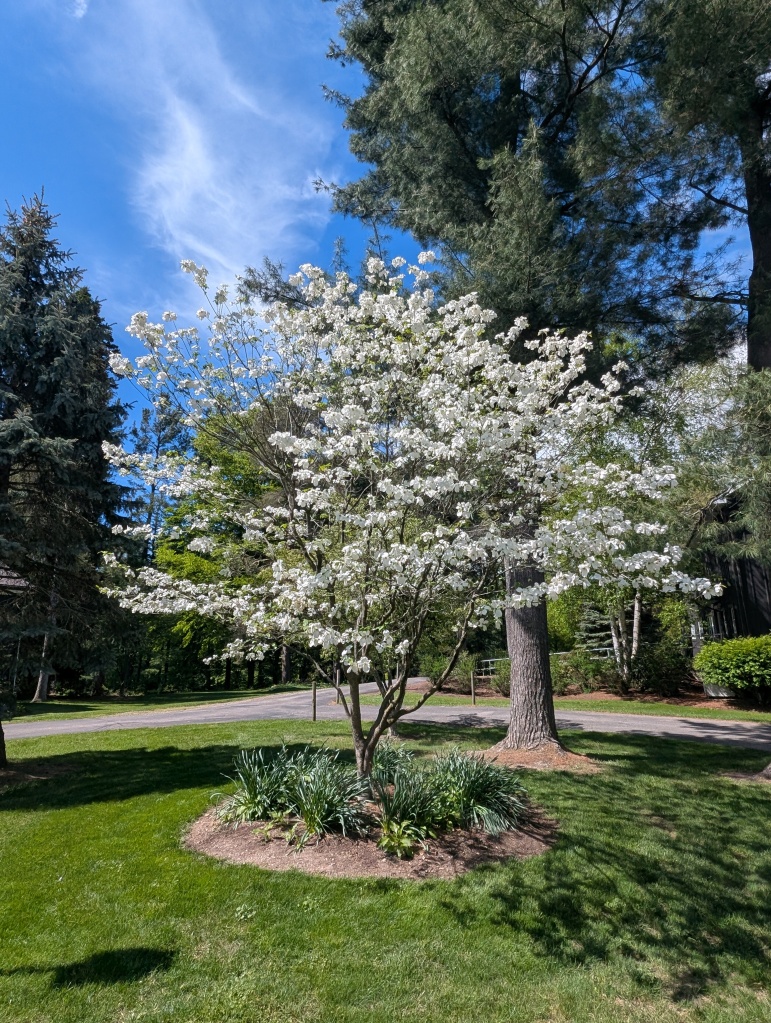
John Troncone, left, and Brooks Travis in front of a flowering dogwood that Troncone has transplanted four times in twenty years.
By Heather Cass, Publications Manager, Penn State Behrend
“Bloom where you are planted” is a metaphorical phrase encouraging individuals to make the best of their current circumstances. A real-life example of this sentiment can be found at Penn State Behrend, where a flowering dogwood tree is thriving even after having been transplanted four times.
The tree, Cornus florida, was first planted two decades ago near Lilley Library by groundskeepers John Troncone and Patricia Blackhurst, who is now retired.
“Patty and I planted it along the east side of the library, but it was too wet, and the tree was struggling there,” Troncone said.
They chose to move it next to the old Erie Hall, where the dogwood grew until a fire at Dobbins Dining Hall in March of 2010 forced another move.
“Housing and Food Services had to set up a temporary kitchen in Erie Hall that required us to remove the tree,” Troncone said.
He and Blackhurst dug a third hole for the growing tree, south of the Glenhill swimming pool. Again, the tree grew and flowered until, a dozen years later, Troncone was once again facing the dogwood that had to go to make room for the Glenhill Gardens project.
He and his new groundskeeping partner, Brooks Travis, had to decide whether to destroy the tree or attempt yet another transplant.
“The timing was good,” Troncone said. “The tree was in the dormant stage at that point, and the weather was dry enough to give it a try.”
Troncone, Travis, and Jack Crowley, a student worker, spent three days carefully digging the tree out, wrapping its roots in burlap and tying them into a root ball for transplant. However, moving the 20-foot tree would be no easy feat.
“Then we got lucky,” Troncone said. “The contractor for the pool project had a track loader and offered to help us move it.”
Troncone and Travis found the perfect spot for the tree in a grassy circle surrounded by the college’s original, historical buildings—Glenhill Farmhouse, Mary Behrend’s Studio, and the Turnbull Building.
It’s space fitting of a tree that has born witness to so many important moments and changes on campus.
It’s currently in full bloom, a gratifying sight for the caretakers who watch over it.
“Brooks and I are pleased with the tree’s condition to date,” Troncone said. “I’m glad we were able to save it. Hopefully, that will be the last time we have to move it.”
A few interesting facts about flowering dogwood
The large, showy “petals” are actually modified leaves called bracts, not true petals.
Native Americans used dogwood bark to make scarlet dyes and medicinal teas.
In some cultures, the dogwood is a symbol of rebirth and resurrection. (Fitting for the subject of this blog post!)
The “fruit” of the dogwood is a drupe, similar to a plum, with a hard seed inside.
Dogwood wood is hard and strong, making it suitable for tool handles, charcoal, and other items.
The name dogwood is thought to be a variation of the Old English word “dagwood,” meaning a skewer or dagger. The hard wood of the tree was used to make these tools.
Another theory regarding the origin of the name dogwood suggests it could have been named for its berries, called “dogberries,” which might have been considered less desirable or “fit for a dog.”
Dogwoods have been used medicinally for generations; the bark is rich in tannins, so ground bark or leaves are used to treat pain, fevers, backaches, dizziness, weakness, excessive sweating, uterine bleeding, and incontinence.
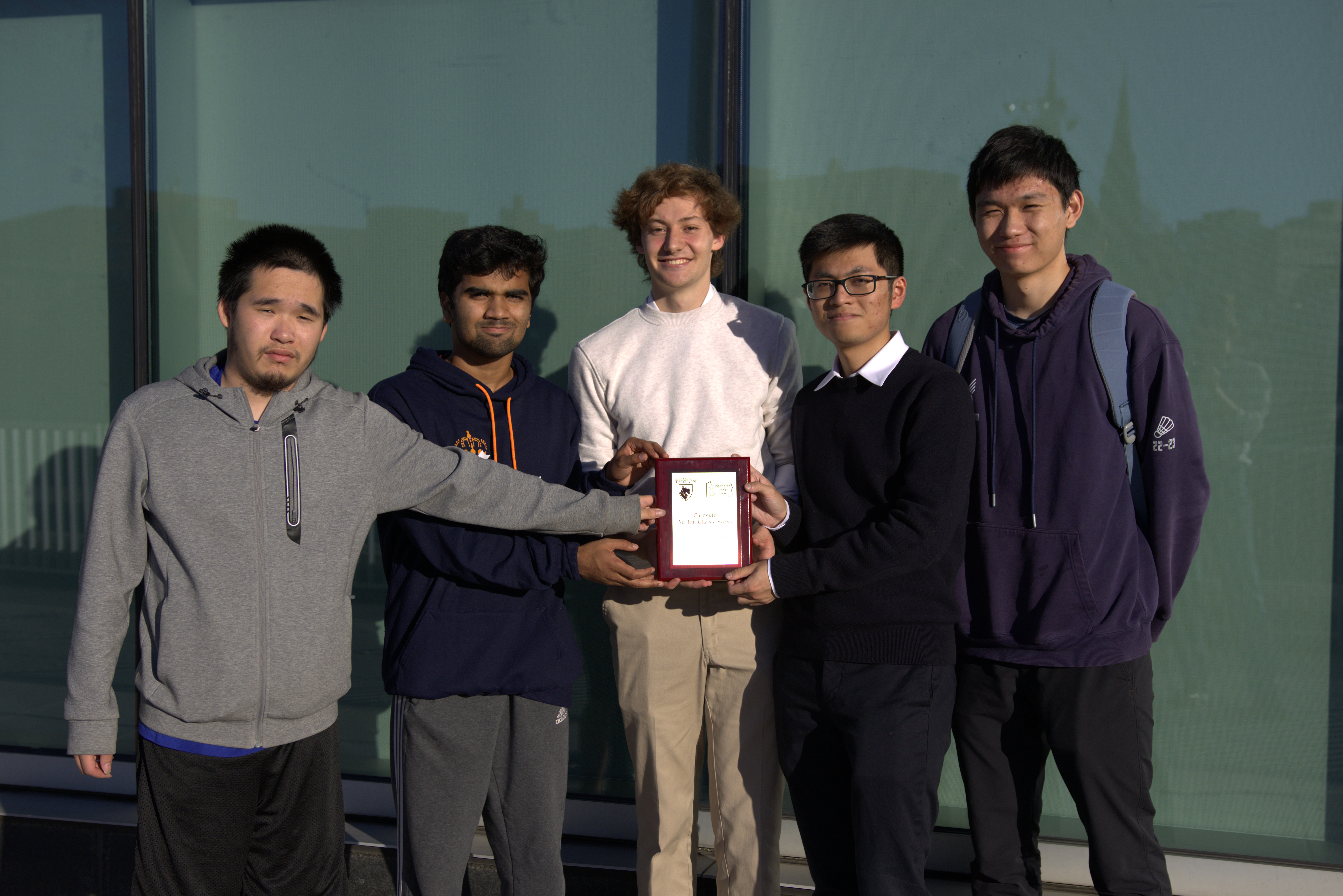
Behrend chess team members: Dennis Chu, Kelvin Li, Advaith Kodipparambil, Jordan DeLauer, Christian Wang, and Seth Mellring.
Chess is a complex game, with sixteen pieces of six types, each moving in a different way. Players must not only master the rules but also develop strategies and tactics to defeat their opponents while adapting to every move.
Kelvin Li, treasurer of Penn State Behrend’s chess club, said the game is worth the effort, especially when he finds the tactic—whether it’s a beautiful move or the only move—that will win the game.
A tactic in chess is a series of moves that gives a player an immediate advantage. Tactics are usually short-term and involve forcing moves that limit the opponent’s options.
“It is incredibly satisfying to find the tactic because they are very difficult to spot, especially for new players,” Li said. “After so many games, you usually develop an intuition and can more quickly spot good moves. But even that is rarely simple because you must think about all your opponent’s possible responses to your move.”
No two chess matches are the same, but there are patterns. A player who can spot the pattern gains the upper hand.
“Advanced players usually study these positional patterns and how to play them, so if they recognize them in a real game, they gain a solid advantage over their opponent,” Li said. “While real games are usually quite messy, knowing what you can work with and how to exploit it is important.”
Spotting patterns is something Li, a dual major in mathematics and physics, is well-versed in. Math can be considered the study of patterns, as it focuses on identifying, analyzing, and describing repeating structures and relationships with numbers, shapes, and other mathematical concepts.
Li began playing chess in high school and was pleased to learn that Behrend had an active chess club. The club, which meets on Thursday nights in the Reed Gaming Lounge, includes a mix of intermediate to advanced players, but they enjoy teaching newbies as well.
“We welcome all players,” Li said. “In our weekly meetings, we play casual games to foster a positive learning environment where newer players can play and learn from some of the more advanced players.”
Each month, the club holds a chess tournament with prizes. To level the playing field, they adopt the Swiss system, a non-elimination tournament format that pairs players with similar scores. The winner is the player with the most points at the end of the tournament.
“Chess is an adversarial game by nature, so we always encourage healthy competition,” Li said.
The practice has paid off. Last semester, the Behrend team won the Carnegie Mellon Chess Open, held at Carnegie Mellon University in Pittsburgh, besting CMU by a half-point to win the top spot. Competition was stiff, with teams from the University of Pittsburgh, Penn State University Park, Shippensburg University, and others participating.
In November, at the Pennsylvania State Chess Federation’s Pennsylvania Team Championship in Shippensburg, the Behrend club won the top college team prize and tied for first place out of thirteen college teams.
The club will compete in the Ira Lee Riddle Memorial Championship in Harrisburg in March and the Pennsylvania State Game/29 Championships in April at the University of Pittsburgh.
Follow the chess club at instagram.com/psbchessclub.
Behrend Chess team members: Jack Ni, Advaith Kodipparambil, Jordan DeLauer, Kelvin Li and Christian Wang.
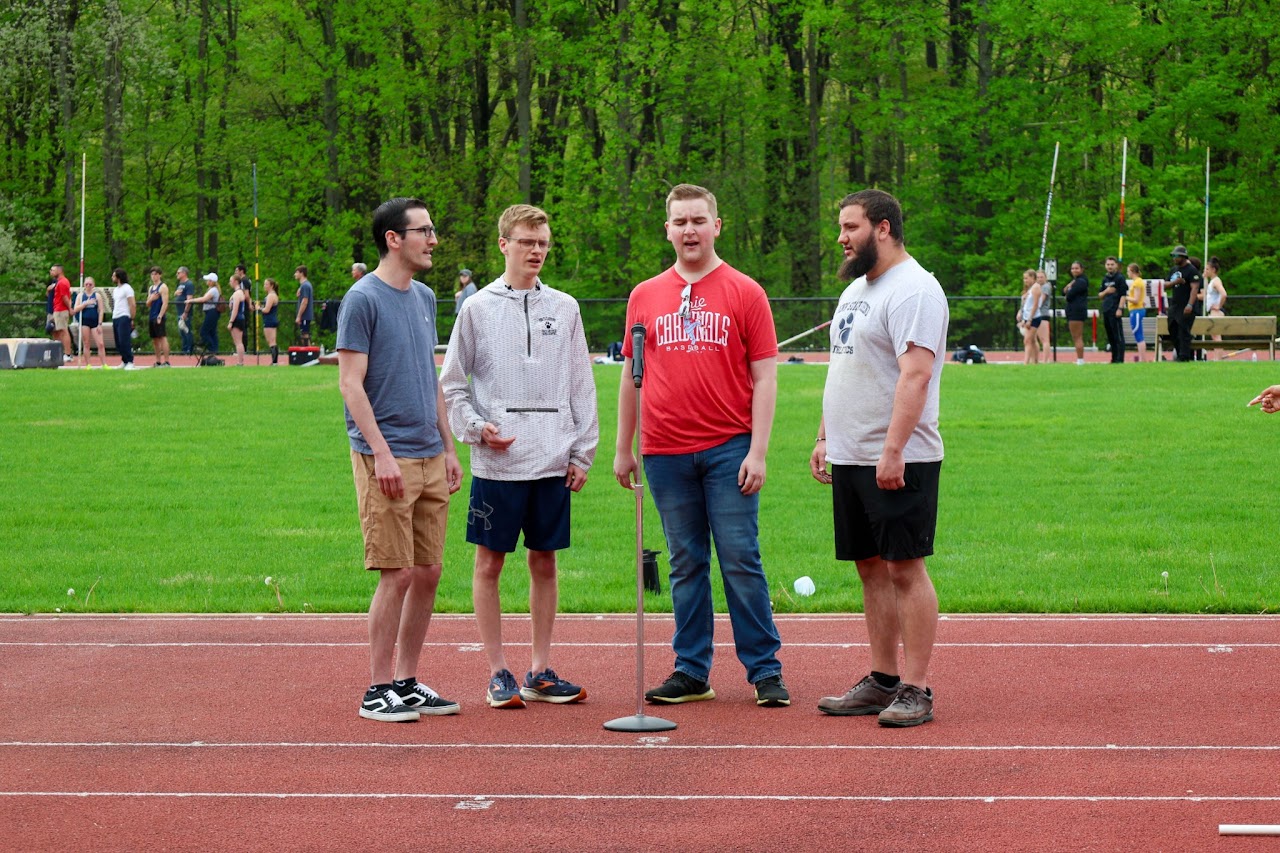
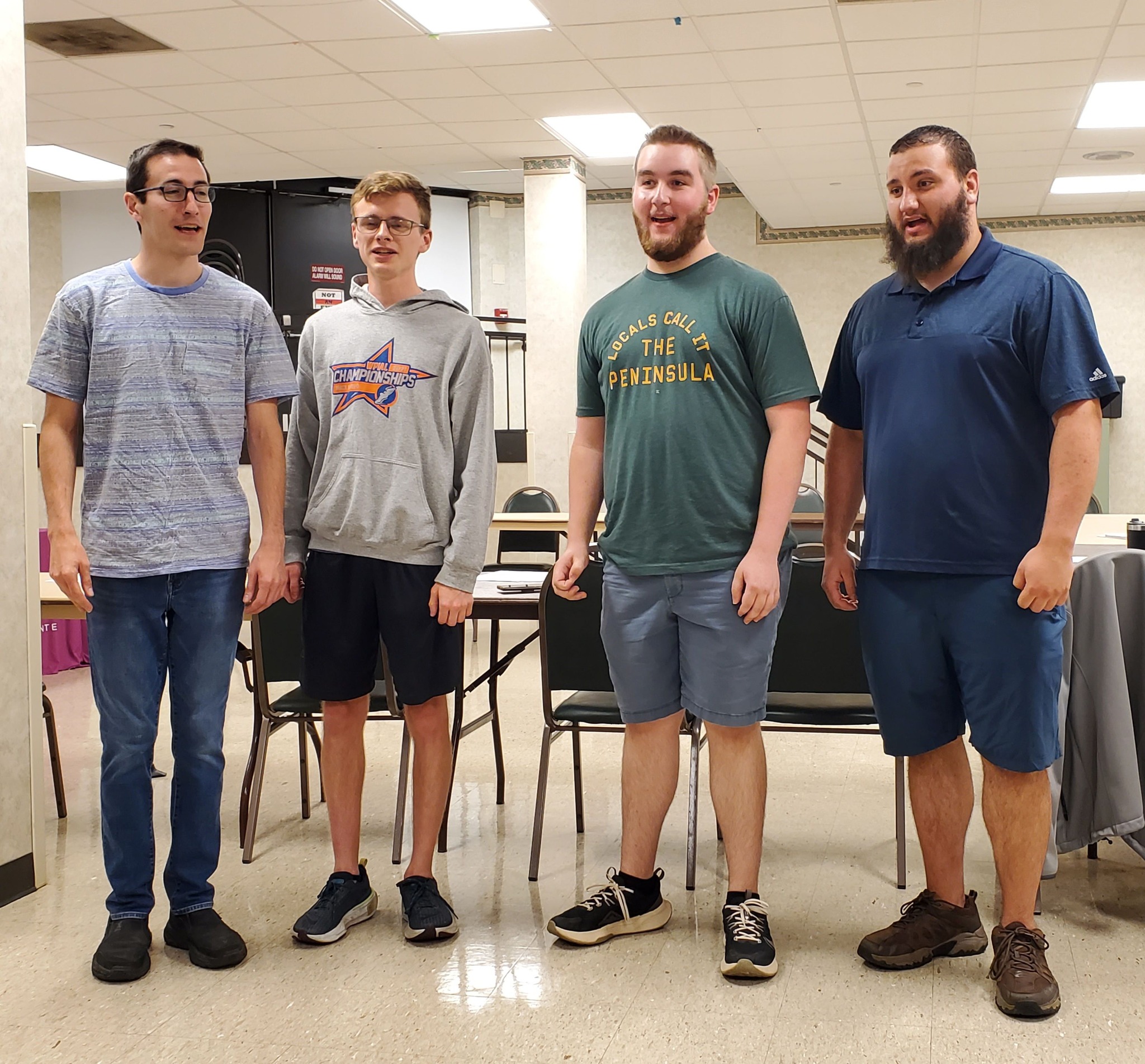
Four Score, a barbershop quartet that includes three Behrend students and one alumnus, perform the National Anthem at a home track meet at Penn State Behrend in spring 2024.
One of the most amazing aspects of college is that a single class can have a profound effect on your life. It might inspire you to change your career plans. It might be the place you meet your best friend or future spouse. It might ignite a lifelong passion or lead you to a place you never expected.
Max Rohl, a senior Interdisciplinary Science and Business major, never dreamed he would be on stage accepting first place in a barbershop quartet competition in Rochester, New York. He had never even sung in a group until he signed up for Concert Choir class in his first year at Behrend.
“Some of us in the class started a kind of club where we would meet up in Ohio Hall to work on our songs,” Rohl said.
One night, at the end of a choir meet-up, he asked if anyone in the group had any other styles of songs they wanted to work on. Rohl, who had been a fan of the barbershop quartet classic, 76 Trombones, was about to suggest barbershop songs when Wade Williams, now a junior History major, said, “I’ve always wanted to start a Barbershop Quartet.”
“Me, too,” Rohl said.
Wade is a bass singer, Rohl is a baritone, so they needed a tenor and a lead.
They found both in Joey George, a senior Computer Engineering major, who had grown up singing in choirs and at church and could sing both tenor and lead.
The trio looked all over Behrend for a fourth member before Wade did an internet search and found Lake Erie Sound, an established Erie barbershop chorus. He reached out to its leader, John Donohue, who directs the chorus of about two dozen men.
“He probably thought, ‘Why are these college kids bugging me?’ but we talked him into coming to listen and sing with us,” Rohl said.
After that one practice, Donohue, a 2015 Mechanical Engineering alumnus, was in.
“It just sounded so good when we sang together that I knew we had to put our efforts toward getting better and refining our performance,” Donohue said.
The group began practicing a couple of times a week, meeting when Donohue, who is about ten years older and has a job and family, could join them.
“It was great to meet young people who had been bitten by the ‘barbershop bug,’” Donohue said. “They were eager from the start and soaked up any knowledge I shared with them.”
They chose a name—Four Score Quartet—and performed the National Anthem at a Behrend home track meet in the spring. They hadn’t considered doing much more until Donohue mentioned a nearby competition—the Seneca Land District of Barbershop Harmony Society District Competition in Rochester, New York.
“He said, ‘Hey, there’s this competition in twenty days. Do you guys want to do it?’” Rohl said.
They not only did it; they won it and were named district champions.
“John was not surprised, but we were!” Rohl said.
The group sang four songs, two in preliminaries and two in the finals: “Wait ‘Til the Sun Shines, Nellie,” “A Son of the Sea,” “Sweet and Lovely,” and “That Old Black Magic,” which earned them their highest score of the day. Each song is scored separately, and then song scores are added together to get a final score.
If it sounds easy, Rohl will assure you that it is not.
“It’s actually really difficult to sing barbershop harmony, but I love challenging myself and doing hard things,” Rohl said. “When you have to work hard at something, mastering it is much more rewarding.”
Barbershop singing is different from any other type of choral group singing but it still requires plenty of talent and practice.
“Although the technique is different than in a classical choir, it’s still very demanding from a musical perspective and can really push an individual both vocally and emotionally,” Donohue said.
Donohue is happy to see younger people interested in barbershop quartet and said that while it is sometimes viewed as an old-fashioned type of singing, that perception is changing.
“In the past ten to fifteen years, quartets have began to adopt more musical theater pieces and songs from pop-culture,” he said.
Winning the competition solidified the students’ commitment to the quartet.
“We’re all very dedicated to it now, even more so than before,” said Rohl.
In the late 1800s and early 1900s, every barbershop had its own quartet. The term “barbershop” in reference to harmonizing was first documented in 1910, alongside the release of the song Play That Barbershop Chord.
During this time, barbers were more than just hairdressers; they also pulled teeth and performed minor surgeries. Barbershops gradually became social hubs where locals could gather, play instruments, and sing while waiting for their turn in the chair.
DID YOU KNOW?
Barbershop harmony is believed to be rooted in the Bllack community. According to a post on The Barbershop Harmony Society blog: “Lynn Abbott, a jazz archivist at Tulane University, was an expert on early African-American popular music and gospel quartets. He discovered overwhelming evidence that barbershop quartetting was pervasive in African-American culture in the late 1800s and early 1900s, including among many men who went on to become the pioneers of jazz. Abbott published his findings in a 1992 academic paper that forever changed the way Barbershoppers understand their roots.”
The Four Score Barbershop Quartet includes, from left, John Donohue ’15, and Behrend students, Joey George, Wade Williams, and Max Rohl.
Students in Photo 202: Fundamentals of Professional Photography recently completed a photo essay project based on “The Land Ethic,” an essay written by Aldo Leopold in 1949 that argues for a deeper connection between humans and the natural world.
Leopold suggests that humans need to expand their concept of ethics beyond just people and animals to include the land—soil, water, plants, and more. The “land” is not something we own, but something we are a part of, and we should treat it with care and respect. Leopold proposes that we should think of ourselves as caretakers, responsible for maintaining balance and harmony with nature.
Urban park. CREDIT: Chelsea Quijas
Tommy Hartung, assistant professor of digital media, arts, and technology, instructed students in the class to choose an area and create a series of five 360-degree panoramic images that document the landscape and the biome it contains.
“The site they chose could be anywhere from urban to complete wilderness,” Hartung said. “Students were also required to take notes documenting the ecosystem and use their notes to draft a 500-word essay to go with the images.”
A second part of the assignment involved time-lapse photography.
“The element of time and motion related to photography has allowed humans to see systems develop by compacting time into short motion clips,” Hartung said. “It allows a focus that the human experience may overlook about the location.”
Dobbin’s Landing in Erie. CREDIT: Evan Gerdes
The students’ essays are impressive and thought-provoking. See for yourself at the links below:












 BEHREND BLOG