From Service Trip to Smith Chapel: A Behrend Love Story

By Heather Cass, Publications Manager, Penn State Behrend

Each year, twenty-four Penn State Behrend students and four advisers participate in an Alternative Spring Break (ASB) service trip coordinated by the Office of Civic and Community Engagement. The experience, in which participants spend their break volunteering for a community in need, is designed to engage students on multiple levels, including personal development, group and team dynamics, and public service.

Many who participate in ASB find it life changing. Some discover a passion for service. Some make lifelong friends. Some choose a new career path. Some meet their soulmate.

Such was the case for Gretchen (Shaffer) Magera ’20 and Max Magera ’19 who met during an ASB trip to Beaumont, Texas, to help with Hurricane Harvey cleanup in 2018.

Though it would be years before they officially dated, their friend Ashlyn Kelly ’18, who was also on the trip, spotted the chemistry right away. (She would have. Ashlyn was a Chemistry major.)

Gretchen (Shaffer) and Max Magera, fourth and fifth from the left, at Penn State Behrend’s 2018 Alternative Spring Break service trip to Beaumont, Texas, where participants helped with Hurricane Harvey cleanup.

“I remember early on in the trip, a group of us were standing around talking while waiting for everyone to go to the worksite, and I noticed how much Gretchen lit up when Max would join the conversation,” Ashlyn said. “I could tell something was going on.”

Ashlyn spent the next several years gently encouraging her friends to be more than friends.

“I always knew they’d end up together one day,” she said.

Sweet as (American) Pie

Gretchen, a Plastics Engineering Technology major, liked Max, a Mechanical Engineering major, right away. He was smart, funny, capable, and among the first in the group to jump in and do the hard labor needed in the flood-ravaged homes they were working on.

It’s a tradition on ASB trips for each person to anonymously submit a favorite song to a playlist members listen to when traveling during the trip. The challenge is to match the song to the person who selected it.

Gretchen chose “The Saga Begins,” a “Weird Al” Yankovic parody of Don McLean’s “American Pie,” with lyrics that humorously summarize the plot of Star Wars: Episode I – The Phantom Menace through the point of view of Obi-Wan Kenobi, one of the film’s protagonists.

“Everyone hated that song,” Gretchen said. “It must’ve played five times before they figured out it was me.”

Halfway through the trip, when the group decided to make another playlist with fresh songs, Max chose the original “American Pie.” Gretchen knew right away who submitted that song.

It went on like this for the two: friendly conversations, shared jokes, and subtle flirting. They did another ASB trip together, traveling to Puerto Rico in 2019.

When Max graduated in May 2019, he moved away and began a series of six-month rotations in Wabtec’s LEAD Program. He and Gretchen stayed in touch with occasional texts.

Rotation Leads to Reunion

“In 2020, Max texted and said that he was going to be back in Erie for six months,” Gretchen said.

They reconnected, and their near-weekly happy hour hangouts at a local brewpub soon turned into something more.

“Every time she made a comment about seeing Max, I asked if they were hanging out or dating,” Ashlyn said. “When she finally said they were dating, I said, ‘Well, it’s about time!’”

Their first official date had a Behrend connection: They went to see The Groove, a band that features Jim Dowds, a case manager in Behrend’s Personal Counseling center, on drums.

By spring 2023, Max decided to pop the question at Behrend’s Lion Shrine.

He enlisted help from Ashlyn and Behrend’s Mary Kay Williams, whose official title is admissions support assistant but who also serves as a surrogate “campus mom” to the many students she befriends.

“Mary Kay and I scheduled a lunch with Gretchen,” Ashlyn said. “The plan was for Mary Kay to cancel at the last minute, which she did, so that I could suggest that Max and Gretchen still meet up with me and my boyfriend for a walk on campus with our dogs.”

First stop was the Lion Shrine to “take some photos.” Ashlyn was prepared, whipping out her camera and handing her phone to her boyfriend, Paul Lutz ’19, to capture the proposal in both photos and video.

“Happy to say that after all that hard work, she said ‘yes,’” Ashlyn said.

This slideshow requires JavaScript.

Blending Blue and White Forever

On September 28, 2024, Max and Gretchen married at Behrend’s Smith Chapel—the building where it all started, with the first ASB planning meetings held in the downstairs lounge. Ashlyn was a bridesmaid.

This slideshow requires JavaScript.

Photo credit: Alan Freed Photography

During the ceremony, the couple performed a unity sand ceremony—a wedding tradition in which a couple pours sand from separate vessels into one vase, symbolizing two people uniting in marriage. The sand in their ceremony was Penn State blue and white, a nod to the college that brought them together.

Max is a supplier quality engineer at Wabtec in Grove City. Gretchen is a project engineer at Molded Fiber Glass in Union City. The couple resides in Cambridge Springs with their dogs, Zeus and Athena.
Hash-Tagging History: Alumna Shapes Social Media at Gettysburg Museums

By Heather Cass, Publications Manager, Penn State Behrend

Alanna Gillis ’24

While job hunting, Alanna Gillis ’24 stumbled across a position as a programs assistant at the Adams County Historical Society (ACHS) in Gettysburg. It seemed a good fit for Gillis, who earned a Creative Writing degree and minored in History at Penn State Behrend.

Though the organization eventually filled that position internally, they encouraged Gillis to interview for a part-time customer service position.

She was disappointed but figured she would interview for the experience.

“One very convincing interview and tour of the building—including their massive library and archives— later, I was working for ACHS as a visitor services associate in a part-time capacity,” she said. “Even though it wasn’t the job I hoped to land right out of college, it was still a job in my field that I felt confident I could do well.”

She did it so well that by September, she was promoted to part-time associate in the marketing department.

“They had been looking for someone to fill that position in marketing and had seen on my resume that I had experience with writing, graphic design, and running social media for the clubs I was in at Behrend,” she said.

Gillis was promoted again in just a few months. Today, she is the full-time social media and marketing coordinator at ACHS, where she creates and curates content for the organization’s social media pages, produces short- and long-form video projects, and contributes to marketing materials and publications.

We chatted with Gillis to learn more about her job, how Behrend helped her get there, what she’s learned so far, and what she’s looking forward to.

Tell us a little bit about the Adams County Historical Society.

The Adams County Historical Society is a nonprofit historical society that runs two museums in Gettysburg. ACHS focuses on preserving, protecting, and sharing the stories of Gettysburg and Adams County. Through our two museums, Gettysburg Beyond the Battle and The Shriver House Museum, we highlight the local history, reaching all the way back to the time of the dinosaurs.

How did your Behrend education help you obtain this role?  

Both of my areas of study were crucial. My History minor helped me get my foot in the door, but my Creative Writing degree allowed me move up and achieve the job I have now.

My job is mainly about communicating with the public, whether that be to our museum patrons, to our followers, or to our YouTube viewers. I needed to have a good grasp of how to best communicate with people through the written word—a skill I felt confident in because of my Creative Writing degree.

Having a good grasp of the English language, from word choice to register, helps me effectively draft both a fun TikTok script and a more formal press release, which is the flexibility that ACHS needed from someone in this position.

My Creative Writing degree has also allowed ACHS to start new projects they wanted to do but didn’t have the staff for, such as publishing firsthand accounts of the Battle of Gettysburg.

What are your primary duties in your current role?

I am responsible for our social media pages; I create and curate content for Facebook, Instagram, TikTok, and YouTube. I generate daily content for all these sites, which varies from photos with captions, to short form videos highlighting our museum, to video thumbnails, to longer videos aimed at teaching people the history of Adams County and Gettysburg.

Beyond that, I am also responsible for filming and editing our longform videos for YouTube. So far, I’ve worked on nearly forty videos with a combined view count of nearly 150,000 on the platform.

I also help with our publications. This includes civilian accounts of the Battle of Gettysburg, informational and promotional flyers, and a museum guide featuring many of the artifacts on display and in our archival collections, like those published by The Smithsonian.

What does a typical day look like for you?

My day starts with a 40-minute commute, but I don’t complain about it too much because it’s a beautiful drive through rural south-central Pennsylvania. It gives me time to center myself and prepare for the day ahead.

The first thing I do is check my email inbox and the inboxes of our various social media sites. If any messages came in overnight, I’ll respond or pass them along to the correct department.

From there, I usually spend the morning editing YouTube and TikTok videos. Depending on the length of the video, this can take anywhere from a few minutes to an hour or more.

After lunch, I work and draft social posts for the week. If I get all that done, I’ll spend time working on secondary assignments like publications.

When do you gather content?

Certain days of the week are reserved for filming content only; I’ll go out onto the Gettysburg Battlefield or into other parts of Adams County with our historian and film episodes for our YouTube channel. Usually, this is how I spend Fridays.

What has been your favorite project so far?

I’m really enjoying getting to put together the civilian accounts of the battle. This project is a perfect blend of my major and my minor, and it’s very rewarding to be able to work on a project where both are useful. Putting together these accounts has also allowed me to see a different type of publishing than I had when I worked on Lake Effect, Behrend’s literary journal.

And your favorite post so far?

The YouTube video “Tim’s Top 10 Defunct Gettysburg Attractions.” Tim Smith is our historian, and he and I spend a lot of time together filming our YouTube videos. I also often consult with him during research or when I’m fact-checking my written content. This was the first episode he and I worked on together, and it was also the first I’d shot and edited in this style. I managed to sneak in some jokes during the editing process, which made the project quite fun.

Have you done anything that turned out to be an unexpected success? 

A few YouTube videos have unexpectedly done well. We don’t typically get more than 3,000 views on our longer lecture videos, but “The Confederate Retreat” lecture has 28,000 views, significantly more than we anticipated.

An unexpected success that is more directly related to me and my work is that I started a book club for fans of Adams County history. Each month, ACHS staff selects a book, usually historical nonfiction, and I prepare a weekly discussion on each section. It’s a virtual book club, which means we have participants from all over the country. So far, we have over 110 members!

What would people be surprised to know about social media marketing? 

A lot of work goes into social media content management and marketing. It’s not as easy as just selecting an image, writing a quick caption, and hitting “post.” Often, images require editing or designs must be created. From there, captions must be drafted and edited to ensure that voice aligns with the company and the historical content is correct. The next step is tagging the correct people and inserting the corresponding ticket links, if necessary. After that, the post is good to go live. Then, it must be cross-posted to all the other platforms. All that work is for one single post, and ACHS usually posts a minimum of five times per week on each platform.

What are you looking forward to? Are there any big events or projects you’re excited about? 

This May, we are hosting the Gettysburg Film Festival: Victory in World War II. We will have guests ranging from historical filmmakers like Ken Burns to authors and screenwriters. I’m excited to help with this and make connections with people in the fields of both writing and history.

What have you learned the hard way? 

When I first started, I was hesitant to ask for help. For a short time, I tried to grin, bear it, and figure it out by myself.

When this resulted in content that I wasn’t happy with, I realized I had two choices: admit I couldn’t do something and ask for help or submit work that I wasn’t proud of.

I asked for help. I realized that if I wanted to succeed in this job and create work that I was happy to have my name associated with, I may need to reach out for guidance sometimes. It’s OK to not know it all.

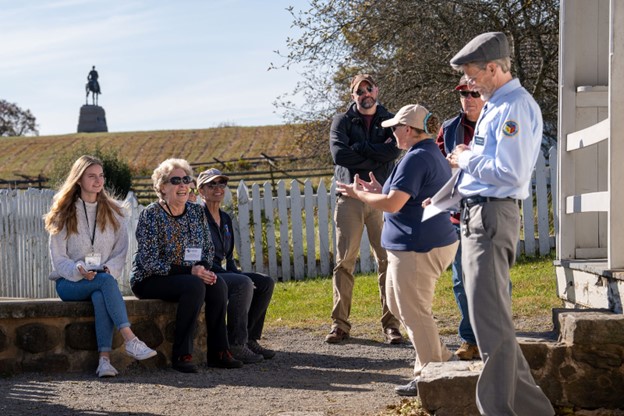
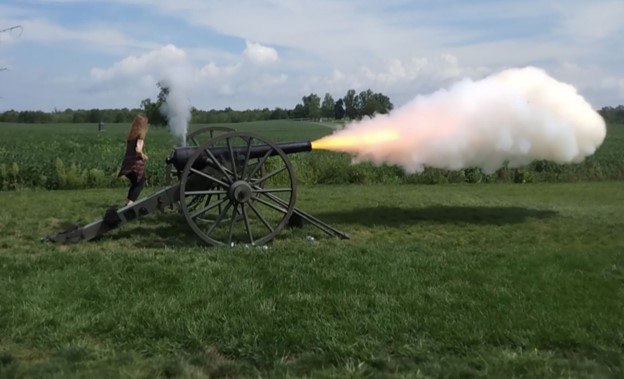
Gillis: “Every now and then, we get to work on fun events or participate in exciting demonstrations. Two examples that I can think of are when I had the chance to shoot a Civil War cannon (above) and when I participated in a day-long leadership tour of the Gettysburg battlefield (below).”  

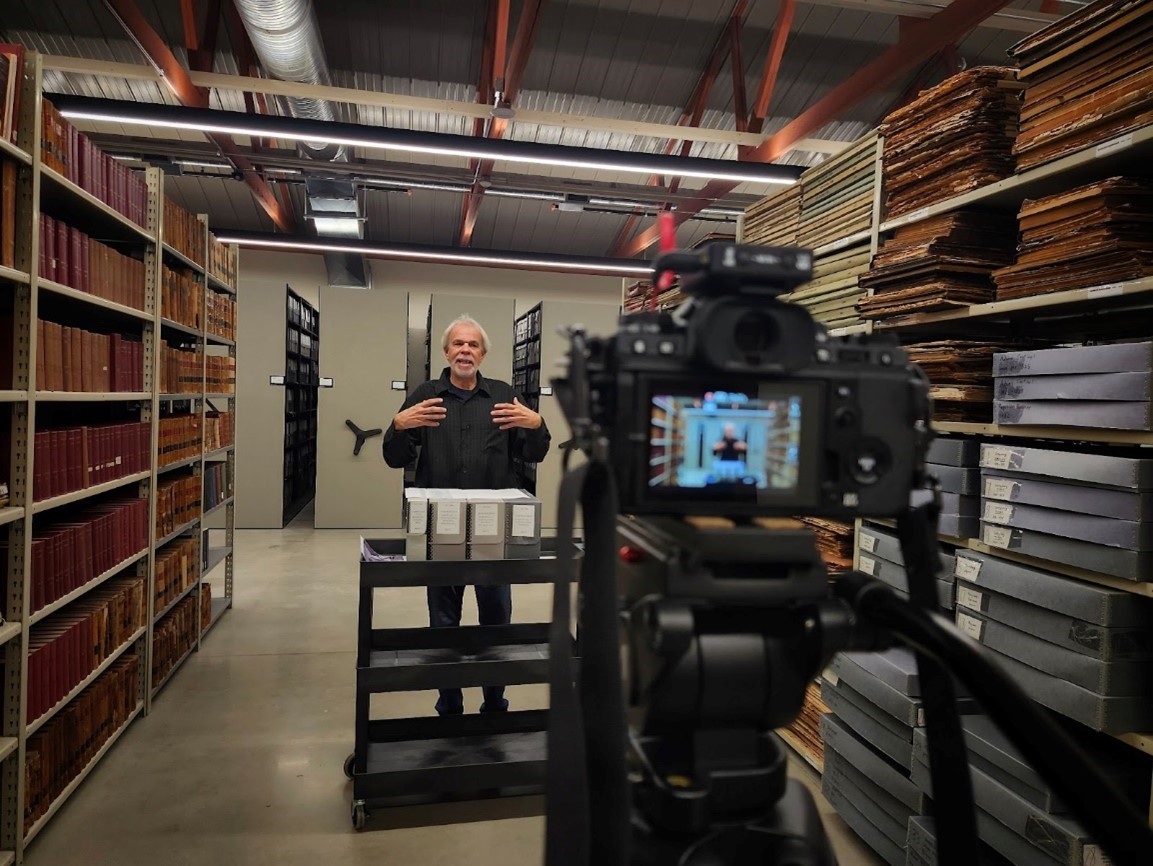
Behind-the-scenes of filming a YouTube video in the ACHS archives. 

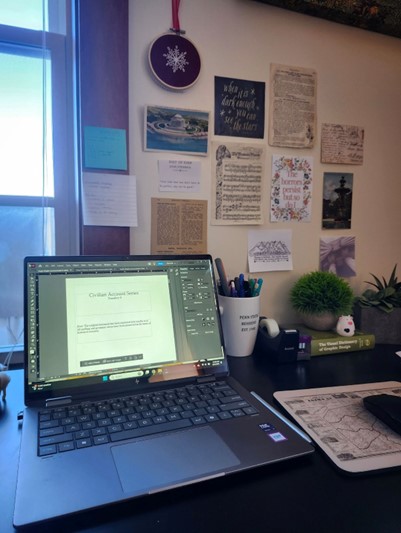
Gillis’ workspace. “I took this while editing a Civilian Account of the Battle of Gettysburg (with my Penn State Behrend mug in the background),” she said.

Behrend Barbershop Quartet Wins District Competition

By Heather Cass, Publications Manager, Penn State Behrend

IMG_1549
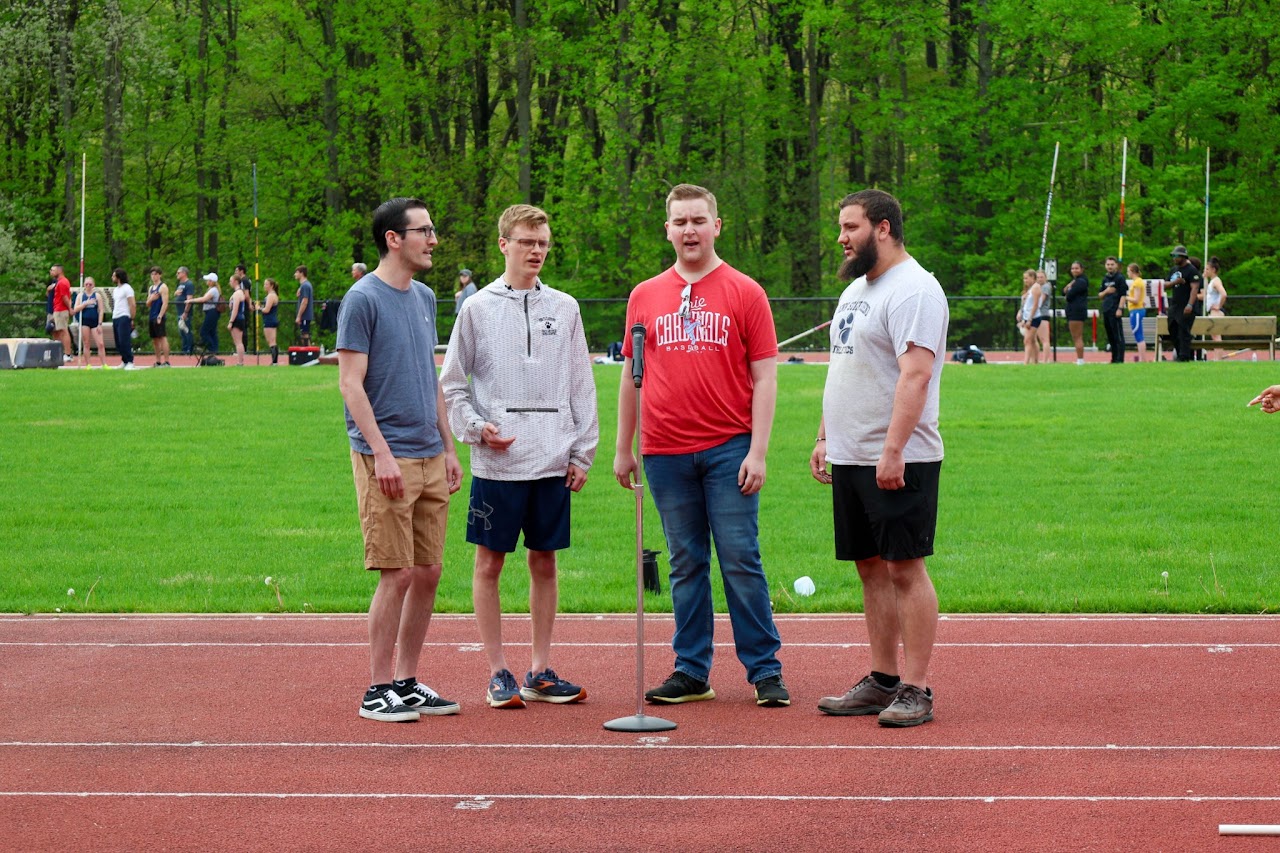
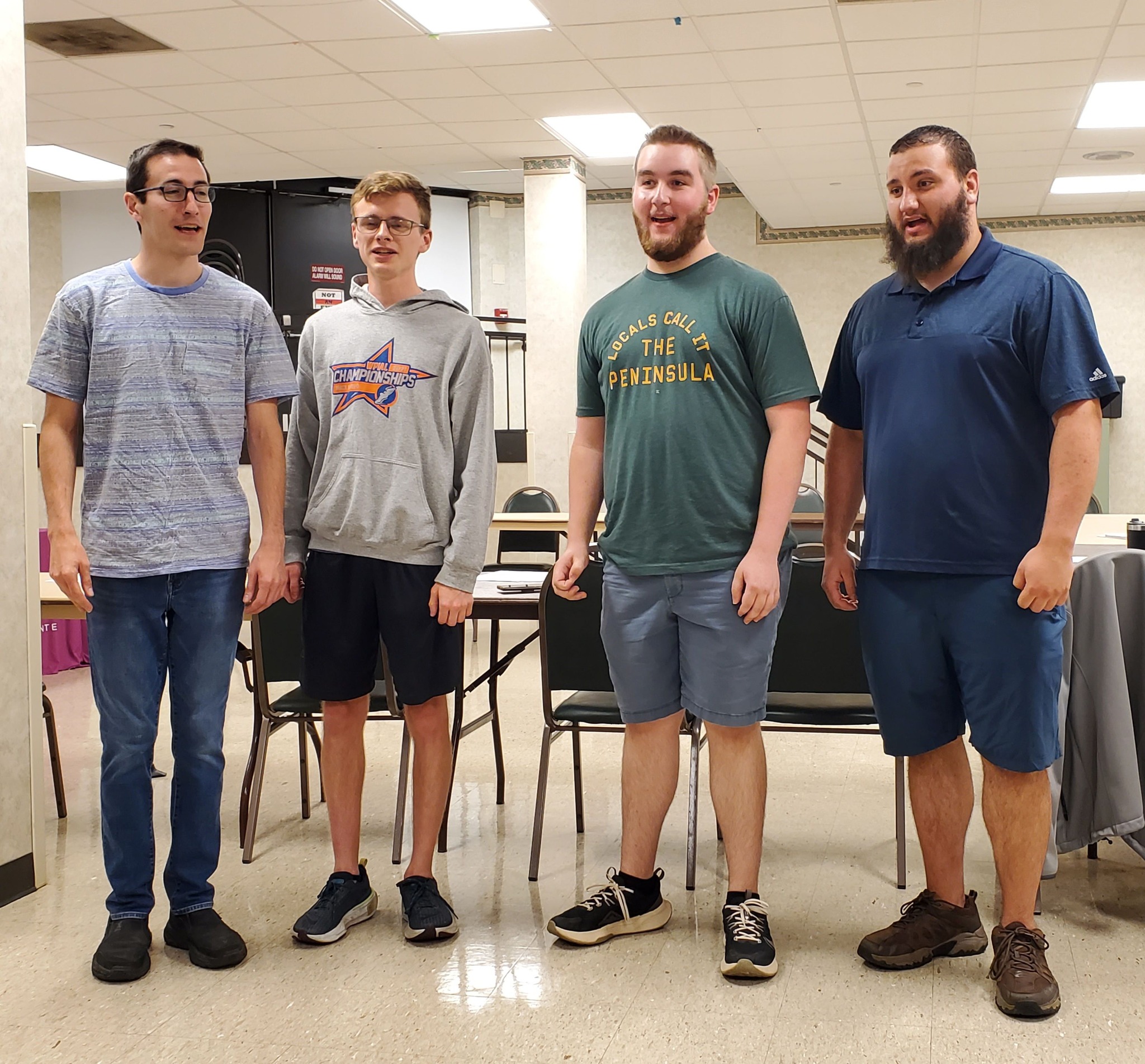
Four Score, a barbershop quartet that includes three Behrend students and one alumnus, perform the National Anthem at a home track meet at Penn State Behrend in spring 2024.

One of the most amazing aspects of college is that a single class can have a profound effect on your life. It might inspire you to change your career plans. It might be the place you meet your best friend or future spouse. It might ignite a lifelong passion or lead you to a place you never expected. 

Max Rohl, a senior Interdisciplinary Science and Business major, never dreamed he would be on stage accepting first place in a barbershop quartet competition in Rochester, New York. He had never even sung in a group until he signed up for Concert Choir class in his first year at Behrend.

“Some of us in the class started a kind of club where we would meet up in Ohio Hall to work on our songs,” Rohl said.

One night, at the end of a choir meet-up, he asked if anyone in the group had any other styles of songs they wanted to work on. Rohl, who had been a fan of the barbershop quartet classic, 76 Trombones, was about to suggest barbershop songs when Wade Williams, now a junior History major, said, “I’ve always wanted to start a Barbershop Quartet.”

“Me, too,” Rohl said.

Wade is a bass singer, Rohl is a baritone, so they needed a tenor and a lead.

They found both in Joey George, a senior Computer Engineering major, who had grown up singing in choirs and at church and could sing both tenor and lead.

The trio looked all over Behrend for a fourth member before Wade did an internet search and found Lake Erie Sound, an established Erie barbershop chorus. He reached out to its leader, John Donohue, who directs the chorus of about two dozen men.

“He probably thought, ‘Why are these college kids bugging me?’ but we talked him into coming to listen and sing with us,” Rohl said.

After that one practice, Donohue, a 2015 Mechanical Engineering alumnus, was in.

“It just sounded so good when we sang together that I knew we had to put our efforts toward getting better and refining our performance,” Donohue said.

The group began practicing a couple of times a week, meeting when Donohue, who is about ten years older and has a job and family, could join them.   

“It was great to meet young people who had been bitten by the ‘barbershop bug,’” Donohue said. “They were eager from the start and soaked up any knowledge I shared with them.”

They chose a name—Four Score Quartet—and performed the National Anthem at a Behrend home track meet in the spring. They hadn’t considered doing much more until Donohue mentioned a nearby competition—the Seneca Land District of Barbershop Harmony Society District Competition in Rochester, New York.

“He said, ‘Hey, there’s this competition in twenty days. Do you guys want to do it?’” Rohl said.

They not only did it; they won it and were named district champions.

“John was not surprised, but we were!” Rohl said.

The group sang four songs, two in preliminaries and two in the finals: “Wait ‘Til the Sun Shines, Nellie,” “A Son of the Sea,” “Sweet and Lovely,” and “That Old Black Magic,” which earned them their highest score of the day. Each song is scored separately, and then song scores are added together to get a final score.

scores

If it sounds easy, Rohl will assure you that it is not.

“It’s actually really difficult to sing barbershop harmony, but I love challenging myself and doing hard things,” Rohl said. “When you have to work hard at something, mastering it is much more rewarding.”

Barbershop singing is different from any other type of choral group singing but it still requires plenty of talent and practice.

 “Although the technique is different than in a classical choir, it’s still very demanding from a musical perspective and can really push an individual both vocally and emotionally,” Donohue said.

Donohue is happy to see younger people interested in barbershop quartet and said that while it is sometimes viewed as an old-fashioned type of singing, that perception is changing.

“In the past ten to fifteen years, quartets have began to adopt more musical theater pieces and songs from pop-culture,” he said.

 Winning the competition solidified the students’ commitment to the quartet.

“We’re all very dedicated to it now, even more so than before,” said Rohl.

Hear the Four Score Quartet for yourself at the group’s YouTube page. 

WHY IS IT CALLED BARBERSHOP QUARTET?

In the late 1800s and early 1900s, every barbershop had its own quartet. The term “barbershop” in reference to harmonizing was first documented in 1910, alongside the release of the song Play That Barbershop Chord.

During this time, barbers were more than just hairdressers; they also pulled teeth and performed minor surgeries. Barbershops gradually became social hubs where locals could gather, play instruments, and sing while waiting for their turn in the chair.

DID YOU KNOW?

Barbershop harmony is believed to be rooted in the Bllack community. According to a post on The Barbershop Harmony Society blog: “Lynn Abbott, a jazz archivist at Tulane University, was an expert on early African-American popular music and gospel quartets. He discovered overwhelming evidence that barbershop quartetting was pervasive in African-American culture in the late 1800s and early 1900s, including among many men who went on to become the pioneers of jazz. Abbott published his findings in a 1992 academic paper that forever changed the way Barbershoppers understand their roots.”

461750648_1101244505337426_3581344516470634633_n
The Four Score Barbershop Quartet includes, from left, John Donohue ’15, and Behrend students, Joey George, Wade Williams, and Max Rohl.

‘Understaffed, underfunded, and under attack’

Alumnus, deputy director of elections in Michigan, to speak at Penn State Behrend Monday

adam fracassi speaker
Adam Fracassi-Wier, deputy director of elections for the state of Michigan.

Adam Fracassi-Wier, deputy director of elections at the Michigan Bureau of Elections, will discuss the state of elections and election security when the Speaker Series returns to Penn State Behrend at 7:30 p.m. Monday, Oct. 21. His talk, “Facing the Storm: Resilience in Elections after 2020,” will be held in the Metzgar Center. The program is free and open to the public.

Fracassi-Wier graduated from Penn State Behrend in 2012 with Bachelor of Arts degrees in Political Science, International Studies, and English. He earned his law degree from Michigan State University College of Law in 2014. His career includes serving as Michigan’s assistant attorney general from 2015 to 2018, as an adjunct professor at Michigan State University College of Law, and currently as deputy director of elections at the Michigan Bureau of Elections.

Behrend Blog talked with Fracassi-Wier to learn more about what it’s like to work in elections and election law in an increasingly partisan environment.

What are your biggest challenges right now?

Election administrators across the country are understaffed, underfunded, and under attack. This is the biggest challenge. We have to manage elections and election administration in a hyper-partisan environment that fuels misinformation, all while ensuring the safety of ourselves, our staff, other election officials, and poll workers. I’ve had to add different facets to my job that I never thought I would have to add. For example, I’m no longer just an attorney – I’ve had to add communications and marketing into my daily responsibilities.

What does it feel like to oversee election integrity when so many are distrustful of our elections today?

This is a heavy burden, especially in this era where misinformation and distrust are rampant.  Being a nonpartisan civil servant who ensures elections are fair is critical, but it brings risks and requires constant communication and transparency. I take very seriously my responsibility to ensure that every eligible citizen can vote while balancing it against the necessary security checks in the system. It’s hard when something you have dedicated your life to is constantly under threat, and things that you have always done because the law requires it, now are the things making you a target.

How do you fight that disinformation and assure voters that Michigan’s elections are secure?

Transparency and communication are vital. We have had a lot of success going to folks directly with messaging. What I’ve seen in the last four years is that many people are interested in the system but don’t understand it. I have allocated and created new resources in the last several years that are focused on providing educational materials and clearly communicating what we’re doing in advance of doing it. Engaging with voters directly and providing them with accurate information is key to building trust.

I’ve also had a lot of success by coordinating with local officials (clerks, township supervisors, etc.) on the messaging. In many instances, voters will trust their local officials.

The key is just to be a constant source of truth. I’ve been able to build trust with both Democrats and Republicans, voters and elected officials, because I’m consistent in what I do, and the decisions I make are not based on politics.

You secured a $40M budget increase to improve election operations in Michigan. What were you focused on improving?

Voters in 2022 passed a constitutional amendment that dramatically changed elections in Michigan. They implemented early in-person voting, mandated that drop boxes be available in all jurisdictions, and required the state to pay for the return of all absent voter ballots. But this required significant funding for us and the local clerks. I was very fortunate to be able to obtain $40 million to fund the constitutional amendment and the subsequent legislation that passed, but it wasn’t enough to fully fund our office and the local clerks’ offices.

Michigan has more than 1,600 township, city, and county clerks who all have different election roles. We are one of, if not the, most decentralized systems in the country for running elections. More than 900 clerks’ offices are single-precinct jurisdictions that likely have only one staff member—themselves.  This is not enough to run elections. When I sought funding, I sought approximately $125 million for our office and the local clerks.  Everyone thought I was crazy for asking for that, but I had the numbers to back me up. I obtained $40 million, and we spent it almost immediately, with more than $30 million being allocated to clerks directly. With this money, we were able to fund thirty-five additional staff members at the Bureau of Elections, more than doubling our staff.

Since 2020, clerks have seen the number of ballots being returned by mail more than double. We went from approximately 25 percent voting by mail to approximately 55 percent. The funding allocation allowed us to buy new equipment for clerks to account for this increase and ease processing. This funding also allowed us to build a new pollbook to be used to better detect and prevent double voting during the early voting period, buy equipment for clerks to administer early voting, and fund poll workers for jurisdictions.

What do you wish people knew about the election and election security?

Trust your election administrators. Almost every single election administrator – regardless of party affiliation – administers the election the same. We all believe in upholding the integrity of the election while ensuring that voters can exercise their most fundamental right of casting a ballot. If you have questions about the process or want to know more, contact your election official. Start that dialogue with them in a respectful manner, and you will find that they will engage and help you to the best of their ability.

It’s also important to know that there are backups for everything.  Michigan uses paper ballots, as do many other states. Even if you don’t have a paper ballot, there are still backup records to do recounts and audits. All of these are done to verify the accuracy of the results.

After 2020, our office conducted more than 250 audits across the state. The Auditor General audited our office, and the Senate Oversight Committee, led by Republican Senator Ed McBroom, examined everything as well. The audits showed that while there are always improvements to be made, the system worked as it should. We have not seen and do not continue to see massive voter fraud like what is suggested by several candidates.

Is there a better way to handle elections in the U.S.?

Our system is very similar to systems across the world. There are positives and negatives with every system, but I think a “better” way is dependent on the eye of the beholder. What you’re seeing in several states are different methods of electing officeholders that are affecting the policies, starting with redistricting.

Several states—Michigan included—have an independent redistricting commission that draws lines in a nonpartisan manner. In Michigan, this has resulted in a more evenly split legislature. Right now, democrats control both chambers, but only by two seats in each house. If either chamber flips, it would likely only be a two-to-four seat majority for either party.  This results in less partisan bills passing in several states.

Additionally, other states have changed from a plurality-based approach to rank choice voting, where voters rank the candidates in order of preference to ensure that whoever wins obtains a majority of support rather than a plurality.  Alaska has a system where everyone runs together in the primary and the top four vote earners advance to the general election, regardless of party, to run in a rank choice election.

Blue Chair Chat Guest Offers Peek Behind the Curtain of Arena Operations

By Heather Cass, Publications Manager, Penn State Behrend

FBEventGraphic_BCChat_Letson1920x1005

Eileen Letson, vice president of finance at PPG Paints Arena in Pittsburgh, was the featured guest at the “Blue Chair Chat” discussion series presented by Penn State Behrend’s Women’s Engagement Council at McGarvey Commons on October 3.

Letson, a 1988 Behrend accounting graduate, talked about her career choice, shared her experience working for convention centers and arenas, offered plenty of sage advice, and dished on what it is like to work with some big performing artists (who shall remain nameless) with an audience of students, staff, faculty members, alumni, and community members who attended the free event.

The Blue Chair Chat series was designed by the Women’s Engagement Council to be a friendly conversation between women in a comfortable and cozy environment, so Letson was interviewed by her friend and former Behrend classmate, Barb Byers, a 1987 Communications graduate who is the director of content development for the University at Buffalo division of university advancement.

PXL_20241003_232001833

Letson talked about the financial side of arena operations, giving attendees a behind the curtain look at what happens to box office proceeds (it goes to the promoter), how the artist gets paid (that’s up to the promoter), how her office determines which events are successful (profit-and-loss statements), and the one thing arena staff hope no event promoter requests (confetti).

A few takeaways for students and recent grads from Letson’s talk:

Believe in yourself. Imposter syndrome is real, especially for young women, but trust your education. You have something to offer and important talents to bring to the table.

Pick a mentor you connect with. Find someone you admire or wish to emulate. Age, gender and position in the company doesn’t matter, choose someone you connect with that can help you grow.

Don’t be afraid to ask why. Rather than just learn a set of steps or procedures, ask questions to determine the “why” behind it. Understanding why you need to something a certain way will help you do it properly.

Join clubs and/or volunteer. Letson said one of the most important things current college students can do to gain leadership and life experience is to serve in a club or do volunteer work. “Whatever they ask you to do, do it well, and don’t complain,” she said. “It’s all a learning experience and doing the things nobody else wants to will earn you respect.”

Admit your mistakes.  If you make a mistake, own up to it, and fix it. Later, you can explore why it happened, what you learned from it, and how to prevent it from happening again.

For much more advice, insight, a few laughs, and a list of books Letson thinks you should read, watch the entire one-hour Blue Chair Chat.

Blue Chair Chat WECMembers of the Penn State Behrend Women’s Engagement Council with Eileen Letson ’88, center left, and Barb Byers ’87, center right. 

From Student to Emmy Winner in Eight Years

Communications alumna wins award for her work at WQLN

KN_Emmy

Kristen (Bessetti) Nielsen ’16 stands out. From her colorful, creatively shorn hair and dozens of tattoos to her infectious, wide smile and obvious joy for life, she is a woman who enjoys being unconventional.

Case in point: She applied to Penn State Behrend on a whim as a 24-year-old mother of two, searching for a new beginning after leaving an abusive relationship. She arrived ready to explore.

“Just because I was an older student didn’t mean I had any idea what my future career path would be,” Nielsen said.

She soon found her niche and graduated in 2016 with a degree in Communication with a focus on Broadcast Journalism, and a Women’s Studies minor.

While still in school, she obtained an internship at WJET/WFXP and YourErie.com, a broadcast news outlet in Erie. After she graduated, the station offered her a job as an in-studio camera operator. She then moved into the newsroom as a news videographer before being promoted to multimedia journalist.

“I’m pretty sure I could have gotten the Guinness World Record for most tattooed news reporter,” she quipped.

After a three-year stint as the morning show producer, Nielsen moved to WQLN, Erie’s public broadcasting station, where she works as an assistant producer on Chronicles, an immersive docuseries that showcases the Lake Erie region’s past and present.

A year later, Nielsen and her team were in Cleveland, hoisting a golden Emmy statue from the Central Great Lakes Chapter of the National Academy of Television Arts & Sciences for their work on the three-part Chronicles: Bellwether episode exploring the political evolution of Erie.

Nielsen, who went from an unlikely college student to an Emmy award winner in just eight years, can scarcely believe it herself.

“When I was a student at Behrend, I never would have imagined accomplishing half the things I have to this point, and I’m still early in my career,” she said.  “Anything is possible when you really care about the work you do.”

Behrend Blog talked with Nielsen about her career trajectory, the advice she has for other Communication students, and why her husband is glad she made the jump from news to historical storytelling.

What is your role in the WQLN Chronicles series?

I am an assistant producer, but with a small crew, we all pitch in on a variety of tasks. Whether it’s operating a camera, setting up lights, writing scripts, animating lake monsters, monitoring audio, directing, or holding a boom mic, most of us have been credited with multiple roles in each episode. I also help a lot with marketing.

How many seasons are there, and are more to come?

We just wrapped up Season 2 with an episode on Strong Vincent. As it stands now, there will be one more season, which will finish next summer.

Ian Murray_Redlining BTS

What are some of the topics featured in the series?

The USS Wolverine, the nation’s first iron-hulled ship, which was built in Erie; rum running during prohibition; the Behrend family; the Hammermill Paper company; Lake Erie shipwrecks; Antarctic expeditionist Paul Siple, aka “the Father of wind chill”; military strategist John Boyd; Civil War hero Strong Vincent; composer Harry T. Burleigh, and much more!  You can find a full list and links to each episode at: wqln.org/shows/chronicles.

How do you decide what to feature?

The mission of the series is to focus on the lesser-known history of our region, so we look for things that have not been done over and over, like the War of 1812. We did do a two-part series on Daniel Dobbins, who does not get as much credit as he should for building the fleet for the Battle of Lake Erie.

What has been your favorite episode so far?

The three-part Bellwether episode, which won the Emmy, is the first project I put a lot of work into when I got to WQLN, so I call it my “baby.” Chronicles had a total of eighteen nominations across several categories. Seeing how all our work paid off has been really gratifying.

What are you working on now?

I’m working on an hour-long episode for Season 3 about journalist Ida Tarbell. She grew up in the Titusville region during the oil boom and went on to expose John D. Rockefeller’s corrupt practices in the oil industry. Her work led the Supreme Court to break up the oil monopolies.

What’s the hardest part of your job?

In news, we worked very fast, running from story to story, event to event, grabbing some b-roll and putting it all together as quickly as possible. Working on Chronicles is the exact opposite. I’m learning to dig deeper to tell a fuller story. I’m also learning a great deal about the equipment and techniques used in more film-oriented productions.

Why is this type of historical storytelling important?

First, it is important to not let the stories of those who came before us be forgotten. Second, understanding the history of the town you come from or live in makes life more interesting. When I walk downtown now, my mind is flooded with facts and images of what it once was. Compare that to when I was working in news and my husband made a rule that I couldn’t point out all the “murder” houses I would see along our journey. This new lens is much nicer.

Chronicles airs on WQLN on Thursdays at 8 p.m. Watch past episodes at wqln.org/shows/chronicles.

This slideshow requires JavaScript.

Paula Dombrowski ’93 Presented with Impact Award

By Heather Cass, Publications Manager, Penn State Behrend

5829e408-fdcc-41fc-ad43-13a1828080cc

Paula J. Dombrowski, P.E., ’93, a structural engineer and owner of Forensics Engineered in Cincinnati, Ohio, is the recipient of the second annual Mary Behrend Impact Award, presented by Penn State Behrend’s Women’s Engagement Council (WEC).

The award was established to recognize individuals who have made contributions that advance the purpose of WEC, which was founded to support and lift women through programs related to women, to the college, and to the greater Erie community. Dombrowski was honored with the award at a luncheon in late March in Behrend’s Lilley Library.

“Paula has left her fingerprints all over Behrend – literally,” said Priscilla Hamilton ’78, a WEC board member who chaired the award committee.  “She was the Engineer of Record for the Burke Center, which houses our School Engineering and our Black School of Business, and her Pennsylvania Professional Engineer’s stamp is on the plans.”

This slideshow requires JavaScript.

Following graduation from Penn State in architectural engineering, Dombrowski began her career in Erie at H.F. Graygo & Associates and Steele Structural Engineering. Over the next twenty years, as a structural engineer, she served  as project manager and Engineer of Record for large building projects, and more recently, has focused her work on building forensics, assessing structural defects. She is the founder and principal/owner of Forensics Engineered, LLC in Cincinnati.

Dombrowski returns to Behrend every year for the Women in Engineering program, sharing her educational and professional journey with local high school and college students.

“Paula’s amazing professional accomplishments and dedication to advancing and empowering women through her direct mentorship exemplifies the spirit of Mary Behrend,” Hamilton said.

“There are just not enough words to express my gratitude to WEC for their recognition of my efforts,” Dombrowski said “The Mary Behrend Impact Award is a genuine honor and boost to my soul.

“I enjoyed my time at Behrend, with much laughter during golf class and plenty of late-night study sessions to pass challenging classes like thermodynamics and statistics,” she said. “By chance, I was also able to tack on a finite elements class, that provided a great engineering analysis foundation that I use every day.”

Dombrowski and her husband, Dean, have two children, Kyle, 22, and Gillian Grace, 20, and they reside in Cincinnati.

This slideshow requires JavaScript.

Major Decisions

By JoLayne Green, Contributing writer, Penn State Behrend

Graduate found confidence, voice when she landed in the right program for her

When Gabi Watson switched her major to English at Penn State Behrend, she finally found her path—and her voice. It just took a little courage for her to follow a passion that was there all along.

“I did every other possible major,” Watson said, with a chuckle.

An Erie native who graduated last semester, Watson started in Forensic Biology at University Park. She learned that a STEM (science, technology, engineering and math) field wasn’t truly what she wanted. Her college journey led her to Behrend and included stops in the Division of Undergraduate Studies and the Political Science program.

“I finally realized I belonged in liberal arts,” she said. “I fell in love with the English program and the teachers in it.”

She also felt at home at Behrend.

“I love how close-knit the campus is and how beautiful Behrend is,” she said. “I got all four seasons here in my hometown where I got a great education and had a close relationship with teachers.”

Before landing in the English department, Watson did a little soul searching.

“I grew up reading. I knew I loved English, but I didn’t know if I loved literature,” she said. “I thought choosing English would mean I would just be reading a lot of poetry.”

Then Watson discovered how diverse a degree in English is.

“I didn’t know how many options there were in writing. I felt I was floating around in the English department until I took Writing for the Web,” she said. “I found out you can have a great career in something you are passionate about.”

While she concentrated on professional writing, it was creative writing classes that helped her find her own voice.

“I learned a lot about expressing emotion and how to transcribe my thoughts into words,” she said.

Watson’s budding confidence carried into extracurricular activities. Describing herself as an introvert, she was a junior before becoming involved in activities at Behrend such as the Lion Entertainment Board and an Alternative Spring Break service trip.

She grew from observer to participant to executive director of the Lion Entertainment Board, helping to advance the club from four members to more than thirty while developing event planning skills.

Watson credits her advisor, Dr. Massimo Verzella, associate professor of English, as well staff members in the Office of Student Leadership and Involvement (SLI) with putting her on a path to success.

“Dr. Verzella changed the trajectory of what I wanted to do in my life,” she said. “He educated me on possibilities I didn’t know existed. I don’t think I’d be as social or as well-rounded as I am now without his support and that of SLI staff members.”

In turn, she began mentoring other students.

“I learned I like leading a team and helping people find their passion, and wanted to help other students figure out what they were good at,” she said.

Watson’s success in leadership was recognized beyond campus when she was chosen to receive the 2023 ATHENA Young Professional Award, celebrating emerging women leaders in Erie.

Watson, who graduated in December 2023, envisions a career that involves writing, generating social media content, travel, event planning, and possibly work in diversity, equity, and inclusion. First, she is going to Walt Disney World for a six-month stint in the Disney College Program in Florida.

After that? Who knows, but she knows she won’t be a silent observer.

“You can be an introvert and still be a leader,” she said. “I never thought I could, but with the right support, I’ve been able to find my voice in writing and in leadership. Wherever I end up next, I know Behrend has given me a solid foundation to build on.”

New Group to Support, Engage Black Alumni and Students

By Heather Cass, Publications Manager, Penn State Behrend

Tesha Nesbit FA19 Commencement
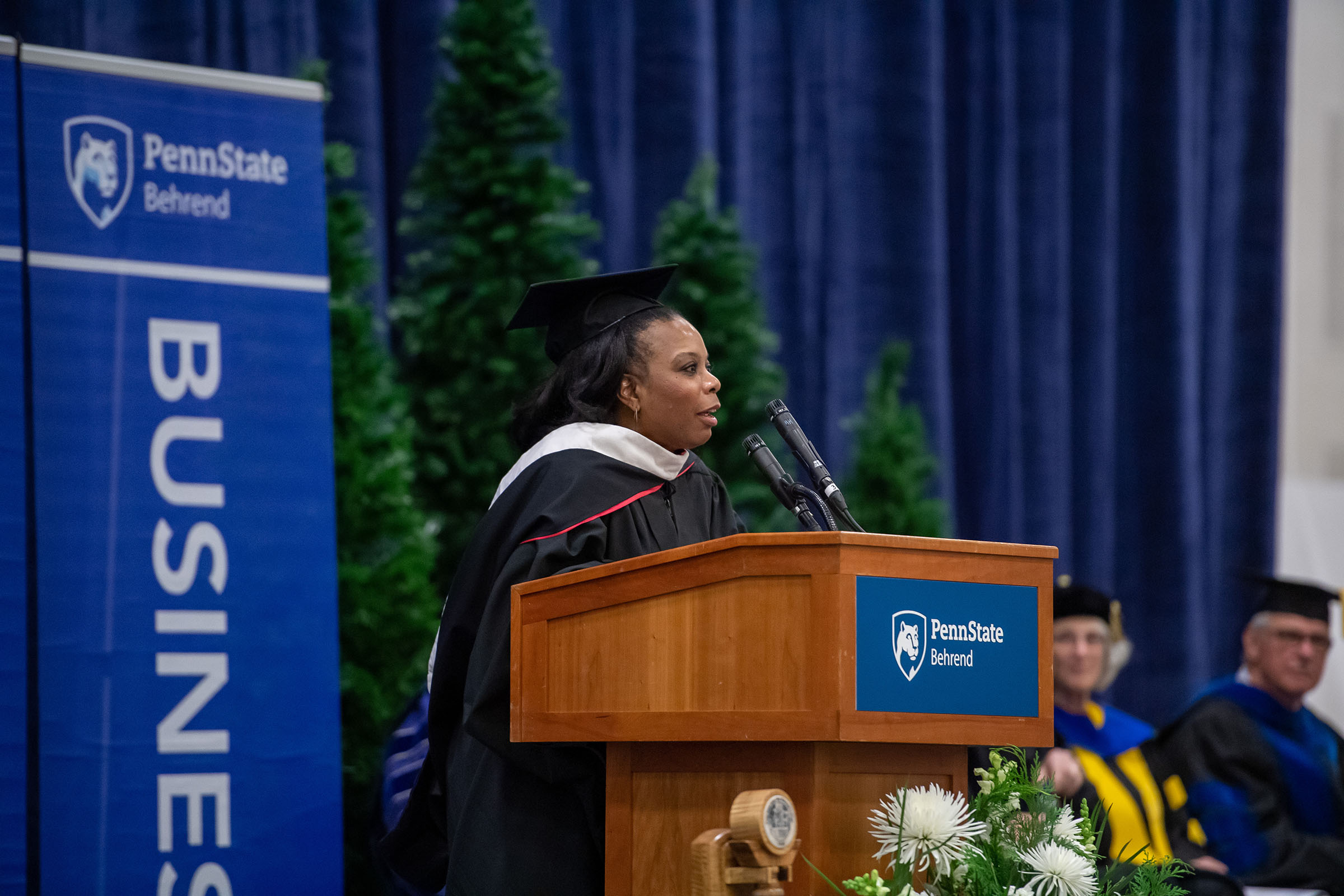
Tesha Nesbit ’93 speaks at a commencement ceremony at Penn State Behrend

Penn State Behrend’s Alumni Society recently opened a new chapter in the college’s Black history – an affiliate programming group (APG) known as the Behrend Black Leadership Alumni Coalition (BBLAC).

This summer, when college leadership identified a need to reach out to individual subsets of alumni, one of the first groups they wanted to reach out to was Behrend’s Black alumni, as it’s one of the largest segments of the alumni population.

The initiative began as a conversation among college administration, faculty, staff, and alumni to explore opportunities to celebrate diverse voices and viewpoints.

“Many members of the Behrend team were instrumental in bringing BBLAC to life,” said Kristen Comstock ’06, assistant director of alumni relations. “We recognized Black alumni are an integral part of the Behrend Alumni Society. We sought input from alumni and campus community to enhance our relationships with Black alumni.”

After months of collaboration, BBLAC was chartered to serve as a direct connection for Black alumni to share their unique perspectives and engage with current and potential Black students. Spearheaded by a group of Black Behrend alumni, the group is the first APG the Behrend Alumni Society has had in at least dozen years.

“We believe that establishing a specific APG for Black Behrend alumni members will improve relations with an important Behrend constituency,” said BBLAC president Brandon McGraw, a 2009 Accounting and Finance graduate who is now the senior manager of accounting operations at The Knot Worldwide, Inc. “We further believe this group will help Behrend leadership guard against systematic biases and mitigate the challenges faced by Black Students as they pursue a Penn State degree.”

BBLAC has hit the ground running with a robust membership and a board of directors who have already formed several committees around the areas of campus engagement, professional development, coalition events, collegiate recruitment, fundraising, and more.

A donation from alumna Tesha Nesbit, a 1993 Communications graduate and director of diversity and inclusion for Erie Insurance Group, will help advance BBLAC’s mission (See BBLAC’s mission statement below).

“Penn State pride pervades the association; we have alumni all over the world,” Nesbit said. “I want to do my part to ensure that Black Behrend students have the full scope of support they need to be inspired and successful in the classroom and in our communities. If we can help them preserve this rich legacy of excellence that is a high-quality education, which has not been equally afforded to everyone, then they also become historians and models for generations to come.”

Comstock is excited about working with BBLAC to expand and enhance current Behrend Alumni Society events and initiatives.

“I’m looking forward to working with this wonderful and enthusiastic group of volunteers as we plan meaningful events for our Black alumni,” she said. “BBLAC leaders are engaged and I’m really looking forward to the programs that connect our Black alumni to current and prospective Behrend students of color.“

While the pandemic currently presents  challenges to hosting in-person events, BBLAC is developing virtual events, including a professional development offering for students, and handwriting notes to accepted Black students encouraging them to attend Behrend.

“They’re also planning a Black Alumni Reunion event this fall for Behrend’s Parents, Families, and Alumni Weekend, which I can confidently say we all hope will be an in-person event this year,” Comstock said.

MISSION OF BBLAC

The mission of the Behrend Black Leadership Alumni Coalition (BBLAC) Affiliate Programming Group is to provide a direct connection for the college’s Black alumni to share their unique perspective as alumni. BBLAC is positioned to: engage with current Black students to support educational opportunities; mentor current Black students as they make the transition to higher education; provide a conduit for Black alumni to advise Behrend leadership; assist in recruiting Black students; help develop greater financial support for Black students; facilitate allyship; and help improve the overall educational environment for students of color.”

Leadership/Board of Directors

Executive Board

  • President: Brandon McGraw ’09
  • Vice President: Adell Coleman ’09
  • Treasurer: Jeremy O’Mard ’13
  • Secretary: Angela Coston Jones ’95
  • Emerita: Conchita Dixon ’97

Committee Chairs

  • Conchita Dixon ’97, Fundraising
  • Tesha Nesbit ’93, Professional Development
  • Shelley Askew Floyd ’92, Campus Engagement
  • Jeffrey Grant ’90, Membership
  • Stanley Husband ’90, Collegiate Recruitment
  • Sasha Singh ’09, Coalition Events

To support BBLAC with a donation, visit raise.psu.edu/BBLAC. To join the alumni group, visit behrend.psu.edu/alumni/alumni-organizations/bblac.  

What’s it Like to Work in Health Care During a Pandemic? Bio Majors Share

Biology alumni, students share their experiences on the frontlines

By Heather Cass,

Publications Manger, Penn State Behrend

For several Penn State Behrend biology students and recent graduates, the COVID-19 pandemic has been a baptism by fire—calling on them to put their new skills to use helping to prevent the spread of the coronavirus and caring for those who have it.

We talked with some of those students and graduates to find out what it’s like working in health care during the pandemic.

Rachel Adams ’19 is a volunteer emergency medical technician (EMT) at Dobler Hose in Girard, Pa.

Jessie Kibbe ’20 is a new graduate. She earned a degree in Biology in May and works as a Certified Nurse Assistant (CNA) at an Erie senior living facility.

Emily Jaskiewiecz1

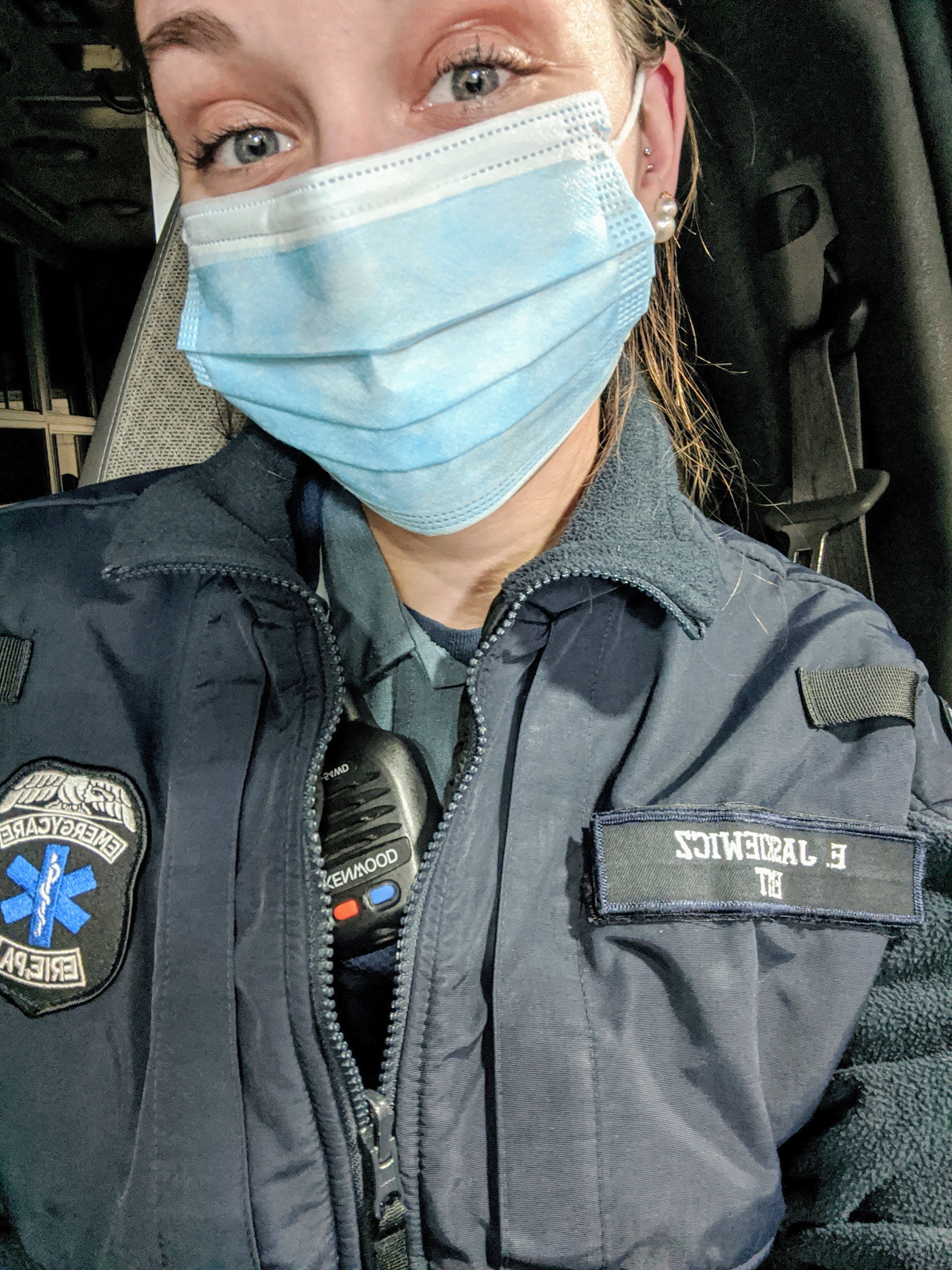
Ellen Jaskiewicz ’19

Ellen Jaskiewicz ’19 is an EMT at EmergyCare and also a volunteer EMT for Brookside Fire Company in Harborcreek, Pa.

Rachel Sinnott ’19 is a patient care technician at UPMC Hamot Hospital in Erie and a volunteer EMT with the Brookside Fire Company in Harborcreek.

zillman2

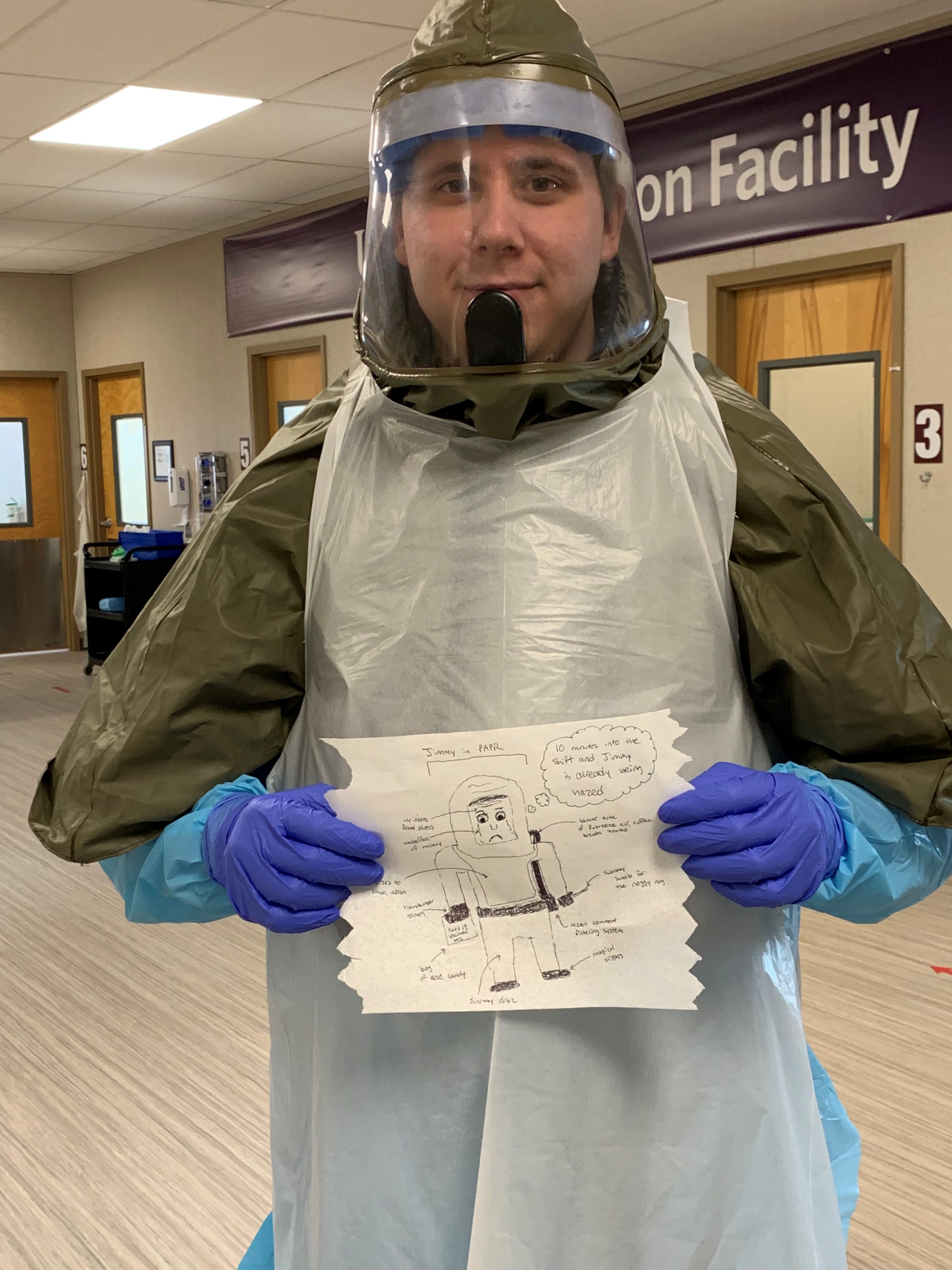
James Zillman, junior Biology major

James Zillman is a junior majoring in Biology in the Pre-Health option. He is an emergency room technician at UPMC Hamot and a COVID-19 specimen collector at the UPMC collection center in Erie.

How has the COVID-19 pandemic affected how you do your work?

Jaskiewicz: The worst part now is having to wear a surgical mask all the time. It’s very difficult for our patients, who are often elderly, to hear us and nearly impossible to get a full assessment done enroute to the hospital. We all take precautions with every patient, of course, but EmergyCare now has designated COVID crews who are trained to transport patients who are positive for the virus.

Zillman: When I first started at the emergency room, it was fast-paced every single day with a lot of patients, and although there are still individuals in cardiac arrest or suffering traumas coming in, the ER has actually slowed down a lot. We are, however, ready to assist and we all have proper PPE (personal protective equipment) and follow the proper guidelines for limiting exposure.

Sinnott: I’ve always been very conscientious about wearing appropriate PPE for the situation I’m in, but I think more carefully about what I bring in and out of work. I no longer bring my purse or a reusable water bottle, and I’m more aware of things I touch regularly like my cell phone, door handles, elevator buttons, and such.

Many remain untouched by this virus. It is certainly a different experience for you. What’s it like being on the front lines?

Jaskiewicz: Our call volume is significantly lower than normal, which is good because it means that people are understanding the importance of staying home. I worry, though, that some people may be too afraid to go to the hospital for treatment now (for fear of the virus), but they should know that health care facilities are following all protocols to keep them safe, and that includes in ambulances.

Kibbe: Before the pandemic hit, it was already a bad year for influenza and pneumonia, which we have to be very careful about in senior facilities. The care center I work in was already taking significant measures to guard against spread of the flu, so the quarantine orders were something we were used to. One of the hardest things has actually been the constantly changing policies and protocols since the pandemic. Some of this is inevitable, as it’s based on new information about the virus and PPE supply availability. Despite the changes for us, we try hard to maintain a normal and optimistic atmosphere to avoid worrying our residents.

Zillman: I truly enjoy my job and helping others, but I do worry about my three-year-old brother who has respiratory issues. I try to limit my exposure to him, and I make sure to wear protective gear around every patient I encounter, whether they are suspected of having COVID-19 or not.

Sinnott: I find myself spending a lot more of my workday trying to keep patients company since they are no longer allowed to have visitors. I try to spend a little extra time talking to them, asking what they are watching on TV or looking at pictures of their family so that they feel more comfortable and have someone to talk to.

What drove home the seriousness of the situation for you?

Adams: In mid-March, I was on wheelchair transport and encountered my first severely at-risk patient. He was a recent organ transplant on immunosuppressants. As I helped transport him home, he told me how frightened he was about contracting COVID-19 because he did not think he would survive it. I cried all the way back to my post. I think about him a lot. I hope he is doing well.

Jaskiewicz: I transported an older gentleman who had spent 90 days in a hospital and then a rehab and was going to a nursing home where visitors are now restricted. He told me he had to say goodbye to his wife for a full two weeks, and they had spent every night together for the past forty years. It was beyond heartbreaking.

Kibbe: When some of the nursing staff gathered early on to discuss the ‘what ifs’ and make plans in case the virus hit our facility, it was sobering and forced me to confront and accept uncertainty.

Zillman: I was at the COVID-19 collection center, swabbing a patient who told me that we were all heroes and that he appreciated us. I understand that there is always risk when you’re on the front lines, but for some reason, his calling us heroes made me realize how serious the pandemic is.

Sinnott: The first week we restricted visitors was really tough. I had a young patient who had a major setback and another who refused surgery because she did not want to go through it alone. Later that week, I had a patient who was receiving end-of-life care and could not have his family there to be with him. It’s scary enough to be sick and in the hospital, but it’s even more frightening for patients when they are not able to have their families with them.

The pandemic is a scary situation to be thrown into as a young professional. How have you dealt with it?

Kibbe: I have not felt frightened. Concerned, sure, but not scared because I have faith in modern medicine and I know that we will find a way to combat the virus. I’ve worked as a CNA for three years, and though the uncertainty of this virus is disconcerting, I’m confident in my training and skills. When someone needs help, your training kicks in and you just do your job.

What’s giving you hope right now?

Kibbe: The people I work alongside. There’s no way for me to fully describe the measure of their compassion and dedication they give to our residents. In my three years here, I’ve seen firsthand the selflessness, sacrifice, and sense of responsibility they have, and that has only been amplified by the pandemic.

Jaskiewicz: Honestly, the free food. It’s nice to be appreciated as a health care employee.

Zillman: First, the people I work with; everyone has such a positive attitude. Also, how the public has responded to health care workers, cheering them on and thanking them. It’s gratifying and motivating.

Sinnott: My coworkers inspire me every day. They’re continuing to risk their own health to help others and they go above and beyond to put patients at ease.

Has this experience confirmed or helped focus your career choice?

Kibbe: I’m planning to attend physician assistant school and this pandemic has without question confirmed my choice to advance in my medical career.

Zillman: I’m planning to apply to medical school in June, and I could not be more motivated to become an ER doctor. I’ve spent more than 100 hours shadowing physicians in the ER before I began working there, and it has confirmed that I’m on the right path.

Sinnott: It has absolutely confirmed my career choice. While this is a challenging time to work in health care, it is also incredibly rewarding.

Parting words for those not on the front lines?

Jaskiewicz: Please do what is asked of you. Wear a mask, stay at home, limit contact with others. I realize it’s an inconvenience and may be financially detrimental to some, but your actions can and will affect others. You don’t see the look on the family’s faces when we transport their mother who is in cardiac arrest and they cannot follow us to be with her at the hospital. You don’t see the patients dying alone, unable to have the comfort of a loved one during their last moments. Honestly, I’d rather wear a mask for the rest of my life than let one patient suffer alone.