
Math and art converge in Behrend’s growing “geometry gallery”
By Heather Cass, Publications Manager, Penn State Behrend
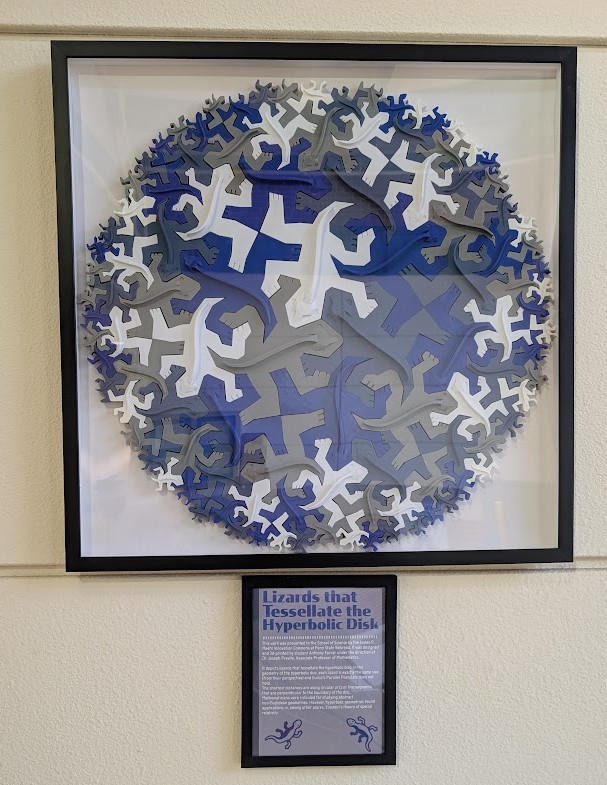
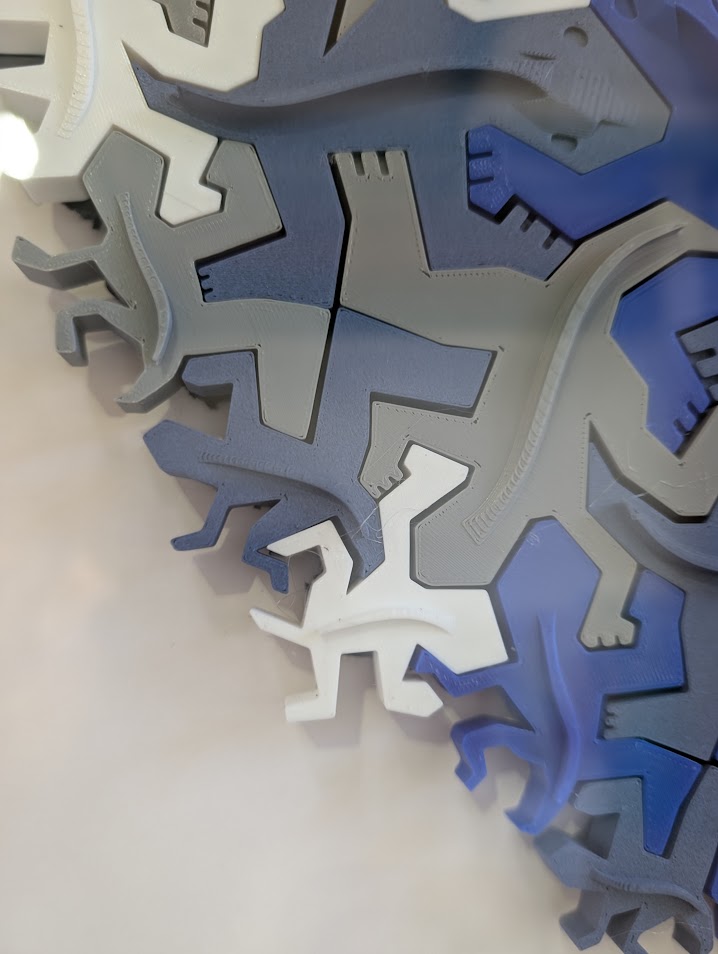
Math isn’t always numbers on a chalkboard. Sometimes it’s a work of art—a swirl of repeating lizards, 3-D printed in Penn State blue and white, then installed in a building where math, art, and science intersect. The lizards blend together in a hypnotic pattern, each appearing to shrink as it spirals toward infinity.
The piece, Lizards that Tessellate the Hyperbolic Disk, was imagined by Dr. Joseph Previte, professor of mathematics, who wanted to capture the beauty of mathematics in a form anyone could see.
He took the design to the James R. Meehl Innovation Commons, the college’s open ideation lab, where engineering students Anthony Farrar and Quinlan Barnes transformed Previte’s concept into reality with 3-D-printed tiles and a sharp eye for symmetry.
The result is art born from math—or perhaps math revealed as art.
Dutch artist M.C. Escher showed the world that geometry could be beautiful with his mesmerizing tessellations and optical illusions, where patterns unfolded in ways both precise and poetic.
“For centuries, mathematicians questioned the value of studying this type of geometry, dismissed it as impractical and useless, with no relation to reality,” Previte said. “But it later proved essential to modern science, including helping Einstein describe how time and space work in his theory of relativity.”
While some mathematicians ridiculed the study of abstract math, others reveled in it. English mathematician G.H. Hardy argued that mathematics was a pure art form, divorced from practicality—something he took great pride in. Hardy’s theories later laid the groundwork for encryption, proving that beauty and utility often travel together.
That same tension—between abstraction and application, imagination and reality—now hangs on the wall at Behrend.
Lizards that Tessellate the Hyperbolic Disk joins an existing sculpture, Math in Flight, a stage-5 Sierpinski tetrahedron, a fractal shape featuring a pattern of infinite triangles, that hangs high above the entrance to Roche Hall in the Science Complex.
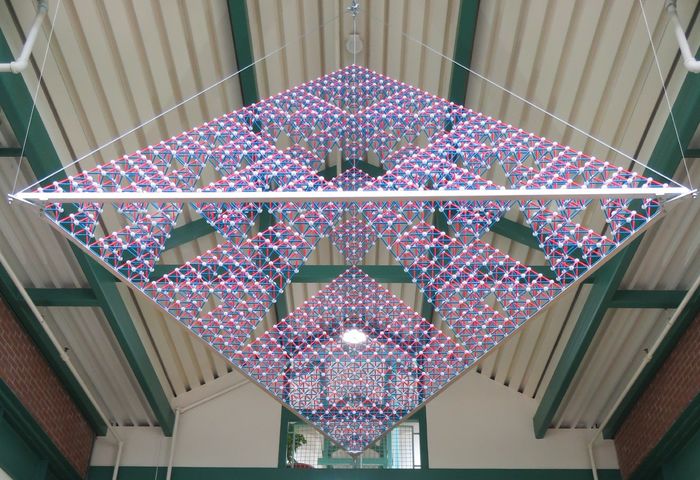
Math Club students built the sculpture using Zometool construction parts. It consists of 2,050 white balls and 6,144 red-and-blue struts.
Previte has plans to continue adding to the mathematics art gallery.
“I’d like to do the Platonic solids next,” he said. “I am currently looking for a student in Innovation Commons to make that project a reality.”
 BEHREND BLOG