
By Heather Cass, Publications Manager, Penn State Behrend
One of the most amazing aspects of college is that a single class can have a profound effect on your life. It might inspire you to change your career plans. It might be the place you meet your best friend or future spouse. It might ignite a lifelong passion or lead you to a place you never expected.
Max Rohl, a senior Interdisciplinary Science and Business major, never dreamed he would be on stage accepting first place in a barbershop quartet competition in Rochester, New York. He had never even sung in a group until he signed up for Concert Choir class in his first year at Behrend.
“Some of us in the class started a kind of club where we would meet up in Ohio Hall to work on our songs,” Rohl said.
One night, at the end of a choir meet-up, he asked if anyone in the group had any other styles of songs they wanted to work on. Rohl, who had been a fan of the barbershop quartet classic, 76 Trombones, was about to suggest barbershop songs when Wade Williams, now a junior History major, said, “I’ve always wanted to start a Barbershop Quartet.”
“Me, too,” Rohl said.
Wade is a bass singer, Rohl is a baritone, so they needed a tenor and a lead.
They found both in Joey George, a senior Computer Engineering major, who had grown up singing in choirs and at church and could sing both tenor and lead.
The trio looked all over Behrend for a fourth member before Wade did an internet search and found Lake Erie Sound, an established Erie barbershop chorus. He reached out to its leader, John Donohue, who directs the chorus of about two dozen men.
“He probably thought, ‘Why are these college kids bugging me?’ but we talked him into coming to listen and sing with us,” Rohl said.
After that one practice, Donohue, a 2015 Mechanical Engineering alumnus, was in.
“It just sounded so good when we sang together that I knew we had to put our efforts toward getting better and refining our performance,” Donohue said.
The group began practicing a couple of times a week, meeting when Donohue, who is about ten years older and has a job and family, could join them.
“It was great to meet young people who had been bitten by the ‘barbershop bug,’” Donohue said. “They were eager from the start and soaked up any knowledge I shared with them.”
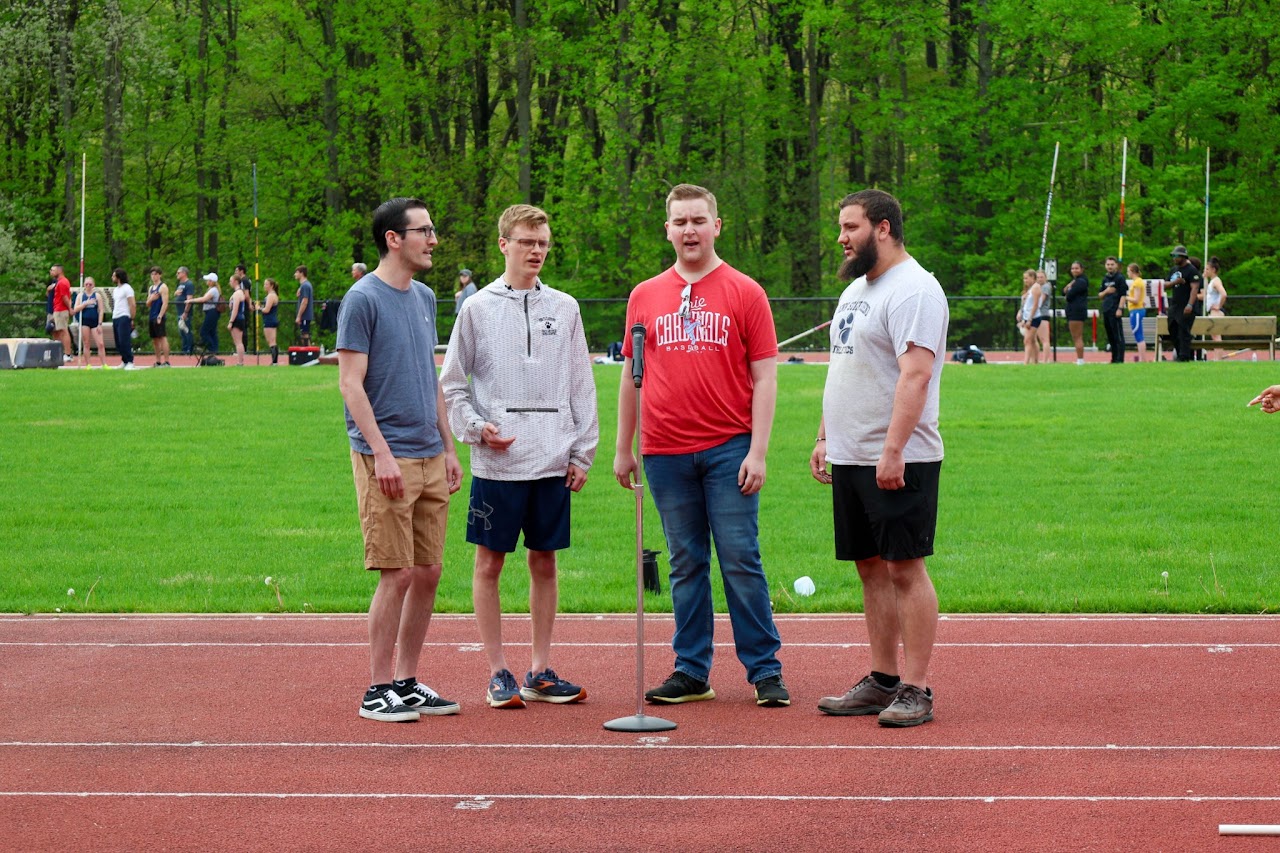
They chose a name—Four Score Quartet—and performed the National Anthem at a Behrend home track meet in the spring. They hadn’t considered doing much more until Donohue mentioned a nearby competition—the Seneca Land District of Barbershop Harmony Society District Competition in Rochester, New York.
“He said, ‘Hey, there’s this competition in twenty days. Do you guys want to do it?’” Rohl said.
They not only did it; they won it and were named district champions.
“John was not surprised, but we were!” Rohl said.
The group sang four songs, two in preliminaries and two in the finals: “Wait ‘Til the Sun Shines, Nellie,” “A Son of the Sea,” “Sweet and Lovely,” and “That Old Black Magic,” which earned them their highest score of the day. Each song is scored separately, and then song scores are added together to get a final score.

If it sounds easy, Rohl will assure you that it is not.
“It’s actually really difficult to sing barbershop harmony, but I love challenging myself and doing hard things,” Rohl said. “When you have to work hard at something, mastering it is much more rewarding.”
Barbershop singing is different from any other type of choral group singing but it still requires plenty of talent and practice.
“Although the technique is different than in a classical choir, it’s still very demanding from a musical perspective and can really push an individual both vocally and emotionally,” Donohue said.
Donohue is happy to see younger people interested in barbershop quartet and said that while it is sometimes viewed as an old-fashioned type of singing, that perception is changing.
“In the past ten to fifteen years, quartets have began to adopt more musical theater pieces and songs from pop-culture,” he said.
Winning the competition solidified the students’ commitment to the quartet.
“We’re all very dedicated to it now, even more so than before,” said Rohl.
Hear the Four Score Quartet for yourself at the group’s YouTube page.
WHY IS IT CALLED BARBERSHOP QUARTET?
In the late 1800s and early 1900s, every barbershop had its own quartet. The term “barbershop” in reference to harmonizing was first documented in 1910, alongside the release of the song Play That Barbershop Chord.
During this time, barbers were more than just hairdressers; they also pulled teeth and performed minor surgeries. Barbershops gradually became social hubs where locals could gather, play instruments, and sing while waiting for their turn in the chair.
DID YOU KNOW?
Barbershop harmony is believed to be rooted in the Bllack community. According to a post on The Barbershop Harmony Society blog: “Lynn Abbott, a jazz archivist at Tulane University, was an expert on early African-American popular music and gospel quartets. He discovered overwhelming evidence that barbershop quartetting was pervasive in African-American culture in the late 1800s and early 1900s, including among many men who went on to become the pioneers of jazz. Abbott published his findings in a 1992 academic paper that forever changed the way Barbershoppers understand their roots.”
 BEHREND BLOG